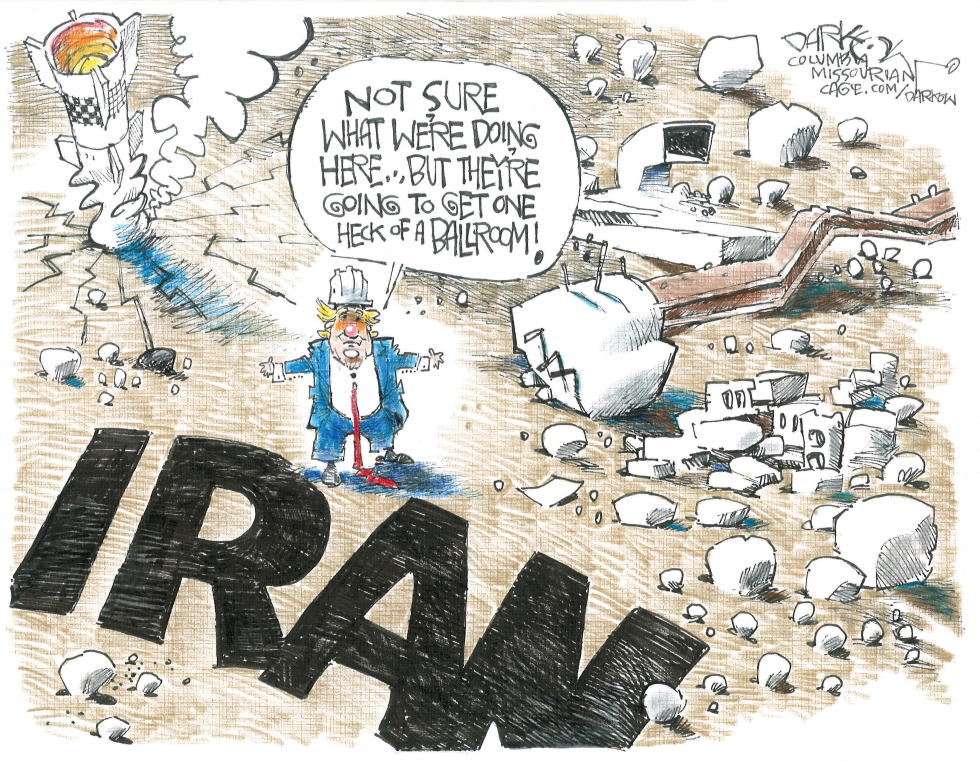
This biting political cartoon features a caricatured Donald Trump in a construction hard hat, overlooking a bombed-out landscape labeled 'IRAN,' with a missile launching in the background. His speech bubble confesses confusion over US actions but promises 'one heck of a ballroom,' a sly pun on Trump's real estate empire clashing with foreign policy blunders. Incorporating tags like political satire, Trump caricature, Iran nuclear program, US-Iran relations, geopolitical humor, and Trump hotel pun, the image mocks the haphazard withdrawal from the nuclear deal, suggesting it paves the way for Iran's nuclear ambitions while Trump envisions luxury redevelopment. The ruined buildings and debris emphasize the destructive fallout, blending humor with insightful critique on Middle East instability.
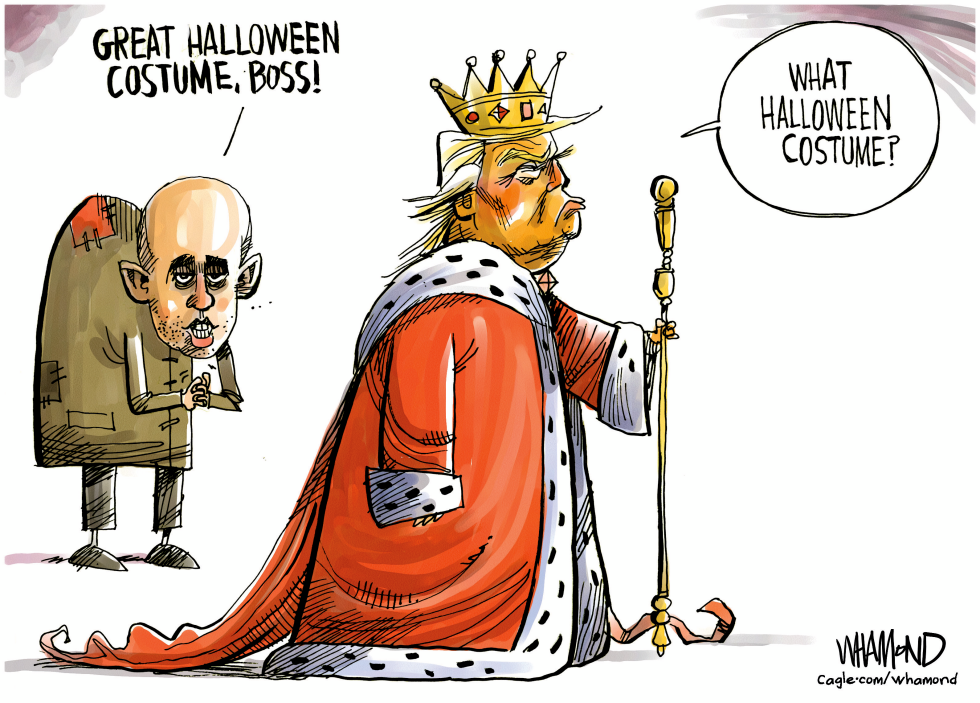
Dave Whamond's cartoon titled 'The Man who would be king' captures a caricatured Donald Trump donned in regal themes, complete with crown and red robe, wielding a scepter. A subservient, bald figure with pointy ears bows and praises the 'Great Halloween Costume, Boss!' while Trump retorts 'What Halloween Costume?' The image tags highlight themes of No Kings, Trump wants kinglike powers, and concerns over constitution and democracy. It satirizes ideas of president transitioning government into a monarchy, with elements of shutdown, taking control, and totalitarian state. The humor lies in Trump playing dress up yet denying it's a costume, symbolizing real aspirations for kinglike authority.
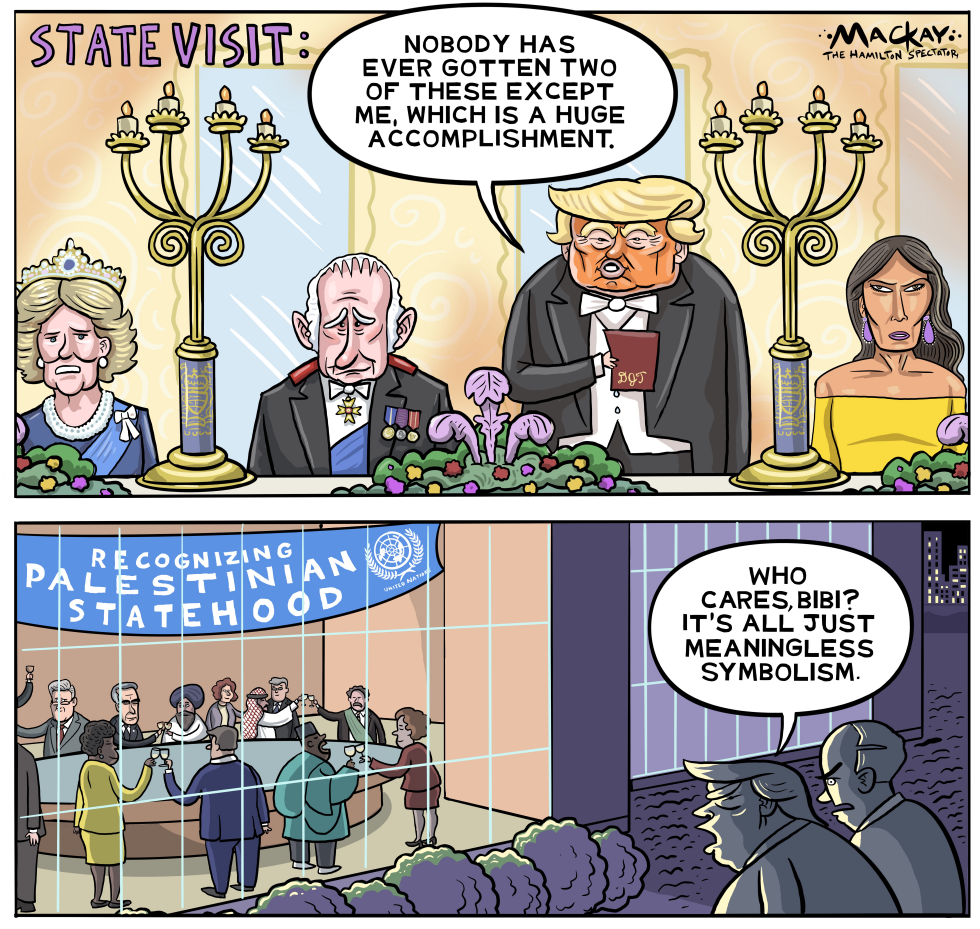
Graeme MacKay's cartoon captures a state visit dinner scene with figures at a table adorned with candelabras, where a caricature resembling Donald Trump boasts about unique accomplishments. The lower panel shifts to a United Nations setting with a banner reading 'Recognizing Palestinian Statehood,' showing delegates toasting, while outside, Trump and another figure, addressed as Bibi, dismiss the event as meaningless symbolism. Incorporating tags like Allies, Palestine, United Nations, Statehood, Recognition, and Peace, the artwork highlights contrasts in diplomatic perceptions. The composition uses split panels to juxtapose formal pomp with cynical realpolitik, emphasizing themes of symbolic gestures versus substantive policy in the Israel-Gaza conflict context.
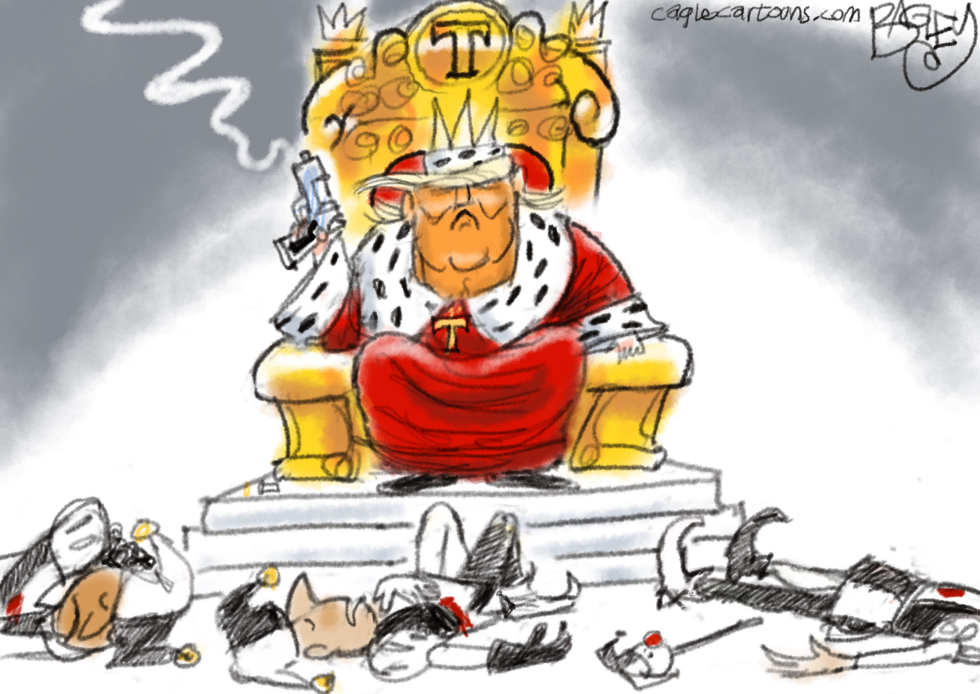
Pat Bagley's 'King Trump' captures a regal Donald Trump caricature seated on an ornate golden throne marked with a prominent 'T,' his expression stern as he grips a smoking pistol. Surrounding the throne's base lie several jester figures in black-and-white outfits, sprawled lifelessly with red blood spots, evoking themes of comedy suppression. Tags like Kimmel, Colbert, and Charlie Kirk hint at late-night hosts and conservative voices, but the image sticks to visible elements: the king's red robe, ermine trim, and the smoky aftermath. This piece comments on cancel culture, GOP dynamics, MAGA loyalty, hate, humor, and first amendment issues without overt labels, relying on caricature for impact. The dry wit underscores a tyrant's intolerance for jesters, a straightforward jab at power and censorship.
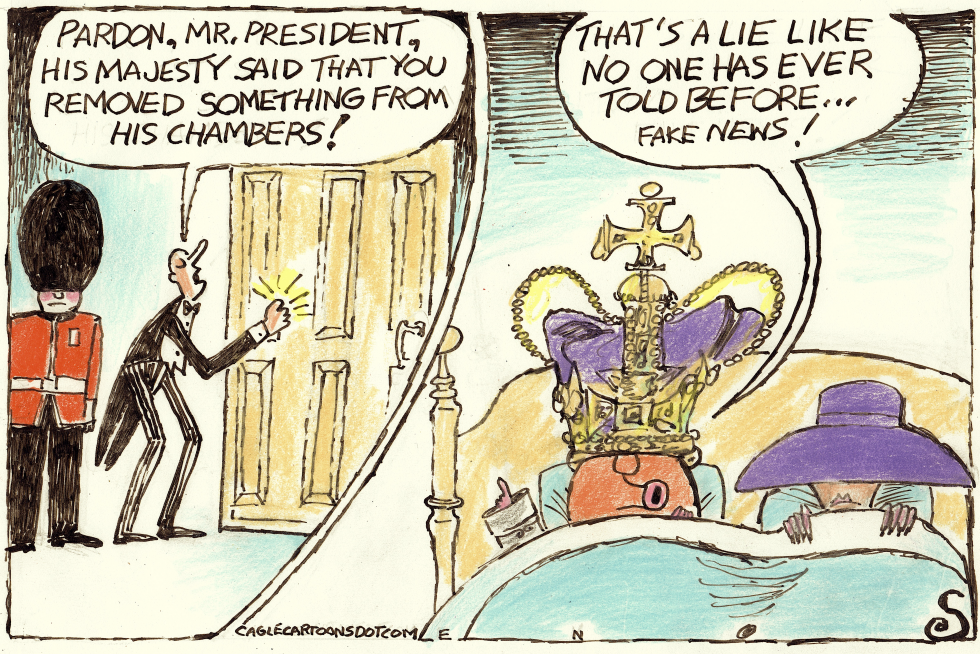
Randall Enos captures Donald Trump in a state visit to England, caricatured as King Trump lounging in bed with Melania, donning a massive crown while dismissing a servant's accusation of removing something from King Charles' chambers as 'fake news.' The cartoon cleverly merges Trump's signature phrases with royal pomp, highlighting the absurdity of his denials in a foreign, majestic context. Tags like state visit, King Charles, and fake news underscore the humor in blending American politics with British monarchy, making it a sharp commentary on Trump's larger-than-life persona.
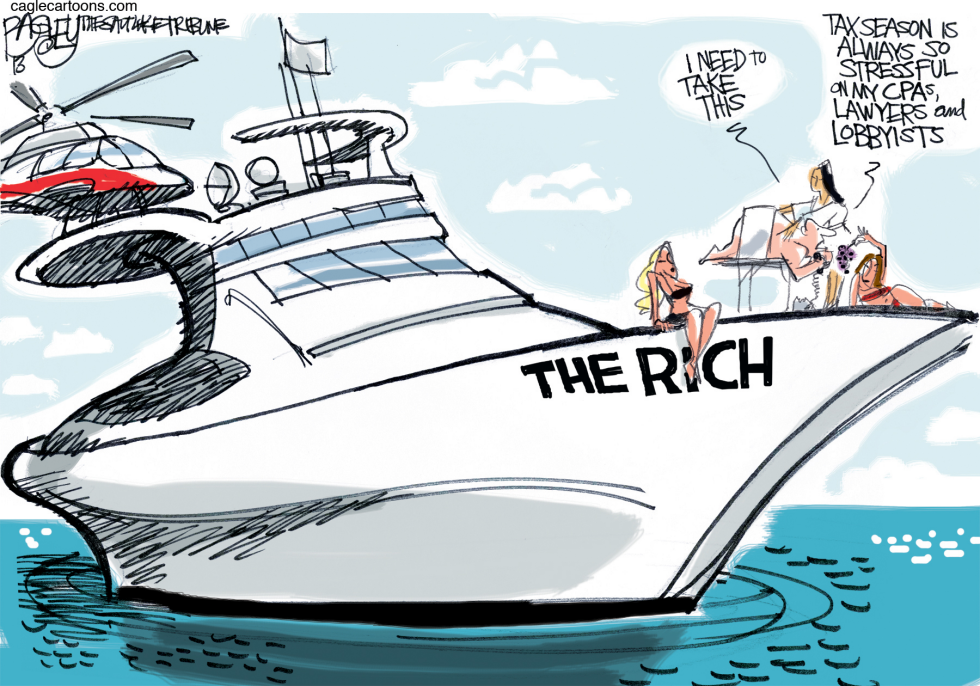
Pat Bagley's 2013 color cartoon captures a luxurious yacht scene labeled 'THE RICH,' where three women embody wealth amid tax season complaints. One lounges in a bikini, another receives a massage, and the third gripes about the stress on her CPAs, lawyers, and lobbyists. A red helicopter hovers above the vessel on blue waters under a clear sky. The artwork ties into IRS, taxes 2013, April 15, tax day, and the 1% themes, offering dry satire on how the elite navigate fiscal duties through hired help. No deeper symbols lurk; it's straightforward visual humor on economic divides.