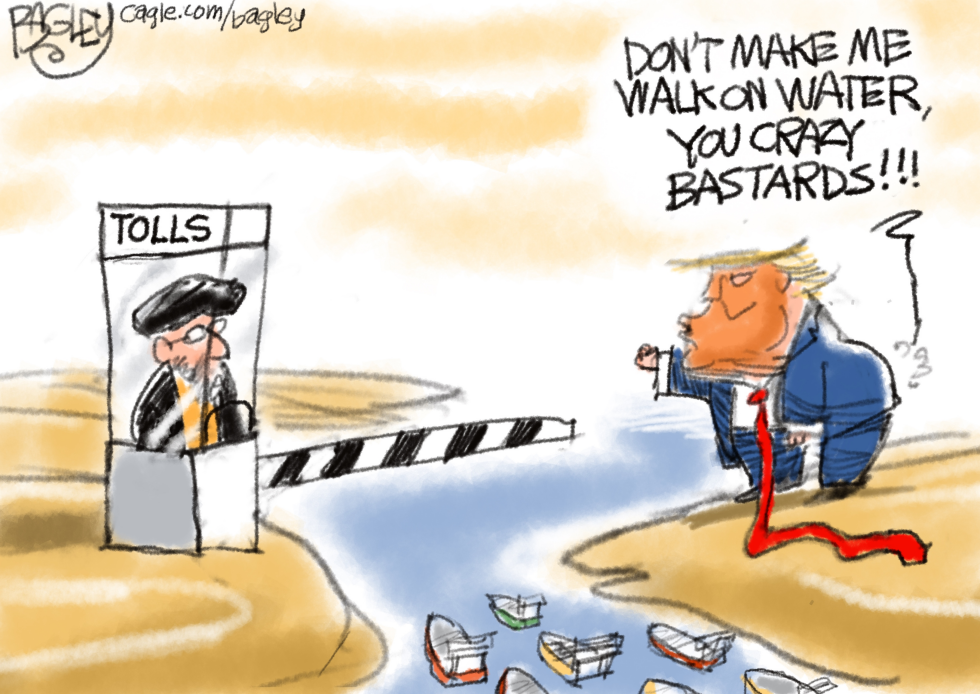
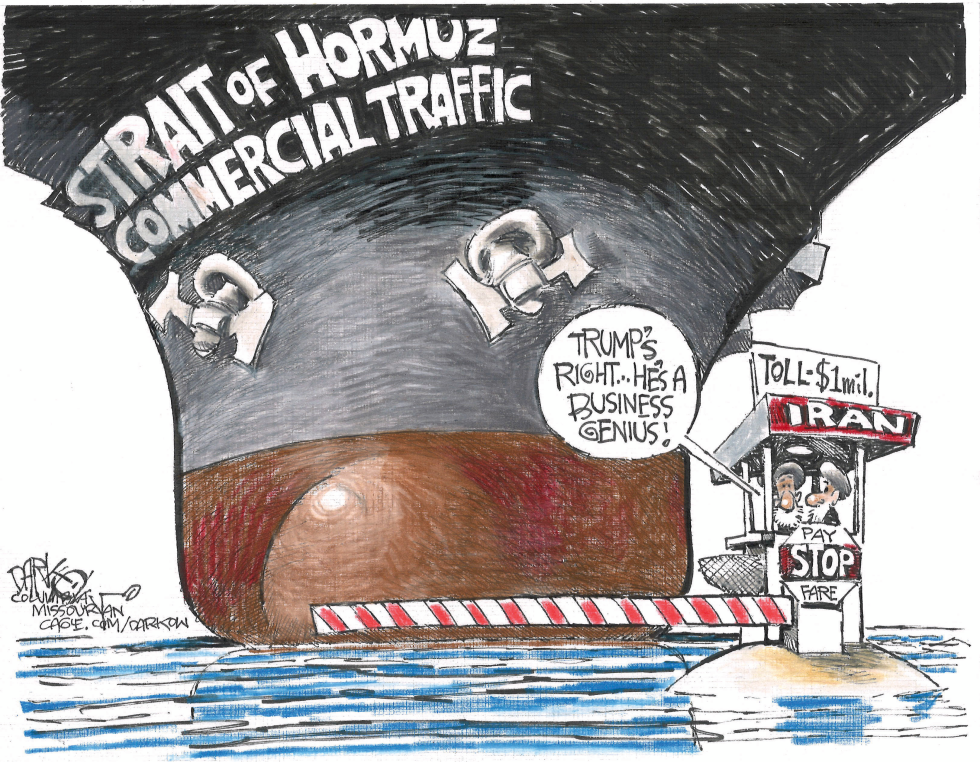
Donald Trump stands at the edge of a body of water confronting a toll booth operated by a figure resembling Ayatollah Khamenei. Small tankers sit in the water below while Trump issues a warning about walking on water. The scene references shipping routes through the Strait of Hormuz and surrounding nations.
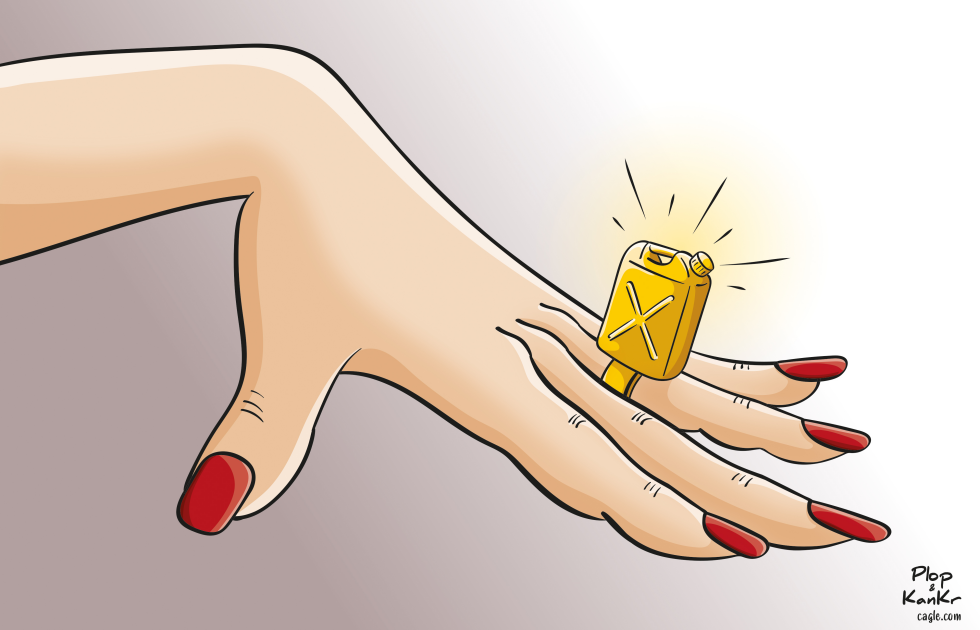
The cartoon shows a hand extended, wearing a ring shaped like a yellow gas can with an X, sparkling as if it's a precious diamond. Red nails add a touch of glamour to the scene against a plain background. This straightforward image pokes fun at oil prices skyrocketing, turning everyday fuel into something as valuable as jewelry. Tags like fuel luxury, energy satire, gasoline bling, petroleum parody, high costs humor, and economic pun capture the dry wit here. Cartoonists Plop and KanKr keep it simple, letting the visual speak without overcomplicating the message. It's a classic setup for editorial pages, reminding readers how energy crises make basics feel extravagant.
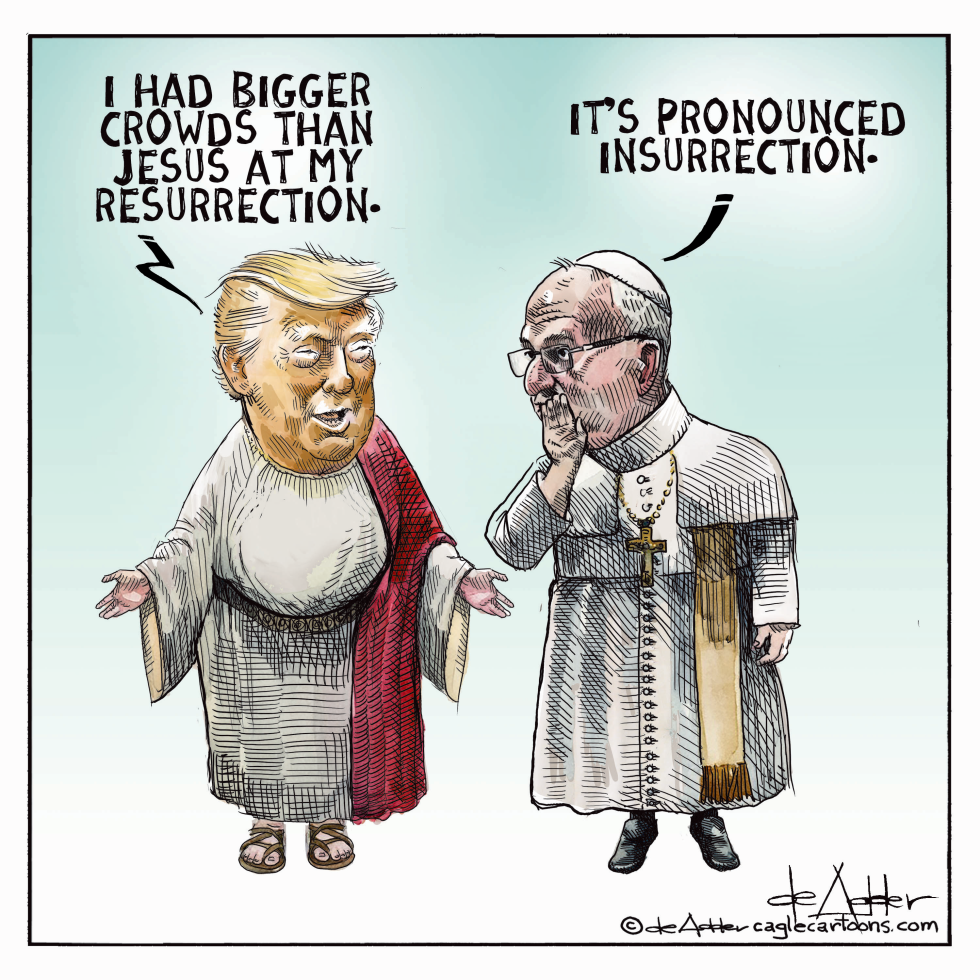
The cartoon depicts Donald Trump as Jesus Christ, complete with robe and sandals, claiming he had bigger crowds than Jesus at his resurrection. Standing beside him is the Pope, dressed in traditional Vatican attire with glasses and a cross, correcting the pronunciation to insurrection. Tags like Trump, Pope, Jesus, resurrection, and insurrection drive the humor, poking at Trump's known obsession with crowd sizes and linking it to the January 6 events. The artist, Michael de Adder, uses simple lines and a light background to focus on the figures and dialogue, creating a sharp satirical commentary on arrogance and political missteps. This piece fits well in editorial sections, blending religious imagery with current politics for a dry, pointed laugh.
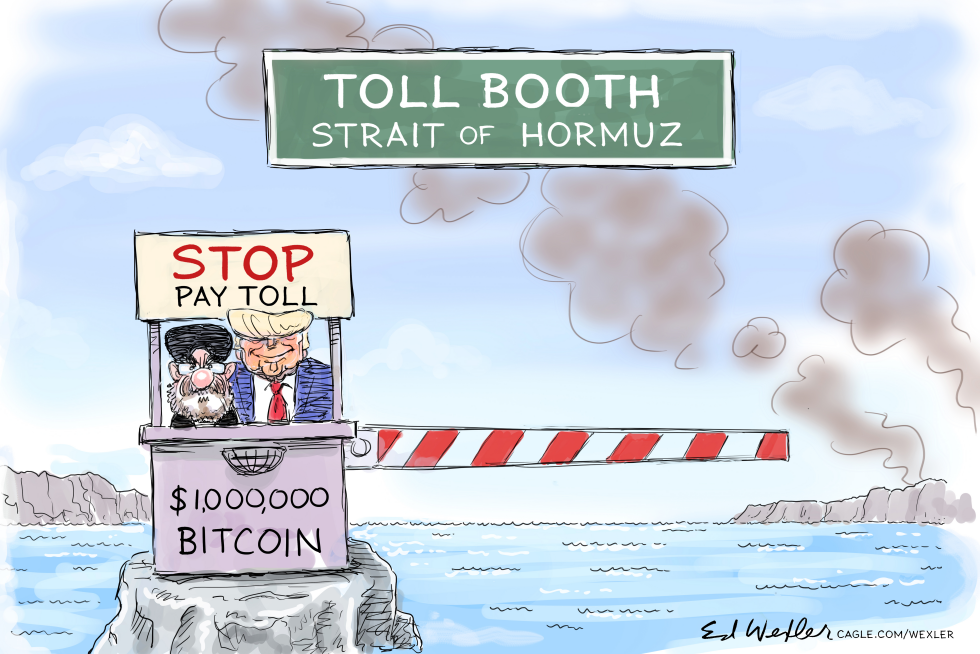
Ed Wexler\\\'s cartoon captures a toll booth in the Strait of Hormuz, where figures resembling Trump and the Ayatollah enforce a $1,000,000 Bitcoin toll. Smoke rises from what look like mines in the water, blending tags like Iran, Strait of Hormuz, tolls, Bitcoin, Trump, Ayatollah, and crypto into a sharp commentary. The barrier arm blocks passage, emphasizing control over this vital shipping lane. It\\\'s a straightforward jab at geopolitical tensions, with the toll sign demanding payment to proceed. No hidden layers here, just clear visuals tying economic pressures to digital currency in a contested area. The dry humor shines through in the absurdity of a Bitcoin booth amid potential explosions.
The cartoon shows a massive ship representing commercial traffic through the Strait of Hormuz approaching an Iran-operated toll booth charging one million dollars. Two figures in the booth exchange remarks crediting Trump with business acumen. The scene illustrates tensions over control of the vital shipping route between Iran and Gulf states.
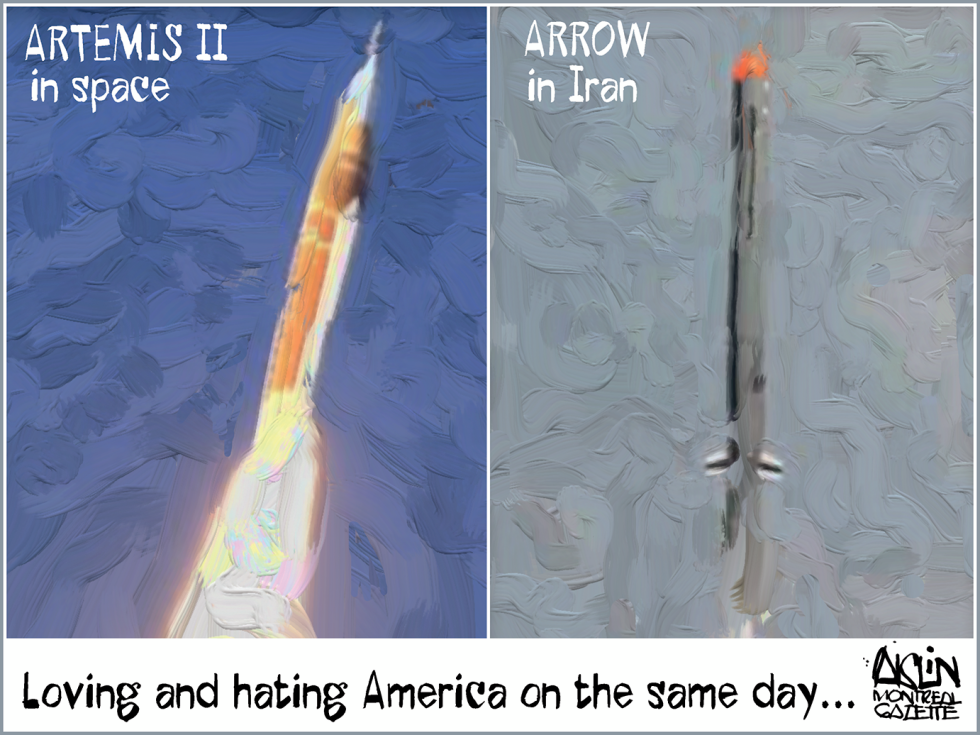
In this irreverent political cartoon, a vibrant Artemis II space launch rockets upward in a blue expanse on the left, symbolizing American innovation and triumph in US space exploration. Contrasting sharply on the right, a stark Arrow in Iran points downward with an orange glow against a gray sky, evoking geopolitical tension and Iranian weaponry. The caption 'Loving and hating America on the same day....' ties it together, offering a humorous take on the bipolar view of America in world news. With its simple yet effective composition, the artwork captures the absurdity of global perceptions, blending satire on international conflict with admiration for NASA's feats. This piece underscores the dichotomy in how the world engages with American power, from awe at space missions to ire over foreign policy frictions.
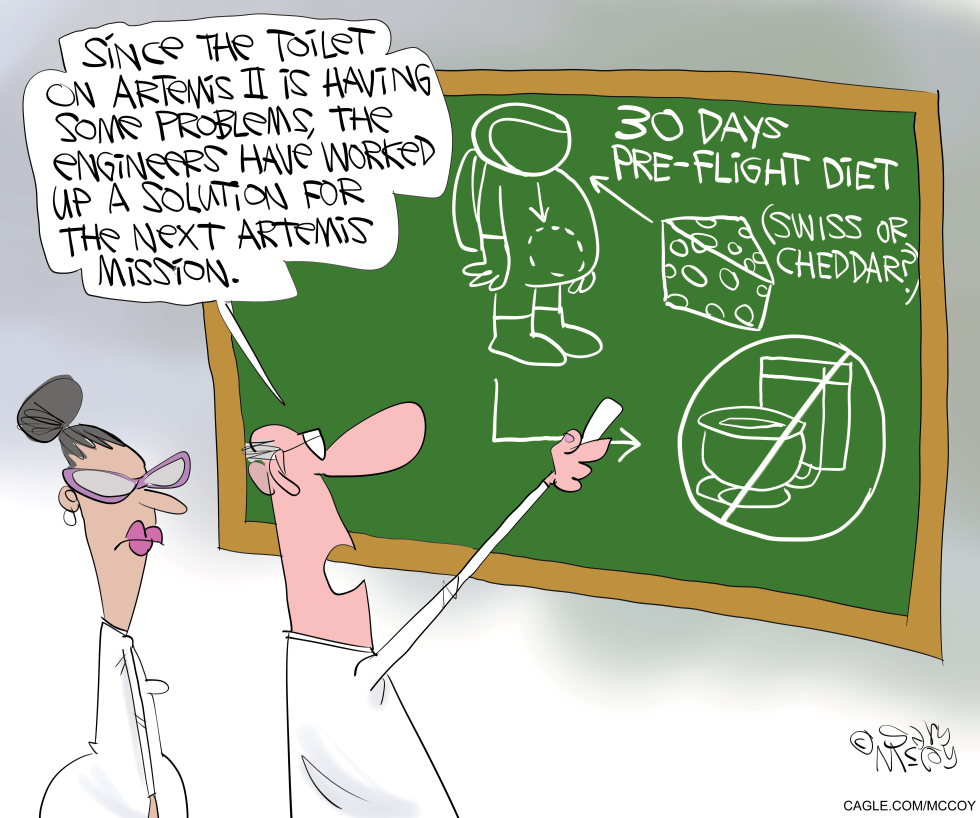
Gary McCoy\\\'s political cartoon depicts two figures in white coats, one pointing to a chalkboard with a speech bubble explaining a solution to Artemis II toilet problems via a 30-day pre-flight diet of Swiss or cheddar cheese. The board features a bloated astronaut sketch, a cheese cube, and a crossed-out toilet, poking fun at NASA engineering woes. This space mission satire uses dry humor to comment on technical glitches in the Artemis program, with tags like NASA Artemis II toilet problems, engineers solution Artemis mission, space mission pre-flight diet, Gary McCoy cartoon, cheesy diet fix, and humorous take on NASA solutions. The image stays light-hearted, focusing on visible elements without deeper speculation.
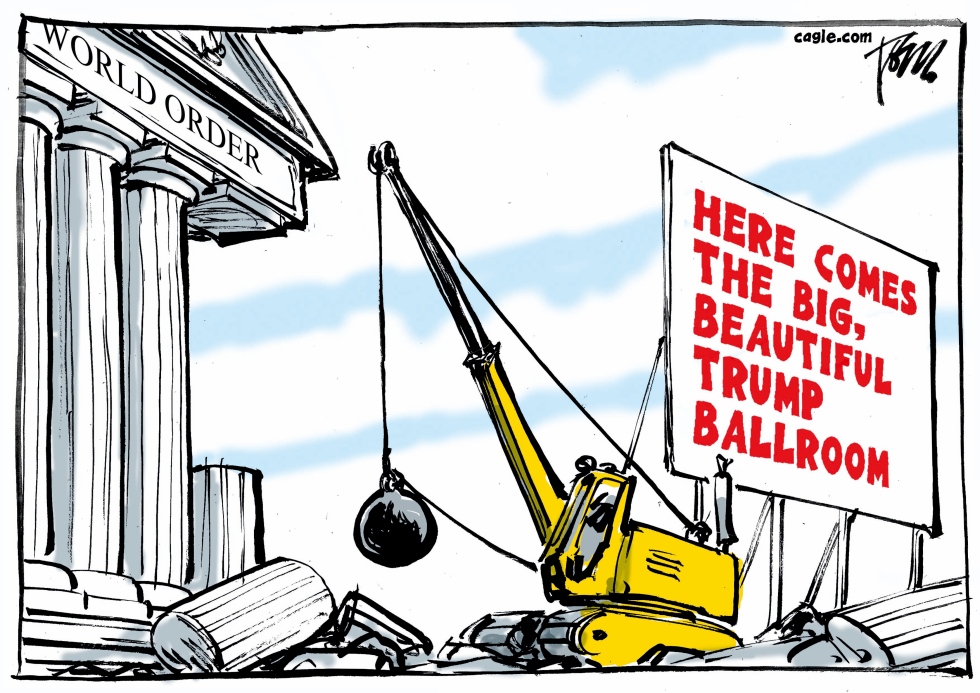
The cartoon depicts a classical building labeled 'World Order' being demolished by a yellow crane's wrecking ball, with debris scattering below and a prominent sign announcing 'Here Comes the Big, Beautiful, Trump Ballroom.' Tags like world order, NATO rift, allies, unreliable, chaos, and tariffs underscore the imagery of disruption. The scene captures a straightforward visual metaphor for upheaval, with broken columns and rubble emphasizing destruction. No characters appear, keeping the focus on structural collapse. Europe and Asia tags suggest broader implications, while the dry humor lies in rebranding ruin as a luxurious ballroom. Oil prices and economy tags tie into the fallout, making it a pointed commentary on global shifts.
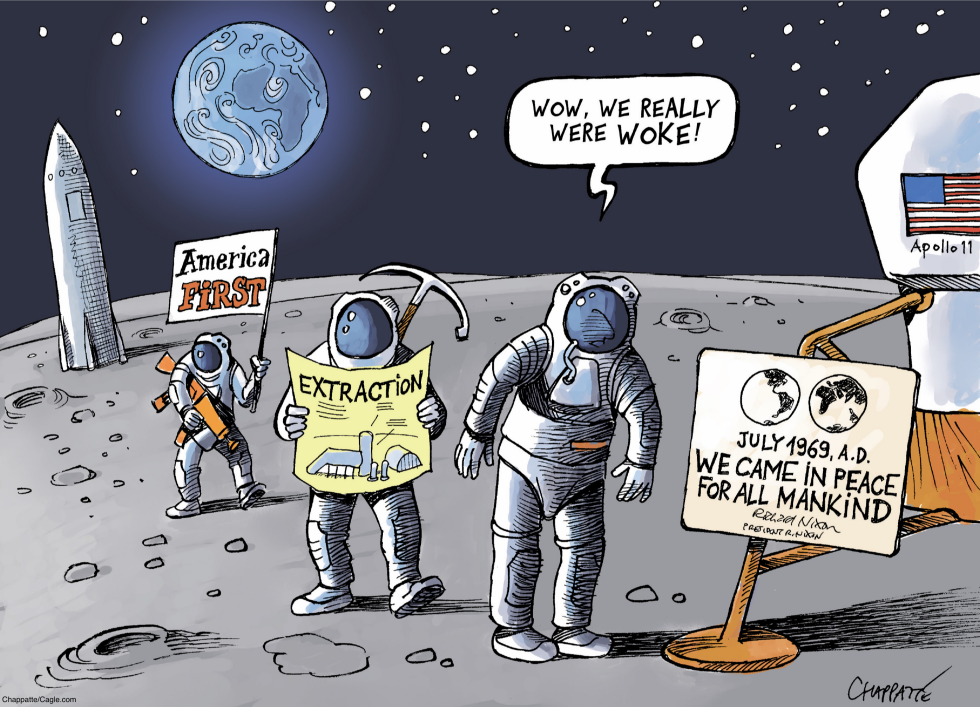
The cartoon shows three astronauts on the moon\\\\\\\'s surface, with Earth visible in the background. One holds a sign reading America First while carrying a weapon, another grips a document titled Extraction with a mining diagram, and the third wields a pickaxe next to a plaque stating We came in peace for all mankind from July 1969 A.D. near the Apollo 11 lander flagged with the US stars and stripes. A speech bubble declares Wow, we really were woke! The scene captures space race satire, lunar exploration humor, political cartoon commentary on shifting priorities from global peace to nationalistic resource grabs, all in Patrick Chappatte\\\\\\\'s style.
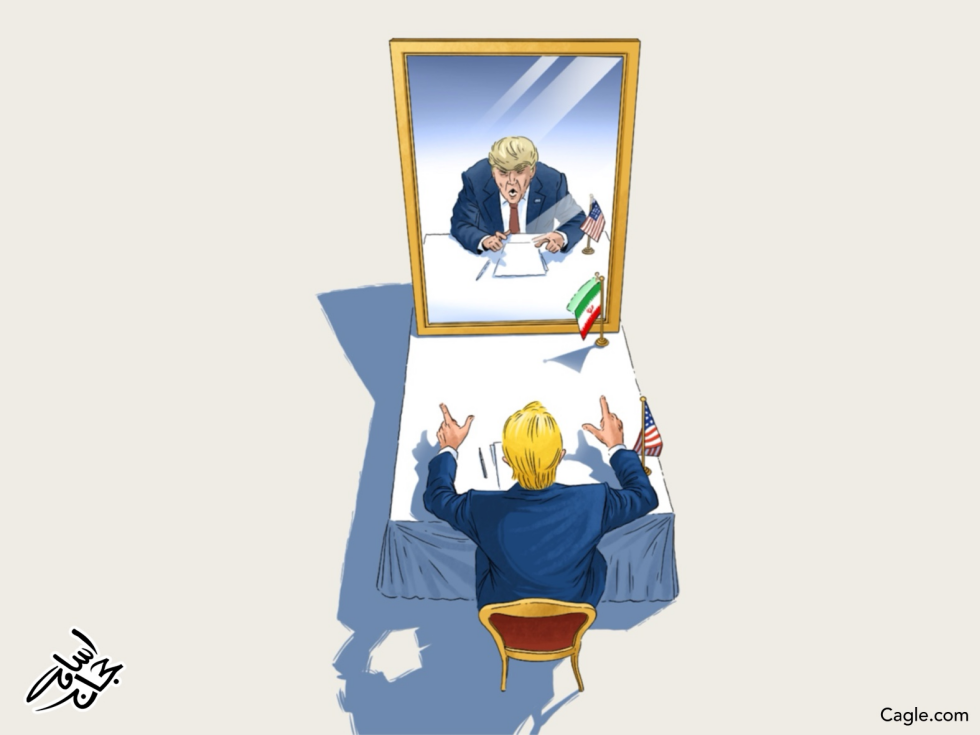
This humorous political cartoon depicts a figure with distinctive yellow hair and a blue suit seated at a table, pointing accusingly at a large mirror. In the reflection, an identical figure points back, but with an Iran flag instead of the US flag beside him. The setup cleverly satirizes self-negotiation or internal conflict in international relations, using mirror imagery for ironic effect. Elements like the pointing fingers, national flags, and desk setup emphasize bilateral tensions. As a satirical piece from Cagle.com, it offers insightful commentary on diplomatic absurdities, blending humor with political critique in a visually striking composition.
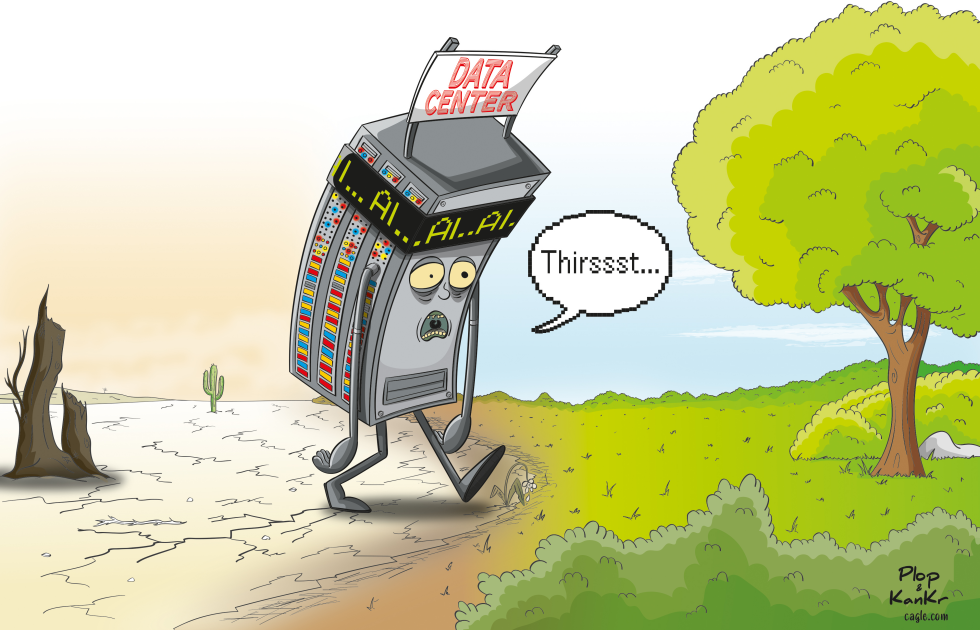
Visible cartoon depicts a walking data center structure with multiple colored server lights on side. The unit shows AI repeated on front panel. Eyes and mouth are drawn on the front. A speech bubble contains the word Thirssst. The machine stands on dry cracked soil near a path leading to grass and a large leafy tree. Artist names appear at bottom right along with cagle.com.
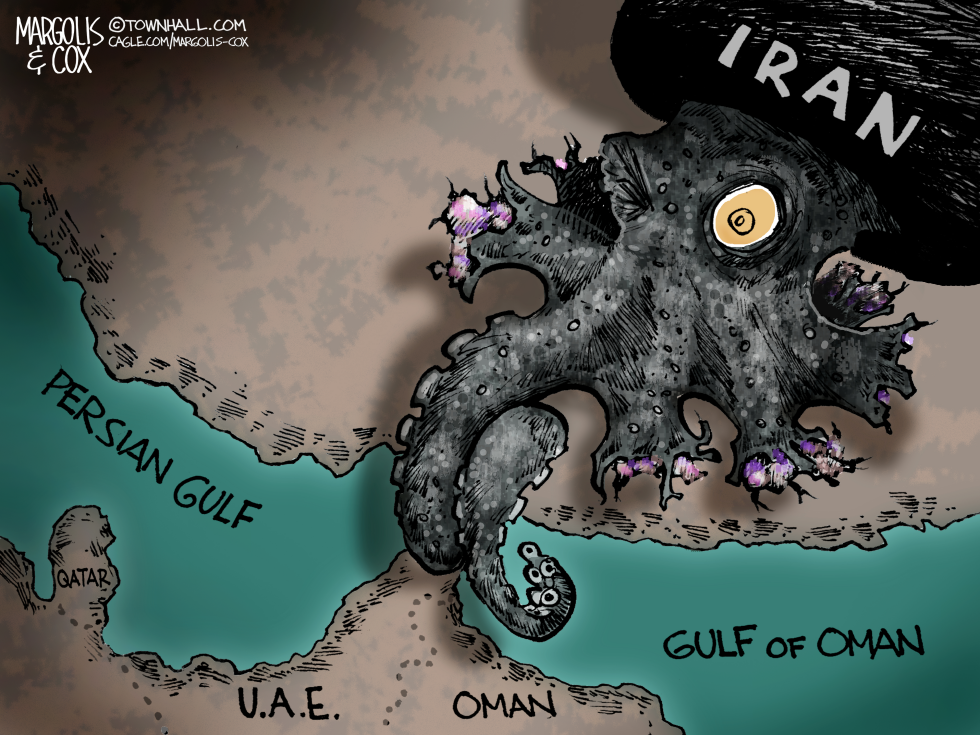
Cartoons like this one from Margolis and Cox cut straight to the absurdity of international posturing. Here, an oversized octopus labeled 'Iran' looms over a simplified map of the Persian Gulf and Gulf of Oman, its tentacles coiling tightly around the Strait of Hormuz. The creature's single eye glares out, while purple-tipped suckers grip the landmasses labeled Qatar, UAE, and Oman. It's a classic visual metaphor for control, poking at Iran's threats to block this crucial oil route. waterway. Such images remind editors how satire distills complex geopolitics into something shareable, even if the humor lands dry as desert sand. With tags like Iran Strait of Hormuz blockade, Persian Gulf tension, octopus metaphor, Middle East satire, oil route choke, and strategic dominance, the piece fits neatly into discussions of global energy security.