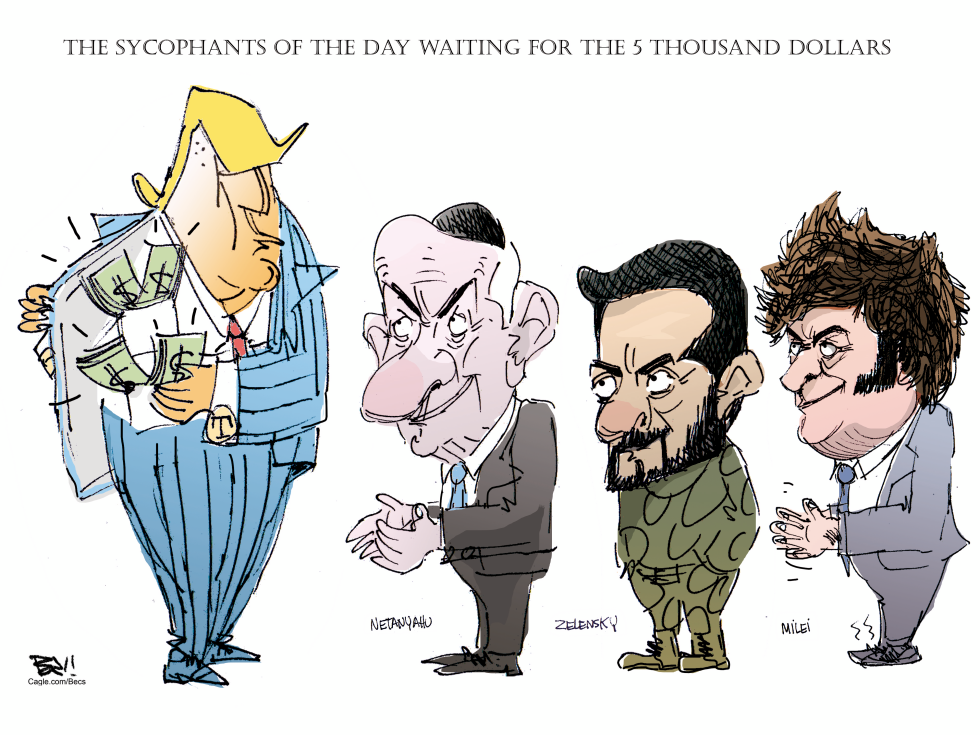
Donald Trump stands at the center of attention from Israeli Prime Minister Benjamin Netanyahu, Ukrainian President Volodymyr Zelensky and Argentine President Javier Milei. The scene reflects ongoing questions about how foreign leaders court favor with the U.S. president through displays of loyalty. The cartoon argues that these relationships reduce international diplomacy to transactional waiting for payoffs.
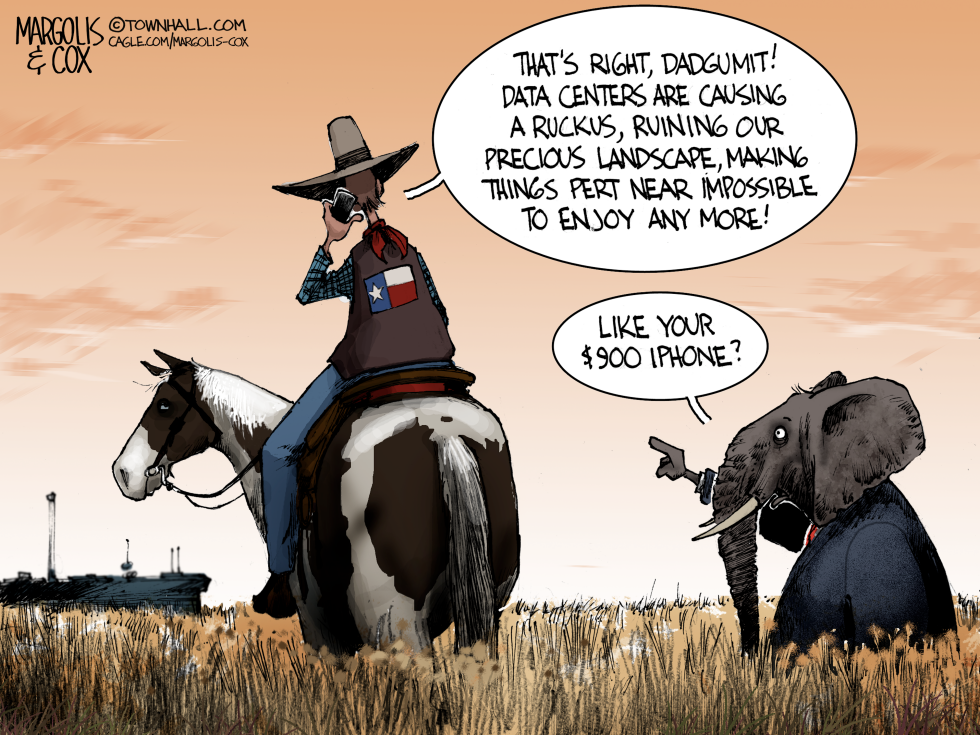
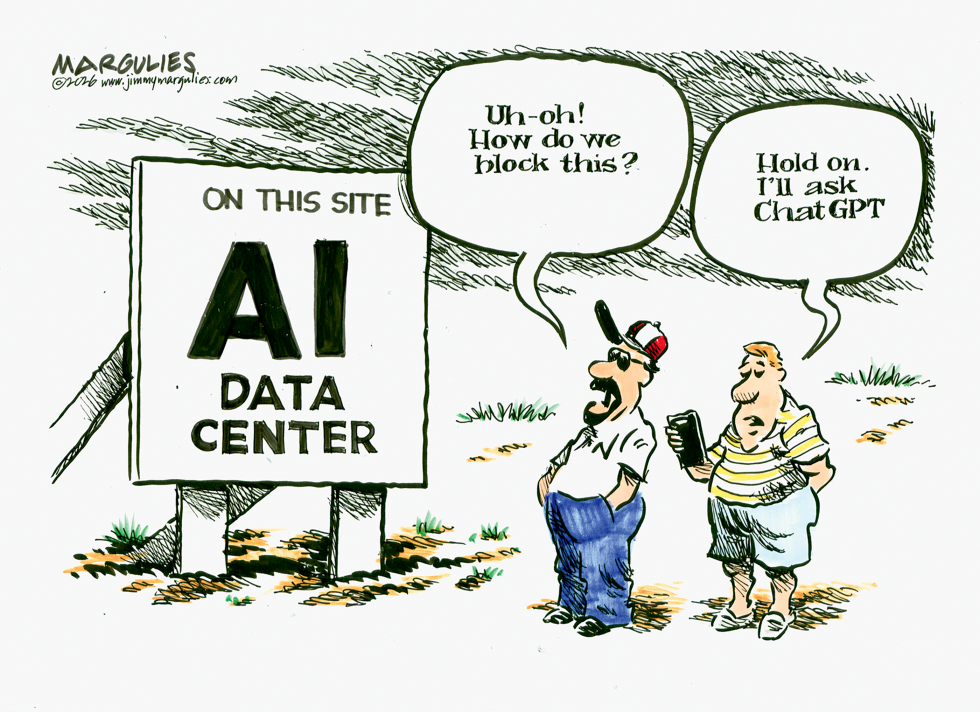
Data centers are expanding rapidly across Texas to support growing digital demands, drawing complaints from local residents and officials over land use and visual impact. Republicans in the state have voiced concerns about the facilities altering rural scenery and affecting quality of life. The cartoon highlights the inconsistency in such criticism given widespread reliance on smartphones and other tech products that necessitate these centers.
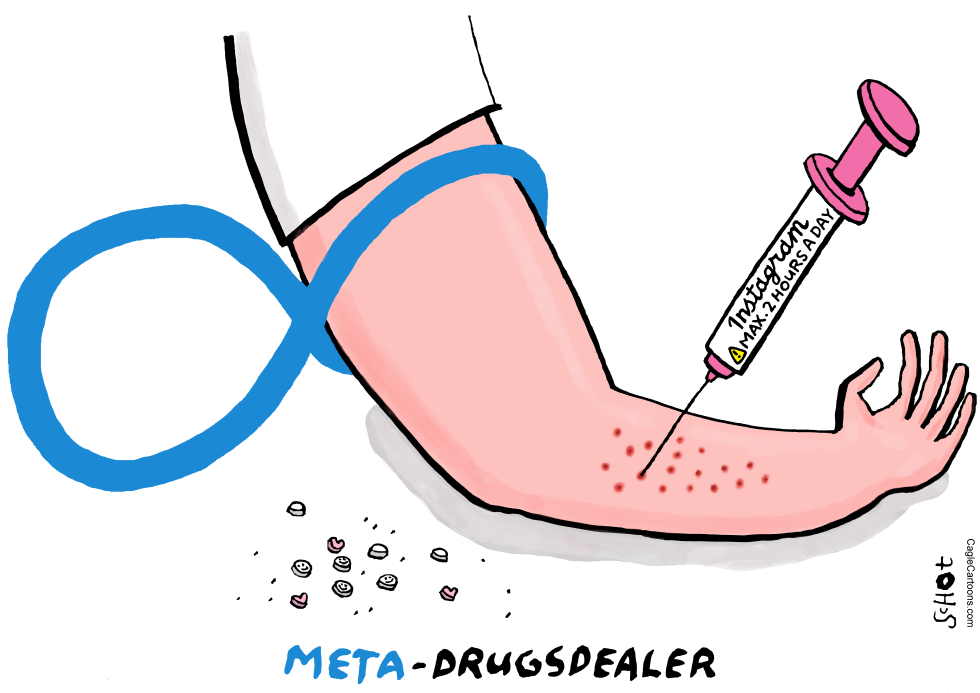
Meta continues to face scrutiny over Instagram's role in fostering user addiction through algorithmic engagement and minimal usage safeguards. Critics argue the platform prioritizes time spent over user well-being, with features that encourage repeated checks and extended sessions. The editorial position holds that Meta acts as a supplier of digital dependency, profiting from habits that mirror substance issues without meaningful intervention.
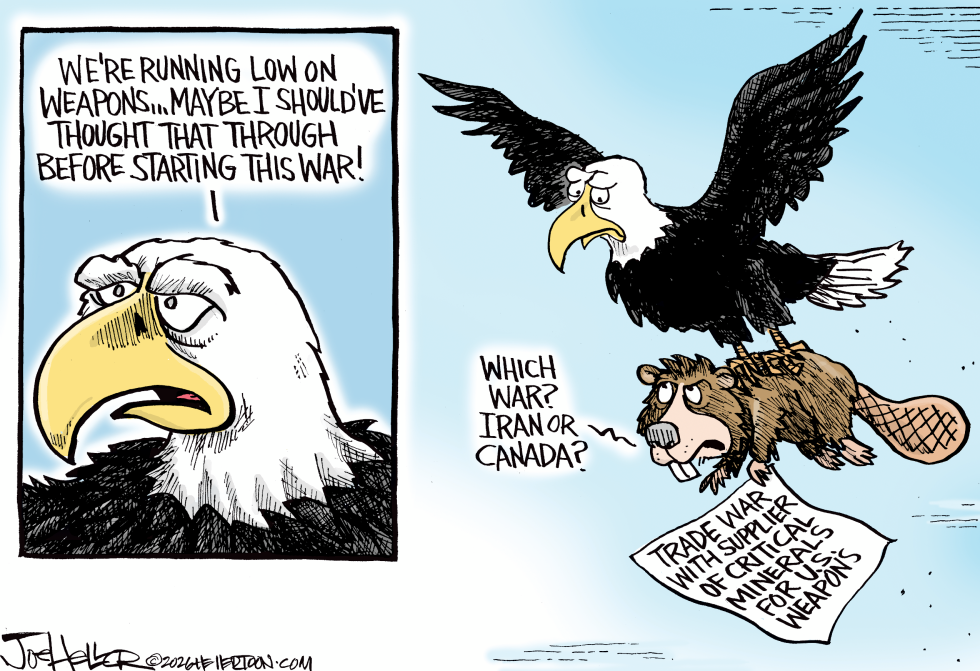
The United States faces potential weapons shortages linked to trade tensions with Canada, a key supplier of critical minerals, while also managing conflicts involving Iran. The situation highlights risks to military readiness from disrupted supply chains. The piece argues that initiating trade disputes with essential partners undermines defense capabilities at a critical time.
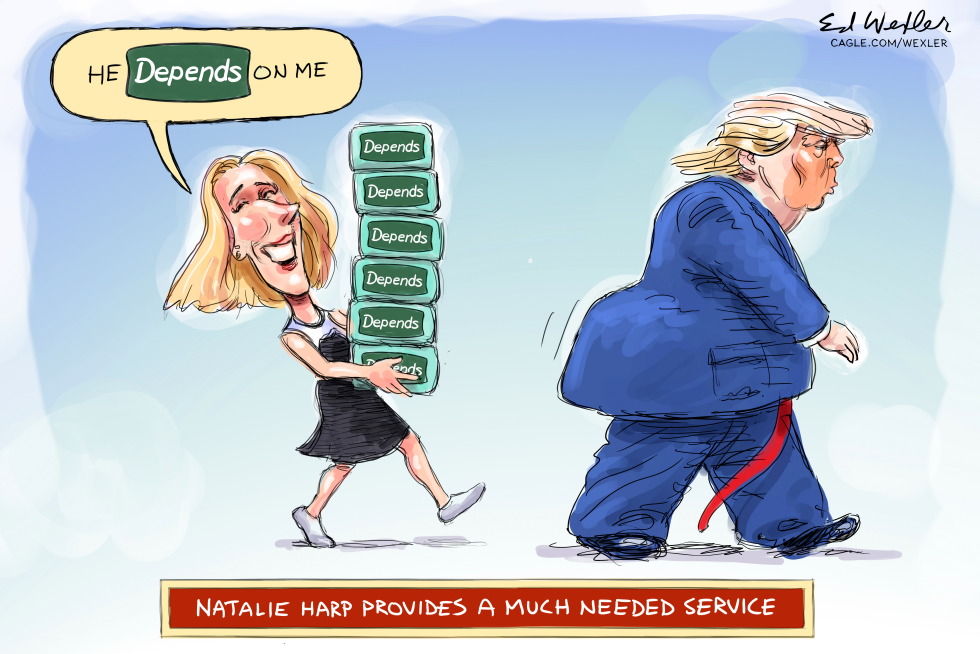
Natalie Harp, a Trump associate, is depicted supplying adult diapers to Donald Trump. The image responds to ongoing public discussion of Trump's age and physical condition during his 2024 campaign and subsequent activities. No specific new event occurred in the days before August 22 2026. The piece takes the position that Trump requires such assistance and that Harp fulfills that role.
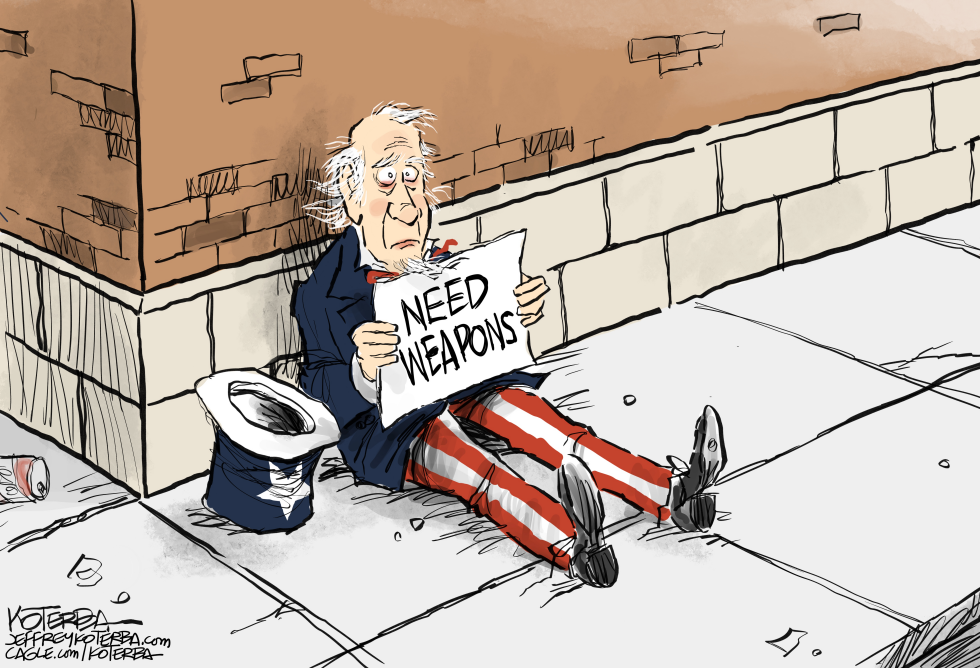
Uncle Sam appears as a disheveled figure on a sidewalk holding a sign requesting weapons. The image captures an ongoing national debate over military resources and international commitments. The editorial stance highlights perceived weakness in current arms policy and funding priorities.
A large sign announces an AI data center on the site. Two men react with concern, one asking how to block access while the other suggests querying ChatGPT on his phone for a solution. The scene highlights the rapid spread of artificial intelligence infrastructure and the reflexive turn to AI tools even when questioning their presence.
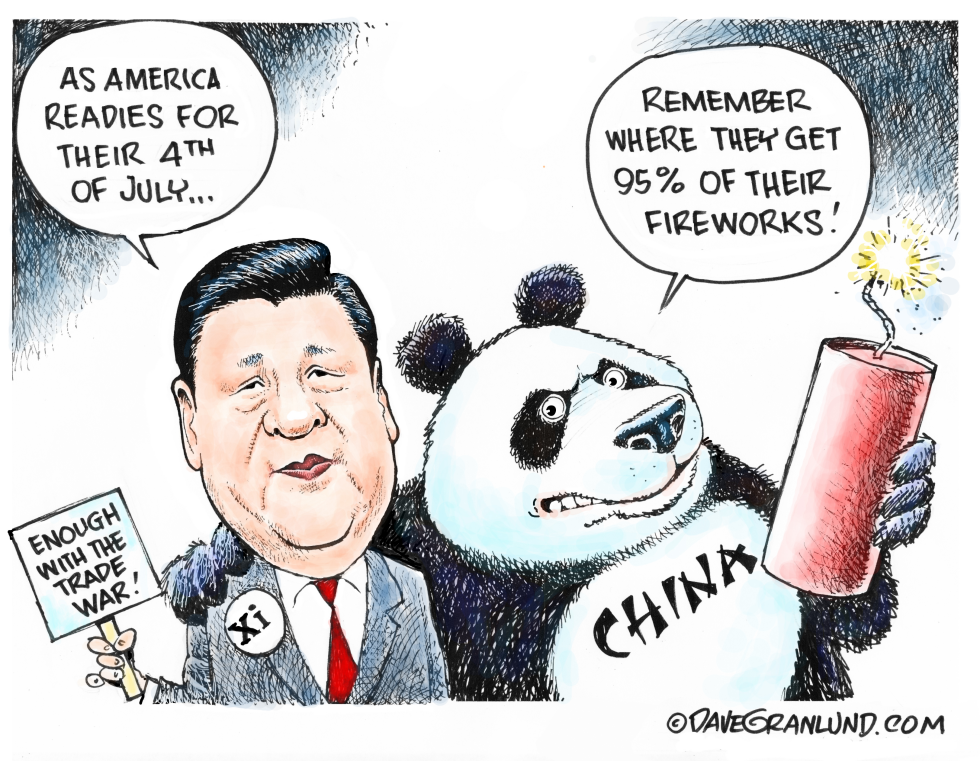
On June 19, 2026, a cartoon by Dave Granlund depicts Chinese leader Xi Jinping alongside a panda representing China. Xi holds a protest sign against the trade war while the panda reminds viewers that China supplies most American fireworks. The image addresses rising costs for July 4th celebrations tied to tariffs and supply issues with the largest provider.
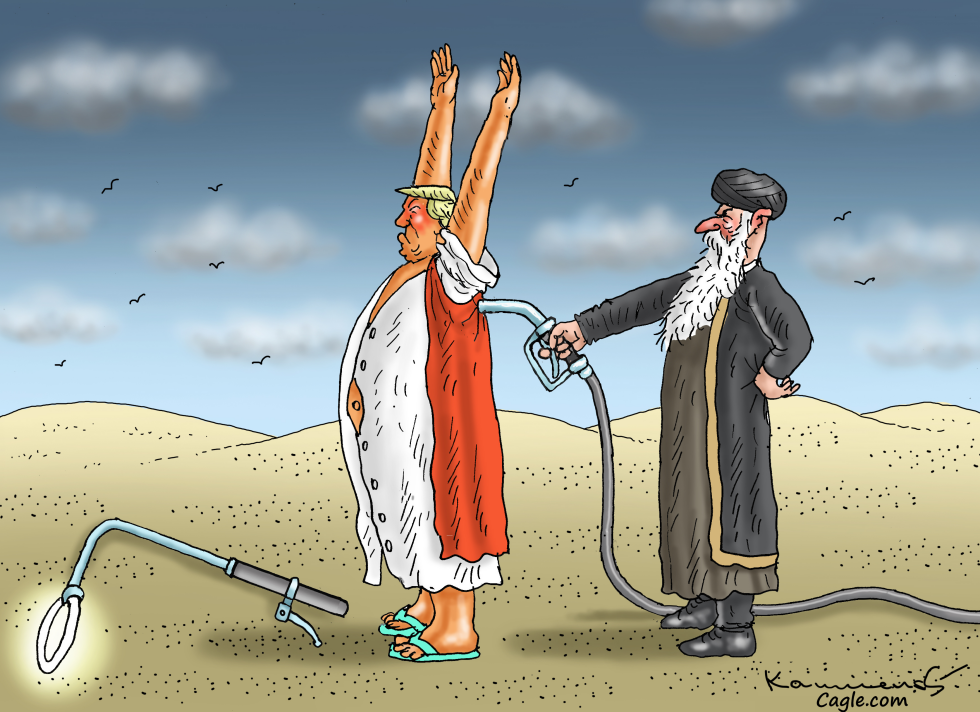
Marian Kamensky's cartoon captures a surreal scene in the desert where a figure resembling Trump, dressed in white and red robes with arms raised skyward, has a gas pump nozzle inserted into his side by a bearded man in dark robes and turban. The image plays on themes of Trump, Iran, Hormuz, fascism, MAGA terror, and oil war, blending religious imagery with modern geopolitical tensions. Birds fly in a cloudy sky over sandy dunes, emphasizing isolation and absurdity. The signature and Cagle.com mark confirm its syndication roots. This piece skewers the intersections of politics, religion, and resource dependency without words, relying on visual punch for impact. Such cartoons thrive in editorial pages for their sharp commentary on current events.
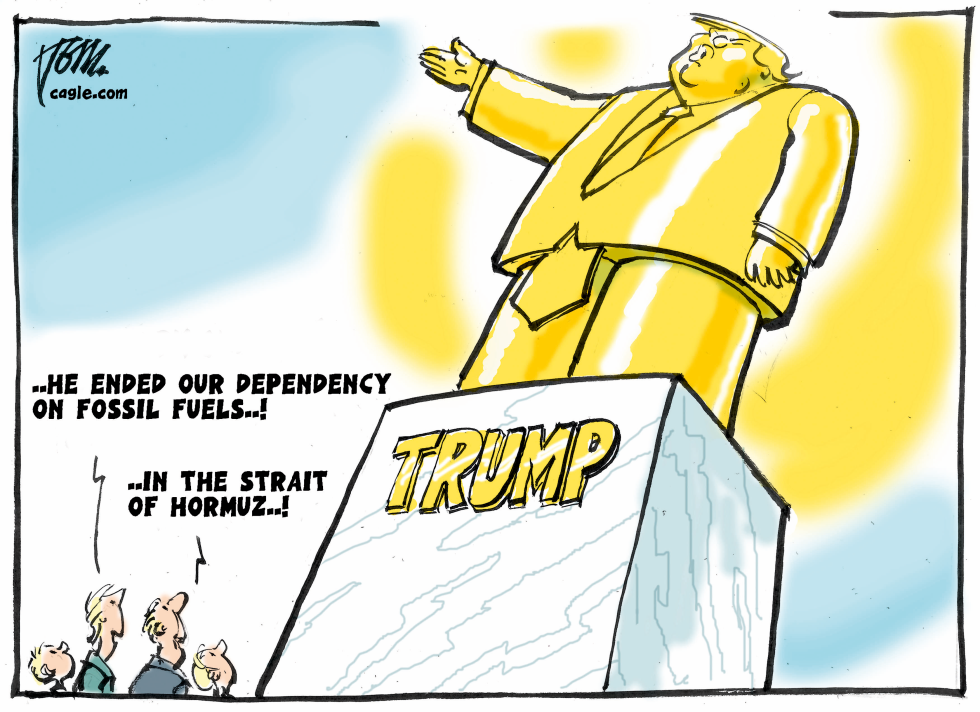
Tom Janssen draws a massive golden statue resembling Trump, arm raised triumphantly on a 'TRUMP' pedestal, with text boasting 'HE ENDED OUR DEPENDENCY ON FOSSIL FUELS!!' A small figure below quips '...IN THE STRAIT OF HORMUZ?!' Three tiny onlookers gaze up. The cartoon ties into tags like Strait of Hormuz, blockade, oil prices, inflation, Iran war, and fossil fuels. It pokes at ironic claims of energy independence through geopolitical tension. The yellow glow and exaggerated features amplify the dry humor on misguided victories. Cagle Cartoons syndicates such pointed takes, reminding editors how visuals cut through policy noise. This one's timely, blending current events with sharp wit.
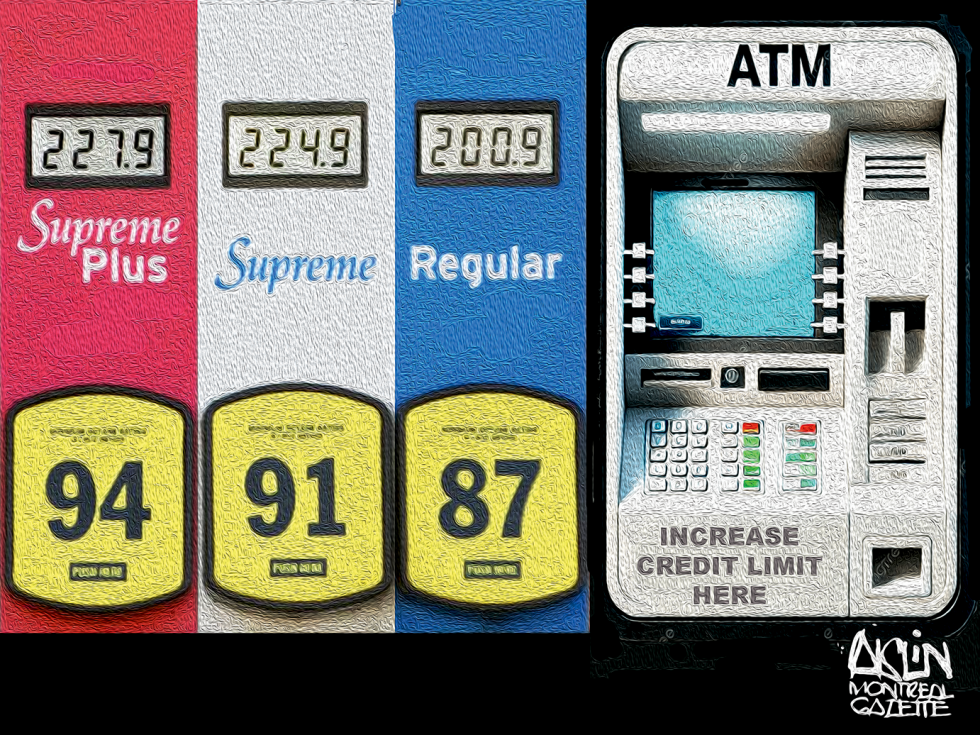
The cartoon shows a gas pump price board with supreme plus at 2.279 per gallon and 94 octane, supreme at 2.249 with 91 octane, and regular at 2.009 with 87 octane. Next to it sits an ATM labeled to increase credit limit here, poking at high gas prices and the economy's push toward more credit. Tags like gas, prices, cost, economy, credit, and pump underline the visual joke on affording fuel through debt. This setup captures the frustration with rising fuel costs without words, relying on the absurdity of blending a gas pump with credit services. Cartoonists often use such direct imagery to comment on everyday economic strains.
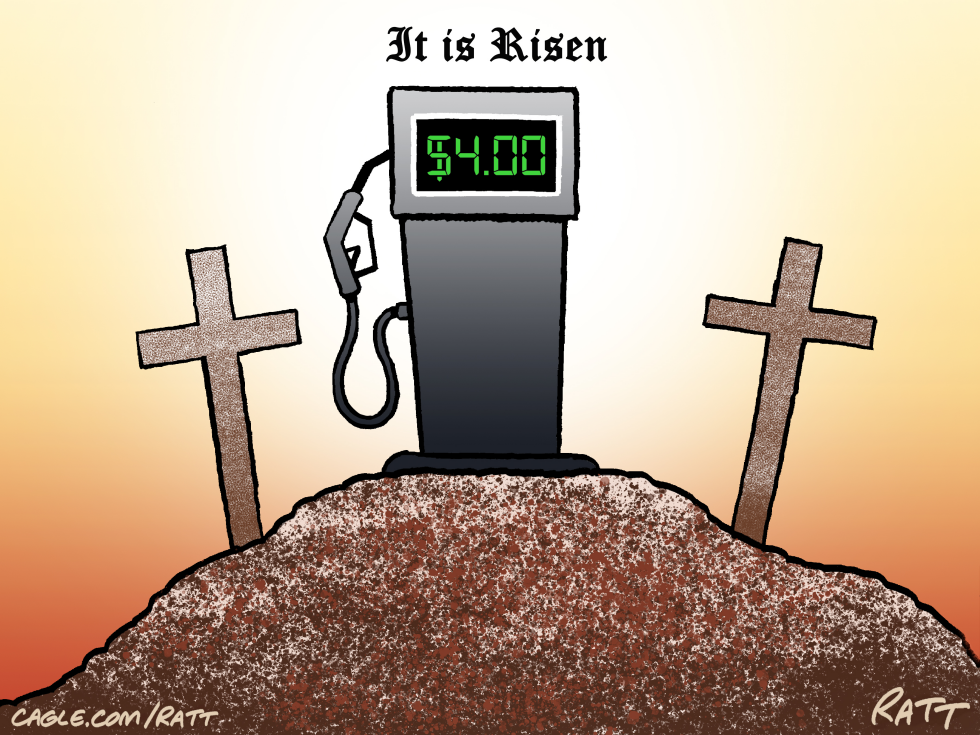
Ratt's cartoon captures Easter in America 2026 with a gas pump standing in for the central cross on a Calvary hill, showing $4.00 on its display and the text 'It is Risen' above, playing on rising gas prices. Tags like Easter, gas prices, oil, Iran war, and Strait of Hormuz suggest a future where geopolitical tensions drive fuel costs skyward. The artwork uses simple lines and a sunset background to evoke the biblical scene, but replaces resurrection with economic pain. This satire highlights how global events, including potential conflicts in the Strait of Hormuz, could lead to exorbitant oil prices by 2026. The dry humor underscores American dependence on foreign oil, making the cartoon timely and shareable amid ongoing energy debates.
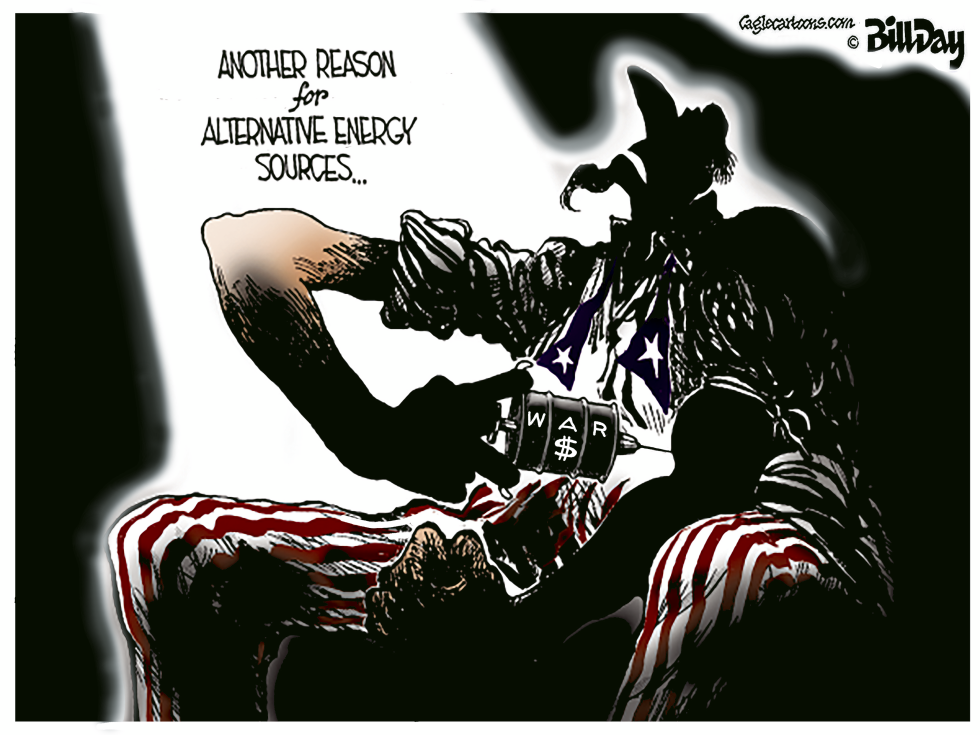
Bill Day's cartoon shows a figure in red-and-white stripes, resembling national colors, self-injecting a syringe marked 'WAR' and '$', with text pleading for alternative energy sources. The dark, shadowy style underscores the grim addiction to oil, tying into tags like war, oil prices, Gulf of Hormuz, global warming, climate change, and addiction. This visual metaphor pushes for wind energy and solar panels as escapes from the cycle of dependency that leads to conflict and environmental harm. The composition is stark, with the arm and syringe dominating, emphasizing the self-destructive habit amid calls for renewable shifts.
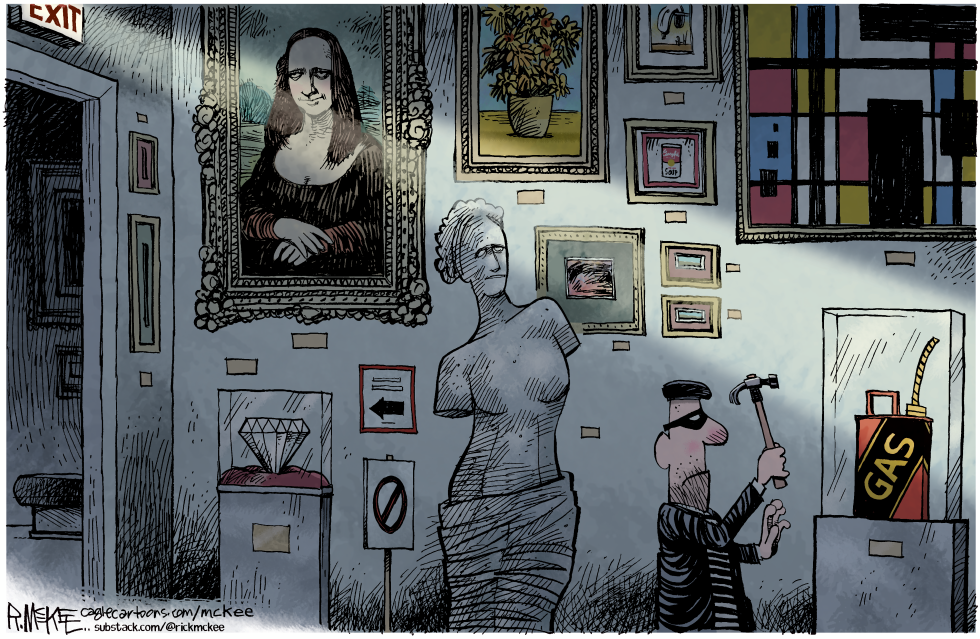
Rick McKee's cartoon depicts a dimly lit museum where a striped-shirted thief, masked and wielding a hammer, targets a display case with a red gas can marked 'GAS,' overlooking iconic pieces like the Mona Lisa portrait, Venus de Milo statue, a large diamond, Van Gogh-style sunflowers painting, abstract Mondrian-like art, and smaller framed works. An 'EXIT' sign glows above, and a 'no' symbol sign hangs nearby. The scene uses tags such as Trump, war, Iran, gas prices, oil, museum to comment on how escalating fuel costs make gasoline more valuable than cultural treasures, blending humor with commentary on energy crises.