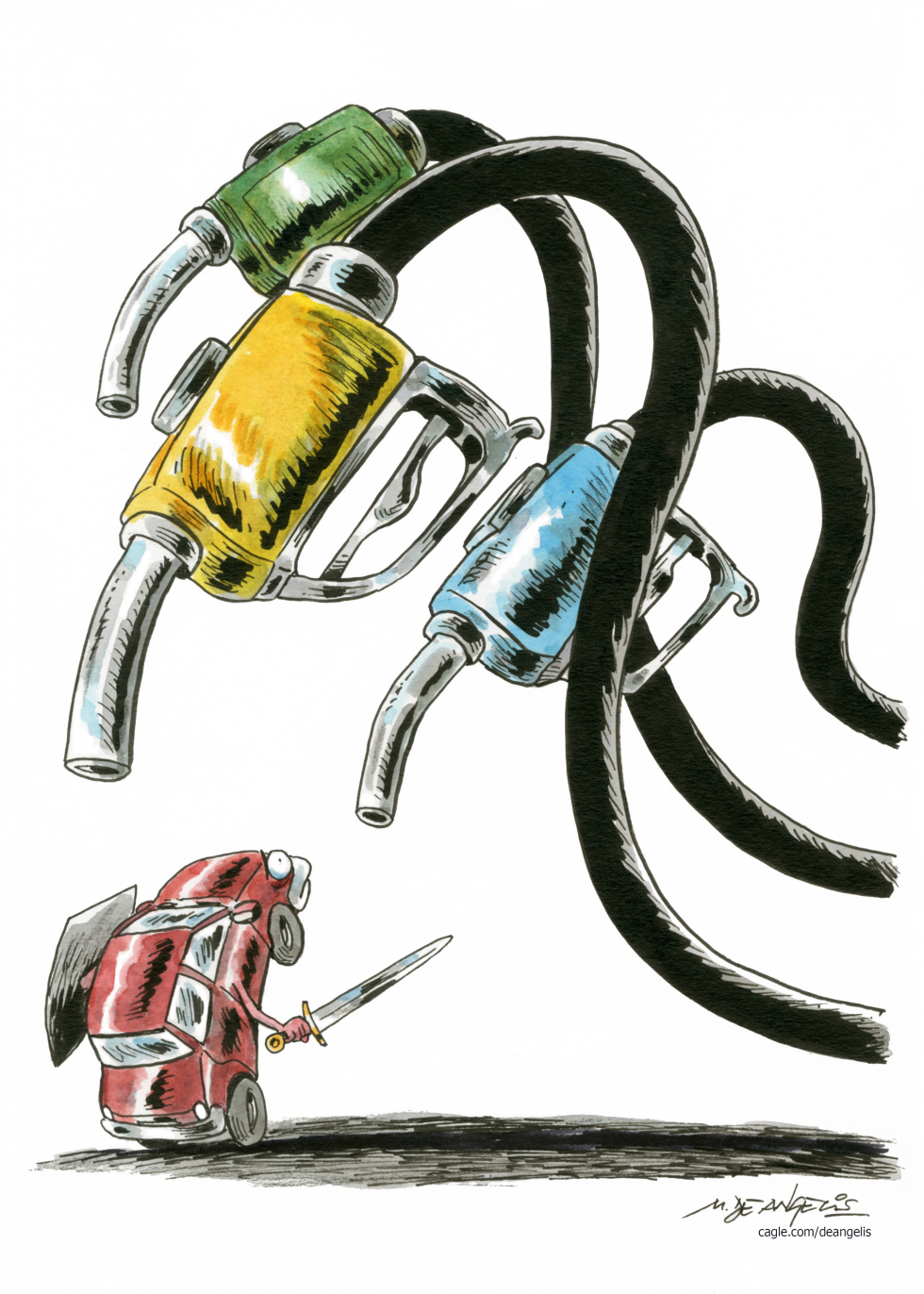
Marco De Angelis draws a clever twist on the ancient HYDRA myth, where a plucky red CAR, sword in hand, squares off against a beastly creature formed by three FUEL pump nozzles—green, yellow, and blue—attached to writhing black hoses. The scene plays on the endless battles drivers face with soaring OIL PRICES and FUEL costs, tying into broader ECONOMY woes. Tags like TRANSPORTATION, TRADE, WAR, CRISIS, IRAN, USA, and HORMUZ hint at real-world tensions in the Strait of Hormuz, where geopolitical strife disrupts global OIL supplies. It's a sharp commentary on how these issues regenerate like hydra heads, making every victory temporary in the fight against economic pressures.
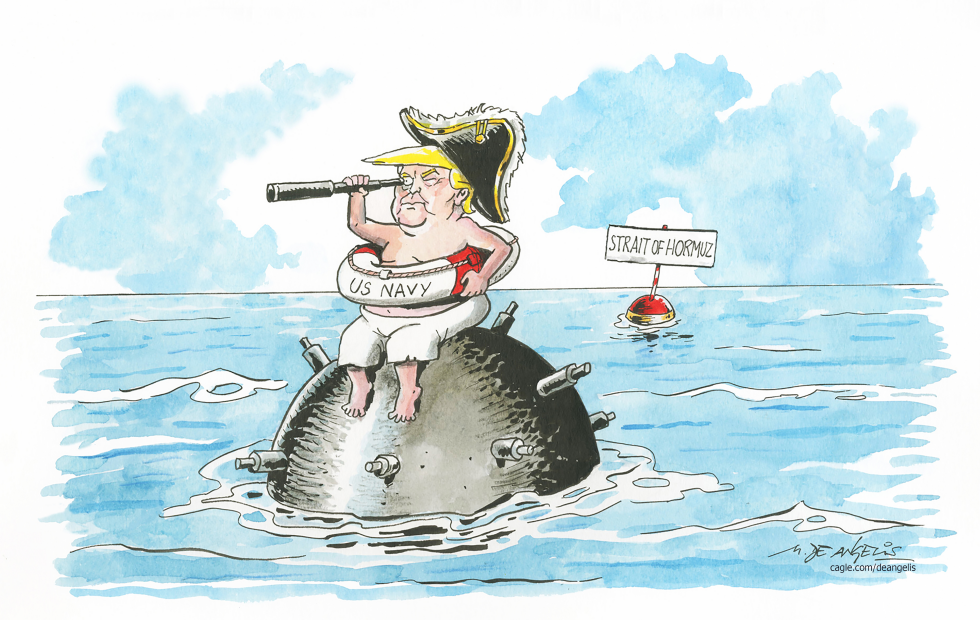
Marco De Angelis draws a caricature resembling Donald Trump, shirtless with a US NAVY life preserver, white shorts, and pirate hat, sitting on a large mine bobbing in blue waters. He holds a telescope to his eye, gazing out, while a small buoy nearby bears a Strait of Hormuz sign. The scene tags USA, IRAN, HORMUZ, NAVY, MINES, OIL, NEGOTIATIONS, FLEET, ALONE, ADMIRAL, MIDDLE EAST, WAR, capturing a sense of solitary watch in troubled seas. The dry humor underscores the absurdity of one man embodying an entire fleet, floating precariously on explosive hardware. Cartoons like this thrive on exaggeration, turning geopolitical standoffs into visual punchlines that newspapers love for their sharability.
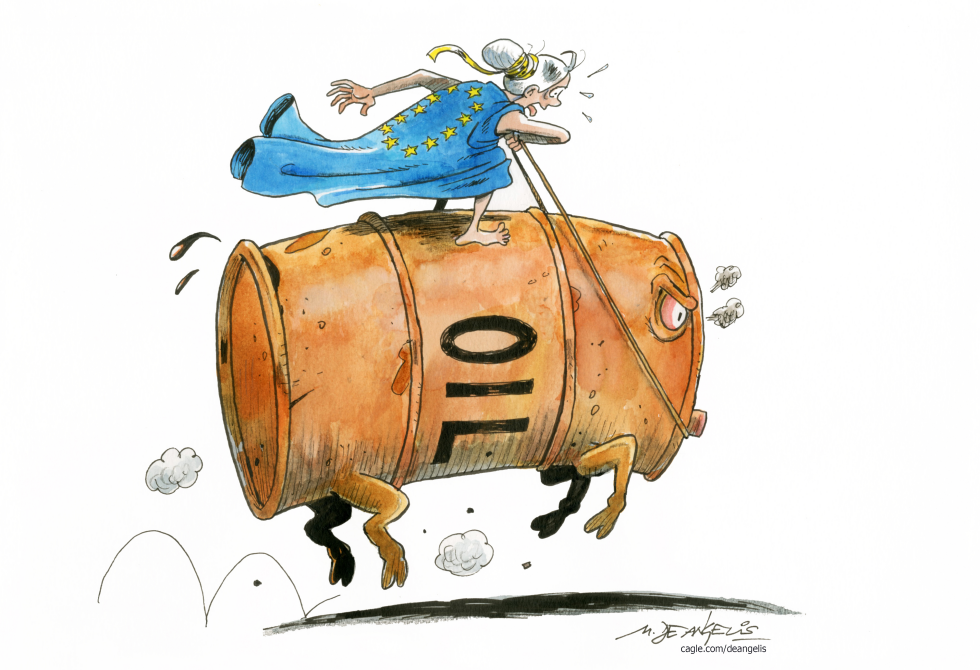
Marco De Angelis draws a sharp symbolic scene where a figure draped in the European Union flag clings to a bucking oil barrel marked OIL, legs kicking like a furious bull, smoke puffing from its nostrils. The rodeo metaphor nails the wild ride of economy and prices amid war in places like Hormuz. Europe looks desperate, one hand waving, mouth open in shock, as the oil tank rears up. It\'s a straightforward jab at how USA policies and global tensions turn energy into a beast no one can tame. Tags like symbolic, European, oil, tank, war, and economy drive the point home without fluff.
Monte Wolverton\'s cartoon depicts a doctor holding up an xray that reveals an intestine shaped like the Strait of Hormuz, complete with stars indicating blockages and inflammation. Trump peers over the top, his distinctive hair visible, as the doctor diagnoses intermittent blockages, polyps, and suggests consuming more fiber while cutting back on fast food. Tags like Iran War and blockade tie into the visual pun, turning a geopolitical chokepoint into a medical ailment. The piece uses dry humor to highlight discomfort in a straightforward way, with the xray\'s pinkish intestine contrasting against the black background. Artistic elements include the doctor\'s pointing finger and Trump\'s curious pose, emphasizing the satire without overcomplicating the scene.
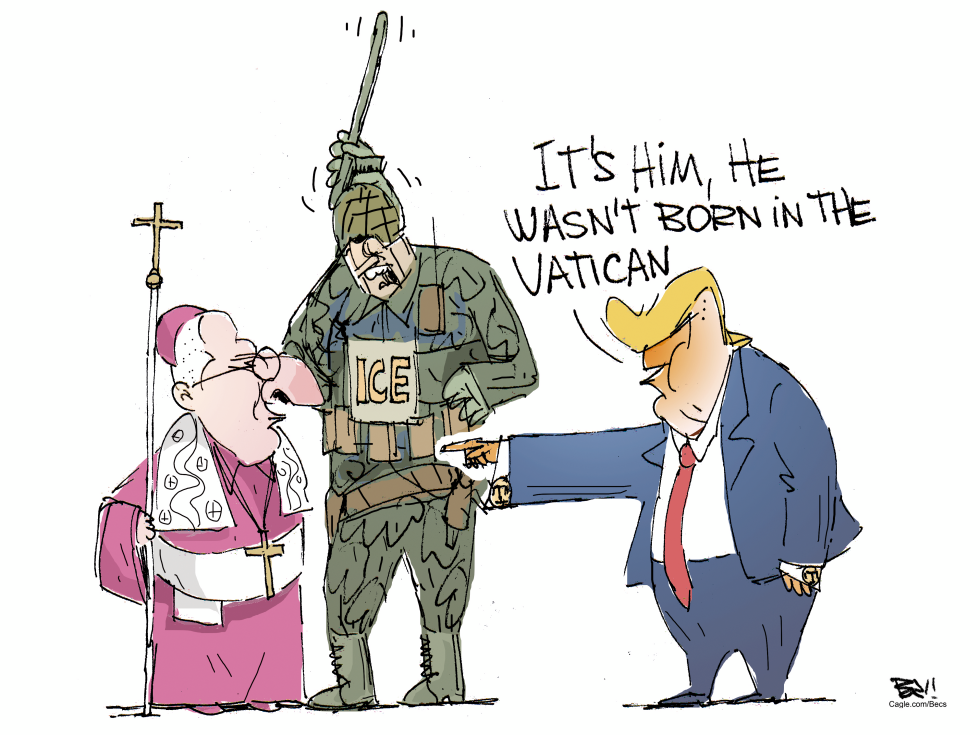
This cartoon shows Donald Trump accusing the Pope of not being born in the Vatican, with an ICE agent poised for action. The tags highlight themes of incompetent narcissistic leadership in US politics, blending Vatican imagery with immigration enforcement. Trump's pointing finger and the Pope's surprised expression drive the satire, while the ICE label on the agent's vest ties into border control debates. Such cartoons often poke at figures like Trump and the Pope to underscore absurdities in power dynamics. With elements of humor targeting narcissism and incompetence, it fits broader discussions on US-Vatican relations and policy follies.
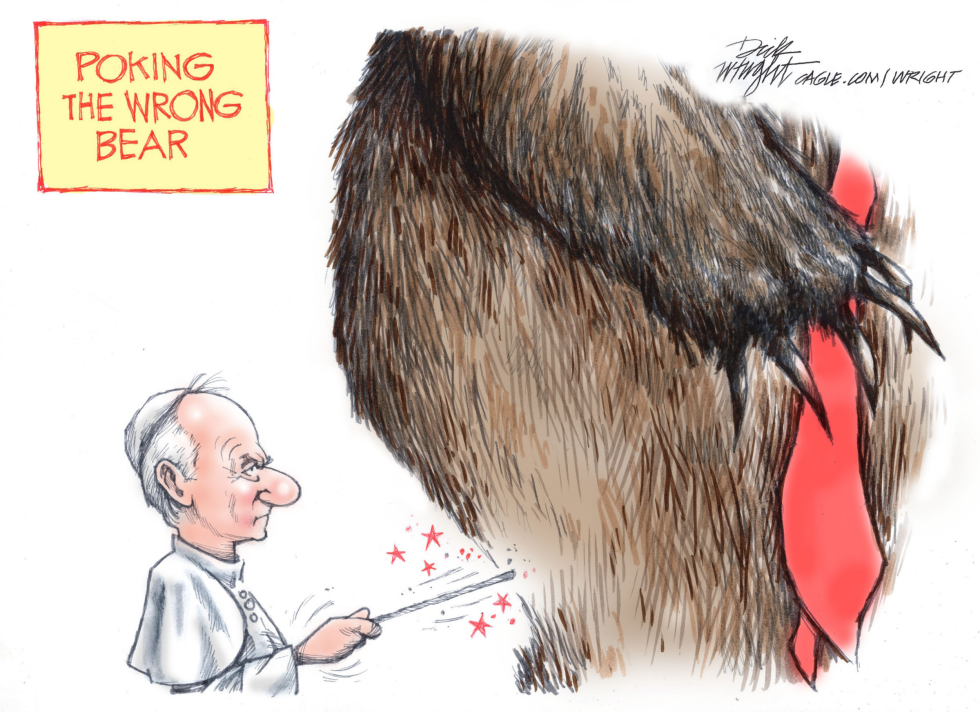
Dick Wright's political cartoon depicts a Pope-like figure in white attire, extending a thin rod toward the rear of a massive brown bear, complete with a dangling red tie and sparkling effects at the point of contact. The yellow label reads 'POKING THE WRONG BEAR,' playing on the idiom with a twist. This satirical illustration ties into the Trump-Pope feud, using the bear as a stand-in for power, the red tie evoking Trump's signature look, and the poking action suggesting provocation. Cartoonists often employ such animal metaphors for political commentary, and Wright's style here delivers clear lines and exaggerated features for impact. The image avoids overstatement, sticking to visible elements like the bear's claws and fur details, making it a straightforward jab at ongoing tensions.
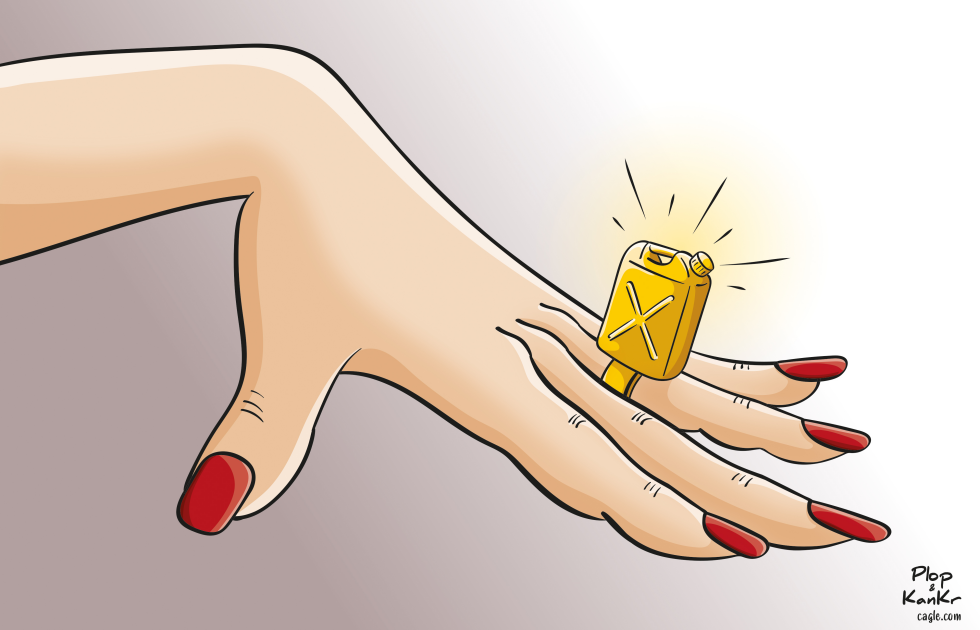
The cartoon shows a hand extended, wearing a ring shaped like a yellow gas can with an X, sparkling as if it's a precious diamond. Red nails add a touch of glamour to the scene against a plain background. This straightforward image pokes fun at oil prices skyrocketing, turning everyday fuel into something as valuable as jewelry. Tags like fuel luxury, energy satire, gasoline bling, petroleum parody, high costs humor, and economic pun capture the dry wit here. Cartoonists Plop and KanKr keep it simple, letting the visual speak without overcomplicating the message. It's a classic setup for editorial pages, reminding readers how energy crises make basics feel extravagant.
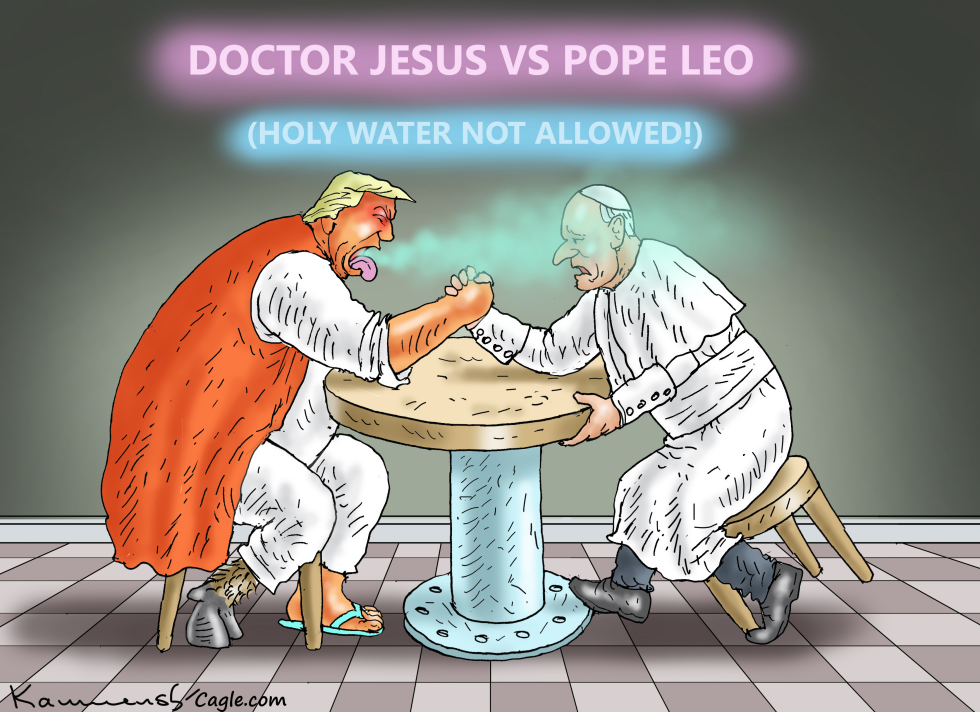
The image shows two figures engaged in arm wrestling, labeled as Doctor Jesus and Pope Leo, with a neon sign overhead stating 'DOCTOR JESUS VS POPE LEO' and a note that holy water is not allowed. Doctor Jesus appears with blonde hair, an orange cape, white robe, and sandals, while Pope Leo wears traditional white papal attire and shoes. A small elephant figure peeks from under Doctor Jesus's robe, and mist surrounds Pope Leo's head. The scene unfolds on a checkered floor with stools and a round table. This setup captures a direct, humorous confrontation between the caricatured holy figures, emphasizing the ban on holy water in their matchup. The artist's signature, Kamensky/Cagle.com, appears at the bottom.
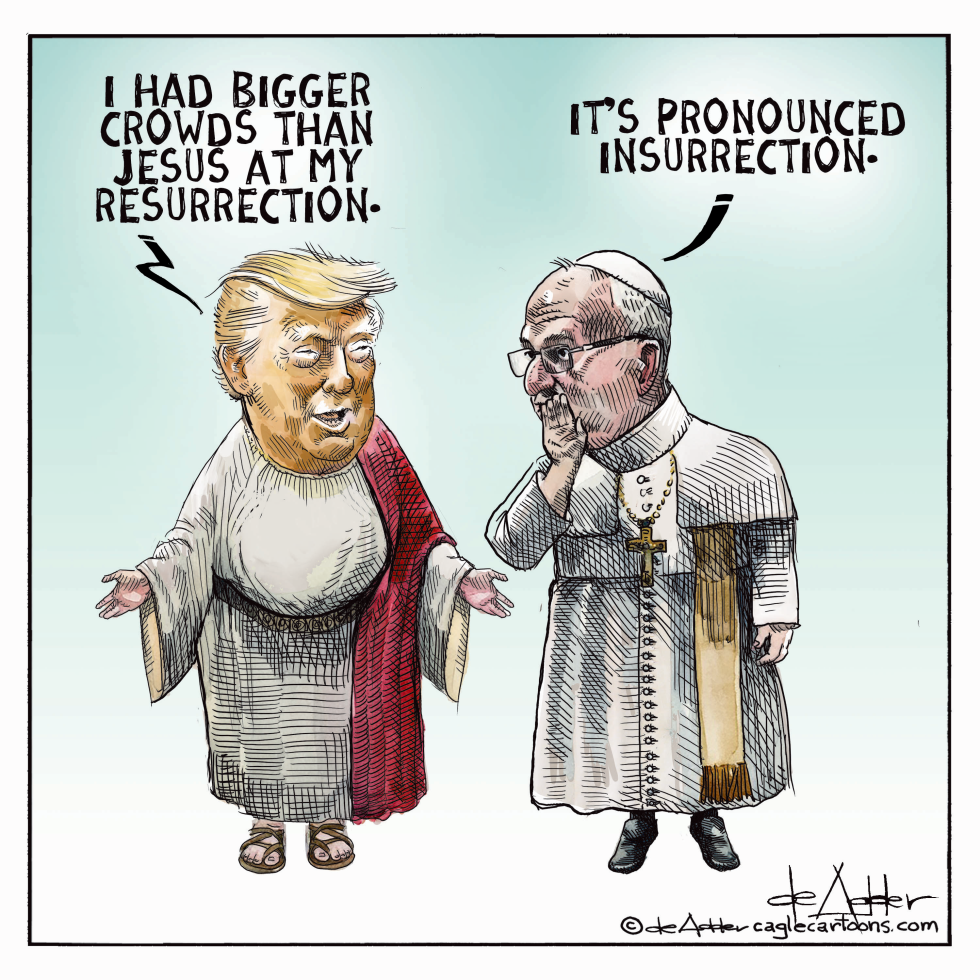
The cartoon depicts Donald Trump as Jesus Christ, complete with robe and sandals, claiming he had bigger crowds than Jesus at his resurrection. Standing beside him is the Pope, dressed in traditional Vatican attire with glasses and a cross, correcting the pronunciation to insurrection. Tags like Trump, Pope, Jesus, resurrection, and insurrection drive the humor, poking at Trump's known obsession with crowd sizes and linking it to the January 6 events. The artist, Michael de Adder, uses simple lines and a light background to focus on the figures and dialogue, creating a sharp satirical commentary on arrogance and political missteps. This piece fits well in editorial sections, blending religious imagery with current politics for a dry, pointed laugh.
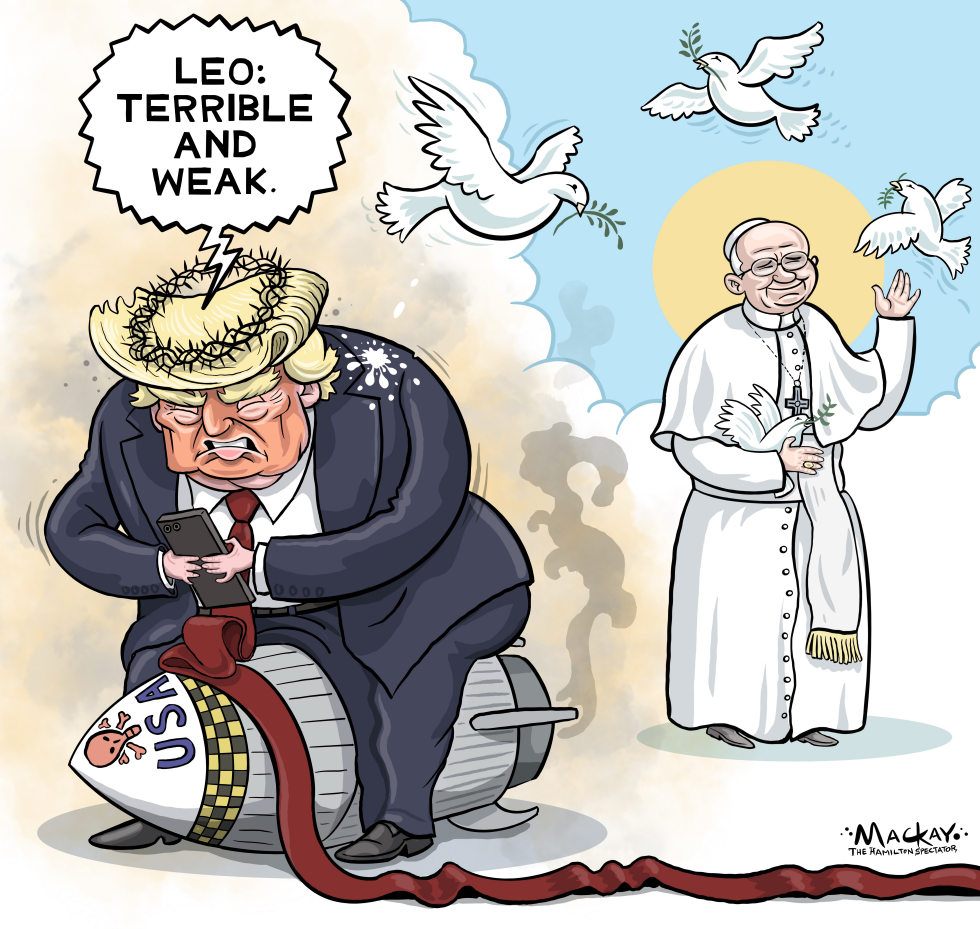
Graeme MacKay's political cartoon captures Trump, caricatured with crown of thorns hair, sitting on a bomb labeled USA with a skull symbol, holding a phone and declaring 'Leo: Terrible and Weak' in a speech bubble. Smoke rises from the missile, contrasting sharply with the Pope on the right, halo glowing, releasing white doves carrying olive branches. The scene unfolds against a cloudy sky, highlighting themes of war and peace. This satirical illustration pokes at political rhetoric, religious symbolism, and international tensions, blending humor with critique in a style that's both direct and pointed.
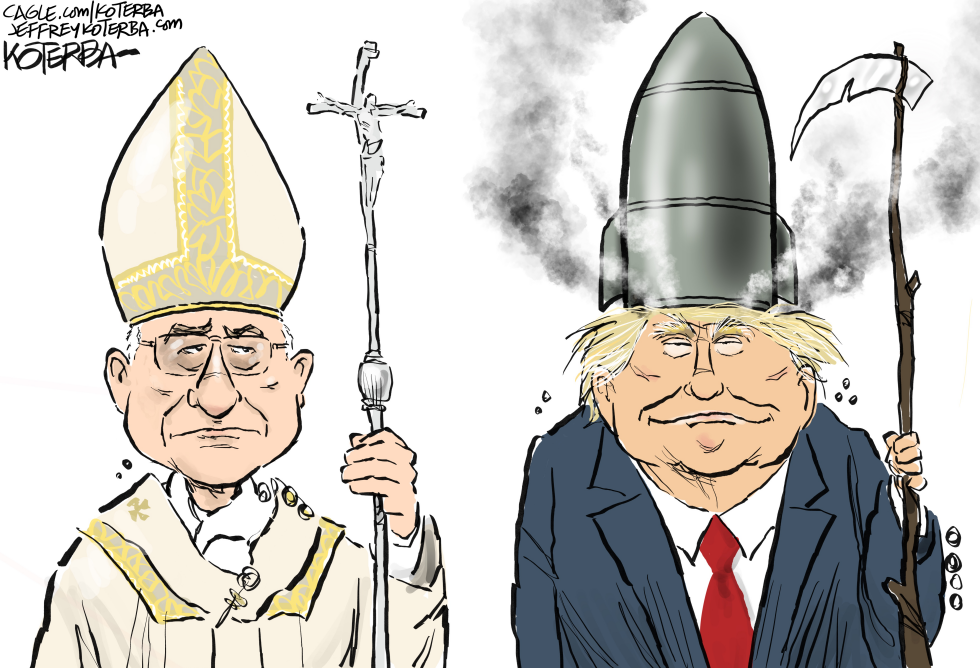
Jeff Koterba's cartoon captures Pope Leo in traditional mitre and Catholic robes, gripping a staff topped with a crucifix and cross featuring Jesus, set against a backdrop of war themes. On the right, a caricature of the president sports a bomb-shaped hat emitting smoke, paired with a grim reaper scythe, evoking missile imagery and Vatican contrasts. The piece blends humor with commentary on leadership, where religious symbols meet destructive elements. Tags such as war, bomb, missile, Catholic, crucifix, and Vatican underscore the satirical edge, pointing to tensions between spiritual authority and political power plays. This 2026-dated work maintains Koterba's style, direct and unflinching, poking at the absurdities of global figures.
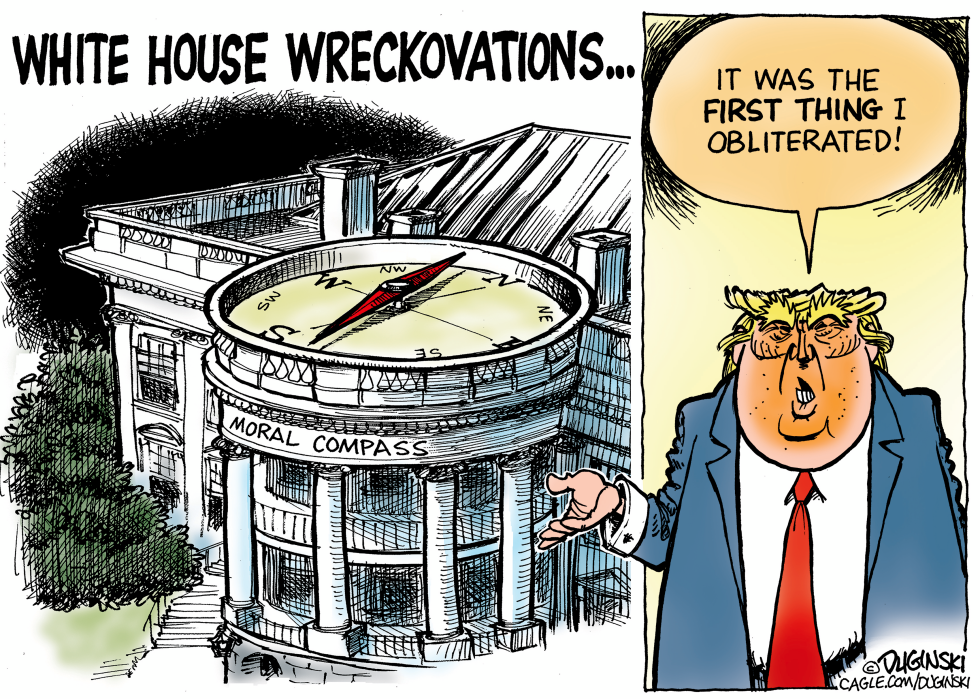
Paul Duginski's cartoon shows a caricatured Trump gesturing proudly while speaking about obliterating the moral compass, a large dome-like structure labeled 'Moral Compass' with directional arrows, placed on the White House roof. The title 'White House Wreckovations' plays on renovations, suggesting destructive changes. Tags including president, MAGA, White House, demolition, morality, ethics, obliteration, Republicans, and Iran war frame the image as a critique of ethical standards in politics. The scene captures a dark night setting with part of the building and trees visible, emphasizing the theme of moral destruction in Washington.
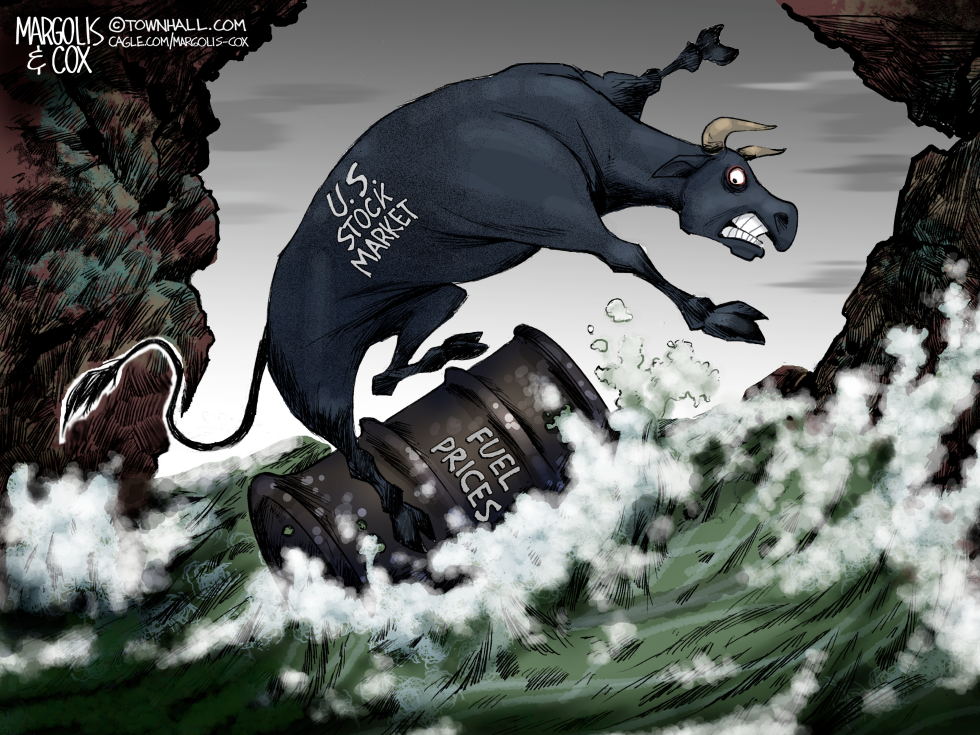
The cartoon shows a fierce black bull, emblazoned with 'U.S. Stock Market,' plummeting off jagged cliffs into a turbulent green sea where an oil barrel labeled 'Fuel Prices' tips over amid white foam. This visual packs a punch on how rising fuel prices can drag down the bull market, touching on economy, stocks, oil, prices, portfolio, and market tags. It's a classic setup: the bull charges ahead but hits the wall of energy costs, splashing into chaos. Editors see these often, where financial optimism meets harsh commodity realities, making it relatable for readers watching their investments swirl in the currents.
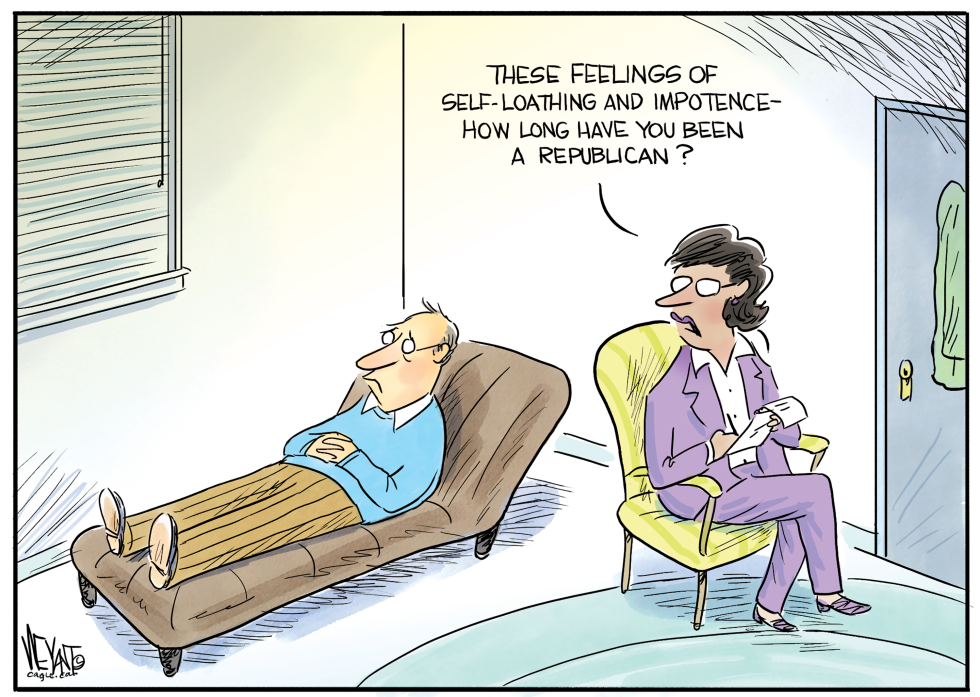
Christopher Weyant's political cartoon shows a therapy room with blinds, a door, and a coat hanger. A balding man in glasses, blue shirt, and brown pants reclines on a brown couch, arms crossed, looking distressed. A woman with dark hair, glasses, purple suit, sits on a yellow chair holding notes, speaking the punchline linking self-loathing and impotence to Republican tenure. The scene captures satirical commentary on political identity, with dry humor evident in the exaggerated expressions and simple setting. Tagged as republican party satire, therapy humor, political cartoon, self-loathing joke, impotence metaphor, and party affiliation critique, it highlights insider views on partisan struggles.
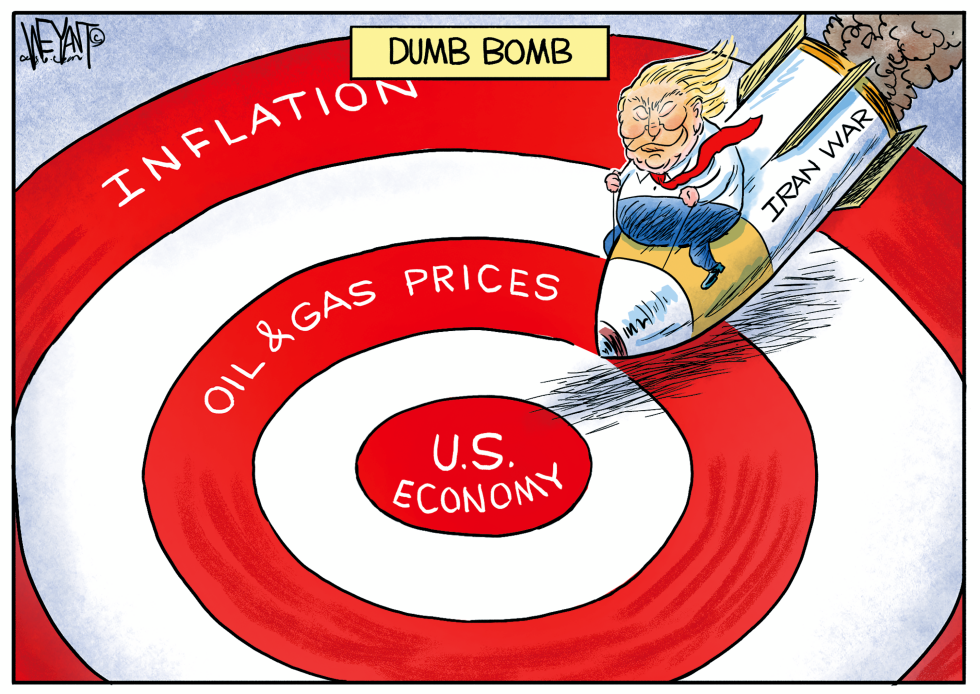
Christopher Weyant's cartoon shows a Donald Trump caricature astride a 'Dumb Bomb' labeled 'Iran War,' plummeting toward a red-and-white bullseye. The target's rings are inscribed with 'Inflation,' 'Oil & Gas Prices,' and at the center, 'U.S. Economy.' This setup highlights concerns over foreign policy decisions affecting domestic finances. The dry humor underscores the risks of impulsive actions in international affairs, with Trump's windswept hair and determined expression adding to the satirical edge. Tags like political cartoon, Trump Iran war, US economy satire, inflation oil prices, dumb bomb cartoon, and Christopher Weyant emphasize the image's relevance to current events.