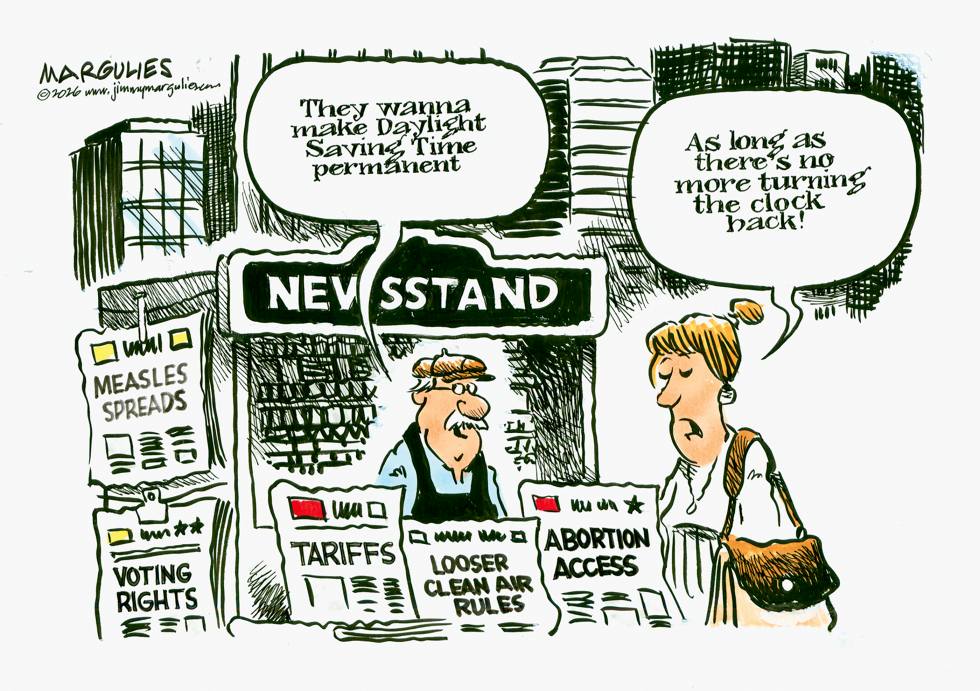
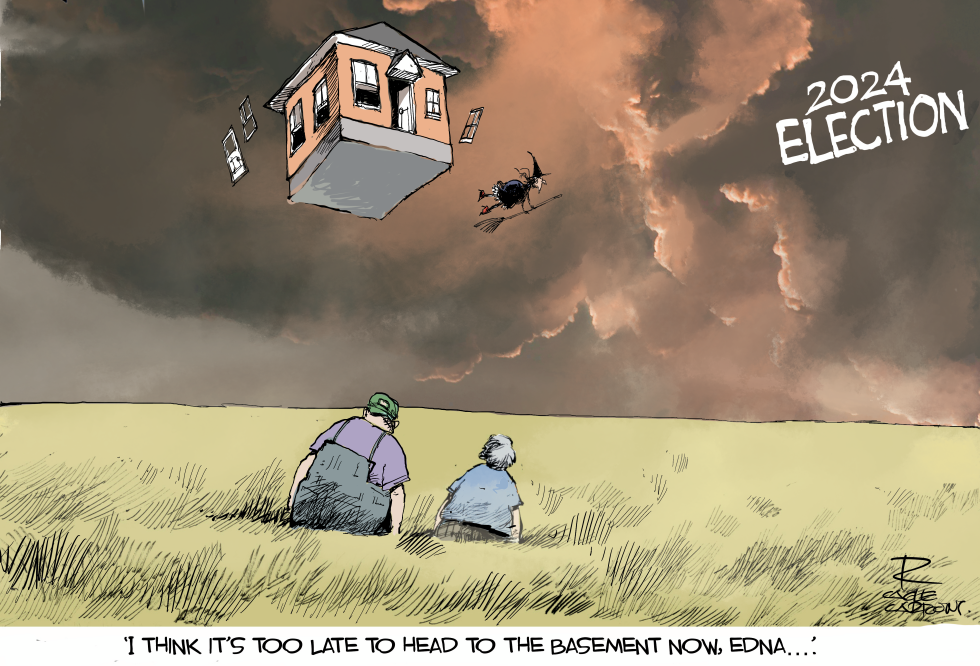
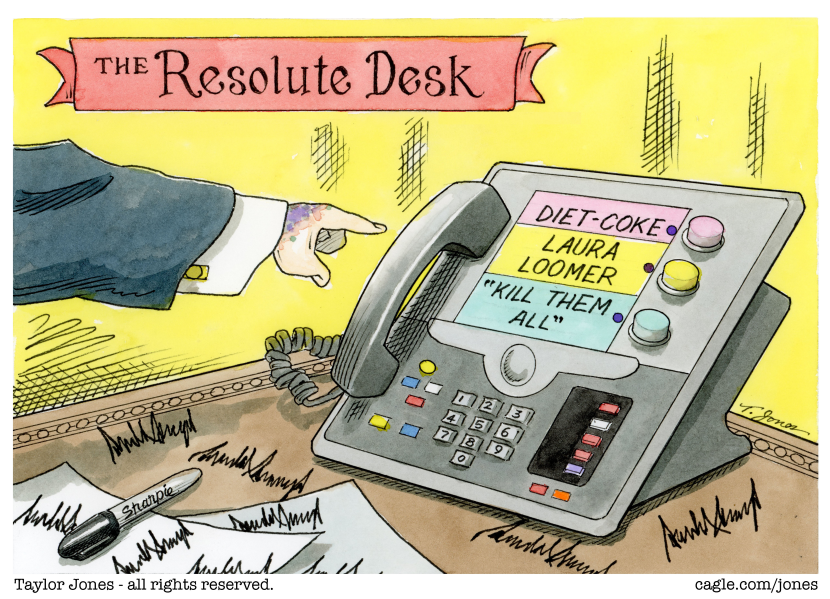
Proposals to make daylight saving time permanent coincide with debates over tariffs, abortion access, voting rights and environmental rules. The cartoon frames these as part of a broader pattern of policy shifts that some view as steps backward.
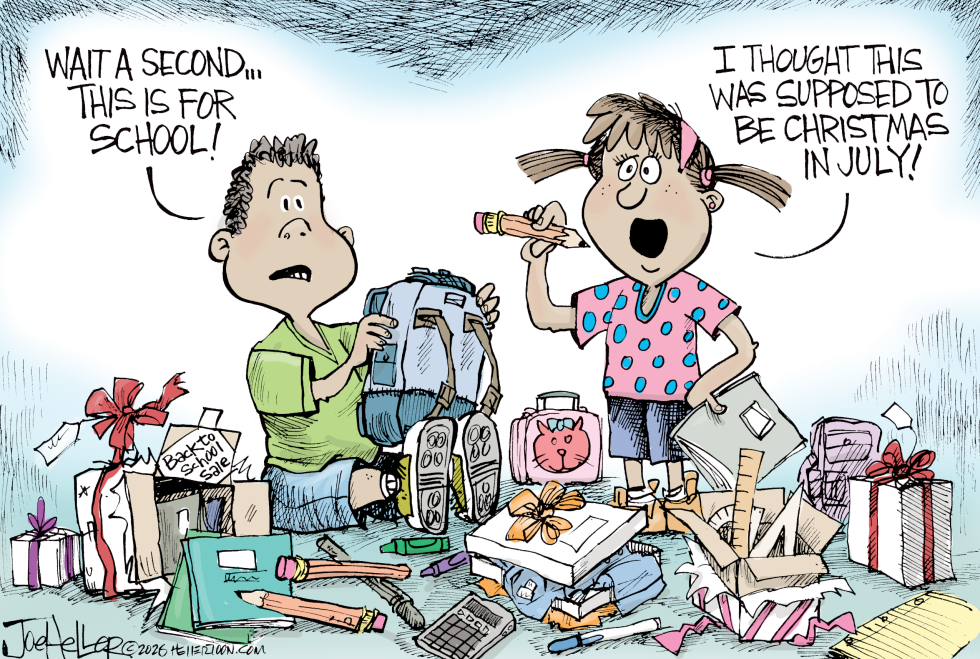
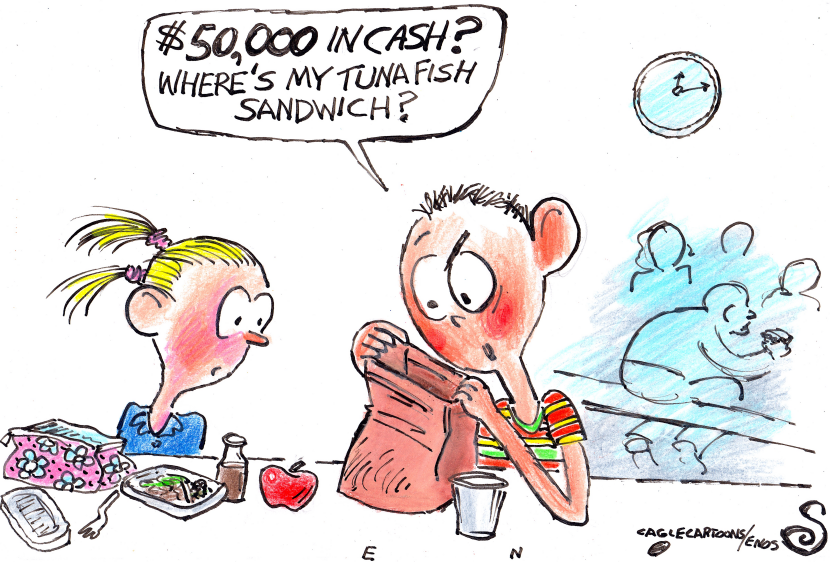
Retailers launched back-to-school promotions in late July, prompting families to stock up on supplies weeks ahead of the academic calendar. The timing overlaps with summer clearance events that mimic holiday marketing tactics. Parents and students face added pressure to buy early amid rising costs for essentials. The piece highlights how commercial calendars compress traditional shopping seasons and shift family routines.
Arend van Dam's cartoon shows a gray battleship marked USA, complete with guns and missiles, driven by a figure in a suit at the wheel, as it goes over a waterfall between rocky cliffs under a blue sky. The image captures the essence of strategy failure in the Strait of Hormuz, tying into themes of Iran, ayatollahs, war, battleship mishaps, Middle East conflicts, oil, gas, energy, and economy. Such visuals often poke at misguided military moves, where the ship's plunge represents a dramatic downfall in strategic planning. The dry humor lies in the absurdity of a warship treating a strait like a river rapid, underscoring potential economic fallout from regional tensions. Cartoons like this thrive on clear, exaggerated metaphors that resonate with readers familiar with global news.
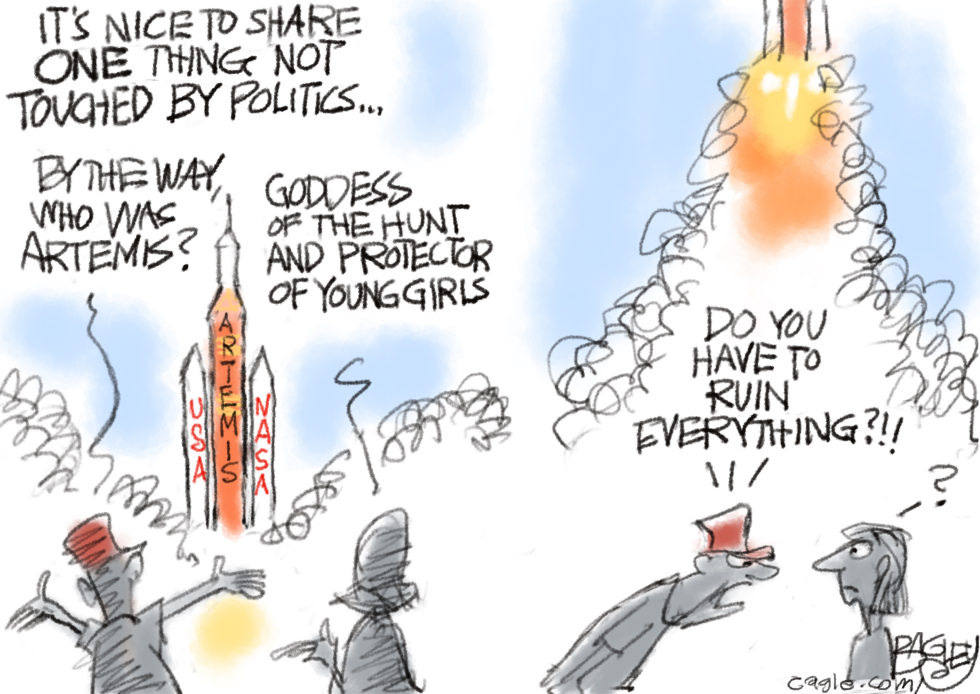
This political cartoon features a launching rocket labeled Artemis, SLS, NASA, and USA, with overlaid text praising one thing untouched by politics before asking about the goddess Artemis, described as goddess of the hunt and protector of young girls. A figure exclaims frustration at ruining everything, satirizing how even space missions get dragged into cultural debates. The irreverent sketch uses humorous figures with red hats to poke at over-politicization in science, blending mythology with modern rocketry in a witty critique. Tags like Artemis rocket launch political cartoon, NASA SLS Artemis mission satire, and politics invading science editorial cartoon underscore the cartoon's sharp insight into societal divisions spilling into apolitical realms like space exploration politicized cartoon.
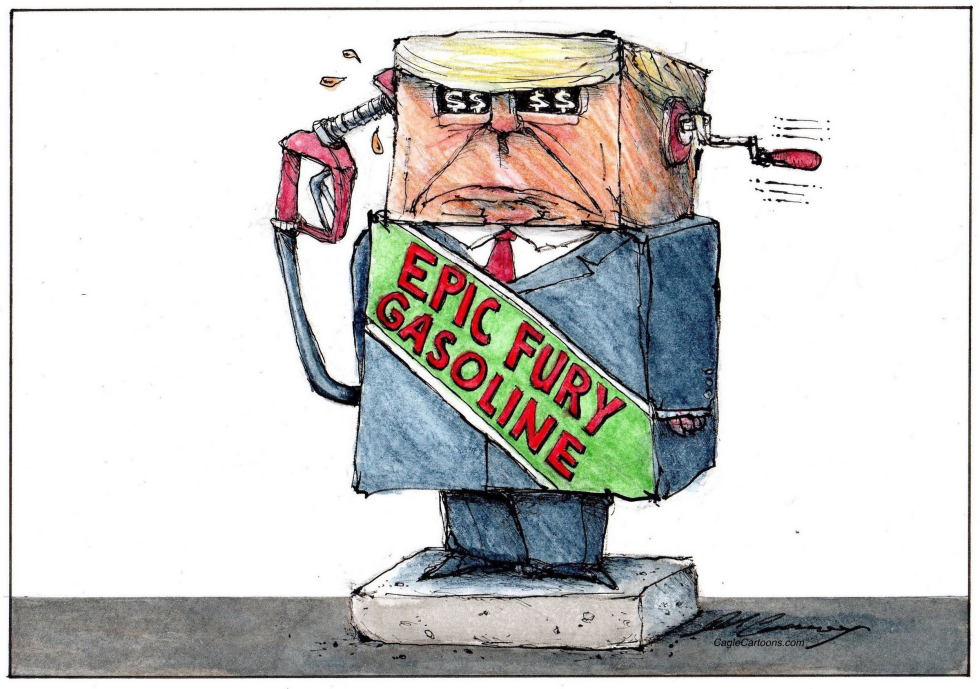
Dale Cummings draws Trump as a boxy gas pump, head topped with a dripping nozzle and $5.55 price tag, frowning in a suit with a green sash screaming Epic Gasoline Fury. Standing on a pedestal, the figure captures the essence of high gas prices tied to War in Iran and Operation Epic Fury. The cartoon skewers oil prices and Strait of Hormuz affordability, blending humor with commentary on economic fallout. It's a straightforward jab at political decisions driving up costs at the pump, rendered in watercolor style for punchy effect. Tags like War in Iran, Operation Epic Fury, oil prices, gas prices, Strait of Hormuz affordability, and affordability underscore the timely critique.
Bruce Plante's cartoon depicts a typical American driver at a gas station, his purple car parked under the canopy, as he reacts with censored profanity to a coin-operated viewer. The sign reads 'TO SEE GAS PRICES DEPOSIT 25¢,' cleverly satirizing how #HighGasPrices have soared beyond easy visibility, like distant sights needing magnification. The man's USA shirt and coffee cup add a relatable everyman touch, emphasizing consumer shock. This piece fits into ongoing #FuelCosts debates, blending #InflationHumor with #EconomicSatire. Plante's style, straightforward and punchy, targets #EnergyPrices and their impact on daily life, making it shareable for #PoliticalCartoons enthusiasts. The dry humor underscores the absurdity without overstatement, a hallmark of syndicated work.
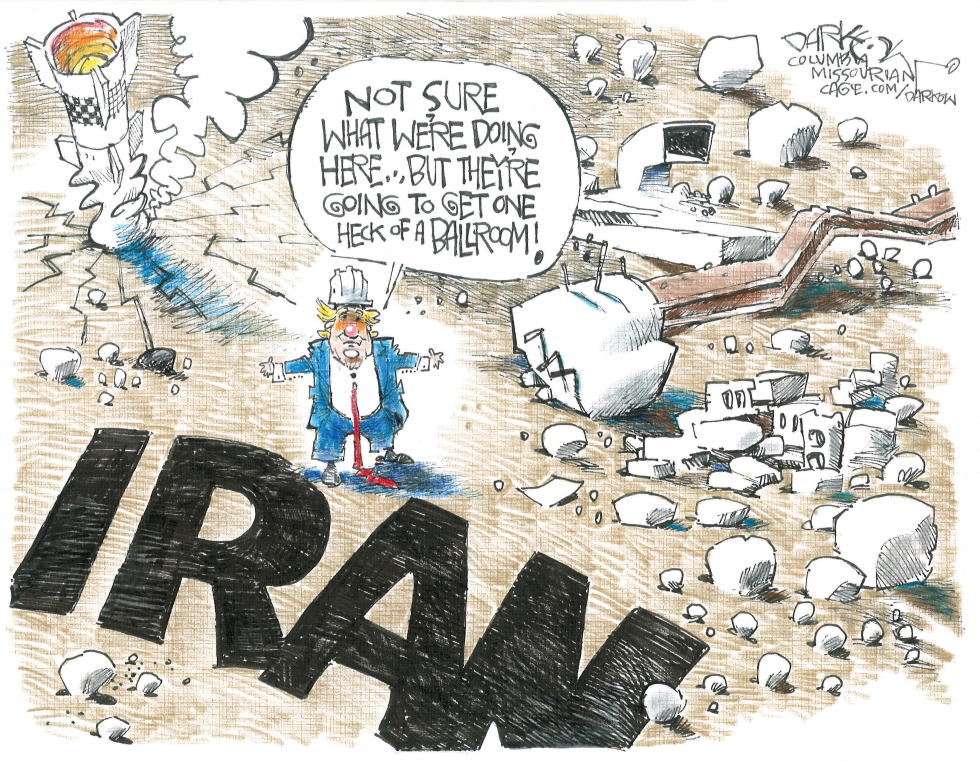
This biting political cartoon features a caricatured Donald Trump in a construction hard hat, overlooking a bombed-out landscape labeled 'IRAN,' with a missile launching in the background. His speech bubble confesses confusion over US actions but promises 'one heck of a ballroom,' a sly pun on Trump's real estate empire clashing with foreign policy blunders. Incorporating tags like political satire, Trump caricature, Iran nuclear program, US-Iran relations, geopolitical humor, and Trump hotel pun, the image mocks the haphazard withdrawal from the nuclear deal, suggesting it paves the way for Iran's nuclear ambitions while Trump envisions luxury redevelopment. The ruined buildings and debris emphasize the destructive fallout, blending humor with insightful critique on Middle East instability.
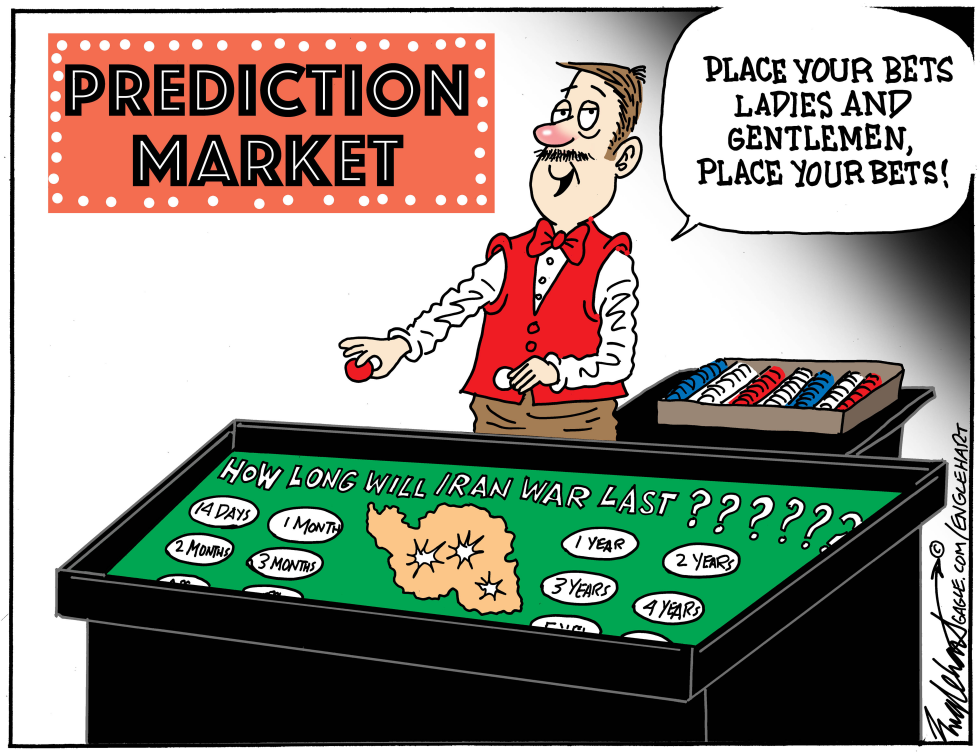
In a biting political cartoon, a smirking croupier oversees a prediction market table shaped like Iran, complete with explosion graphics, where punters can wager on war duration options ranging from 14 days to 5 years. This satirical take skewers the commodification of geopolitical betting, turning grave matters like Iran war into casino-style gambles. By blending elements of gambling on war with Middle East conflict, the artwork highlights the absurdity of prediction markets applied to real-world crises, offering humorous yet insightful commentary on how society speculates on political humor and potential catastrophes. The irreverent style underscores the folly of treating war length wager as just another market fluctuation.
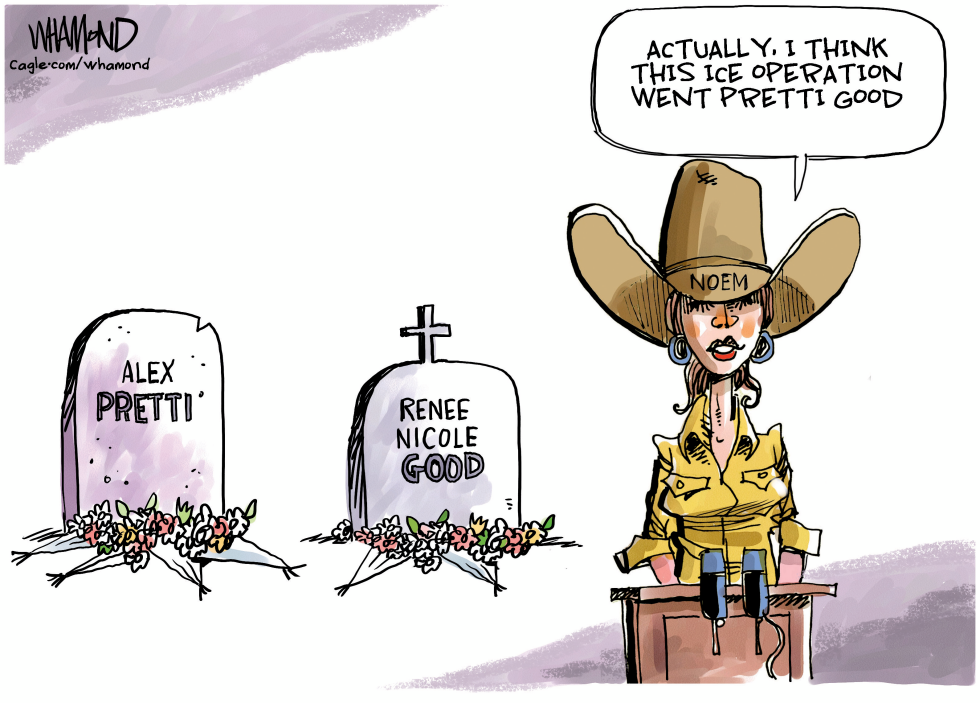
This political cartoon by Whamond features South Dakota Governor Kristi Noem, a prominent Republican and potential Trump ally, wearing a cowboy hat labeled 'NOEM' and speaking at a podium. She declares, 'Actually, I think this ICE operation went pretty good,' while standing beside two gravestones inscribed with 'Alex Pretti' and 'Renee Nicole Good,' adorned with flowers. The image satirizes immigration enforcement, border policy, and the human cost of deportation, highlighting perceived political callousness toward migrant deaths. Through humor and irony, it critiques how politicians like Noem might downplay tragedies in ICE operations, making it a sharp editorial cartoon on current Republican stances.
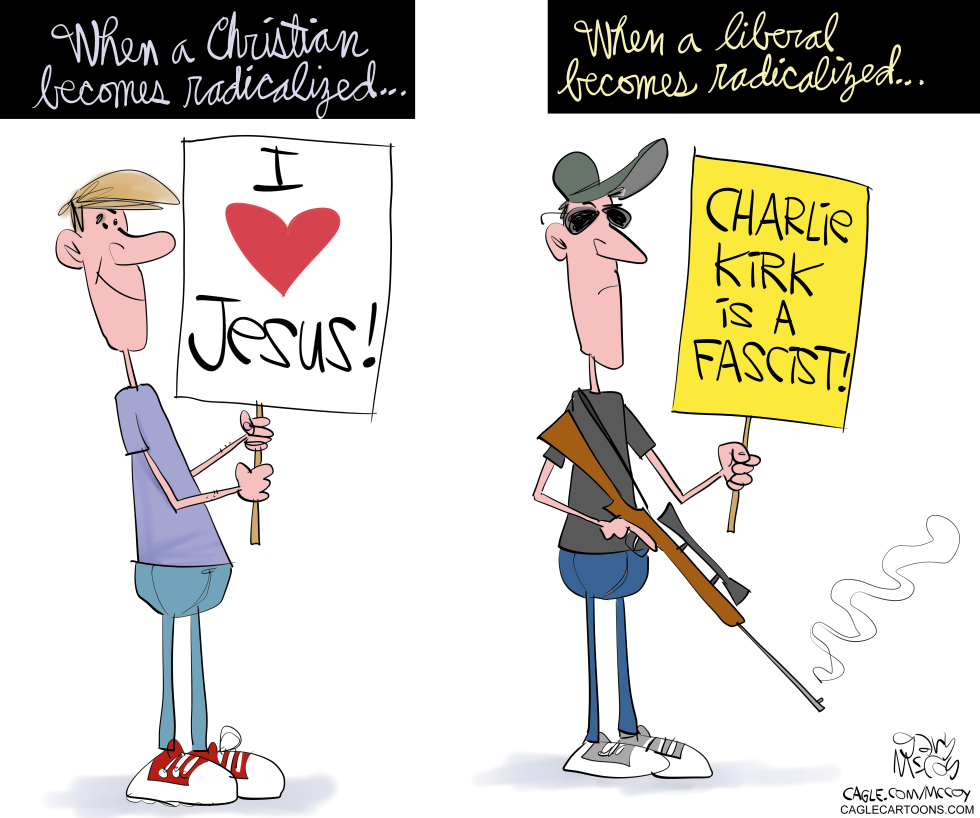
Gary McCoy's cartoon from 2025 divides the frame into two scenarios on radicalization. On the left, a figure in a cap holds a sign declaring 'I ♥ Jesus!' under the label 'When a Christian becomes radicalized...'. The right side shows a sunglasses-wearing man with a rifle emitting smoke, gripping a yellow sign that reads 'CHARLIE KIRK IS A FASCIST!' labeled 'When a liberal becomes radicalized.'. Tags like MAGA, Jesus, radicalized, Christian, liberal, Charlie Kirk, gun control, mental health, religion, Donald Trump, social media, and science frame the visual commentary. The piece highlights perceived disparities in how extremism manifests across ideological lines, with the Christian side shown as affectionate and the liberal as potentially violent.
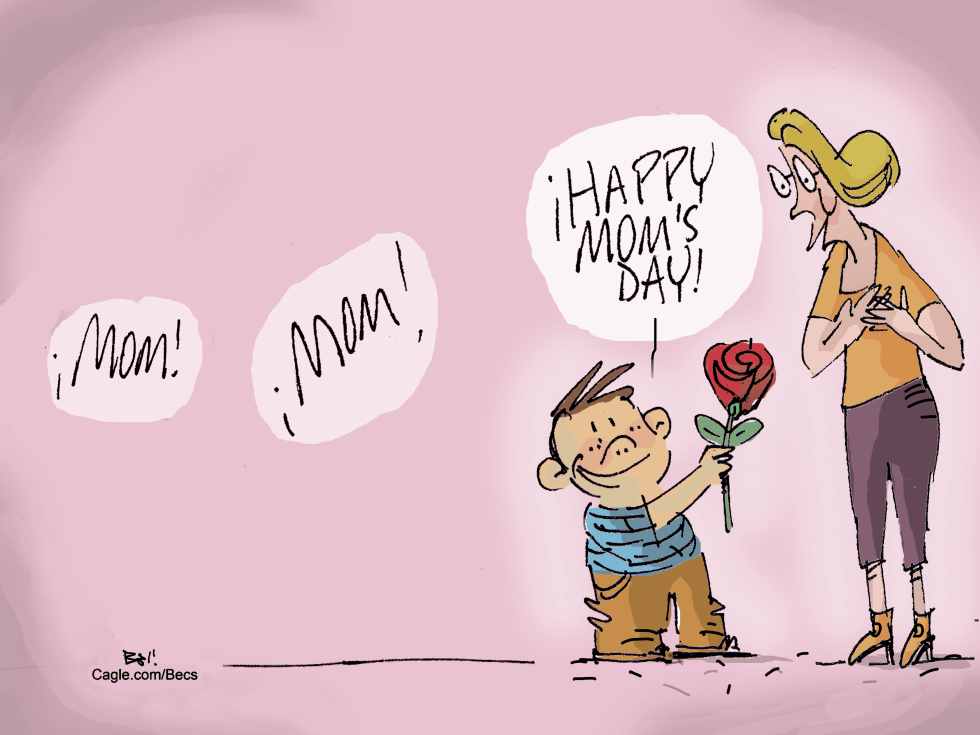
Cartoons like this mother's day illustration capture everyday humor with a tech twist. Here, a young boy extends a single red rose to a blonde woman in glasses, her hand to her chest in surprise. Speech bubbles blend Apple's 'i' prefix into classic greetings: 'iMom!', 'Mom!', and 'iHAPPY MOM'S DAY!'. It's a light satire on how digital branding seeps into personal moments. The pink backdrop keeps it warm and approachable, signed by Becs via Cagle.com. Such pieces remind us how tech parody fits into holiday cartoons, poking fun at modern family dynamics without overcomplicating the scene.
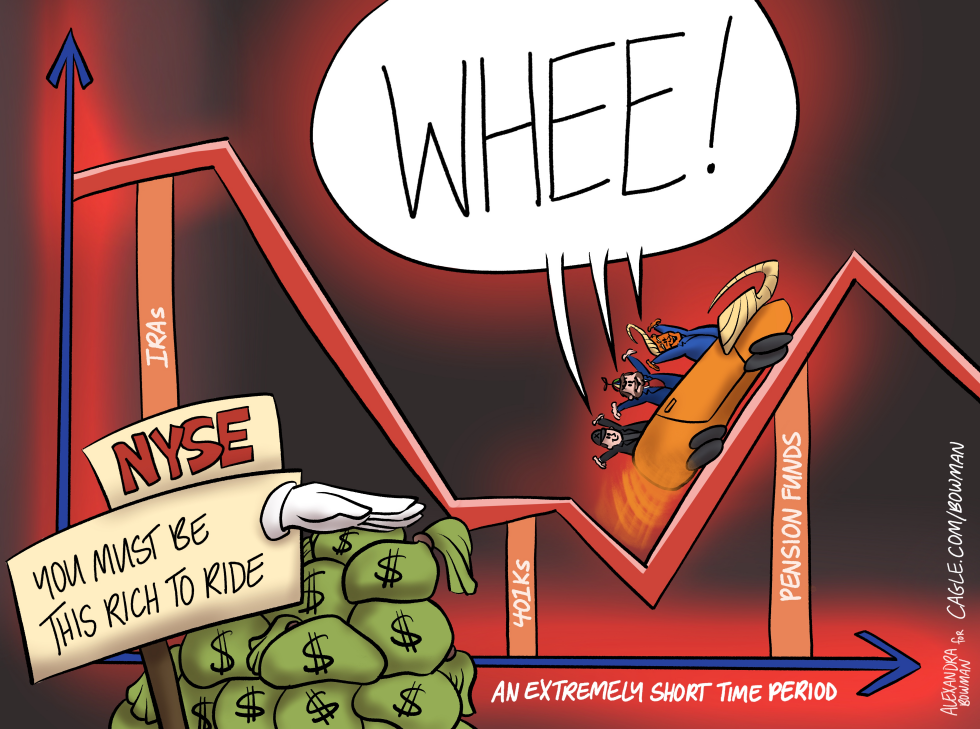
Alexandra Bowman's cartoon captures the stock market turmoil under Trump policies, showing caricatures of Trump, Elon Musk, and JD Vance gleefully riding a rocket down a crashing graph line marked with IRAs, stocks, 401ks, and pension funds. The NYSE sign declares 'You Must Be This Rich to Ride,' piled with money bags, satirizing how tariffs and Republican strategies favor the wealthy while everyday investments and retirement savings take a dive over an extremely short time period. The 'WHEEE!' shout adds dry humor to the volatile Wall Street scene, poking at MAGA's high-risk economic ride.
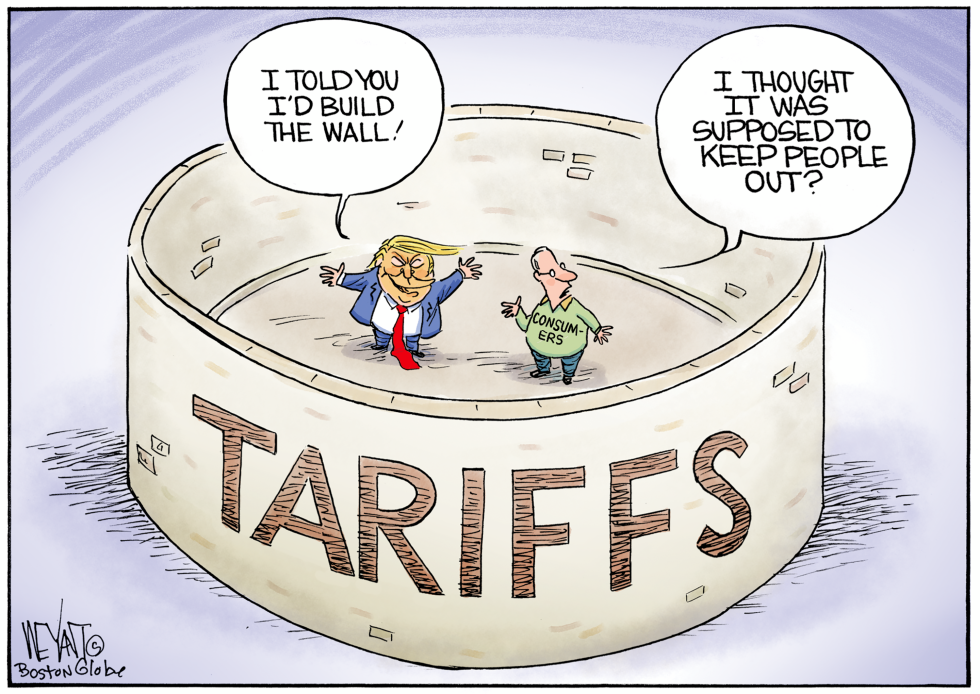
The cartoon shows Trump inside a circular wall labeled 'TARIFFS,' declaring he built the wall, with a figure marked 'CONSUMERS' puzzled that it's supposed to keep people out. Tags like trump, tariffs, threats, Mexico, Canada, China, trade, wall, prisoner, consumers underscore the irony. The image critiques how tariffs meant to protect against foreign threats from Mexico, Canada, and China end up trapping domestic consumers like prisoners. This visual metaphor draws on Trump's famous wall promise, flipping it to show trade policies harming those inside. The dry humor lies in the reversal, where the wall imprisons rather than excludes, commenting on economic fallout.
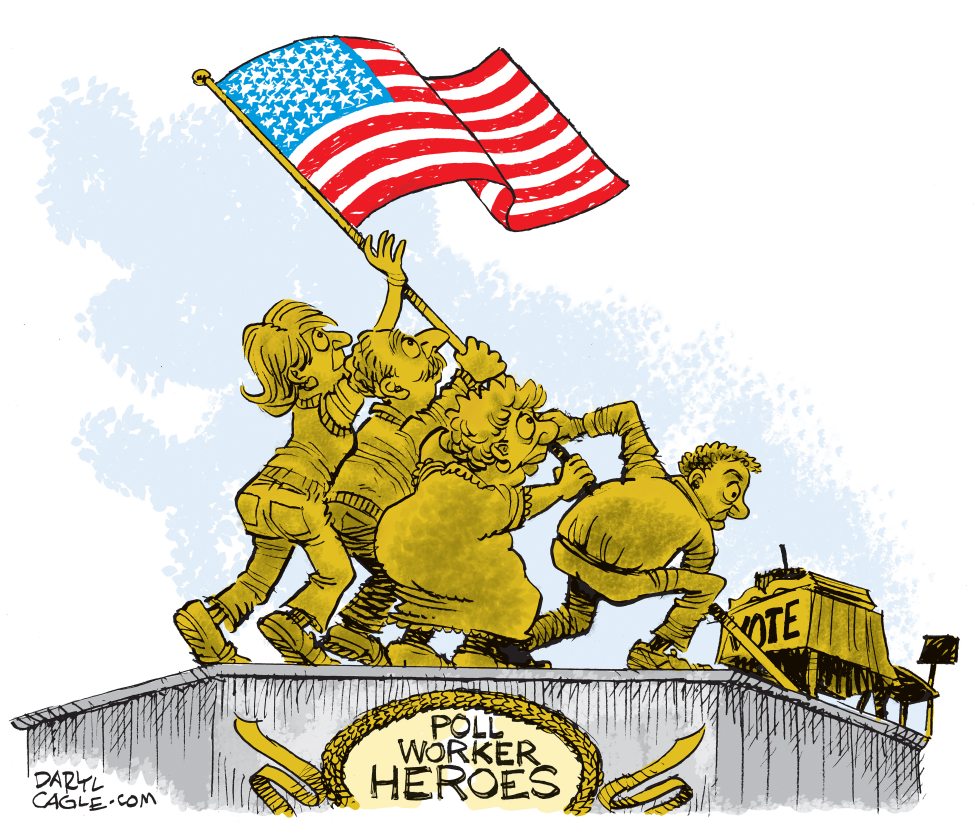
The cartoon shows a group of figures styled as a bronze statue, mimicking the famous Iwo Jima war memorial in Washington DC, where Marines raised the American flag during World War Two. Here, poll workers struggle to plant the flagpole into a box labeled 'VOTE,' with the base inscribed 'POLL WORKER HEROES.' This satire ties into the 2024 presidential election, featuring tags like campaign 2024, Donald Trump, Kamala Harris, voter fraud, and MAGA. It underscores the heroic efforts of election staff amid heated debates over fraud allegations, blending historical reverence with contemporary political tension in a straightforward, humorous visual commentary on democracy's frontline defenders.