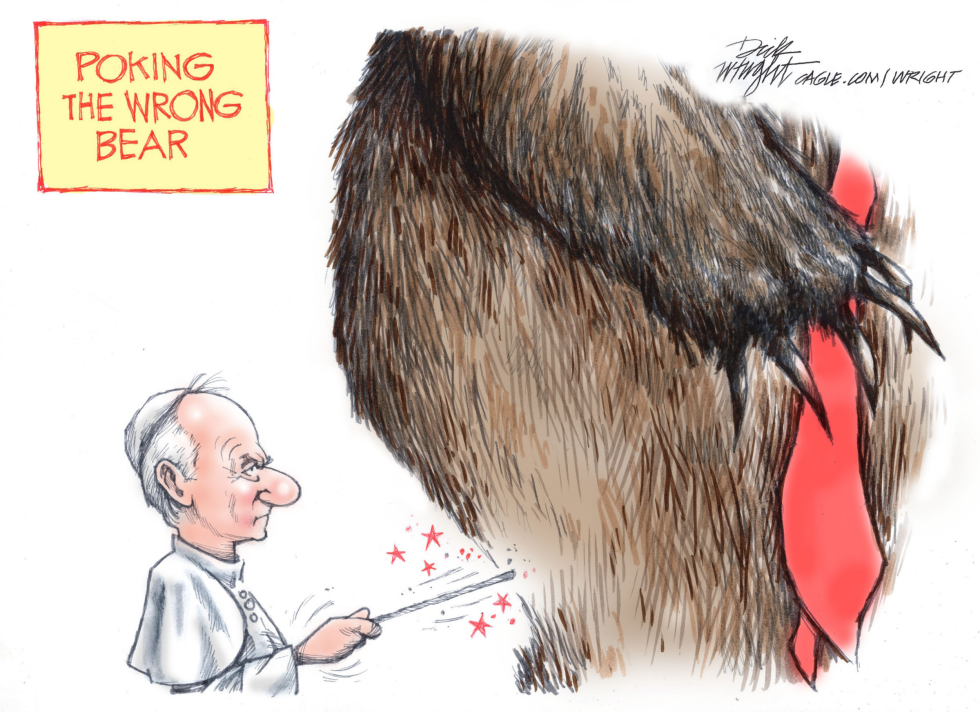
Dick Wright's political cartoon depicts a Pope-like figure in white attire, extending a thin rod toward the rear of a massive brown bear, complete with a dangling red tie and sparkling effects at the point of contact. The yellow label reads 'POKING THE WRONG BEAR,' playing on the idiom with a twist. This satirical illustration ties into the Trump-Pope feud, using the bear as a stand-in for power, the red tie evoking Trump's signature look, and the poking action suggesting provocation. Cartoonists often employ such animal metaphors for political commentary, and Wright's style here delivers clear lines and exaggerated features for impact. The image avoids overstatement, sticking to visible elements like the bear's claws and fur details, making it a straightforward jab at ongoing tensions.
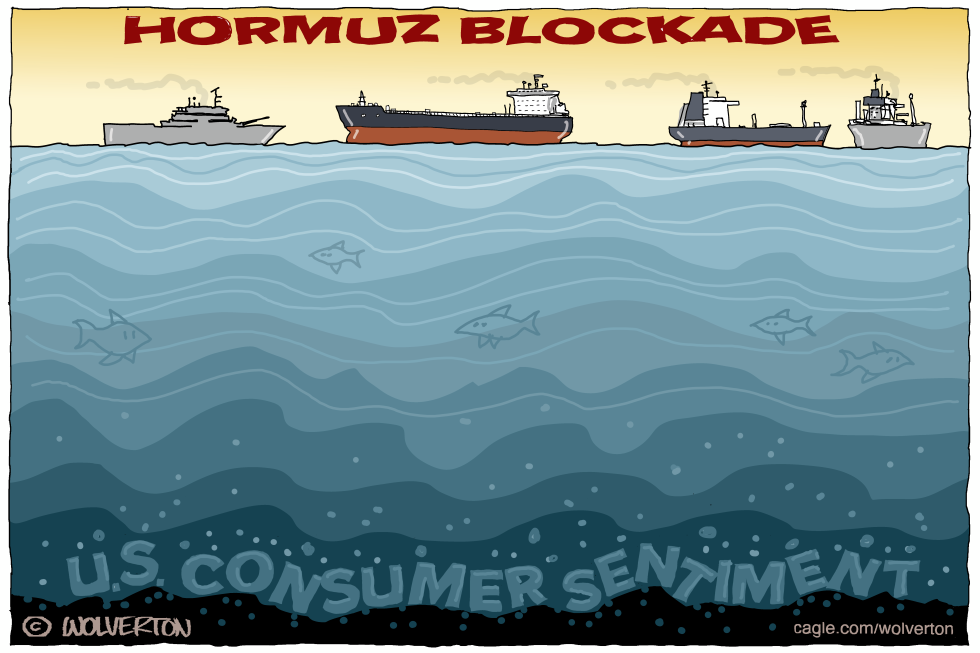
Monte Wolverton's cartoon captures the Hormuz Strait blockade with warships and tankers lined up on the water's surface, a clear nod to geopolitical strife in key oil passages. Below, the phrase U.S. consumer sentiment is etched into the ocean floor, surrounded by fish, driving home the idea of economic morale hitting rock bottom. This piece uses simple lines and color to highlight how international blockades can sink domestic confidence, tying into broader themes of global trade disruptions. The dry humor shines through in the visual pun, making it a standout in political satire circles. Tags like Hormuz Strait blockade political cartoon, US consumer sentiment sinking economy illustration, oil tanker ships naval blockade satire, Strait of Hormuz geopolitical tension comic, economic impact of Middle East conflict drawing, and consumer confidence underwater metaphor cartoon amplify its SEO reach.
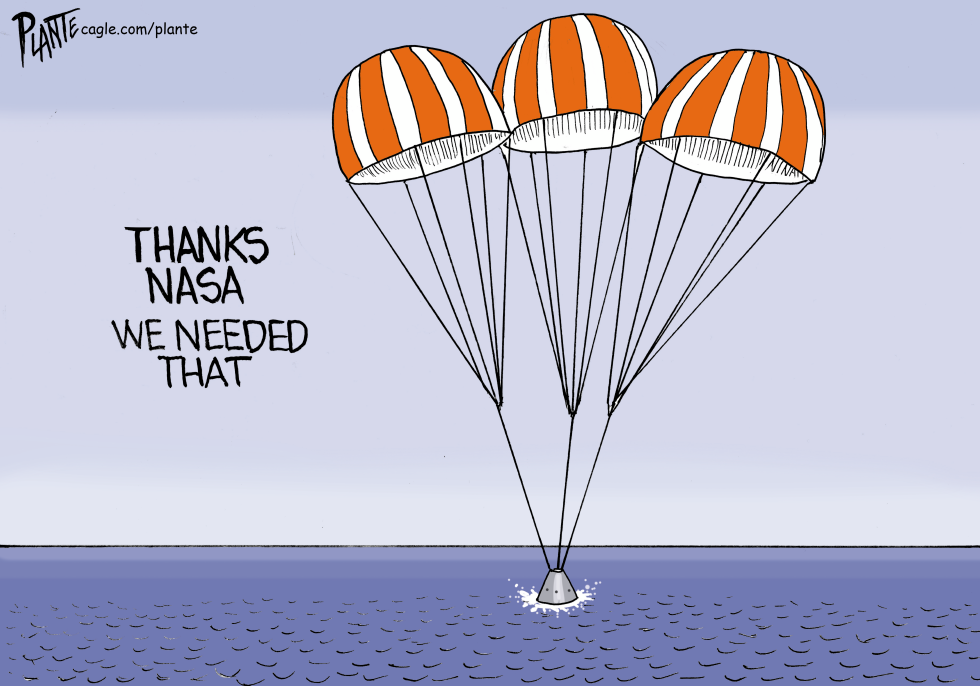
Bruce Plante\'s cartoon captures a space capsule\'s splashdown, complete with three orange and white striped parachutes guiding it to a blue ocean teeming with black fish-like forms. The prominent text \'Thanks NASA We Needed That\' adds a layer of sarcasm, typical in editorial illustrations commenting on high-profile events like the Artemis II mission. The simple composition, with a light blue sky and wavy ocean surface, emphasizes the moment of impact, shown by a small splash at the capsule\'s base. This piece fits into the tradition of political cartoons that highlight public sentiments toward government projects, using minimal elements for maximum impact. The artist\'s signature and website appear in the top left, grounding it in syndicated cartoon style.
John Darkow's cartoon captures the Artemis II crew gazing through their spacecraft window at the far side of the moon, where craters frame an unexpected sight: the Midvale School for the Gifted from Gary Larson's The Far Side, complete with a striped-shirted figure fumbling at a 'pull' door on stairs. Tagged with artemis ii, moon flyby, far side, gary larson, nasa, space, and science, the image blends real space exploration with absurd humor. One crew member exclaims excitement, labeled with Artemis II Crew and NASA markings. This satire highlights the blend of high-stakes missions and pop culture whimsy, poking fun at what astronauts might hope to find beyond the visible lunar surface. The dry wit underscores how science fiction tropes collide with actual programs like Artemis II.
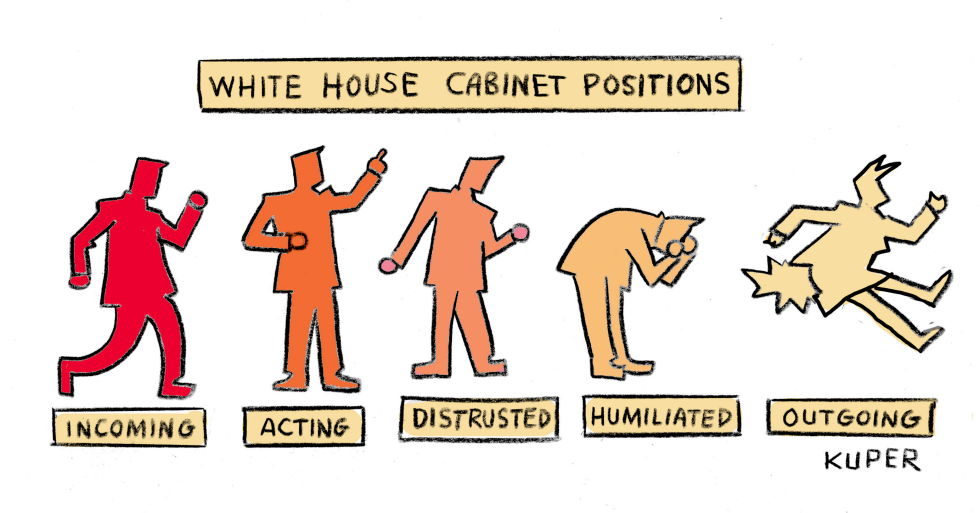
Peter Kuper nails the absurdity of Trump White House cabinet positions in this sharp cartoon. Five stylized figures march through stages: incoming in red, striding confidently; acting with a pointing gesture; distrusted standing still; humiliated bent over in shame; outgoing fleeing with a kick. Labels underscore the progression from promise to humiliation. Tags like cabinet turnover, political satire, administration instability, Trump firings, White House staff cycle, and executive distrust highlight the revolving door of appointments. It's a dry commentary on the chaos, where loyalty meets betrayal in quick succession. The simplicity amplifies the bite, making it perfect for syndication.
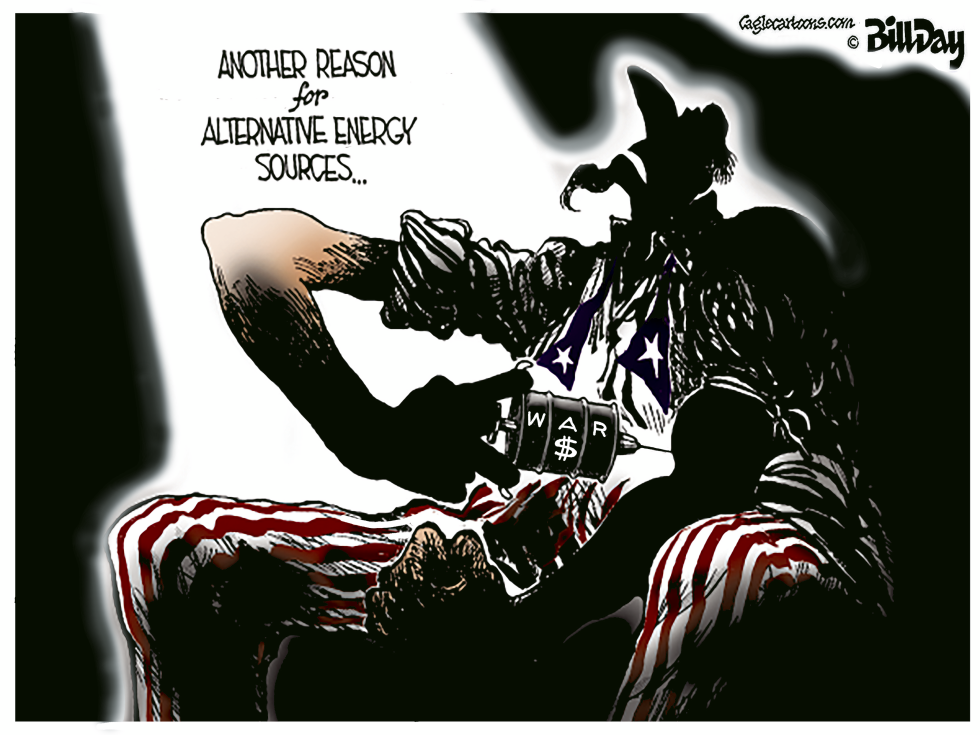
Bill Day's cartoon shows a figure in red-and-white stripes, resembling national colors, self-injecting a syringe marked 'WAR' and '$', with text pleading for alternative energy sources. The dark, shadowy style underscores the grim addiction to oil, tying into tags like war, oil prices, Gulf of Hormuz, global warming, climate change, and addiction. This visual metaphor pushes for wind energy and solar panels as escapes from the cycle of dependency that leads to conflict and environmental harm. The composition is stark, with the arm and syringe dominating, emphasizing the self-destructive habit amid calls for renewable shifts.
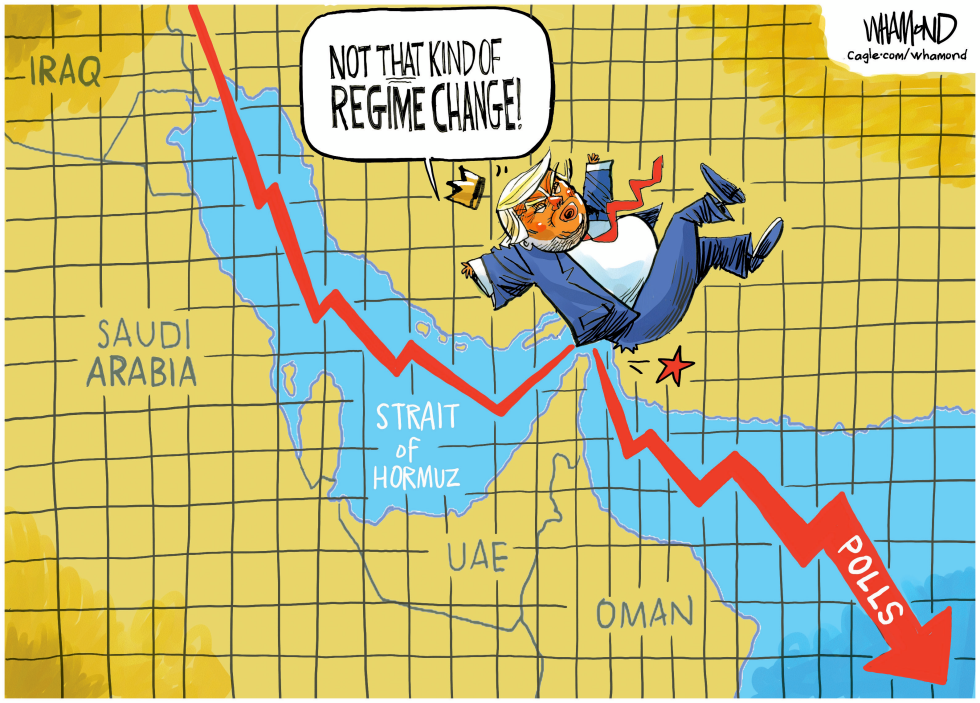
Dave Whamond's Trump regime change cartoon depicts the ex-president caricature plummeting down a jagged red line labeled 'POLLS' across a simplified map of the Persian Gulf region, including Strait of Hormuz, Iraq, Saudi Arabia, UAE, and Oman. The speech bubble exclaims 'Not that kind of REGIME CHANGE!' in a clear pun on foreign policy term versus political fortunes. This political satire captures the visual wordplay with Trump in suit and tie, mid-fall with a starburst impact, against a grid background. The dry humor lands on current events without overstatement, fitting newspaper syndication. Tags like regime change pun, Trump falling polls, Middle East map cartoon, satirical Trump caricature, polls decline illustration, and editorial cartoon Trump downfall emphasize the image's SEO potential.
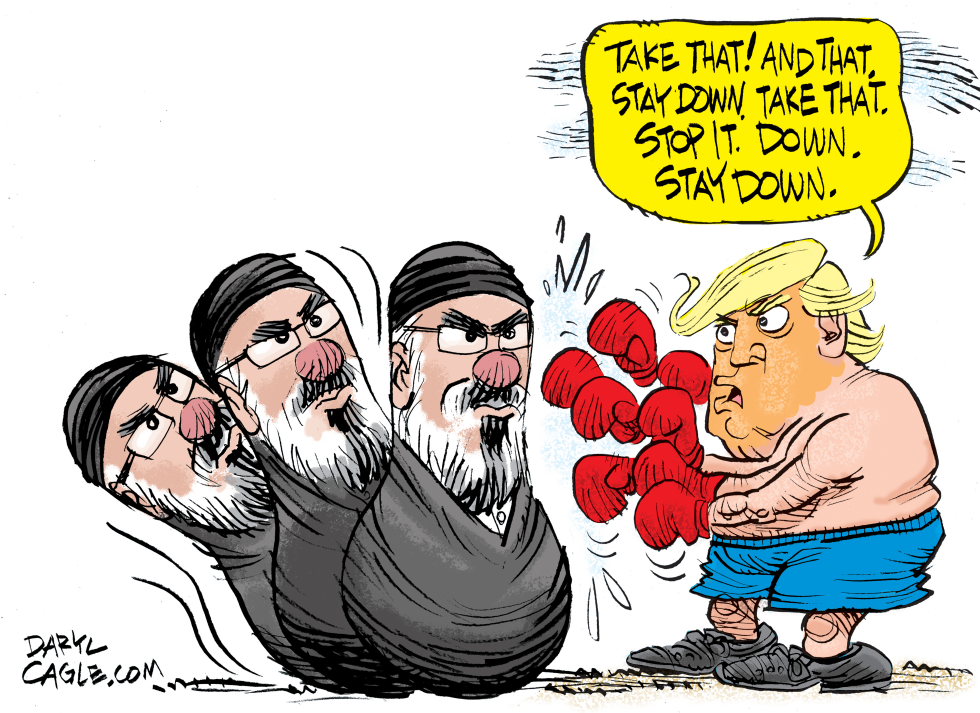
The cartoon shows Donald Trump, shirtless and wearing boxing gloves, repeatedly striking a large bop bag shaped like an Iranian cleric. Multiple faces of bearded men in turbans appear on the bag, which rebounds after each punch. A speech bubble captures Trump's frustrated commands for the figure to stay down. The image responds to reports of a new Iranian supreme leader and U.S. efforts against the regime in early 2026. It highlights the perceived futility of direct confrontations with Iran's leadership structure.
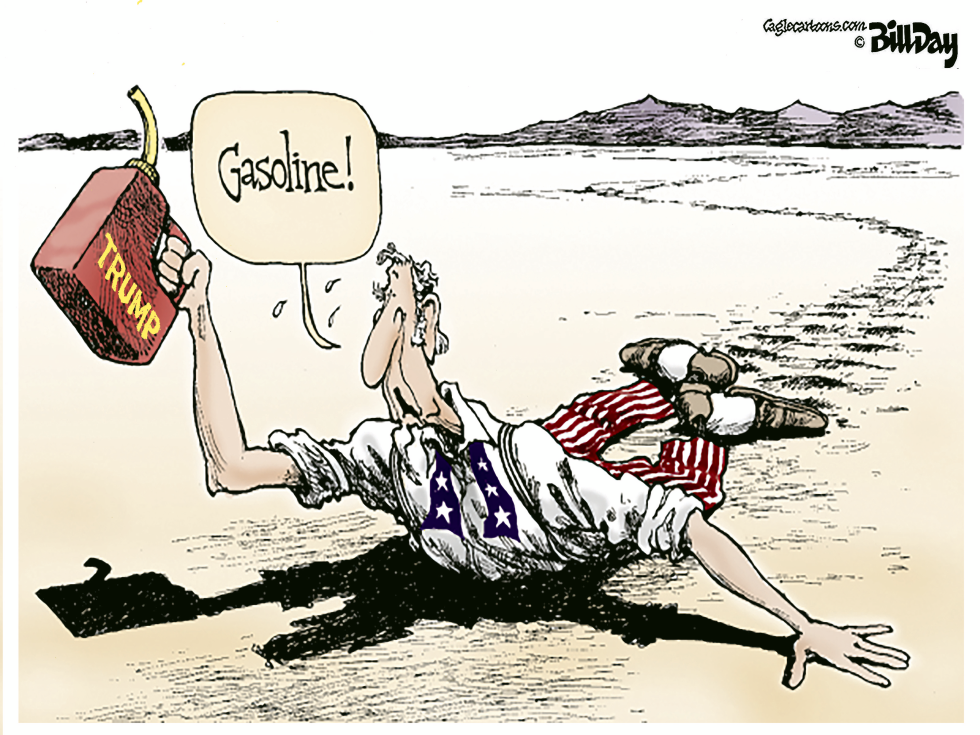
Bill Day's cartoon shows Uncle Sam in American flag attire, crawling through a sandy desert with distant mountains, his trail marking exhaustion. He grips a red gas can labeled Trump, spout dripping, and yells 'Gasoline!' in a speech bubble. The scene captures desperation for fuel, tying into political satire on energy policies. Tags like political cartoon Trump gasoline, Uncle Sam crawling desert Trump gas can, satirical cartoon high gas prices Trump, Bill Day political cartoon 2026, American flag outfit man needing gasoline, and desert survival political satire Trump underscore the visual punch.
Bruce Plante's cartoon depicts a typical American driver at a gas station, his purple car parked under the canopy, as he reacts with censored profanity to a coin-operated viewer. The sign reads 'TO SEE GAS PRICES DEPOSIT 25¢,' cleverly satirizing how #HighGasPrices have soared beyond easy visibility, like distant sights needing magnification. The man's USA shirt and coffee cup add a relatable everyman touch, emphasizing consumer shock. This piece fits into ongoing #FuelCosts debates, blending #InflationHumor with #EconomicSatire. Plante's style, straightforward and punchy, targets #EnergyPrices and their impact on daily life, making it shareable for #PoliticalCartoons enthusiasts. The dry humor underscores the absurdity without overstatement, a hallmark of syndicated work.
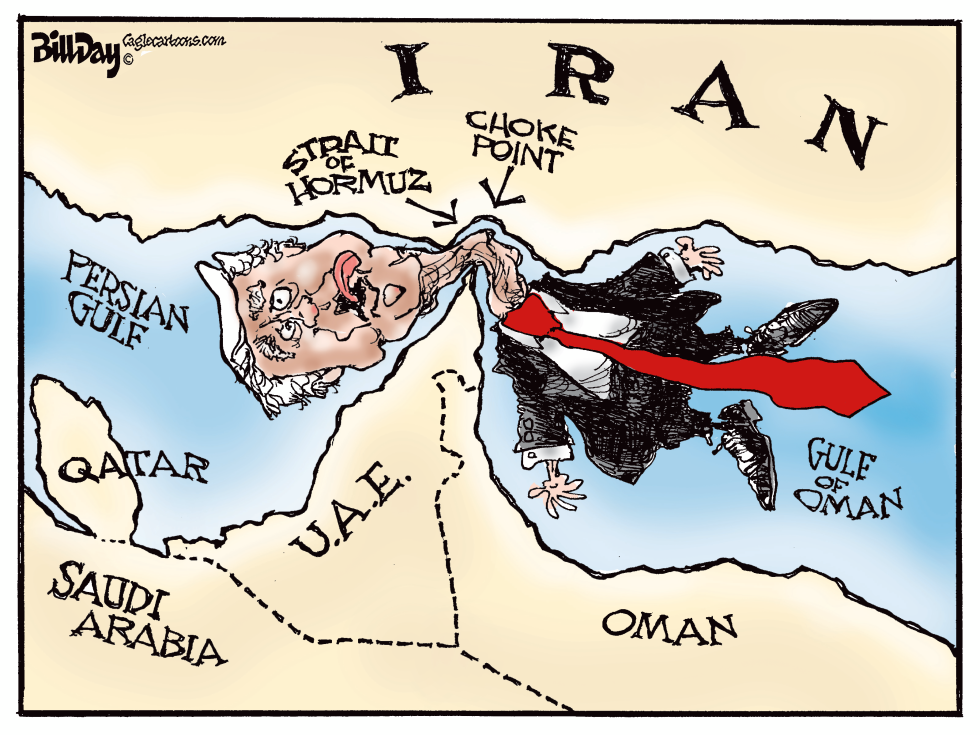
Dive into this Bill Day creation where the map of Iran morphs into a menacing hand at the Strait of Hormuz choke point, gripping a flailing figure in a suit and red tie, symbolizing tension in the Persian Gulf. Surrounding nations like Saudi Arabia, UAE, Qatar, Oman, and the Gulf of Oman frame the scene, highlighting the strategic choke point. This political cartoon Iran Strait of Hormuz captures the essence of Middle East satire, with Iran's form literally choking the strait, a nod to real-world frictions without delving into unshown depths. The irreverent style pokes fun at power plays, making the geopolitical humor both insightful and shareable in editorial circles.
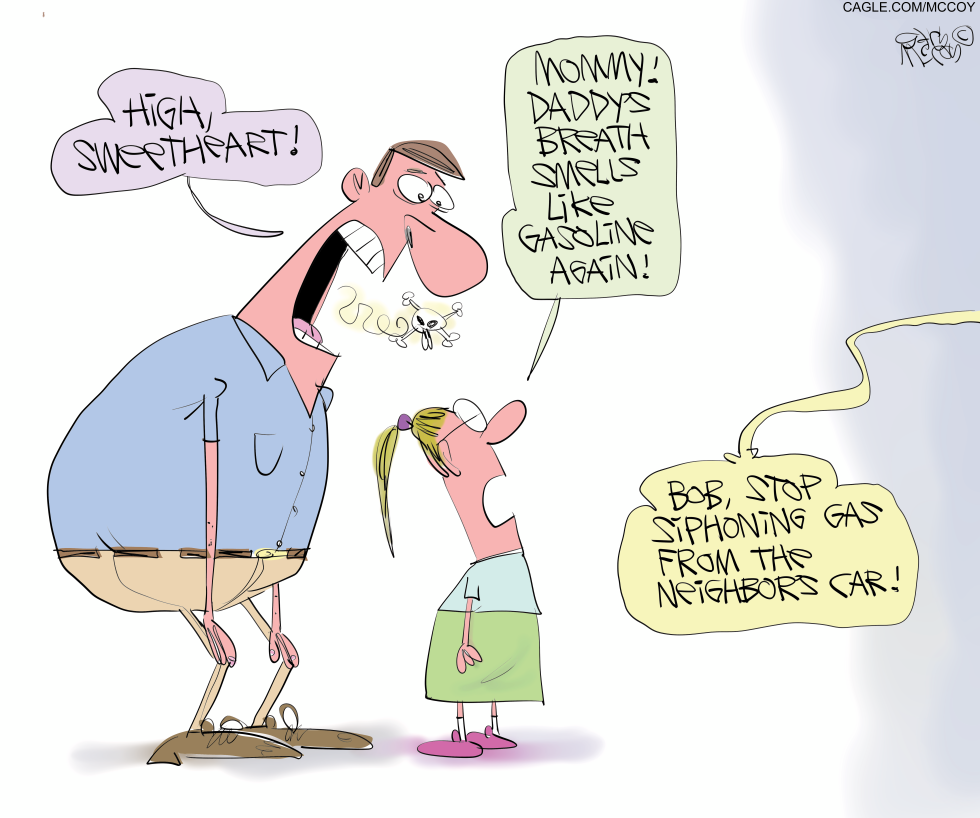
Gary McCoy nails the absurdity of high gas prices in this political cartoon where a dad's breath smells like gasoline after siphoning from the neighbor's car. The daughter's complaint to mommy and the wife's scolding of Bob bring dry humor to economic hardship. Satire on fuel costs and inflation hits home, showing family reactions to desperate measures. Theft due to rising expenses gets a witty twist, making the cartoon sharable amid 2026 gas crisis talks. Cartoonists like McCoy keep it real with straightforward jabs at everyday struggles.
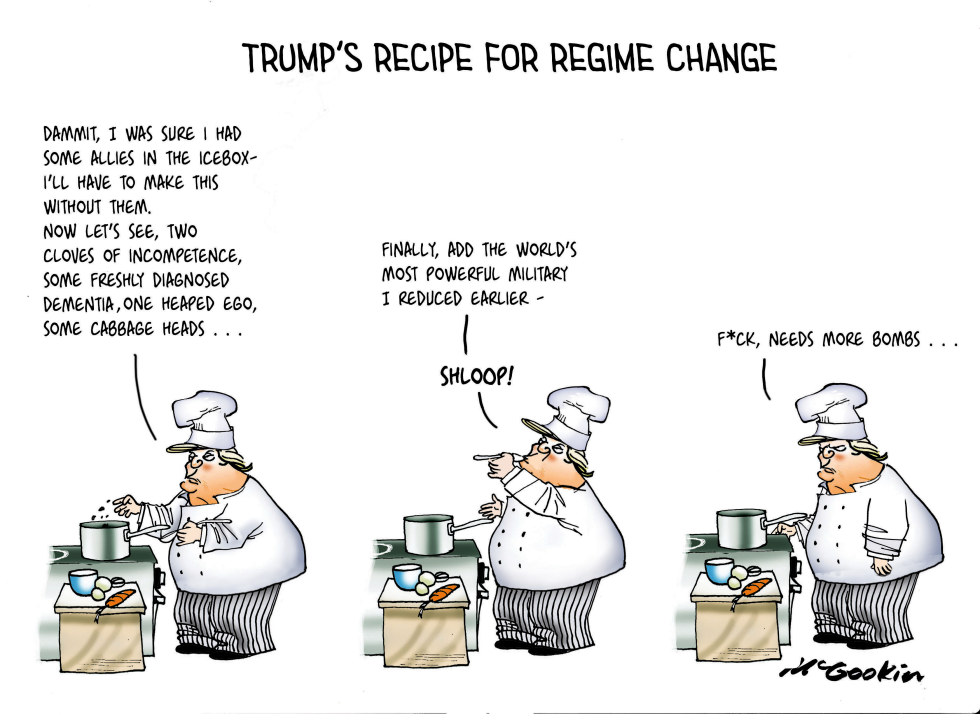
The image shows Donald Trump depicted as a chef preparing a dish labeled regime change. Three panels illustrate adding ingredients like incompetence and dementia then reducing military power before demanding more bombs. The work responds to ongoing tensions involving Iran and regional conflicts as of March 2026.
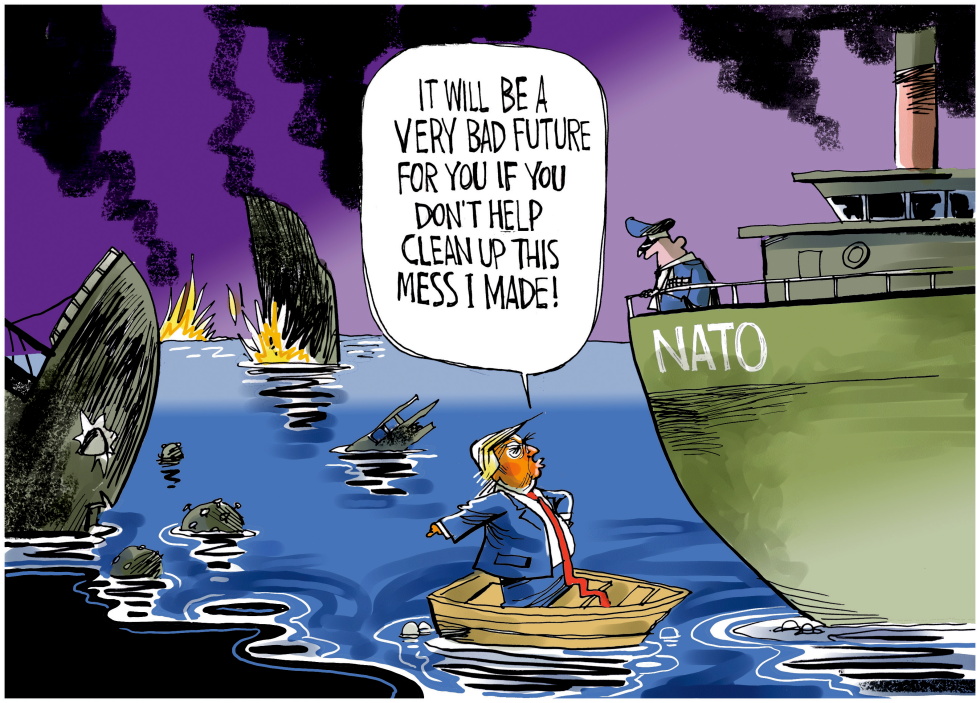
Dave Whamond's cartoon shows a caricature of Donald Trump in a small rowboat, suit and tie askew, shouting threats at a massive green ship labeled NATO. A uniformed figure leans over the railing, watching impassively. Surrounding them are sinking ships with stars, flames bursting from hulls, black smoke curling into a purple sky. The dark water is littered with debris. Trump's speech bubble warns of a bad future if allies don't clean up his mess. This setup nails trump demands, nato alliance, political satire, foreign policy mess, alliance tensions, and satirical caricature with sharp lines and exaggerated features typical of editorial cartoons.
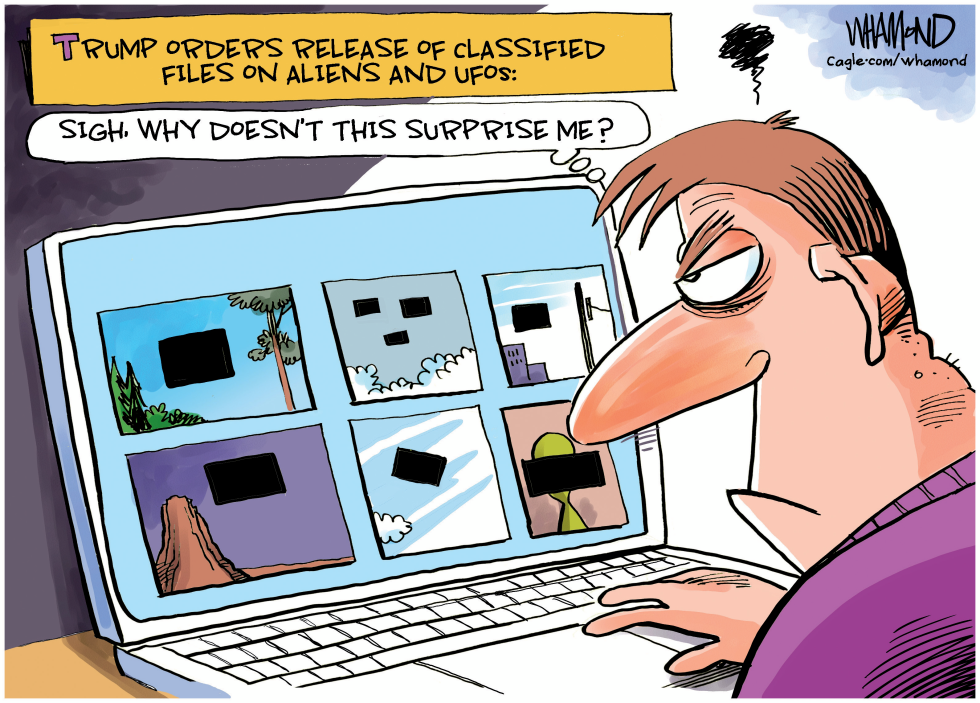
Dave Whamond draws a scene where a man views a laptop displaying Trump-ordered release of classified files on aliens and UFOs, all heavily redacted with black bars. The headline announces the declassification, but the images reveal nothing, from blurred landscapes to censored figures. The man sighs, saying it doesn't surprise him, highlighting themes of distractions and conspiracies. Tags like classified information, extraterrestrial life, UAP, flying saucers, CIA archives, and evidence of ET underscore the satire on empty revelations. The cartoon captures skepticism toward political maneuvers involving secret files.