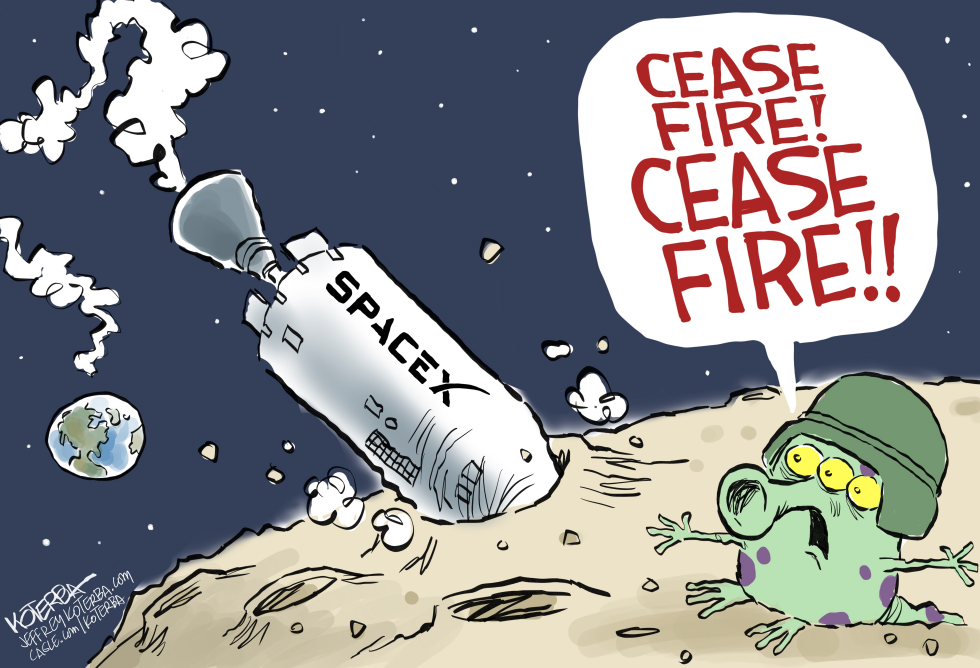
A SpaceX rocket has impacted the lunar surface in this imagined scenario. The event draws an immediate reaction from a local alien resident calling for an end to the activity. The piece uses the mishap to highlight ongoing risks in commercial spaceflight and the expanding human presence beyond Earth.
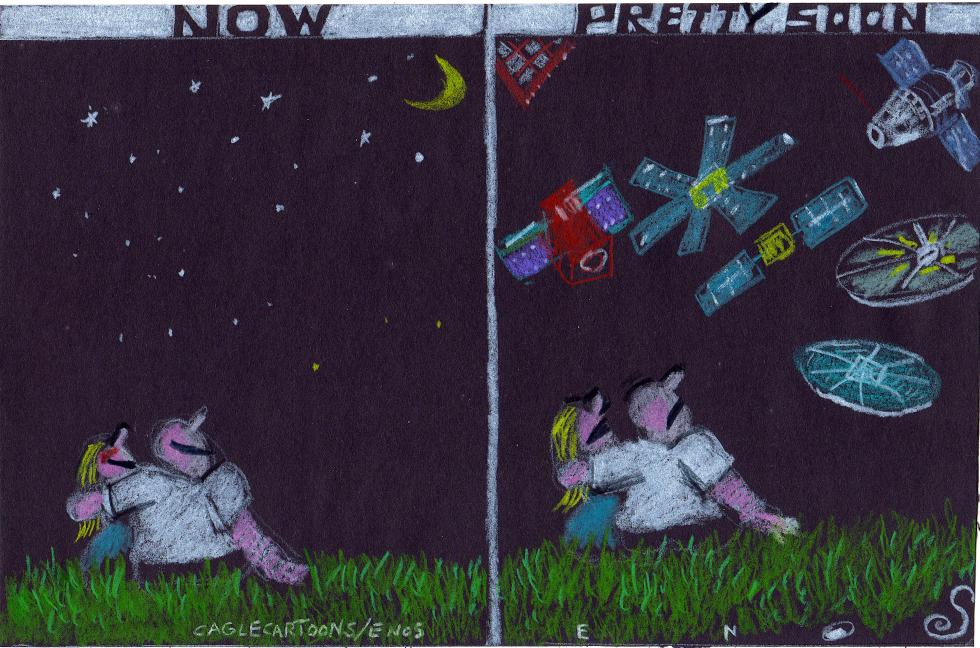
The night sky remains a quiet backdrop for stargazers in the present. Within a short time, however, proliferating satellites and debris will dominate the view overhead. The piece highlights how rapid expansion of orbital technology alters even simple moments of connection with the natural world.
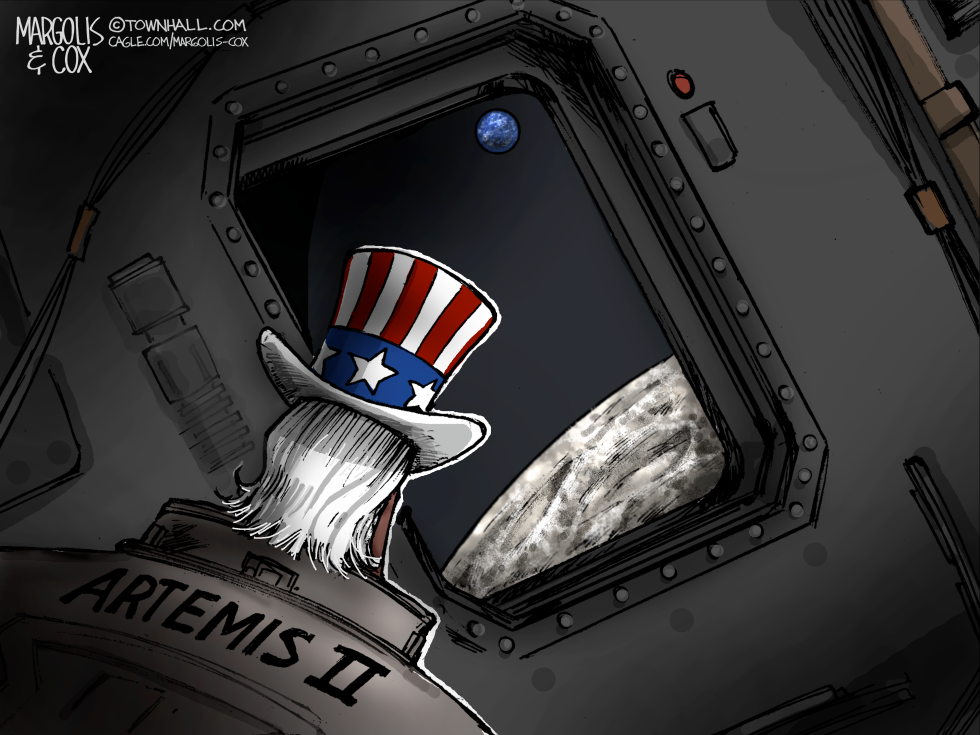
This political cartoon features Uncle Sam, complete with his red-white-blue top hat, inside the Artemis II spacecraft, staring out at the cratered moon surface with Earth visible in the background. The image satirizes American space exploration efforts, highlighting themes of patriotism, lunar missions, NASA programs, humorous commentary, political satire, and the return to moon orbits. It cleverly juxtaposes a classic symbol of America with modern space endeavors, poking fun at the grandeur and perhaps the delays or ambitions of the Artemis II project, all rendered in a dark, shadowy style that emphasizes the vastness of space.
This political cartoon splits into two scenes: top shows astronauts in orange suits, one with NASA patch and another with Canadian flag, waving and exclaiming 'IT'S A PARADE! HOW MARVELLOUS!' as they march from a crashed, smoking NASA capsule in water on a sandy surface. Below, a group carries a regal throne with a crowned figure wearing a T medal, surrounded by confetti and banners reading 'MASSIVE' and 'VICTORY'. In the background, smoke rises from a fractured globe labeled 'Iran' and 'Iraq'. The artwork, signed by MacKay for The Hamilton Spectator, uses humor to juxtapose apparent failure with proclaimed triumph, featuring waving figures and stern expressions in a sandy landscape.
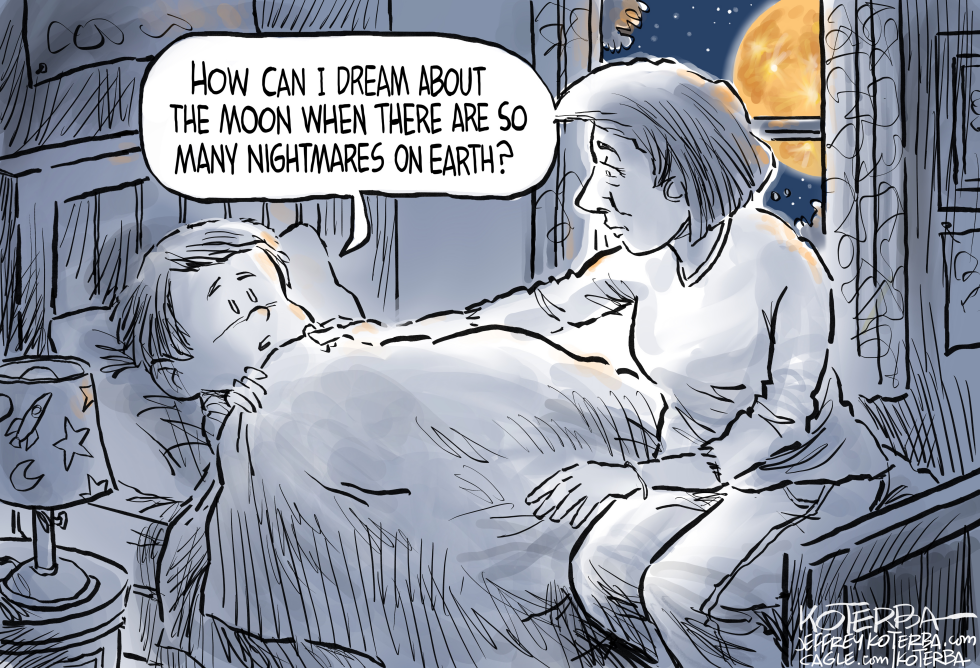
This poignant political cartoon depicts a child in bed, gazing toward a window framing a massive orange moon against a starry night sky, while confiding in a seated adult figure. The child's speech bubble reads: 'How Can I Dream About The Moon When There Are So Many Nightmares On Earth?' A bedside lamp with a star design illuminates the scene. Through this setup, the artwork satirizes how youth anxiety from global issues—like wars, climate woes, and social upheavals—stifles big dreams and aspirations. It's a clever commentary on how earthly nightmares eclipse celestial hopes, blending humor with insight into modern parenthood and childhood innocence lost. Tags: political cartoon, child nightmares, moon dreams, earth troubles, satirical illustration, youth anxiety, global chaos.
John Darkow's cartoon captures the Artemis II crew gazing through their spacecraft window at the far side of the moon, where craters frame an unexpected sight: the Midvale School for the Gifted from Gary Larson's The Far Side, complete with a striped-shirted figure fumbling at a 'pull' door on stairs. Tagged with artemis ii, moon flyby, far side, gary larson, nasa, space, and science, the image blends real space exploration with absurd humor. One crew member exclaims excitement, labeled with Artemis II Crew and NASA markings. This satire highlights the blend of high-stakes missions and pop culture whimsy, poking fun at what astronauts might hope to find beyond the visible lunar surface. The dry wit underscores how science fiction tropes collide with actual programs like Artemis II.
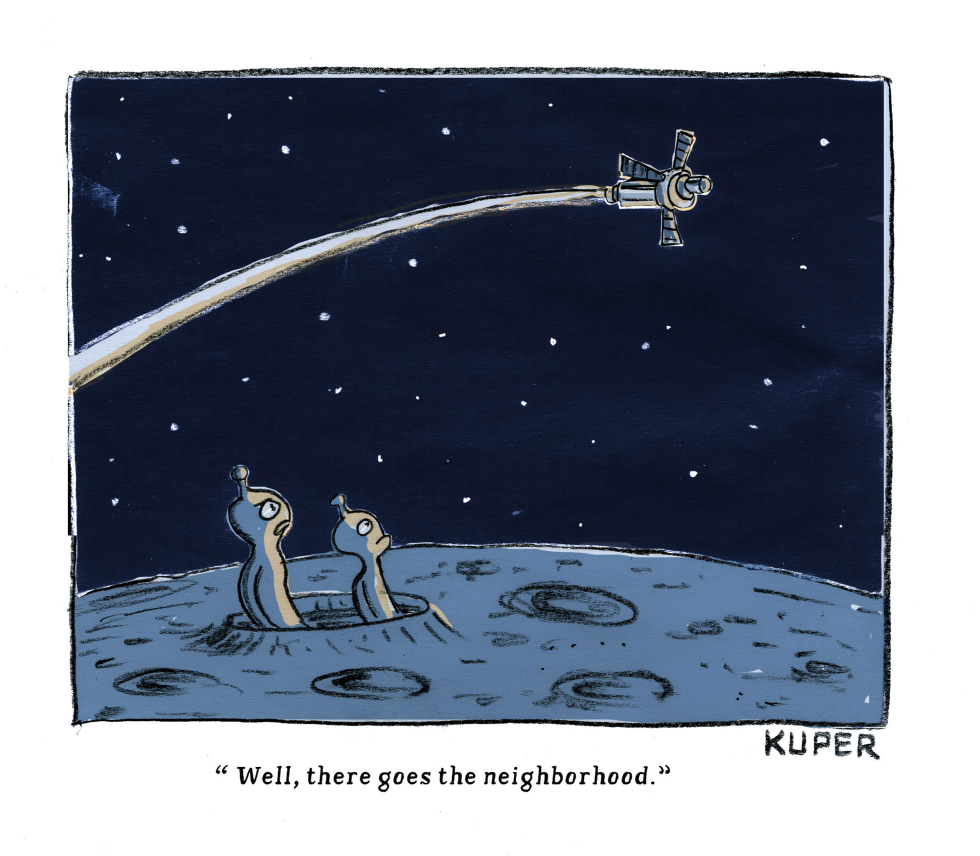
Peter Kuper's cartoon shows two blob-shaped aliens peeking from a crater on the moon's surface, eyes fixed on a departing rocketship trailing exhaust. The dark side of the moon setting includes craters and a starry sky, with the caption 'Well, there goes the neighborhood.' Tags like Artemis II, astronauts, Canada, United States NASA, dark side of the moon, and orbiting highlight the satirical take on human space exploration intruding on alien territory. The image pokes fun at the idea of extraterrestrials reacting to NASA's mission, blending science, data, and humorous alienation.
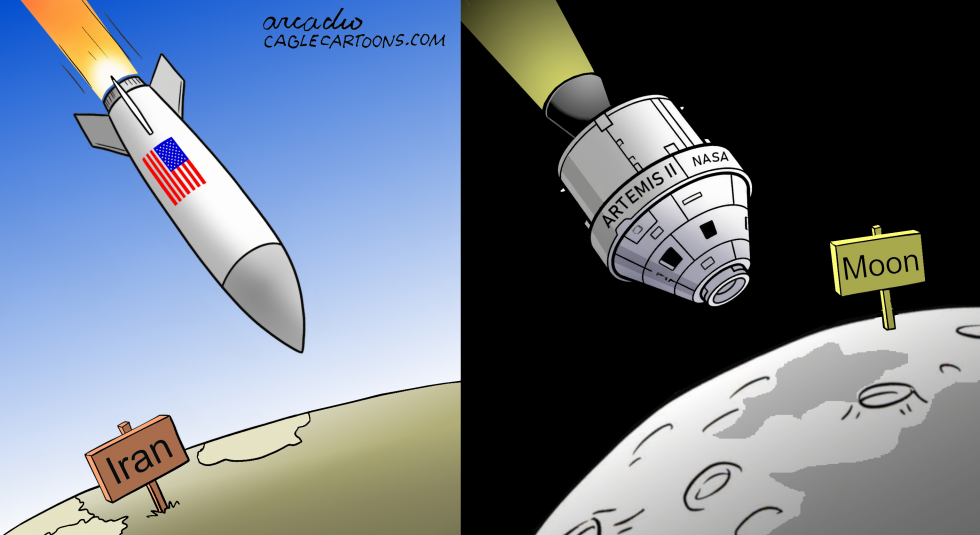
Arcadio Esquivel's cartoon splits the scene: on one side, a missile with an American flag streaks toward a planetary surface marked 'Iran,' flames trailing from its base against a blue sky. On the other, the Artemis II NASA capsule floats in space, nearing a gray lunar landscape labeled 'Moon' under a starry black backdrop. Tags including war, moon, exploration, Artemis II, NASA, Middle East, and Iran capture the visual pun. The dry humor points to misplaced priorities, where grand goals like space missions veer into military misadventures. Cagle Cartoons syndicates such pointed commentary, blending current events with sharp satire.
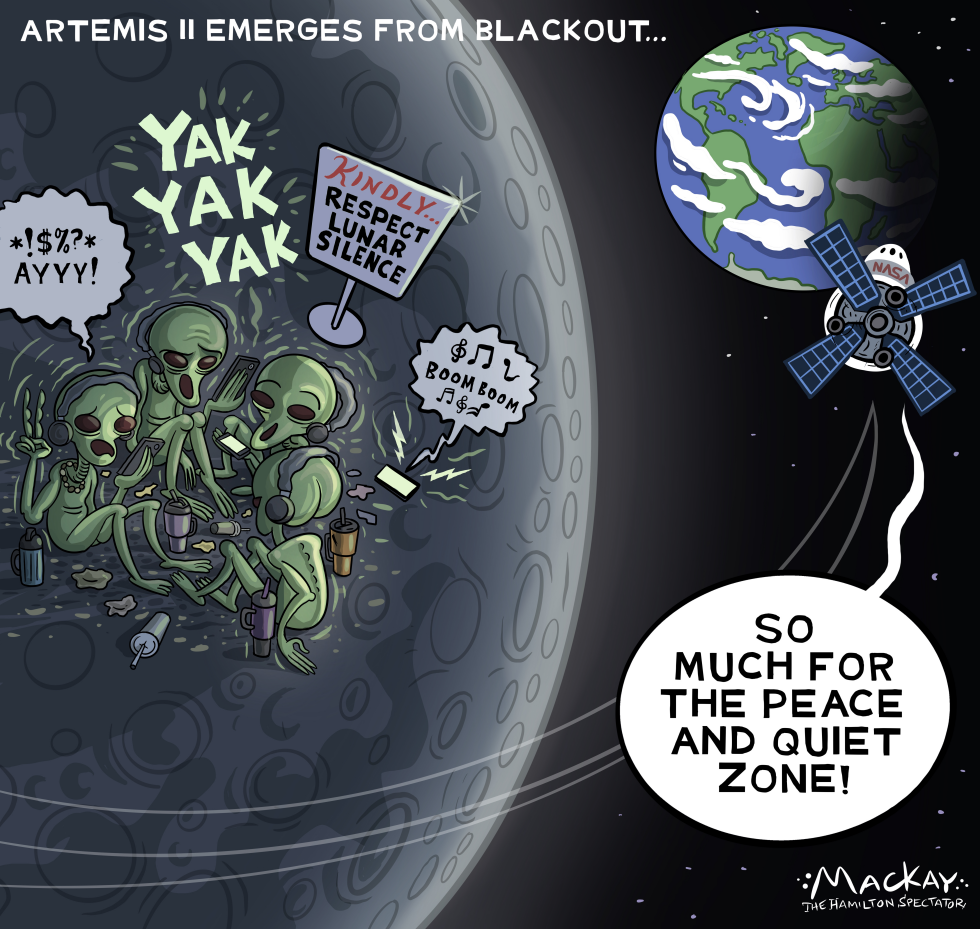
Graeme MacKay's cartoon shows a group of green aliens on the moon, clearly annoyed by the approaching NASA Artemis II spacecraft emerging from blackout. The aliens, depicted with headphones, phones, and drinks, make noisy exclamations like 'Yak Yak Yak' and music notes, while a sign pleads 'Kindly Respect Lunar Silence.' One alien laments, 'So much for the peace and quiet zone!' against the backdrop of Earth. This piece satirizes space exploration's impact on supposed lunar solitude, touching on tags like Artemis, moon, NASA, aliens, quiet zone, and communication. The far side setting emphasizes the interruption of silence by human astronauts.
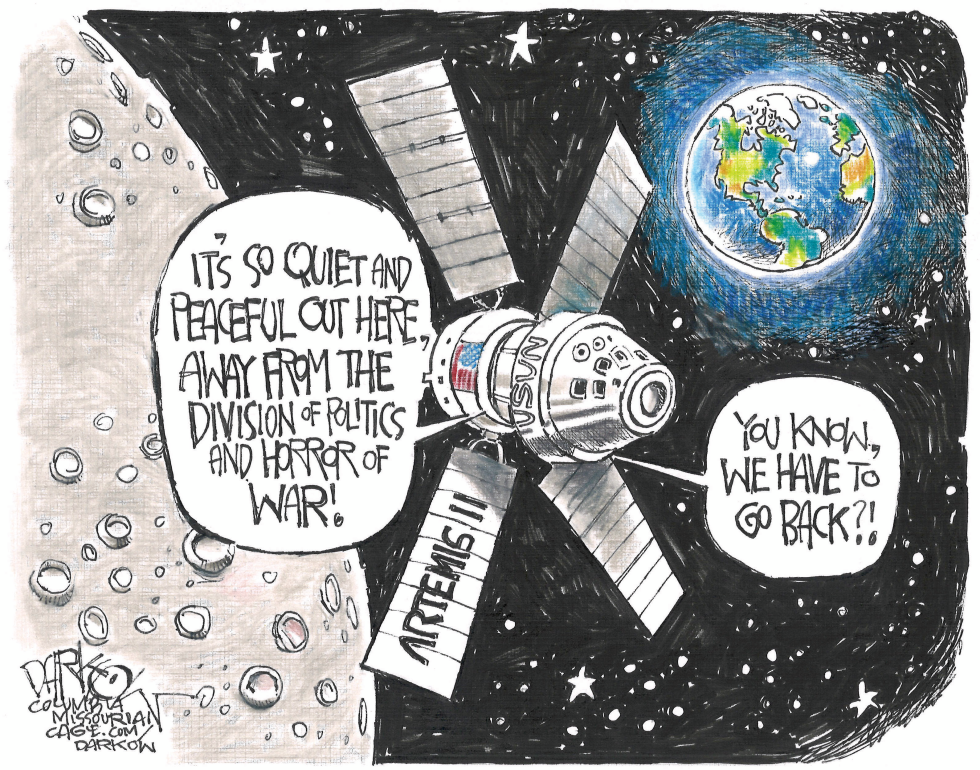
This Daryl Cagle political cartoon analysis features the Artemis II spacecraft floating in serene space, with Earth glowing in the background and the moon nearby. The left speech bubble extols the quiet peace away from division of politics and horror of war, while the right one resignedly notes the need to go back. It's a satirical cartoon on politics and war division, poking fun at how space exploration escaping earthly conflicts offers temporary respite. The NASA Artemis program humor illustration underscores the irony of advanced space missions contrasting with unresolved human divisions on Earth. Through this humorous take on returning to political division, the cartoon cleverly comments on the allure of peaceful space vs chaotic Earth without delving into specifics.
Canadian astronaut Jeremy Hansen appears in an Artemis mission spacesuit surrounded by floating Canadian snacks including ketchup chips and a peameal bacon sandwich. The scene shows him with a speech bubble saying amazing eh while Earth is visible through the window.
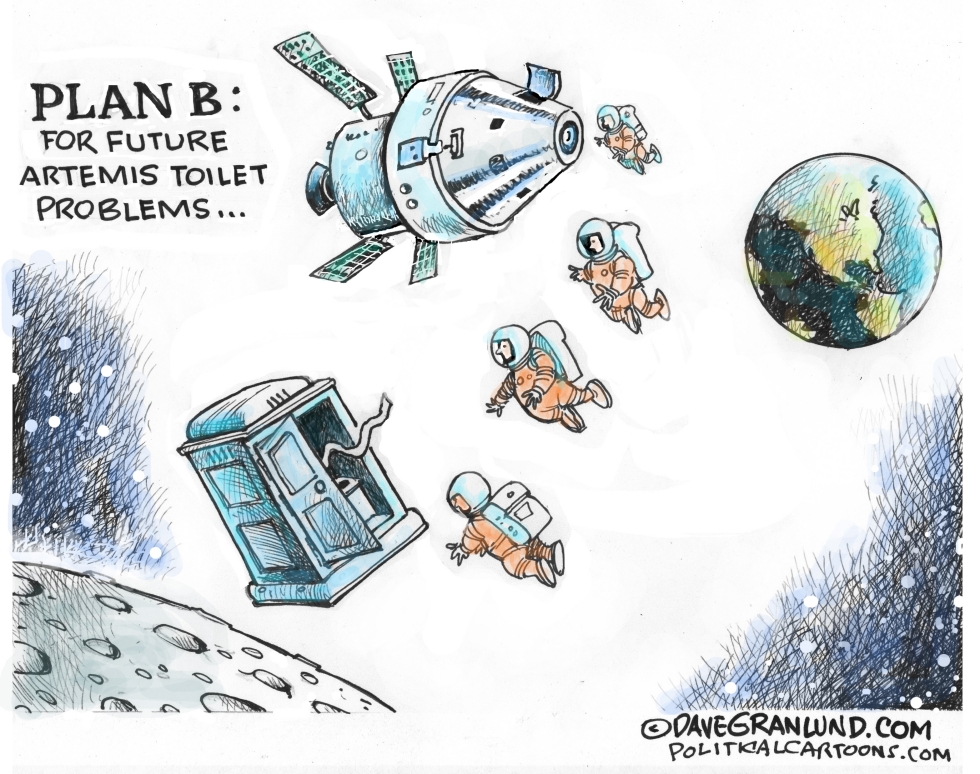
Dave Granlund\'s cartoon captures the absurdity of potential toilet glitch in the Artemis mission around moon, showing astronauts drifting toward a floating porta-potty labeled as Plan B for future Artemis toilet problems. The scene includes a spacecraft, the moon below, and Earth in the background, highlighting backup plan necessities in space travel. With tags like mission around moon, astronauts, toilet glitch, alternate, and one toilet, the image pokes fun at logistical challenges in lunar expeditions. Such humorous takes remind viewers of the everyday hurdles even in high-tech endeavors like NASA\'s Artemis program.
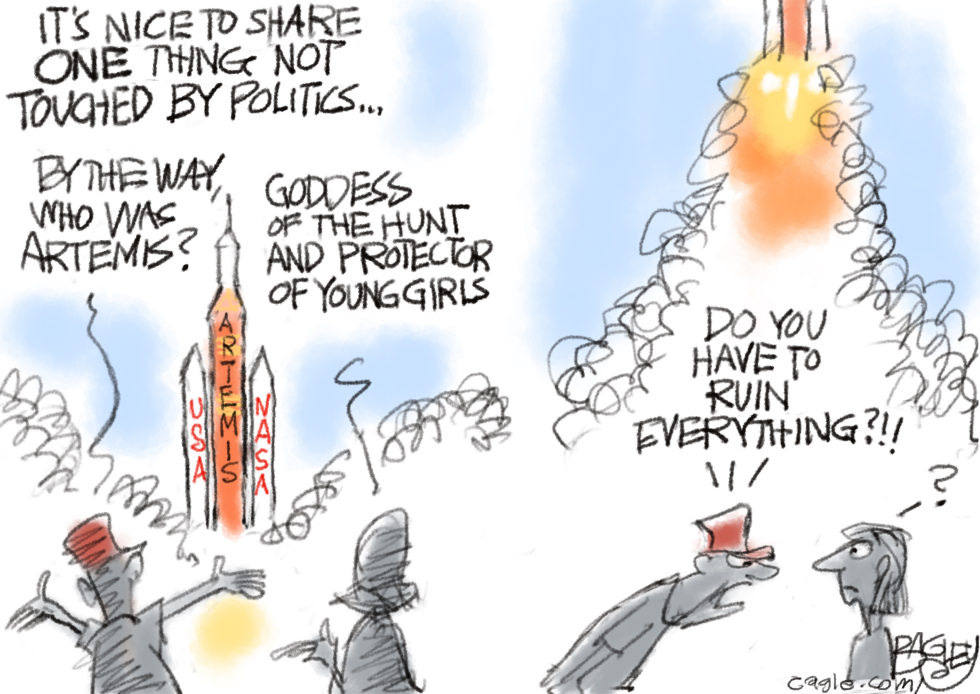
This political cartoon features a launching rocket labeled Artemis, SLS, NASA, and USA, with overlaid text praising one thing untouched by politics before asking about the goddess Artemis, described as goddess of the hunt and protector of young girls. A figure exclaims frustration at ruining everything, satirizing how even space missions get dragged into cultural debates. The irreverent sketch uses humorous figures with red hats to poke at over-politicization in science, blending mythology with modern rocketry in a witty critique. Tags like Artemis rocket launch political cartoon, NASA SLS Artemis mission satire, and politics invading science editorial cartoon underscore the cartoon's sharp insight into societal divisions spilling into apolitical realms like space exploration politicized cartoon.
This satirical political cartoon depicts a bizarre lunar scene where a green alien is climbing a gushing oil derrick, tethered by rope to a spacesuit-wearing figure holding a 'TACO' sign. The backdrop includes a cratered moon surface, a starry sky, and a blue planet, with the white rocket labeled 'ARTEMIS 2 MAGA OIL MOON' emitting green smoke. A ladder leans against the rocket's open door, and a black barrel sits nearby. The imagery humorously critiques ambitious lunar exploits, blending space exploration with oil drilling fantasies in a visually striking composition that highlights the absurdity of extraterrestrial resource grabs.
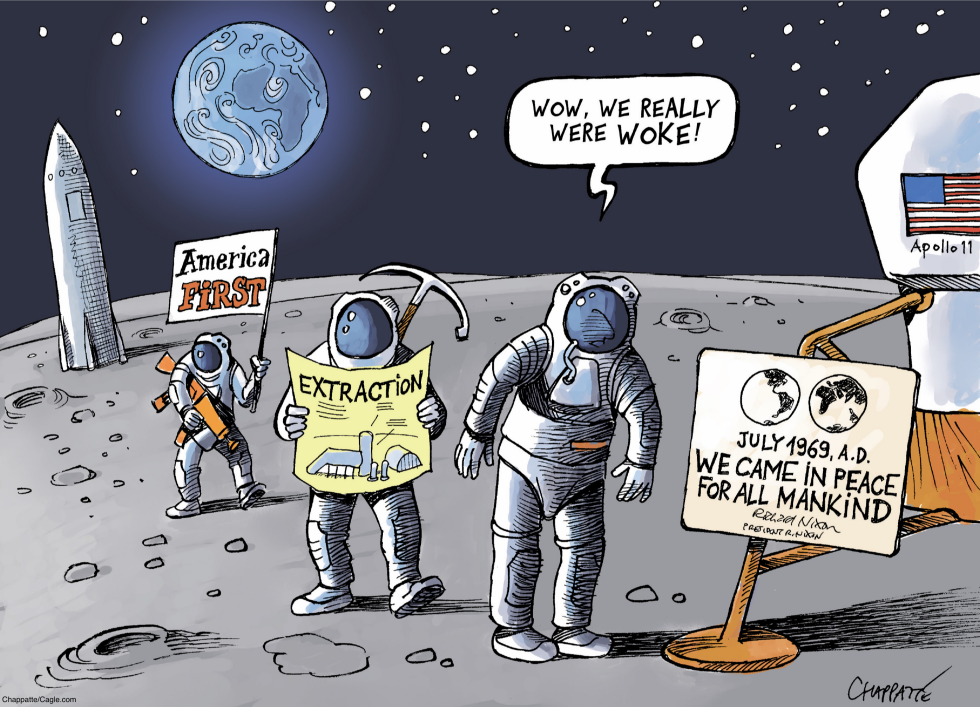
The cartoon shows three astronauts on the moon\\\\\\\'s surface, with Earth visible in the background. One holds a sign reading America First while carrying a weapon, another grips a document titled Extraction with a mining diagram, and the third wields a pickaxe next to a plaque stating We came in peace for all mankind from July 1969 A.D. near the Apollo 11 lander flagged with the US stars and stripes. A speech bubble declares Wow, we really were woke! The scene captures space race satire, lunar exploration humor, political cartoon commentary on shifting priorities from global peace to nationalistic resource grabs, all in Patrick Chappatte\\\\\\\'s style.