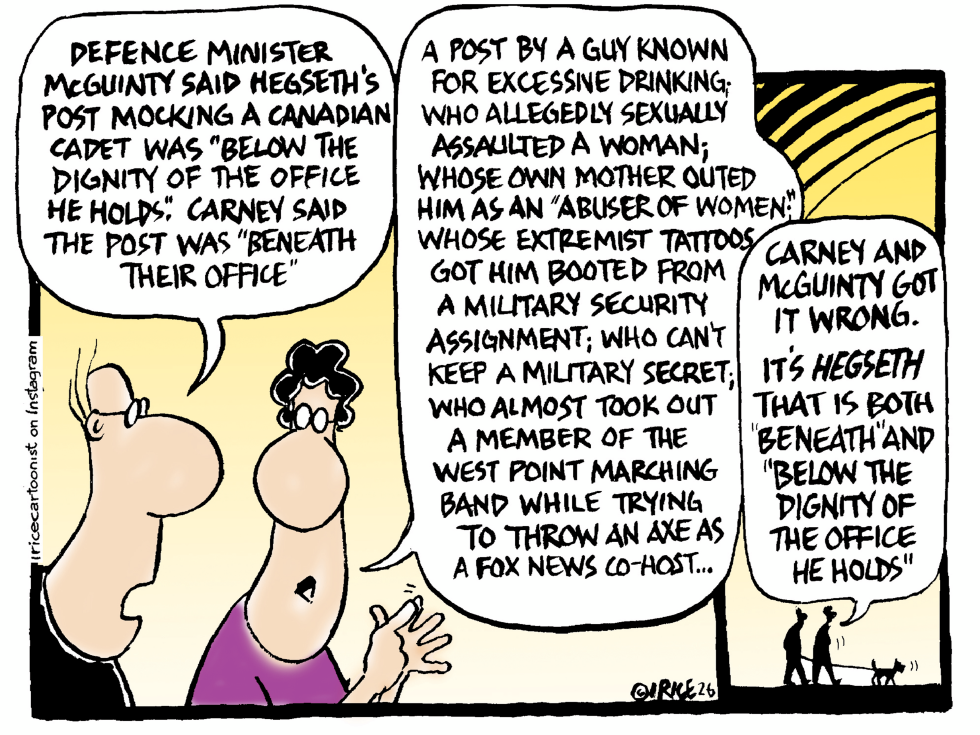
Canadian Defence Minister David McGuinty and Mark Carney publicly condemned a social media post by Pete Hegseth mocking a Canadian cadet, calling it beneath the dignity of the office. The remarks came amid Hegseth's nomination process for a senior U.S. defense position. The cartoon argues the ministers have the assessment backward, pointing instead to Hegseth's history of alleged misconduct, security clearance problems, and public incidents as the true disqualifiers. This reflects ongoing debate over nominee vetting standards and cross-border political commentary on U.S. appointments.
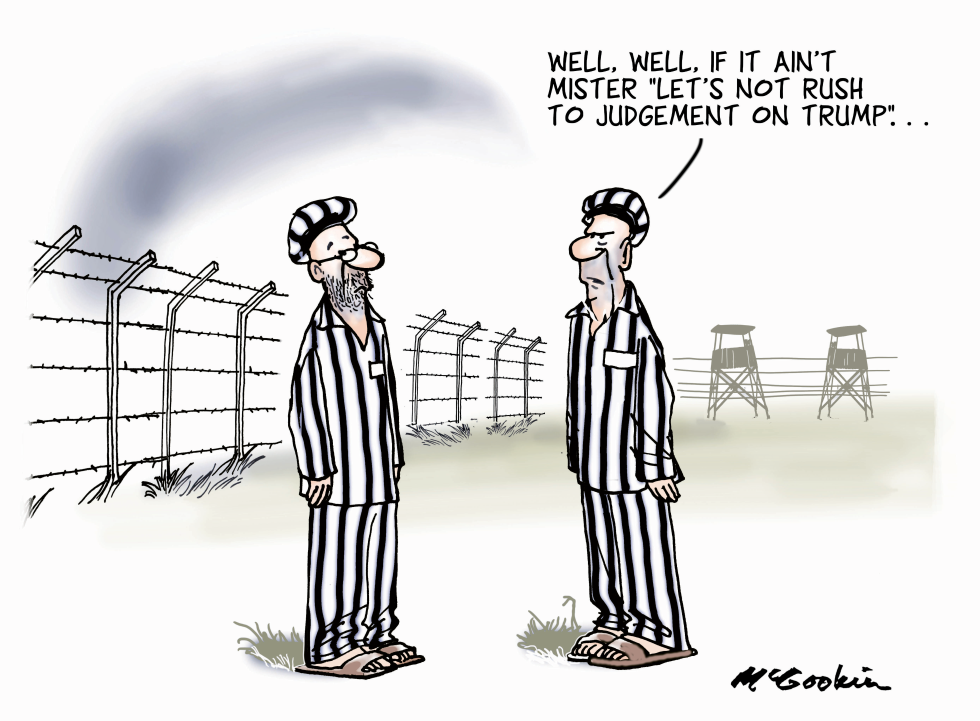
Prisoners in a secure facility highlight reluctance to rush judgment on Donald Trump. The exchange underscores ongoing debate over timing and fairness in evaluating the former president's actions. The piece argues that hesitation to judge reflects inconsistent standards applied to political figures.
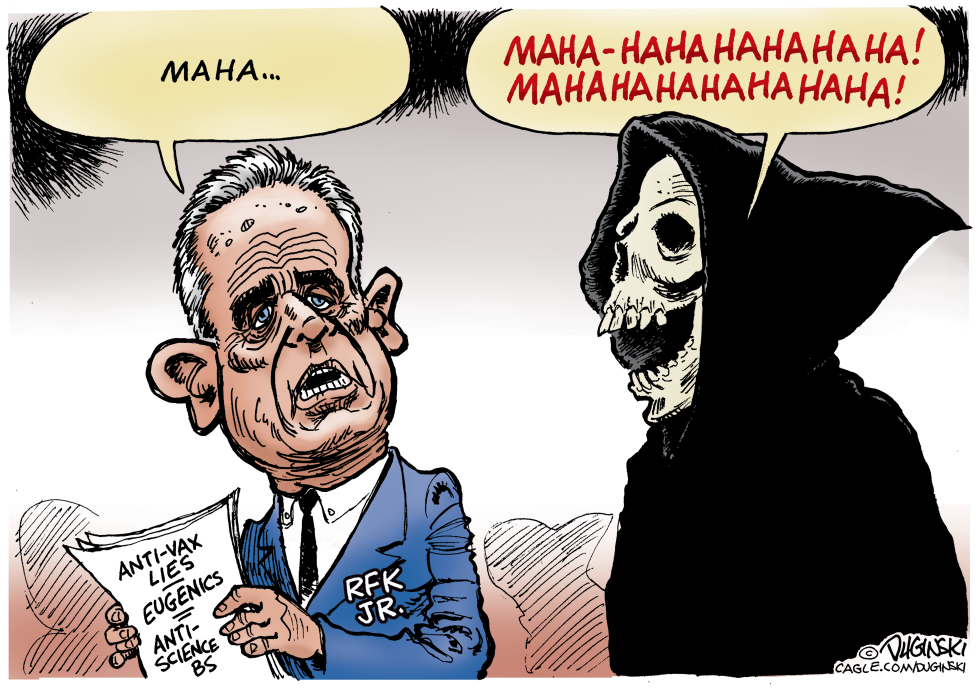
Robert F. Kennedy Jr. continues promoting Make America Healthy Again initiatives tied to his anti-vaccine positions in mid-2026. The approach draws criticism for linking public health measures to eugenics concerns and undermining scientific consensus. The editorial takes the position that such rhetoric risks real harm by eroding trust in established medical guidance.
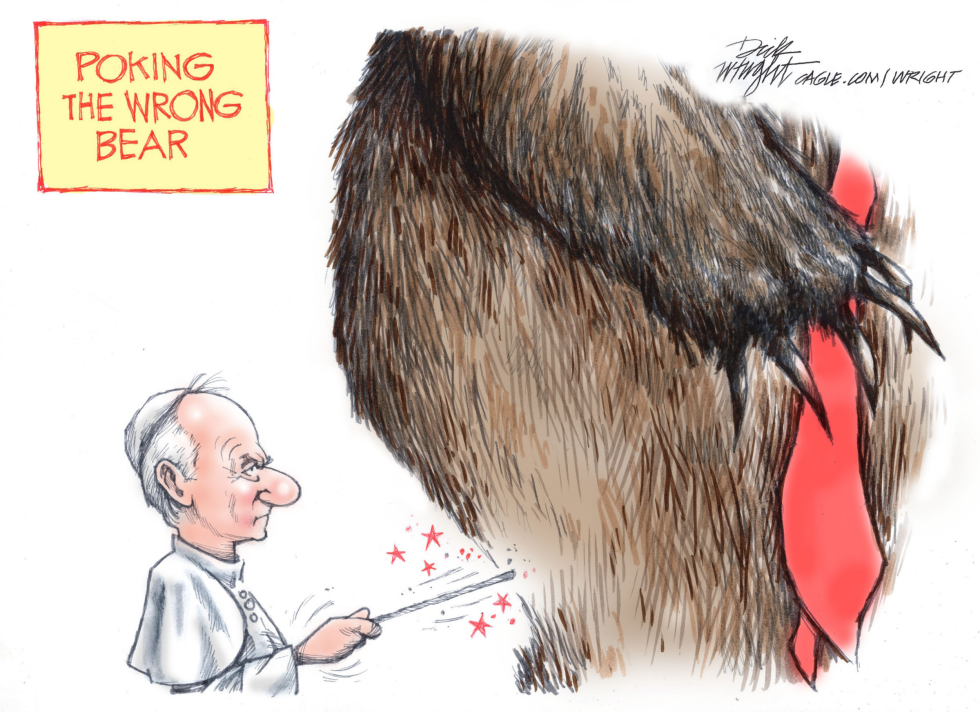
Dick Wright's political cartoon depicts a Pope-like figure in white attire, extending a thin rod toward the rear of a massive brown bear, complete with a dangling red tie and sparkling effects at the point of contact. The yellow label reads 'POKING THE WRONG BEAR,' playing on the idiom with a twist. This satirical illustration ties into the Trump-Pope feud, using the bear as a stand-in for power, the red tie evoking Trump's signature look, and the poking action suggesting provocation. Cartoonists often employ such animal metaphors for political commentary, and Wright's style here delivers clear lines and exaggerated features for impact. The image avoids overstatement, sticking to visible elements like the bear's claws and fur details, making it a straightforward jab at ongoing tensions.
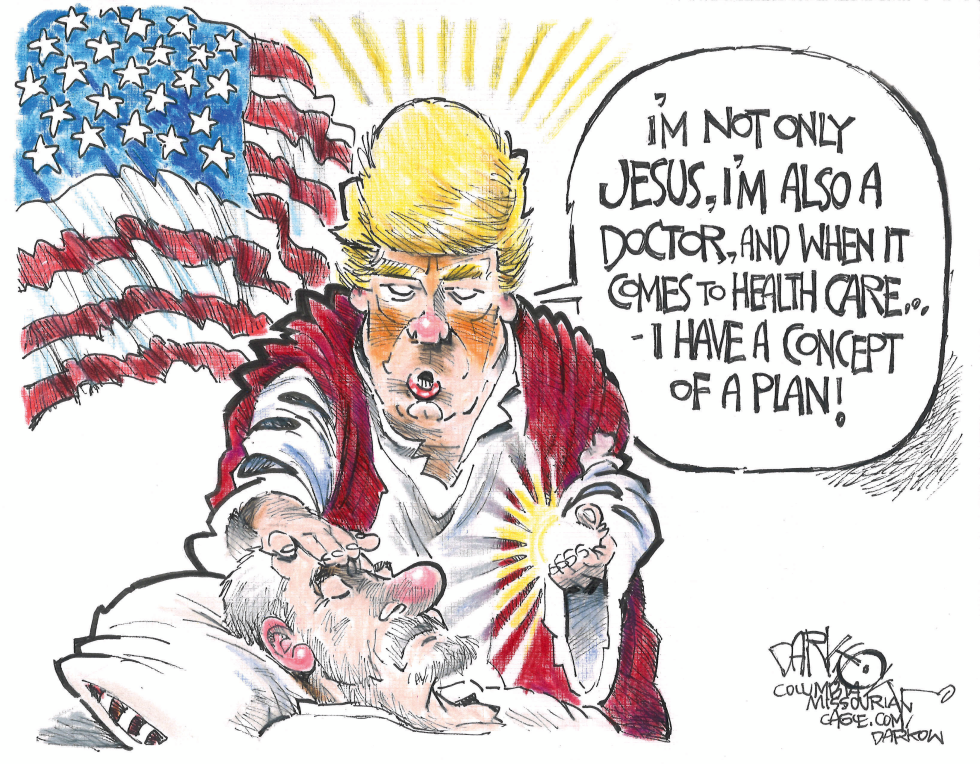
John Darkow's cartoon shows a blonde-haired figure resembling Donald Trump, clad in a red cape and white garment, extending a glowing hand toward an elderly man lying in bed. An American flag waves in the background with radiant beams from above. The speech bubble declares the figure as both Jesus and a doctor, boasting a concept of a health care plan. This setup highlights satirical elements in political imagery. Tags like donald trump political cartoon, trump health care plan satire, jesus doctor parody cartoon, american flag political humor, trump messiah complex illustration, and health care policy cartoon fit the visible components.
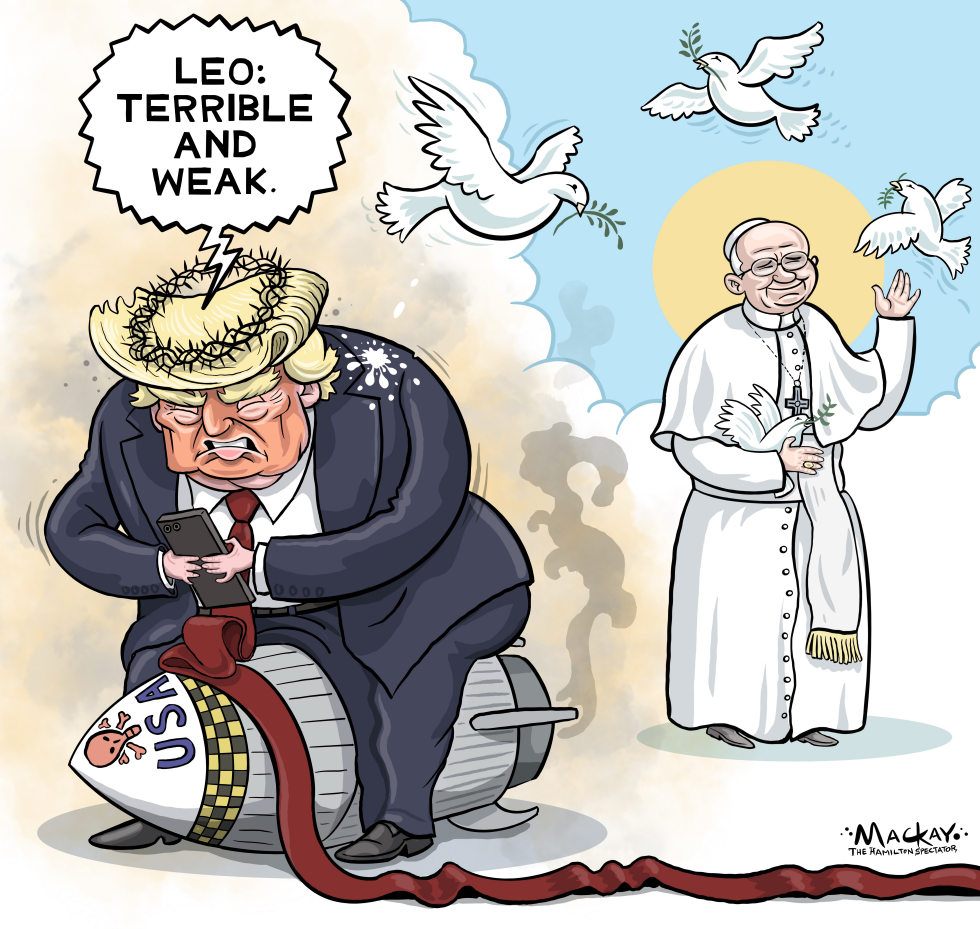
Graeme MacKay's political cartoon captures Trump, caricatured with crown of thorns hair, sitting on a bomb labeled USA with a skull symbol, holding a phone and declaring 'Leo: Terrible and Weak' in a speech bubble. Smoke rises from the missile, contrasting sharply with the Pope on the right, halo glowing, releasing white doves carrying olive branches. The scene unfolds against a cloudy sky, highlighting themes of war and peace. This satirical illustration pokes at political rhetoric, religious symbolism, and international tensions, blending humor with critique in a style that's both direct and pointed.
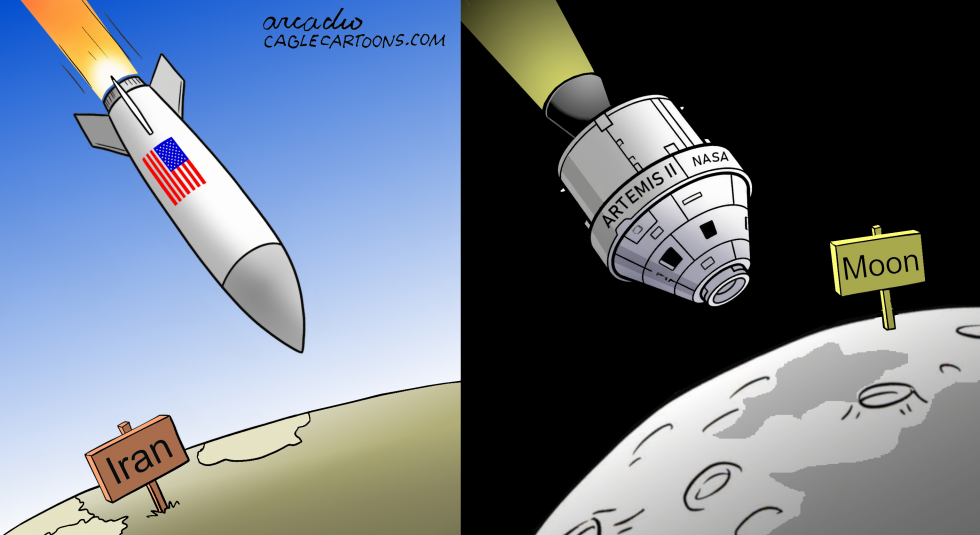
Arcadio Esquivel's cartoon splits the scene: on one side, a missile with an American flag streaks toward a planetary surface marked 'Iran,' flames trailing from its base against a blue sky. On the other, the Artemis II NASA capsule floats in space, nearing a gray lunar landscape labeled 'Moon' under a starry black backdrop. Tags including war, moon, exploration, Artemis II, NASA, Middle East, and Iran capture the visual pun. The dry humor points to misplaced priorities, where grand goals like space missions veer into military misadventures. Cagle Cartoons syndicates such pointed commentary, blending current events with sharp satire.
This satirical political cartoon depicts a bizarre lunar scene where a green alien is climbing a gushing oil derrick, tethered by rope to a spacesuit-wearing figure holding a 'TACO' sign. The backdrop includes a cratered moon surface, a starry sky, and a blue planet, with the white rocket labeled 'ARTEMIS 2 MAGA OIL MOON' emitting green smoke. A ladder leans against the rocket's open door, and a black barrel sits nearby. The imagery humorously critiques ambitious lunar exploits, blending space exploration with oil drilling fantasies in a visually striking composition that highlights the absurdity of extraterrestrial resource grabs.
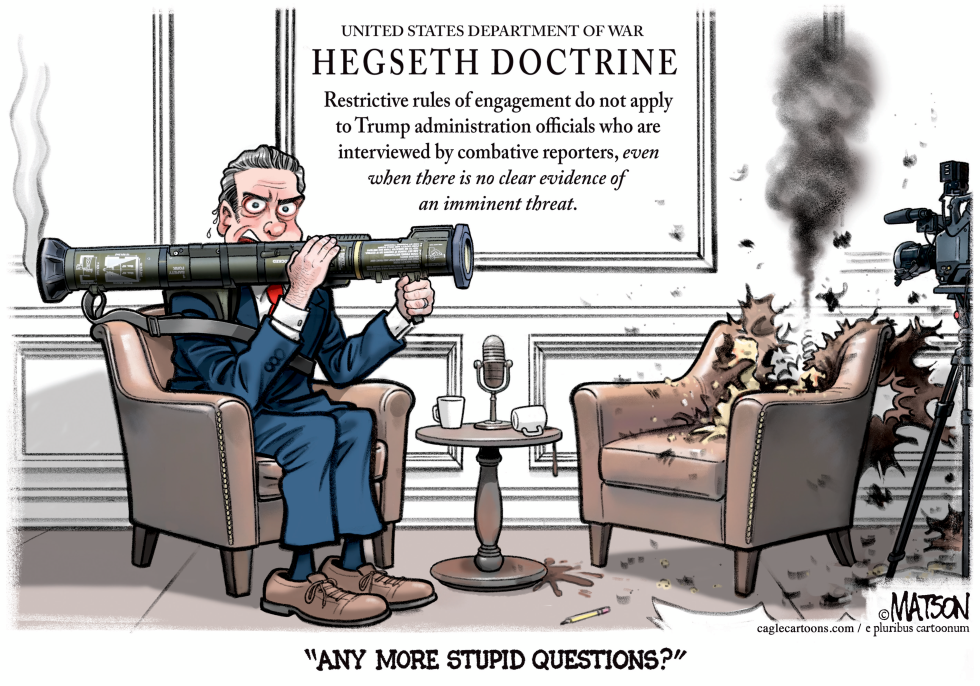
R.J. Matson's cartoon depicts a stern-faced official in a formal setting, wielding a massive rocket launcher that has just obliterated the interviewer's chair, smoke billowing from the debris. The header proclaims the 'Hegseth Doctrine' under the 'United States Department of War,' stating that restrictive rules of engagement don't apply to Trump administration officials facing combative reporters, even without clear evidence of an imminent threat. The official snarls, 'Any more stupid questions?' as a camera topples amid the chaos. This setup skewers the notion of overreactive defenses in political interviews, blending dry humor with sharp commentary on media relations. Tags like Hegseth Doctrine, Trump administration satire, press interview violence, combative reporters parody, imminent threat joke, and political cartoon Matson capture the essence of this visually punchy critique.
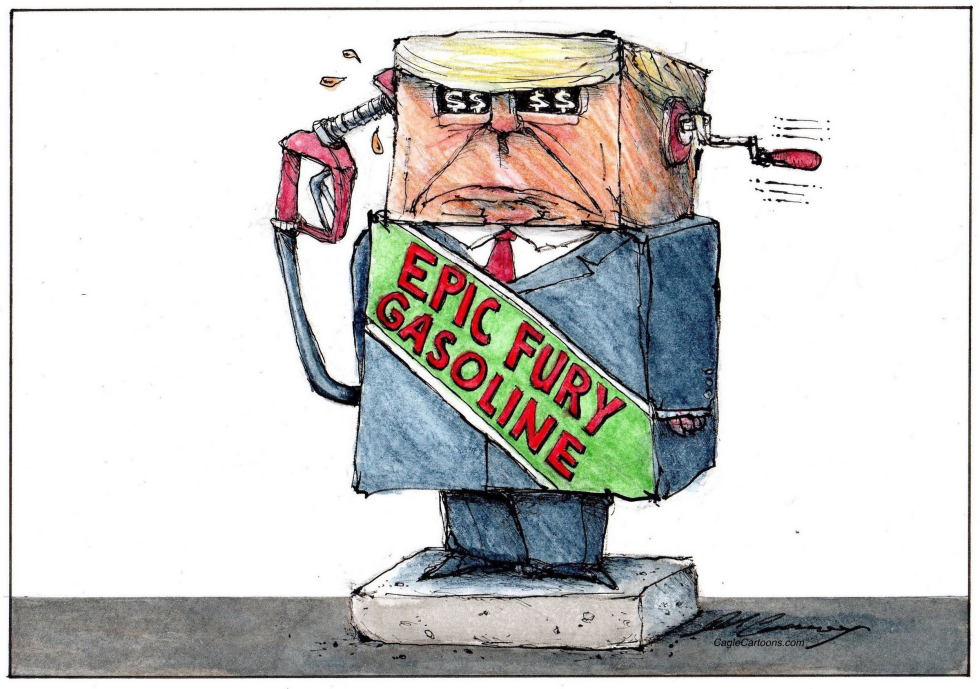
Dale Cummings draws Trump as a boxy gas pump, head topped with a dripping nozzle and $5.55 price tag, frowning in a suit with a green sash screaming Epic Gasoline Fury. Standing on a pedestal, the figure captures the essence of high gas prices tied to War in Iran and Operation Epic Fury. The cartoon skewers oil prices and Strait of Hormuz affordability, blending humor with commentary on economic fallout. It's a straightforward jab at political decisions driving up costs at the pump, rendered in watercolor style for punchy effect. Tags like War in Iran, Operation Epic Fury, oil prices, gas prices, Strait of Hormuz affordability, and affordability underscore the timely critique.
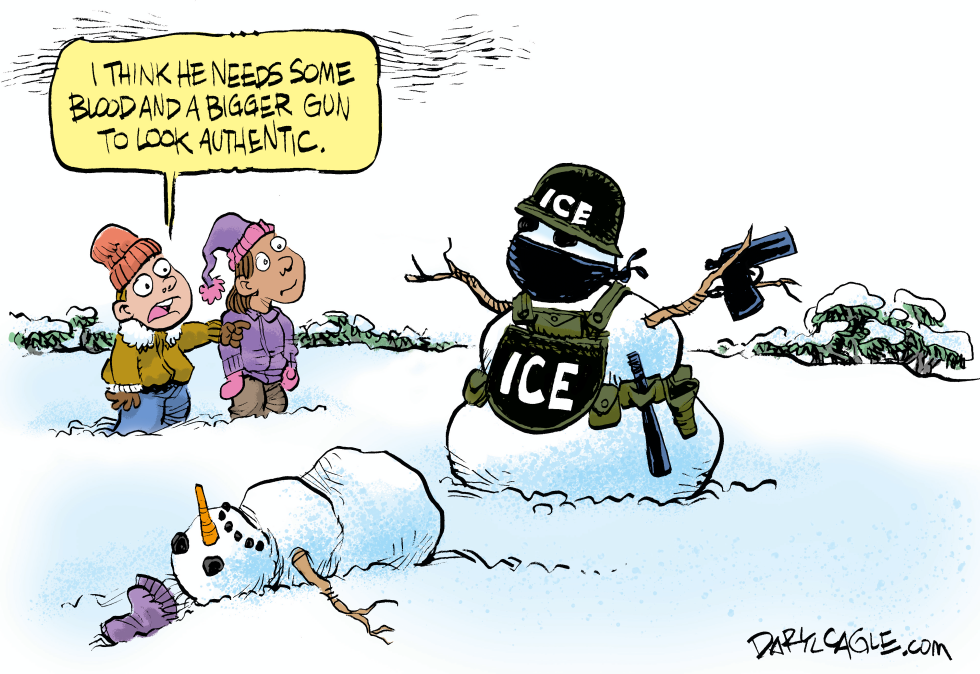
The cartoon depicts two children observing a snowman dressed as an ICE agent complete with helmet, vest, mask and firearm. One child remarks that blood and a bigger gun would improve authenticity. A second snowman lies toppled in the foreground. The scene uses winter play to comment on immigration enforcement imagery.
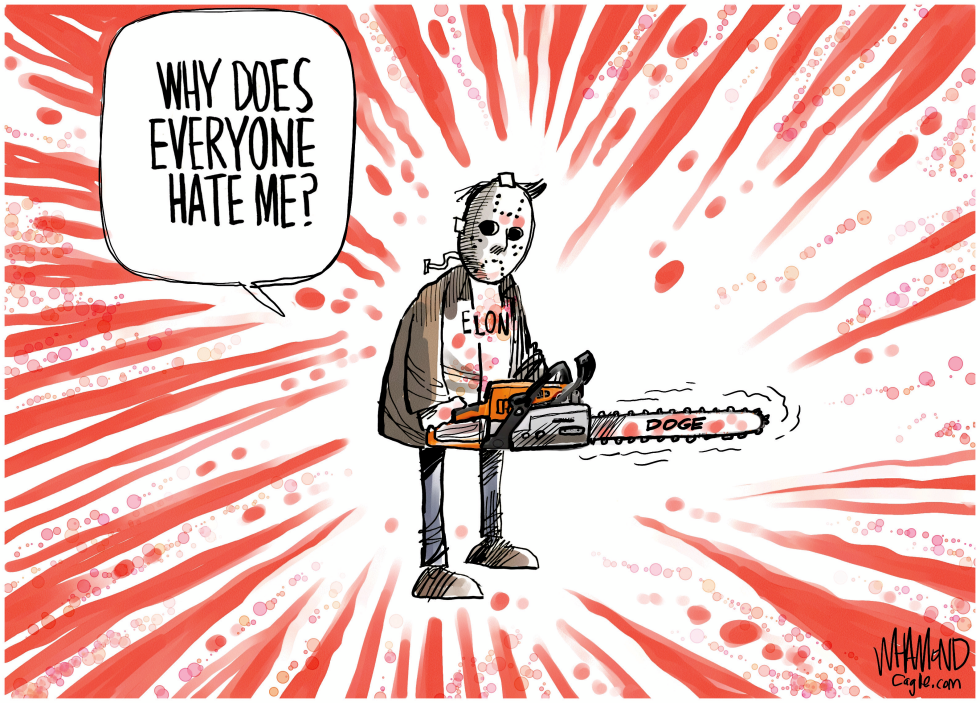
On March 30 2025 Elon Musk is shown as a masked horror figure wielding a DOGE-labeled chainsaw while asking why everyone hates him. The image coincides with reports of his planned departure from the Department of Government Efficiency amid ongoing federal spending cuts and public criticism.
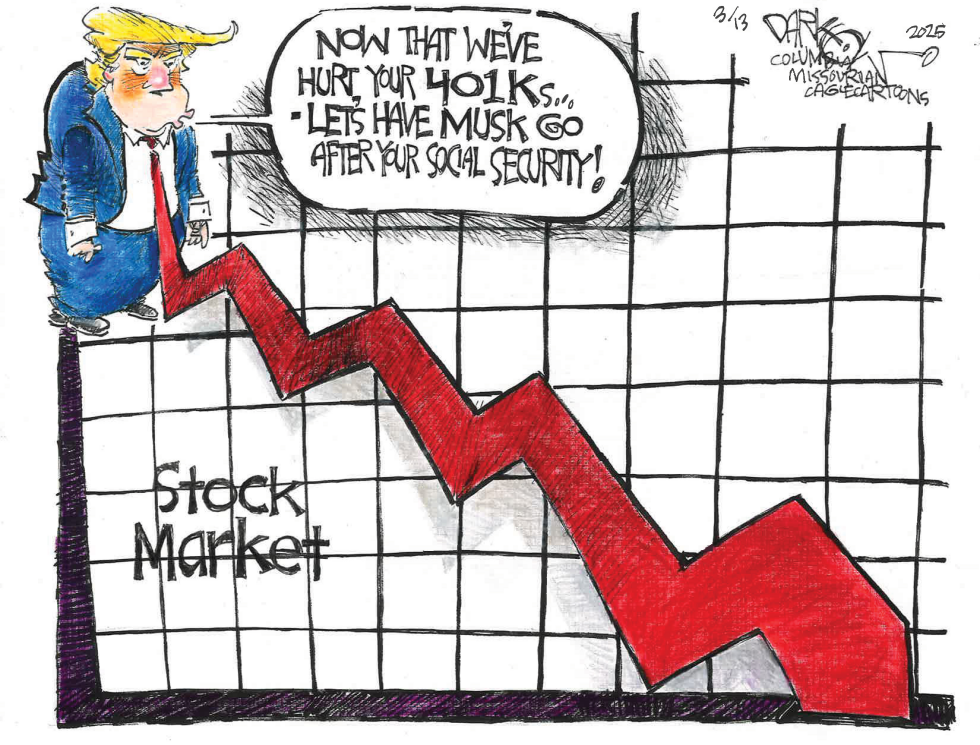
The cartoon shows a caricature of Trump perched on a sharply declining red line labeled 'Stock Market,' with a speech bubble declaring, 'Now that we've hurt your 401Ks - Lets have Musk go after your Social Security!' This visual satire ties into ongoing debates about trade war, tariffs on Mexico, Canada, EU, and China, and their impact on retirement accounts like nest eggs and 401Ks. Inflation worries loom large in the imagery, as the downward graph symbolizes economic fallout. Musk's mention hints at controversial figures meddling in social security, blending humor with critique of policy directions.
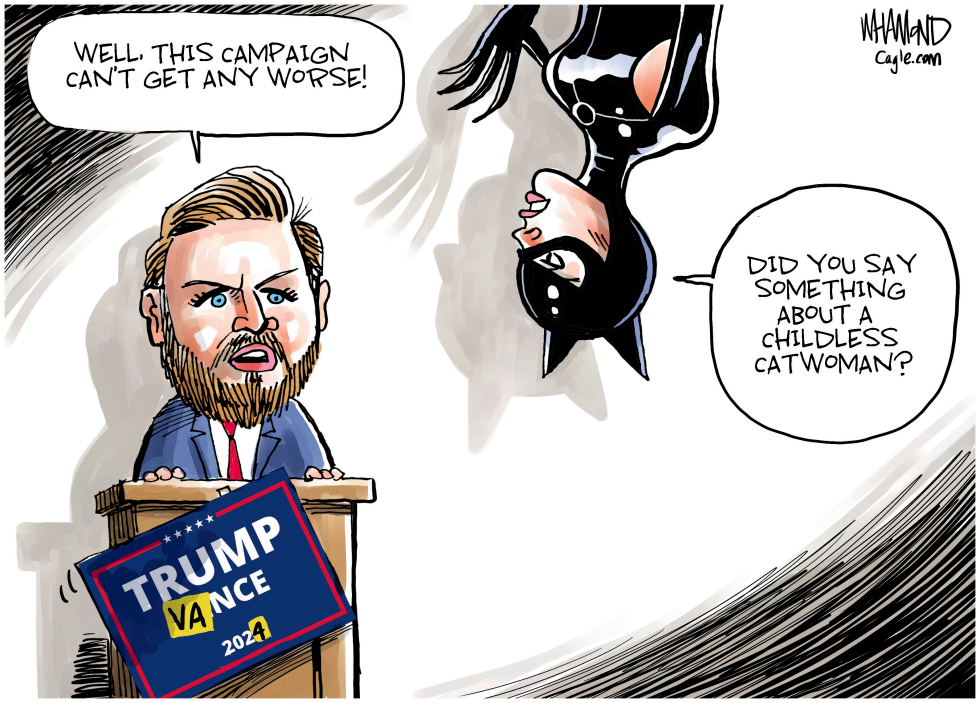
The cartoon shows JD Vance at a podium bearing a Trump Vance 2024 sign, declaring the campaign cannot worsen. Catwoman appears upside down nearby, asking if he mentioned a childless catwoman. The image responds to Vance's earlier remarks about childless women during the 2024 election cycle. Vance, selected as Donald Trump's running mate, encountered immediate criticism over the comments and subsequent public appearances. The visual ties the DC Comics figure directly to the phrase that drew widespread media attention in late July 2024.