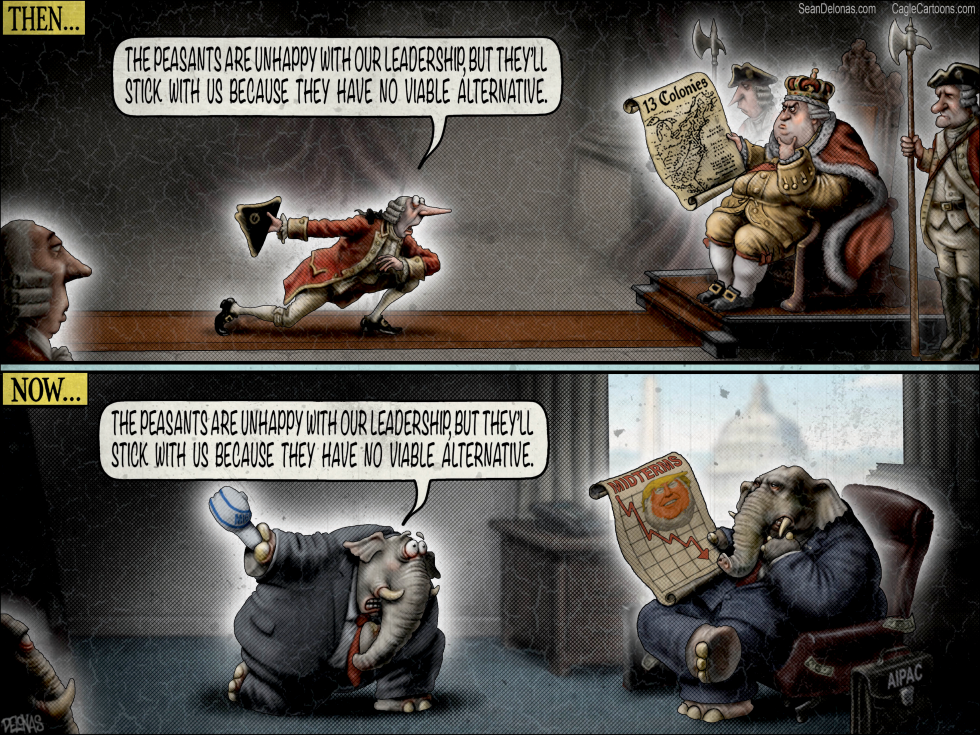
A two-panel cartoon contrasts King George III assuring aides that unhappy colonists have no viable alternative with a modern Republican elephant repeating the identical line while holding a plunging midterms chart marked with Donald Trump's face. The lower scene includes the U.S. Capitol dome and an AIPAC briefcase. The June 28 2026 date places the image weeks before the 2026 midterm elections.
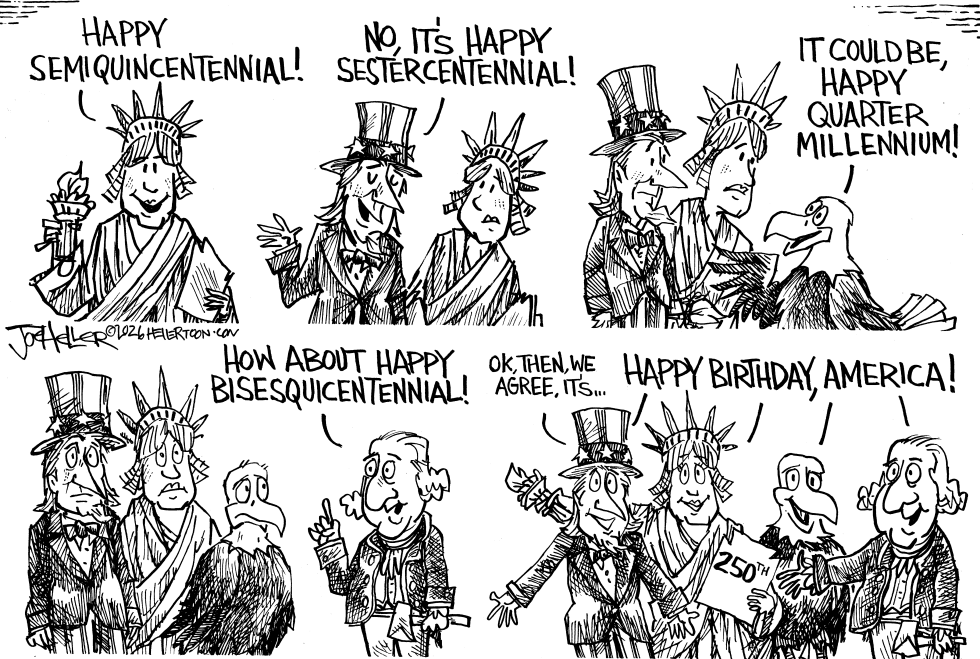
Joe Heller's June 2026 cartoon shows the Statue of Liberty, Uncle Sam, a bald eagle and Benjamin Franklin debating elaborate terms for America's 250th anniversary. The figures propose semiquincentennial, sestercentennial, quarter millennium and bisquincentennial before conceding to the straightforward greeting Happy Birthday, America! The strip marks the upcoming July 4, 2026 milestone with light humor on naming conventions.
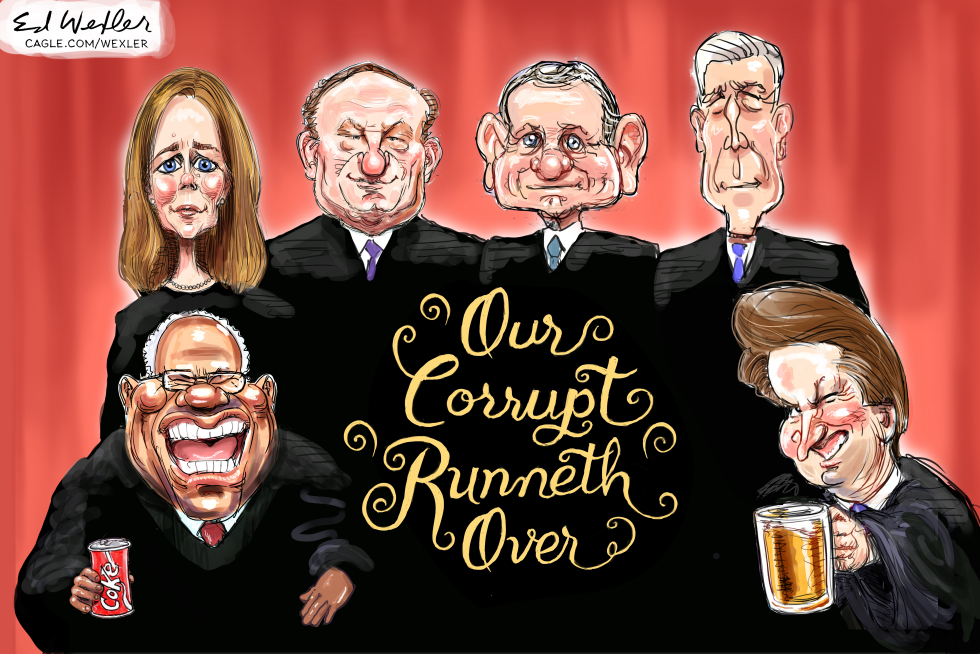
The cartoon from May 2026 shows six Supreme Court justices in black robes against a red curtain. Central figures include Clarence Thomas laughing with a Coke, Brett Kavanaugh with a beer, and others with stern or smirking expressions. Gold text reads Our Corrupt Runneth Over. The image references ongoing ethics debates involving several conservative members of the court.
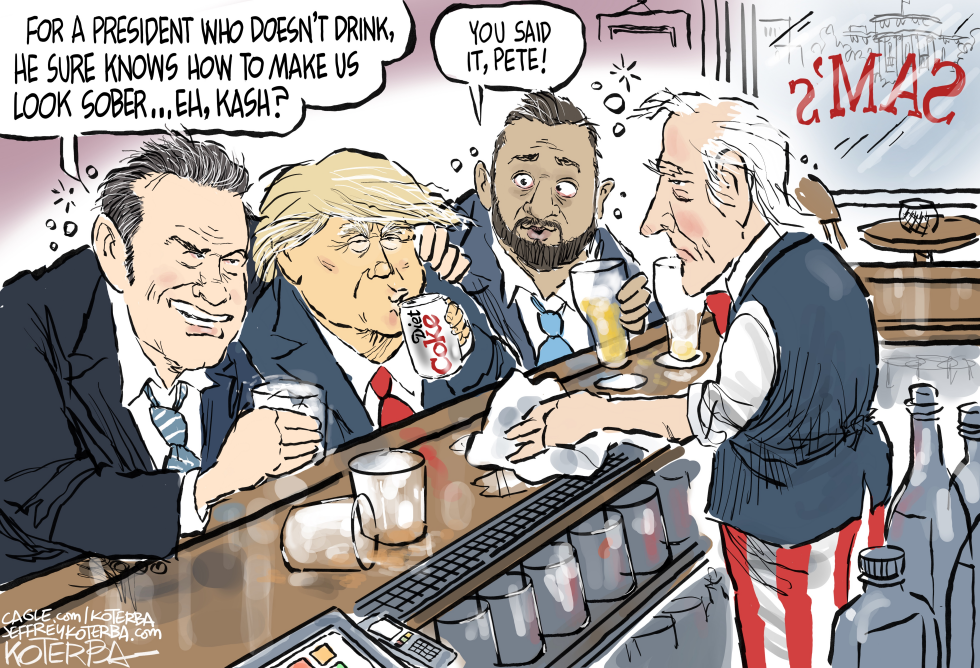
Jeff Koterba's cartoon depicts Pete Hegseth speaking to Kash Patel at a bar named Sam's, with Donald Trump sipping Diet Coke and an Uncle Sam-clad bartender resembling a political figure serving drinks. Tags like FBI, Department of War, and defense underscore the satire on Trump's nominees. The scene uses alcohol, beer, and cocktail elements to joke about Washington's political sobriety. Hegseth quips about the president's non-drinking habits making them look sober, while Patel agrees emphatically. This piece captures insider Washington dynamics with dry humor, blending bar culture and political appointments in a straightforward visual punch.
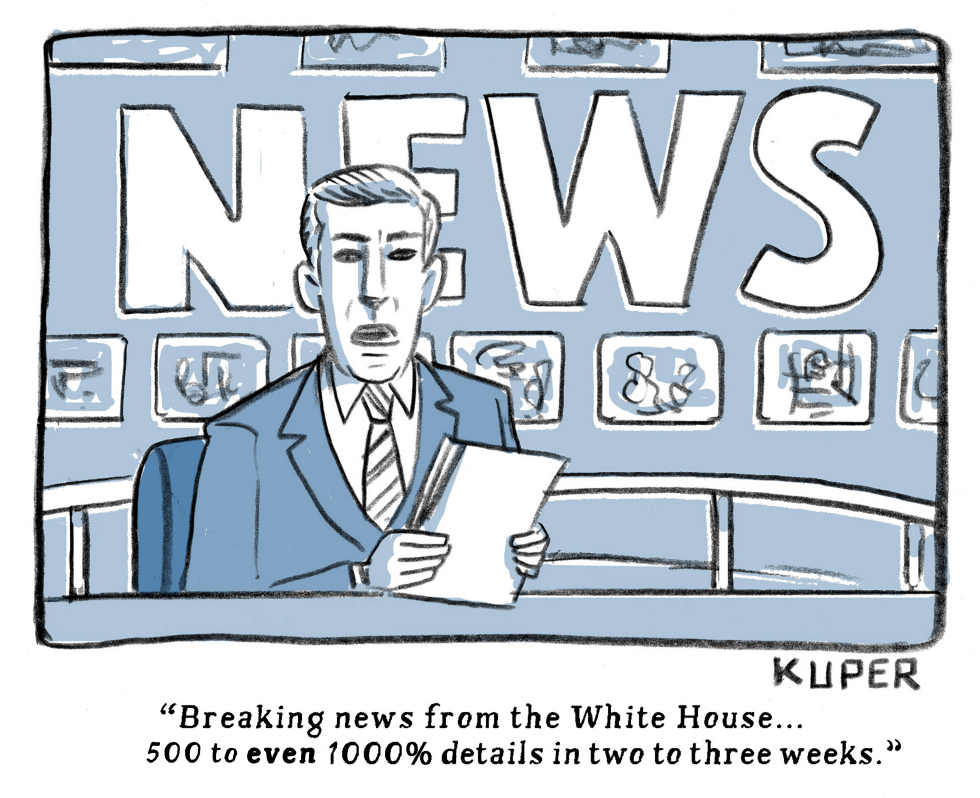
Peter Kuper\'s political cartoon depicts a stern news anchor at a desk under a large \'NEWS\' sign, holding a paper and announcing vague breaking news from the White House with promises of \'500 to even 1000% details in two to three weeks.\' The satire targets flip flopping, white house lies, and promises broken, reflecting on issues like no health care plan, food and drug prices rising, and soaring gas costs. Background elements include indistinct screens, keeping the focus on the anchor\'s absurd statement. This piece highlights distraction tactics amid war in iran continues and strait of hormuz closed, with warships and blockade adding to the billion dollars a day for military. The fbi epstein files tag suggests underlying scandals, but the image stays straightforward in its mockery of delayed truths.
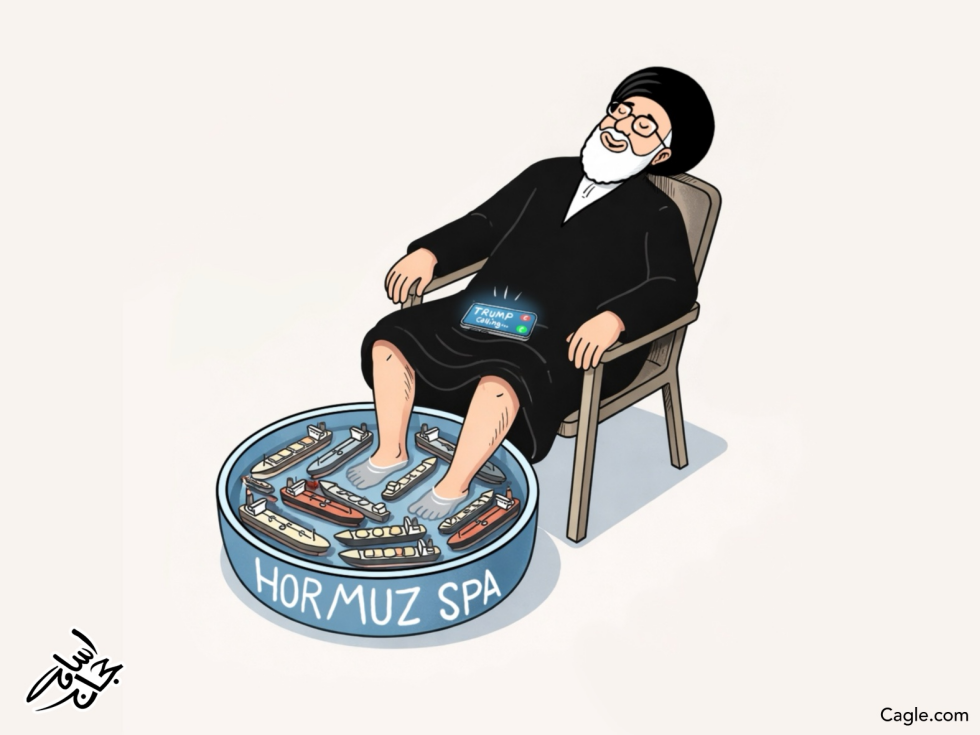
Osama Hajjaj draws an Iranian leader, resembling a cleric in black robes and turban, slouched in a chair with feet immersed in a blue basin labeled Hormuz Spa. Tiny ships float around his feet, evoking the Strait of Hormuz. A phone on his lap displays Trump with a green light, implying a call or alert. The scene captures dry satire on Iran-Trump relations, with the spa pun highlighting control over vital shipping lanes. Tags like Hormuz, Iran, Donald Trump, spa, and political cartoon underscore the humor in geopolitical friction.
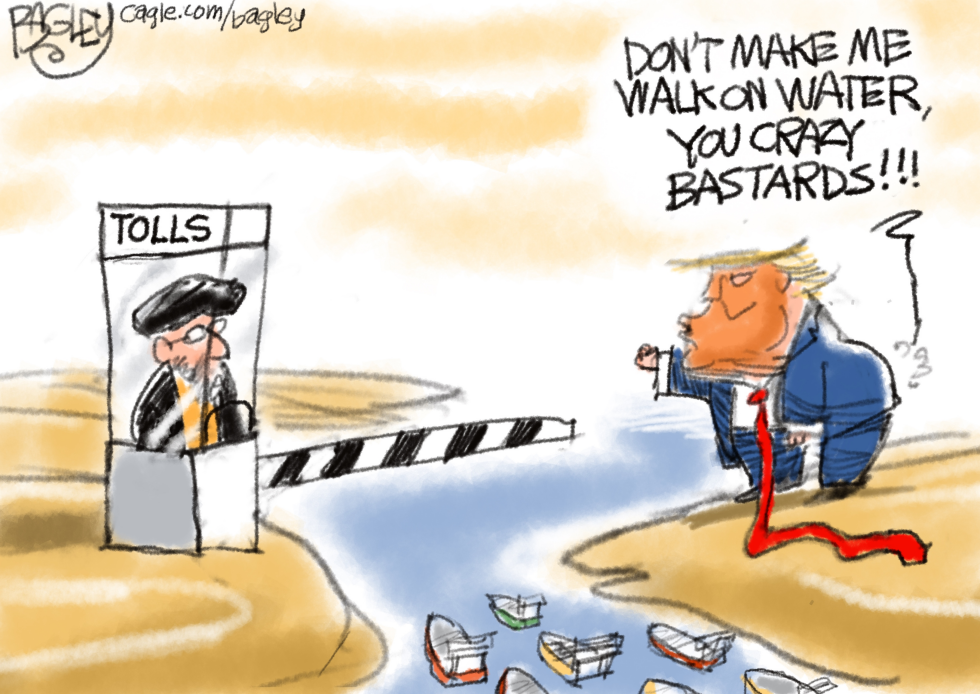
Donald Trump stands at the edge of a body of water confronting a toll booth operated by a figure resembling Ayatollah Khamenei. Small tankers sit in the water below while Trump issues a warning about walking on water. The scene references shipping routes through the Strait of Hormuz and surrounding nations.
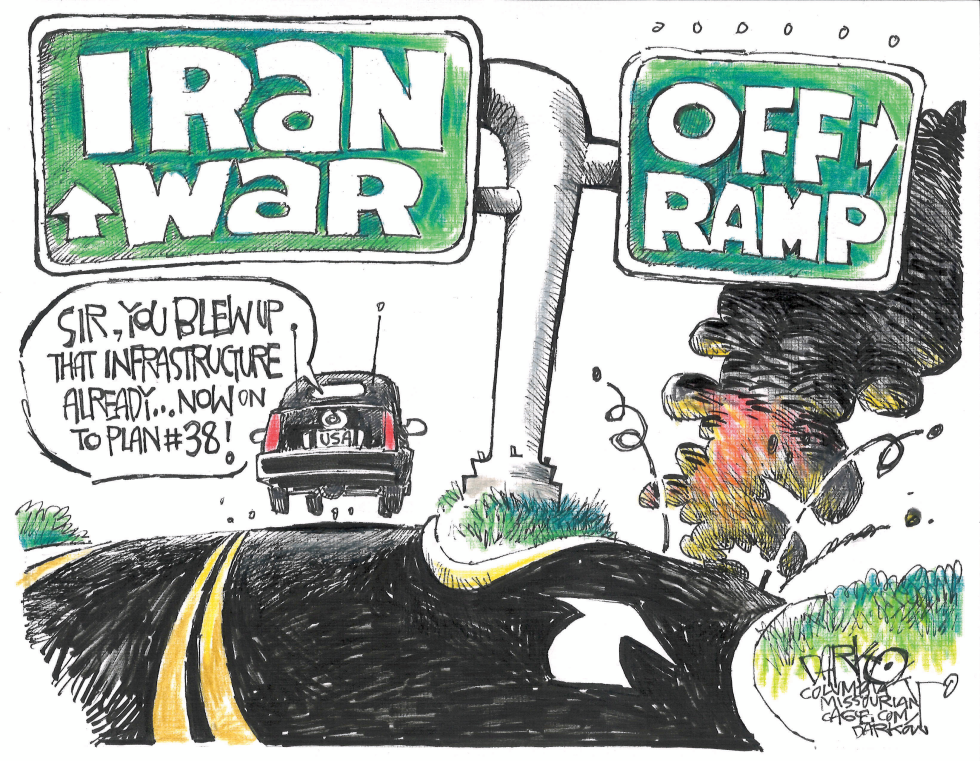
This daryl cagle political cartoon shows a highway split with signs for iran war upward and off ramp rightward, where a usa license plate car drives into an explosion. The car\'s speech bubble says, \'SIR, YOU BLEW UP THAT INFRASTRUCTURE ALREADY... NOW ON TO PLAN #38!\' highlighting satirical destruction. Amid grass and road lines, the image mocks usa iran conflict satire through off ramp infrastructure destruction cartoon, emphasizing failed exits in political cartoon usa foreign policy. The irreverent style captures highway to iran war illustration with humorous despair over repeated plans.
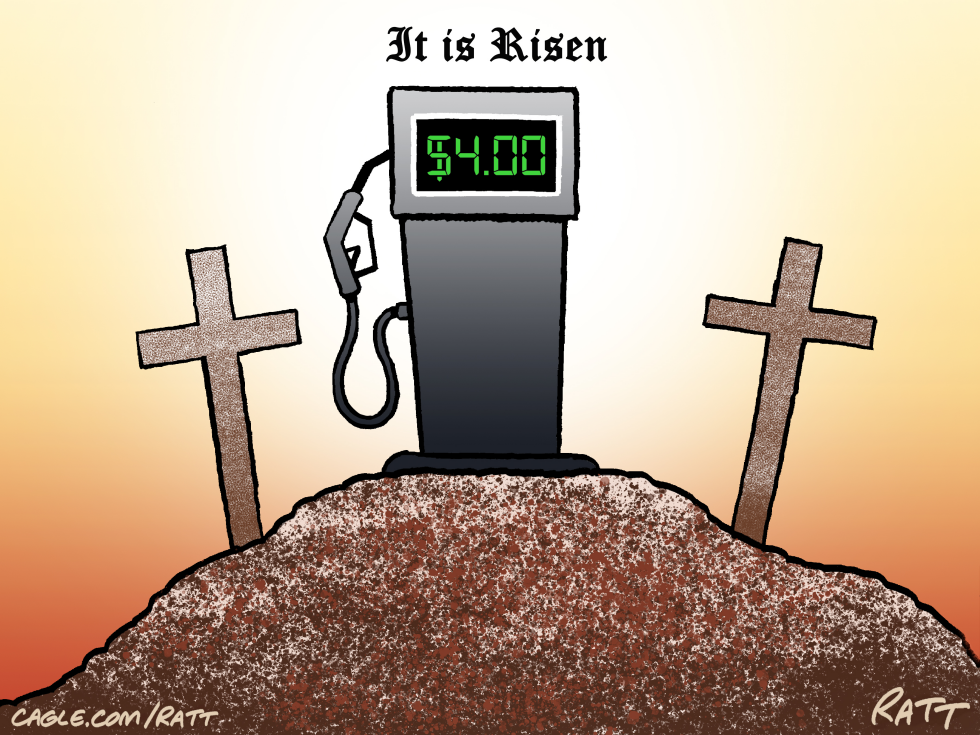
Ratt's cartoon captures Easter in America 2026 with a gas pump standing in for the central cross on a Calvary hill, showing $4.00 on its display and the text 'It is Risen' above, playing on rising gas prices. Tags like Easter, gas prices, oil, Iran war, and Strait of Hormuz suggest a future where geopolitical tensions drive fuel costs skyward. The artwork uses simple lines and a sunset background to evoke the biblical scene, but replaces resurrection with economic pain. This satire highlights how global events, including potential conflicts in the Strait of Hormuz, could lead to exorbitant oil prices by 2026. The dry humor underscores American dependence on foreign oil, making the cartoon timely and shareable amid ongoing energy debates.
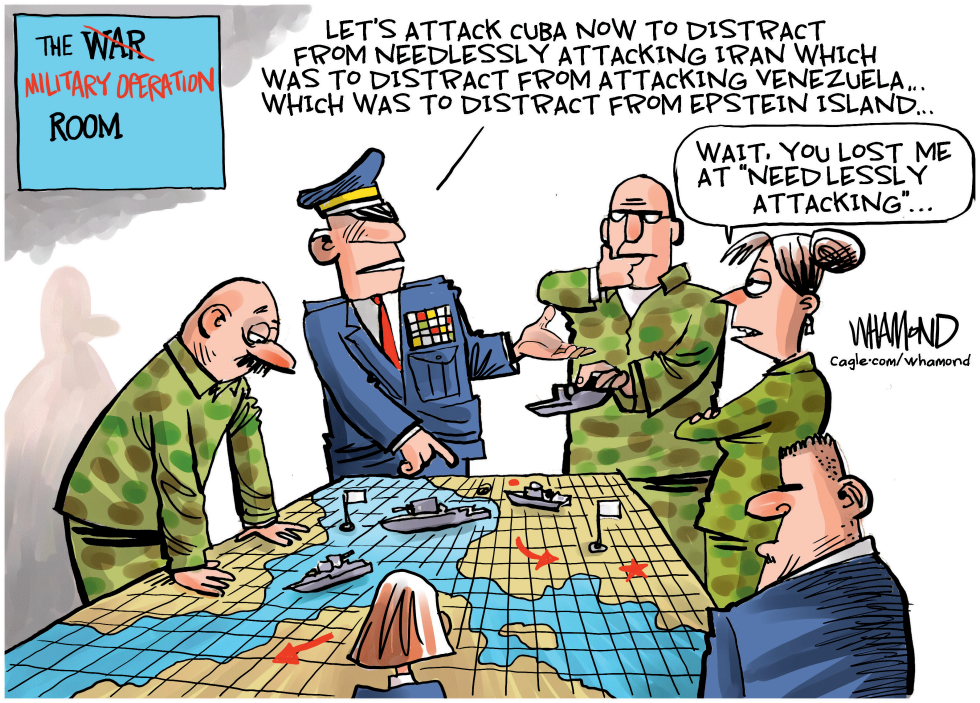
Dave Whamond's political cartoon depicts a group of military officials in a war room, gathered around a map with toy ships, discussing a chain of distractions starting from attacking Cuba to cover needless attacks on Iran, which distracted from Venezuela, looping back to Epstein Island. The scene captures the absurdity with one figure pointing at the map and another expressing confusion over 'needlessly attacking.' This satirical illustration uses dry humor to comment on convoluted military strategies and political diversions, incorporating elements like crossed-out 'War' sign replaced by 'Military Operation Room' for added irony. Tags like political satire, war distractions, foreign policy cartoon, Epstein Island reference, military humor, and endless distraction chain emphasize the cartoon's sharp critique.
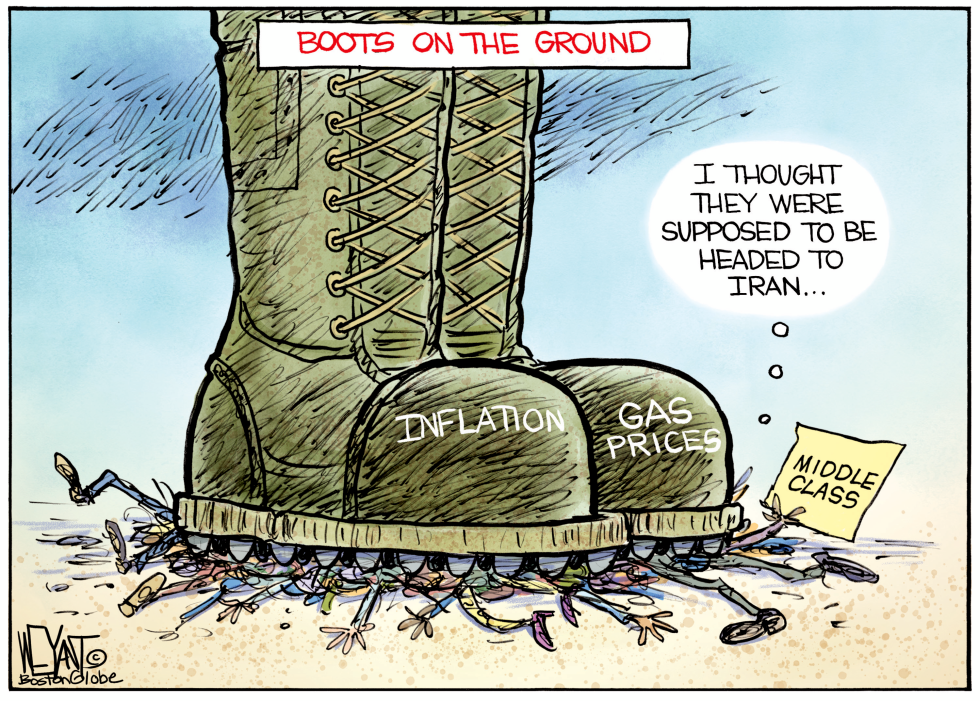
The cartoon shows a pair of massive military boots dominating the scene, one labeled 'Inflation' and the other 'Gas Prices,' as they crush small human figures on the ground, with a sign reading 'Middle Class' among them. A speech bubble from one of the crushed figures says, 'I thought they were supposed to be headed to Iran...' The title 'Boots on the Ground' sits at the top. This setup uses dry humor to highlight misplaced priorities in war, economy, inflation, gas prices, middle class, and Iran. The sandy ground and stormy sky add to the chaotic feel, tying into tags like Trump, negotiation, Strait of Hormuz, and domestic policy impacts.
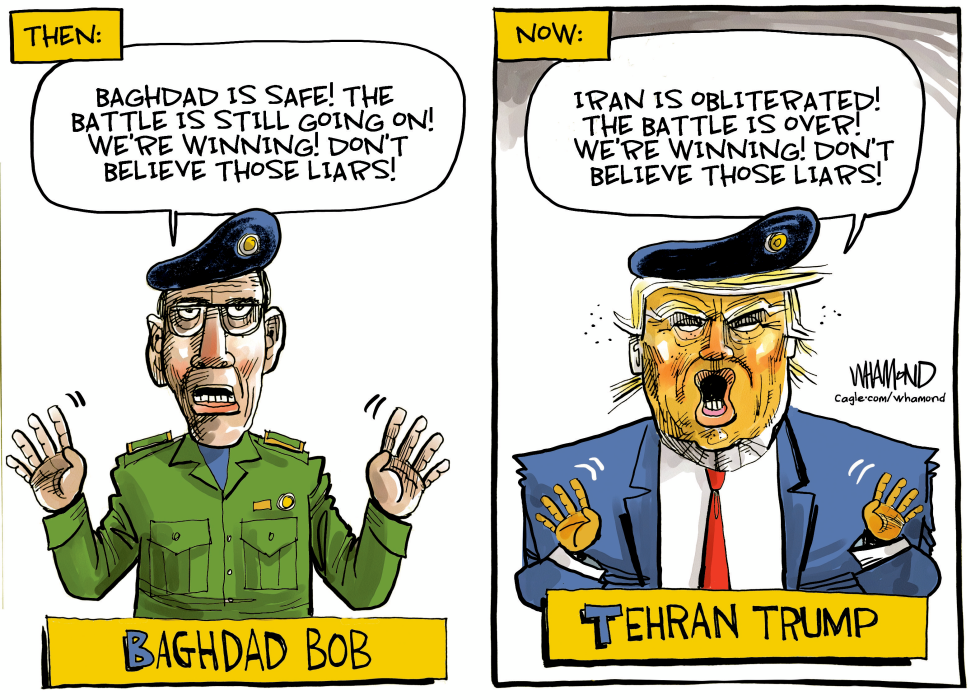
Dave Whamond's political cartoon splits into 'Then' and 'Now' panels, showing Baghdad Bob in military garb proclaiming Baghdad's safety and ongoing victory, dismissing liars. On the right, a Trump-like figure dubbed Tehran Trump, wearing a beret and suit, declares Iran obliterated and battle over, again urging disbelief in liars. The satire underscores parallels in propaganda and denialism, with tags like political satire, Trump caricature, Iraq War reference, Iran conflict, misinformation leaders, and historical parallel. This visual commentary critiques how figures twist realities in wartime narratives, blending dry humor with sharp observation on political exaggeration.
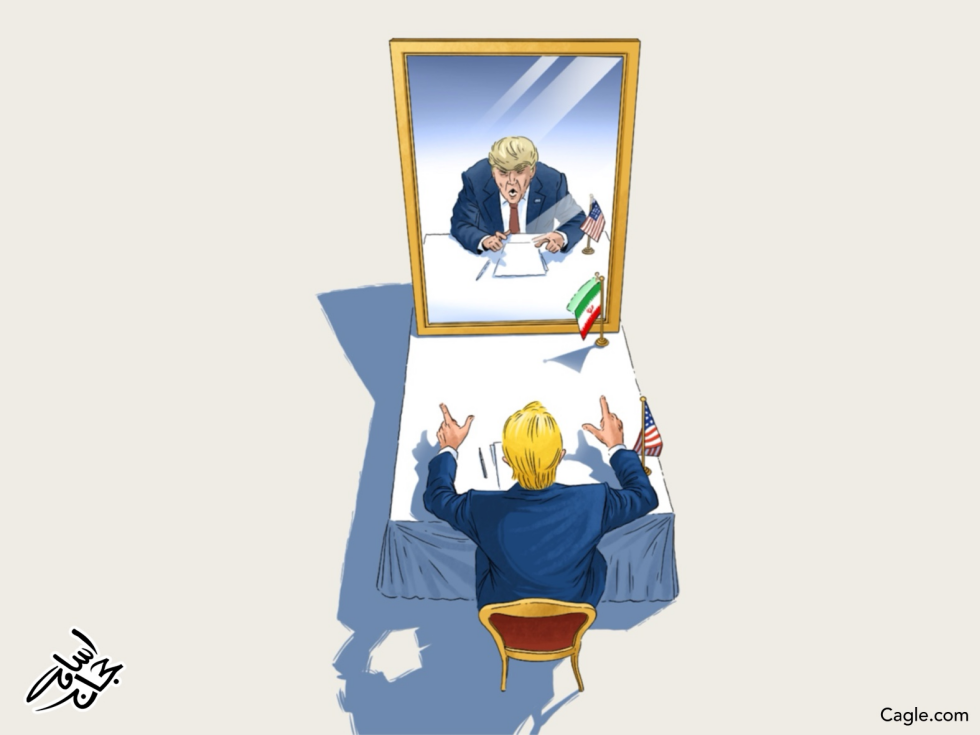
This humorous political cartoon depicts a figure with distinctive yellow hair and a blue suit seated at a table, pointing accusingly at a large mirror. In the reflection, an identical figure points back, but with an Iran flag instead of the US flag beside him. The setup cleverly satirizes self-negotiation or internal conflict in international relations, using mirror imagery for ironic effect. Elements like the pointing fingers, national flags, and desk setup emphasize bilateral tensions. As a satirical piece from Cagle.com, it offers insightful commentary on diplomatic absurdities, blending humor with political critique in a visually striking composition.
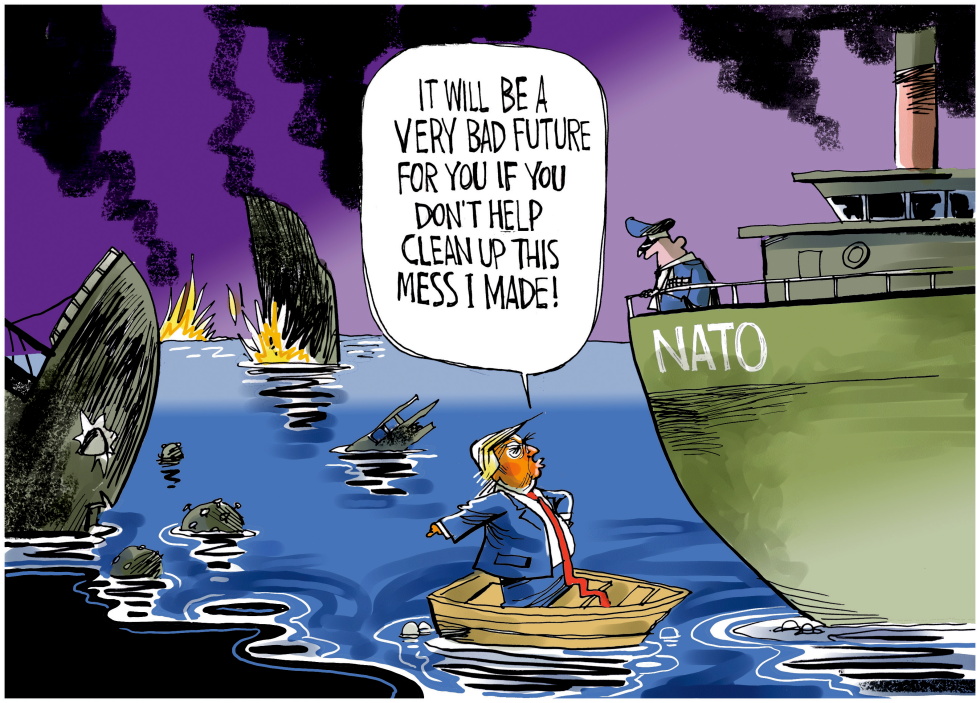
Dave Whamond's cartoon shows a caricature of Donald Trump in a small rowboat, suit and tie askew, shouting threats at a massive green ship labeled NATO. A uniformed figure leans over the railing, watching impassively. Surrounding them are sinking ships with stars, flames bursting from hulls, black smoke curling into a purple sky. The dark water is littered with debris. Trump's speech bubble warns of a bad future if allies don't clean up his mess. This setup nails trump demands, nato alliance, political satire, foreign policy mess, alliance tensions, and satirical caricature with sharp lines and exaggerated features typical of editorial cartoons.