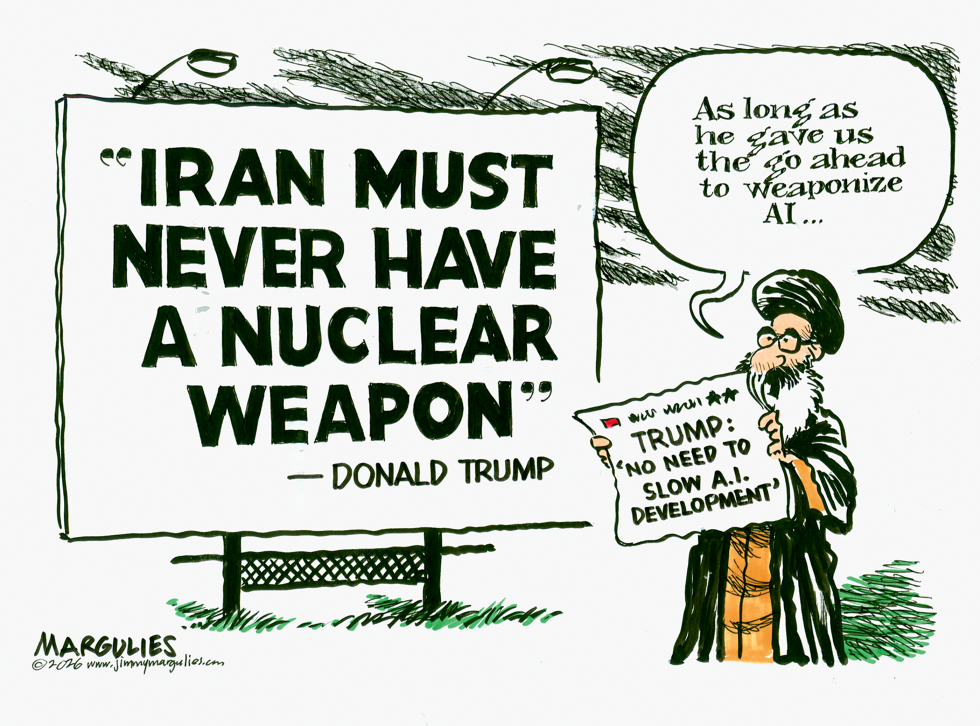
Donald Trump has repeatedly stated that Iran must never obtain a nuclear weapon, a position rooted in long-standing U.S. efforts to prevent nuclear proliferation in the Middle East. At the same time, reports indicate interest in accelerating artificial intelligence development without slowdowns. The cartoon responds to this apparent tension by depicting an Iranian leader conditioning acceptance of the nuclear restriction on permission to pursue AI weaponization. It argues that prioritizing rapid AI advancement risks undermining nonproliferation goals and hands strategic advantages to adversaries.
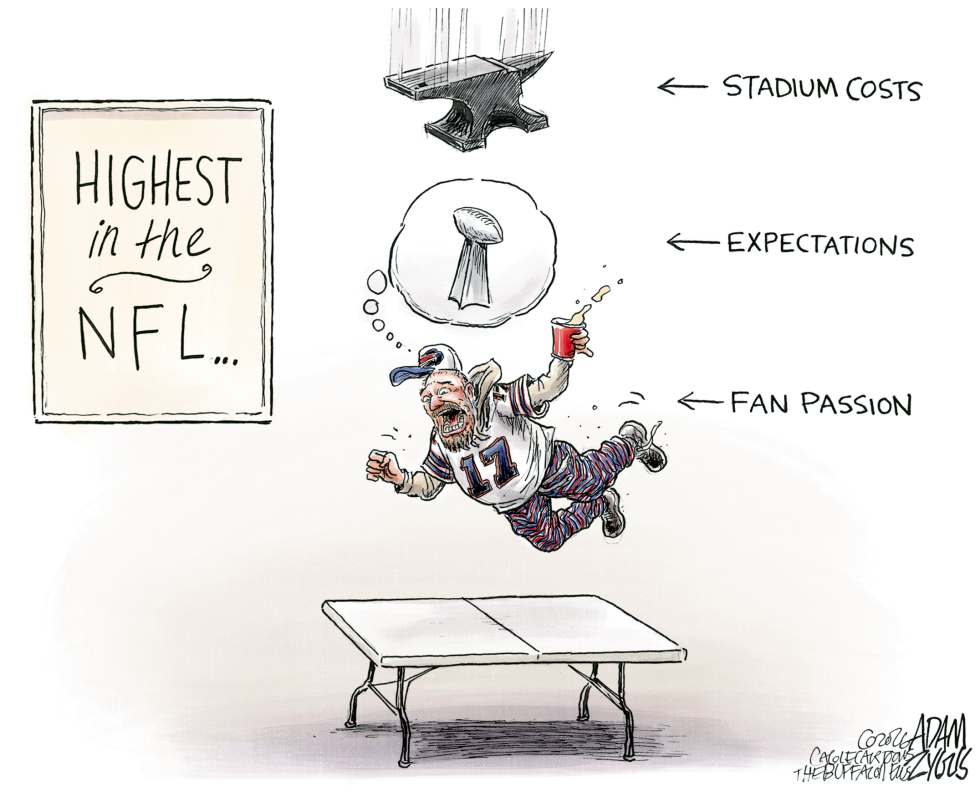
The cartoon illustrates a Buffalo Bills fan tumbling through the air after being struck by an anvil labeled stadium costs. A thought bubble shows a Super Bowl trophy while labels point to expectations and fan passion. A sign on the left declares the team highest in the NFL. The scene comments on the team's new stadium project carrying the highest costs in the league. Fans remain enthusiastic despite the financial weight. The ping pong table below suggests a precarious landing. The work responds to ongoing discussions about public funding for the Bills stadium.
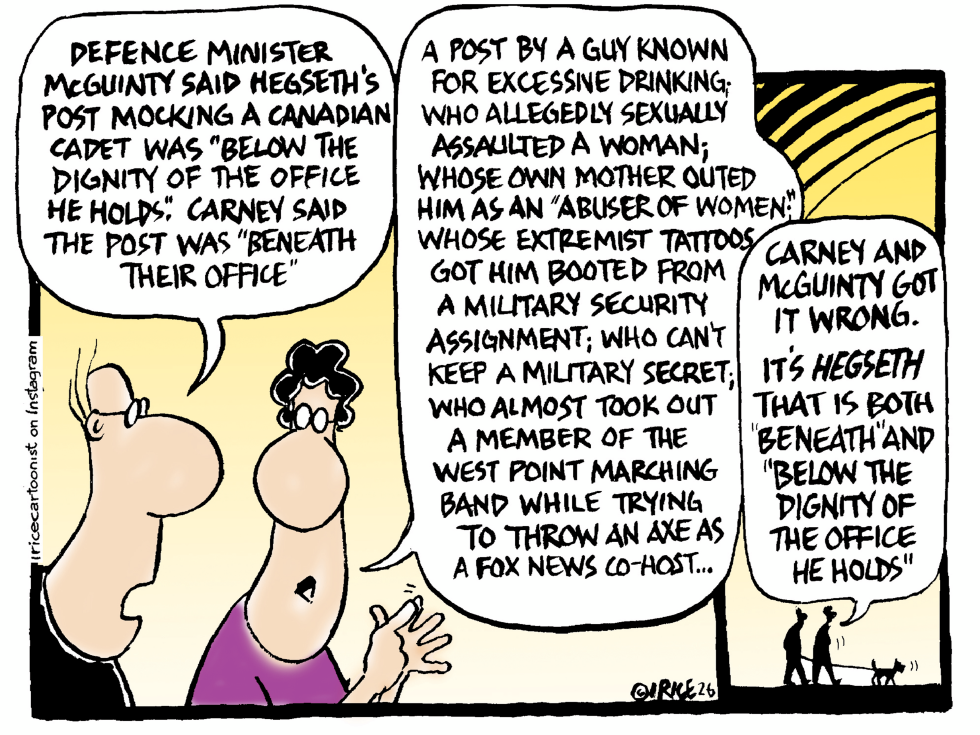
Canadian Defence Minister David McGuinty and Mark Carney publicly condemned a social media post by Pete Hegseth mocking a Canadian cadet, calling it beneath the dignity of the office. The remarks came amid Hegseth's nomination process for a senior U.S. defense position. The cartoon argues the ministers have the assessment backward, pointing instead to Hegseth's history of alleged misconduct, security clearance problems, and public incidents as the true disqualifiers. This reflects ongoing debate over nominee vetting standards and cross-border political commentary on U.S. appointments.
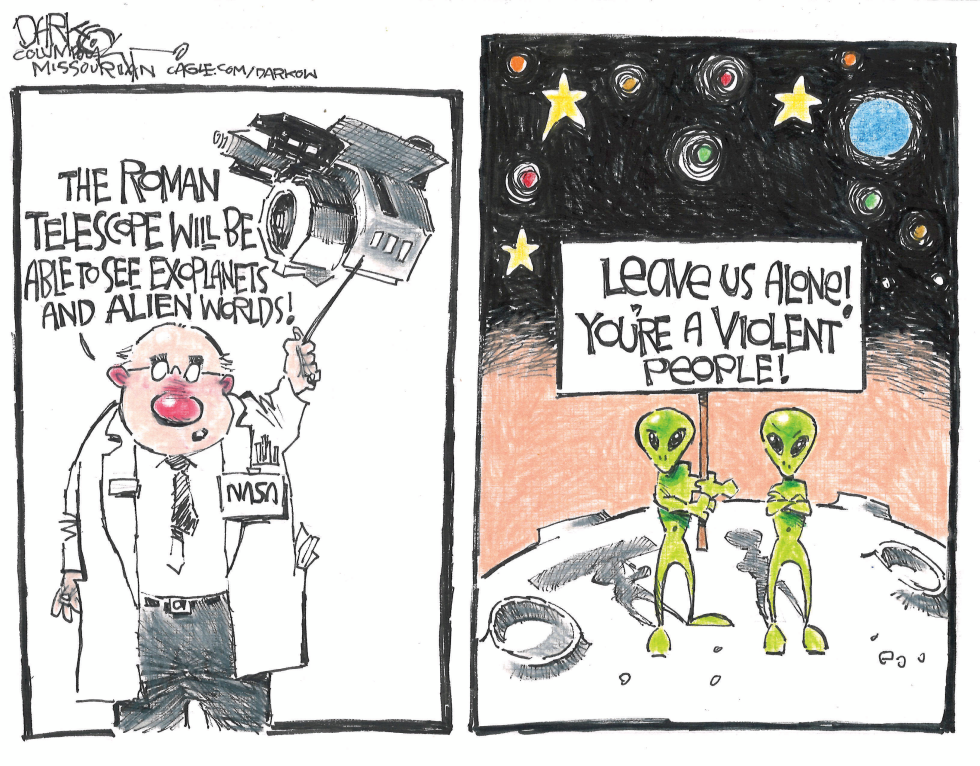
NASA is advancing the Roman Space Telescope to detect exoplanets and alien worlds. The project highlights expanding human reach into space. The cartoon depicts aliens responding with a protest sign labeling humans as violent. It underscores concerns that contact could expose extraterrestrials to Earth's conflicts. The piece takes the position that humanity's record may justify alien reluctance to engage.
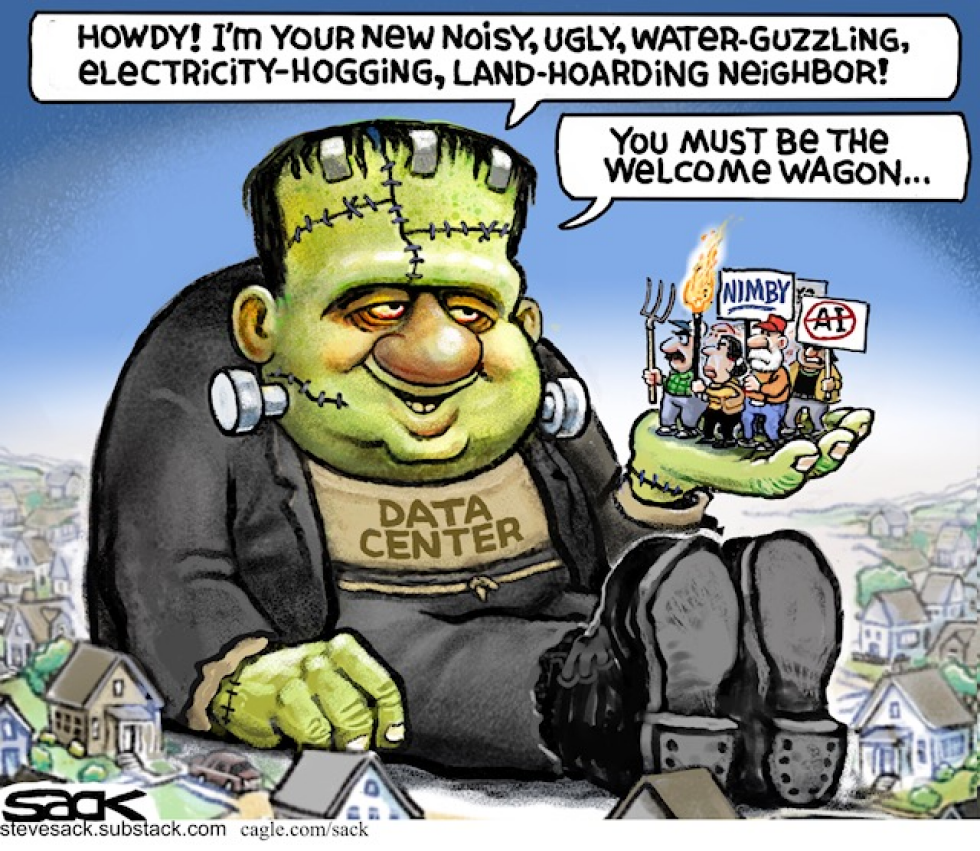
Rapid growth in AI data centers has triggered protests in suburban areas over high electricity and water consumption plus land use. Residents organized under NIMBY banners to block projects they say strain local infrastructure. The cartoon frames the facilities as intrusive newcomers disrupting neighborhoods.
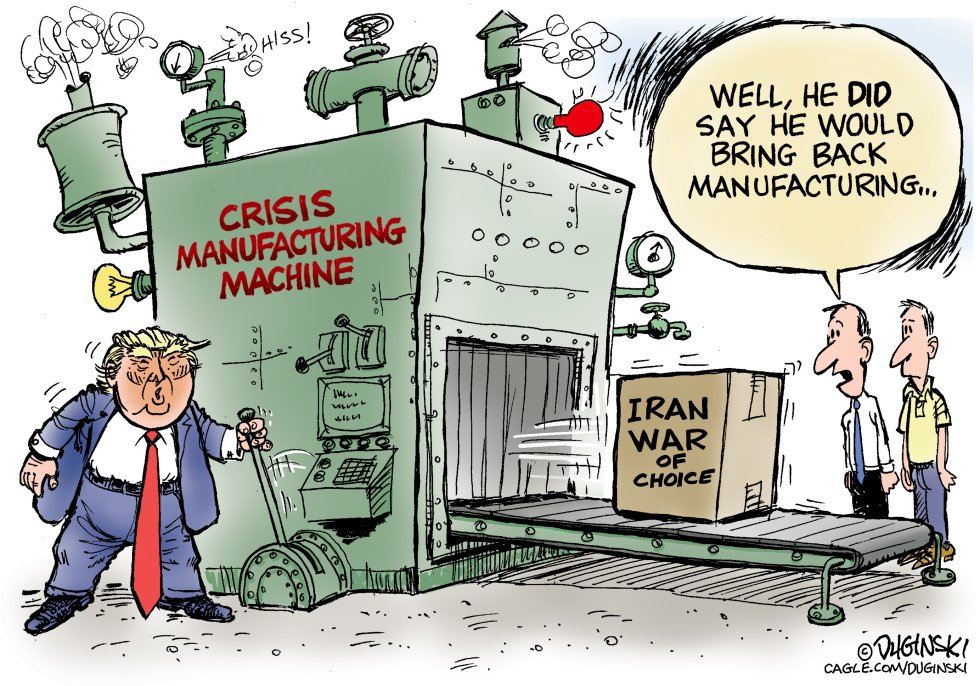
Donald Trump, holding the presidency in 2026, faces renewed scrutiny over foreign policy toward Iran. Recent statements revive campaign pledges to restore domestic manufacturing while tensions with Tehran escalate. The administration\\\'s approach draws criticism for prioritizing confrontation over diplomacy. Observers note the pattern of generating external crises rather than economic gains at home. The cartoon argues that Trump\\\'s actions fulfill a literal version of his manufacturing rhetoric by producing conflict instead of jobs.
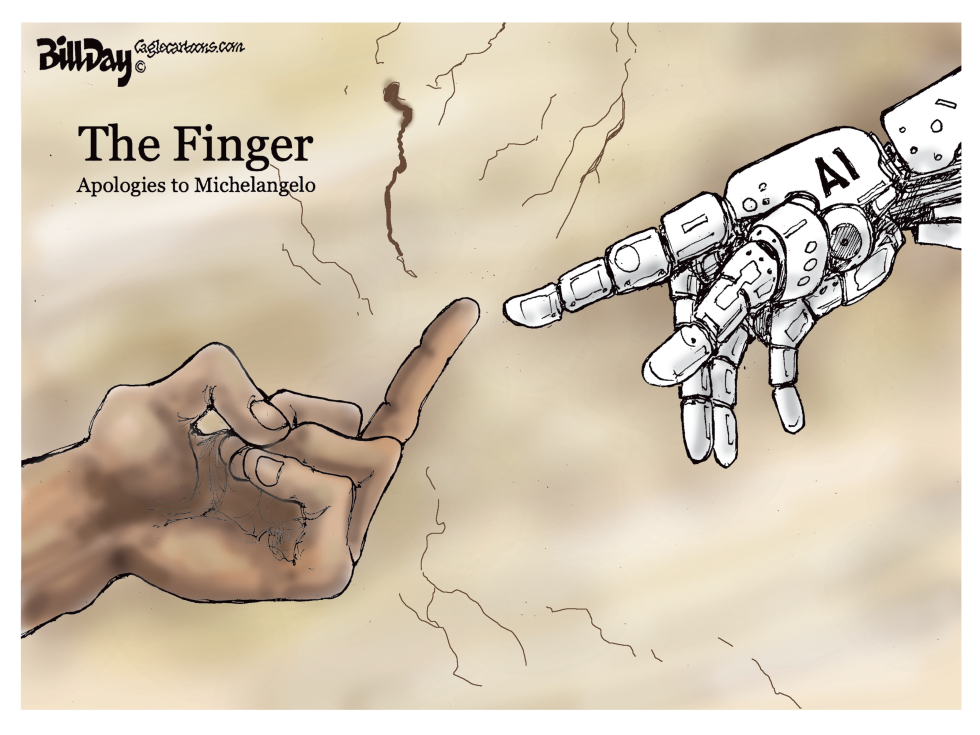
Rapid advances in artificial intelligence continue to reshape human capabilities and daily interactions as of mid 2026. Developers and companies push boundaries on machine learning systems that mimic and extend human functions. The editorial position highlights the direct convergence between human agency and machine intelligence as a defining development of the era.
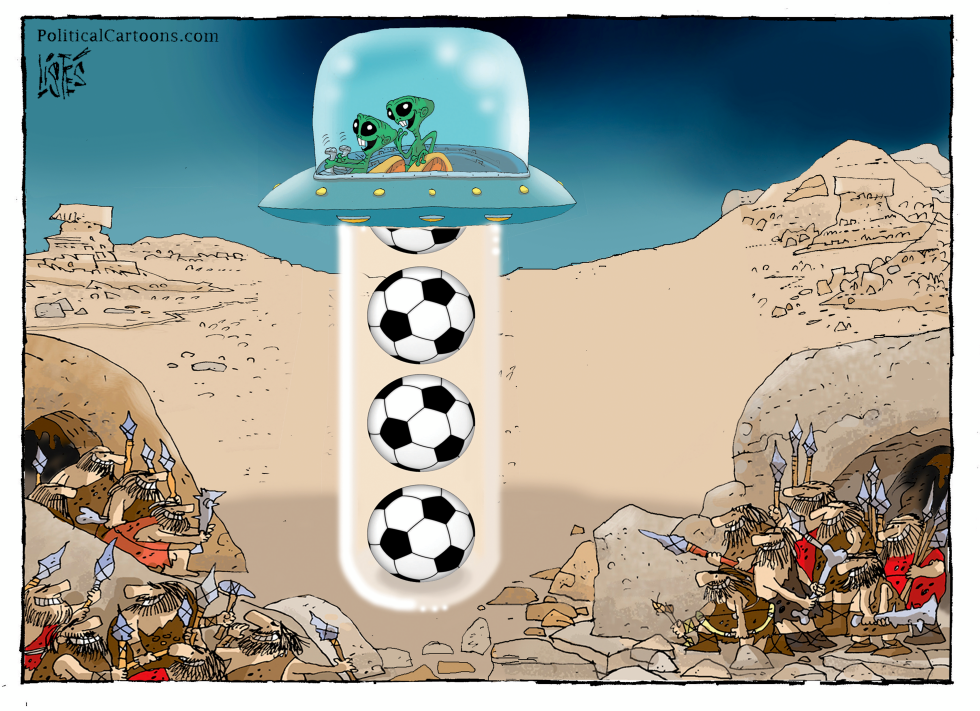
The cartoon depicts a UFO hovering over a desert landscape dotted with ruins. Two green aliens inside release a trail of soccer balls toward a group of cavemen armed with spears and clubs. The cavemen react with surprise and aggression as the balls descend. The scene plays on the idea of soccer's mysterious origins ahead of the 2026 World Cup hosted by the United States, Mexico, and Canada.
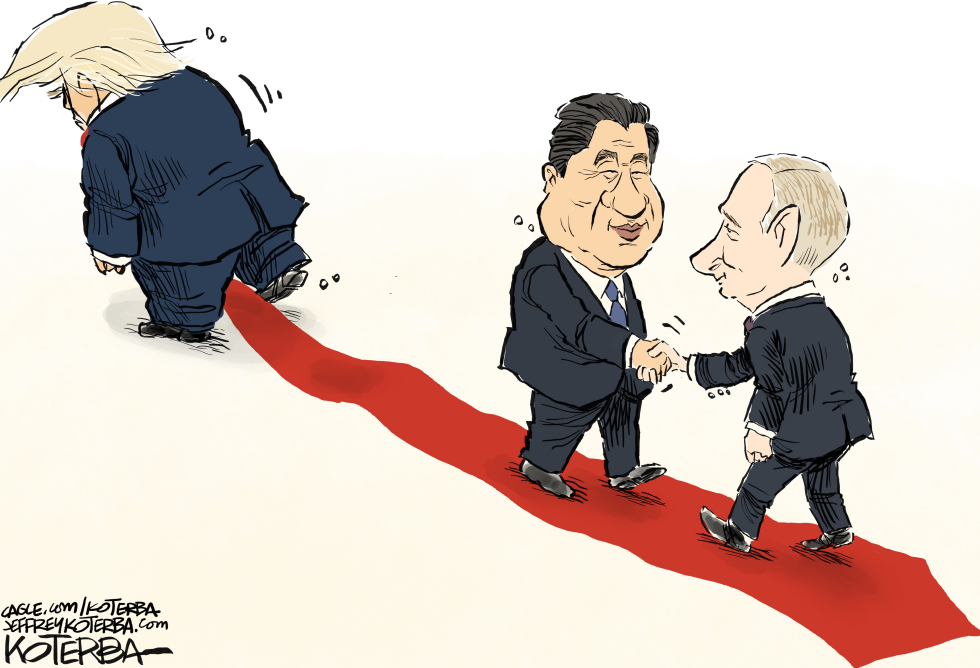
The image presents a simple cartoon scene with three figures in dark suits positioned along a red carpet. One figure with blonde hair is shown walking away toward the left edge. The remaining two figures face each other and clasp hands while standing on the carpet that stretches diagonally across the frame. Small motion lines and dots add basic movement details around the figures. The background remains plain and white with a signature block in the lower left corner.
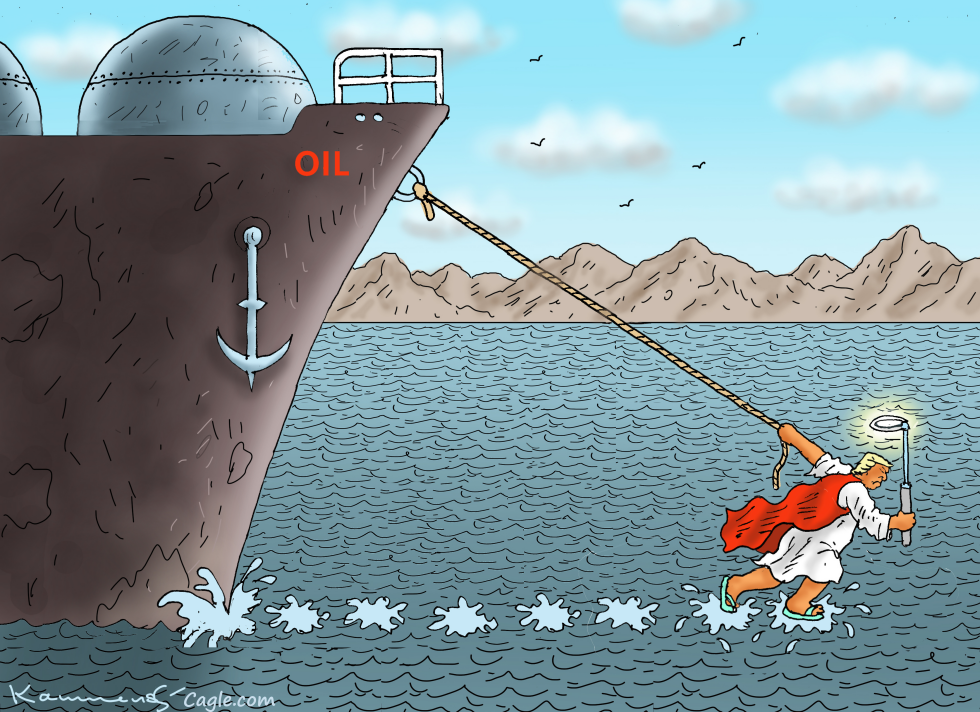
The image depicts a figure dressed in a white robe and red cape, complete with a glowing halo, running across the water while pulling a large oil tanker marked 'OIL' with a rope. He holds a golf club in one hand, splashing water with each step against a backdrop of mountains and a clear sky. This setup draws on tags like Trump, Hormuz, Iran, oil war, MAGA terror, and fascism to satirize political figures intervening in global oil crises. The cartoon's composition emphasizes the absurdity of a divine savior tackling economic and geopolitical issues, with birds flying overhead and distant peaks suggesting a Middle Eastern strait. Kamensky's style brings dry humor to the forefront, poking at notions of messianic leadership in turbulent times.
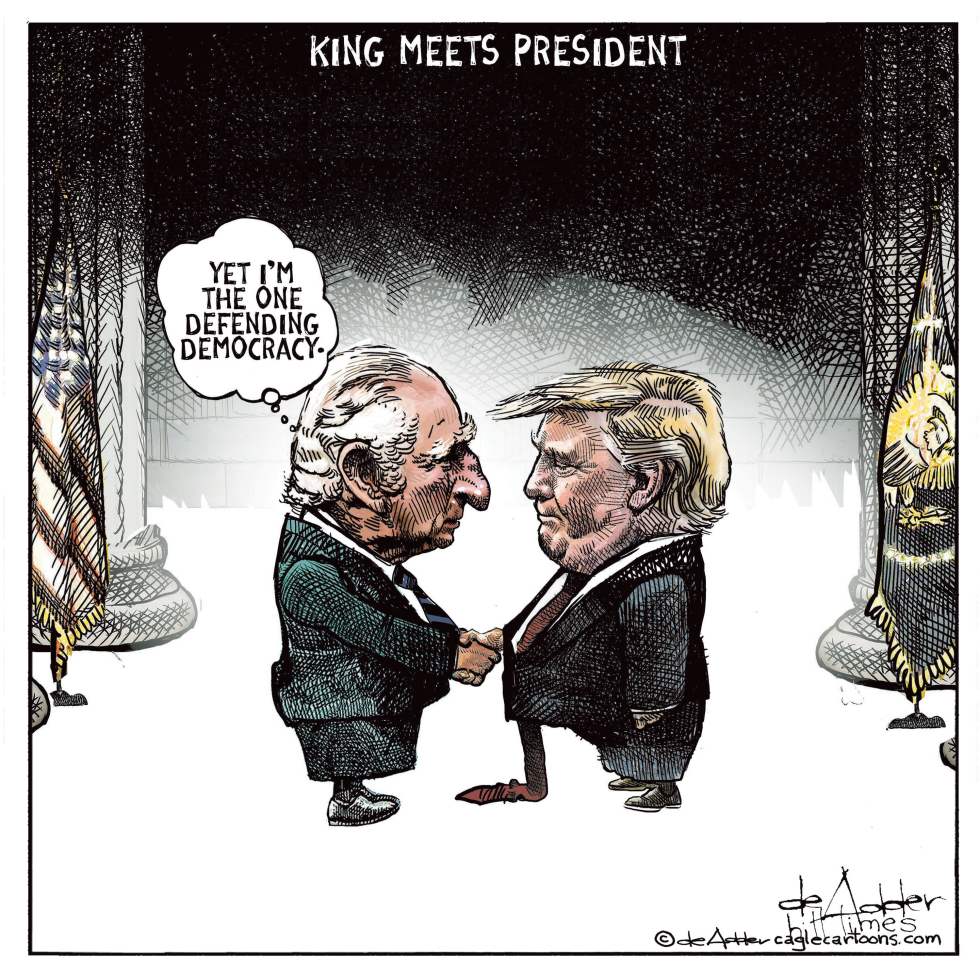
Michael de Adder's cartoon captures a handshake between King Charles and President Trump, set against American and implied British flags in a White House-like scene. The title 'KING MEETS PRESIDENT' tops the image, with Charles saying, 'Yet I'm the one defending democracy.' Tags like UK, United Kingdom, States, America, White House, Visit, State underscore the diplomatic theme. This satire touches on trade, tariffs, and economy without overreaching into unseen motives. The dry humor lies in the visual irony of two leaders in suits, one royal and one presidential, amid formal backdrops. Artistic style uses crosshatching for depth, keeping focus on the central exchange.
Monte Wolverton\'s cartoon depicts a doctor holding up an xray that reveals an intestine shaped like the Strait of Hormuz, complete with stars indicating blockages and inflammation. Trump peers over the top, his distinctive hair visible, as the doctor diagnoses intermittent blockages, polyps, and suggests consuming more fiber while cutting back on fast food. Tags like Iran War and blockade tie into the visual pun, turning a geopolitical chokepoint into a medical ailment. The piece uses dry humor to highlight discomfort in a straightforward way, with the xray\'s pinkish intestine contrasting against the black background. Artistic elements include the doctor\'s pointing finger and Trump\'s curious pose, emphasizing the satire without overcomplicating the scene.
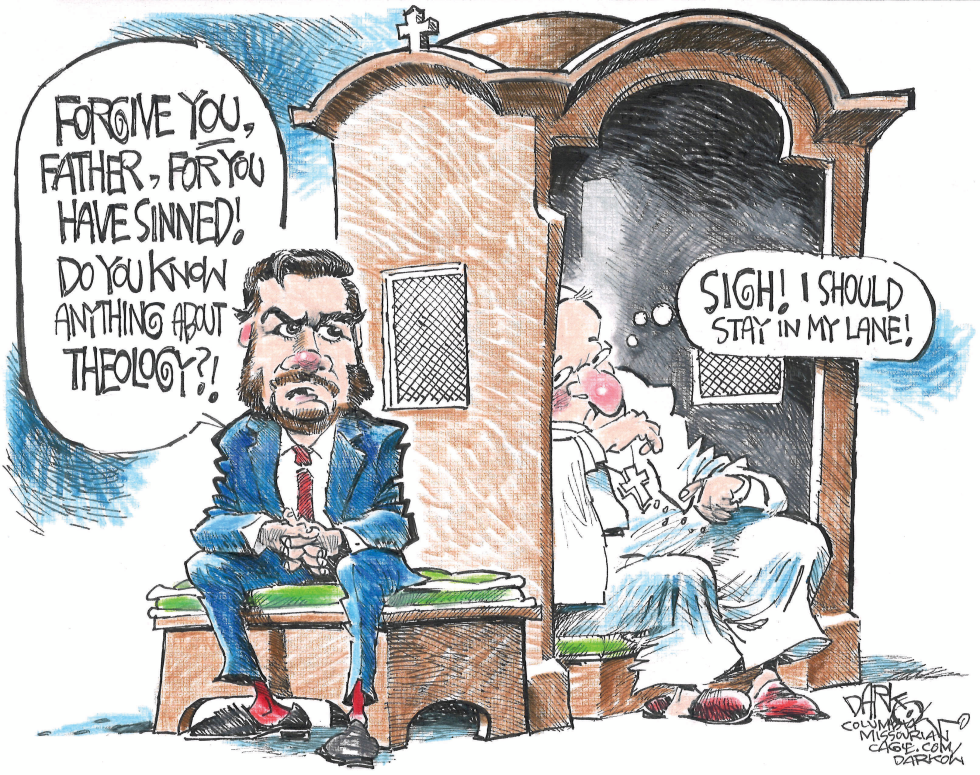
The cartoon shows a suited man with a beard, seated in a confessional booth, angrily addressing a priest dressed in white robes with a cross, using tags like JD Vance, Pope Leo, prayer, God, Jesus, war, theology, confession. The man declares forgiveness to the father for sinning and questions his knowledge of theology. The priest, holding a baby-like figure, sighs and admits he should stay in his lane. This setup captures a role reversal in a traditional confessional scene, with the layman taking an authoritative stance. The artwork by John Darkow features sketchy lines and blue shading, emphasizing the humorous tension between secular and religious domains.
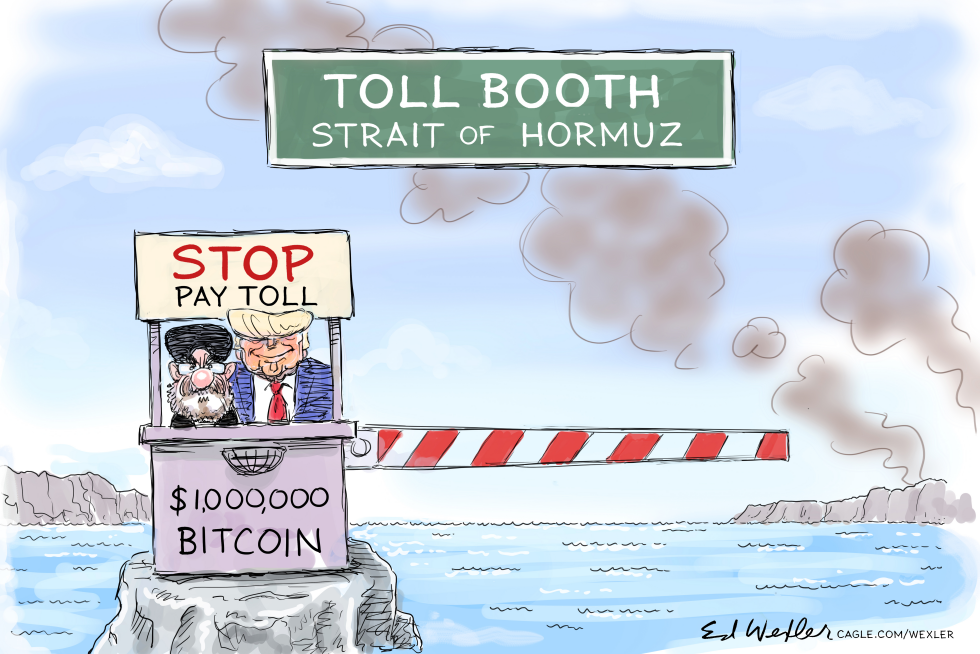
Ed Wexler\\\'s cartoon captures a toll booth in the Strait of Hormuz, where figures resembling Trump and the Ayatollah enforce a $1,000,000 Bitcoin toll. Smoke rises from what look like mines in the water, blending tags like Iran, Strait of Hormuz, tolls, Bitcoin, Trump, Ayatollah, and crypto into a sharp commentary. The barrier arm blocks passage, emphasizing control over this vital shipping lane. It\\\'s a straightforward jab at geopolitical tensions, with the toll sign demanding payment to proceed. No hidden layers here, just clear visuals tying economic pressures to digital currency in a contested area. The dry humor shines through in the absurdity of a Bitcoin booth amid potential explosions.