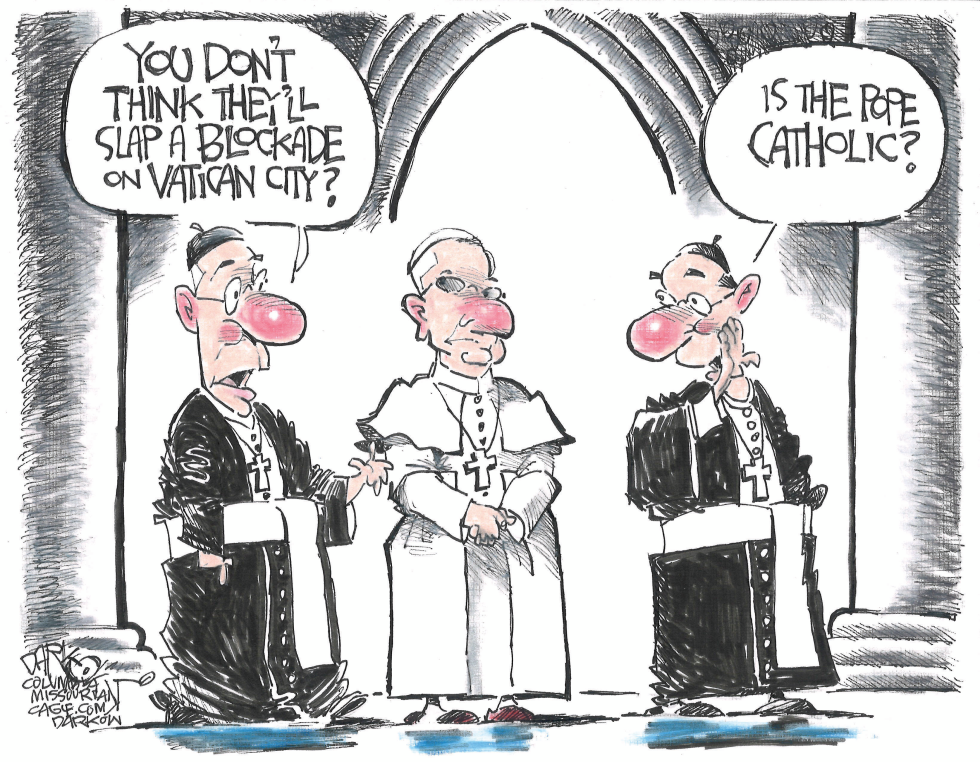
John Darkow's cartoon captures three Catholic clergy in traditional attire, with the central Pope figure amid a discussion on a Vatican blockade. The left figure worries about sanctions slapping Vatican City, while the right delivers the classic 'Is the Pope Catholic?' line, a rhetorical jab at obvious truths. This piece uses dry humor to spotlight tensions around religious institutions facing isolation, blending blockade fears with papal identity. The archway background grounds it in Vatican aesthetics, emphasizing the blockade theme without overreaching into unseen politics.
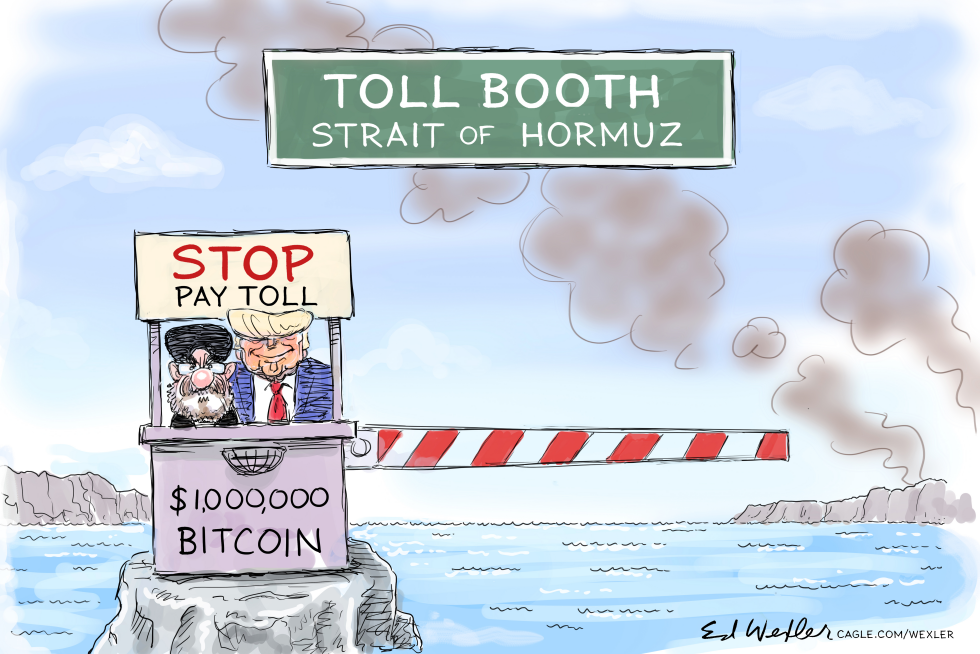
Ed Wexler\\\'s cartoon captures a toll booth in the Strait of Hormuz, where figures resembling Trump and the Ayatollah enforce a $1,000,000 Bitcoin toll. Smoke rises from what look like mines in the water, blending tags like Iran, Strait of Hormuz, tolls, Bitcoin, Trump, Ayatollah, and crypto into a sharp commentary. The barrier arm blocks passage, emphasizing control over this vital shipping lane. It\\\'s a straightforward jab at geopolitical tensions, with the toll sign demanding payment to proceed. No hidden layers here, just clear visuals tying economic pressures to digital currency in a contested area. The dry humor shines through in the absurdity of a Bitcoin booth amid potential explosions.
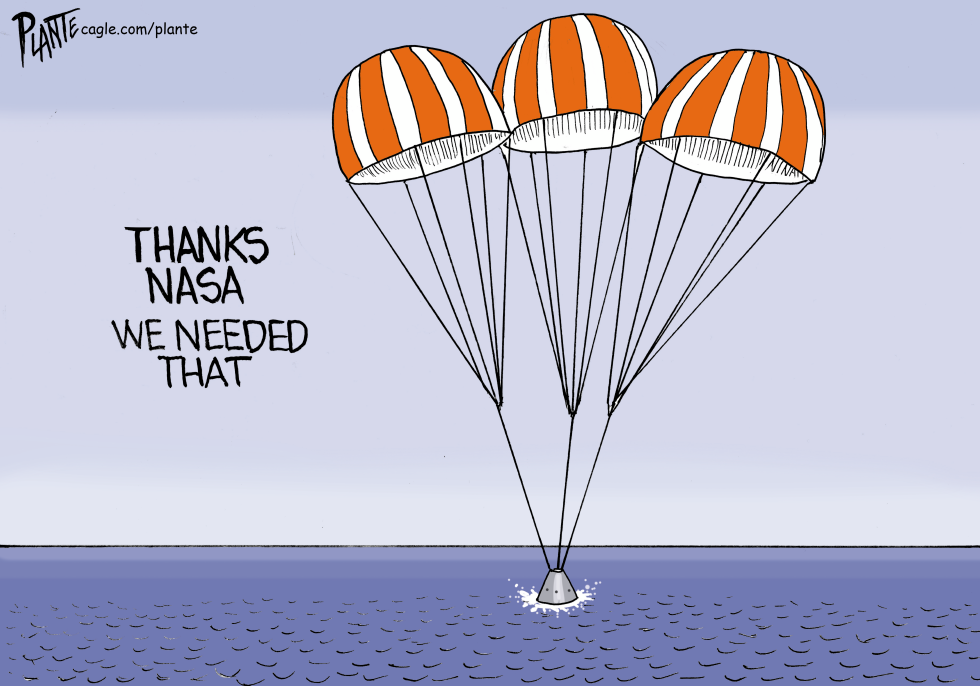
Bruce Plante\'s cartoon captures a space capsule\'s splashdown, complete with three orange and white striped parachutes guiding it to a blue ocean teeming with black fish-like forms. The prominent text \'Thanks NASA We Needed That\' adds a layer of sarcasm, typical in editorial illustrations commenting on high-profile events like the Artemis II mission. The simple composition, with a light blue sky and wavy ocean surface, emphasizes the moment of impact, shown by a small splash at the capsule\'s base. This piece fits into the tradition of political cartoons that highlight public sentiments toward government projects, using minimal elements for maximum impact. The artist\'s signature and website appear in the top left, grounding it in syndicated cartoon style.
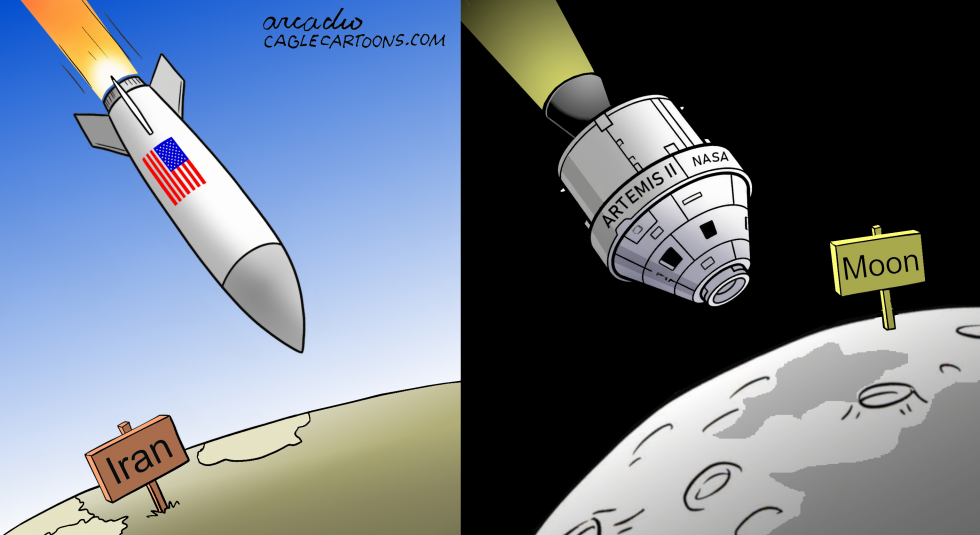
Arcadio Esquivel's cartoon splits the scene: on one side, a missile with an American flag streaks toward a planetary surface marked 'Iran,' flames trailing from its base against a blue sky. On the other, the Artemis II NASA capsule floats in space, nearing a gray lunar landscape labeled 'Moon' under a starry black backdrop. Tags including war, moon, exploration, Artemis II, NASA, Middle East, and Iran capture the visual pun. The dry humor points to misplaced priorities, where grand goals like space missions veer into military misadventures. Cagle Cartoons syndicates such pointed commentary, blending current events with sharp satire.
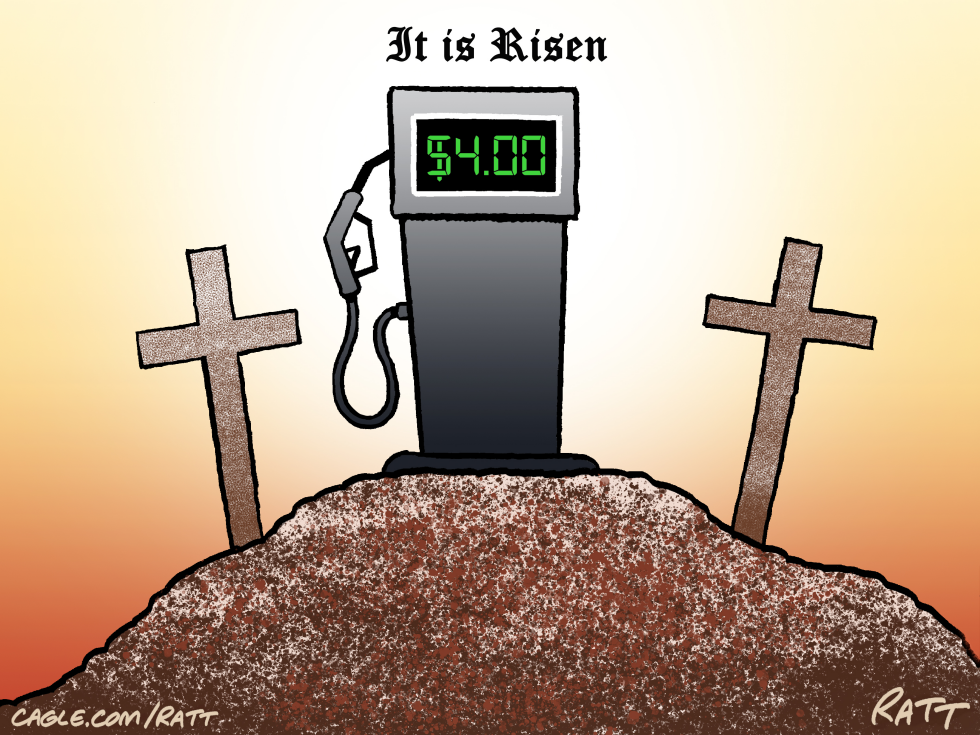
Ratt's cartoon captures Easter in America 2026 with a gas pump standing in for the central cross on a Calvary hill, showing $4.00 on its display and the text 'It is Risen' above, playing on rising gas prices. Tags like Easter, gas prices, oil, Iran war, and Strait of Hormuz suggest a future where geopolitical tensions drive fuel costs skyward. The artwork uses simple lines and a sunset background to evoke the biblical scene, but replaces resurrection with economic pain. This satire highlights how global events, including potential conflicts in the Strait of Hormuz, could lead to exorbitant oil prices by 2026. The dry humor underscores American dependence on foreign oil, making the cartoon timely and shareable amid ongoing energy debates.
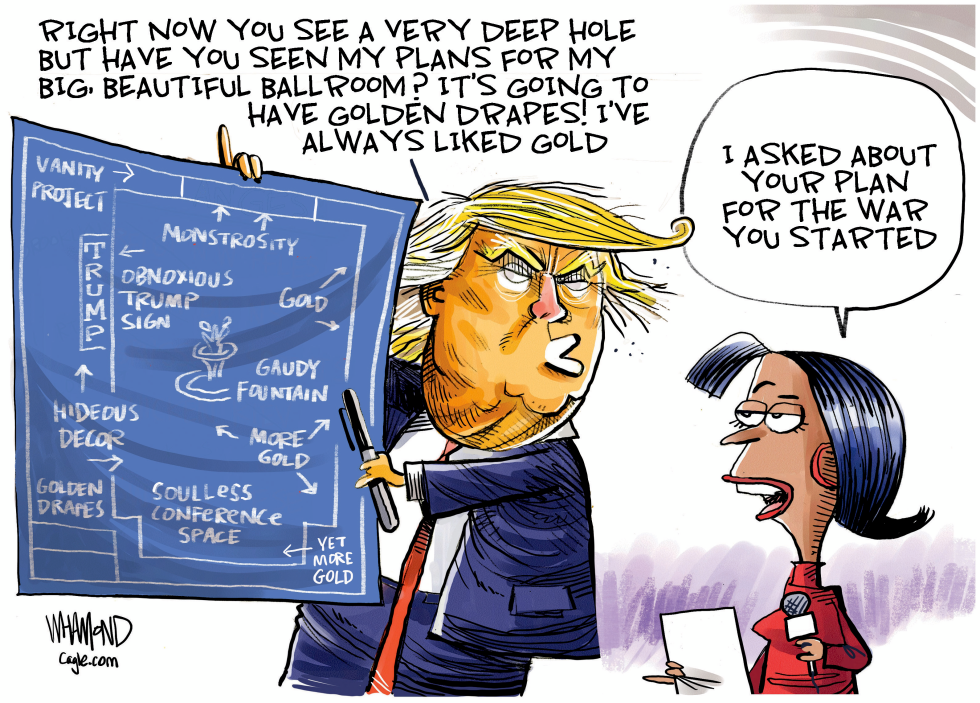
Dave Whamond's cartoon captures Trump in a classic pose, holding up a blueprint riddled with tags like vanity project, monstrosity, Trump obnoxious Trump sign, gaudy fountain, hideous decor, golden drapes, soulless conference space, and repeated calls for more gold. The scene unfolds with Trump enthusiastically describing a very deep hole for his big beautiful ballroom, emphasizing his love for golden drapes. A female reporter, microphone in hand, points out the mismatch, stating she asked about the plan for the war he started. This setup skewers Trump's apparent lack of strategy, turning serious inquiries about Iran war, no endgame, quagmire, military campaign, regime change, and improvising into a punchline about frivolous vanity. The dry humor lands on the contradictions, with Trump's focus on gaudy aesthetics over critical issues like troops in danger and boots on ground.
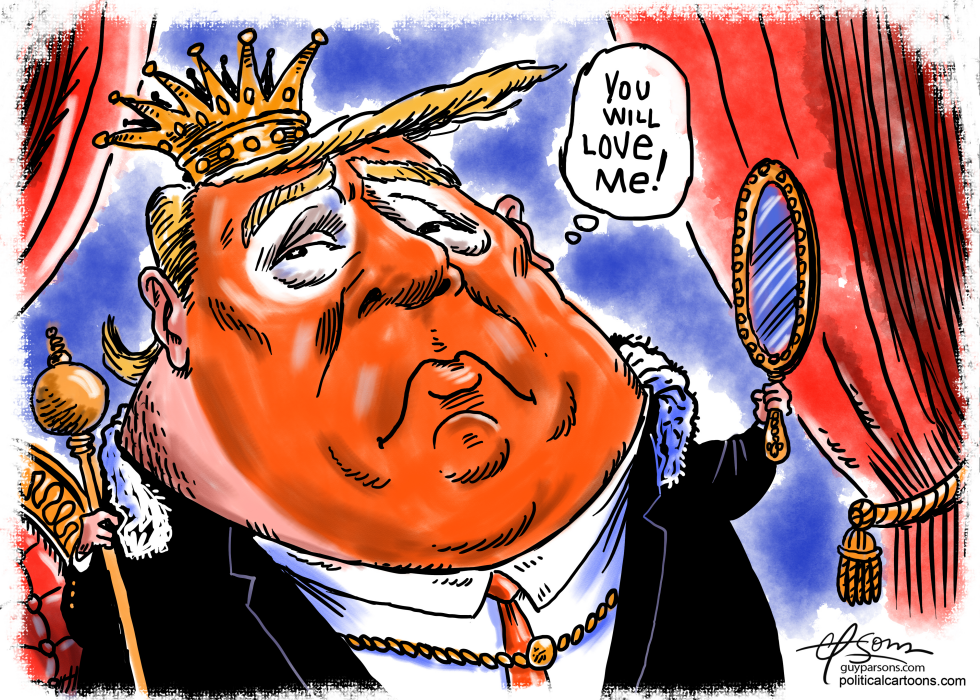
Guy Parsons draws a bloated, orange-faced figure resembling Donald Trump, decked out in a golden crown and royal robe, clutching a scepter in one hand and a hand mirror in the other. The speech bubble proclaims 'You will LOVE ME!' against a backdrop of red curtains, tying into tags like USA, America, Army, 250th anniversary, Trump birthday, and no kings. This setup pokes at delusions of monarchy in a nation founded on rejecting kings, with the mirror emphasizing self-adoration. The cartoon's timing, around Trump's birthday and the upcoming 250th anniversary of American independence, underscores the irony of a leader aspiring to unchecked power. Parsons' style keeps it bold and colorful, making the satire pop without subtlety.
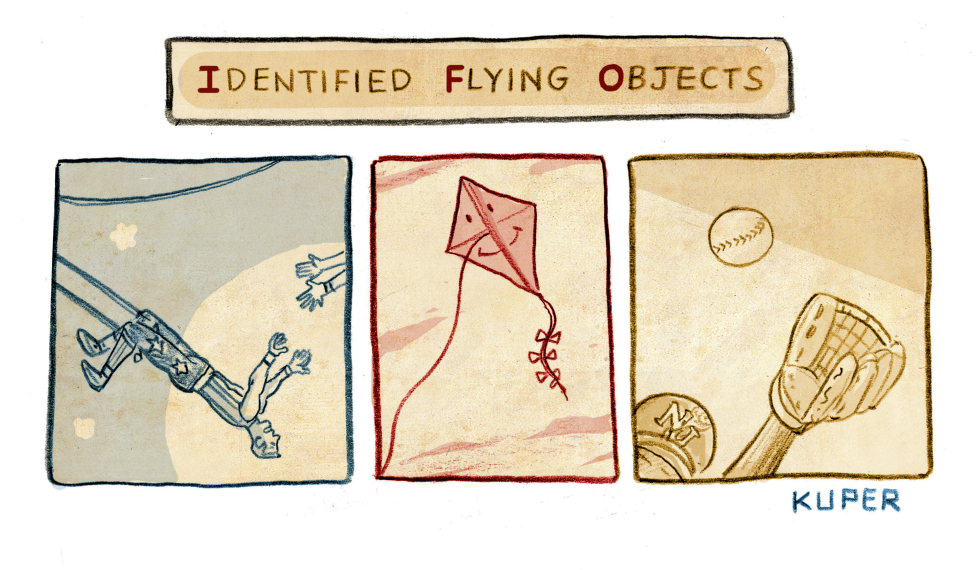
Peter Kuper delivers a sharp political cartoon titled 'Identified Flying Objects,' flipping the UFO script by showcasing mundane sky travelers: a figure suspended upside down on a zip line, a kite with a grin and tiny arms, and a baseball soaring toward a catcher's mitt marked 'NY.' This piece skewers the drone craze and conspiracy theories swirling around recent aerial sightings, reminding viewers that not every dot in the sky signals alien invasion or government plots. With dry humor, it grounds wild speculations in everyday reality, using simple panels to puncture overblown fears. Tags like UFO sightings, drone craze, conspiracy theories, political cartoon, Peter Kuper, and aerial mysteries keep it relevant in today's paranoia-fueled news cycle.
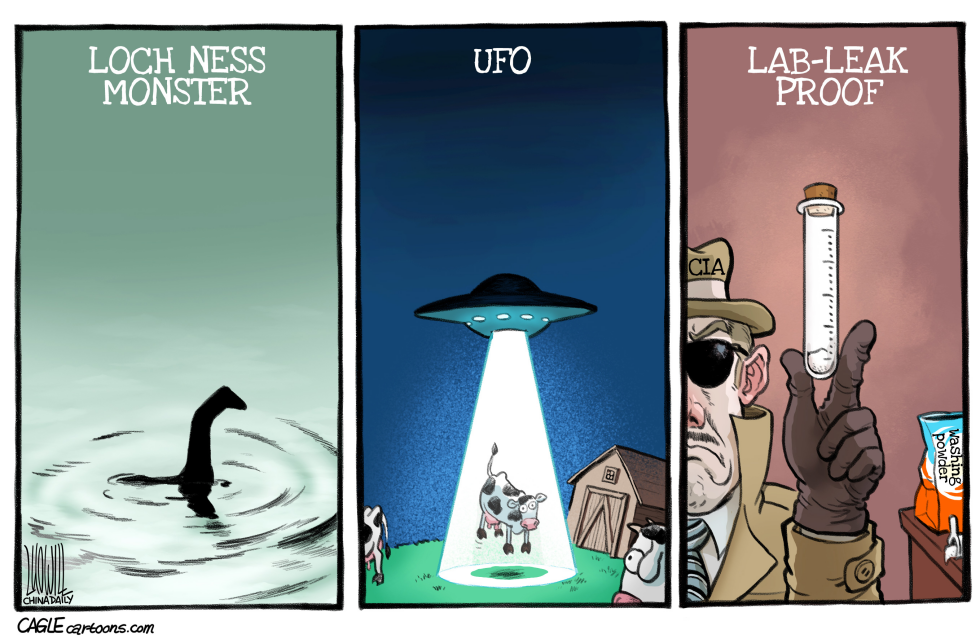
This political cartoon features three panels: one with the Loch Ness Monster emerging from water, another with a UFO beaming up a cow from a farm, and a third showing a man in a CIA hat holding a test tube next to a baking powder box, labeled as lab-leak proof. The artwork ties together famous hoaxes like the Loch Ness Monster and UFO phenomena with the lab leak theory, suggesting skepticism toward claims about the virus origin from China. Artist Luojie uses simple, bold lines to highlight the absurdity, placing the CIA figure in a detective-like pose to mock intelligence reports. Tags such as hoaxes, lab leak theory, CIA, China, political, and virus underscore the satirical take on conspiracy narratives. The composition groups these elements to question the validity of unproven theories.
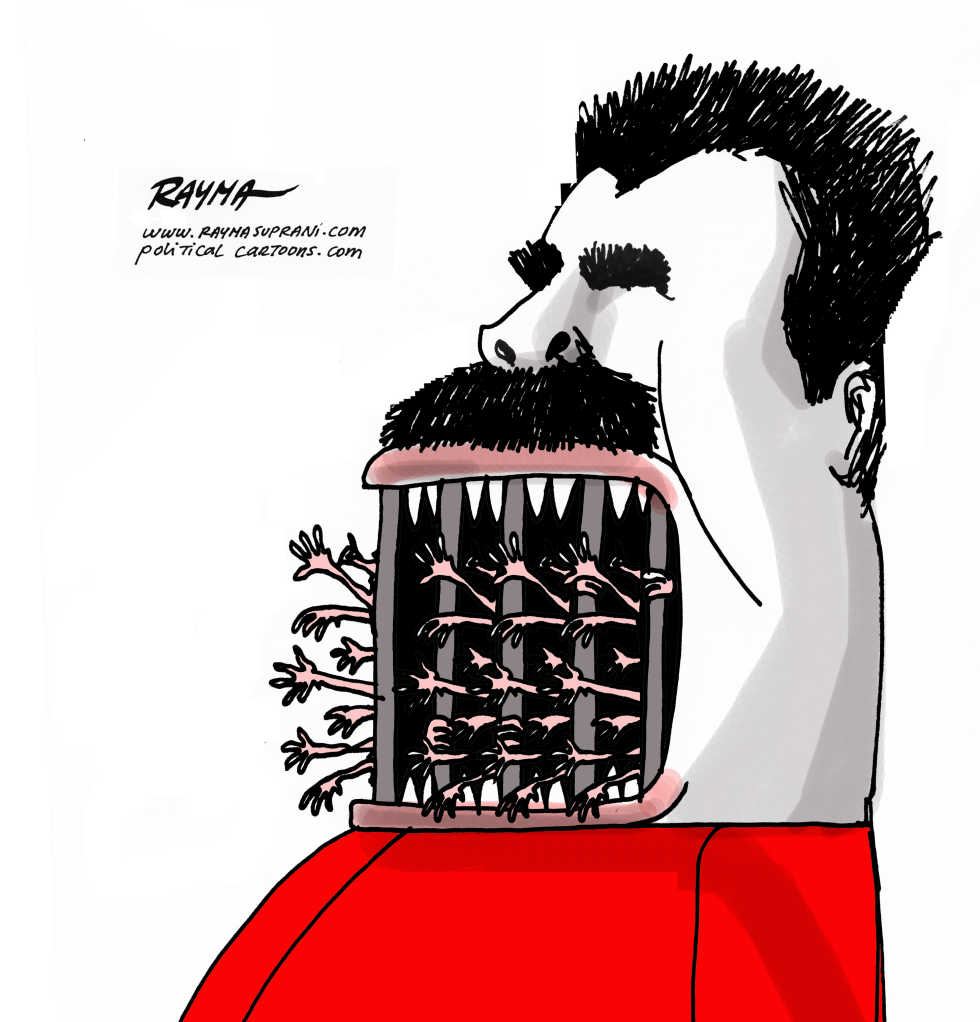
Rayma Suprani's 2017 cartoon captures the essence of dialog in Venezuela under Maduro, showing a man's head with black hair and mustache, his mouth transformed into prison bars containing numerous reaching hands. The red shirt and intense expression underscore the theme of repression. Tags like Venezuela, Maduro, dialog weave into this visual metaphor, where hands strain against confinement, illustrating how political talks trap voices. The artwork's simplicity amplifies its satirical punch, a hallmark of Suprani's style in critiquing authoritarianism. Political cartoons like this one from PoliticalCartoons.com highlight ongoing struggles in Latin America, blending humor with stark reality.