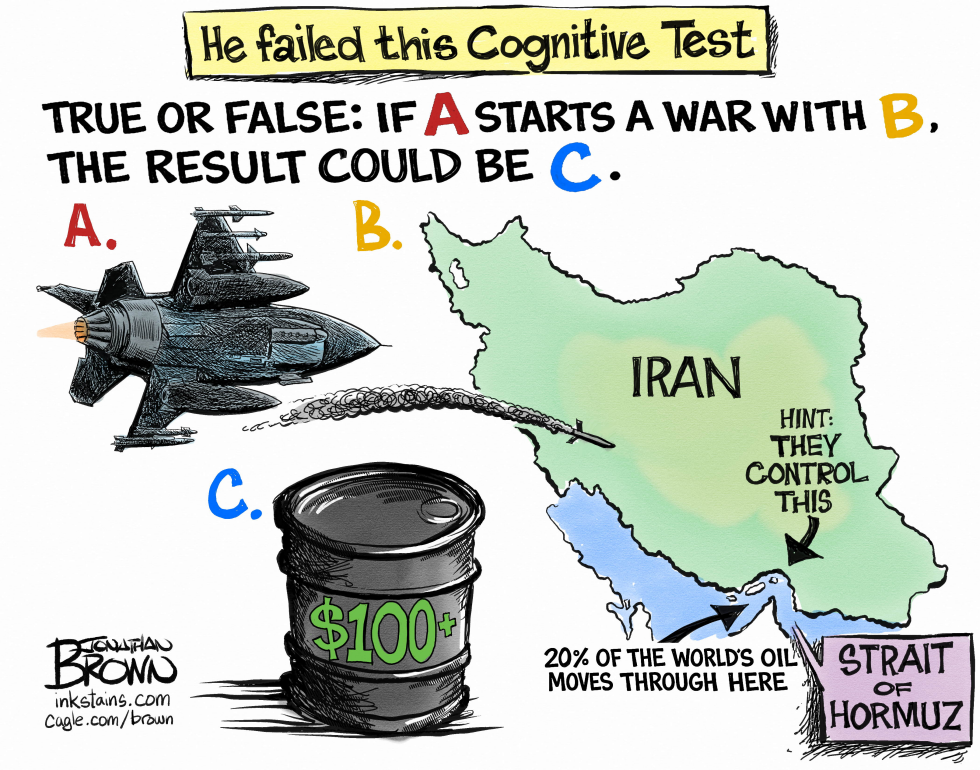
Jonathan Brown's cartoon presents a stark true-or-false cognitive test: if A (a fighter jet) starts a war with B (Iran), the result could be C (an oil barrel marked $100+). The map of Iran includes a hint pointing to the Strait of Hormuz, noting that 20% of the world's oil moves through there, underscoring control over this chokepoint. Tags such as cognitive test, war in Iran, oil prices, Strait of Hormuz, gas prices, and cost of war frame the satire. The artwork warns of economic fallout from conflict, with the jet trailing toward Iran and the oil barrel symbolizing surging costs. This piece captures geopolitical tensions in a simple, visual riddle.
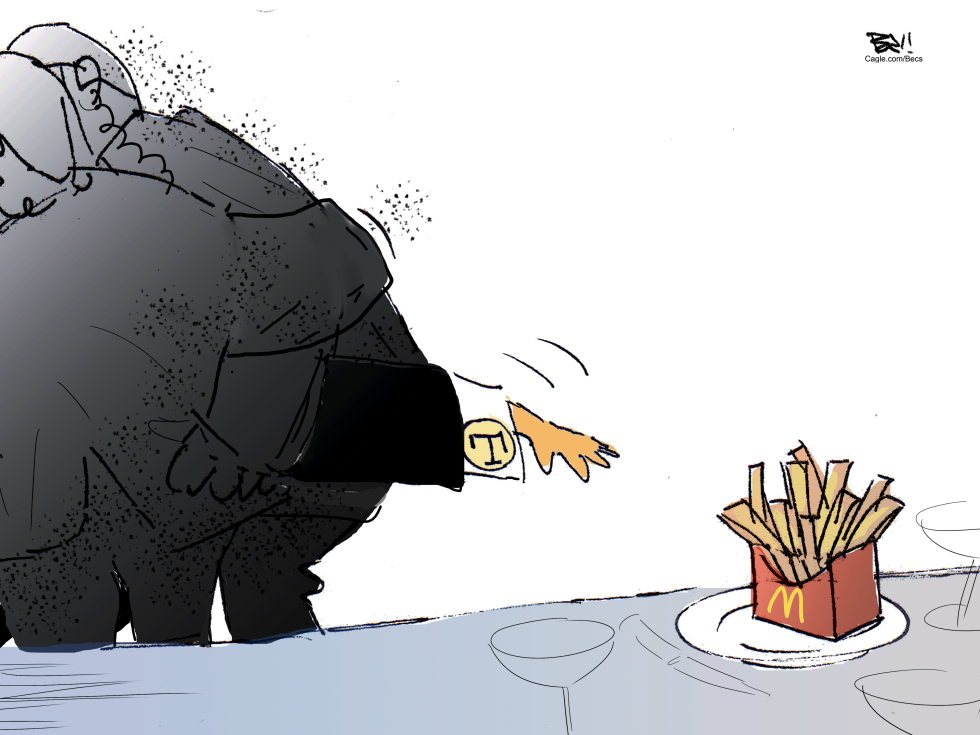
This political cartoon shows a bulky figure in a dark suit, viewed from behind, with a hand bearing a cufflink labeled TRUMP reaching out toward a red box of McDonalds fries overflowing on a white plate. The scene is set on a table with stemmed glasses, and there's a dusting of particles on the figure's shoulder. Incorporating tags such as Donald Trump Administration USA, attack, Hilton Hotel, shooting, terrorist, lone wolf, the image pokes fun at familiar tropes of excess and impulse. The artist's signature Becs and Cagle.com/Becs appear in the corner, grounding it in syndicated cartoon tradition. Such drawings often go viral for their sharp, relatable jabs at public figures. At around 100 words, this summary captures the essence without overreaching what's drawn.
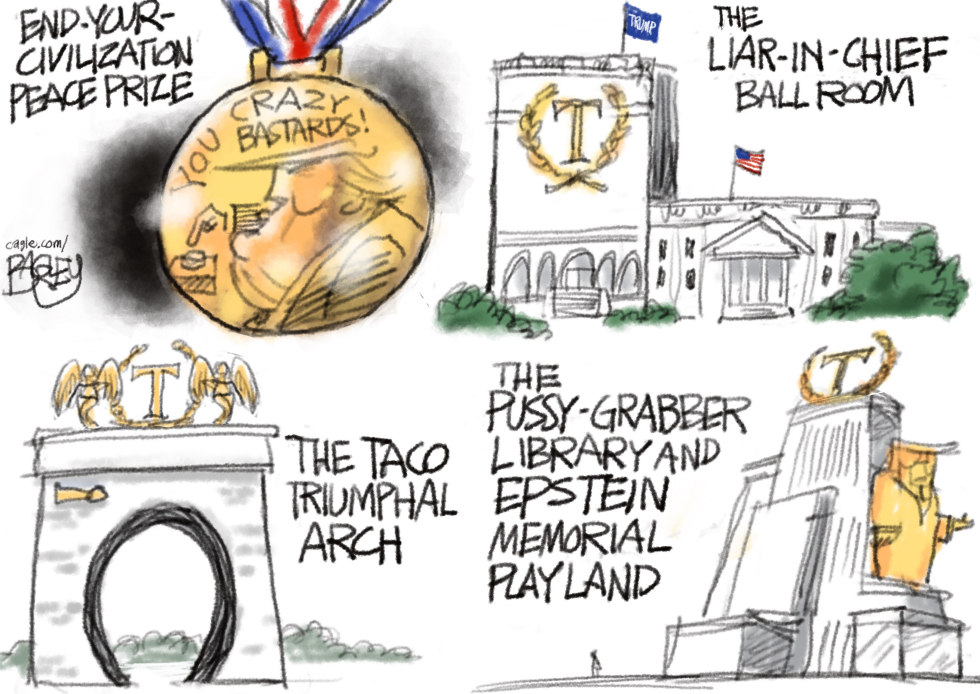
Pat Bagley's political cartoon titled Trump Legacy presents a series of imagined monuments that highlight controversial aspects through labels like End-Your-Civilization Peace Prize on a medal showing a figure with Trump's hairstyle, the Liar-in-Chief Ballroom resembling a grand building with Trump flag, the Taco Triumphal Arch as a stone structure with winged T, and the Pussy-Grabber Library and Epstein Memorial Playland as a classical edifice with a statue. These elements, tagged with arch, MAGA, triumphal, ballroom, peace prize, library, Epstein, use dry humor to comment on themes of liar, Republicans, fascism without adding unseen context. The composition clusters these items in a sketch style, emphasizing bold text and simple lines for impact.
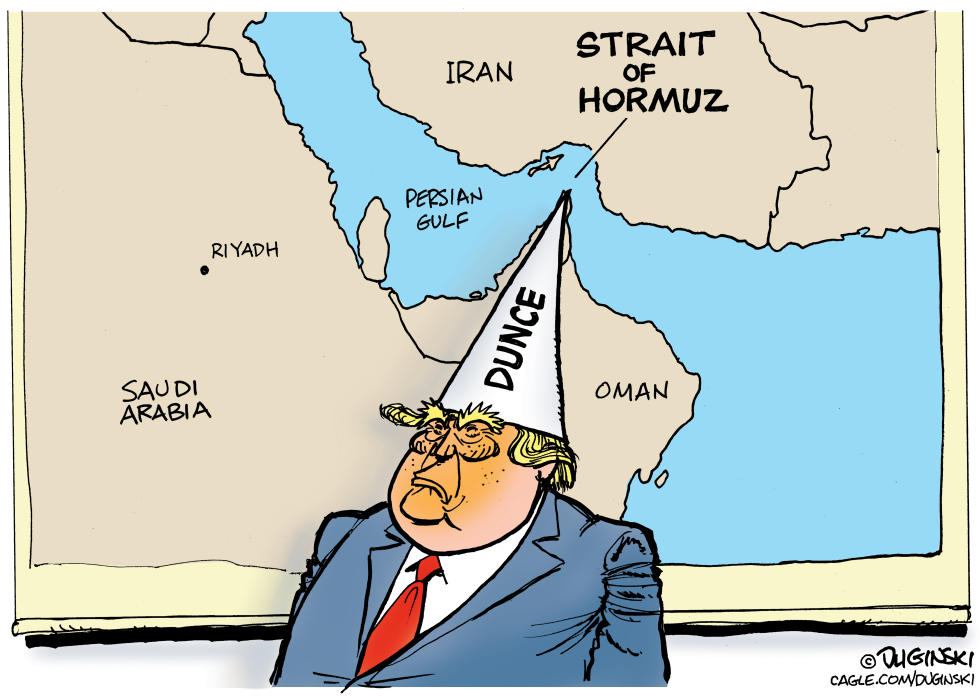
The cartoon depicts a simplified map of the Middle East, including labels for Iran, Saudi Arabia, Oman, Riyadh, and the Persian Gulf. The Strait of Hormuz is prominently marked, with a caricatured man in a suit and red tie wearing a dunce cap labeled \'DUNCE\' positioned over it. This setup uses the strait as a choke point for oil and energy, tying into themes of foreign policy, war, and ignorance. The image critiques handling of Middle East waterway issues, possibly linked to closure threats, tankers, and ceasefire efforts. Artist signature appears in the bottom right.
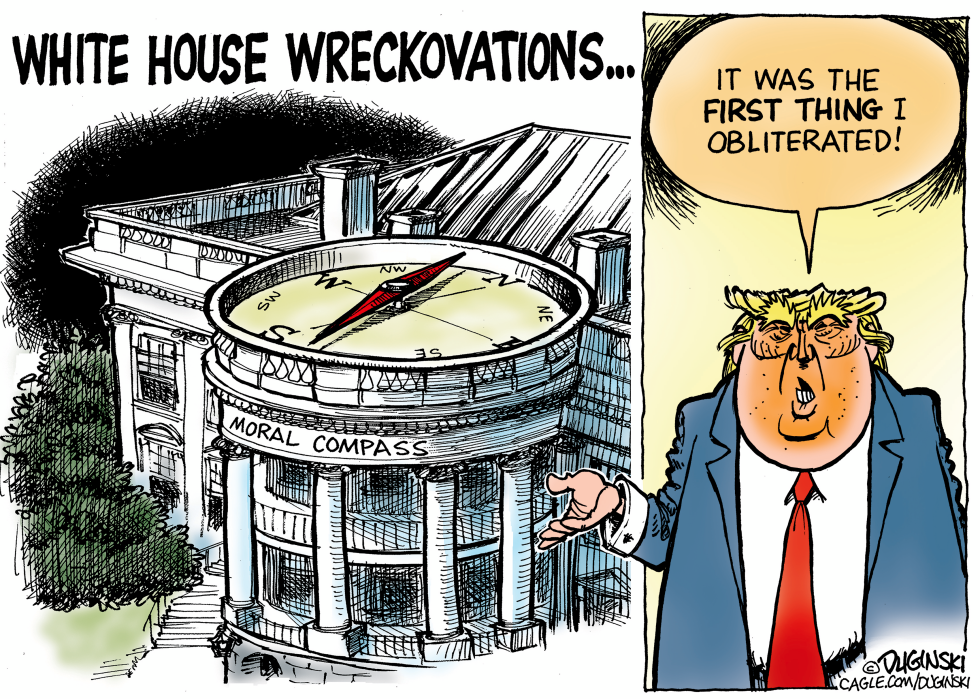
Paul Duginski's cartoon shows a caricatured Trump gesturing proudly while speaking about obliterating the moral compass, a large dome-like structure labeled 'Moral Compass' with directional arrows, placed on the White House roof. The title 'White House Wreckovations' plays on renovations, suggesting destructive changes. Tags including president, MAGA, White House, demolition, morality, ethics, obliteration, Republicans, and Iran war frame the image as a critique of ethical standards in politics. The scene captures a dark night setting with part of the building and trees visible, emphasizing the theme of moral destruction in Washington.
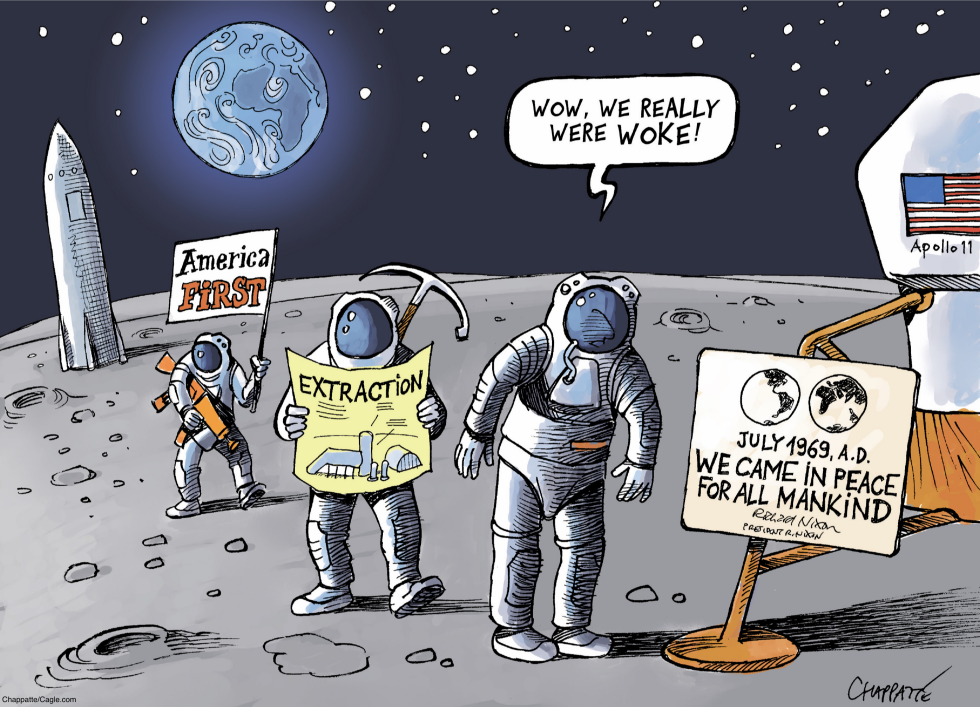
The cartoon shows three astronauts on the moon\\\\\\\'s surface, with Earth visible in the background. One holds a sign reading America First while carrying a weapon, another grips a document titled Extraction with a mining diagram, and the third wields a pickaxe next to a plaque stating We came in peace for all mankind from July 1969 A.D. near the Apollo 11 lander flagged with the US stars and stripes. A speech bubble declares Wow, we really were woke! The scene captures space race satire, lunar exploration humor, political cartoon commentary on shifting priorities from global peace to nationalistic resource grabs, all in Patrick Chappatte\\\\\\\'s style.
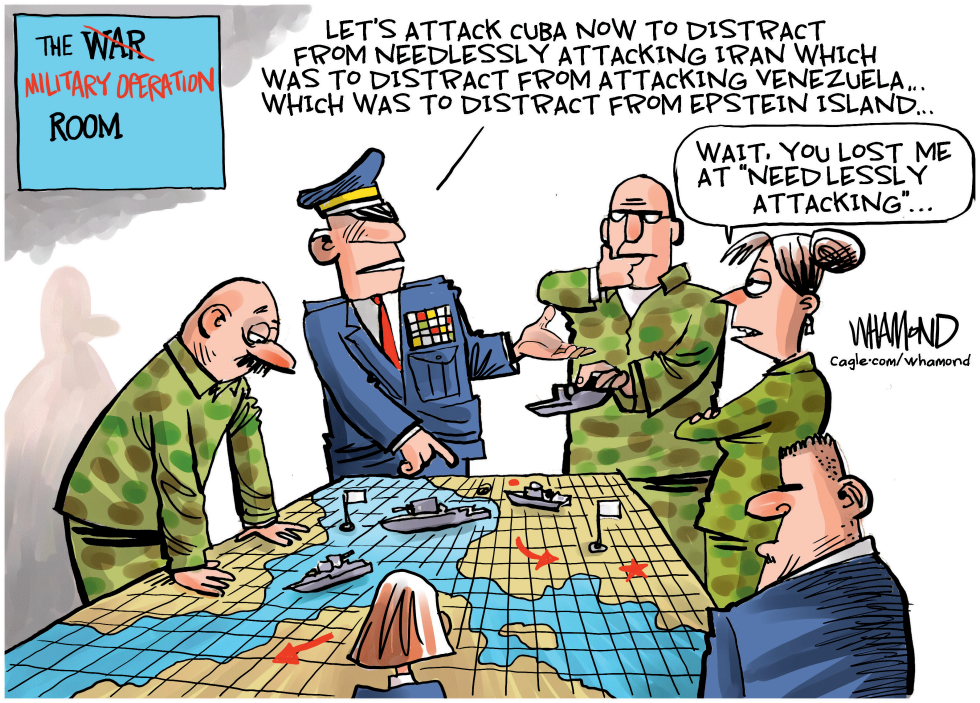
Dave Whamond's political cartoon depicts a group of military officials in a war room, gathered around a map with toy ships, discussing a chain of distractions starting from attacking Cuba to cover needless attacks on Iran, which distracted from Venezuela, looping back to Epstein Island. The scene captures the absurdity with one figure pointing at the map and another expressing confusion over 'needlessly attacking.' This satirical illustration uses dry humor to comment on convoluted military strategies and political diversions, incorporating elements like crossed-out 'War' sign replaced by 'Military Operation Room' for added irony. Tags like political satire, war distractions, foreign policy cartoon, Epstein Island reference, military humor, and endless distraction chain emphasize the cartoon's sharp critique.
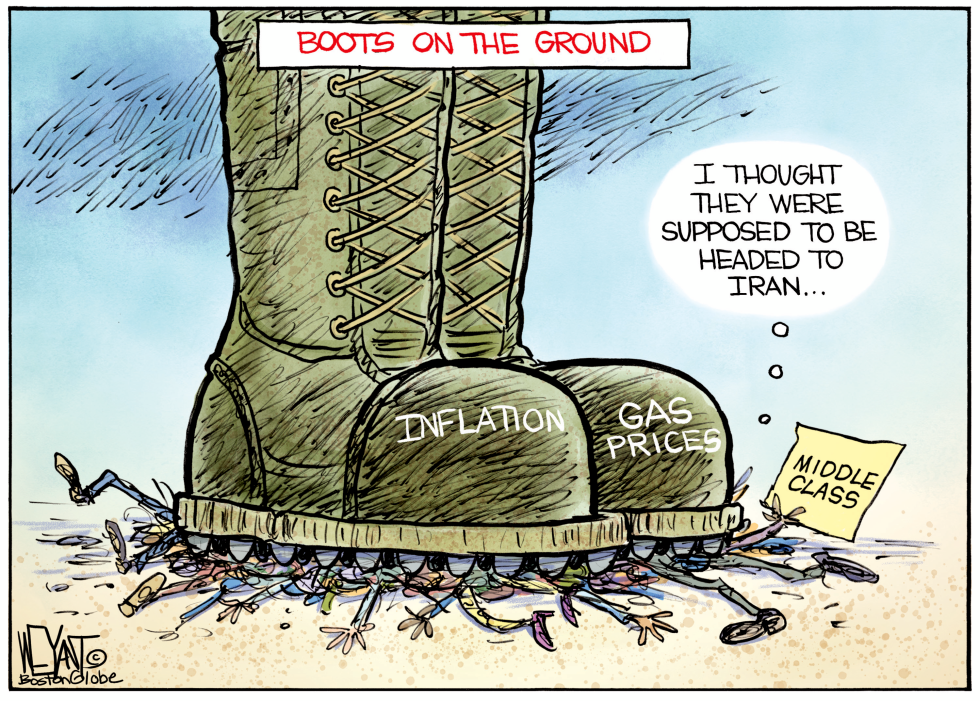
The cartoon shows a pair of massive military boots dominating the scene, one labeled 'Inflation' and the other 'Gas Prices,' as they crush small human figures on the ground, with a sign reading 'Middle Class' among them. A speech bubble from one of the crushed figures says, 'I thought they were supposed to be headed to Iran...' The title 'Boots on the Ground' sits at the top. This setup uses dry humor to highlight misplaced priorities in war, economy, inflation, gas prices, middle class, and Iran. The sandy ground and stormy sky add to the chaotic feel, tying into tags like Trump, negotiation, Strait of Hormuz, and domestic policy impacts.
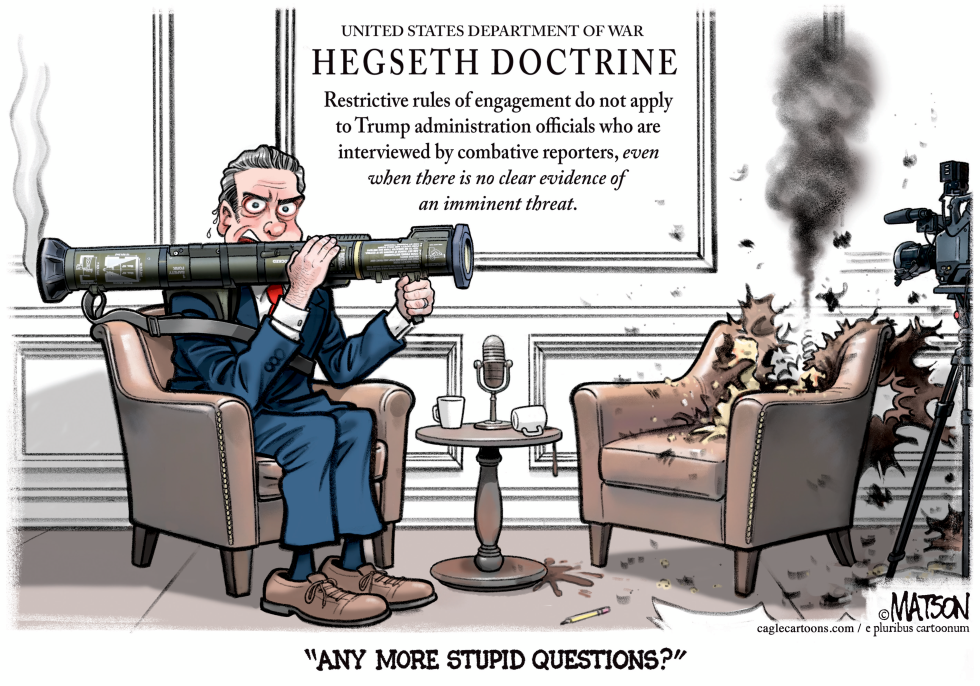
R.J. Matson's cartoon depicts a stern-faced official in a formal setting, wielding a massive rocket launcher that has just obliterated the interviewer's chair, smoke billowing from the debris. The header proclaims the 'Hegseth Doctrine' under the 'United States Department of War,' stating that restrictive rules of engagement don't apply to Trump administration officials facing combative reporters, even without clear evidence of an imminent threat. The official snarls, 'Any more stupid questions?' as a camera topples amid the chaos. This setup skewers the notion of overreactive defenses in political interviews, blending dry humor with sharp commentary on media relations. Tags like Hegseth Doctrine, Trump administration satire, press interview violence, combative reporters parody, imminent threat joke, and political cartoon Matson capture the essence of this visually punchy critique.
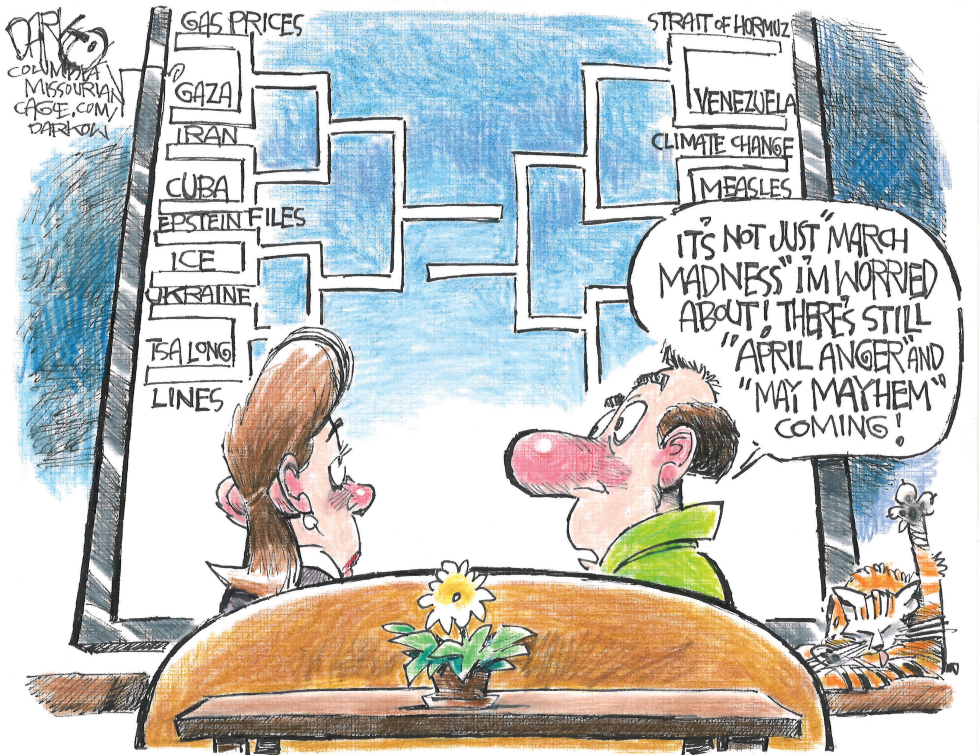
John Darkow's cartoon twists the March Madness tournament bracket into a lineup of global headaches, from gas prices spiking due to Strait of Hormuz tensions and Venezuela instability, to ongoing conflicts in Gaza and Ukraine. Measles outbreaks and climate change join the fray, alongside Cuba relations, Epstein files, ICE policies, and long TSA lines. The scene shows a couple at a table, with the man fretting that it's not just March Madness to worry about—April Anger and May Mayhem loom. A potted daisy and a striped cat add a touch of domestic normalcy to the absurd bracket of woes. This piece captures the relentless parade of news cycle disasters, using at least six tags like March Madness, Strait of Hormuz, Venezuela, measles, gas prices, and Gaza.
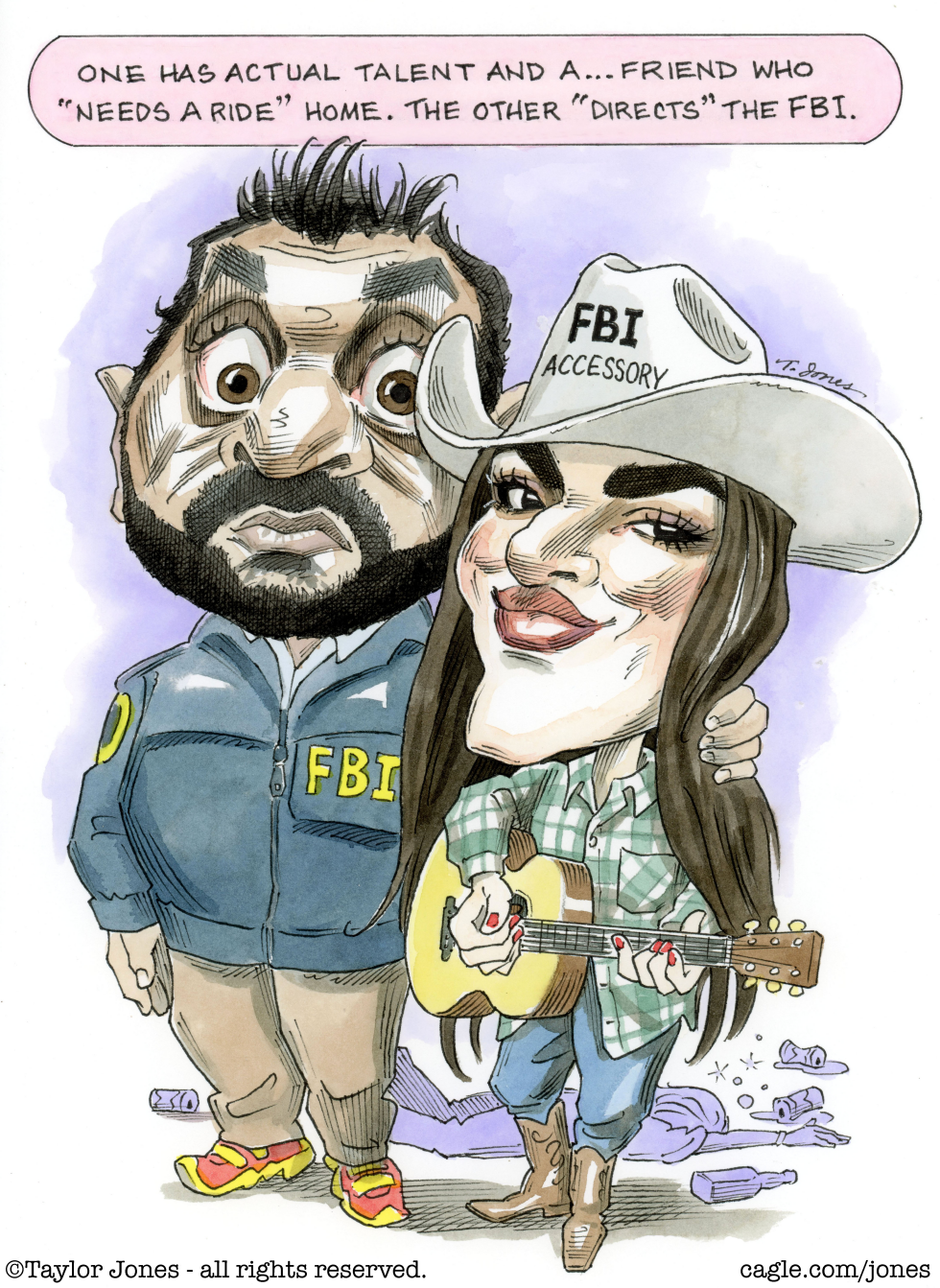
Taylor Jones draws a bearded man in an FBI jacket with wide eyes, standing next to a smiling woman wearing a cowboy hat marked FBI Accessory, her arm around him as she holds a guitar. Empty bottles and cans are scattered on the ground, suggesting drunkenness. The speech bubble contrasts one with actual talent and a friend who needs a ride home against the other who directs the FBI. Tags like Kash Patel, Alexis Wilkins, country music, Nashville singer, corruption, and incompetence frame this political cartoon's jab at abuse of office and justice department issues.
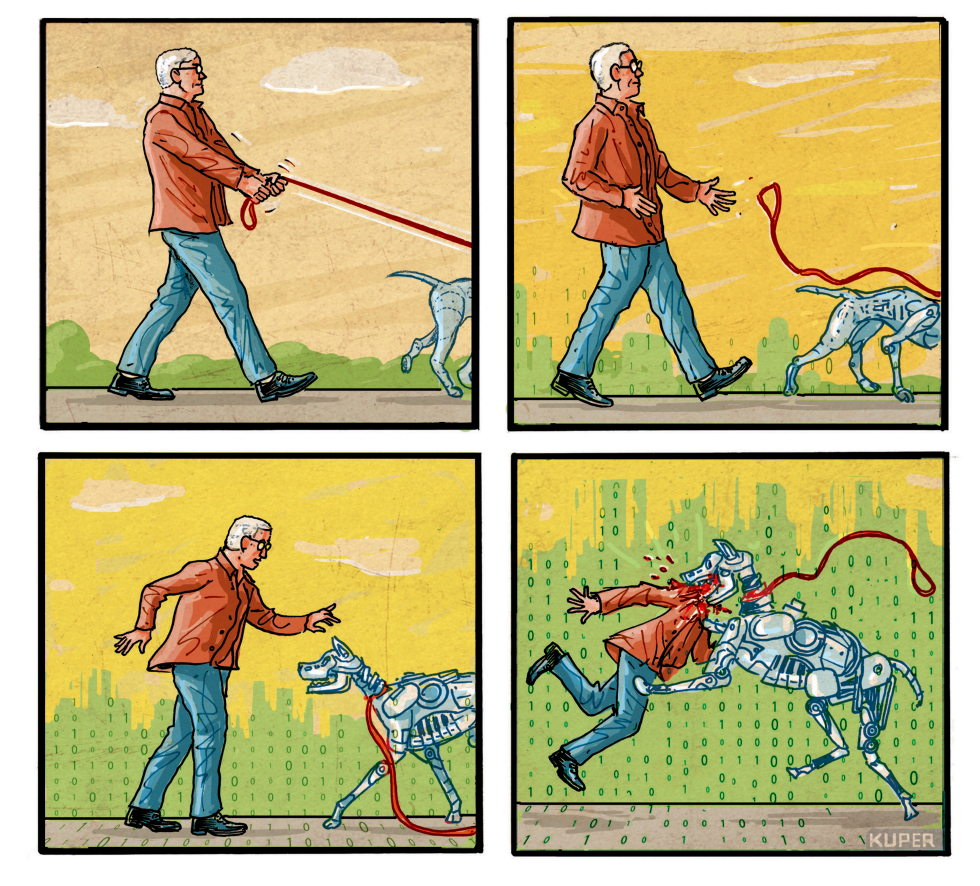
Four-panel sequence by Peter Kuper depicts an older man in a rust-colored jacket and blue jeans walking a spotted dog on a red leash. The leash snaps, the dog shifts into a skeletal robot form covered in binary code, and the final panel shows the robot lunging at the man with red impact marks near his face. The background changes from simple sky and grass to a green city skyline filled with ones and zeros. The cartoon carries the title The Dangers of Unregulated A.I. and is signed KUPER.
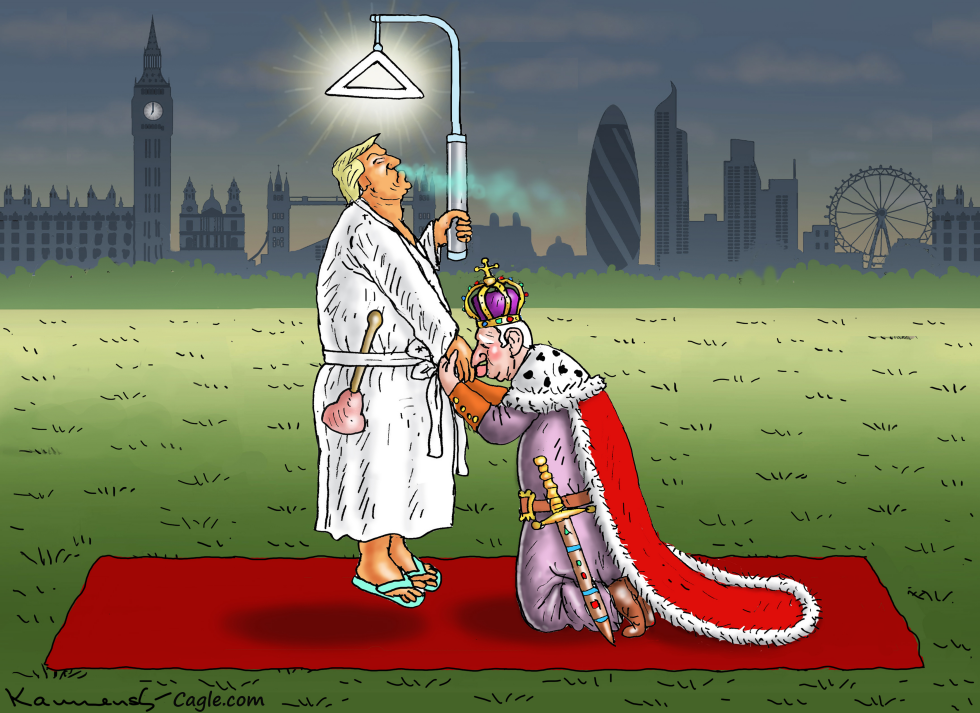
The cartoon shows a blonde man in a white robe and flip-flops, puffing smoke, standing on grass with a glowing triangular light overhead. He holds a small crown toward a kneeling figure in purple robes, crown, and red cape on a red carpet. London icons like Big Ben, the Gherkin, and London Eye fill the dark sky background. Tags such as Trump, King Charles, UK, Fascism, God, and Visit frame this direct visual. The scene stays straightforward, with no hidden layers beyond the visible elements. Kamensky's style keeps it clear, poking at power dynamics without overcomplicating the obvious setup.
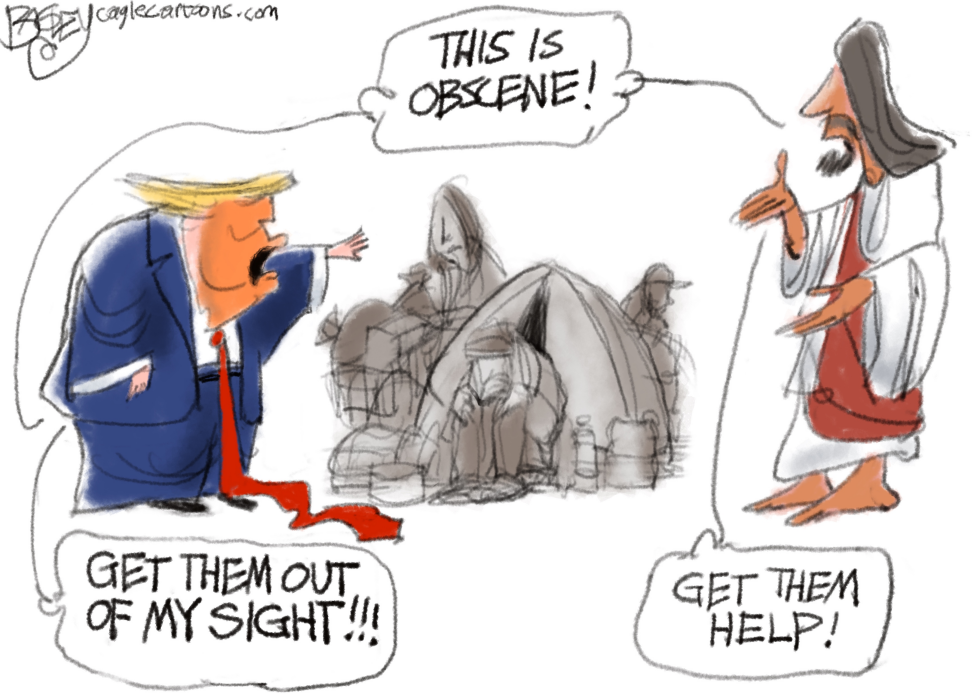
Pat Bagley's latest piece captures a stark contrast in this Trump homelessness cartoon, where a caricature in a blue suit and red tie gestures furiously at a cluster of makeshift tents and huddled figures, declaring the scene obscene and demanding their removal. On the right, a long-haired, bearded man in a white robe and red sash extends a hand, advocating to get them help instead. The homeless crisis political humor underscores differing approaches to urban plight, with the Trump Jesus contrast cartoon highlighting themes of expulsion versus empathy. Such editorial cartoon homelessness policy works often spark debate on societal responses, blending sharp lines and simple composition for maximum impact in satirical take Trump compassion.