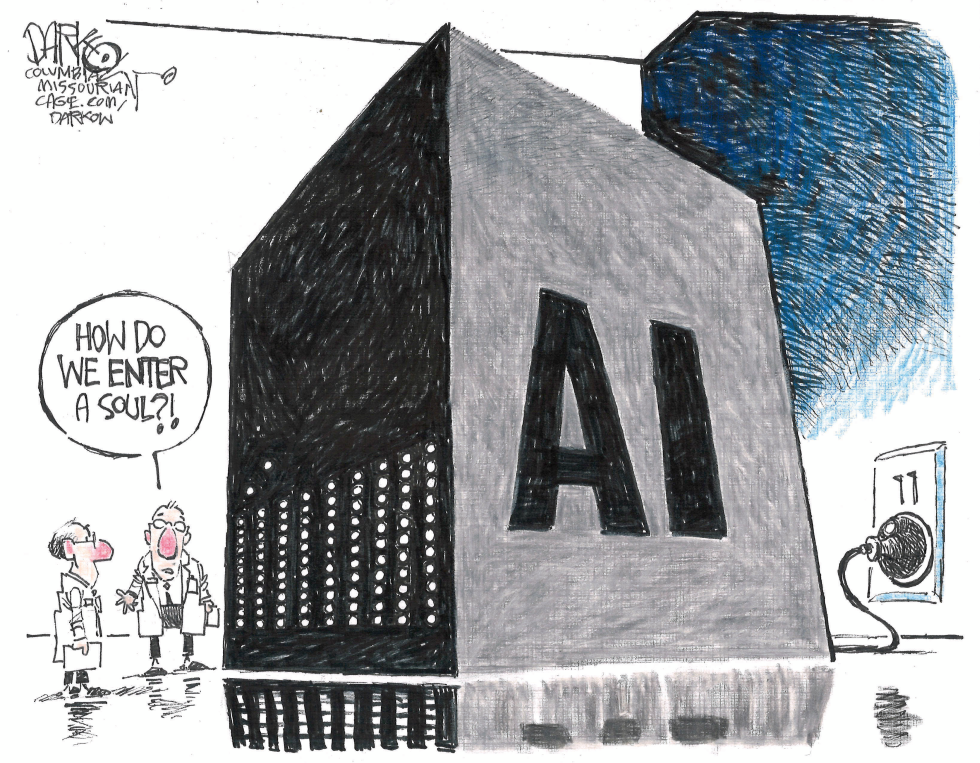
Developers continue racing to create advanced AI systems with greater capabilities. The core challenge remains embedding ethical judgment and moral reasoning into machines that process data at superhuman speed. Without that foundation, even the most powerful systems risk operating without regard for right and wrong. The cartoon highlights this persistent gap between technical achievement and ethical grounding.
know now
Jul
10
2026
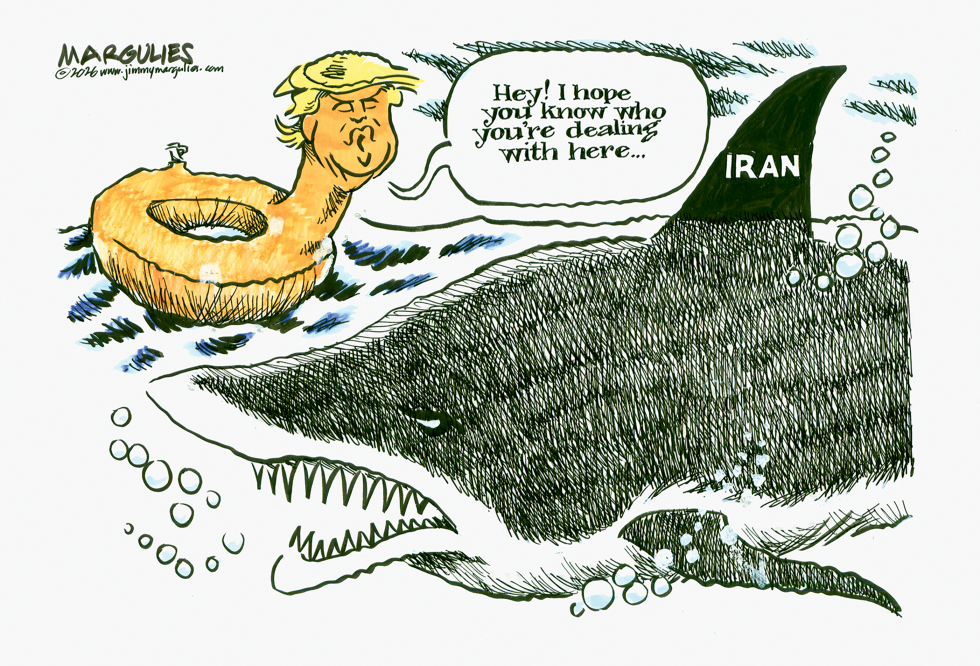
On July 10 2026 Jimmy Margulies depicts Donald Trump floating in an inflatable ring while confronting a large shark fin labeled Iran. The president issues a direct warning through a speech bubble asserting his identity and authority in the confrontation.
May
11
2026
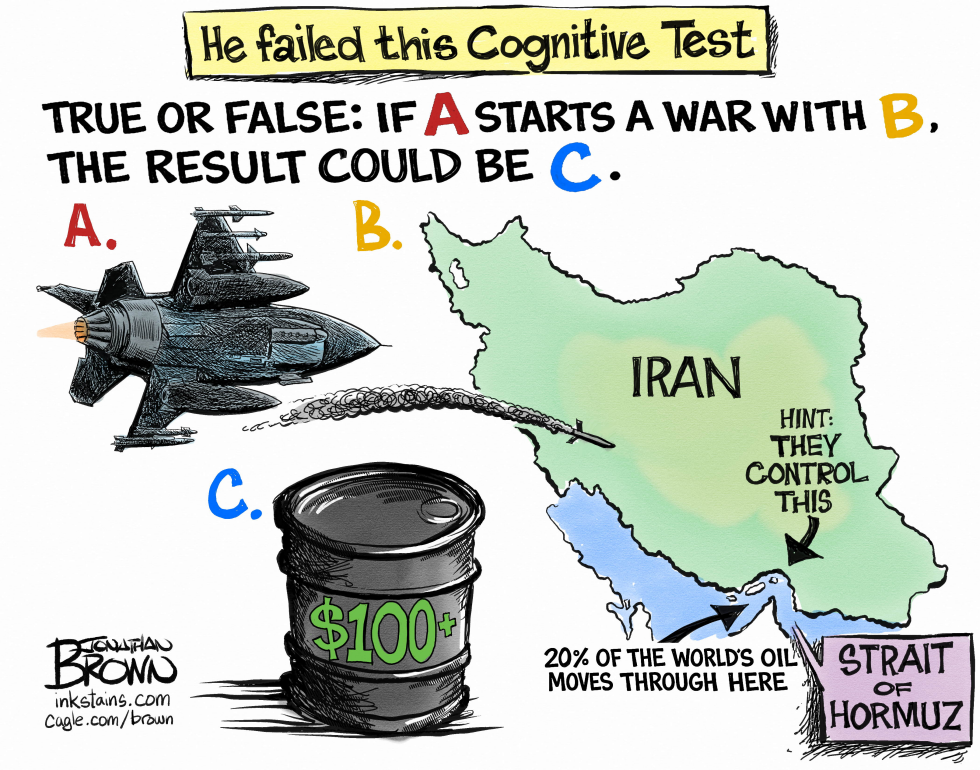
Jonathan Brown's cartoon presents a stark true-or-false cognitive test: if A (a fighter jet) starts a war with B (Iran), the result could be C (an oil barrel marked $100+). The map of Iran includes a hint pointing to the Strait of Hormuz, noting that 20% of the world's oil moves through there, underscoring control over this chokepoint. Tags such as cognitive test, war in Iran, oil prices, Strait of Hormuz, gas prices, and cost of war frame the satire. The artwork warns of economic fallout from conflict, with the jet trailing toward Iran and the oil barrel symbolizing surging costs. This piece captures geopolitical tensions in a simple, visual riddle.
May
4
2026
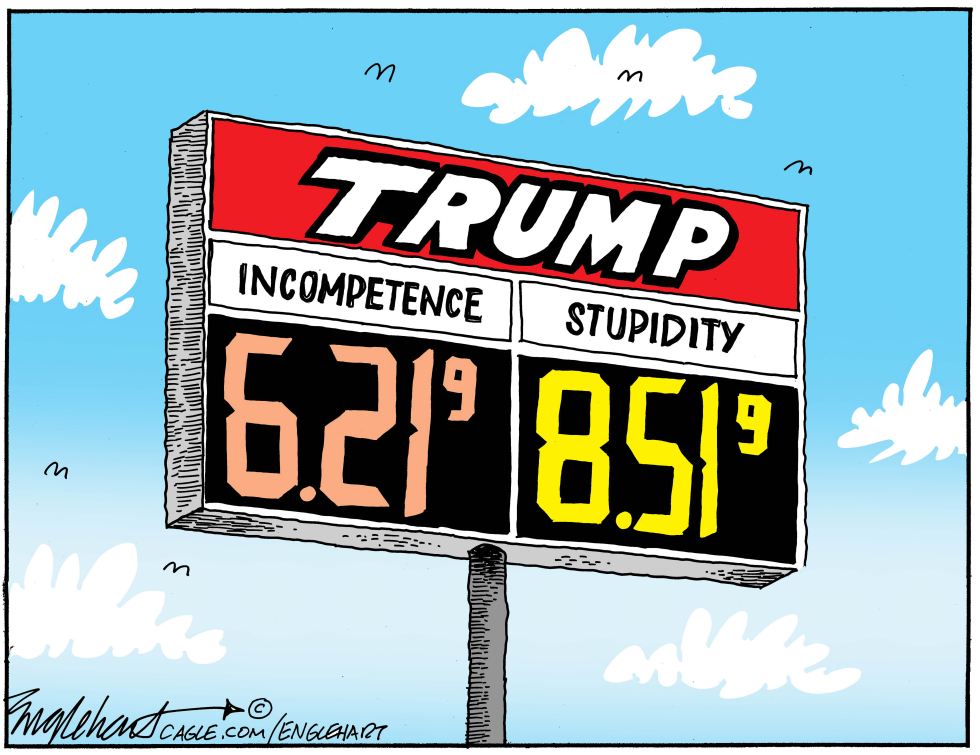
Bob Englehart's cartoon features a gas station sign with Trump at the top, showing prices for incompetence at 6.21⁹ and stupidity at 8.51⁹ against a blue sky with clouds. The tags Trump, Iran War, gas prices, gasoline, and gallon frame the visual pun. Such cartoons often tie political figures to everyday economic pains like fuel costs. The dry humor lands on how leadership flaws inflate prices, making it relatable for readers hit by pump shocks. With no characters, just the sign, it keeps the message direct. Tags like incompetence and stupidity drive the satire home, poking at perceived policy missteps without overcomplicating the scene.
Trump Gets Pumped: Iranian Cleric Fuels the MAGA Messiah in Desert Satire
Trump Fueled by Iranian Cleric
Apr
25
2026
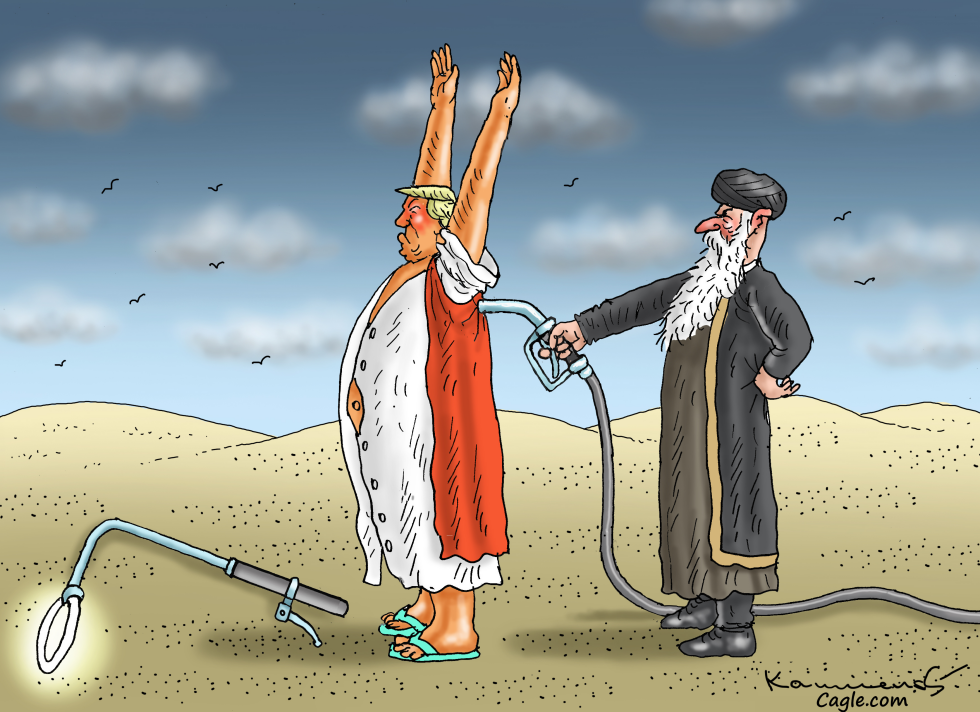
Marian Kamensky's cartoon captures a surreal scene in the desert where a figure resembling Trump, dressed in white and red robes with arms raised skyward, has a gas pump nozzle inserted into his side by a bearded man in dark robes and turban. The image plays on themes of Trump, Iran, Hormuz, fascism, MAGA terror, and oil war, blending religious imagery with modern geopolitical tensions. Birds fly in a cloudy sky over sandy dunes, emphasizing isolation and absurdity. The signature and Cagle.com mark confirm its syndication roots. This piece skewers the intersections of politics, religion, and resource dependency without words, relying on visual punch for impact. Such cartoons thrive in editorial pages for their sharp commentary on current events.
Golden Trump Statue Ends Fossil Fuel Dependency in Hormuz Strait Satire
Trump's Golden End to Fossil Fuels
Apr
24
2026
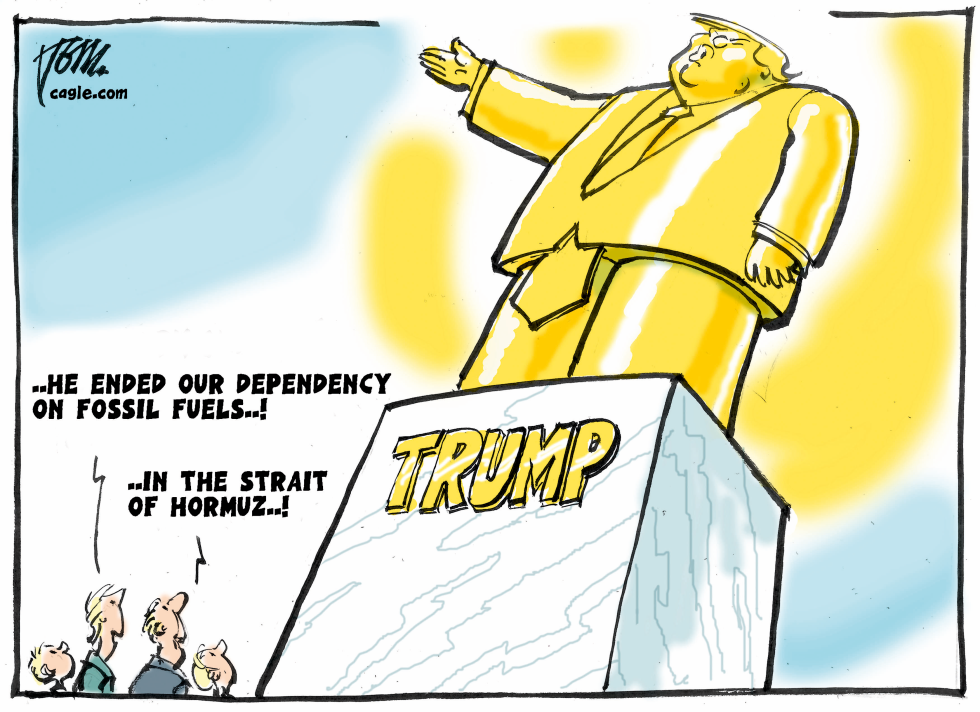
Tom Janssen draws a massive golden statue resembling Trump, arm raised triumphantly on a 'TRUMP' pedestal, with text boasting 'HE ENDED OUR DEPENDENCY ON FOSSIL FUELS!!' A small figure below quips '...IN THE STRAIT OF HORMUZ?!' Three tiny onlookers gaze up. The cartoon ties into tags like Strait of Hormuz, blockade, oil prices, inflation, Iran war, and fossil fuels. It pokes at ironic claims of energy independence through geopolitical tension. The yellow glow and exaggerated features amplify the dry humor on misguided victories. Cagle Cartoons syndicates such pointed takes, reminding editors how visuals cut through policy noise. This one's timely, blending current events with sharp wit.
Apr
21
2026
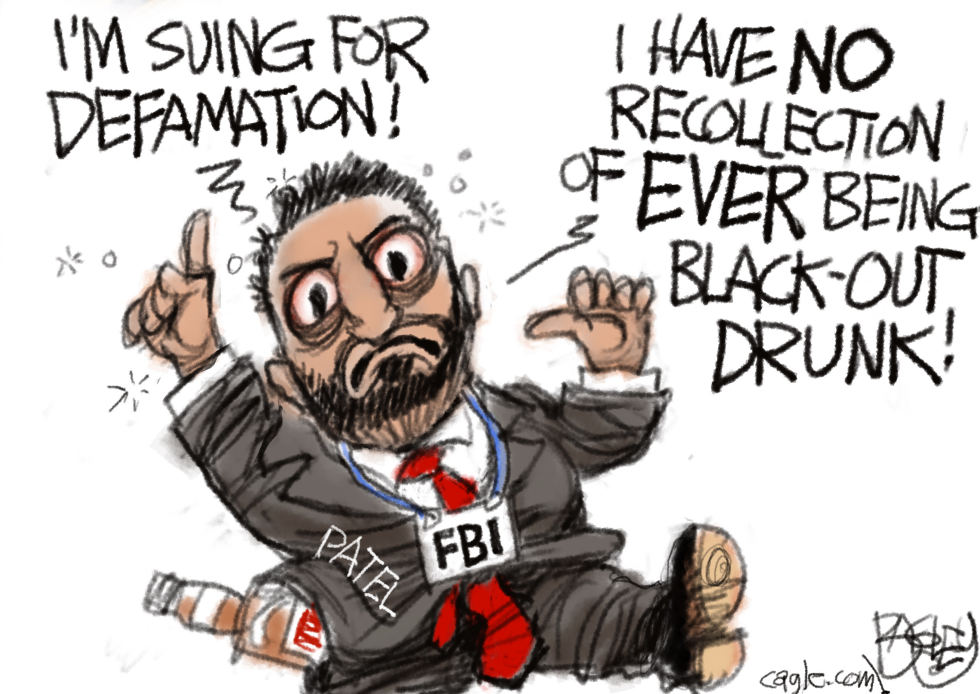
Pat Bagley's cartoon captures a caricatured Kash Patel, sprawled with a liquor bottle, his suit disheveled and FBI badge prominent. He gestures wildly, proclaiming a defamation lawsuit while insisting on no recollection of ever being blackout drunk. The image ties into themes of DUI, corruption, fraud, drinking, drunkenness, alcohol, national security, and terrorism, highlighting irony in a political figure's denial. Such satire underscores the absurdity in public denials, especially for someone eyed for a high-security role. The dry humor pokes at reliability amid scandal tags like Trump, GOP, and MAGA.
Apr
20
2026
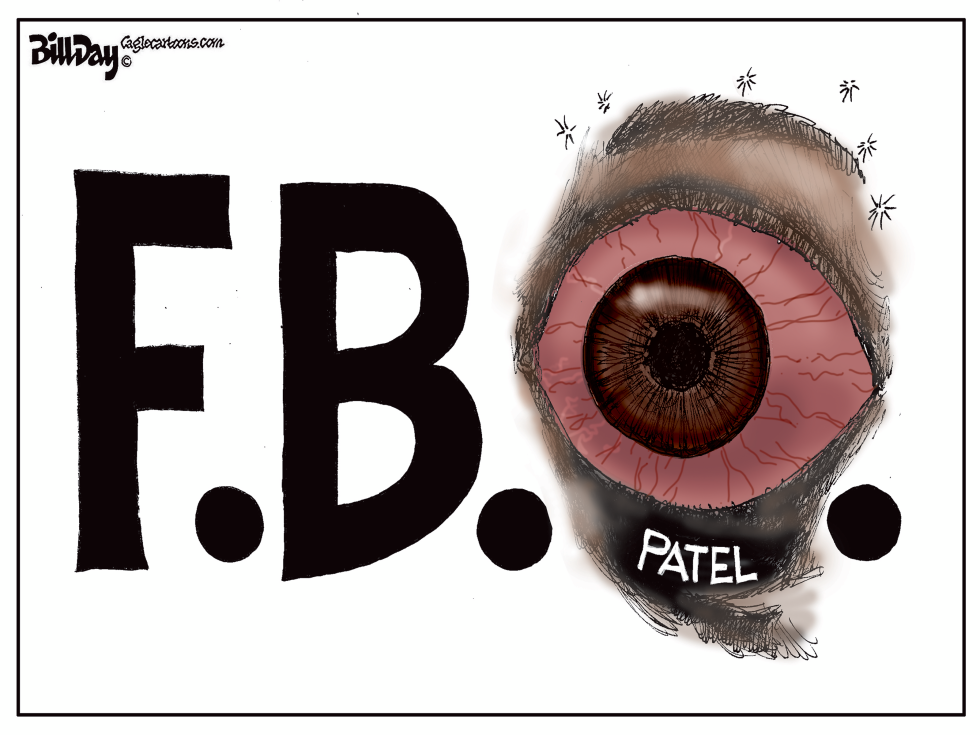
Bill Day's cartoon features the letters F.B.I. with a veiny, bloodshot eye replacing the 'I', and the word Patel scrawled beneath it, evoking themes of booze and drinking. Stars sparkle above the eye, adding to the sense of disorientation or absence. This piece, tagged with Patel, FBI, booze, drinking, absent, and drunk, offers a straightforward jab at a figure's rumored state. In the world of political cartoons, such direct visuals cut through the noise, reminding editors that simplicity often packs the biggest punch. Day's style here is classic, with rough lines emphasizing the eye's intoxicated look, making it shareable for those following nomination sagas.
Apr
16
2026
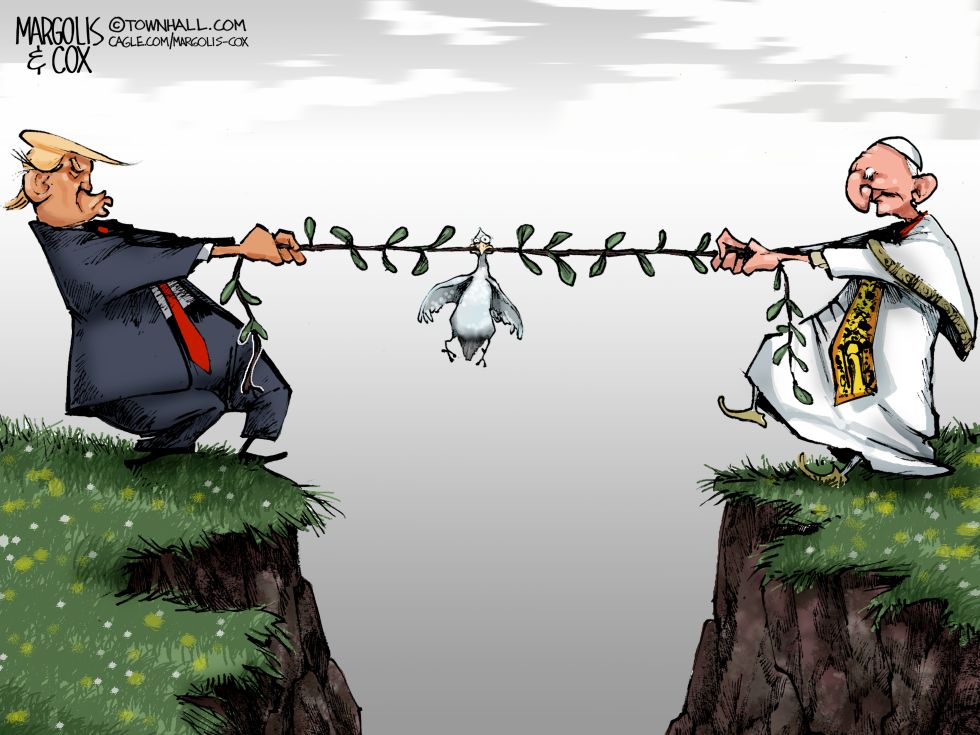
The cartoon shows a caricature of President Trump on one grassy cliff, gripping a vine with leaves that connects to a white dove in the center, while a figure resembling Pope Leo stands on the opposite cliff, also pulling the vine. They face each other across a deep chasm, with cloudy skies above. Tags like war, peace, dove, Iran, Middle East, and Church underscore the visual tension. The artists, Margolis & Cox, place their signature prominently. This setup captures a straightforward conflict over a peace symbol, without hidden layers. The dove hangs upside down, wings slightly spread, as the two figures strain. No emotions or backstories are added; it's just the visible pull between suited man and robed leader.
Apr
16
2026
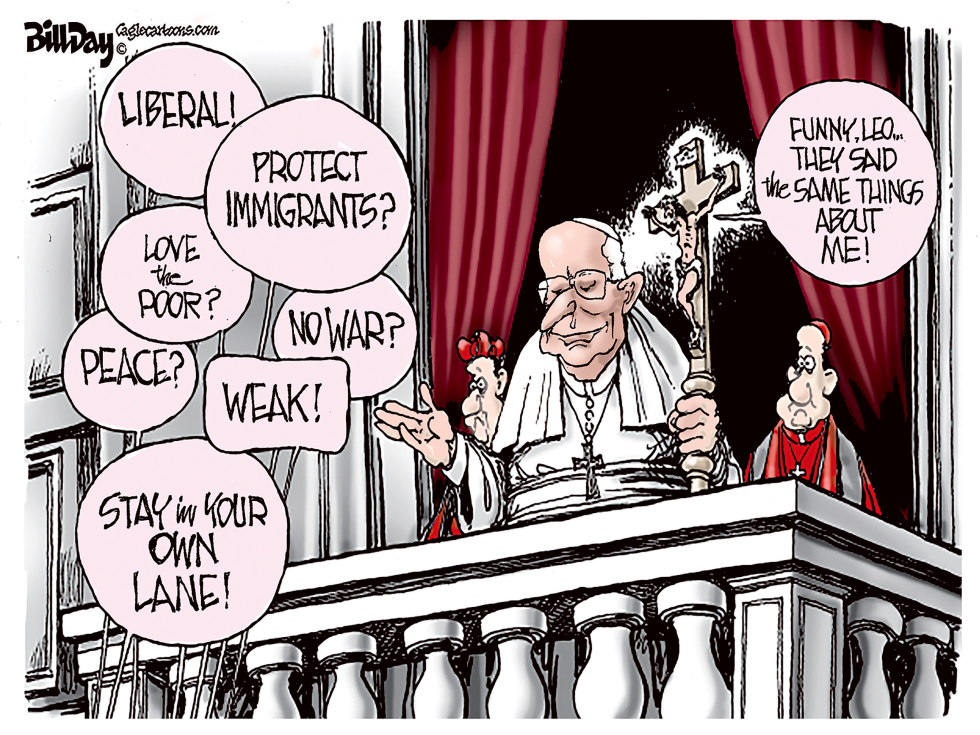
Bill Day's political cartoon shows a central pope figure on a balcony, holding a cross staff, surrounded by speech bubbles accusing liberal views like protect immigrants, love the poor, peace, no war, weak. A side figure remarks on funny Leo saying the same things about me, drawing a clear visual parallel. The composition uses red curtains and clerical attire for a Vatican setting, emphasizing satire on church politics. Tags include political cartoon pope francis, bill day cartoon, pope leo comparison, conservative backlash pope, anti-war pope, catholic church politics.
Apr
16
2026
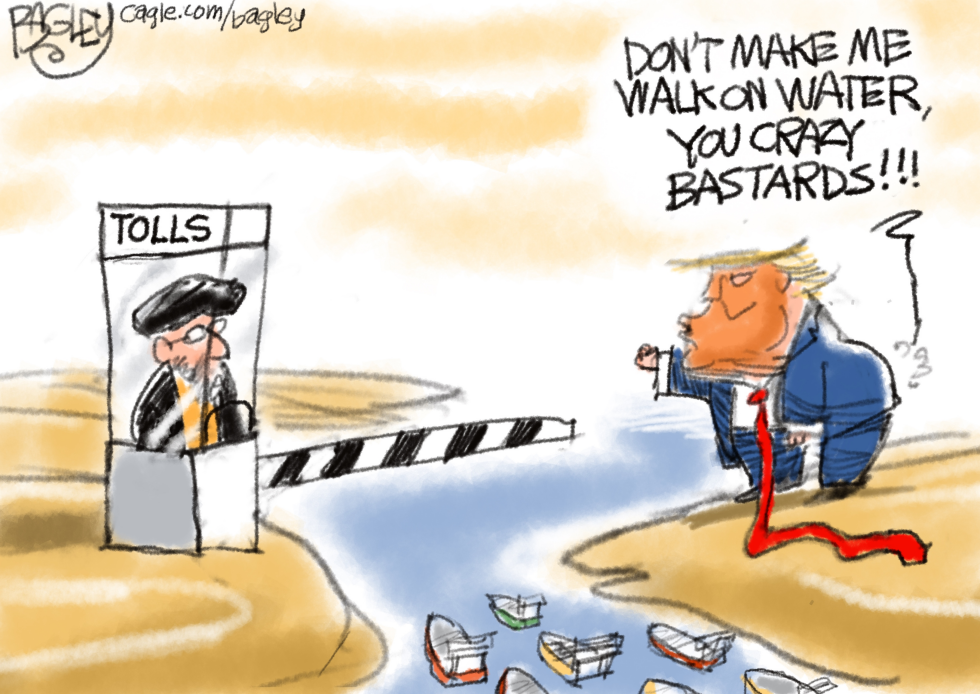
Donald Trump stands at the edge of a body of water confronting a toll booth operated by a figure resembling Ayatollah Khamenei. Small tankers sit in the water below while Trump issues a warning about walking on water. The scene references shipping routes through the Strait of Hormuz and surrounding nations.
Apr
15
2026
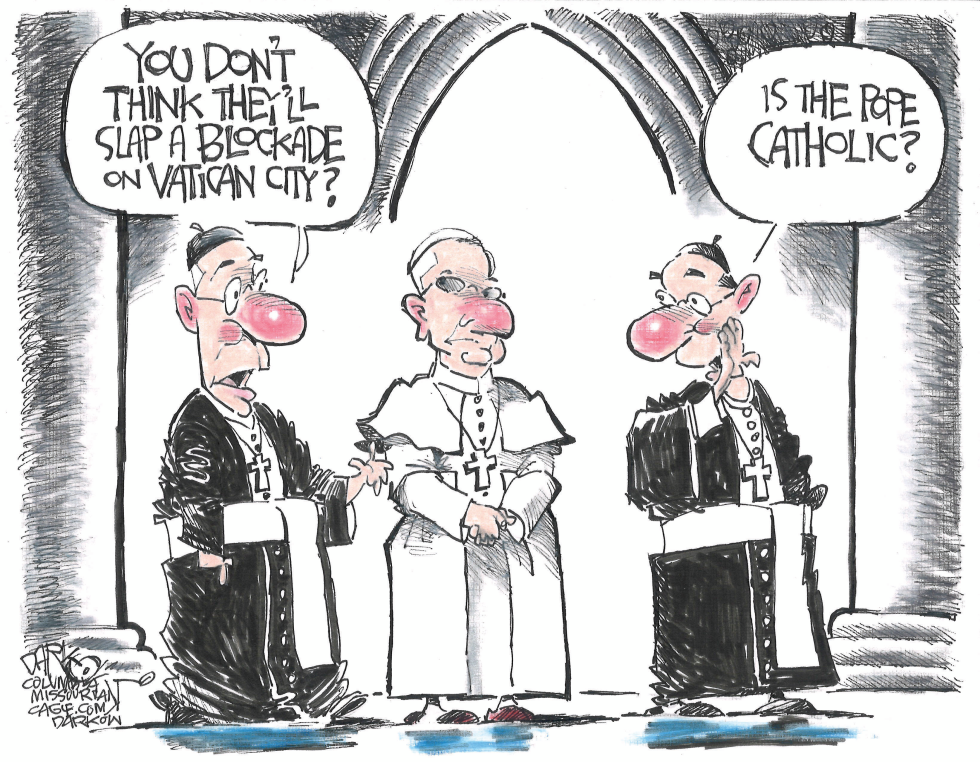
John Darkow's cartoon captures three Catholic clergy in traditional attire, with the central Pope figure amid a discussion on a Vatican blockade. The left figure worries about sanctions slapping Vatican City, while the right delivers the classic 'Is the Pope Catholic?' line, a rhetorical jab at obvious truths. This piece uses dry humor to spotlight tensions around religious institutions facing isolation, blending blockade fears with papal identity. The archway background grounds it in Vatican aesthetics, emphasizing the blockade theme without overreaching into unseen politics.
Apr
15
2026
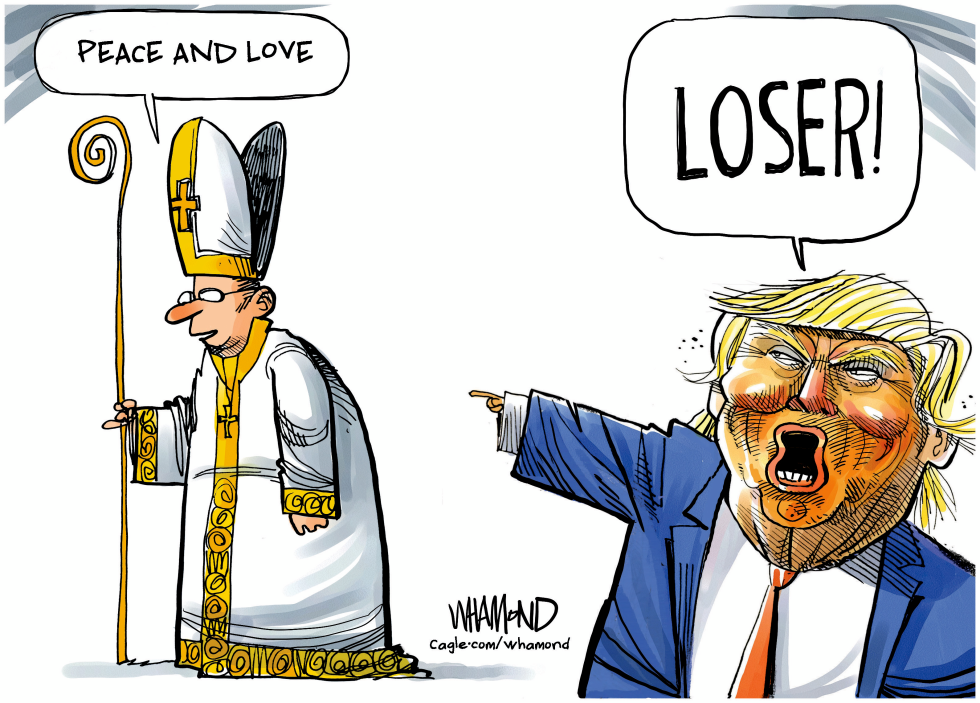
Dave Whamond's political cartoon captures Donald Trump in a blue suit, pointing aggressively and shouting 'loser' at a figure resembling the Pope, dressed in white robes with a tall mitre and holding a crozier, who calmly utters 'peace and love.' This satirical illustration underscores Trump's bombastic personality clashing with symbols of compassion and spirituality. The simple composition, with speech bubbles dominating the scene, amplifies the humor in the contrast between aggression and serenity. Tags like political cartoon Trump Pope, satirical illustration Trump insults religious leader, and cartoon Trump calls Pope loser emphasize the editorial bite. Such cartoons thrive in syndication for their timely jab at public figures. The dry wit lies in the exaggerated expressions, making it shareable across social media platforms.
Apr
13
2026
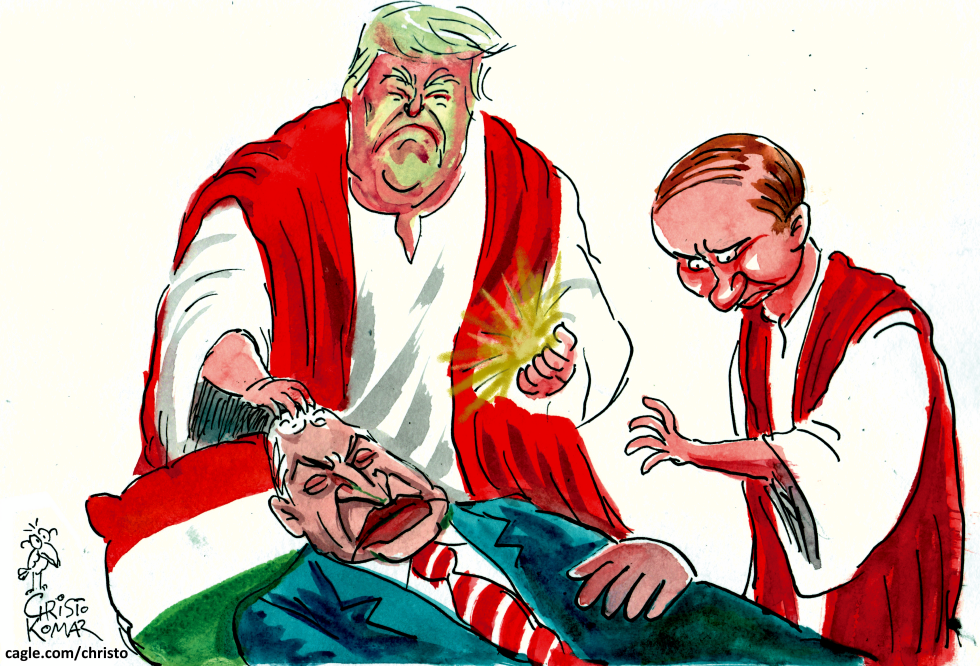
Christo Komarnitski's cartoon captures Trump dressed as a healer in red and white robes, his hand emitting a yellow spark as it touches the head of a mustached man in a suit, lying on a pillow colored like the Hungary flag with red, white, and green stripes. Beside him, another figure in matching robes extends a clawed hand. The image employs political satire, caricature, humor, editorial art, parody, and illustration to highlight the scene without deeper inference. The artist's signature appears at the bottom left, marking it as a straightforward visual gag in the tradition of sharp political cartoons.