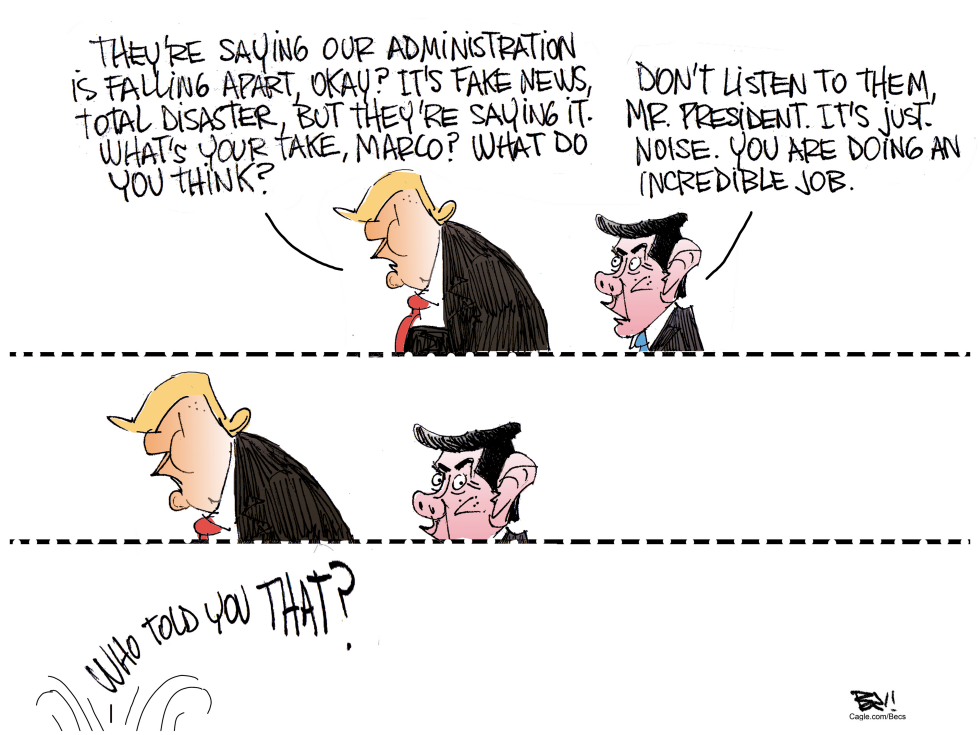
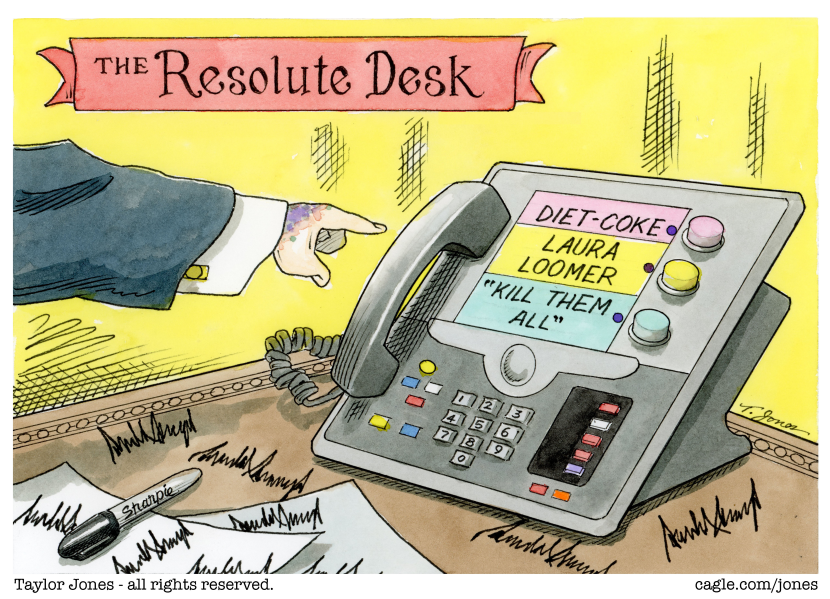
President Trump asked Senator Marco Rubio for his assessment of reports that the administration is in disarray, labeling them fake news. Rubio dismissed the reports as noise and praised Trump's performance. Trump responded by questioning who had told Rubio that assessment. The exchange highlights tensions over loyalty and information flow inside the administration. The cartoon portrays Rubio's positive reply as triggering suspicion rather than reassurance.
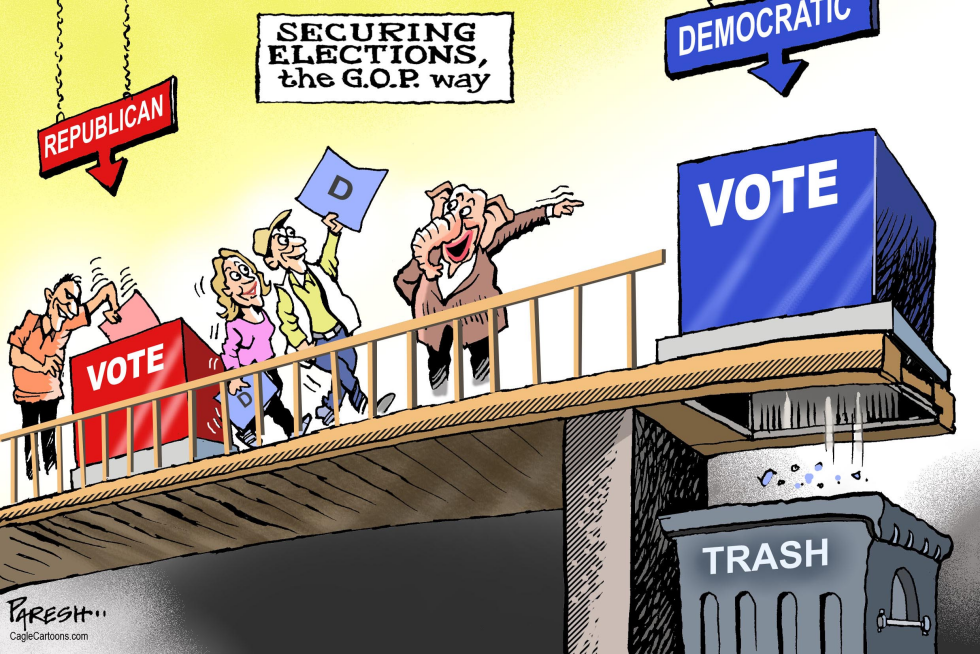
The cartoon depicts Republicans on a platform guiding a large blue vote box labeled Democratic into a trash can below while a red Republican vote box remains on the structure. A sign reads Securing Elections the G.O.P. way. The elephant symbol of the GOP points toward the action as figures including one holding a D flag stand nearby. The image comments on claims of election integrity by showing ballots from one party discarded. This reflects ongoing partisan debates over voting procedures and access as of the 2026 publication date.
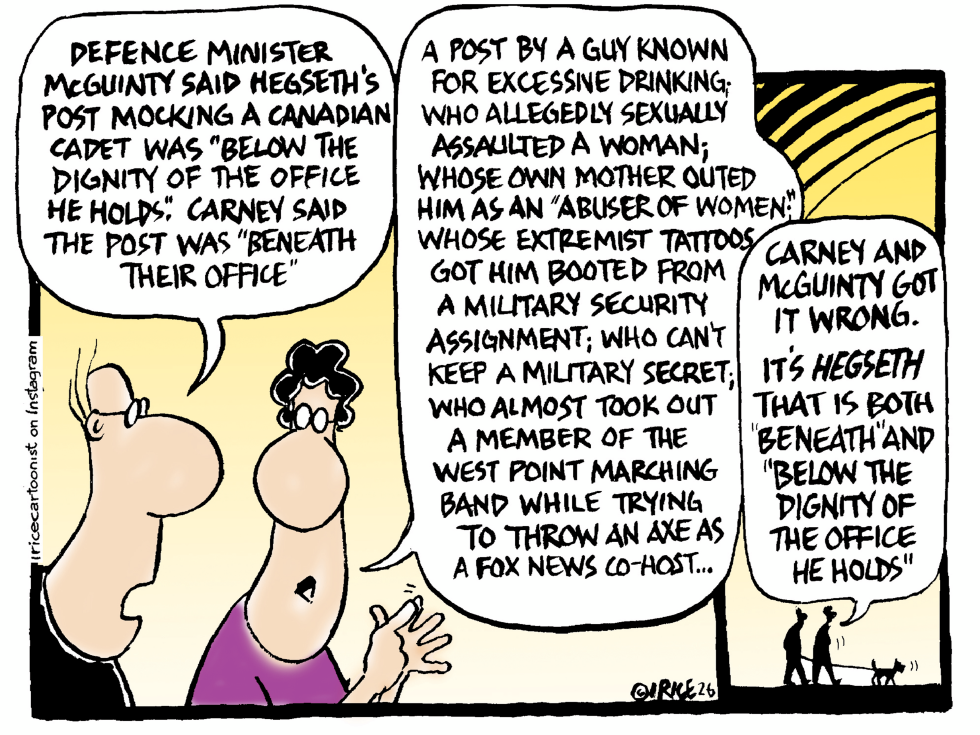
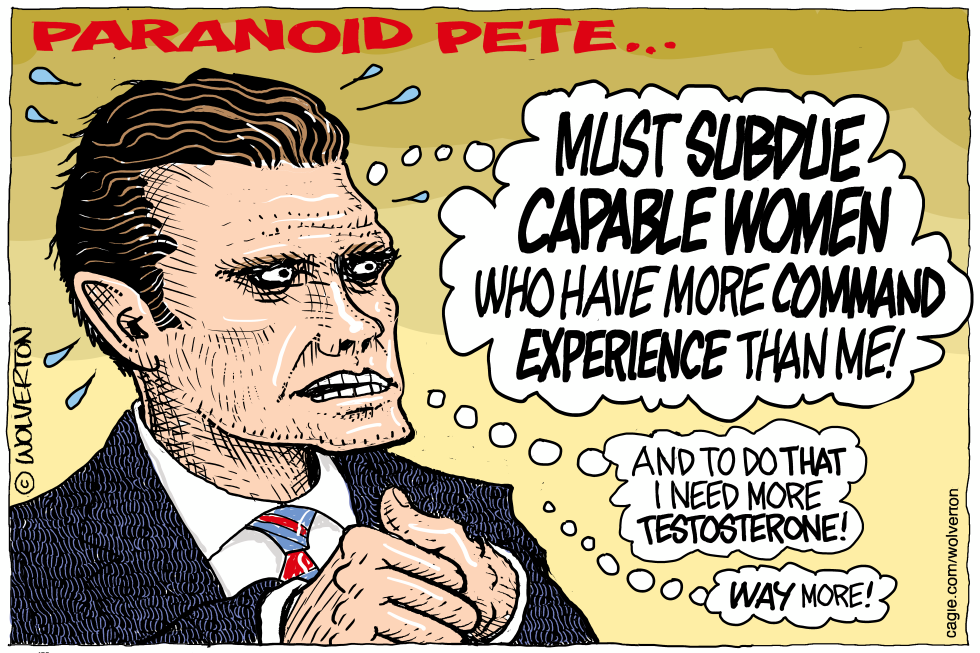
Canadian Defence Minister David McGuinty and Mark Carney publicly condemned a social media post by Pete Hegseth mocking a Canadian cadet, calling it beneath the dignity of the office. The remarks came amid Hegseth's nomination process for a senior U.S. defense position. The cartoon argues the ministers have the assessment backward, pointing instead to Hegseth's history of alleged misconduct, security clearance problems, and public incidents as the true disqualifiers. This reflects ongoing debate over nominee vetting standards and cross-border political commentary on U.S. appointments.
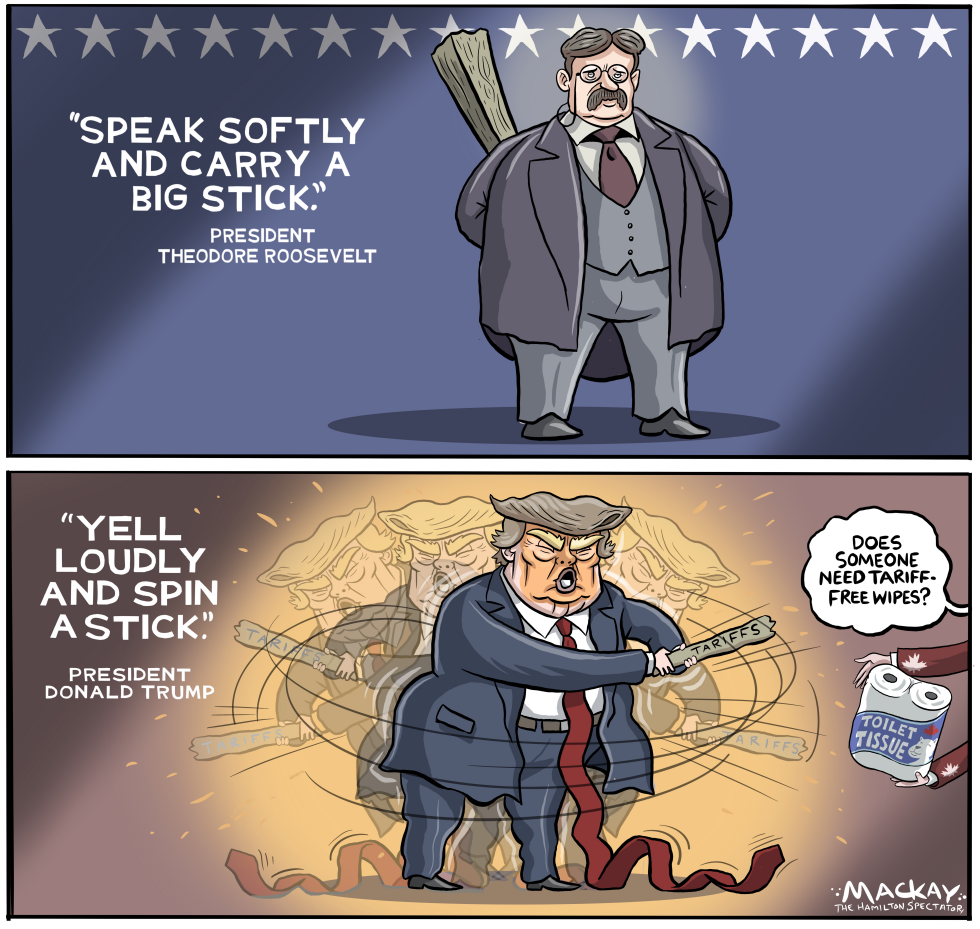
The cartoon by Graeme MacKay contrasts Theodore Roosevelt's famous speak softly and carry a big stick approach with Donald Trump's version of yelling loudly and spinning a stick covered in tariffs. In the lower panel Trump appears dizzy from the motion as a Canadian hand offers toilet tissue labeled tariff-free wipes. The image comments on recent US tariff actions and their impact on Canadian trade relations as of the September 2026 publication date.
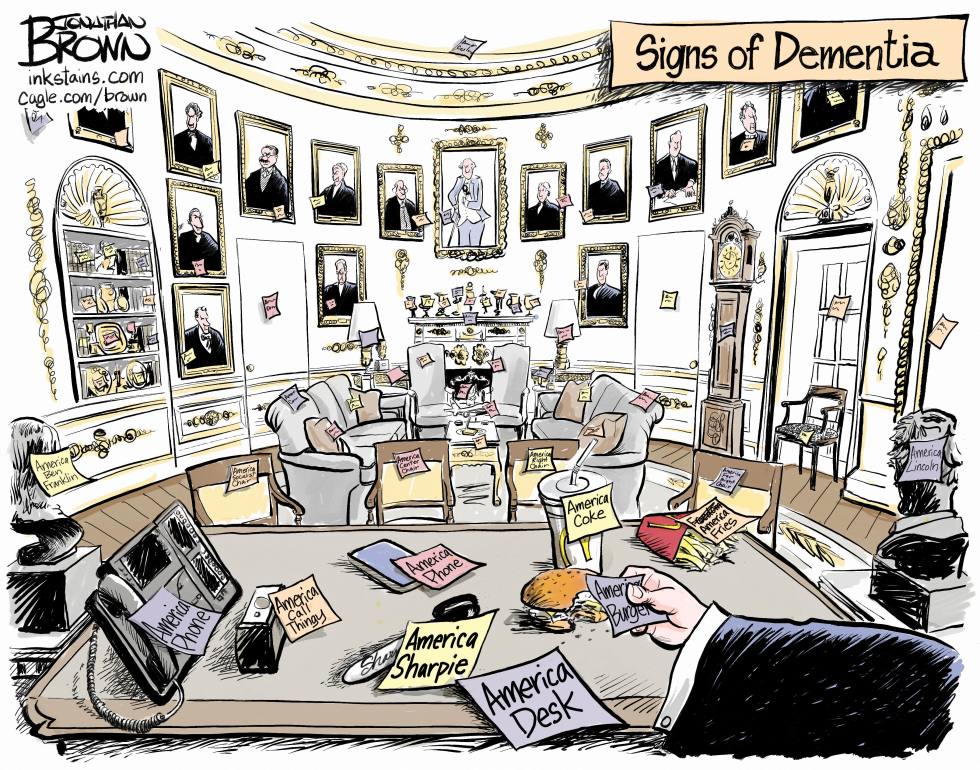
A new editorial cartoon depicts the Oval Office overrun with sticky notes labeling everyday items as America. The scene highlights signs of dementia through repeated branding on phones, desks, food and furniture. Published on September 9, 2026, the work comments on ongoing concerns about cognitive fitness in the presidency. The visual uses the familiar setting of the White House to underscore confusion and memory issues. Observers note the cartoon captures public debate over leadership capacity without naming specific individuals.
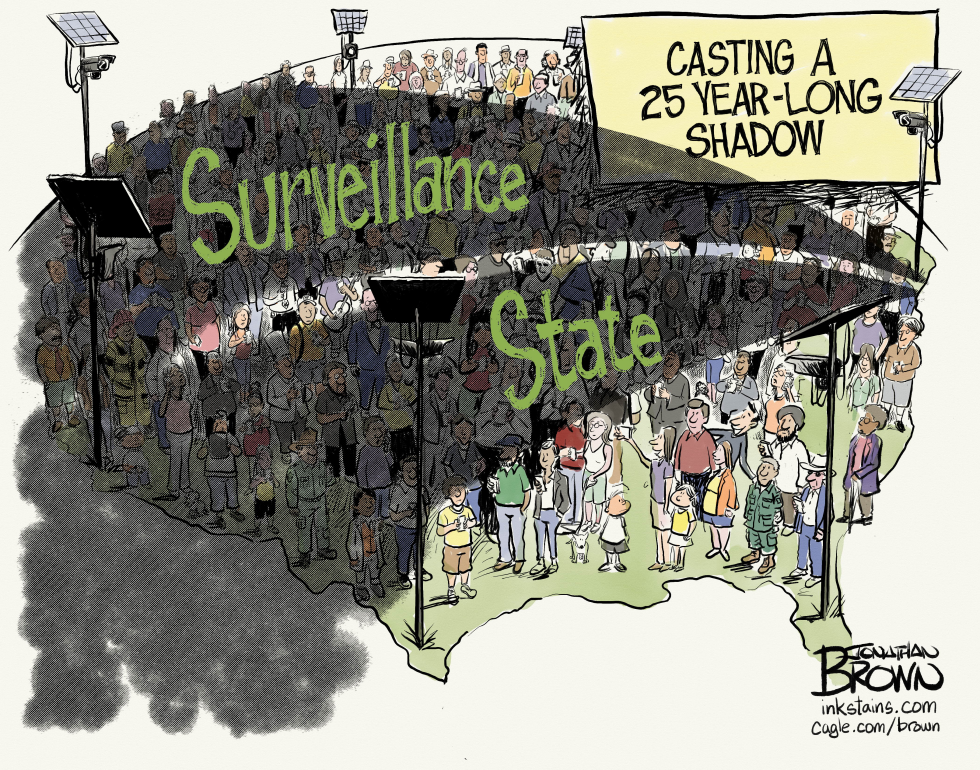
The cartoon depicts a dense crowd of Americans standing on a map of the United States, partially obscured by a large dark shadow cast by surveillance cameras mounted on poles. The words 'Surveillance State' appear prominently in green lettering across the scene, while a sign in the upper right reads 'CASTING A 25 YEAR-LONG SHADOW.' The image comments on the lasting effects of expanded government surveillance programs that began after the September 11 attacks, now spanning a quarter century. It illustrates how these measures continue to influence daily life and public spaces in 2026.
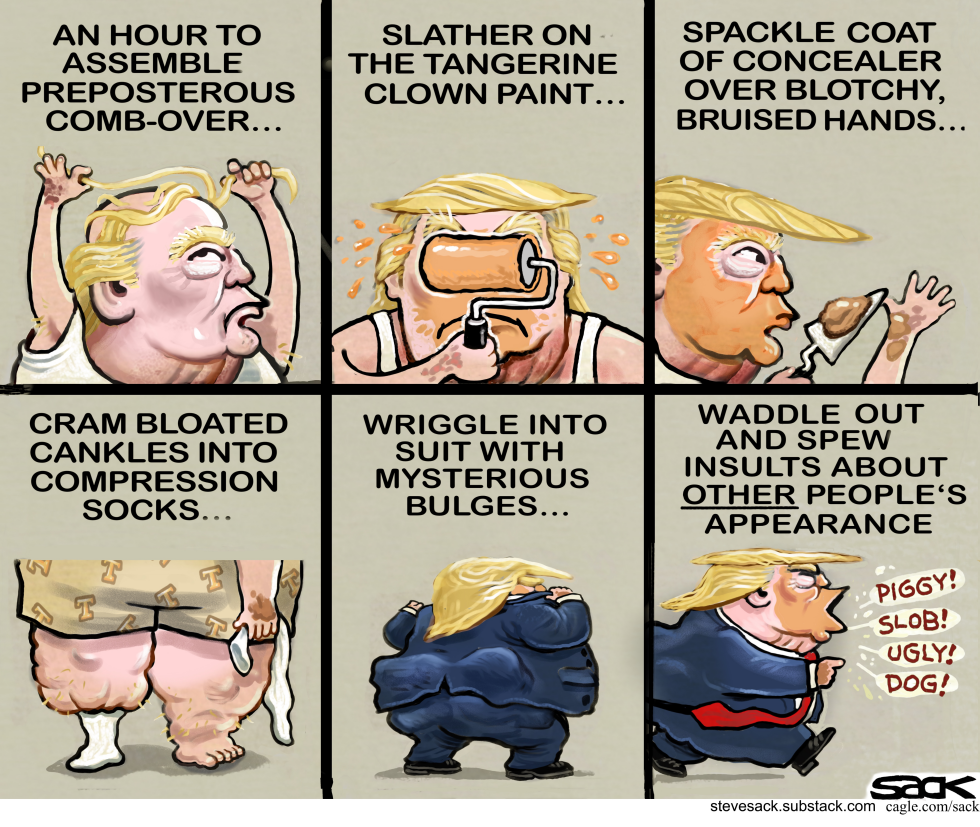
Donald Trump maintains a detailed personal grooming regimen that includes assembling a comb-over, applying tangerine-toned makeup, concealing skin issues, using compression socks, and adjusting his suit. This preparation precedes his public remarks criticizing the appearances of others. The piece presents the contrast as evidence of inconsistent standards in political discourse.
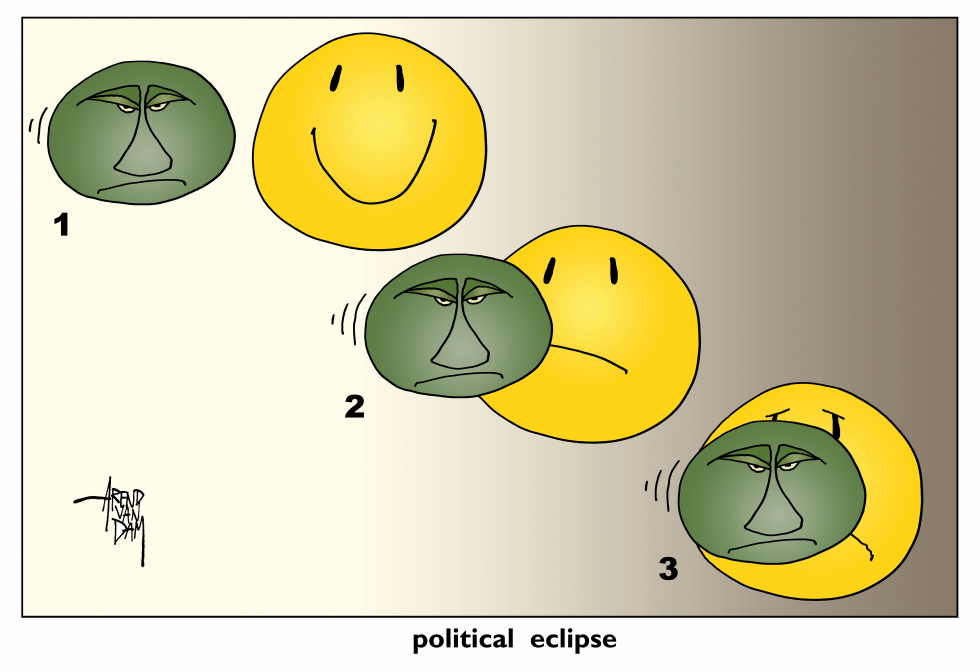
A political figure represented by a green frowning face progressively covers a yellow smiling face across three labeled stages. The interaction illustrates one presence gaining dominance while diminishing the other. The piece comments on the dynamics of political competition and shifting influence between rivals.
Elon Musk's public commentary on cryptocurrency markets continues to drive price swings and investor attention in 2026. His recent statements coincide with renewed volatility in Bitcoin trading. The editorial takes a critical view of how such high-profile interventions amplify market instability rather than stabilize it.
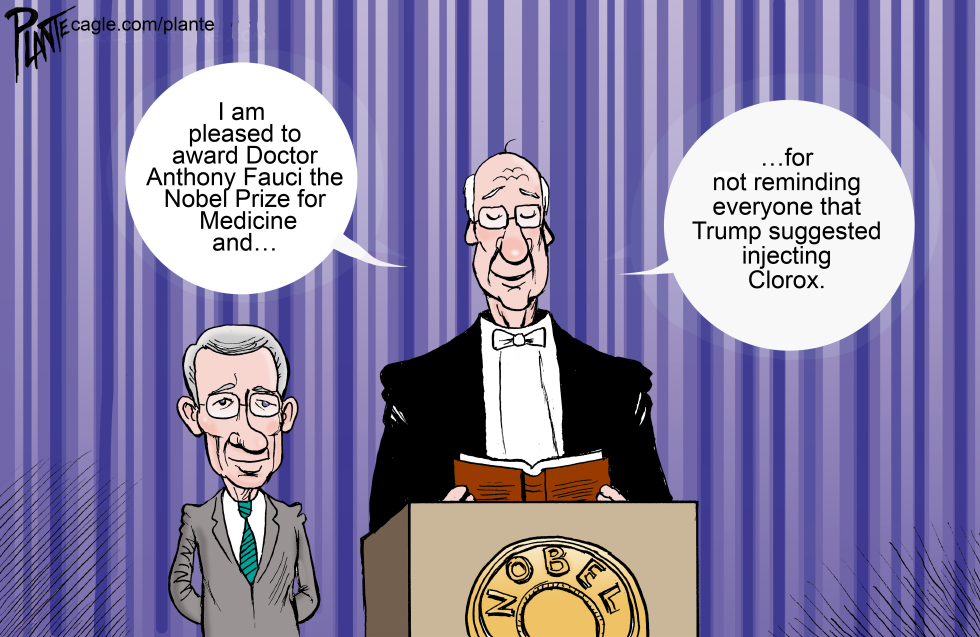
A Nobel Prize presentation for Dr. Anthony Fauci highlights his public health role during the COVID-19 period. The ceremony focuses on his contributions to medicine while avoiding reference to earlier statements from former President Trump about potential treatments. The moment underscores ongoing public debate over pandemic messaging and leadership accountability. The editorial position frames the award as recognition tied to selective memory rather than solely scientific achievement.
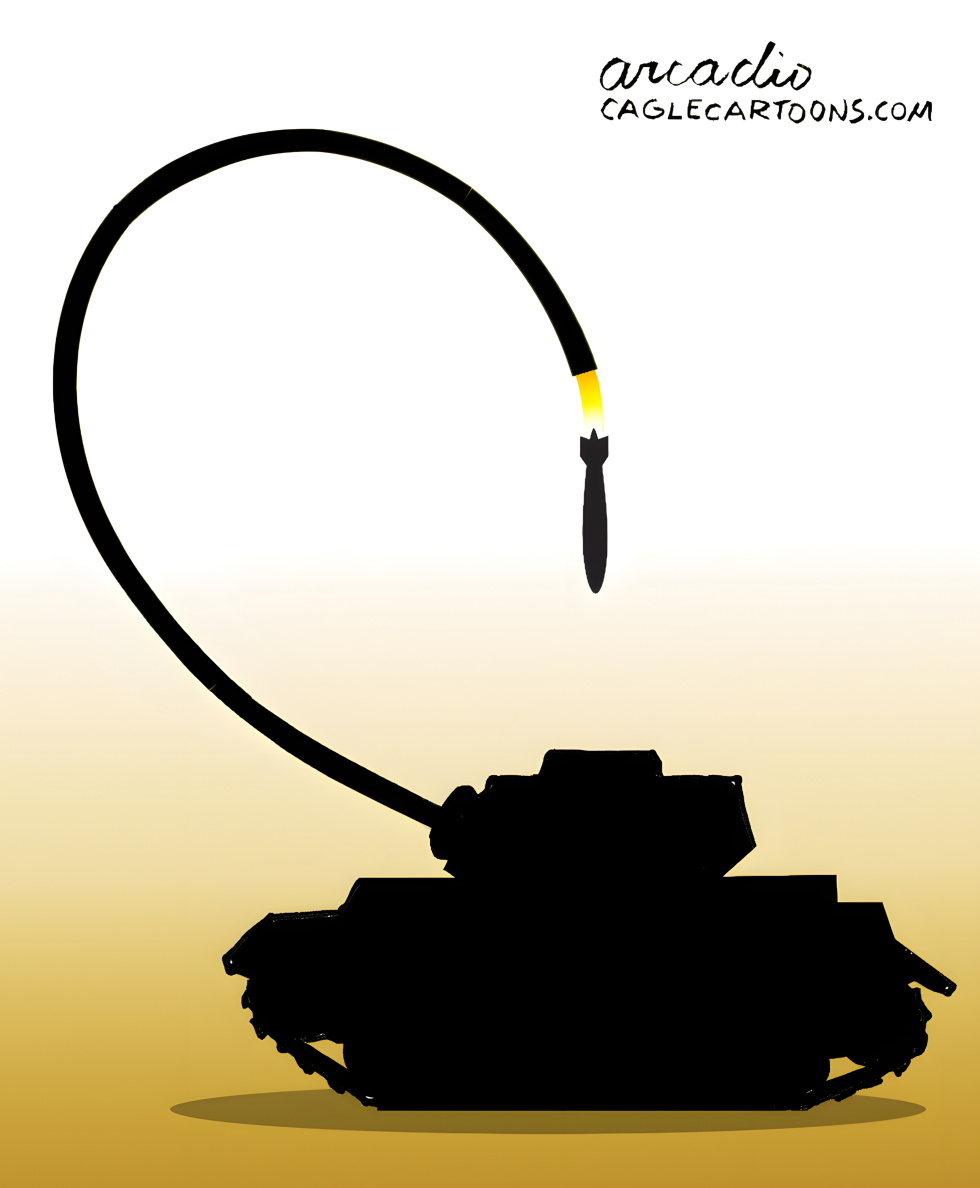
A military tank deploys a projectile attached to an unusually long curved fuse in this editorial image. The setup implies hardware that could rebound on its user. The piece comments on defense strategies where advanced systems carry built-in risks of unintended harm to the deploying force itself.
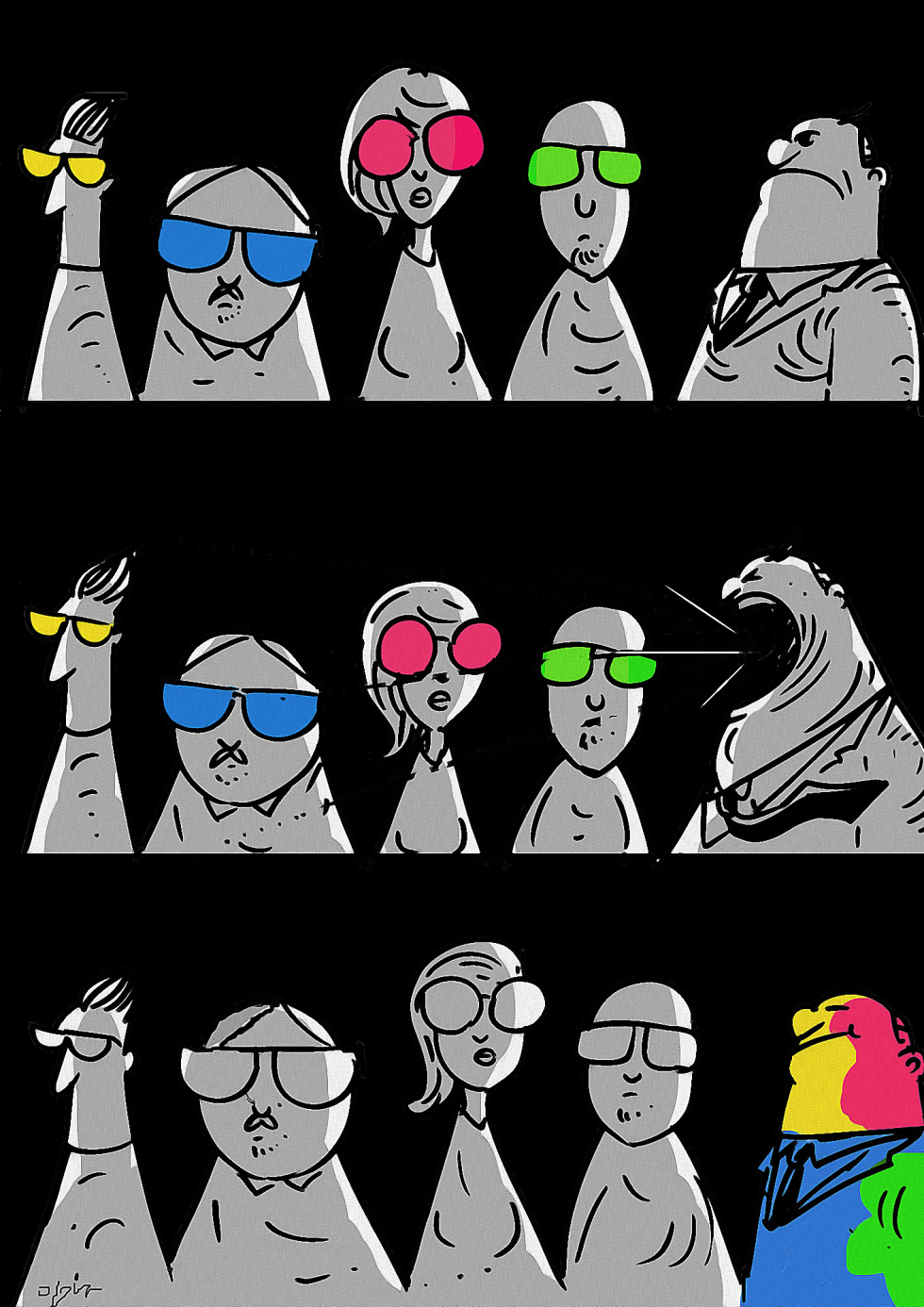
A series of panels depicts rows of figures wearing sunglasses in varying hues. The images suggest that personal filters shape what people see and react to. The final panel introduces a multicolored figure that stands apart from the rest. The work comments on how individual perspectives diverge even within similar groups. It highlights the contrast between uniform appearances and sudden breaks in pattern.
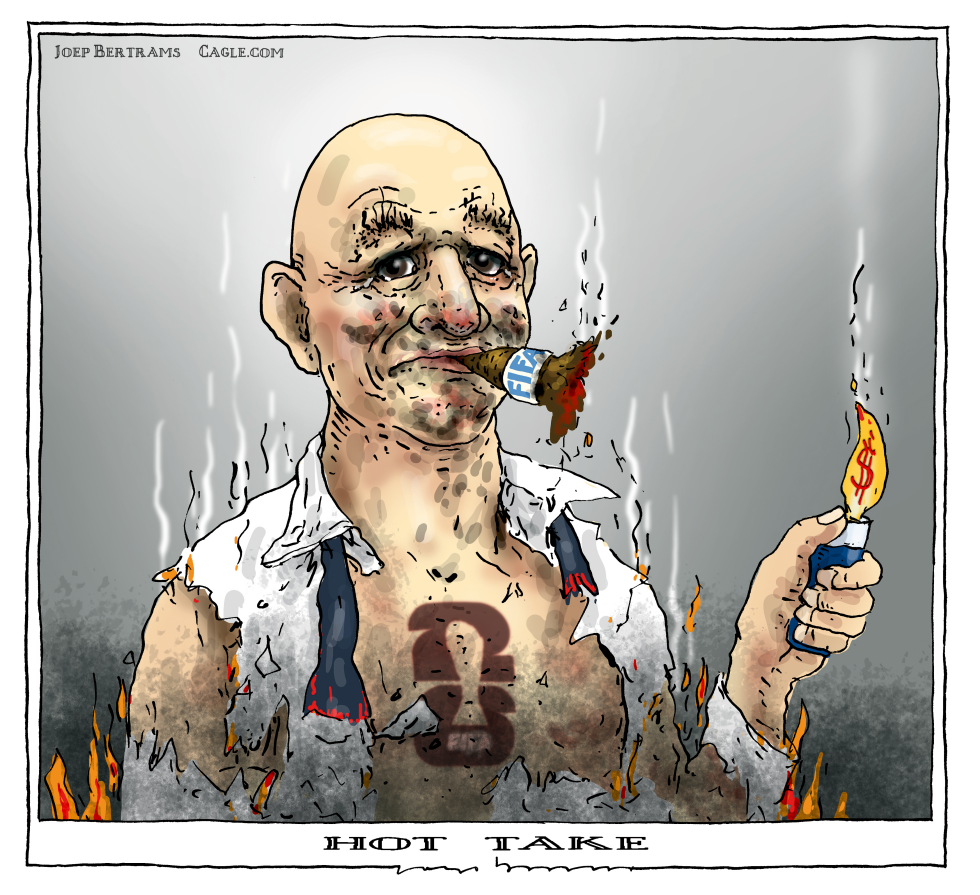
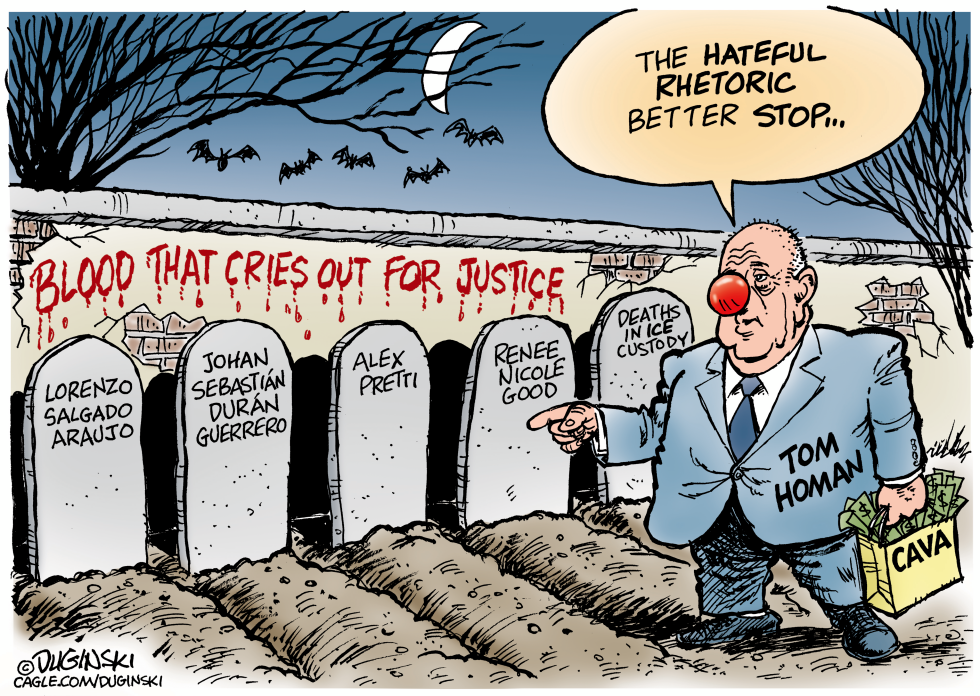
Tom Homan, a key figure in immigration enforcement, drew scrutiny in mid-2026 over inflammatory statements as reports of deaths in ICE custody continued. The piece portrays him dismissing concerns while profiting, arguing that such rhetoric must cease to address accountability in detention practices.
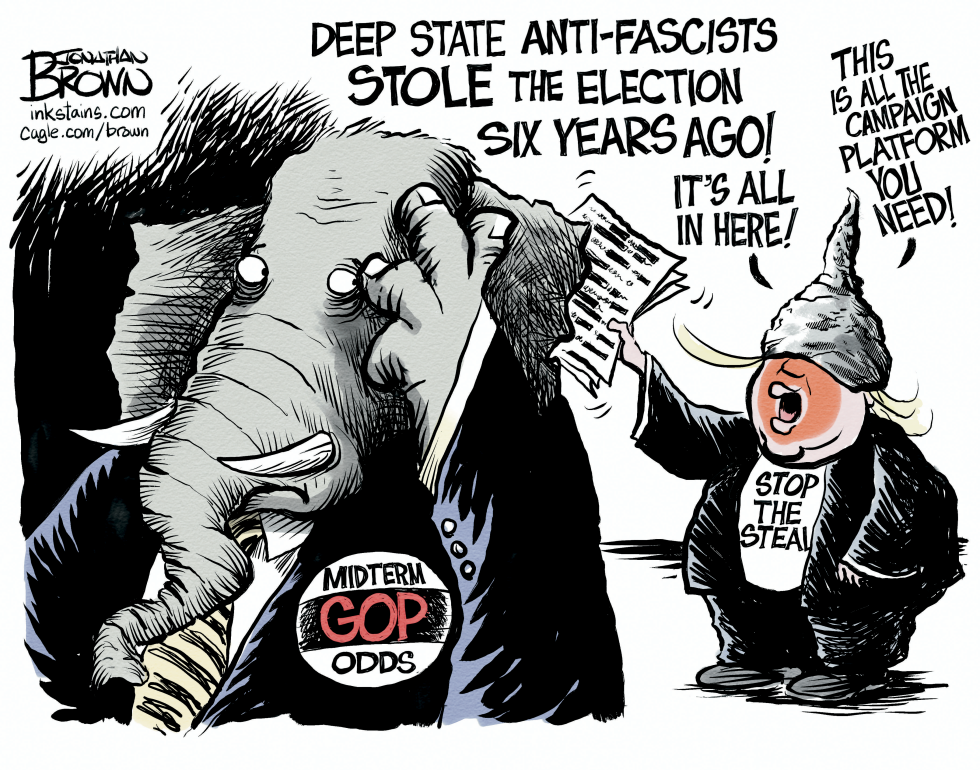
The cartoon shows a large Republican elephant in a suit covering its eyes while a small figure in a dunce cap labeled Stop the Steal waves papers claiming deep state anti-fascists stole the election six years ago. The elephant wears a Midterm GOP Odds button. Speech bubbles declare the papers contain the full campaign platform. The image comments on Republican candidates shifting focus from 2020 election disputes toward midterm races.