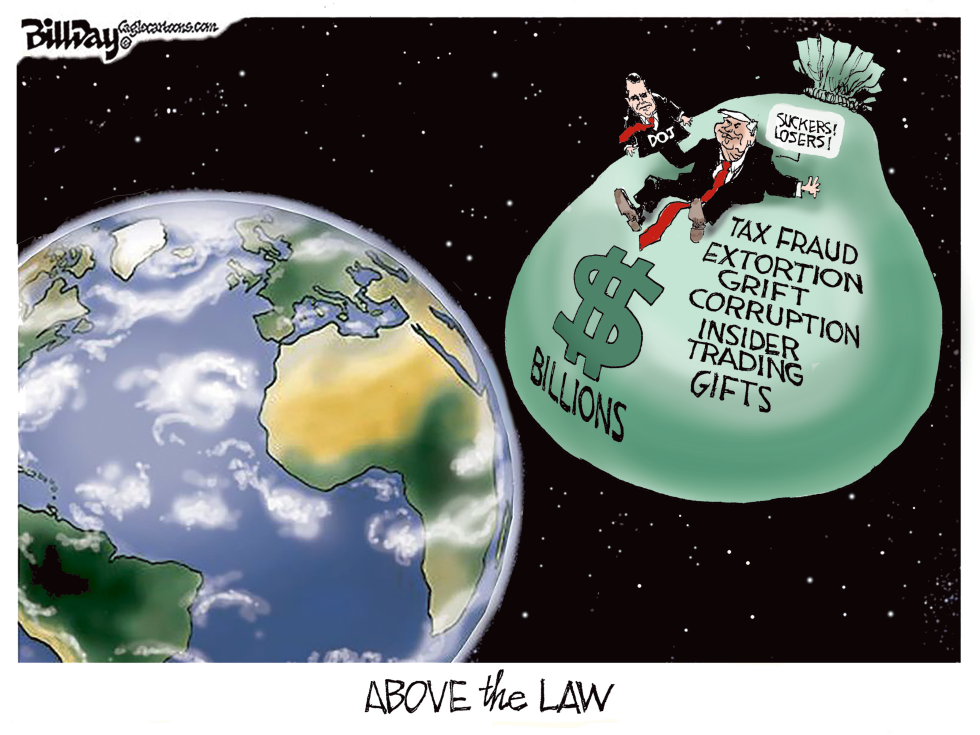
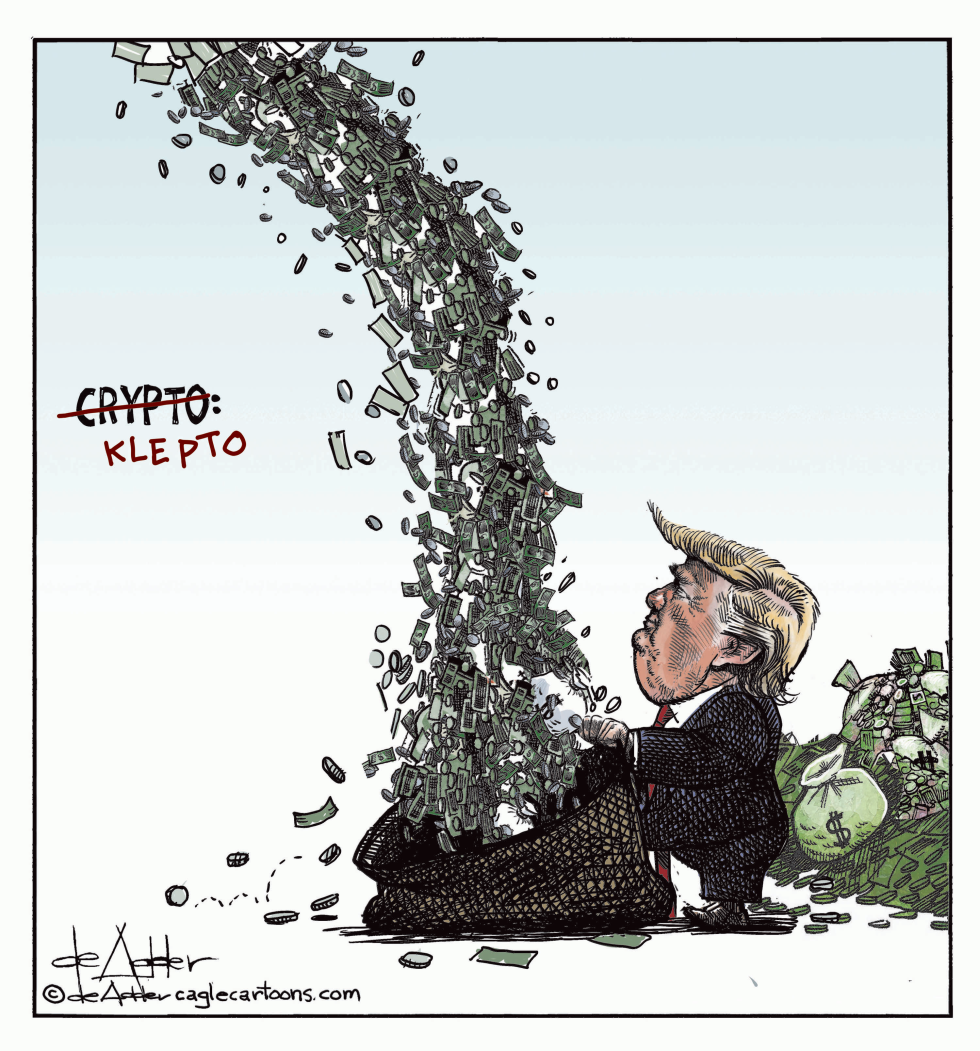
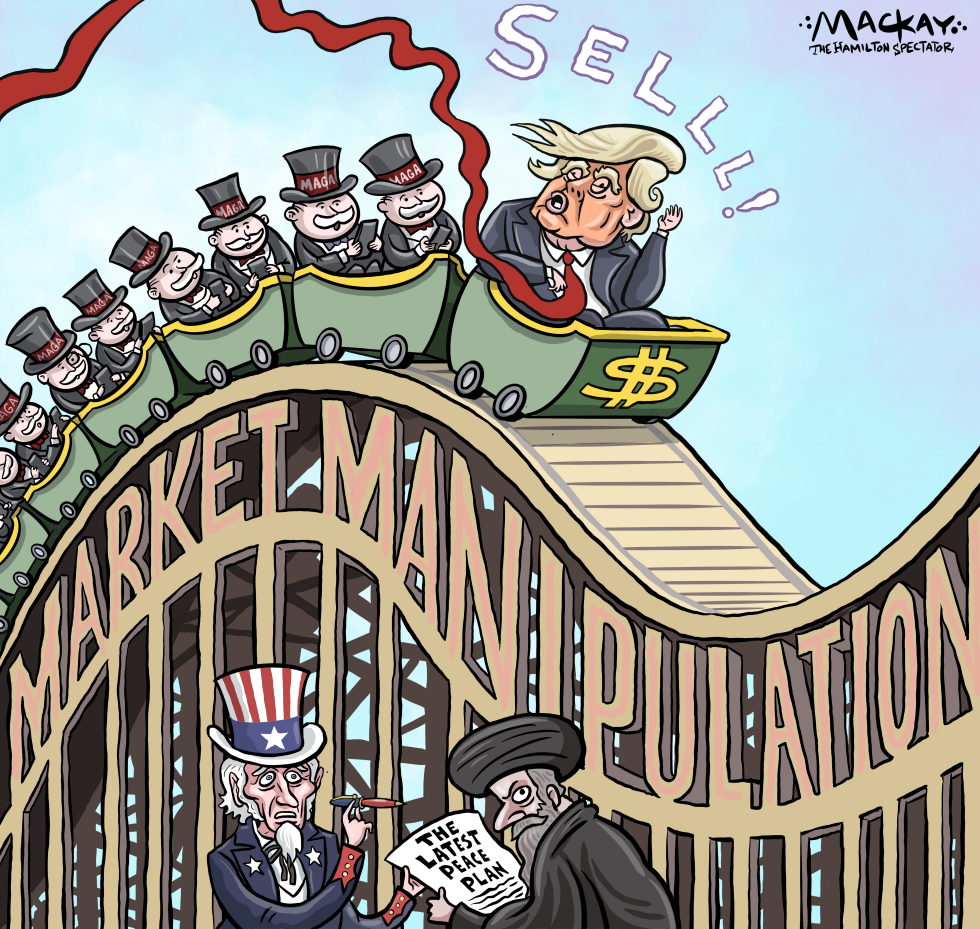
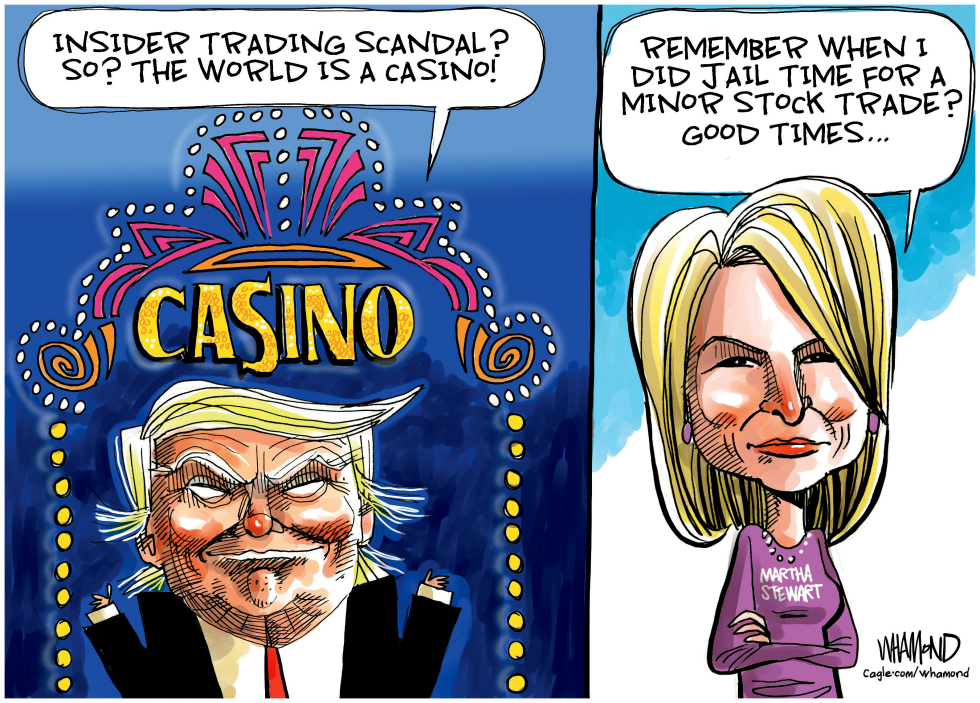
Donald Trump faces ongoing legal scrutiny over business practices and influence as former president. The image responds to persistent allegations of financial misconduct tied to his post-presidency activities and prior office. It portrays him as operating beyond accountability while pushing aside oversight efforts.
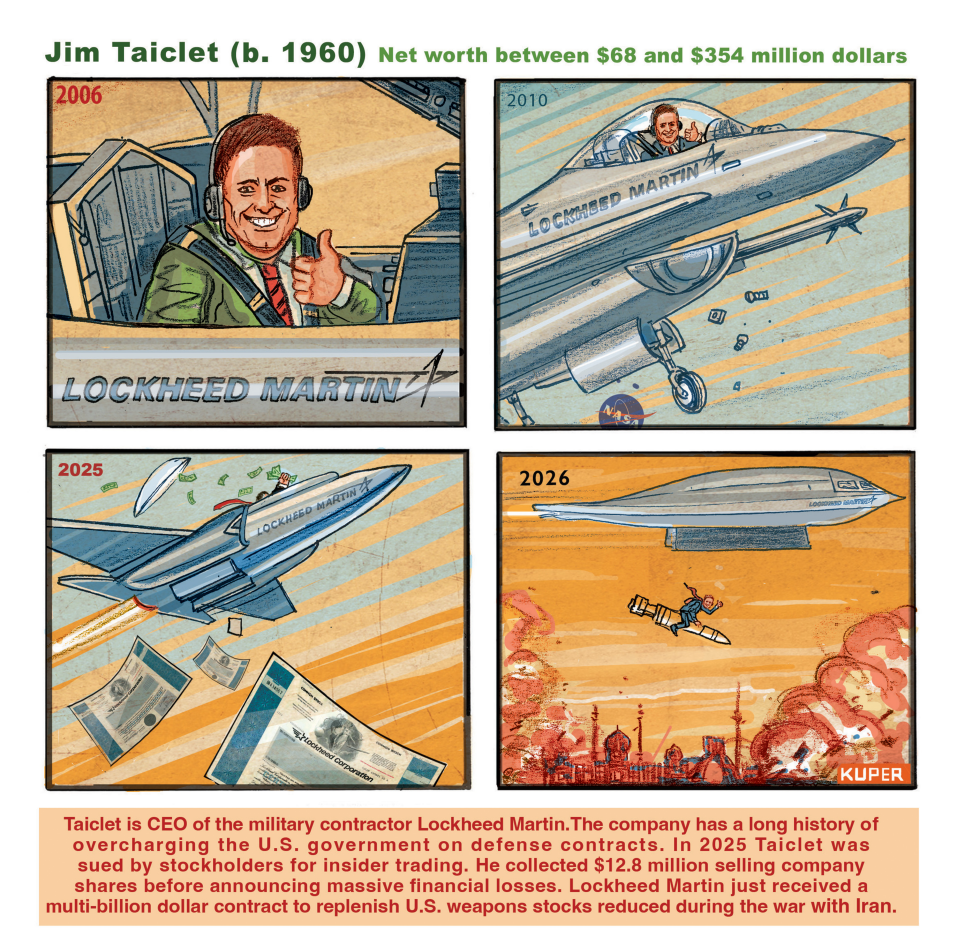
Lockheed Martin CEO Jim Taiclet was sued by stockholders in 2025 for selling $12.8 million in shares before announcing major losses. The company then won a multi-billion contract to replenish weapons depleted in the Iran conflict. The piece criticizes Taiclet and the contractor for insider trading and repeated government overcharging.
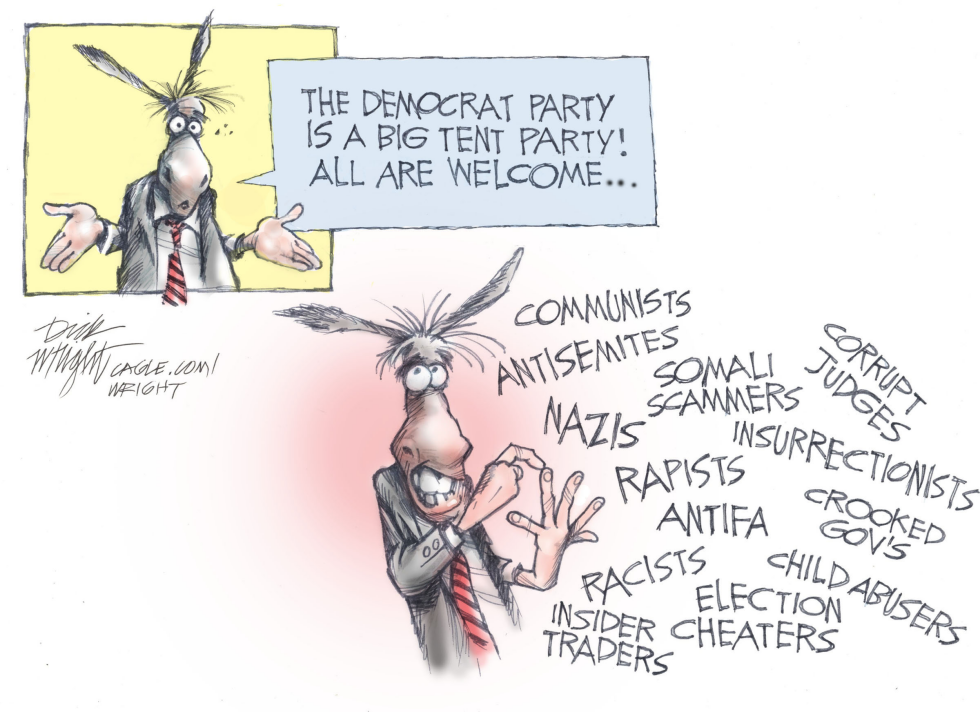
A July 2026 cartoon by Dick Wright depicts the Democrat Party's big tent claim through an inset donkey figure. The main character, also a donkey in a suit, gestures amid a cloud of labels naming groups such as communists, antisemites, Nazis, rapists, Antifa, racists, and election cheaters. The image critiques the party's inclusivity rhetoric by associating it with these categories. Publication occurs amid ongoing partisan debates over party platforms and voter bases.
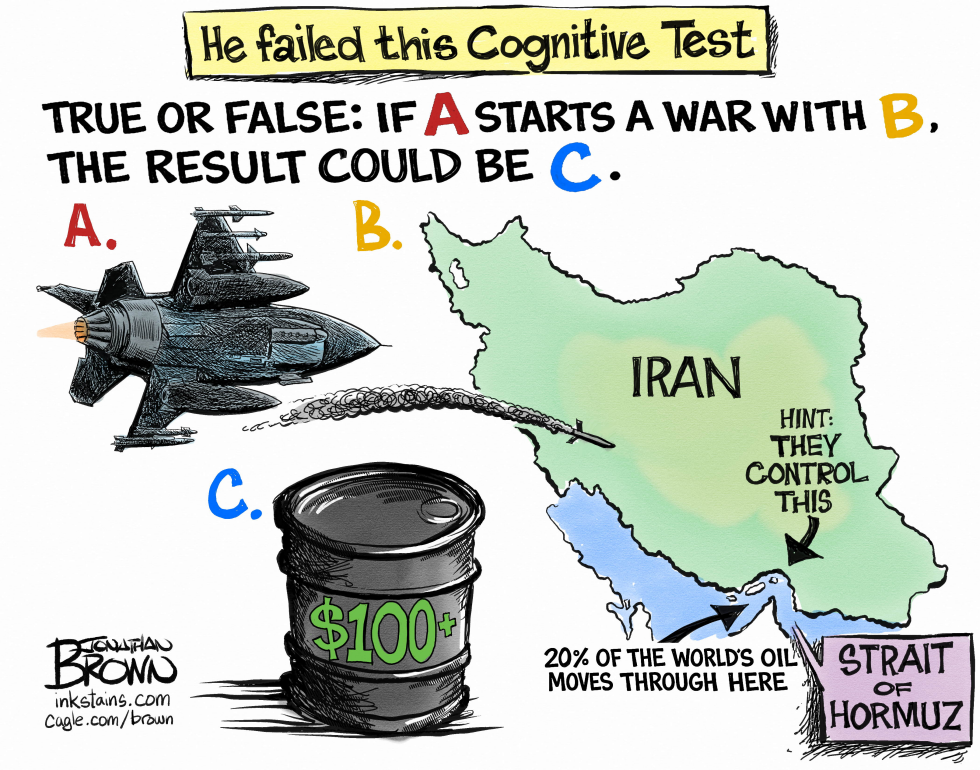
Jonathan Brown's cartoon presents a stark true-or-false cognitive test: if A (a fighter jet) starts a war with B (Iran), the result could be C (an oil barrel marked $100+). The map of Iran includes a hint pointing to the Strait of Hormuz, noting that 20% of the world's oil moves through there, underscoring control over this chokepoint. Tags such as cognitive test, war in Iran, oil prices, Strait of Hormuz, gas prices, and cost of war frame the satire. The artwork warns of economic fallout from conflict, with the jet trailing toward Iran and the oil barrel symbolizing surging costs. This piece captures geopolitical tensions in a simple, visual riddle.
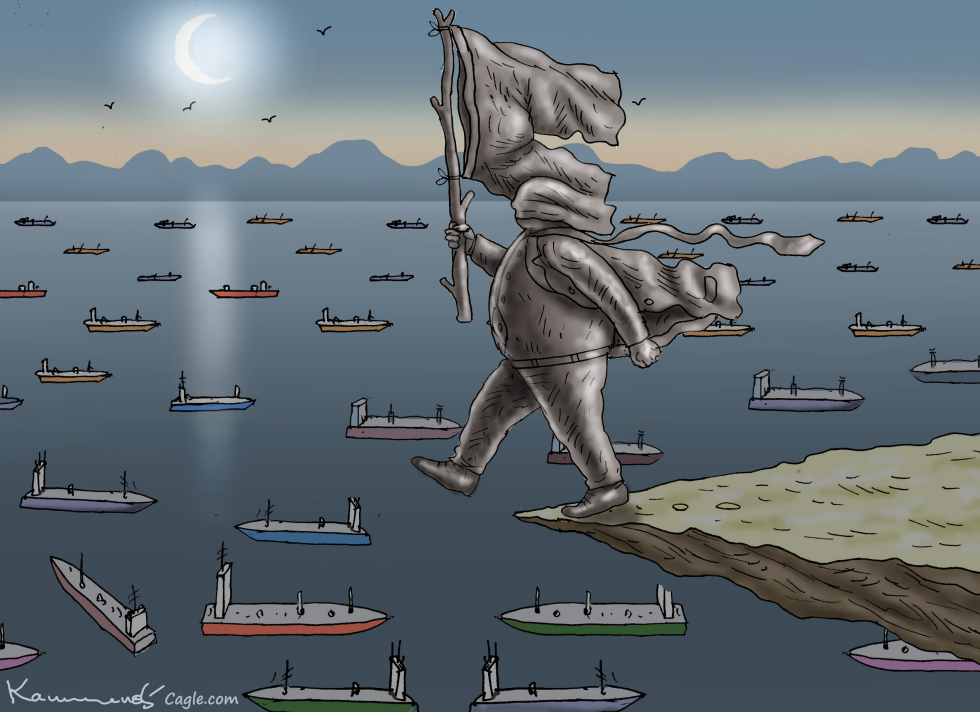
The cartoon shows a large, gray, statue-like figure with a hooded cloak, gripping a flag on a pole, as it steps forward off a cliff's edge. Below stretches a dark sea filled with many small ships of various colors, scattered across the water. In the background, mountains rise against a sky with a crescent moon and flying birds. The image, tagged with Banksy, Trumo, Hormuz, fascism, patriotism, and Maga terror, captures a moment of precarious advance. Artist Marian Kamensky signs it at the bottom left, linking to Cagle.com. This setup highlights a bold, unyielding march into potential downfall amid a busy maritime scene.
Arend van Dam's cartoon shows a gray battleship marked USA, complete with guns and missiles, driven by a figure in a suit at the wheel, as it goes over a waterfall between rocky cliffs under a blue sky. The image captures the essence of strategy failure in the Strait of Hormuz, tying into themes of Iran, ayatollahs, war, battleship mishaps, Middle East conflicts, oil, gas, energy, and economy. Such visuals often poke at misguided military moves, where the ship's plunge represents a dramatic downfall in strategic planning. The dry humor lies in the absurdity of a warship treating a strait like a river rapid, underscoring potential economic fallout from regional tensions. Cartoons like this thrive on clear, exaggerated metaphors that resonate with readers familiar with global news.
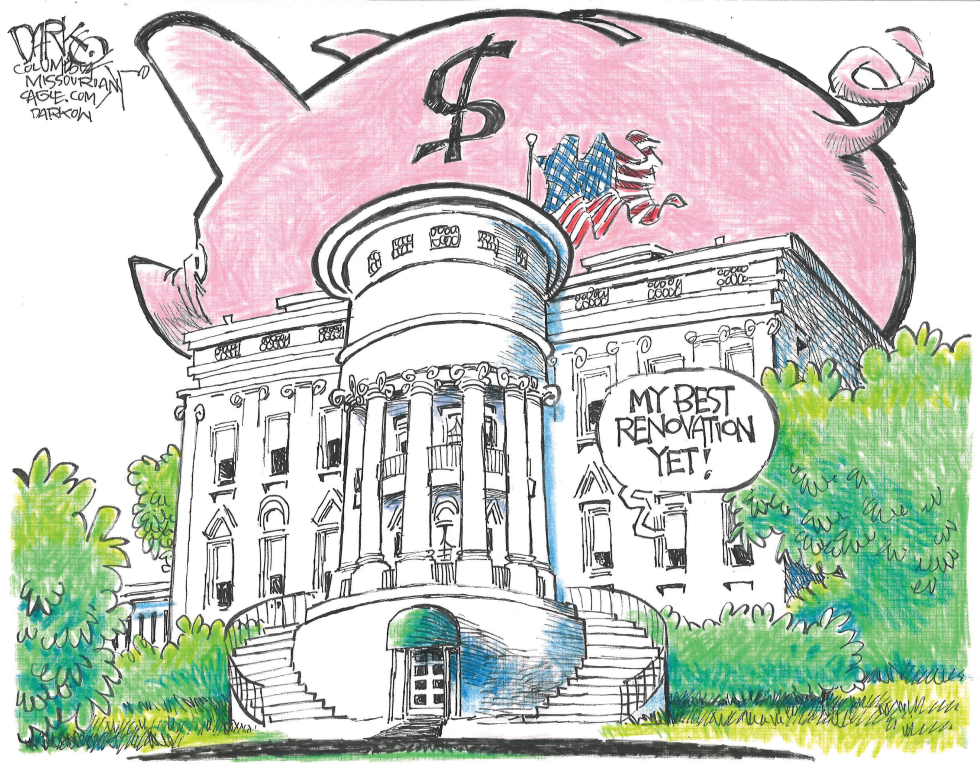
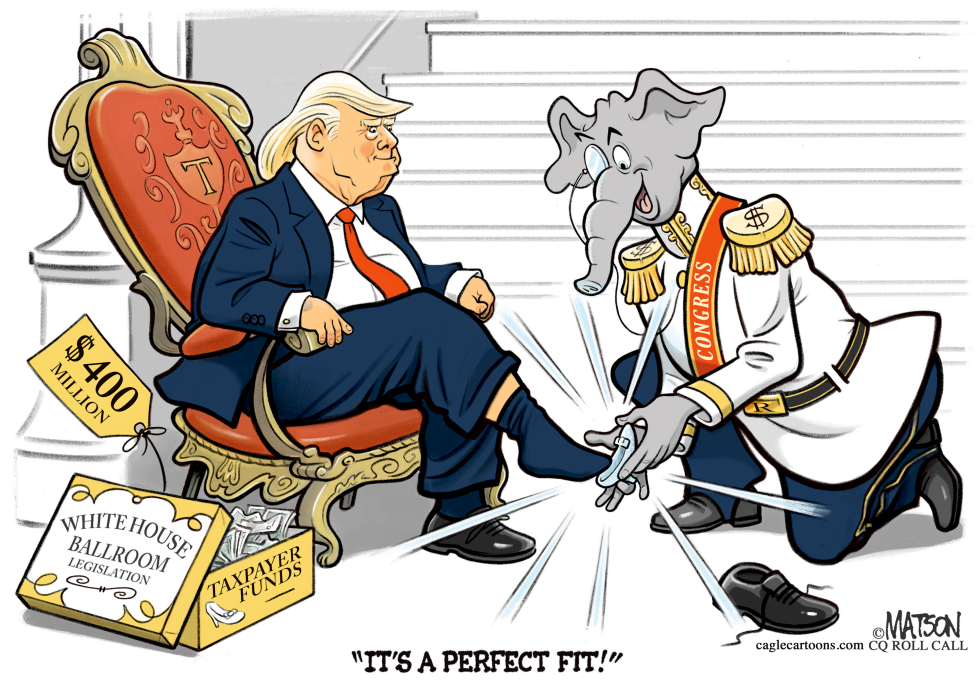
RJ Matson's cartoon depicts President Trump as Cinderella, lounging on a throne while a grinning Congress elephant, adorned with a sash and dollar-sign epaulets, slips a black shoe onto his foot, exclaiming 'It's a perfect fit!!' A box labeled 'White House Ballroom' overflows with 'Taxpayer Funds,' and a $400 million tag dangles nearby. This sharp satire targets Congressional Republicans' approval of hefty taxpayer funding for White House upgrades, echoing the fairy tale but with a political twist on government spending and Donald Trump's influence. The White House Correspondents Association Dinner at the Hilton Hotel lurks in the background tags, highlighting budget priorities amid fiscal debates.
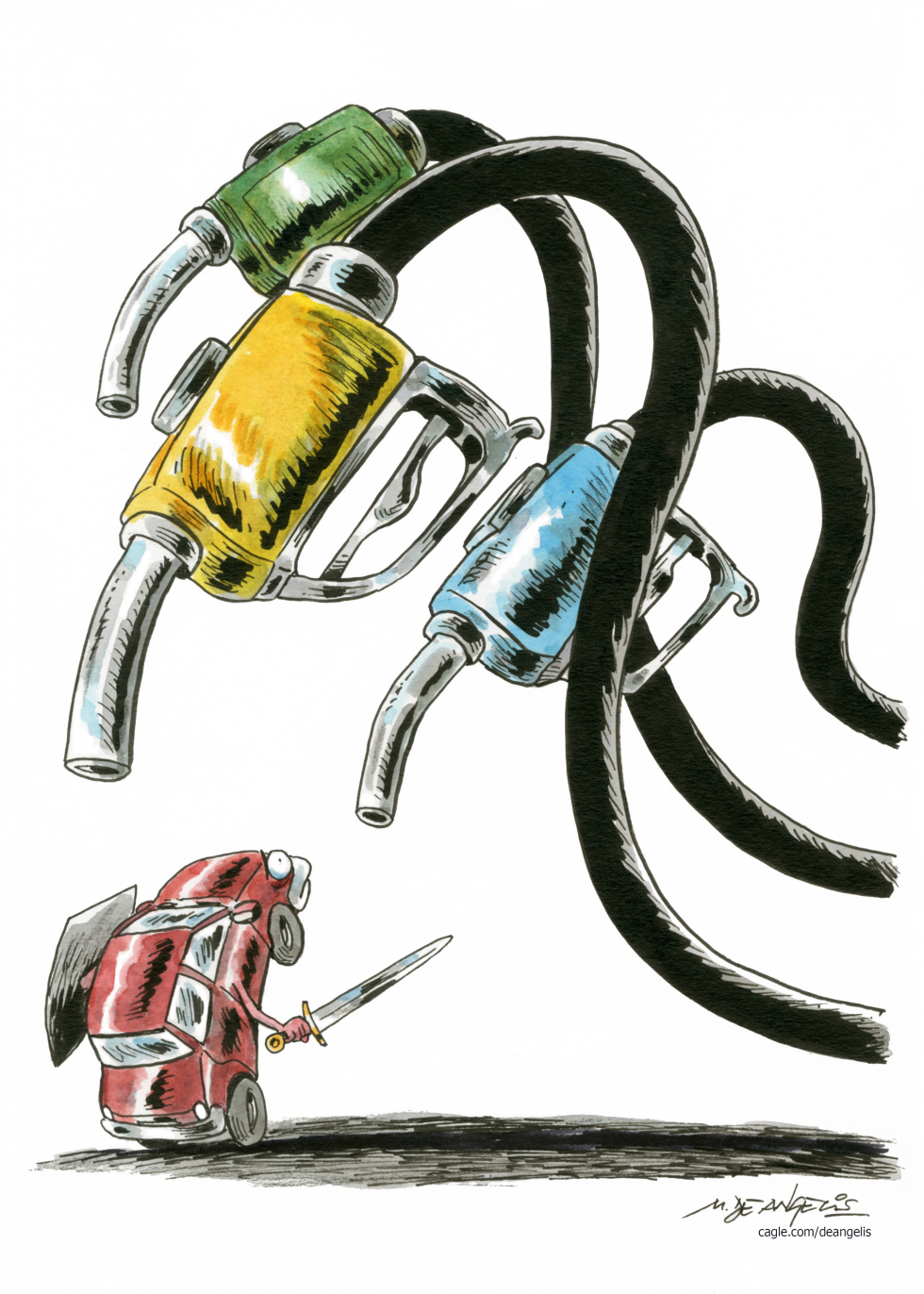
Marco De Angelis draws a clever twist on the ancient HYDRA myth, where a plucky red CAR, sword in hand, squares off against a beastly creature formed by three FUEL pump nozzles—green, yellow, and blue—attached to writhing black hoses. The scene plays on the endless battles drivers face with soaring OIL PRICES and FUEL costs, tying into broader ECONOMY woes. Tags like TRANSPORTATION, TRADE, WAR, CRISIS, IRAN, USA, and HORMUZ hint at real-world tensions in the Strait of Hormuz, where geopolitical strife disrupts global OIL supplies. It's a sharp commentary on how these issues regenerate like hydra heads, making every victory temporary in the fight against economic pressures.
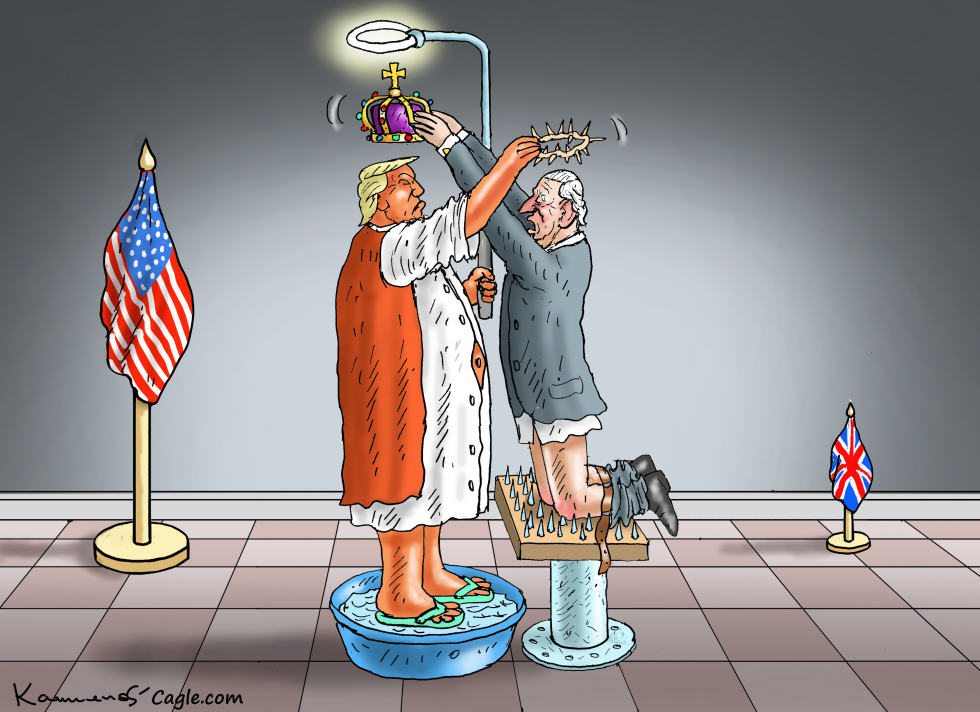
Marian Kamensky's cartoon depicts Trump holding a jeweled crown over King Charles's head while King Charles extends a crown of thorns, set against US and UK flags. The image, tagged Trump, King Charles, MAGA terror, Doctor Jesus, fascism, shows King Charles in a suit with pants down, standing in a basin on a spiked stool. This setup underscores themes of painful power exchanges, with Trump in a robe-like garment. The dark background and illuminated halo add to the satirical edge, commenting on political alliances and suffering in leadership.
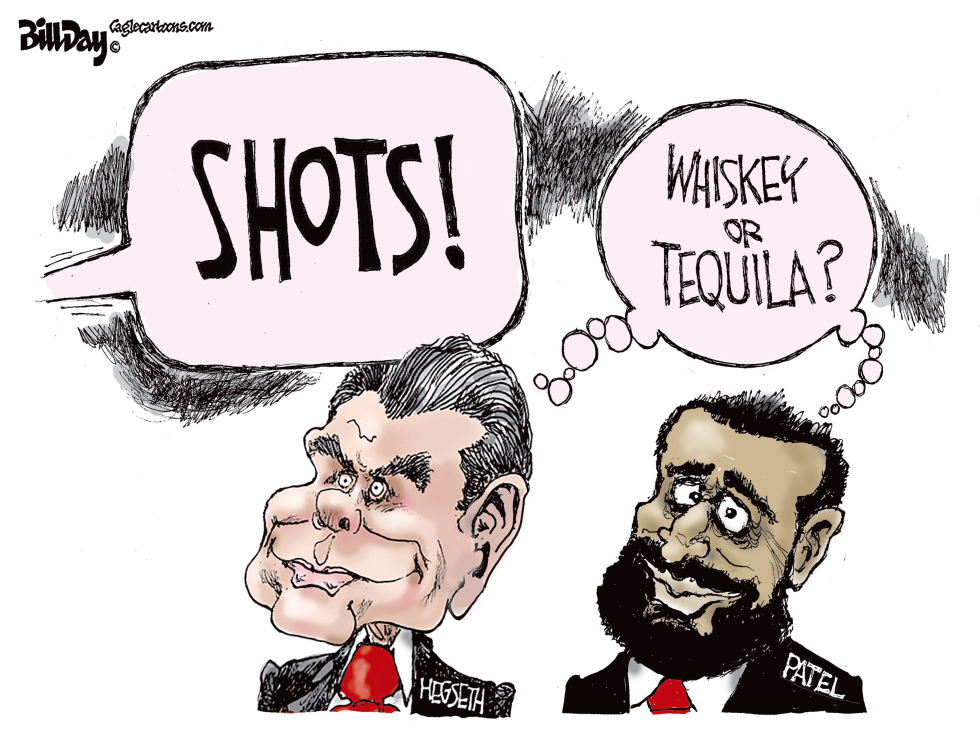
Bill Day's cartoon captures two suited figures, labeled Hegseth and Patel, in a moment of apparent revelry. Hegseth, on the left, bellows 'SHOTS!' from a speech bubble, his expression intense and caricatured. Patel, to the right, responds with a thought bubble pondering 'WHISKEY or TEQUILA?', his face drawn with wide eyes and a beard. The artwork, signed by Bill Day and linked to CagleCartoons.com, uses simple lines and shading for a classic political cartoon style. Tags such as shots, whiskey, tequila, Hegseth, Patel, and correspondence dinner frame the scene, suggesting a lighthearted jab at social or political gatherings. The white background keeps focus on the characters and their dialogue, emphasizing the pun on 'shots' without additional context or props visible.