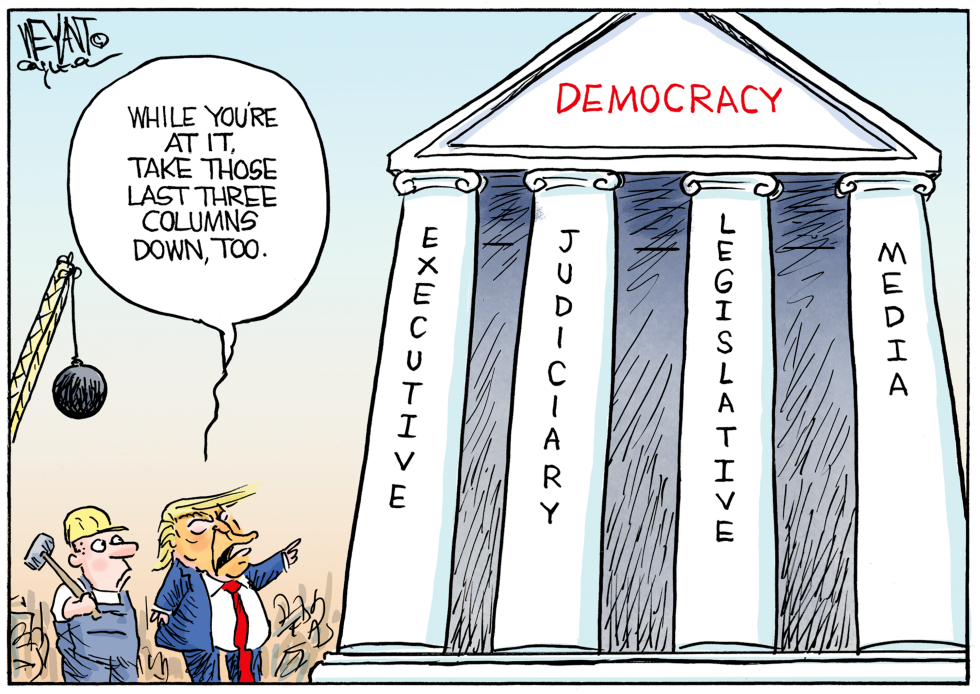
On July 12 2026 the cartoon depicts Donald Trump instructing a construction worker to demolish the judiciary legislative and media pillars of a structure labeled democracy. The executive pillar already stands removed. A wrecking ball crane looms on the left while Trump gestures emphatically from the foreground rubble. The image responds to ongoing debates over institutional checks and executive actions during the second Trump term.
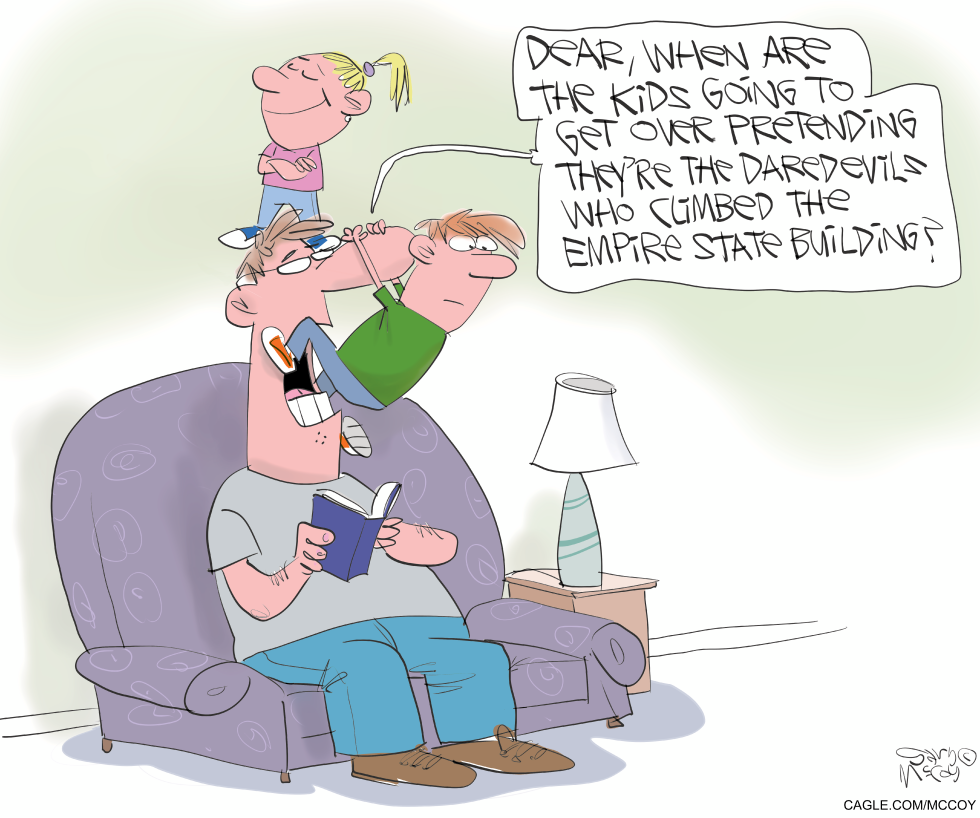
A father attempts to read in a living room chair while his son climbs over him and daughter stands atop his head in a game of pretend Empire State Building climb. An offscreen mother asks when the children will stop pretending to be the daredevils who scaled the building. The scene captures typical family play and parental patience during imaginative activities at home.
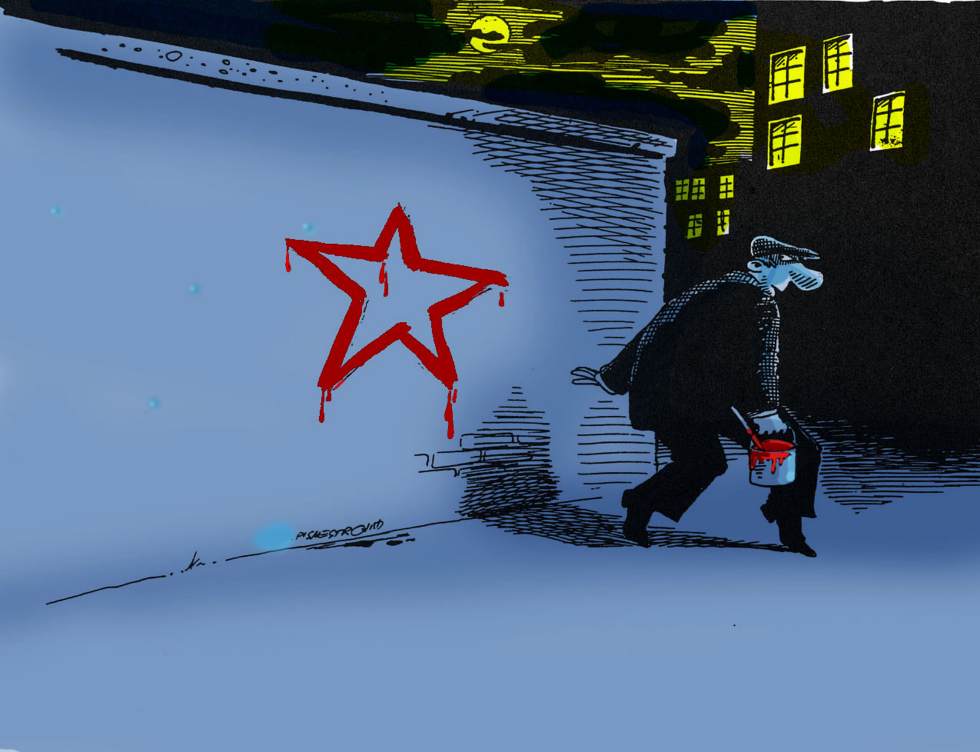
The cartoon depicts a man in dark clothing painting a large red star on a light-colored wall at night. Paint drips from the star. The figure then walks to the right holding a bucket of red paint and a brush. A building with illuminated windows stands in the background along with a yellow circle in the sky. The signature appears near the bottom. The image presents an act of applying a political symbol in a covert manner.
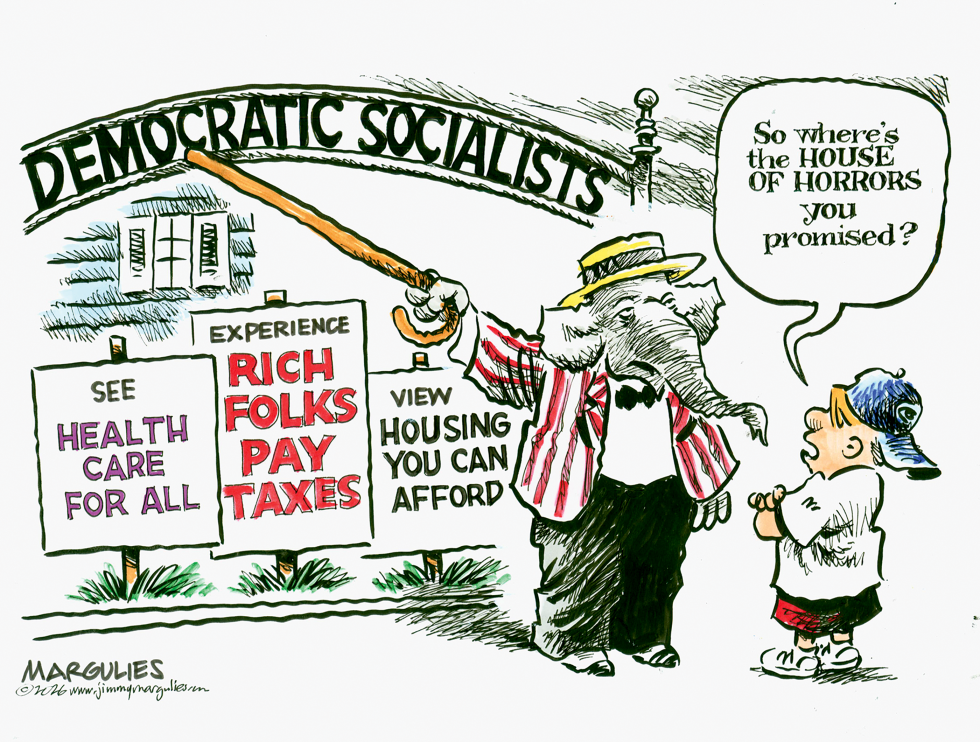
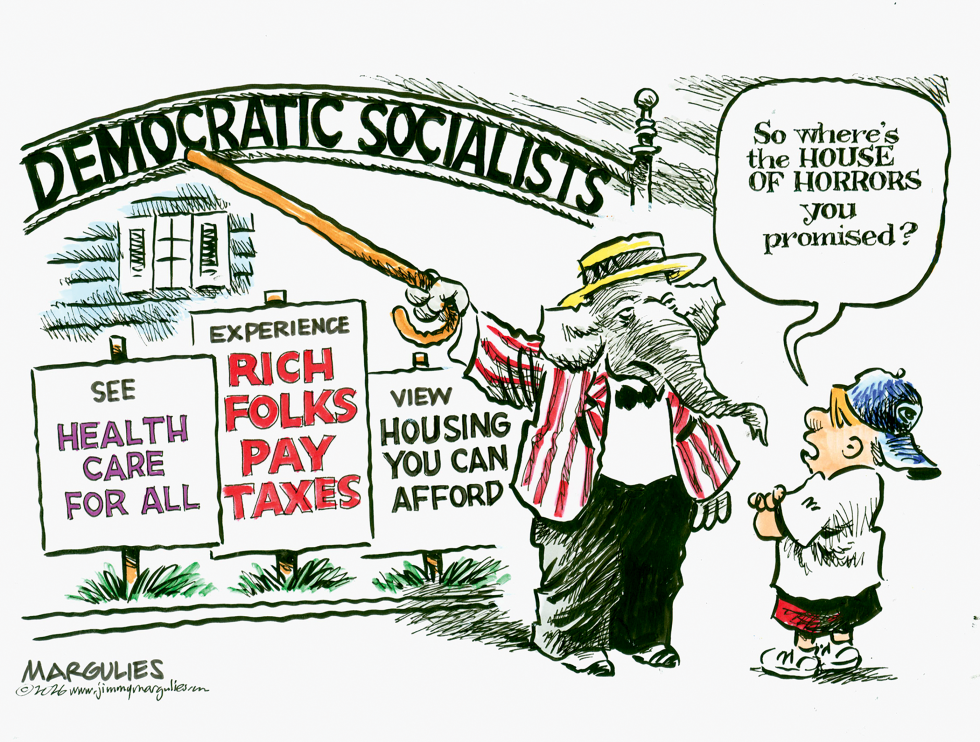
An elephant representing Republicans conducts a tour of attractions labeled Democratic Socialists on July 1 2026. Three signs advertise health care for all, taxes paid by the rich and housing that average people can afford. A young visitor in a cap asks where the house of horrors is that was promised. The scene uses the classic elephant symbol to frame policy offerings as ordinary exhibits rather than frightening outcomes.
An elephant dressed as a barker stands at a Democratic Socialists booth displaying signs for health care for all, rich folks paying taxes, and housing you can afford. The figure holds a pointer toward the arch and addresses a child visitor. The child asks where the house of horrors is located. The scene is set outdoors with a building facade visible behind the signs. Publication occurred on July 1 2026.
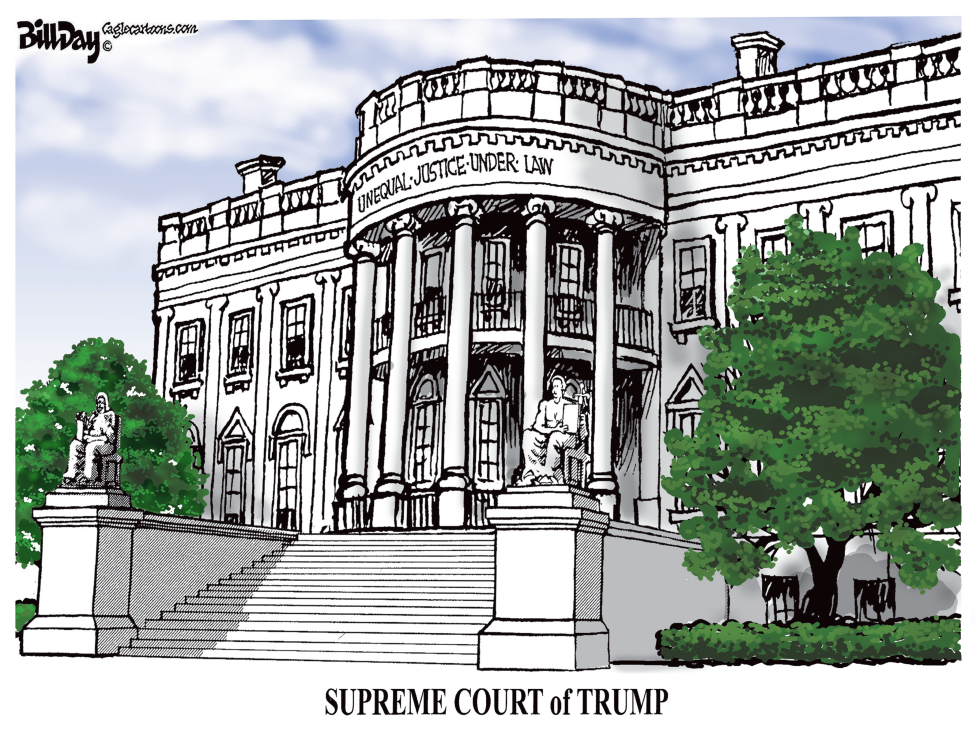
The image presents the Supreme Court building in Washington with the traditional inscription changed to read UNEQUAL JUSTICE UNDER LAW. The title below identifies the structure as the SUPREME COURT of TRUMP. Statues remain in place on either side of the central steps while trees stand to the left and right of the facade.
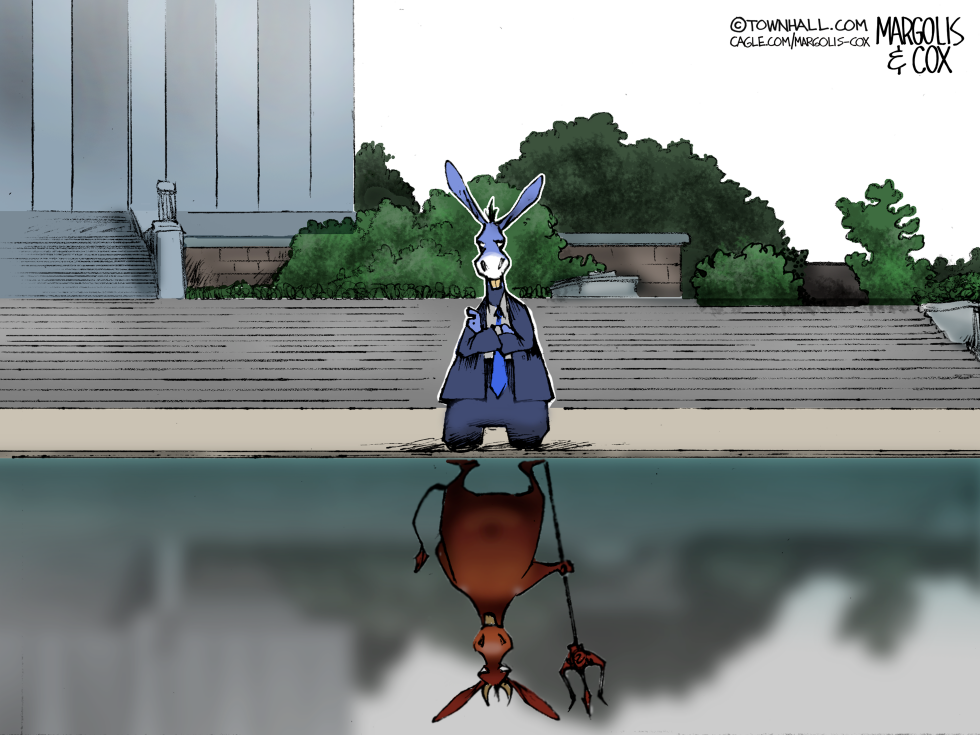
A donkey wearing a blue suit and tie stands with arms crossed on stone steps before a government-style building. Its reflection in the foreground water transforms into a red devil complete with horns, tail and pitchfork. The image from Margolis & Cox dated June 26 2026 uses the classic Democratic Party symbol to present an internal self-view. No specific legislation or election from the prior month is referenced in the visual. The composition places the figure centrally against trees and columns with the credit line in the upper right.
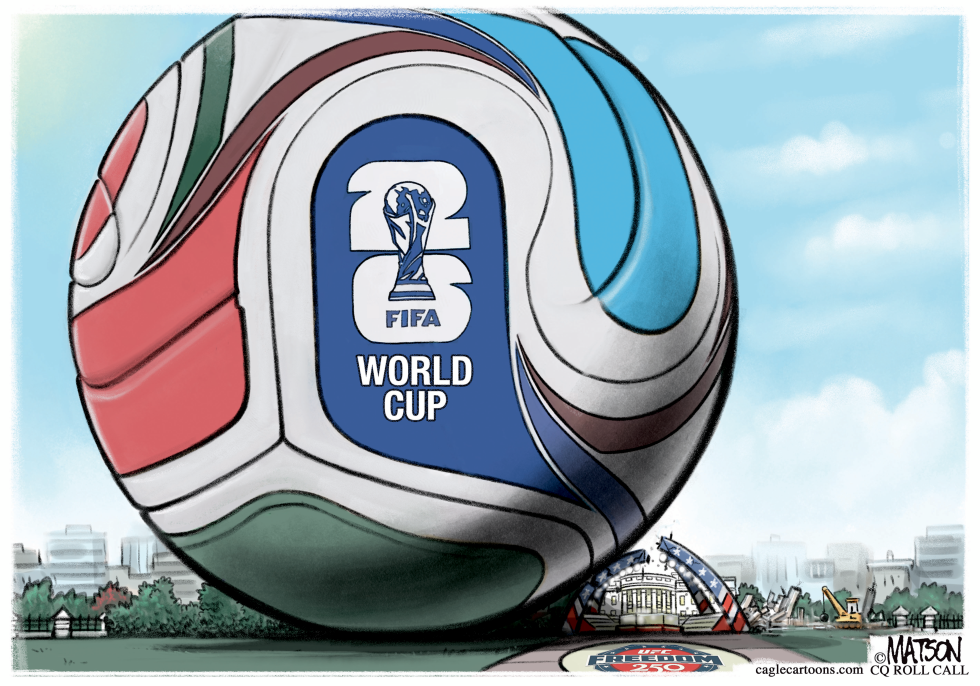
A massive soccer ball labeled for the 2026 FIFA World Cup rolls into the foreground and dwarfs the White House. A UFC Freedom 250 stage sits directly in front of the residence on the publication date when both events compete for attention.
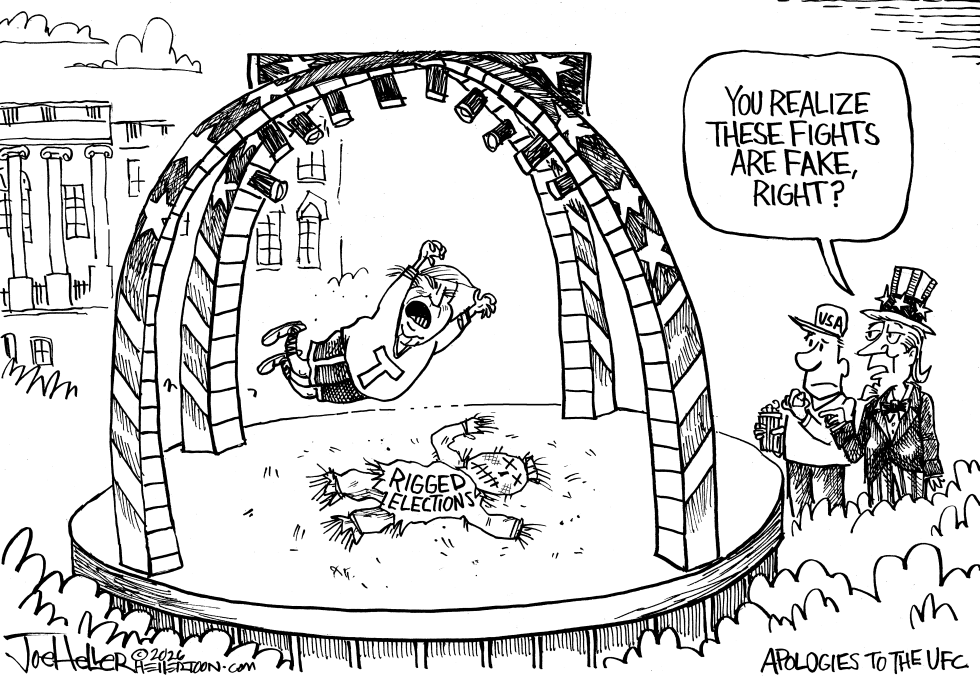
A wrestling ring scene shows a Trump figure thrown onto a mat labeled rigged elections while Uncle Sam remarks that the fights are fake. The image responds to ongoing 2026 election integrity debates with a direct visual comparison to staged matches.
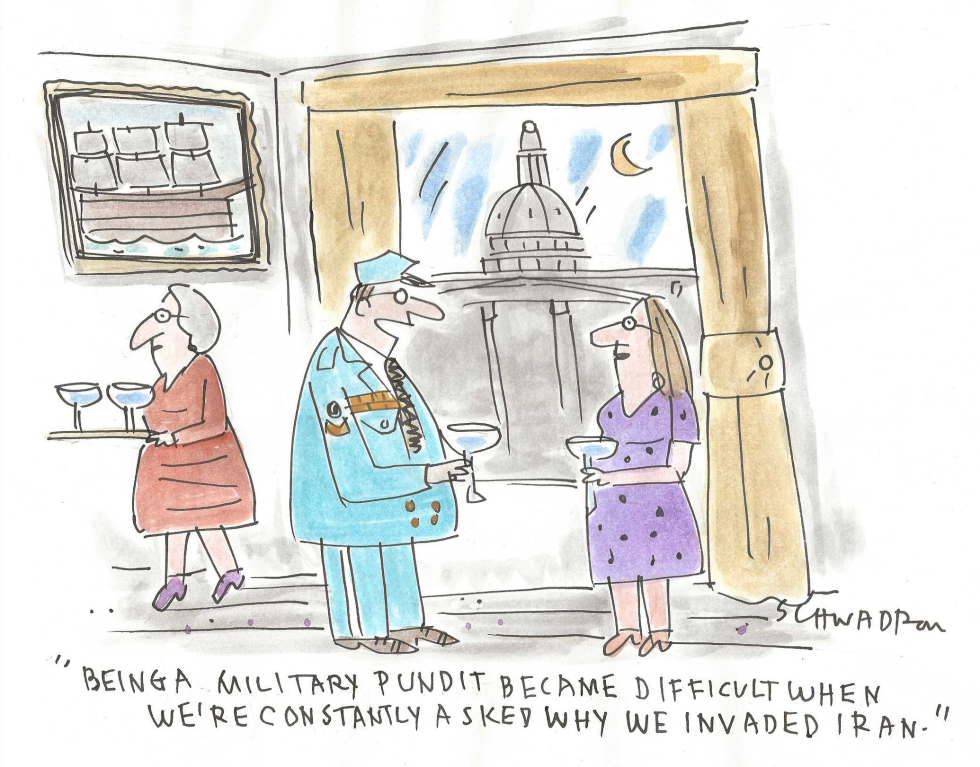
The cartoon displays three figures in a room with a window view. A man in uniform talks to a woman while another woman stands apart. The visible caption addresses the difficulty of being a military pundit asked about invading Iran. Tags include military, pundit, Iran, Middle East, Israel, nukes, bombs, Trump, foreign policy.
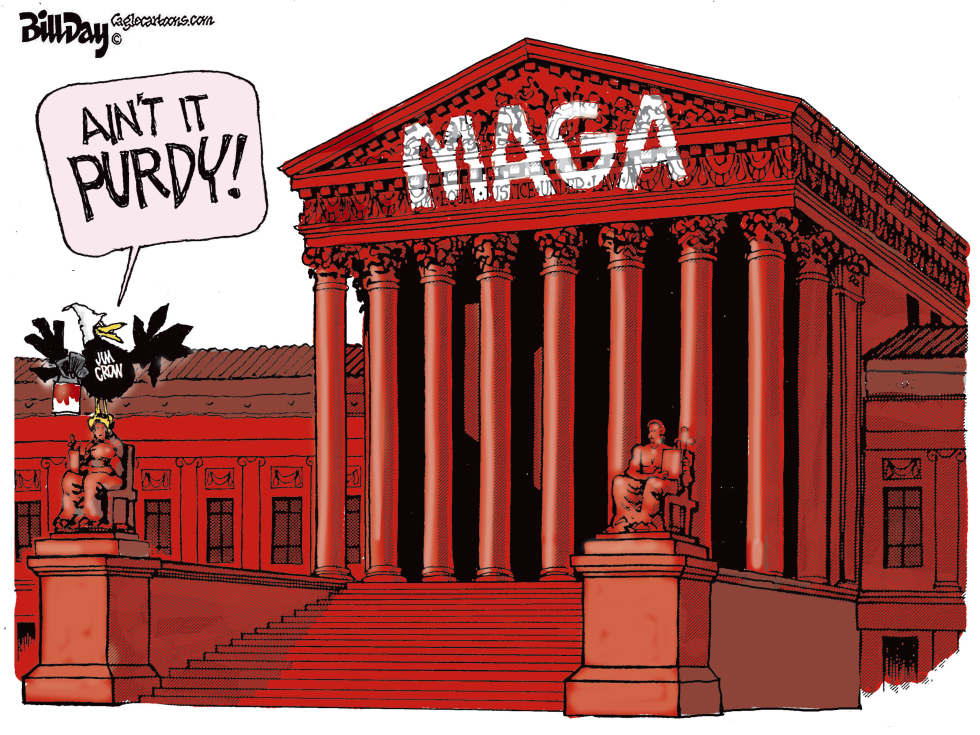
The May 2026 cartoon by Bill Day depicts the U.S. Supreme Court building painted red with MAGA letters dominating the pediment. A figure labeled Jim Crow appears on the left beside a crowned seated person. A speech bubble from the bird reads AIN'T IT PURDY! The frieze text EQUAL JUSTICE UNDER LAW remains partially visible beneath the new lettering. The image ties recent redistricting and voting rights debates to historical racial restrictions.
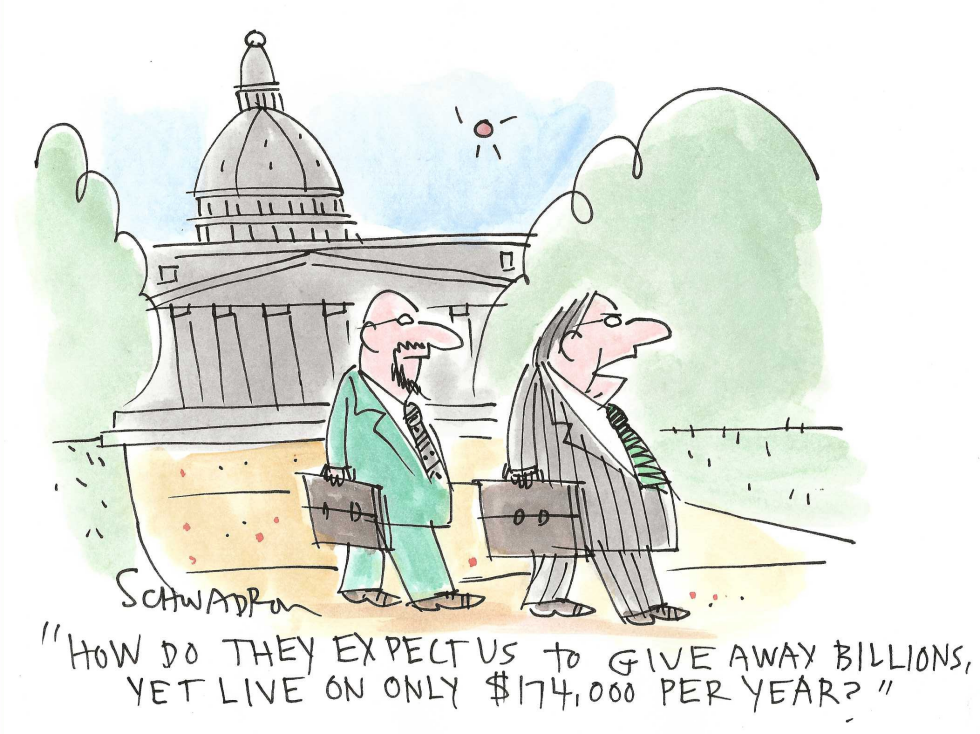
The cartoon shows two men in business attire carrying briefcases in front of a large domed building resembling Congress. One wears green, the other gray stripes. They hold cases labeled with dollar signs. The caption questions giving away billions on a $174,000 salary. Visible elements include green bushes, a path, and a small sun. Tags reference Congress, give away, billions, wars, tariffs, inflation, cost of living, and money. The scene focuses on the figures and their dialogue about expenditures.
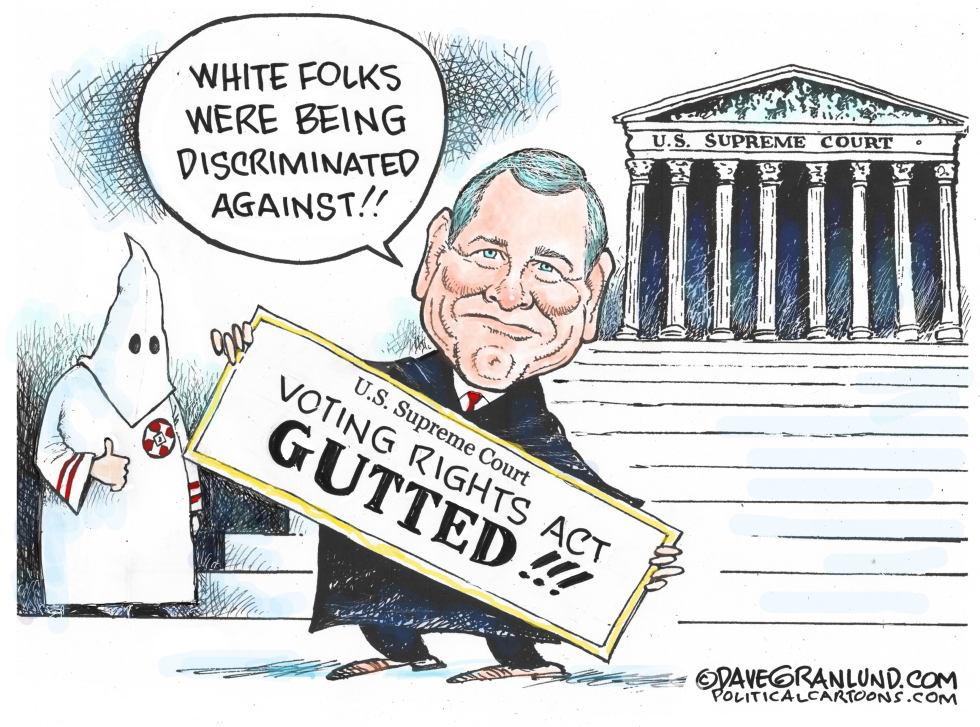
The cartoon shows Chief Justice John Roberts holding a sign declaring the U.S. Supreme Court has gutted the Voting Rights Act. A figure in KKK robes stands nearby with a speech bubble claiming white folks were being discriminated against. The U.S. Supreme Court building appears in the background. The image responds to ongoing debates over voting laws and redistricting following recent court decisions. It highlights accusations that the ruling favors certain groups while disadvantaging voters of color.
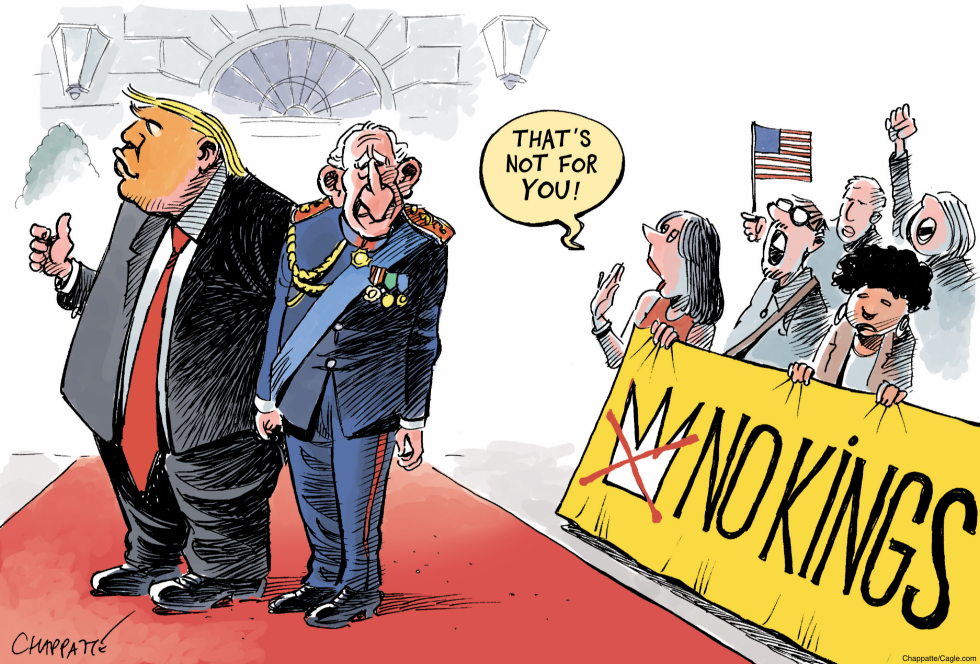
Patrick Chappatte's cartoon captures a fictional royal visit in Washington DC, where Trump, with his signature hair and suit, walks arm-in-arm with King Charles in full regalia. A group of protesters, waving a USA flag, holds a yellow sign featuring a crossed-out crown and 'NO KINGS,' while one shouts 'That's Not For You!' The scene tags USA, Great Britain, Trump, King Charles, monarchy, Democrats, demonstrations, United Kingdom, blending humor on transatlantic relations and anti-monarchy sentiments in a clearly visible setup on a red carpet against a grand building backdrop. The dry satire highlights visible contrasts without deeper inference.
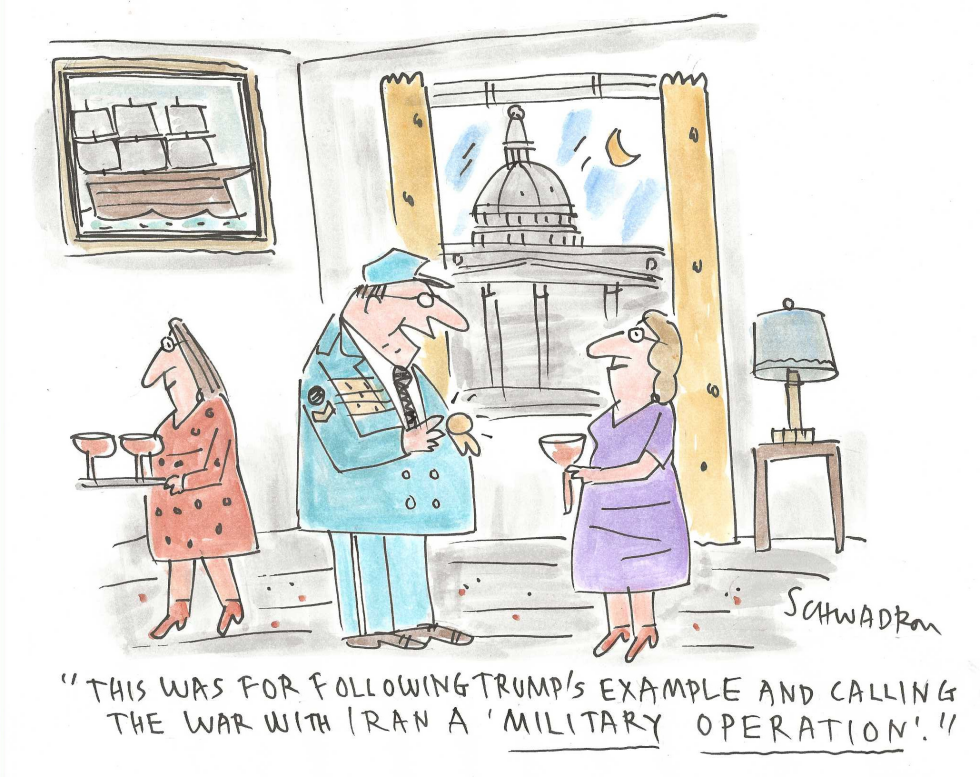
Harley Schwadron's cartoon depicts a cocktail party scene where a military officer toasts with two women, celebrating the decision to follow Trump's example by calling the war with Iran a 'military operation.' The room features a framed ship painting, a window view of the Capitol dome under a crescent moon, and a lamp on a table. Tags such as war, Iran, military, Trump, shipping, and oil underscore the satirical jab at semantic dodges in foreign policy. The dry humor highlights how leaders reframe conflicts to soften public perception, with the officer's uniform and medals emphasizing official endorsement. This piece captures the absurdity in political language, set against a backdrop of potential economic fallout like inflation and gas prices, though peace negotiations remain distant.