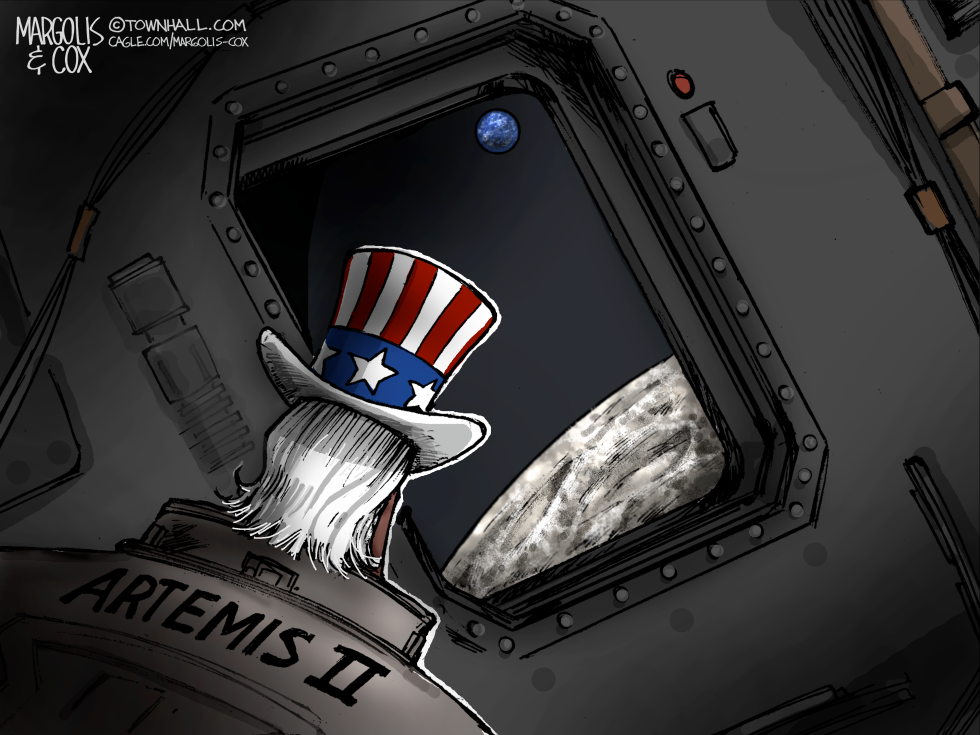
This political cartoon features Uncle Sam, complete with his red-white-blue top hat, inside the Artemis II spacecraft, staring out at the cratered moon surface with Earth visible in the background. The image satirizes American space exploration efforts, highlighting themes of patriotism, lunar missions, NASA programs, humorous commentary, political satire, and the return to moon orbits. It cleverly juxtaposes a classic symbol of America with modern space endeavors, poking fun at the grandeur and perhaps the delays or ambitions of the Artemis II project, all rendered in a dark, shadowy style that emphasizes the vastness of space.
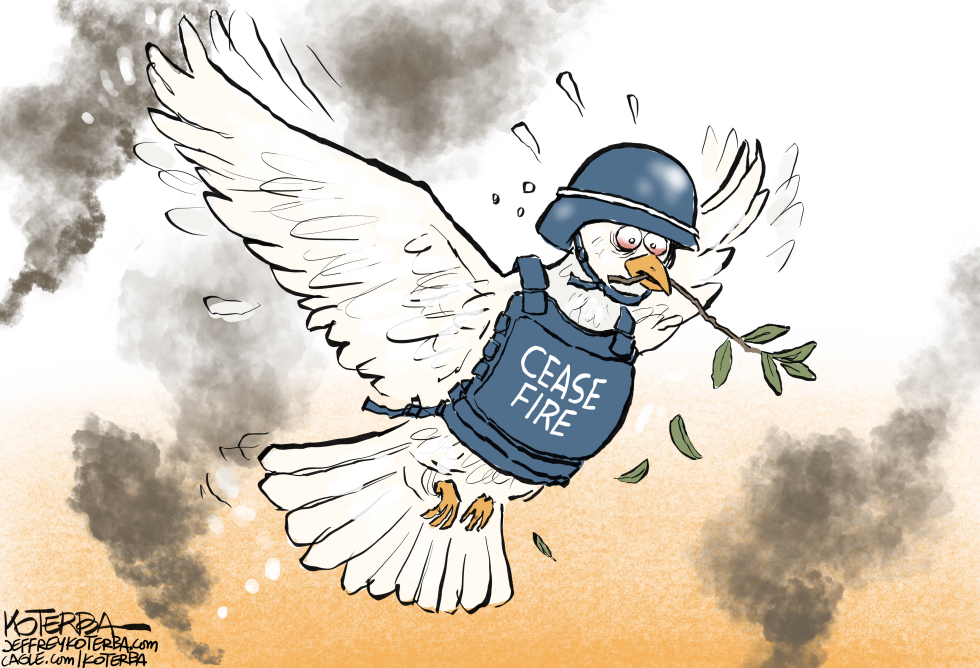
Jeff Koterba's cartoon shows a white dove, traditional symbol of peace, outfitted in a blue military helmet and a bulletproof vest marked 'CEASE FIRE.' The bird clutches an olive branch in its beak, eyes wide in surprise, as it navigates through billowing dark smoke clouds. This setup highlights the fragility of cease fire attempts in war zones, with the armored dove representing protected yet vulnerable peace initiatives. The orange-tinted background suggests a fiery landscape, emphasizing conflict's harsh reality. Tags like political cartoon, peace dove, cease fire vest, olive branch, war smoke, and satirical illustration capture the image's essence for SEO.
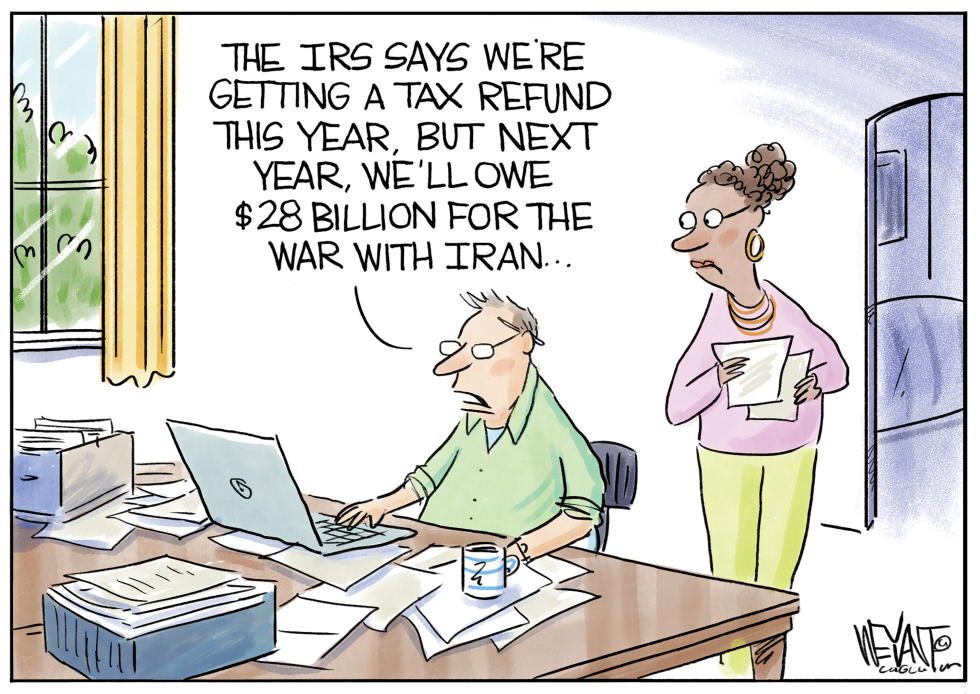
Dive into this biting political cartoon tax refund piece where a woman, holding papers, informs a laptop-working man about their IRS windfall this year, only to drop the bomb of owing $28 billion next for the war with Iran. The satirical cartoon Iran war vibe captures the absurdity of US taxes funding wars, with cluttered desks and exasperated expressions underscoring the humorous take on federal spending. It's a classic taxpayer burden Iran conflict jab, poking fun at government spending satire while illustrating the disconnect between personal finances and massive military expenses. Through cartoon about military expenses, it cleverly critiques fiscal policy in an office setting, making the war with Iran taxpayer joke both relatable and irreverently insightful for viewers pondering editorial cartoon fiscal policy.
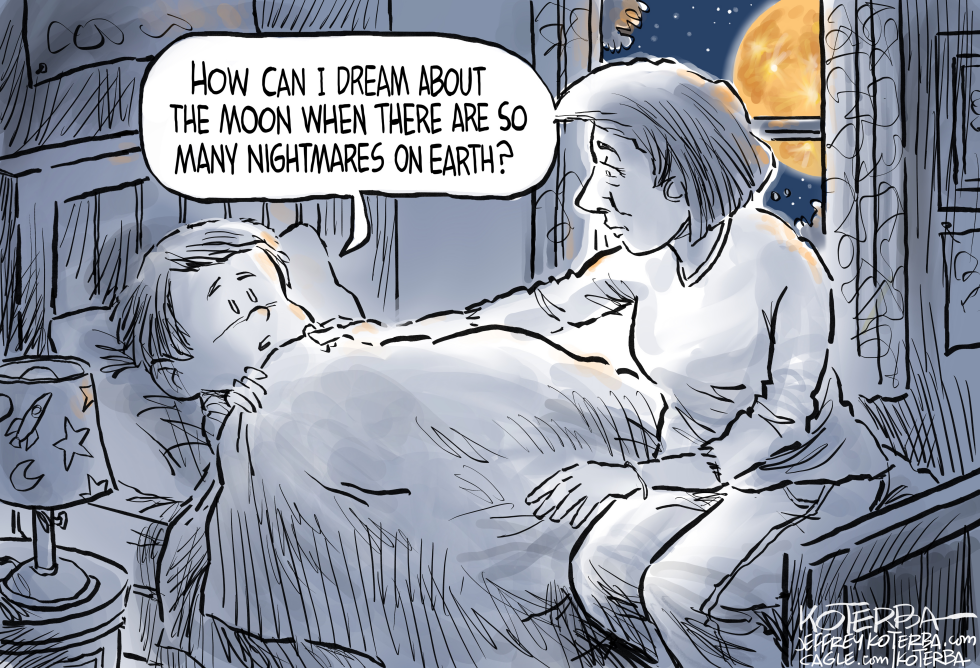
This poignant political cartoon depicts a child in bed, gazing toward a window framing a massive orange moon against a starry night sky, while confiding in a seated adult figure. The child's speech bubble reads: 'How Can I Dream About The Moon When There Are So Many Nightmares On Earth?' A bedside lamp with a star design illuminates the scene. Through this setup, the artwork satirizes how youth anxiety from global issues—like wars, climate woes, and social upheavals—stifles big dreams and aspirations. It's a clever commentary on how earthly nightmares eclipse celestial hopes, blending humor with insight into modern parenthood and childhood innocence lost. Tags: political cartoon, child nightmares, moon dreams, earth troubles, satirical illustration, youth anxiety, global chaos.
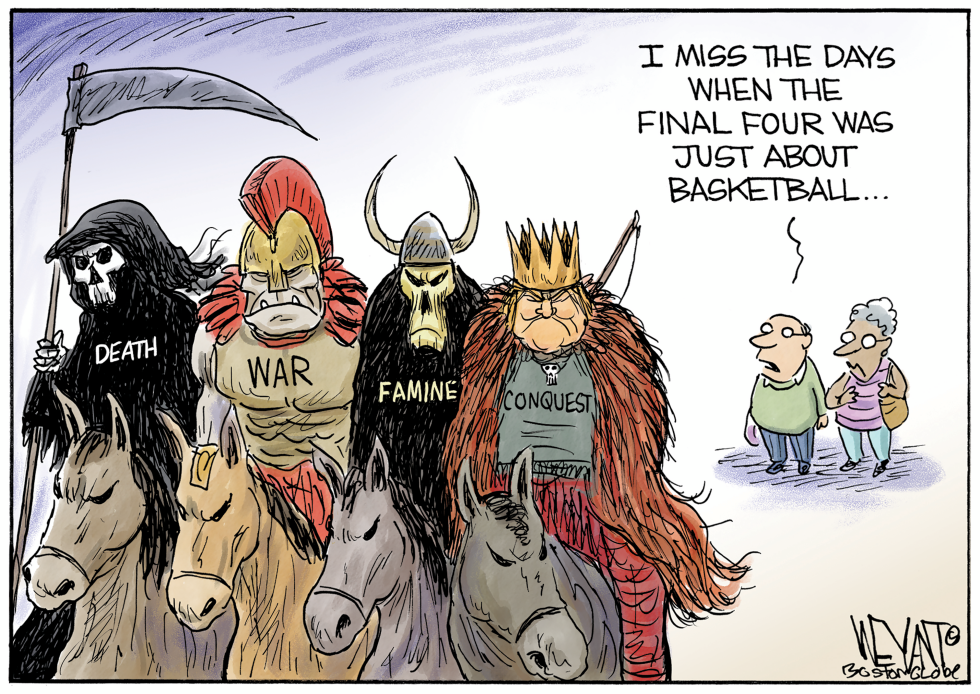
The April 2026 cartoon depicts the Four Horsemen of the Apocalypse marching forward during NCAA Final Four season. Their presence highlights how international conflicts eclipse traditional sports focus. A speech bubble expresses longing for basketball-only coverage while bystanders observe the shift.
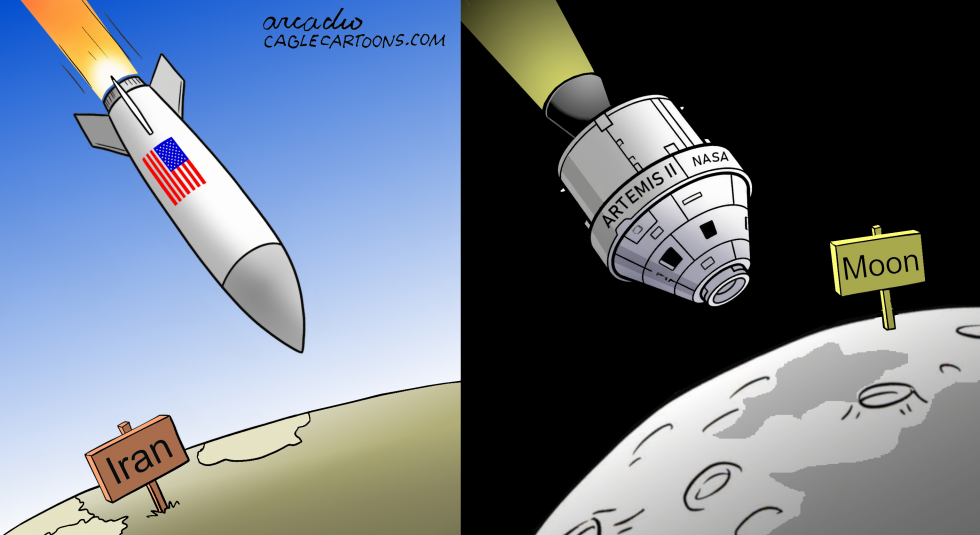
Arcadio Esquivel's cartoon splits the scene: on one side, a missile with an American flag streaks toward a planetary surface marked 'Iran,' flames trailing from its base against a blue sky. On the other, the Artemis II NASA capsule floats in space, nearing a gray lunar landscape labeled 'Moon' under a starry black backdrop. Tags including war, moon, exploration, Artemis II, NASA, Middle East, and Iran capture the visual pun. The dry humor points to misplaced priorities, where grand goals like space missions veer into military misadventures. Cagle Cartoons syndicates such pointed commentary, blending current events with sharp satire.
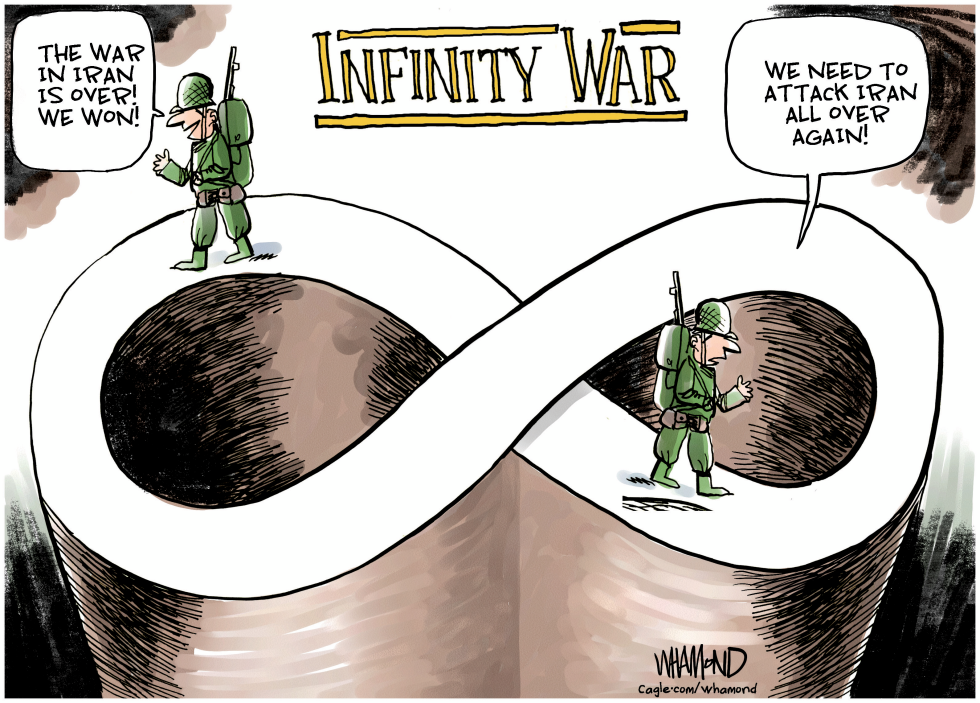
Dave Whamond's cartoon features two soldiers positioned on a large infinity symbol, one announcing victory in the Iran war while the other insists on attacking again, highlighting the perpetual nature of conflict. The title 'Infinity War' parodies endless warfare, with the loop representing cycles of victory and renewed aggression. Tags like iran war cartoon, infinity symbol war, endless conflict satire, military parody, perpetual war illustration, and satirical soldiers emphasize the dry humor in depicting how wars in regions like Iran seem to restart indefinitely, a common theme in political cartoons that resonates with ongoing global tensions.
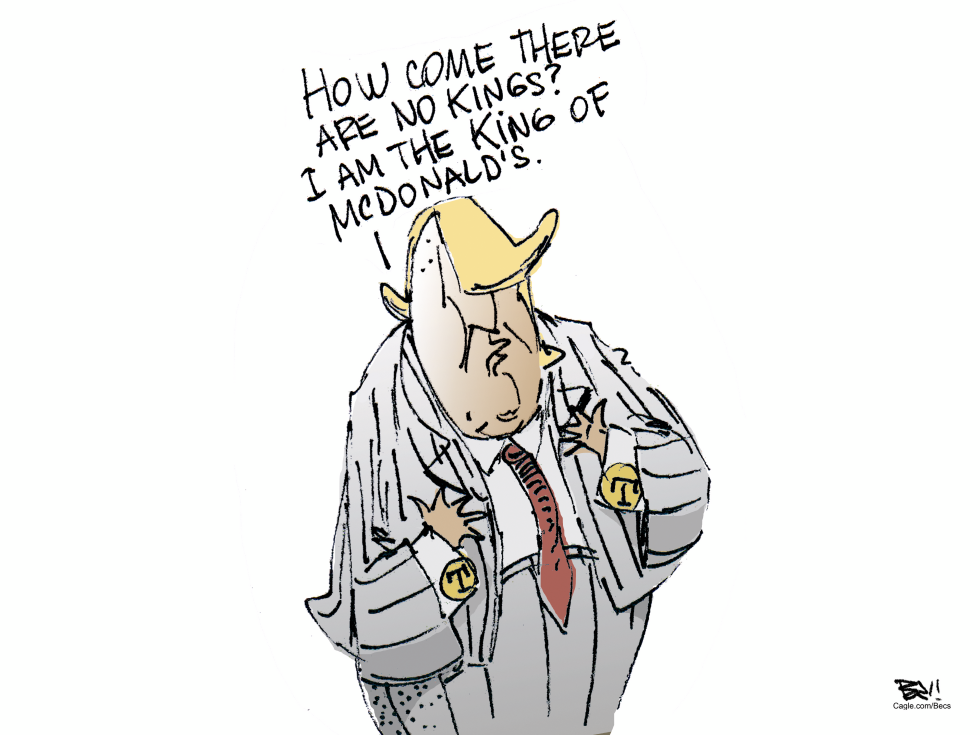
Becs's cartoon from 2026 captures a familiar figure in US politics, dressed in a white suit with yellow hair and hat, gesturing emphatically. The speech bubble reads, 'How come there are no kings? I am the king of McDonald's!' This piece tags into Donald Trump Administration themes, portraying the subject as Not King yet self-proclaimed ruler of McDonalds, emphasizing traits like Glutton, Egomaniac, Bad Guy, Dictator, and Arrogant. It's a straightforward jab at overblown self-importance, common in political satire. The simple line art keeps focus on the absurdity, making it shareable for those tracking Trump-era humor. Cagle.com hosts such works, blending dry wit with insider commentary on power and excess.
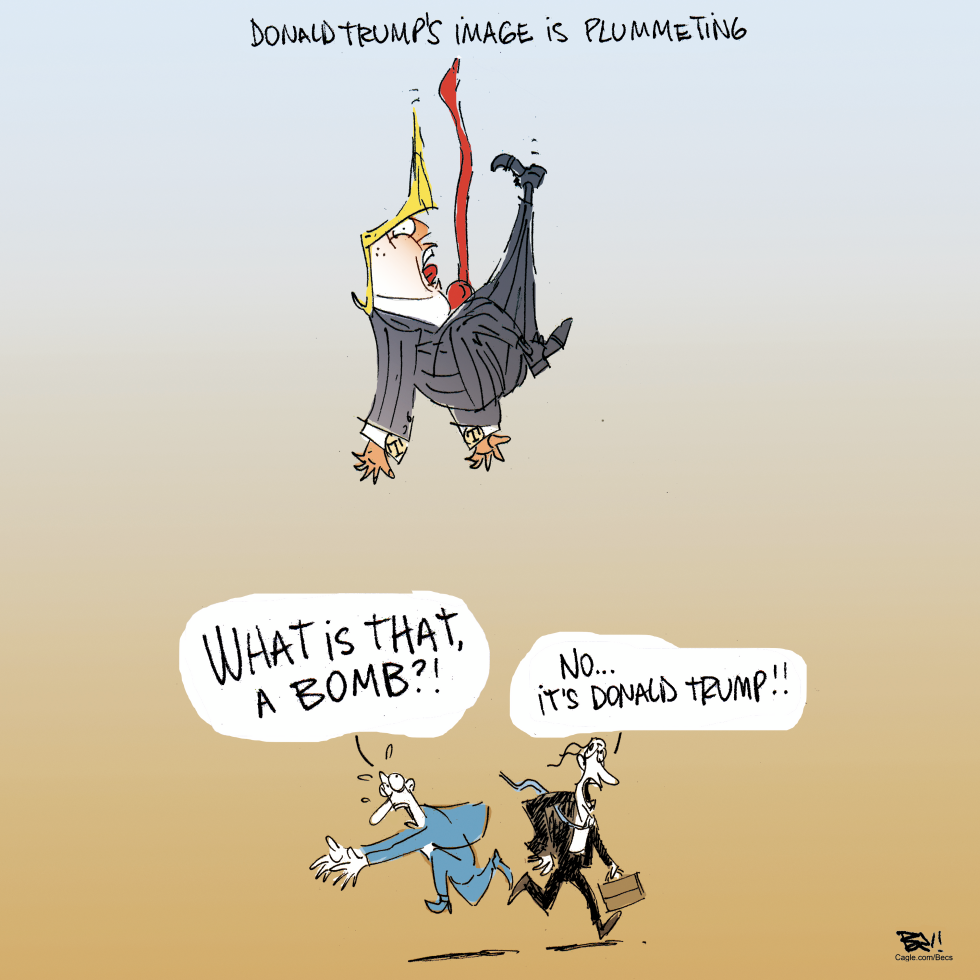
The cartoon depicts a figure with yellow hair and red tie, clearly caricaturing Donald Trump, diving headfirst from the sky like a falling bomb, mouth agape and limbs flailing. Below, two suited men run in panic, one asking if it's a bomb, the other identifying it as Trump. The title declares 'Donald Trumps Image is Plummeting,' playing on the pun of falling popularity. This piece skewers the Trump administration in the US for saying one thing then another, coming off as perverse and arrogant. It portrays him as thinking he's a king, the absolute tyrant of the world, with Europe and the world fed up. The dry humor lands through the visual metaphor, emphasizing global exasperation.
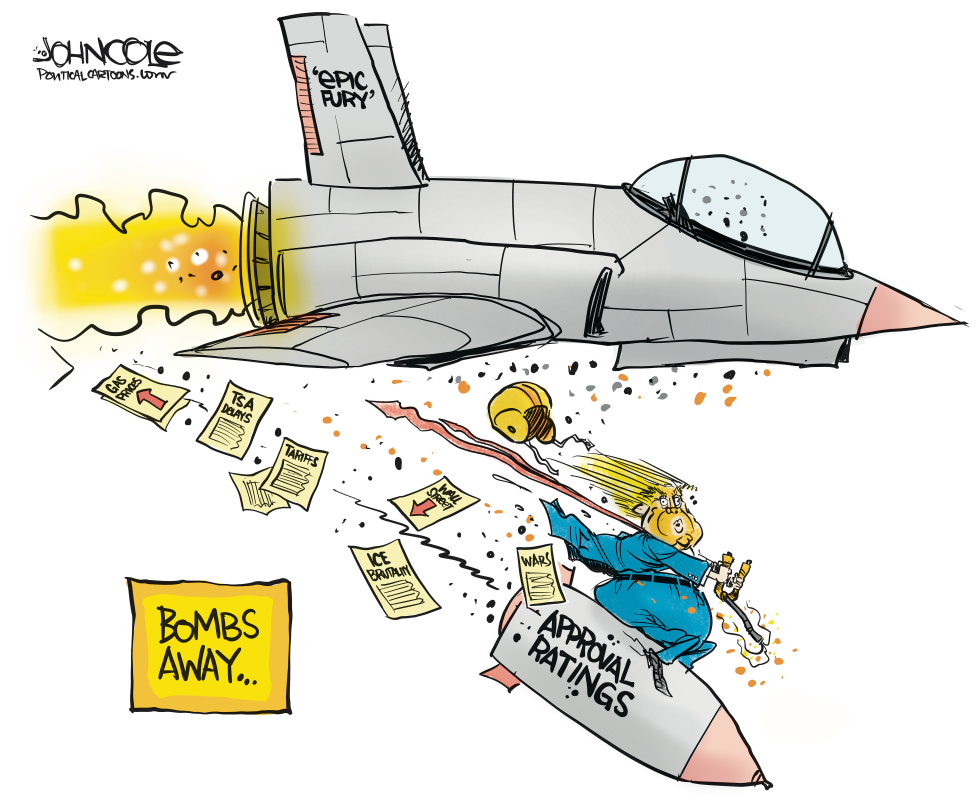
This political cartoon features a fighter jet labeled 'EPIC FURY' with flames bursting from its rear, dropping papers marked 'Gas Prices,' 'TSA Plays,' 'Tariffs,' 'ICE Brutality,' and 'War' like bombs away. A blonde figure in a blue outfit rides a white missile labeled 'APPROVAL RATINGS,' wielding a stick as if charging forward amid falling debris and sparks. The scene captures satirical chaos with 'Bombs Away..' sign floating nearby, emphasizing themes of political maneuvering through policy drops to boost approval ratings. John Cole's signature and PoliticalCartoons.com appear in the top left, adding to the irreverent commentary on epic fury in governance.
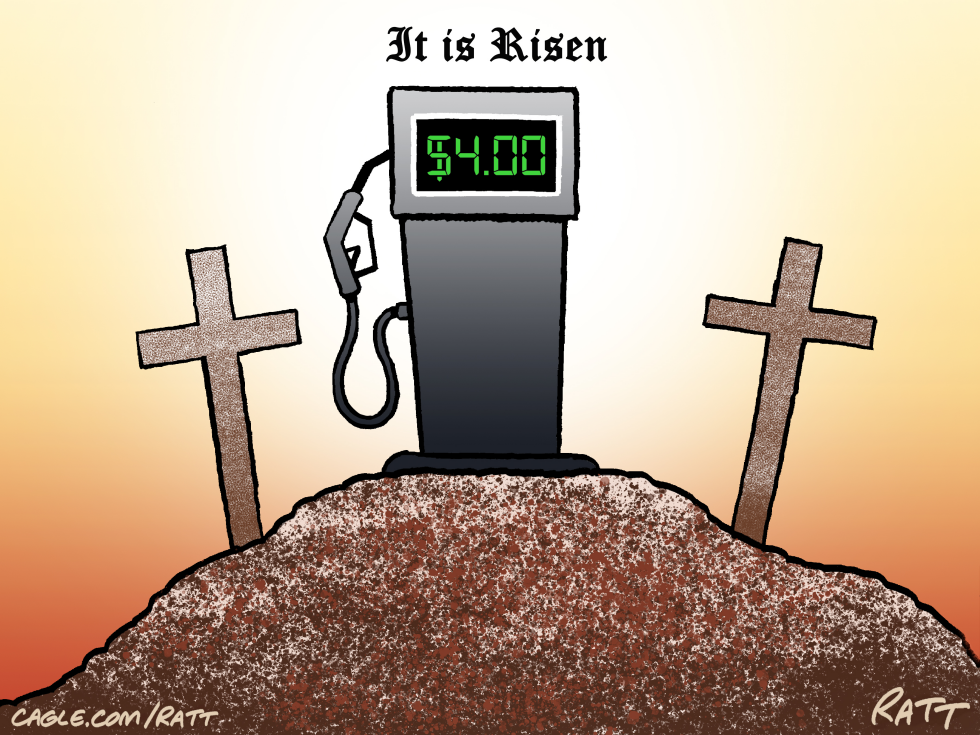
Ratt's cartoon captures Easter in America 2026 with a gas pump standing in for the central cross on a Calvary hill, showing $4.00 on its display and the text 'It is Risen' above, playing on rising gas prices. Tags like Easter, gas prices, oil, Iran war, and Strait of Hormuz suggest a future where geopolitical tensions drive fuel costs skyward. The artwork uses simple lines and a sunset background to evoke the biblical scene, but replaces resurrection with economic pain. This satire highlights how global events, including potential conflicts in the Strait of Hormuz, could lead to exorbitant oil prices by 2026. The dry humor underscores American dependence on foreign oil, making the cartoon timely and shareable amid ongoing energy debates.
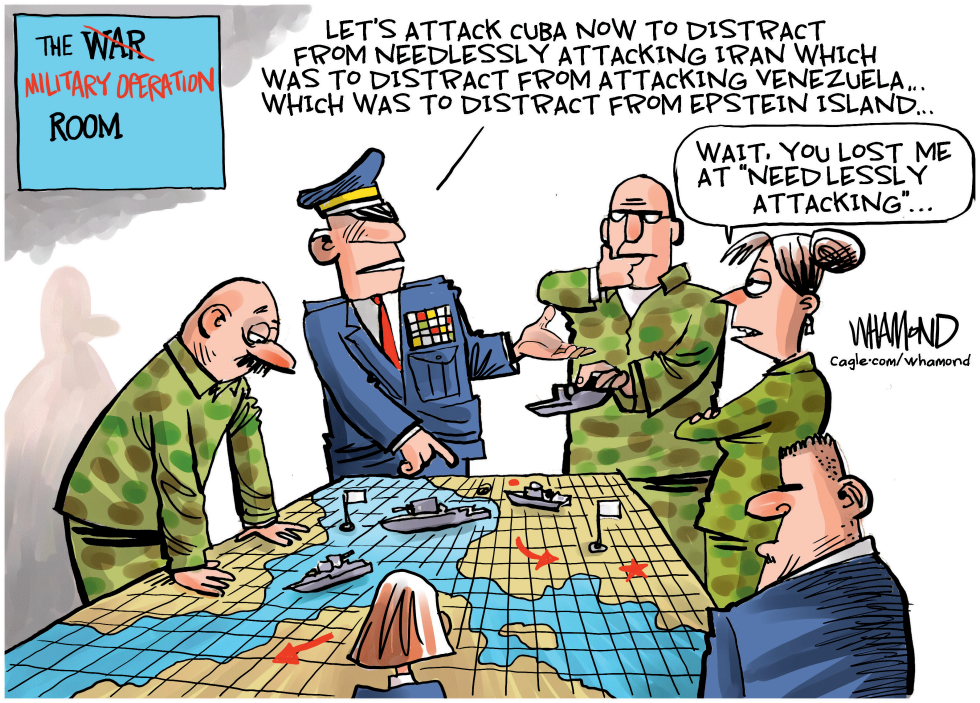
Dave Whamond's political cartoon depicts a group of military officials in a war room, gathered around a map with toy ships, discussing a chain of distractions starting from attacking Cuba to cover needless attacks on Iran, which distracted from Venezuela, looping back to Epstein Island. The scene captures the absurdity with one figure pointing at the map and another expressing confusion over 'needlessly attacking.' This satirical illustration uses dry humor to comment on convoluted military strategies and political diversions, incorporating elements like crossed-out 'War' sign replaced by 'Military Operation Room' for added irony. Tags like political satire, war distractions, foreign policy cartoon, Epstein Island reference, military humor, and endless distraction chain emphasize the cartoon's sharp critique.
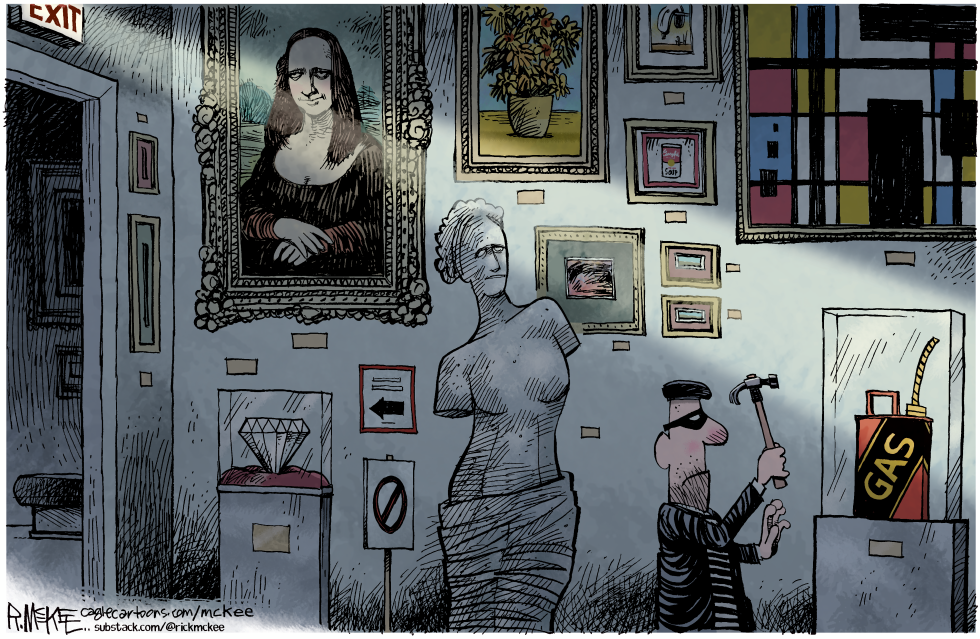
Rick McKee's cartoon depicts a dimly lit museum where a striped-shirted thief, masked and wielding a hammer, targets a display case with a red gas can marked 'GAS,' overlooking iconic pieces like the Mona Lisa portrait, Venus de Milo statue, a large diamond, Van Gogh-style sunflowers painting, abstract Mondrian-like art, and smaller framed works. An 'EXIT' sign glows above, and a 'no' symbol sign hangs nearby. The scene uses tags such as Trump, war, Iran, gas prices, oil, museum to comment on how escalating fuel costs make gasoline more valuable than cultural treasures, blending humor with commentary on energy crises.
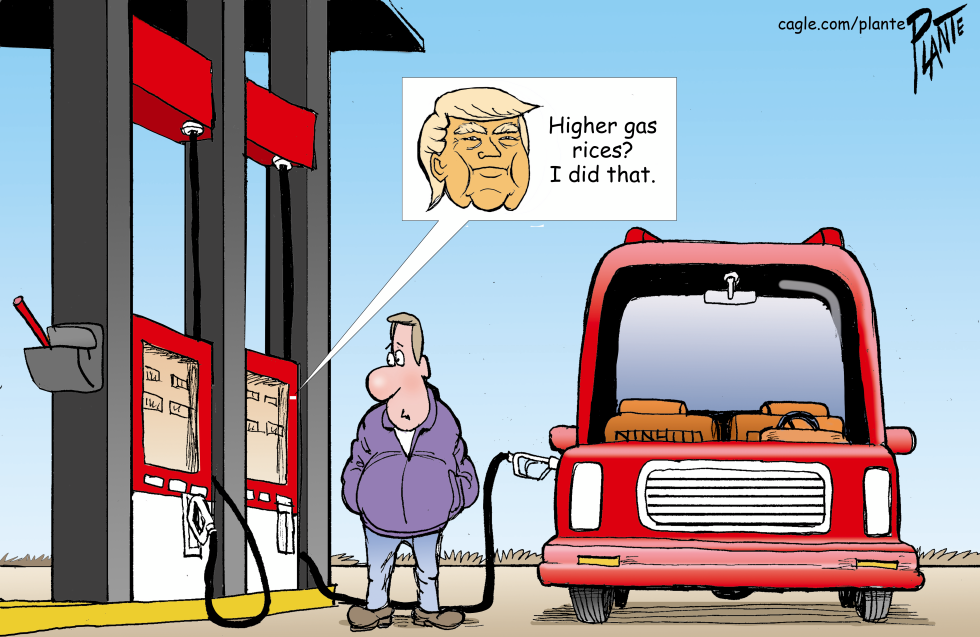
Bruce Plante's cartoon shows a gas pump topped with President Donald J. Trump's head, smirking as it says, 'Higher gas rices? I did that,' while a driver fuels his red truck. The image ties into tags like higher gas prices, war, Iran, Israel, Middle East, and energy crisis, poking at Trump's potential role in escalating fuel costs through foreign policy missteps. It's a straightforward jab, clear in its satire without overcomplicating the visuals. The dry humor lands on the absurdity of a politician claiming credit for economic pain at the pump. With tags covering UAE, Saudi Arabia, and other regional players, the cartoon nods to broader geopolitical tensions driving oil prices up. Editors see these kinds of cartoons circulate well when gas prices spike, reminding readers of the human cost in everyday routines.