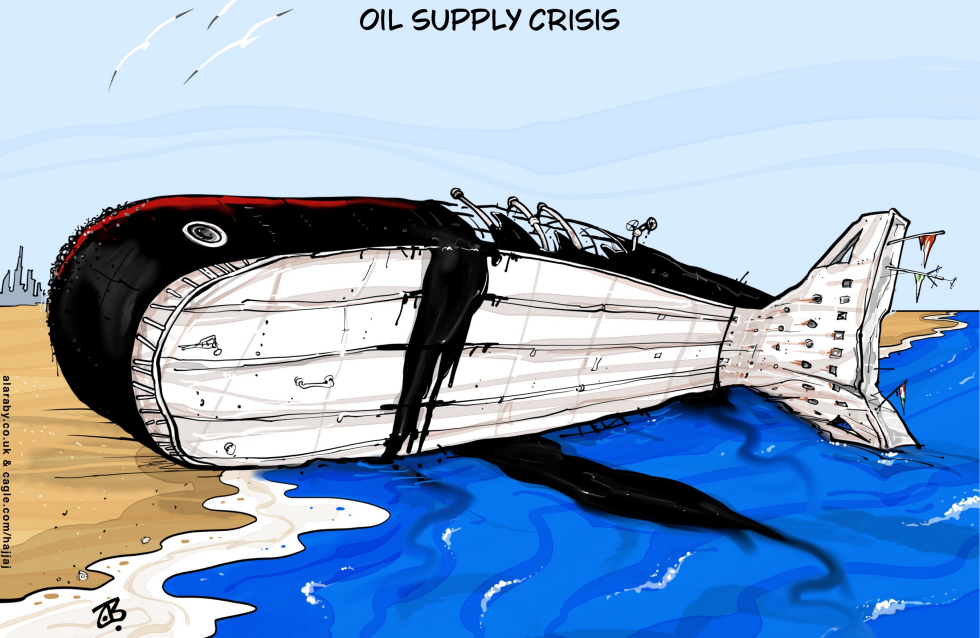
A major oil tanker has run aground, disrupting supply routes and releasing crude into coastal waters. The incident underscores vulnerabilities in global energy transport networks that rely on aging or poorly maintained vessels. Such events can spike fuel prices and trigger immediate cleanup costs for affected regions. The cartoon frames the grounding as a direct cause of the broader supply crisis rather than an isolated accident. It points to systemic weaknesses in oversight and infrastructure that allow one failure to cascade into wider shortages and ecological harm.
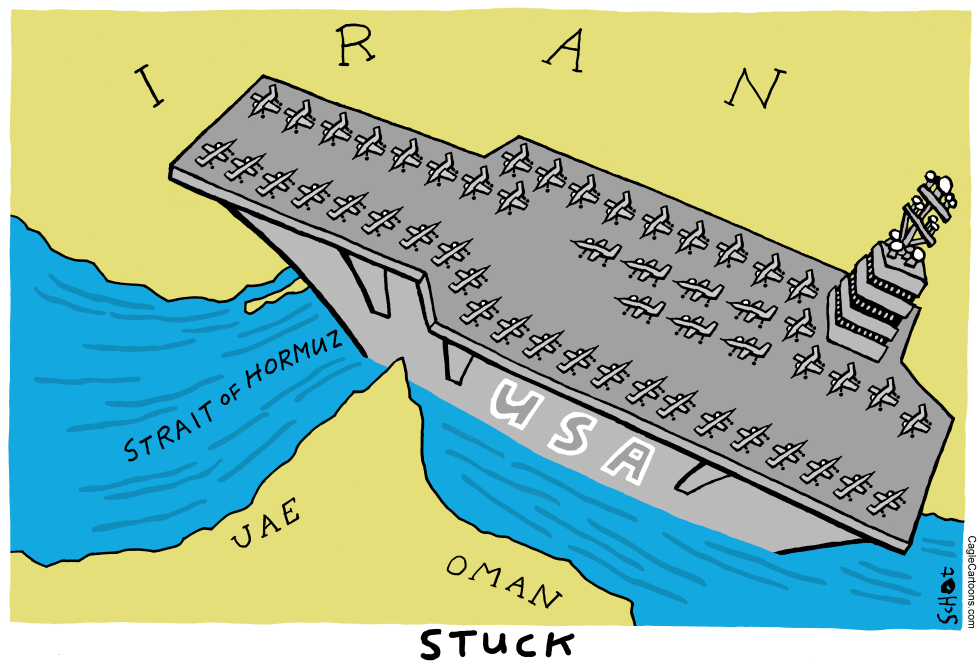
A political cartoon depicts a large US aircraft carrier marked USA jammed in the Strait of Hormuz between land labeled Iran, UAE and Oman. The vessel carries dozens of fighter jets on its deck. The word STUCK appears prominently below the scene. The image responds to persistent concerns over freedom of navigation in the vital oil shipping route. Iran has long threatened to close the strait during conflicts. The cartoon uses the visual of a grounded carrier to illustrate potential US military vulnerability in the narrow passage.
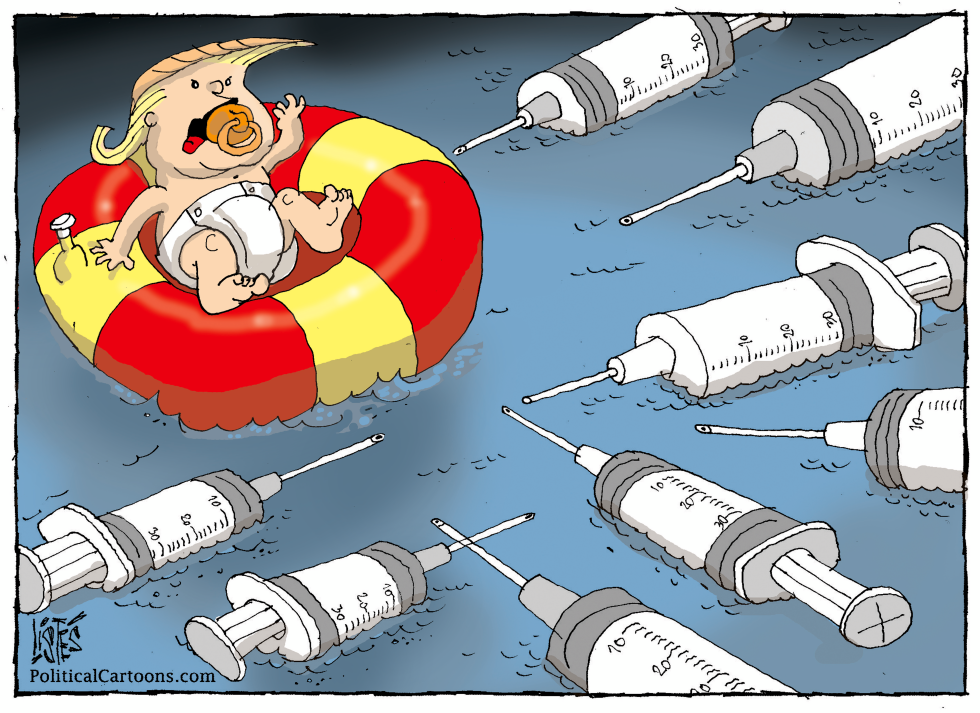
Donald Trump has maintained vocal opposition to certain vaccine mandates and public health measures in recent political discourse. The piece frames this stance through an infant metaphor to underscore perceived vulnerability and fear. It critiques the position as immature amid ongoing public health debates.
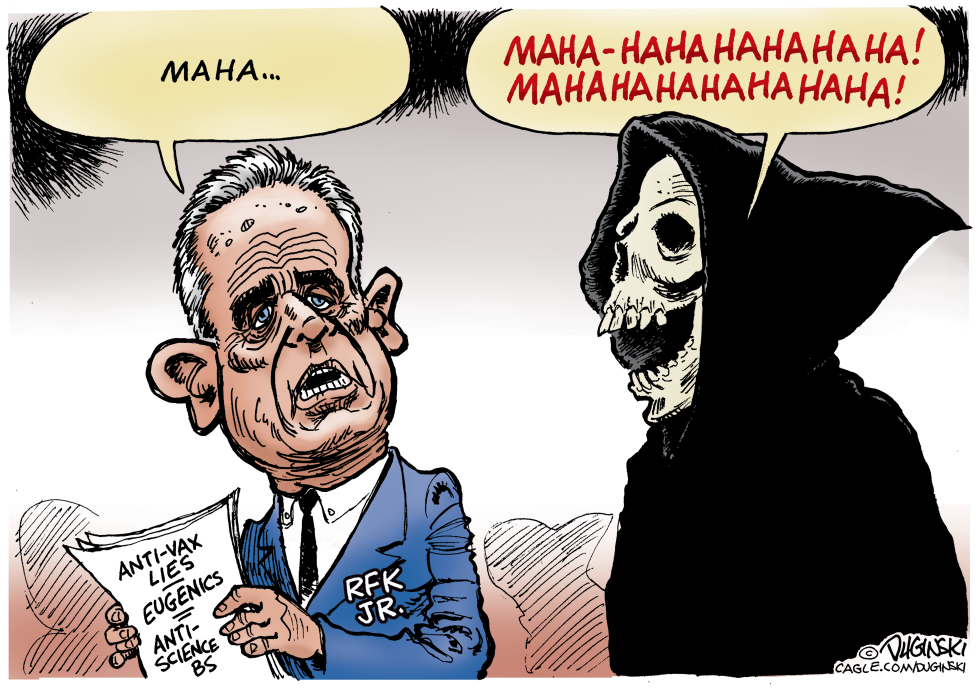
Robert F. Kennedy Jr. continues promoting Make America Healthy Again initiatives tied to his anti-vaccine positions in mid-2026. The approach draws criticism for linking public health measures to eugenics concerns and undermining scientific consensus. The editorial takes the position that such rhetoric risks real harm by eroding trust in established medical guidance.
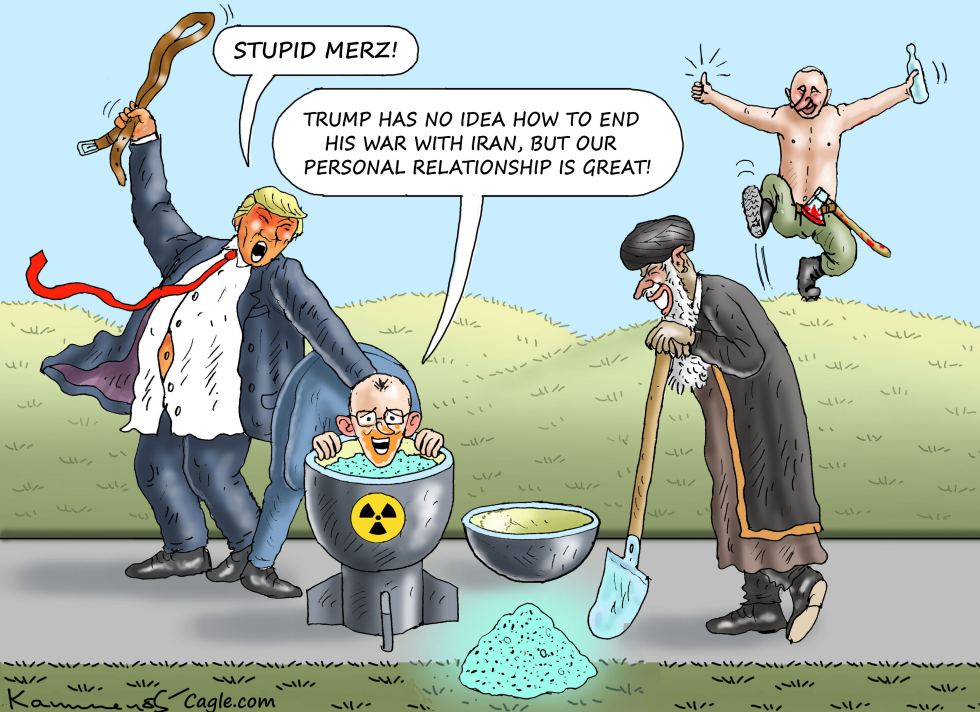
The cartoon depicts a red-faced Trump, tie askew, raising a belt to strike a bald, bespectacled man labeled Merz whose head pokes from a nuclear bomb-shaped vat of blue liquid. An elderly bearded man in turban and robe uses a shovel to scoop more blue material from a bowl, while a shirtless, axe-wielding figure resembling Putin jumps in approval, bottle in hand, speech bubble praising the great personal relationship amid Trump's cluelessness on ending his Iran war. Tags like Trump, Merz, Iran War, Middle East, Fascism, Maga Terror, Hormuz underscore the satirical jab at geopolitical follies, with dry humor poking at failed diplomacy and bizarre alliances in this Kamensky creation for Cagle.com.
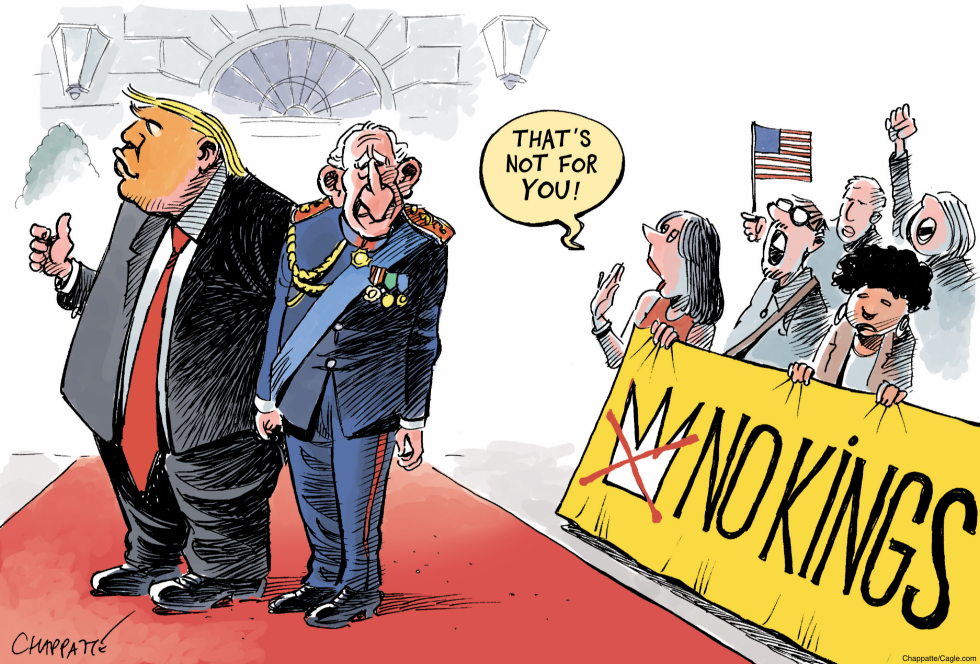
Patrick Chappatte's cartoon captures a fictional royal visit in Washington DC, where Trump, with his signature hair and suit, walks arm-in-arm with King Charles in full regalia. A group of protesters, waving a USA flag, holds a yellow sign featuring a crossed-out crown and 'NO KINGS,' while one shouts 'That's Not For You!' The scene tags USA, Great Britain, Trump, King Charles, monarchy, Democrats, demonstrations, United Kingdom, blending humor on transatlantic relations and anti-monarchy sentiments in a clearly visible setup on a red carpet against a grand building backdrop. The dry satire highlights visible contrasts without deeper inference.
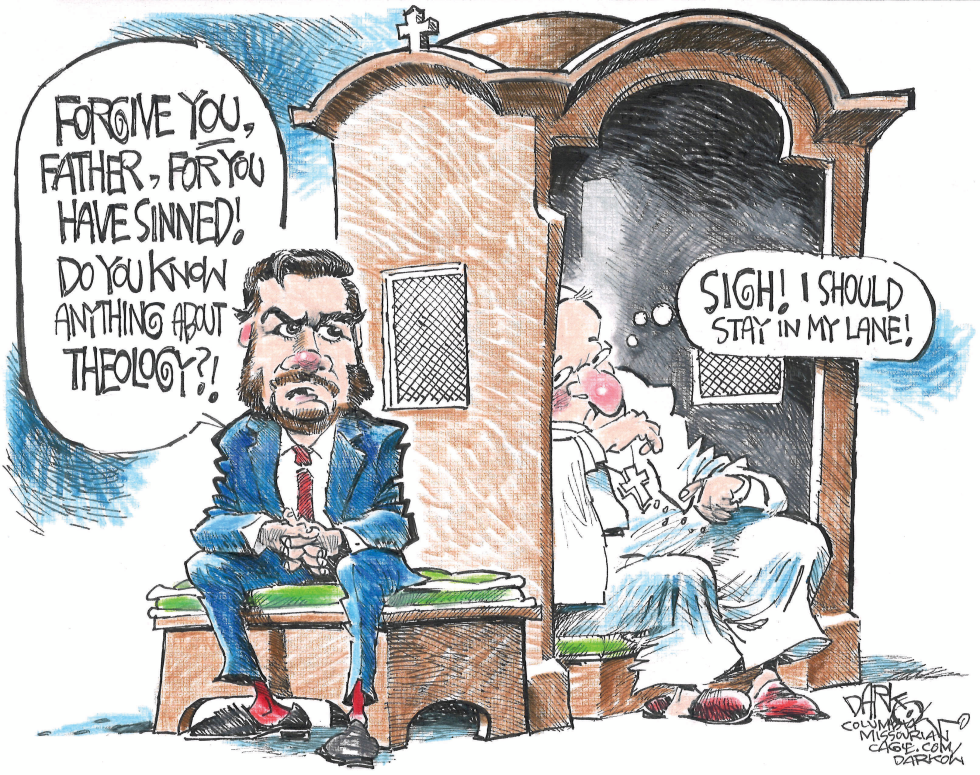
The cartoon shows a suited man with a beard, seated in a confessional booth, angrily addressing a priest dressed in white robes with a cross, using tags like JD Vance, Pope Leo, prayer, God, Jesus, war, theology, confession. The man declares forgiveness to the father for sinning and questions his knowledge of theology. The priest, holding a baby-like figure, sighs and admits he should stay in his lane. This setup captures a role reversal in a traditional confessional scene, with the layman taking an authoritative stance. The artwork by John Darkow features sketchy lines and blue shading, emphasizing the humorous tension between secular and religious domains.
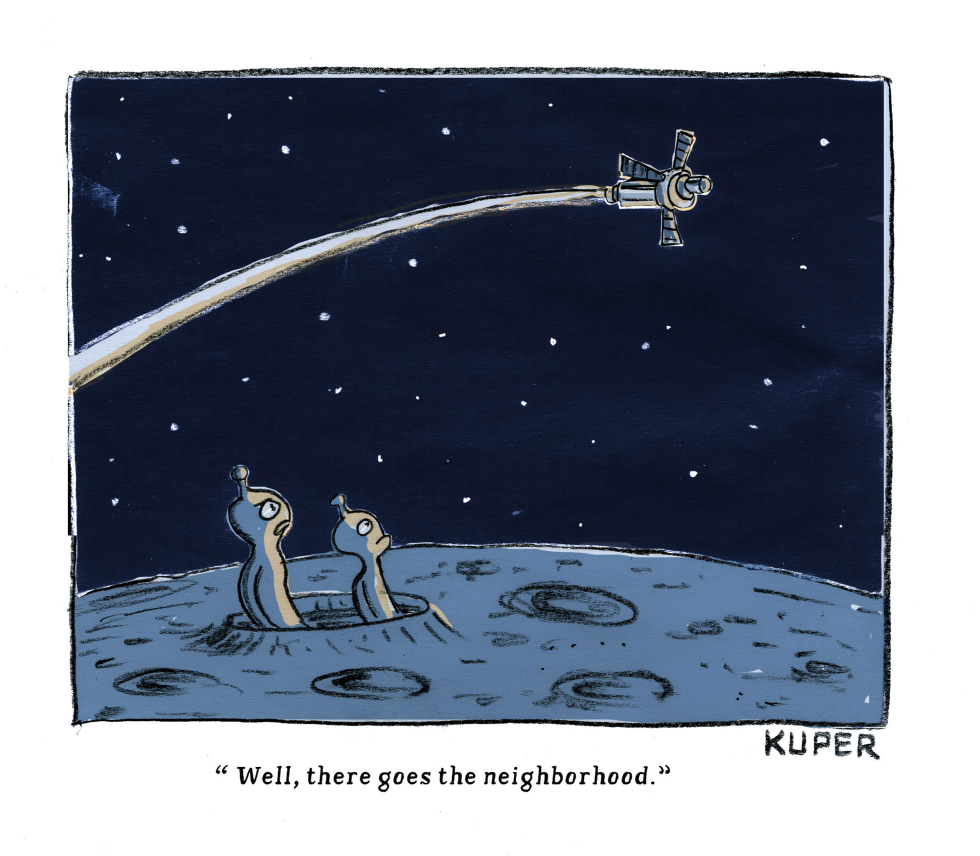
Peter Kuper's cartoon shows two blob-shaped aliens peeking from a crater on the moon's surface, eyes fixed on a departing rocketship trailing exhaust. The dark side of the moon setting includes craters and a starry sky, with the caption 'Well, there goes the neighborhood.' Tags like Artemis II, astronauts, Canada, United States NASA, dark side of the moon, and orbiting highlight the satirical take on human space exploration intruding on alien territory. The image pokes fun at the idea of extraterrestrials reacting to NASA's mission, blending science, data, and humorous alienation.
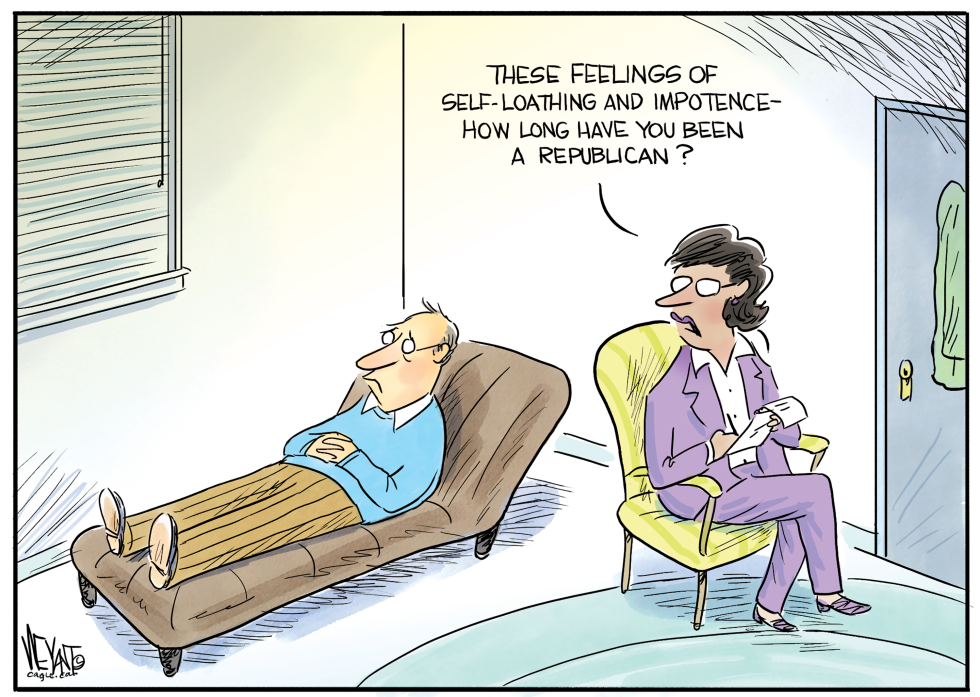
Christopher Weyant's political cartoon shows a therapy room with blinds, a door, and a coat hanger. A balding man in glasses, blue shirt, and brown pants reclines on a brown couch, arms crossed, looking distressed. A woman with dark hair, glasses, purple suit, sits on a yellow chair holding notes, speaking the punchline linking self-loathing and impotence to Republican tenure. The scene captures satirical commentary on political identity, with dry humor evident in the exaggerated expressions and simple setting. Tagged as republican party satire, therapy humor, political cartoon, self-loathing joke, impotence metaphor, and party affiliation critique, it highlights insider views on partisan struggles.
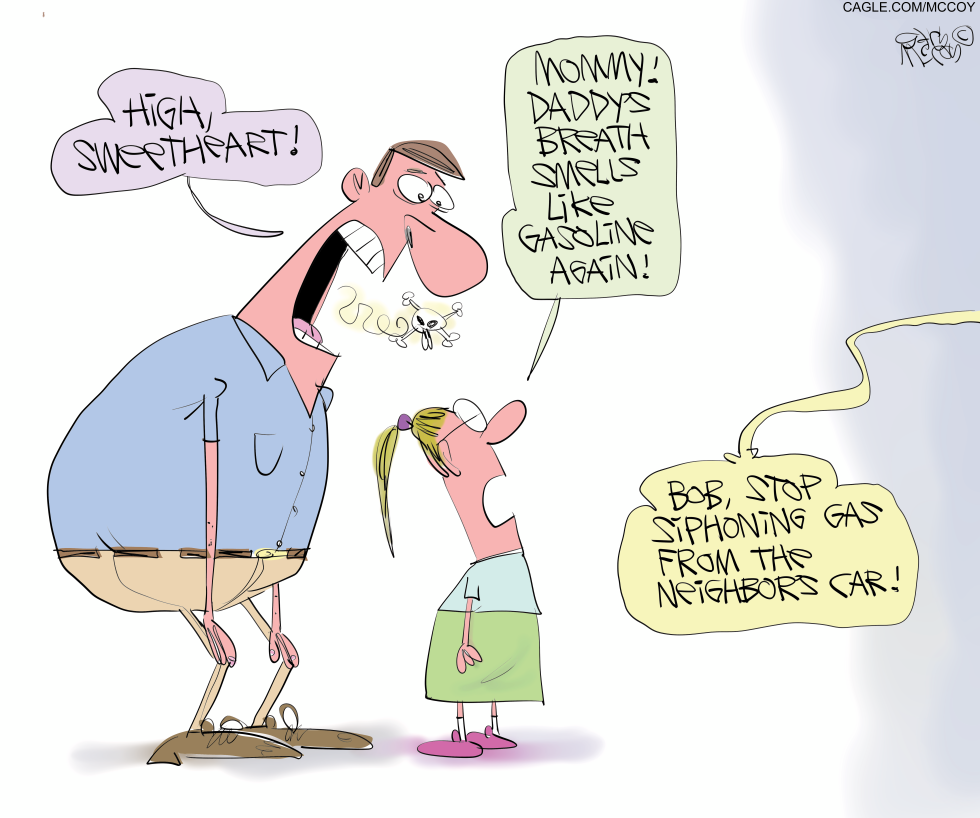
Gary McCoy nails the absurdity of high gas prices in this political cartoon where a dad's breath smells like gasoline after siphoning from the neighbor's car. The daughter's complaint to mommy and the wife's scolding of Bob bring dry humor to economic hardship. Satire on fuel costs and inflation hits home, showing family reactions to desperate measures. Theft due to rising expenses gets a witty twist, making the cartoon sharable amid 2026 gas crisis talks. Cartoonists like McCoy keep it real with straightforward jabs at everyday struggles.
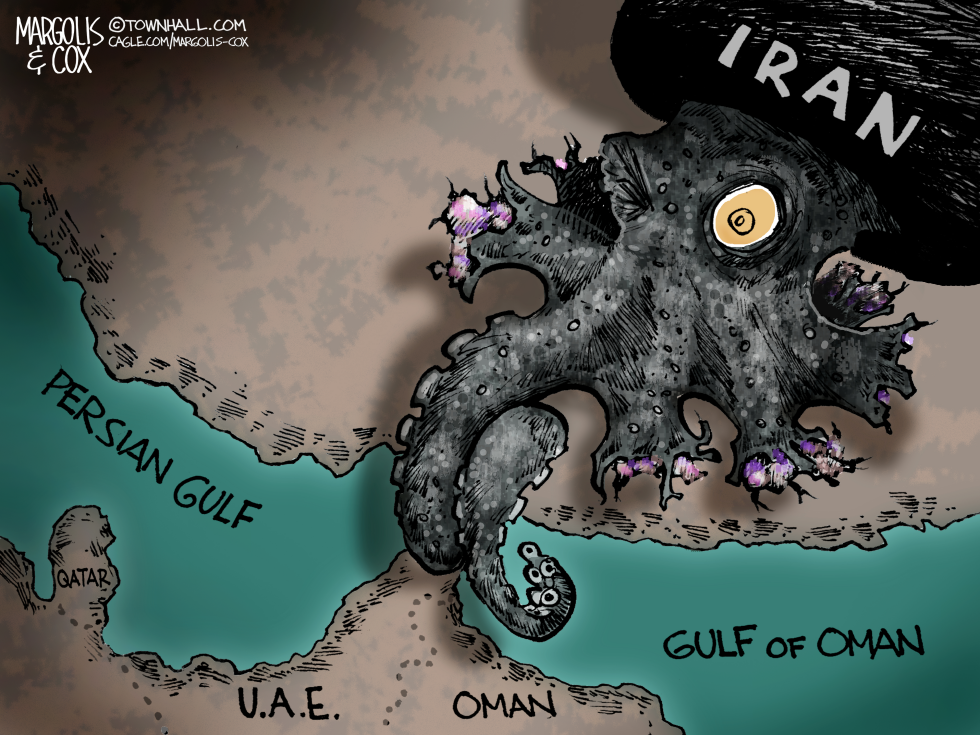
Cartoons like this one from Margolis and Cox cut straight to the absurdity of international posturing. Here, an oversized octopus labeled 'Iran' looms over a simplified map of the Persian Gulf and Gulf of Oman, its tentacles coiling tightly around the Strait of Hormuz. The creature's single eye glares out, while purple-tipped suckers grip the landmasses labeled Qatar, UAE, and Oman. It's a classic visual metaphor for control, poking at Iran's threats to block this crucial oil route. waterway. Such images remind editors how satire distills complex geopolitics into something shareable, even if the humor lands dry as desert sand. With tags like Iran Strait of Hormuz blockade, Persian Gulf tension, octopus metaphor, Middle East satire, oil route choke, and strategic dominance, the piece fits neatly into discussions of global energy security.
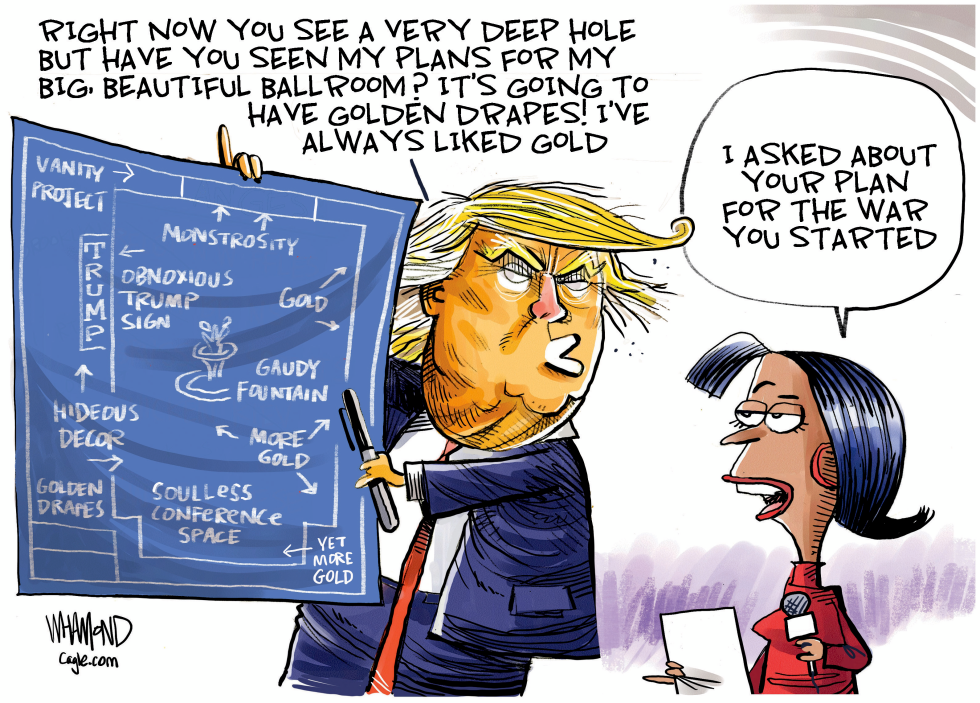
Dave Whamond's cartoon captures Trump in a classic pose, holding up a blueprint riddled with tags like vanity project, monstrosity, Trump obnoxious Trump sign, gaudy fountain, hideous decor, golden drapes, soulless conference space, and repeated calls for more gold. The scene unfolds with Trump enthusiastically describing a very deep hole for his big beautiful ballroom, emphasizing his love for golden drapes. A female reporter, microphone in hand, points out the mismatch, stating she asked about the plan for the war he started. This setup skewers Trump's apparent lack of strategy, turning serious inquiries about Iran war, no endgame, quagmire, military campaign, regime change, and improvising into a punchline about frivolous vanity. The dry humor lands on the contradictions, with Trump's focus on gaudy aesthetics over critical issues like troops in danger and boots on ground.
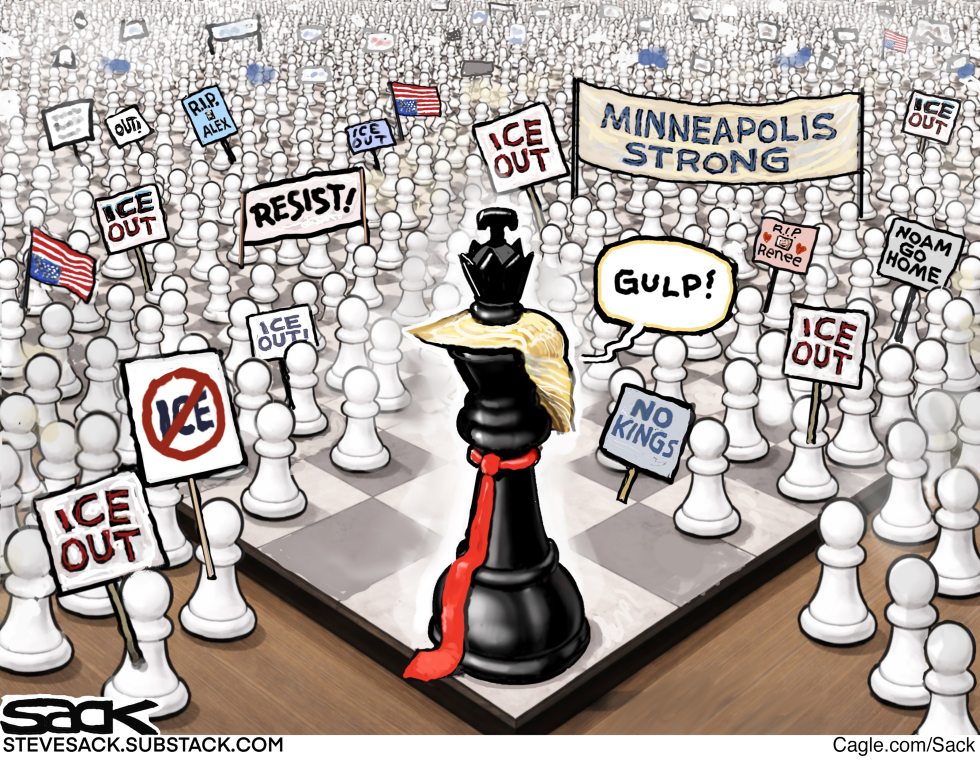
In this political cartoon, a vast army of white chess pawns, each holding protest signs like ICE out and resist, encircles a solitary black king resembling Trump, complete with blonde hair and red tie, uttering a nervous gulp. The scene unfolds on a chessboard, symbolizing confrontation, with banners proclaiming Minneapolis strong and no kings amid American flags and memorial RIP signs for Alex and Renee. Tags such as Minneapolis ICE protests, Trump king chess, ICE out pawns, anti-ICE rally, chess protest imagery, and gulp ICE king highlight the visual satire of resistance against immigration enforcement. The composition captures a moment of overwhelming protest, emphasizing themes of uprising and defiance in a straightforward, unambiguous depiction.
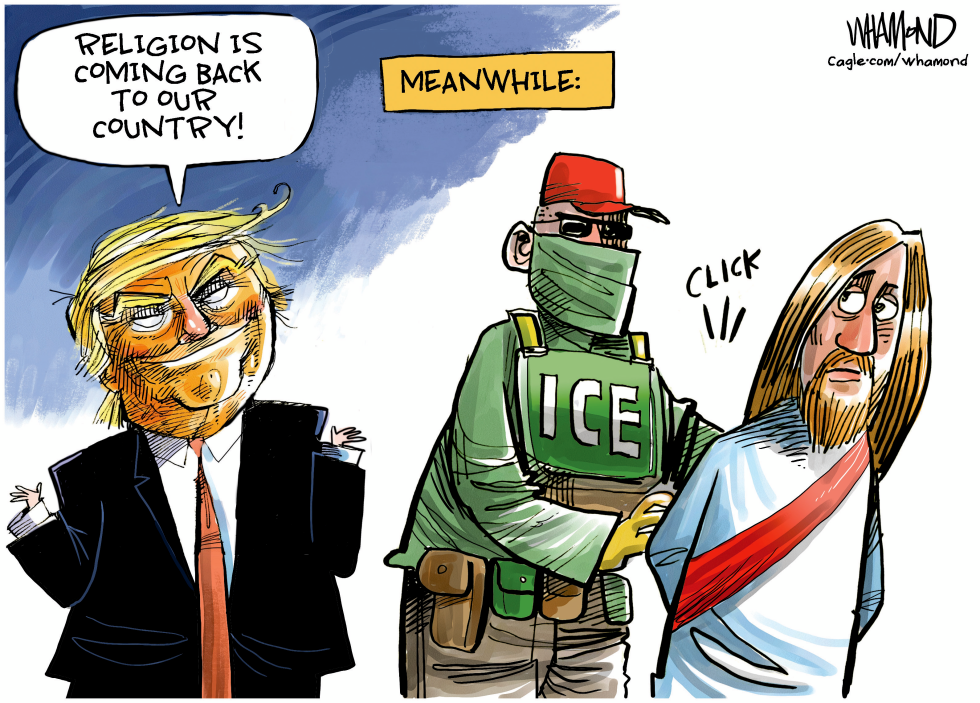
Dave Whamond's cartoon captures Trump religion cartoon essence with the former president boldly stating religion's return to America. Meanwhile, an ICE agent is shown handcuffing a figure resembling Jesus, complete with long hair, beard, and robes, in a clear ICE deporting Jesus satire. This piece dives into political cartoon religion America themes, poking at immigration policy religion hypocrisy. The dry humor shines through the contrast between Trump's proclamation and the 'meanwhile' scene of deportation. Such satirical take on US immigration and faith often sparks debate on religious revival and deportation. Overall, it's a pointed commentary on blending faith with strict border controls.