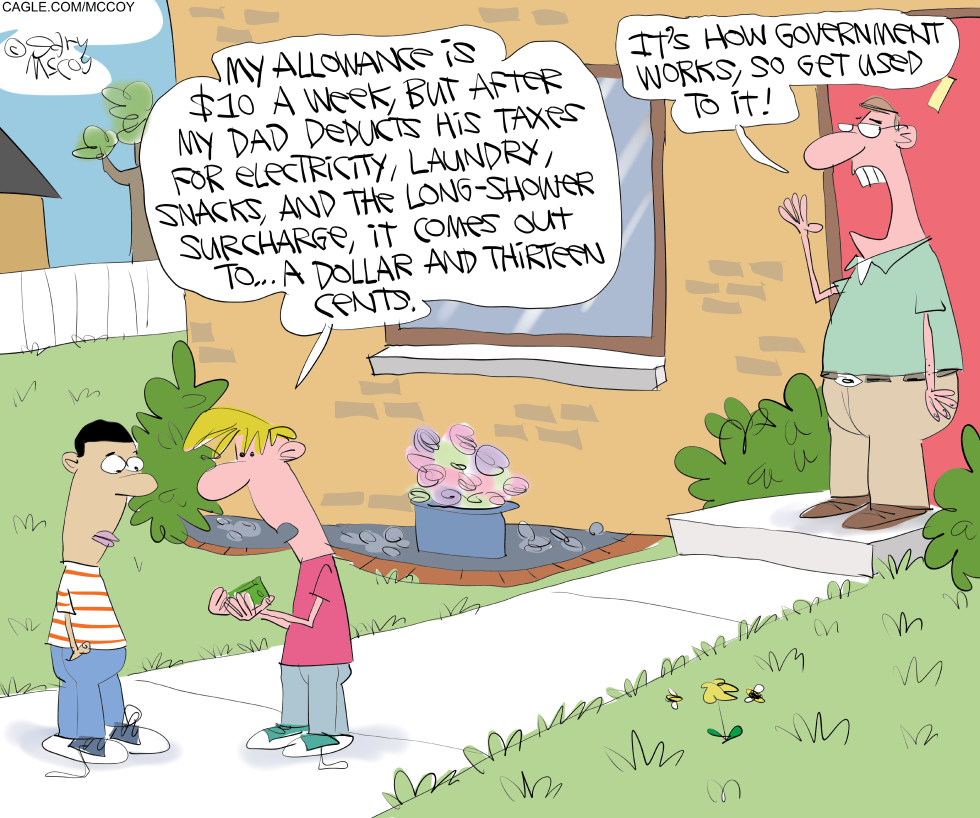
In the cartoon a blond boy in a pink shirt tells a friend in a striped shirt that his ten dollar allowance drops to a dollar thirteen after his dad deducts taxes for electricity laundry snacks and a long shower surcharge. The father stands on the porch in a green shirt and khakis waving one hand while stating that is how government works so get used to it. The scene includes a flower pot a sidewalk and green lawn with the artist signature visible.
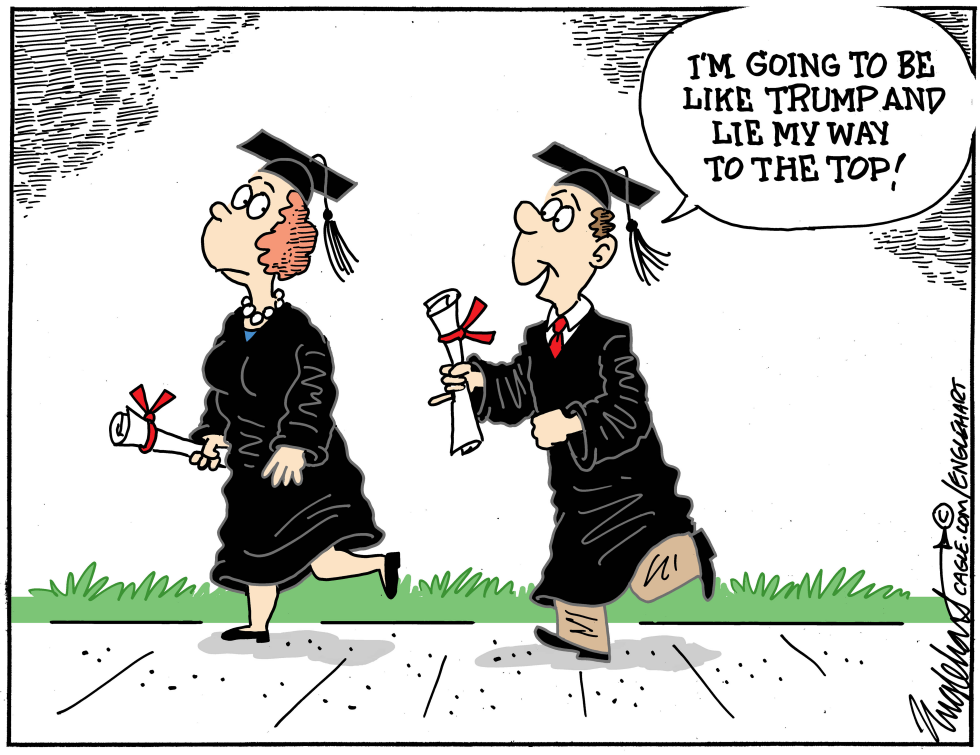
The image shows a female graduate and a male graduate in caps and gowns. Both hold rolled diplomas with red ribbons. The male graduate has a speech bubble. They stand on a paved area with green grass below. The date is 2026.
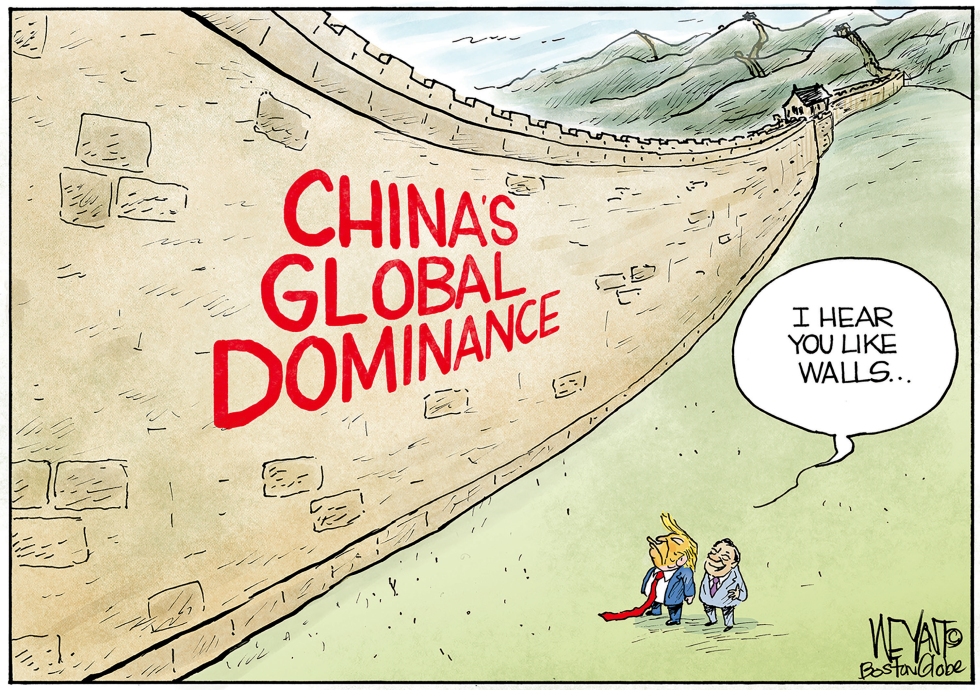
The image shows a massive stone wall curving across hills labeled in red text China's global dominance. At the bottom right two men in suits stand on grass one with yellow hair and red tie. A speech bubble extends from the second man stating I hear you like walls. The wall has watchtowers and the background shows green hills under a blue sky.
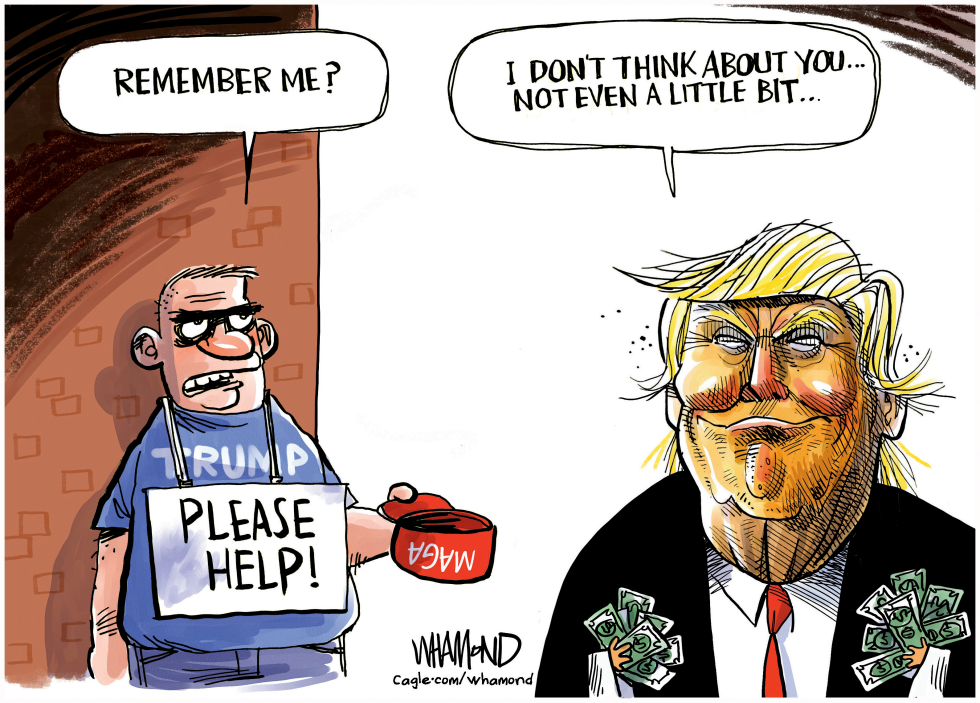
Visible in the cartoon are two figures facing each other. The left figure wears a blue shirt labeled trump, holds a white sign reading please help, and carries a red hat marked maga. The right figure has yellow hair, a black jacket with green bills protruding from pockets, and a red tie. Two speech bubbles display the phrases remember me and i dont think about you not even a little bit. The artist signature whamond and cagle.com/whamond appear at the bottom.
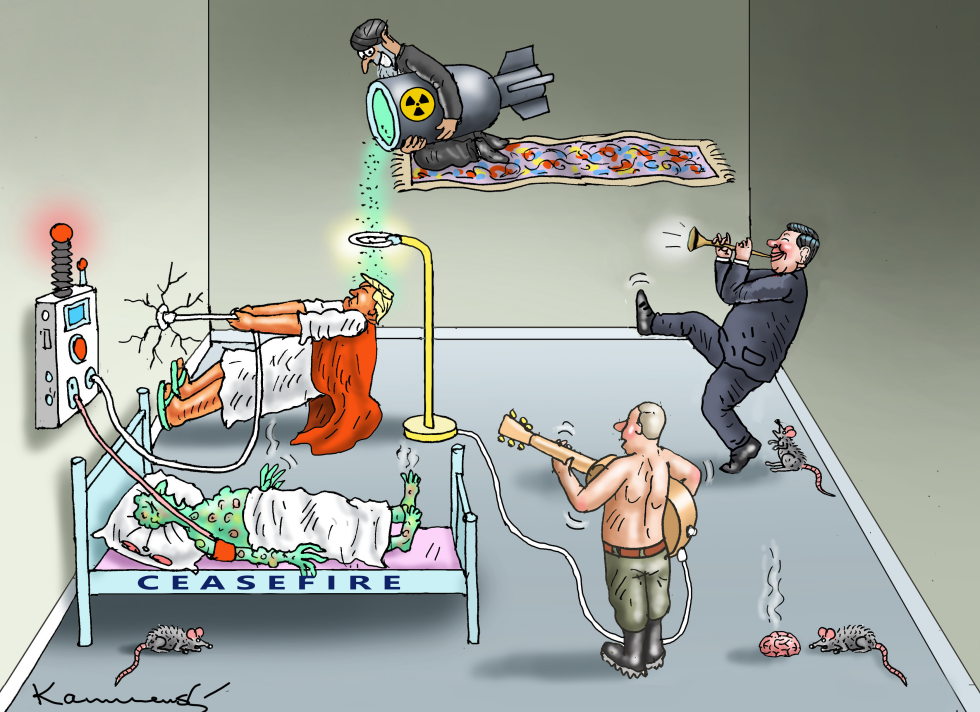
The image addresses recent Middle East developments involving Iran and nuclear issues by depicting a hospital setting where a labeled bed draws attention from several figures including Trump and a descending bomb carrier.
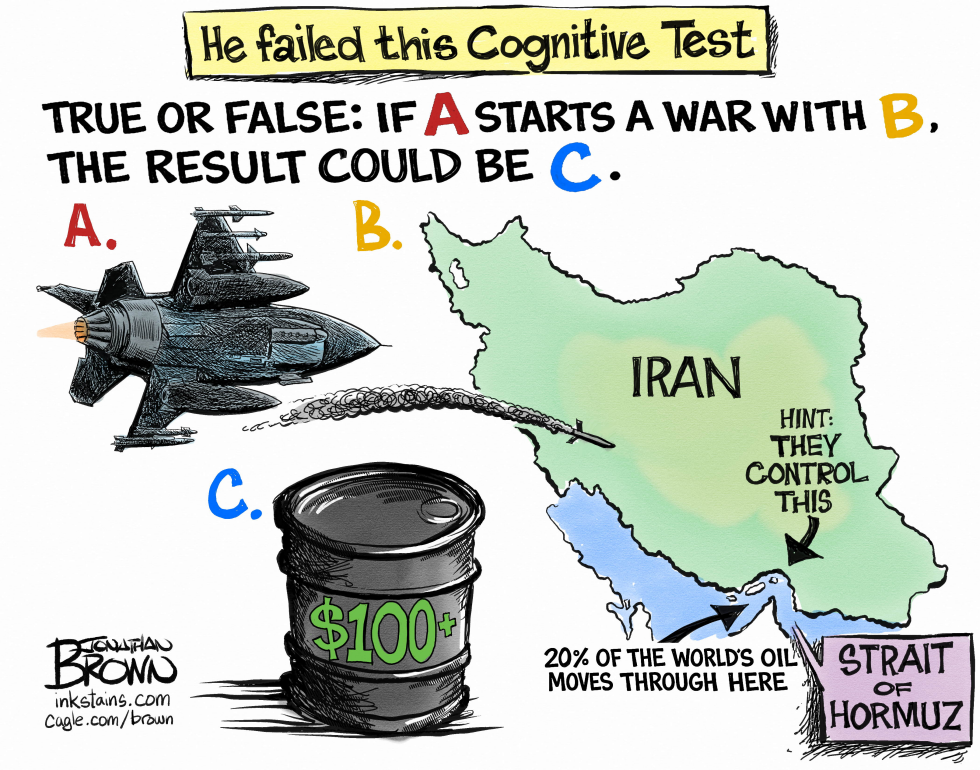
Jonathan Brown's cartoon presents a stark true-or-false cognitive test: if A (a fighter jet) starts a war with B (Iran), the result could be C (an oil barrel marked $100+). The map of Iran includes a hint pointing to the Strait of Hormuz, noting that 20% of the world's oil moves through there, underscoring control over this chokepoint. Tags such as cognitive test, war in Iran, oil prices, Strait of Hormuz, gas prices, and cost of war frame the satire. The artwork warns of economic fallout from conflict, with the jet trailing toward Iran and the oil barrel symbolizing surging costs. This piece captures geopolitical tensions in a simple, visual riddle.
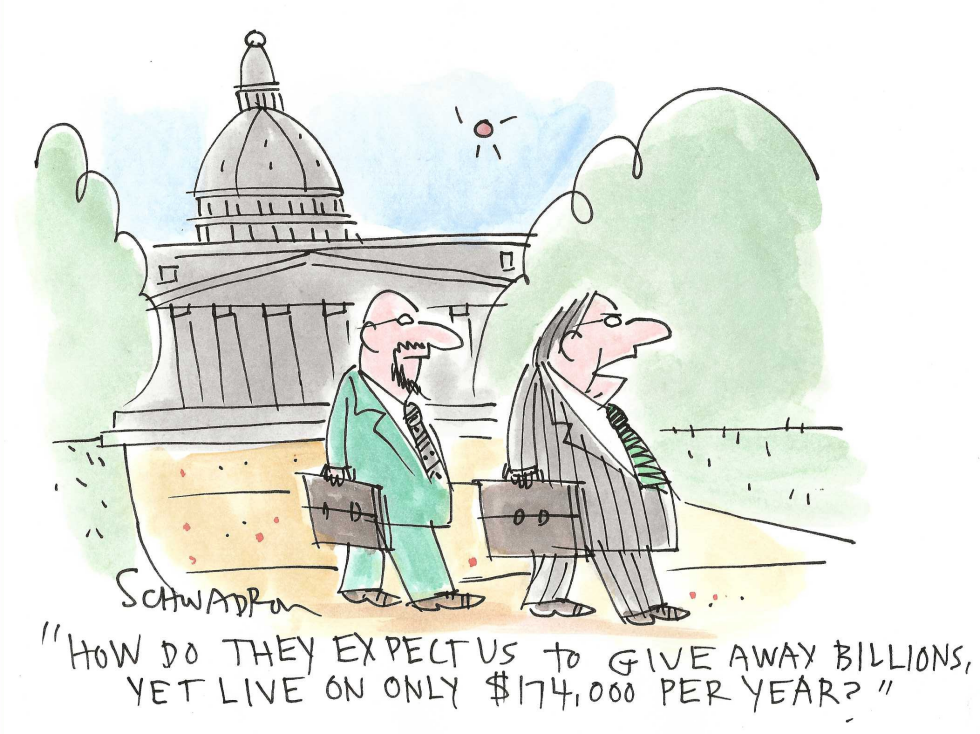
The cartoon shows two men in business attire carrying briefcases in front of a large domed building resembling Congress. One wears green, the other gray stripes. They hold cases labeled with dollar signs. The caption questions giving away billions on a $174,000 salary. Visible elements include green bushes, a path, and a small sun. Tags reference Congress, give away, billions, wars, tariffs, inflation, cost of living, and money. The scene focuses on the figures and their dialogue about expenditures.
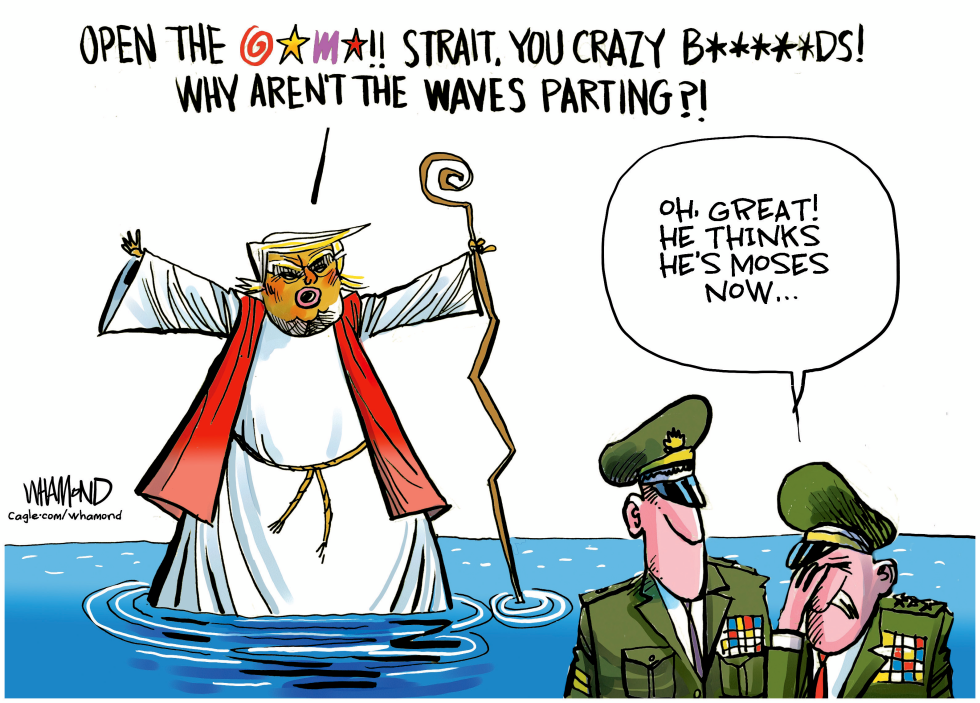
The cartoon shows Donald Trump in Moses robes and holding a staff, standing in the Strait of Hormuz while shouting for the waters to part. Two military officers in the foreground comment on the scene. The image responds to ongoing tensions involving Iran, the strait blockade, and U.S. policy responses as of early May 2026.
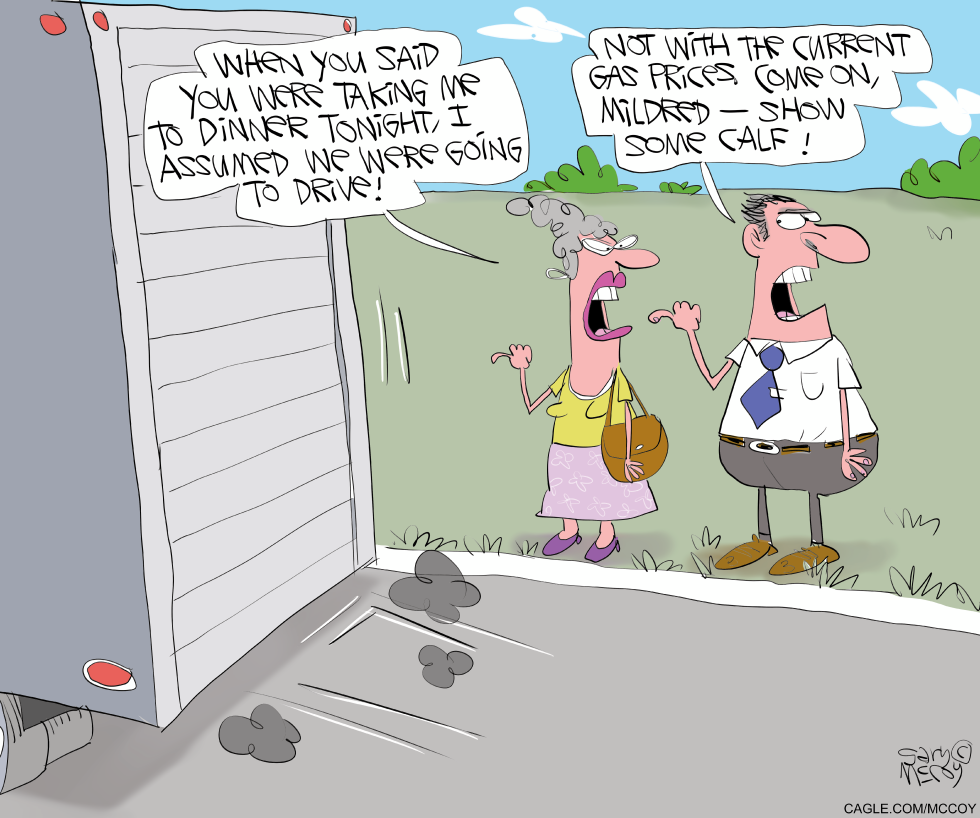
The cartoon depicts an elderly woman in a yellow top and purple skirt standing with a man in a white shirt and blue tie beside a large gray truck with its door open. Speech bubbles show the woman assuming a drive to dinner and the man citing current gas prices while suggesting she show some calf. The scene includes grass, sky, and tire marks on the ground.
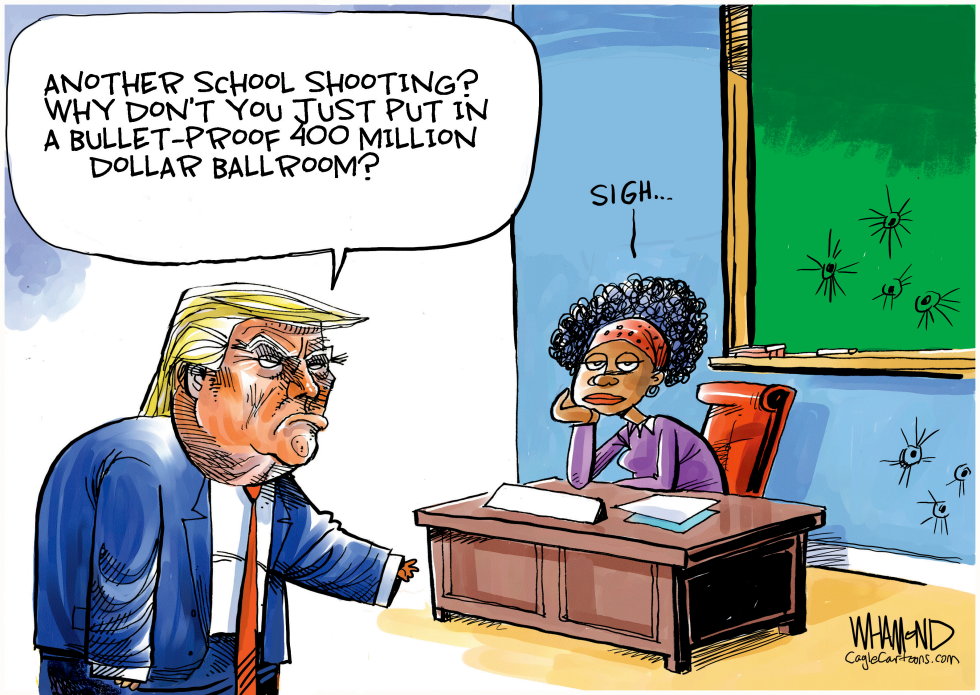
Dave Whamond's cartoon captures a man resembling a political figure leaning over a desk in a classroom, suggesting a bullet-proof 400 million dollar ballroom as a fix for another school shooting. The woman at the desk sighs in response, with a green blackboard showing marks that look like bullet impacts. Tags like school shootings, national issue, security, guns, education, and bullet proof underscore the satire on misplaced priorities, where vanity projects like a top secret ballroom or Trump bunker get funding justifications, echoing build the wall rhetoric and emergency exemptions amid issues like WHCD shooting.
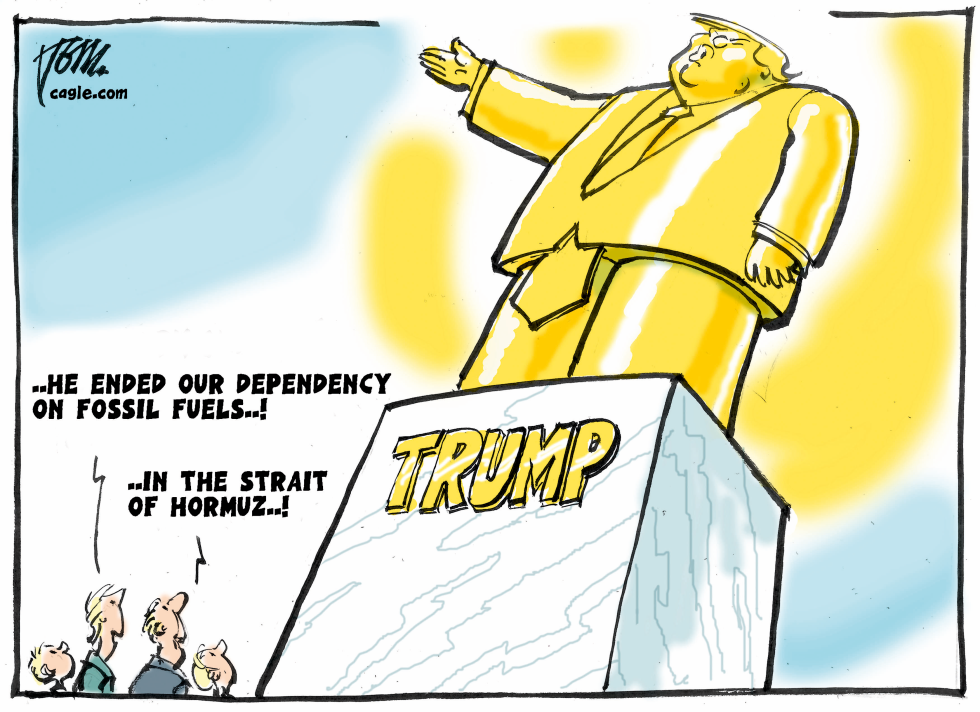
Tom Janssen draws a massive golden statue resembling Trump, arm raised triumphantly on a 'TRUMP' pedestal, with text boasting 'HE ENDED OUR DEPENDENCY ON FOSSIL FUELS!!' A small figure below quips '...IN THE STRAIT OF HORMUZ?!' Three tiny onlookers gaze up. The cartoon ties into tags like Strait of Hormuz, blockade, oil prices, inflation, Iran war, and fossil fuels. It pokes at ironic claims of energy independence through geopolitical tension. The yellow glow and exaggerated features amplify the dry humor on misguided victories. Cagle Cartoons syndicates such pointed takes, reminding editors how visuals cut through policy noise. This one's timely, blending current events with sharp wit.
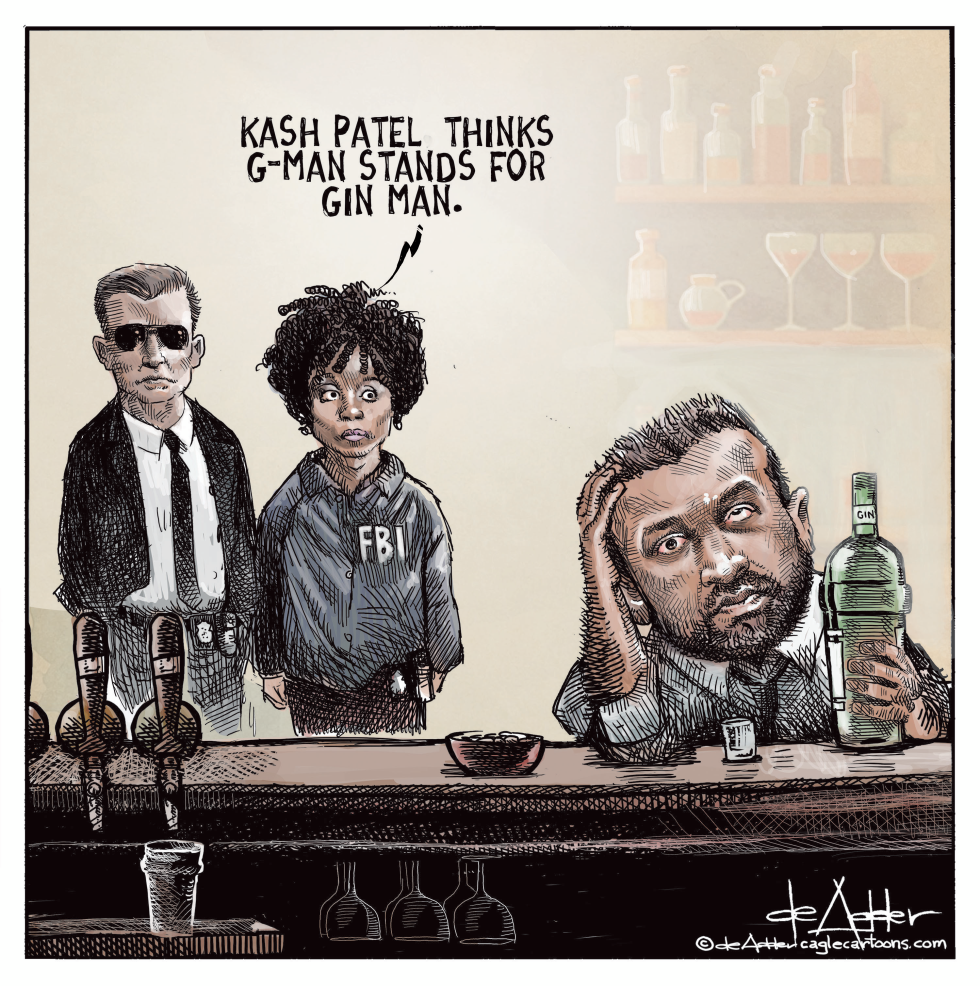
Michael de Adder's cartoon depicts a bearded man at a bar, hand on forehead, holding a green gin bottle, looking inebriated. Two figures stand behind: one in a suit with sunglasses, another in an FBI jacket. The text reads 'Kash Patel thinks G-man stands for gin man.' Bottles line the shelf, beer taps and glasses on the counter. Tags like Kash Patel, FBI, gin, drinking, alcohol, drunk underscore the visual pun on FBI agents as 'G-men' versus a 'gin man' in a bar setting. The scene captures a straightforward satirical jab without deeper layers visible.
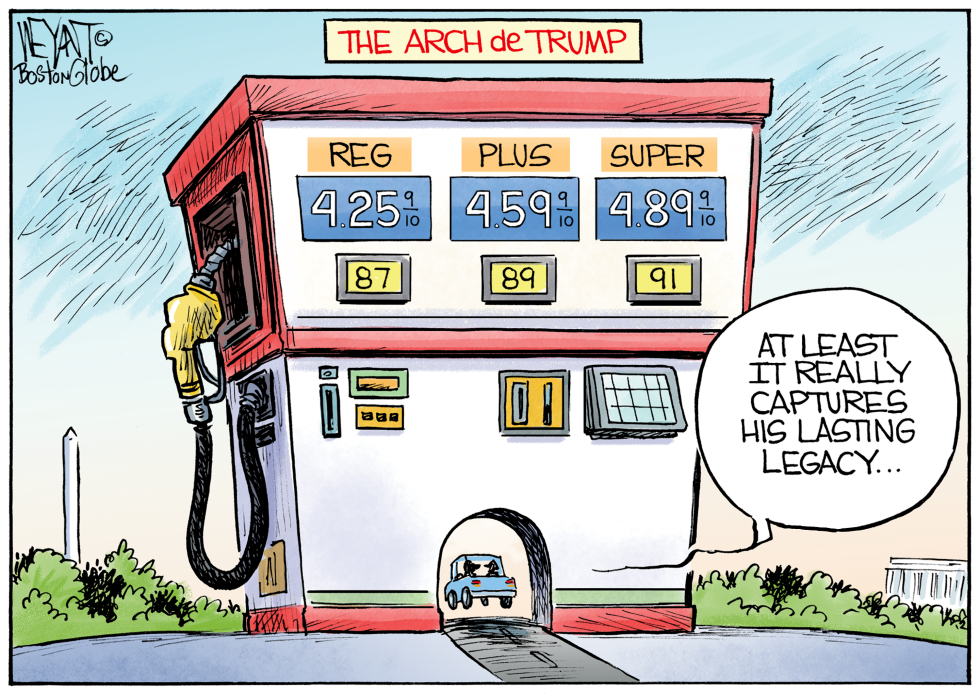
The cartoon illustrates a massive gas pump designed as an arch, prominently labeled 'The Arch de Trump,' with prices listed for regular at 4.25 per gallon, plus at 4.59, and super at 4.89, alongside octane ratings of 87, 89, and 91. A car drives through the arch, set against a backdrop of the Washington Monument and another structure resembling the Lincoln Memorial. A speech bubble comments, 'At least it really captures his lasting legacy...' This setup parodies monumental architecture, tying into themes of trump, gas prices, inflation, vanity, and Washington. The image uses dry humor to highlight economic elements without depicting any figures, focusing solely on the structure and text for its satirical punch. Tags like Middle East, Iran, and oil underscore the visible high prices, while the arch form evokes famous landmarks.