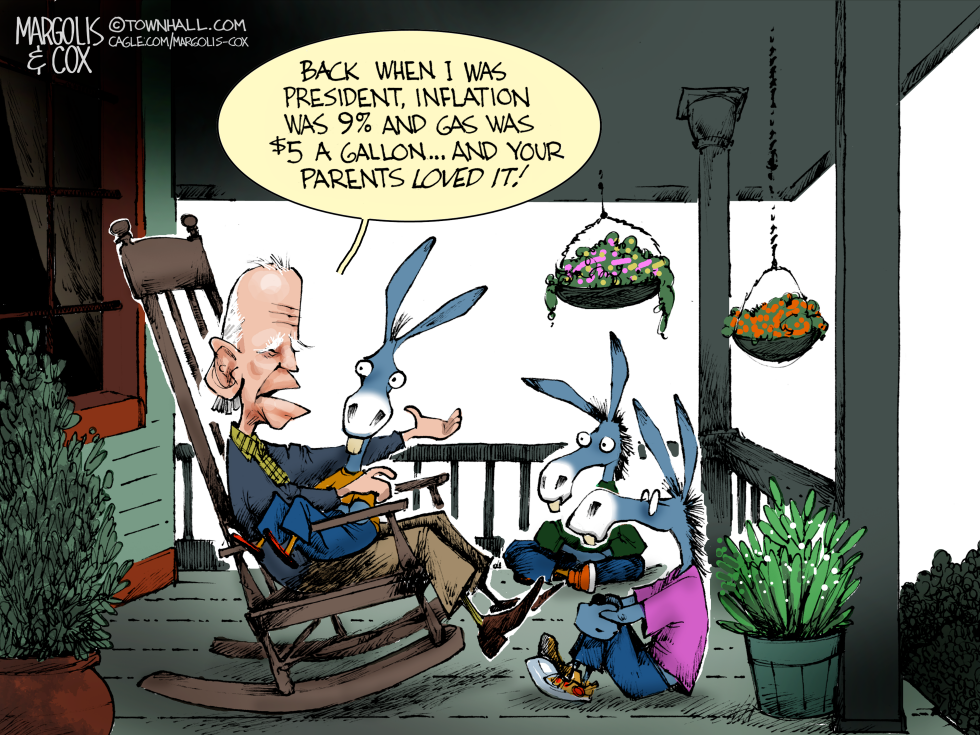
Former President Joe Biden addressed young Democrats on a porch, recalling the 9 percent inflation and $5-per-gallon gas prices from his term as something their parents loved. The remark comes amid ongoing Democratic efforts to move past the economic record of the Biden years. The cartoon presents the comment as tone-deaf revisionism that highlights the party's difficulty distancing itself from those results.
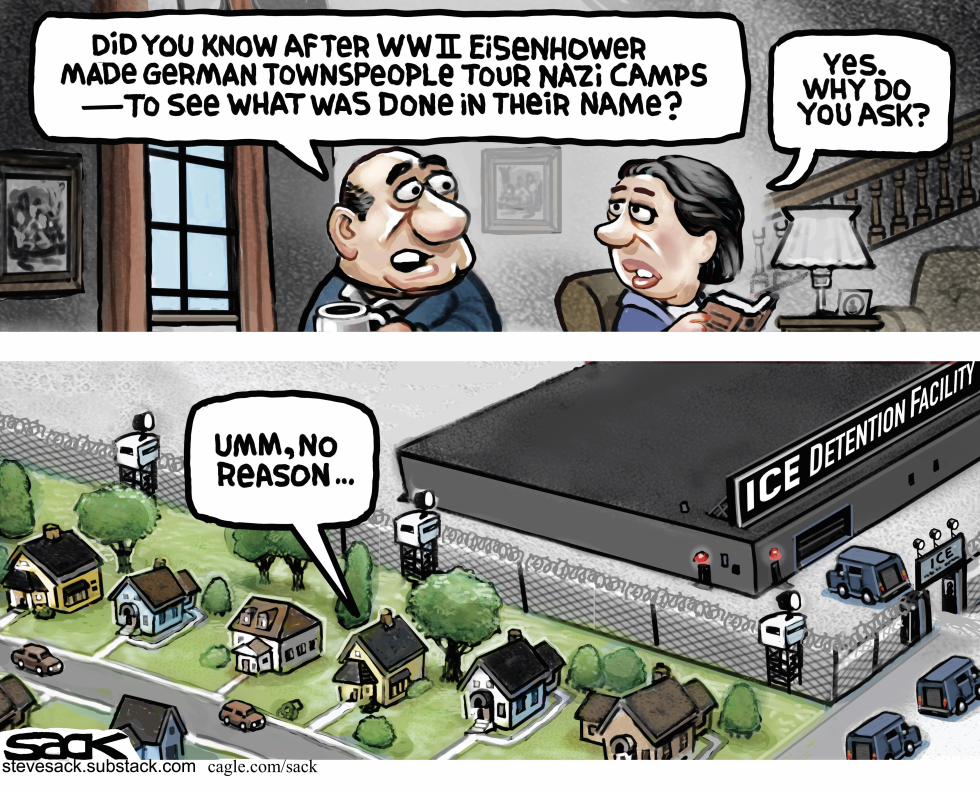
A two-panel cartoon contrasts a living room discussion of Eisenhower's order for German civilians to tour Nazi camps after World War II with a suburban scene featuring a large ICE detention facility adjacent to homes. One resident deflects when asked why the historical example was raised. The image highlights proximity of such facilities to neighborhoods and reluctance to acknowledge operations conducted in the community's name.
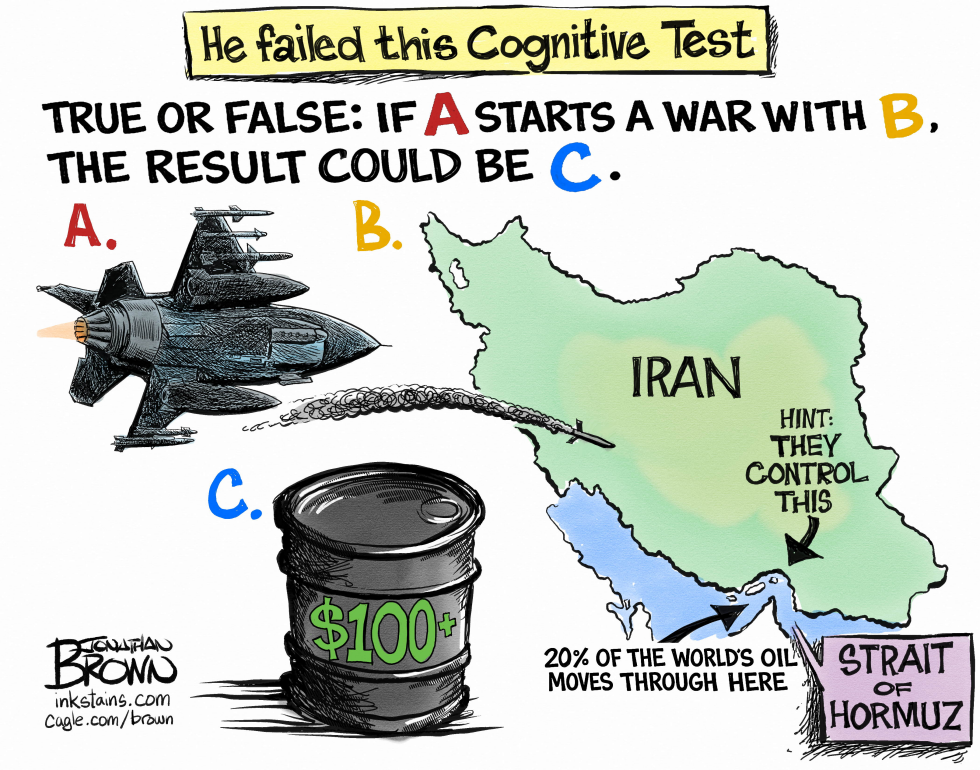
Jonathan Brown's cartoon presents a stark true-or-false cognitive test: if A (a fighter jet) starts a war with B (Iran), the result could be C (an oil barrel marked $100+). The map of Iran includes a hint pointing to the Strait of Hormuz, noting that 20% of the world's oil moves through there, underscoring control over this chokepoint. Tags such as cognitive test, war in Iran, oil prices, Strait of Hormuz, gas prices, and cost of war frame the satire. The artwork warns of economic fallout from conflict, with the jet trailing toward Iran and the oil barrel symbolizing surging costs. This piece captures geopolitical tensions in a simple, visual riddle.
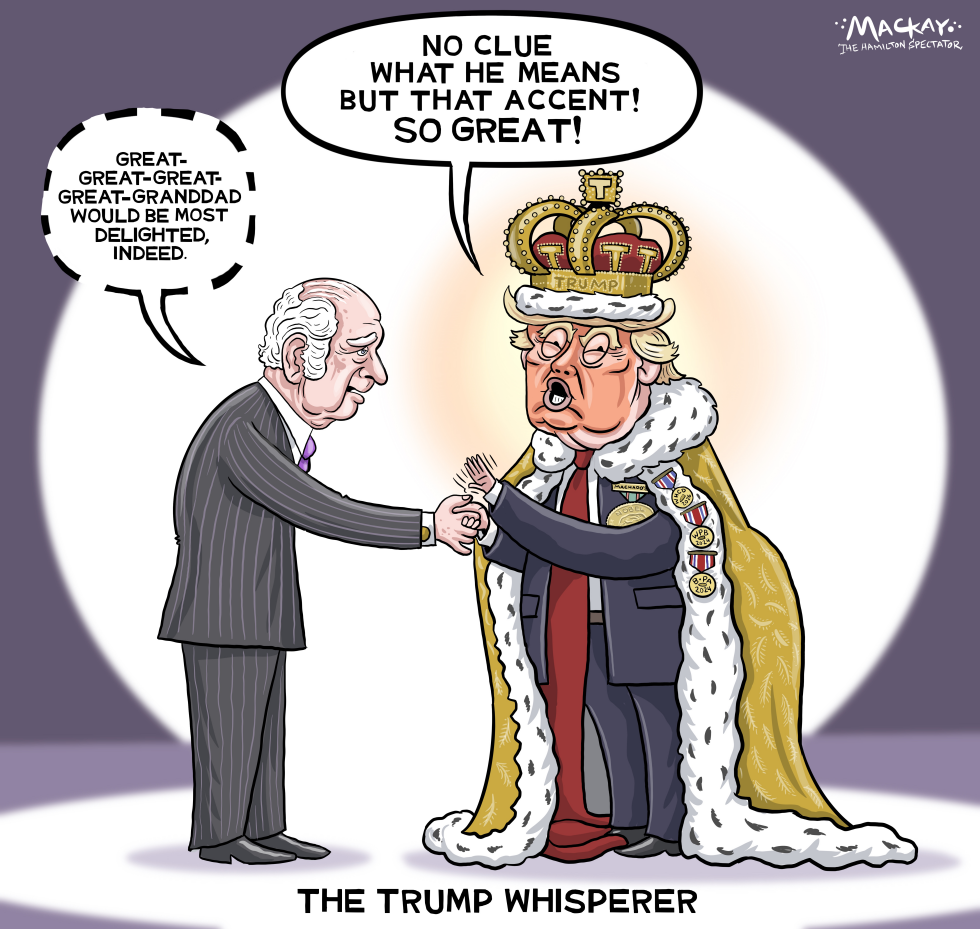
Graeme MacKay's cartoon depicts King Charles III leaning in to whisper a message from King George III to a regally dressed President Trump, who misinterprets it due to the accent. Tagged with USA, Canada, UK, the image explores monarchy, diplomacy, and alliance themes. Trump's crown labeled with his name adds symbolism of self-aggrandizement, while the 'Trump Whisperer' caption underscores the tension in this leadership encounter. Historical nods to tradition and stability contrast with modern visit dynamics, blending respect and satire in a visually striking composition.
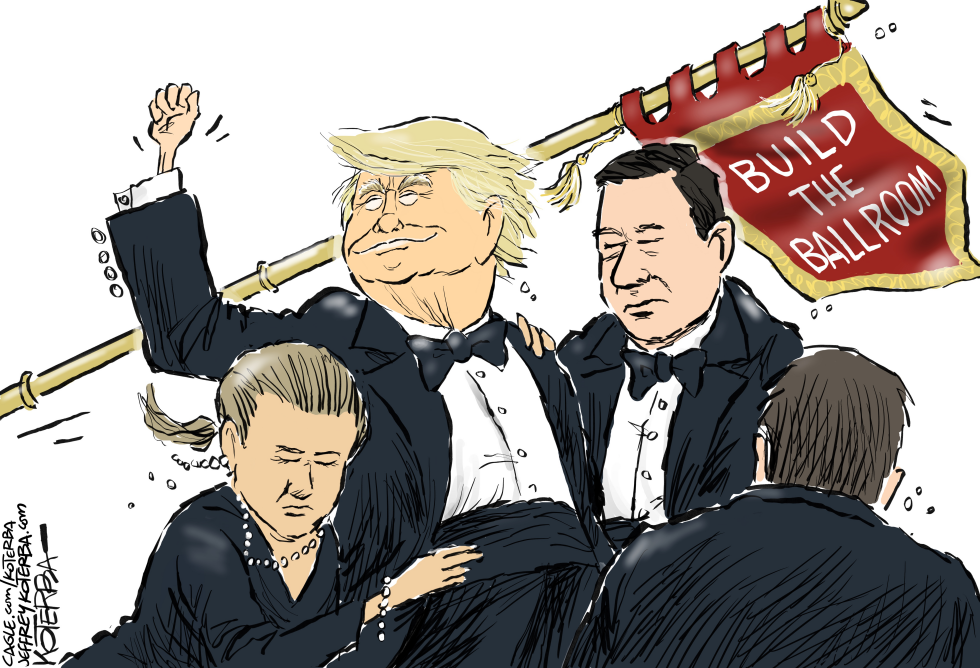
Jeff Koterba draws Trump in tuxedo, fist raised high, gripping a flagpole with a red banner proclaiming 'Build the Ballroom.' Surrounded by figures in formal wear, the scene captures a moment in a Washington ballroom, tagging into press and journalism themes. The cartoon nods to an assassination attempt in Butler, with secret service elements visible. Trump's caricature dominates, his expression set as agents cluster around. This piece fits into White House Correspondents' Dinner aftermath, blending fist symbolism with ballroom absurdity. Tags like flag and tuxedo underscore the satirical take on political resilience.
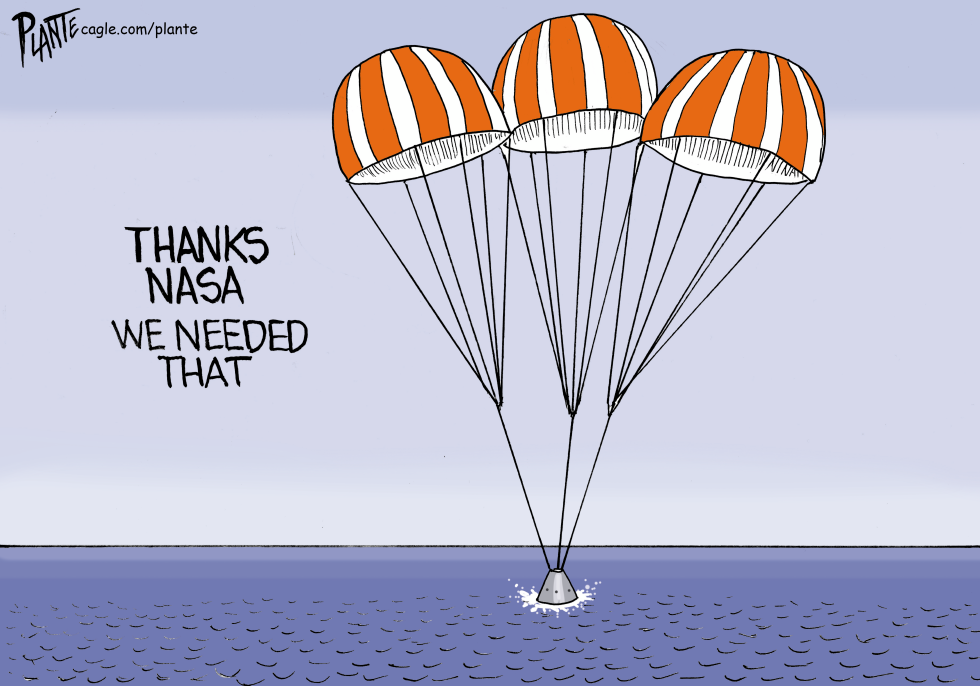
Bruce Plante\'s cartoon captures a space capsule\'s splashdown, complete with three orange and white striped parachutes guiding it to a blue ocean teeming with black fish-like forms. The prominent text \'Thanks NASA We Needed That\' adds a layer of sarcasm, typical in editorial illustrations commenting on high-profile events like the Artemis II mission. The simple composition, with a light blue sky and wavy ocean surface, emphasizes the moment of impact, shown by a small splash at the capsule\'s base. This piece fits into the tradition of political cartoons that highlight public sentiments toward government projects, using minimal elements for maximum impact. The artist\'s signature and website appear in the top left, grounding it in syndicated cartoon style.
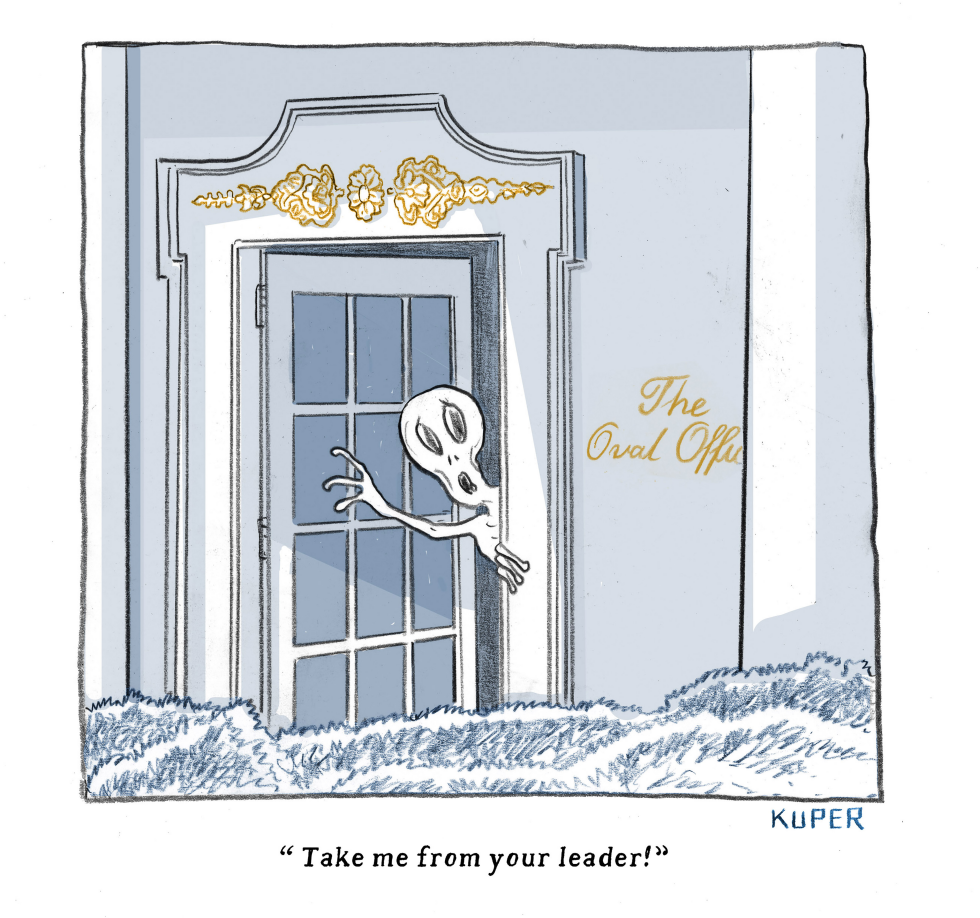
Peter Kuper's cartoon depicts a door with ornate gold trim labeled 'The Oval Offi,' partially obscured by a skeletal alien figure extending bony arms outward arms outward, one hand clawing at the glass panes. The figure's skull-like head with large eyes peers out, and below, a speech bubble reads 'Take me from your leader?!' Grass or shrubbery lines the bottom, with the signature 'KUPER' at the lower right. This setup twists the classic alien phrase into a plea for rescue, fitting presidency satire, Oval Office humor, extraterrestrial parody, skeletal cartoon, White House illustration, and political leader commentary in a straightforward line drawing style.
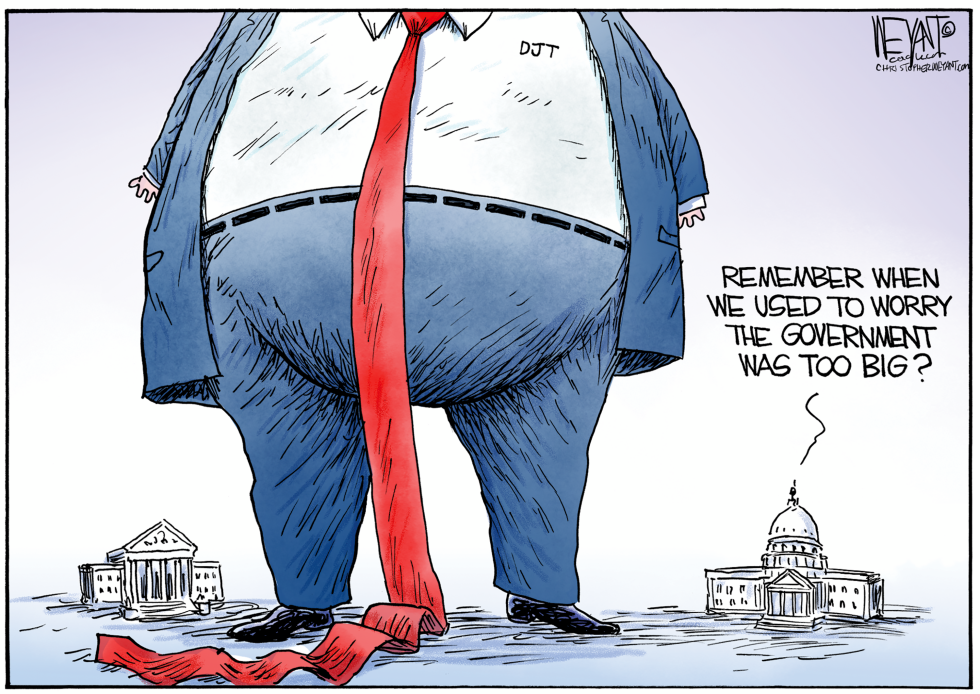
A cartoon published October 20, 2025, depicts a massive figure marked DJT standing over miniature representations of the Supreme Court and Capitol building. The figure's red tie lies on the ground near the structures. Text on the right recalls earlier concerns about an oversized government. The image highlights the contrast between the dominant central figure and the diminished institutions below.
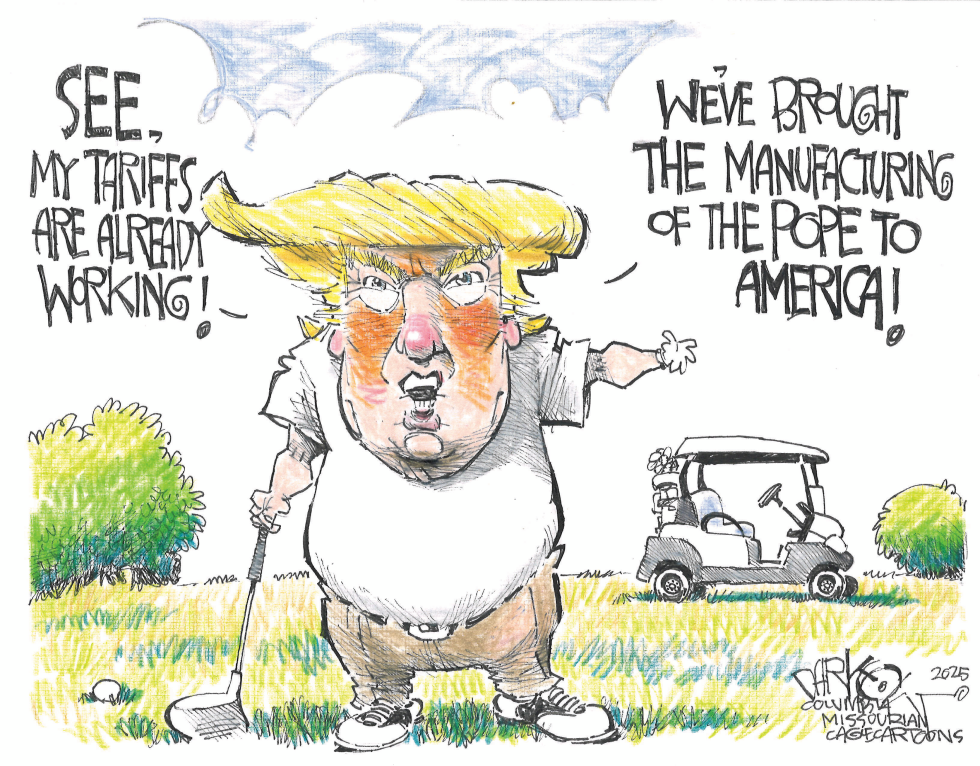
John Darkow's cartoon depicts a caricatured Donald Trump on a golf course, holding a club near a ball, with a golf cart nearby. He exclaims that his tariffs are already working, pointing to a claim about bringing the manufacturing of the pope to America. The image uses dry humor to poke at trade policies, with Trump’s distinctive hair and expression emphasizing the satire. Bushes and grass fill the scene, under a cloudy sky. This piece comments on economic nationalism through absurd exaggeration, fitting into broader discussions of tariffs, manufacturing jobs, America first policies, political cartoons, and satirical art.
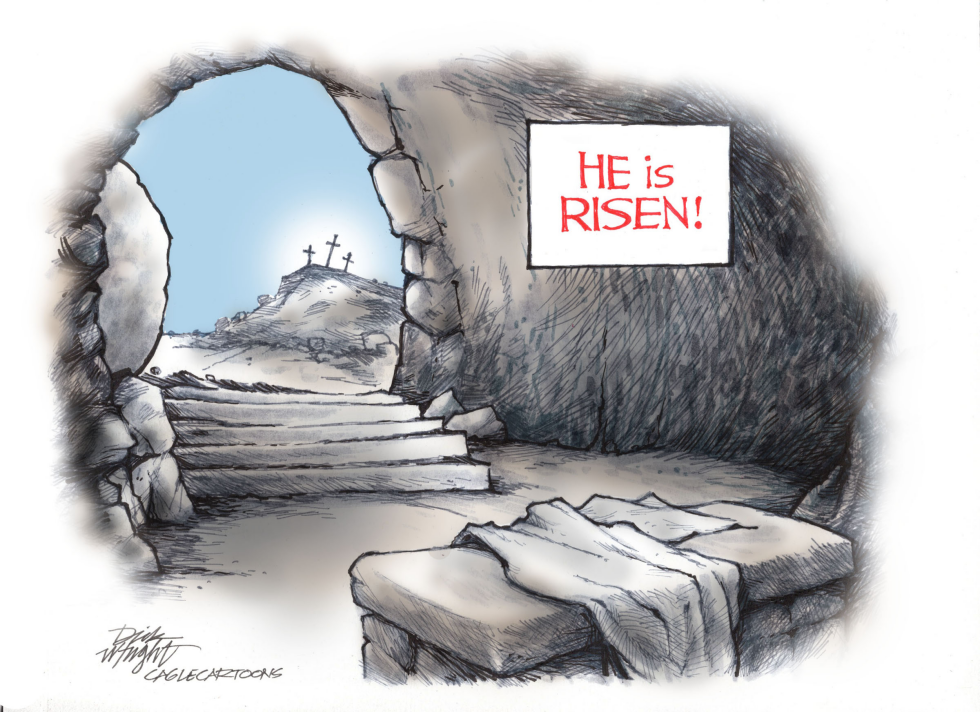
The illustration shows the interior of a stone tomb with the entrance open to a bright sky. A white sign on the right wall reads HE is RISEN! in red letters. Folded linens rest on a ledge in the foreground. Outside, stone steps lead toward a hill with three crosses visible against the horizon. The date of April 4 2025 places the image near the Easter season. The work focuses on the biblical account of the resurrection without additional figures or text.
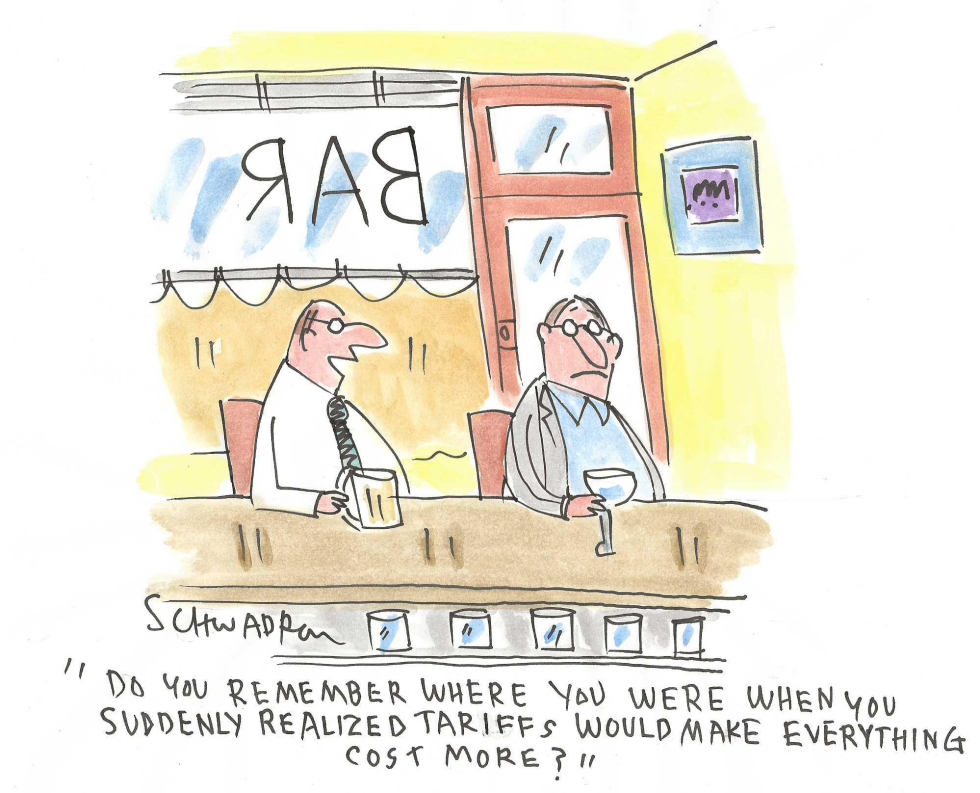
On January 14 2025 a cartoon depicts two men at a bar discussing the economic shock of import tariffs. The exchange focuses on the sudden awareness that duties on foreign goods drive up everyday costs. This reflects ongoing debates over trade policy and its effects on inflation and consumer spending.
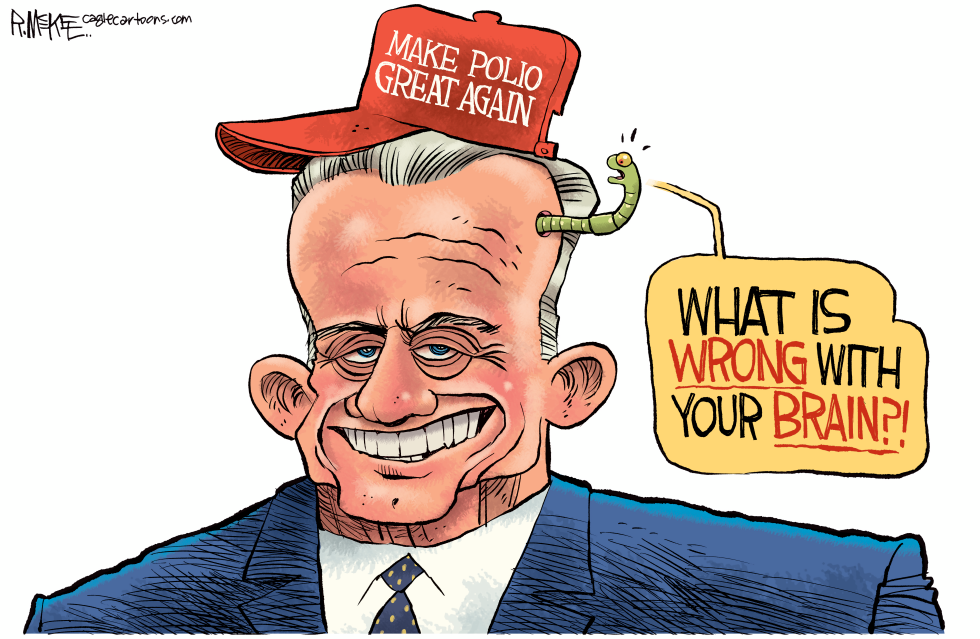
Published December 16 2024 the cartoon shows Robert F Kennedy Jr in a red cap reading Make Polio Great Again. A green worm emerges from his head as a speech bubble asks what is wrong with your brain. The image responds to President elect Donald Trump naming RFK Jr as his choice to lead the Department of Health and Human Services. RFK Jr has long promoted vaccine skepticism including past comments on polio and other diseases. The visual highlights ongoing debates over his fitness for the post amid public health concerns.