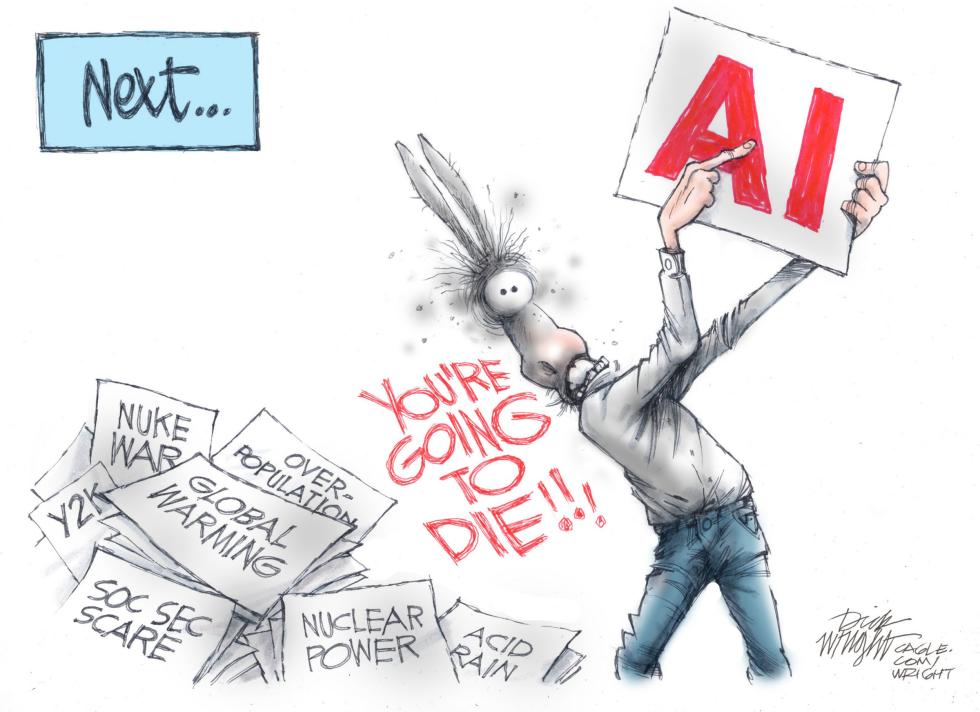
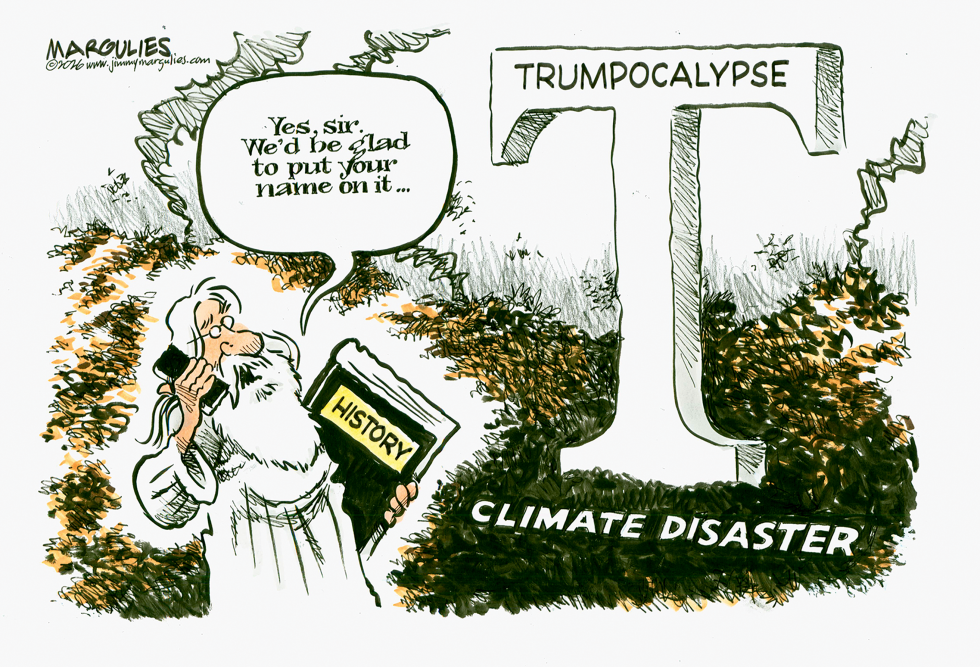
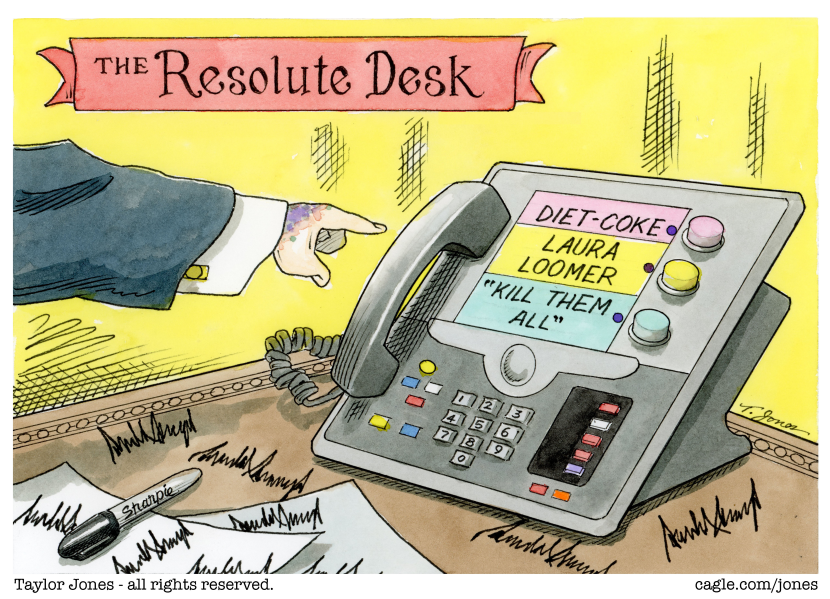
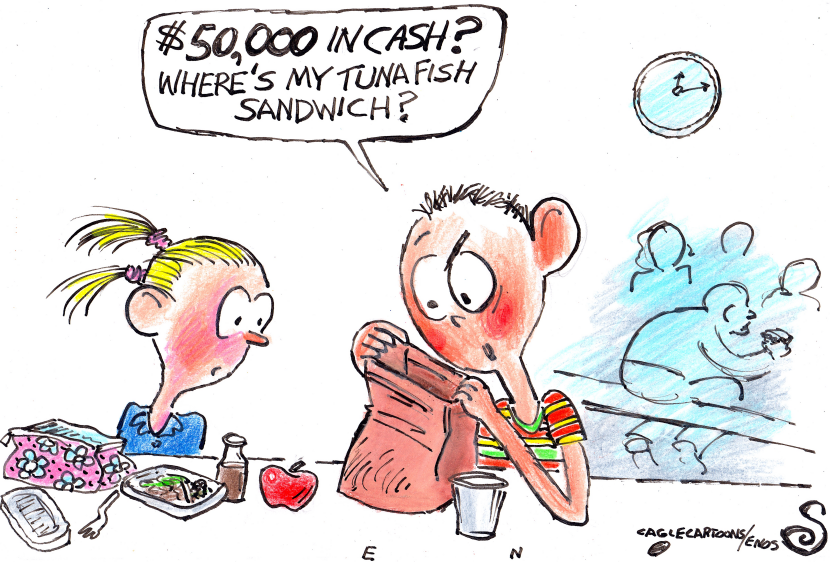
Democrats have renewed warnings that artificial intelligence poses an existential threat, echoing earlier alarms over Y2K, nuclear power, and climate change that later lost urgency. The pattern suggests political use of successive crises to maintain attention. The cartoon argues these claims recycle familiar tactics without new substance.
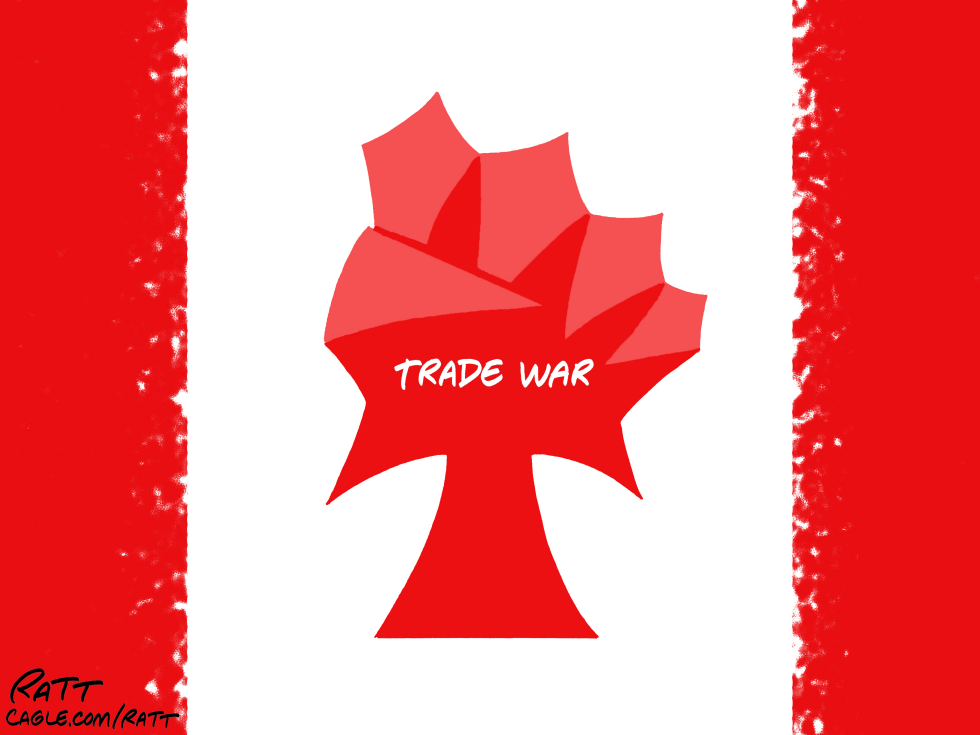
Ongoing US-Canada trade tensions escalated in 2026 with new tariff threats targeting Canadian exports. The dispute threatens key sectors including autos, lumber and agriculture, raising costs for consumers on both sides of the border. Canada has signaled plans to diversify markets and strengthen domestic industry. The cartoon frames the conflict as a direct assault on Canadian sovereignty and economic stability. It portrays the trade war as fracturing national symbols while urging a stronger northern response.
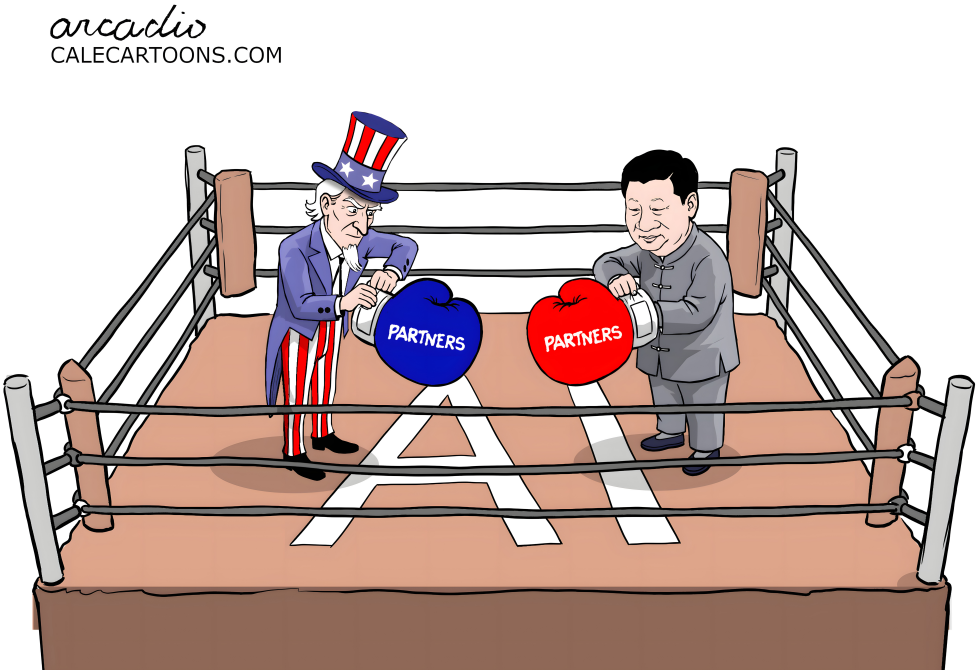
The United States and China continue their contest for leadership in artificial intelligence development. Both nations invest heavily in research and infrastructure to secure advantages in computing power and applications. The competition carries implications for economic growth, military capabilities, and global standards. Recent policy moves on export controls and domestic incentives underscore the stakes. The editorial position frames the dynamic as a direct contest where surface cooperation masks deeper rivalry.
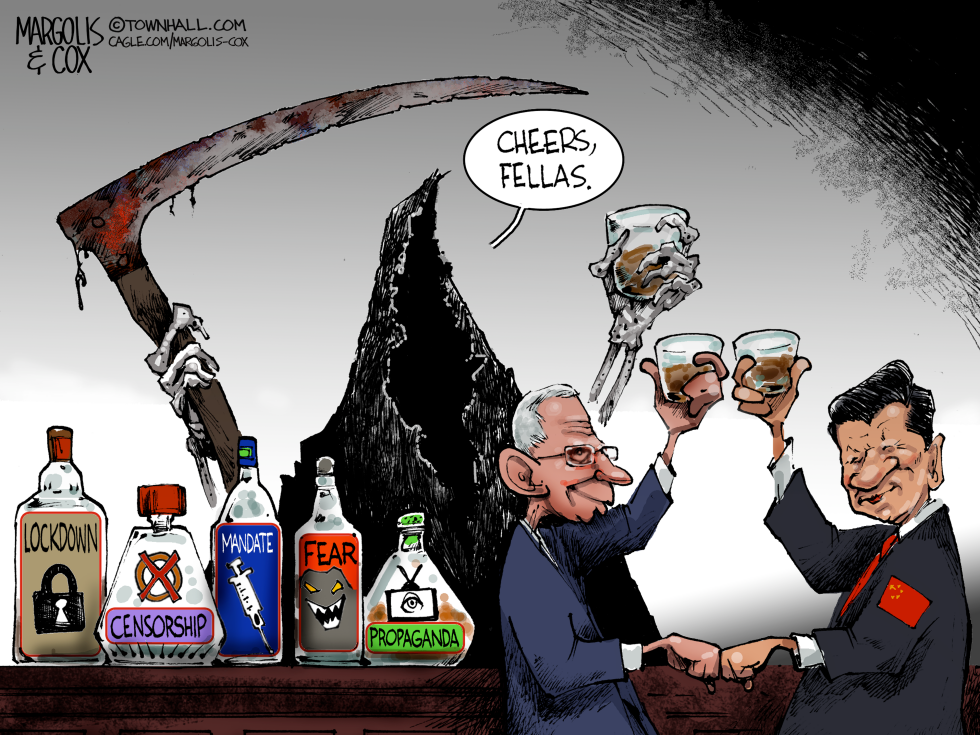
On August 6, 2026, the cartoon responds to lingering debates over COVID-19 policies by depicting former NIAID director Anthony Fauci and Chinese leader Xi Jinping toasting with the Grim Reaper. The image frames pandemic tools as shared instruments of control. The editorial position criticizes both figures for embracing fear-driven measures and information suppression.
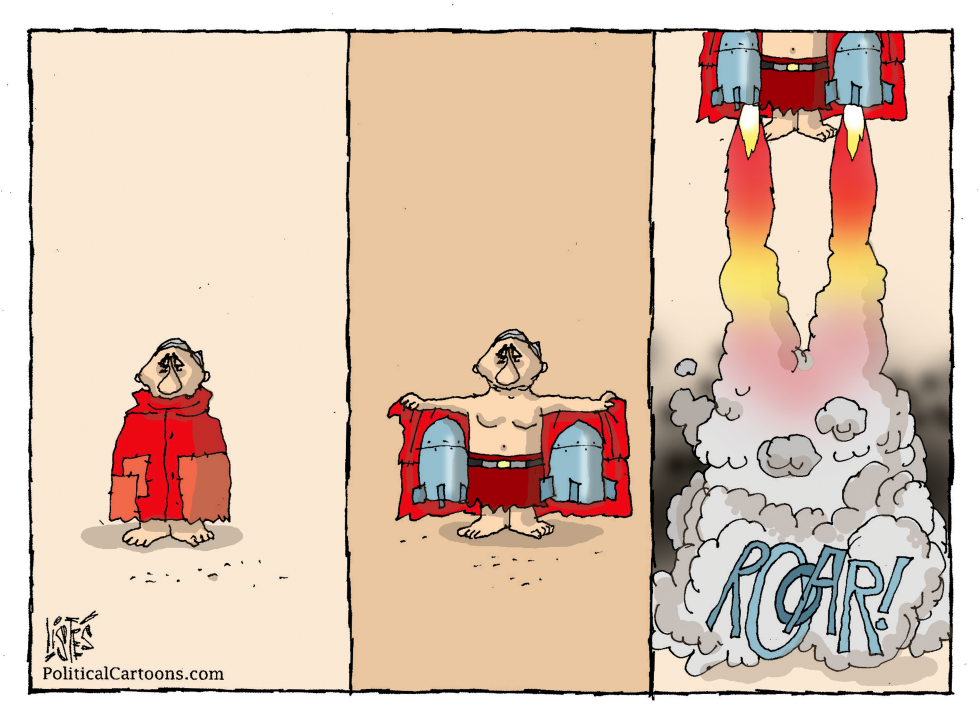
Vladimir Putin demonstrates a new personal rocket system as Russia continues military modernization efforts. The development underscores ongoing emphasis on advanced weaponry in national defense strategy. The piece portrays the move as an extension of Russia's assertive posture in global affairs.
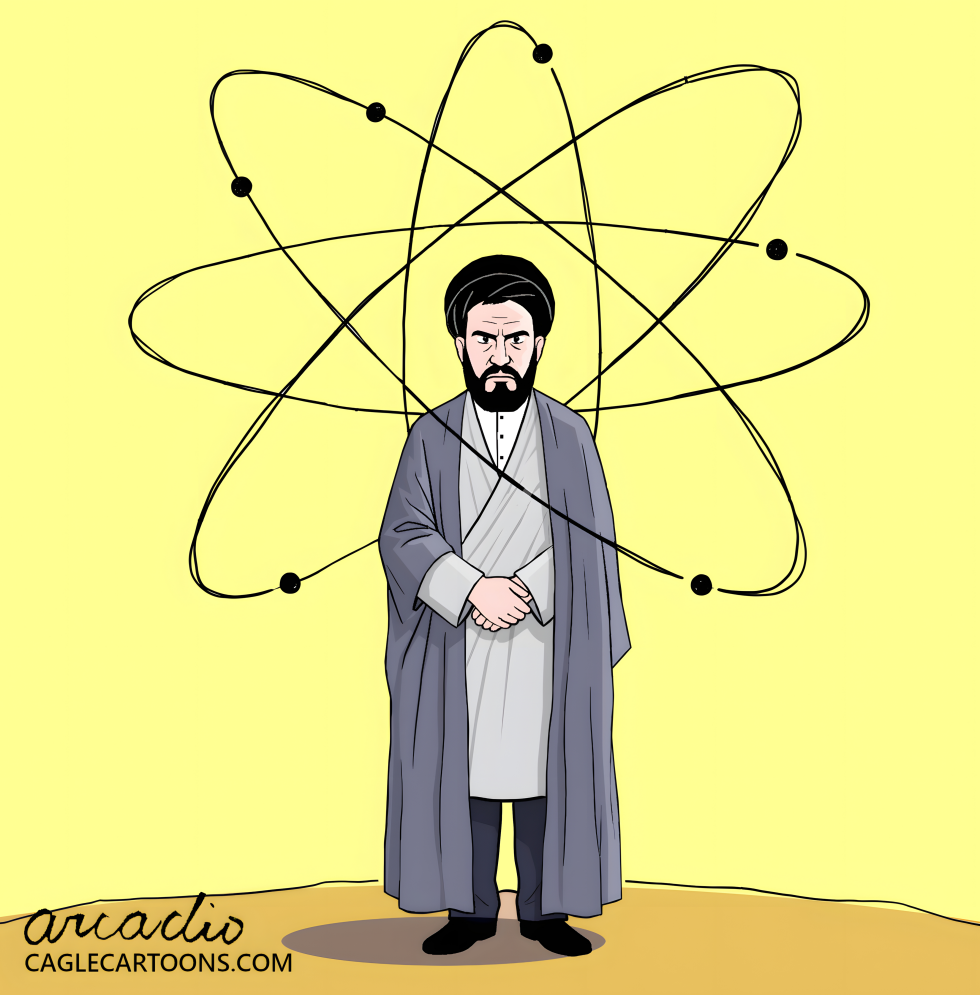
The cartoon shows Iran's supreme leader positioned in front of a large atom symbol. It responds to persistent international concerns over Tehran's nuclear activities as of mid-2026. The visual places the figure directly under the orbiting electrons, underscoring the central role of the nuclear issue in global discussions about the country.
Arend van Dam's cartoon shows a gray battleship marked USA, complete with guns and missiles, driven by a figure in a suit at the wheel, as it goes over a waterfall between rocky cliffs under a blue sky. The image captures the essence of strategy failure in the Strait of Hormuz, tying into themes of Iran, ayatollahs, war, battleship mishaps, Middle East conflicts, oil, gas, energy, and economy. Such visuals often poke at misguided military moves, where the ship's plunge represents a dramatic downfall in strategic planning. The dry humor lies in the absurdity of a warship treating a strait like a river rapid, underscoring potential economic fallout from regional tensions. Cartoons like this thrive on clear, exaggerated metaphors that resonate with readers familiar with global news.
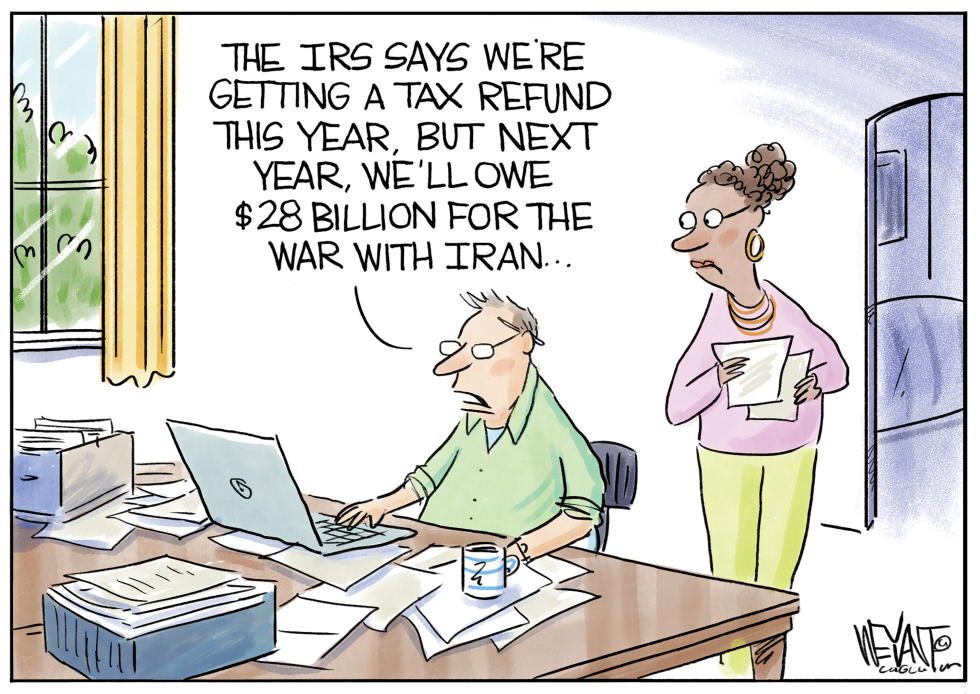
Dive into this biting political cartoon tax refund piece where a woman, holding papers, informs a laptop-working man about their IRS windfall this year, only to drop the bomb of owing $28 billion next for the war with Iran. The satirical cartoon Iran war vibe captures the absurdity of US taxes funding wars, with cluttered desks and exasperated expressions underscoring the humorous take on federal spending. It's a classic taxpayer burden Iran conflict jab, poking fun at government spending satire while illustrating the disconnect between personal finances and massive military expenses. Through cartoon about military expenses, it cleverly critiques fiscal policy in an office setting, making the war with Iran taxpayer joke both relatable and irreverently insightful for viewers pondering editorial cartoon fiscal policy.
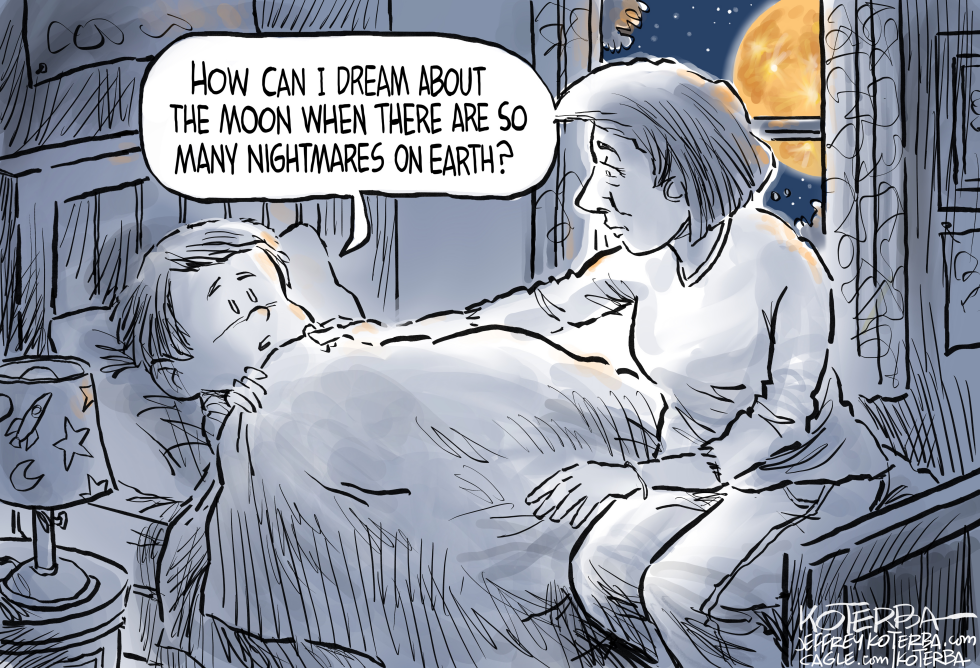
This poignant political cartoon depicts a child in bed, gazing toward a window framing a massive orange moon against a starry night sky, while confiding in a seated adult figure. The child's speech bubble reads: 'How Can I Dream About The Moon When There Are So Many Nightmares On Earth?' A bedside lamp with a star design illuminates the scene. Through this setup, the artwork satirizes how youth anxiety from global issues—like wars, climate woes, and social upheavals—stifles big dreams and aspirations. It's a clever commentary on how earthly nightmares eclipse celestial hopes, blending humor with insight into modern parenthood and childhood innocence lost. Tags: political cartoon, child nightmares, moon dreams, earth troubles, satirical illustration, youth anxiety, global chaos.
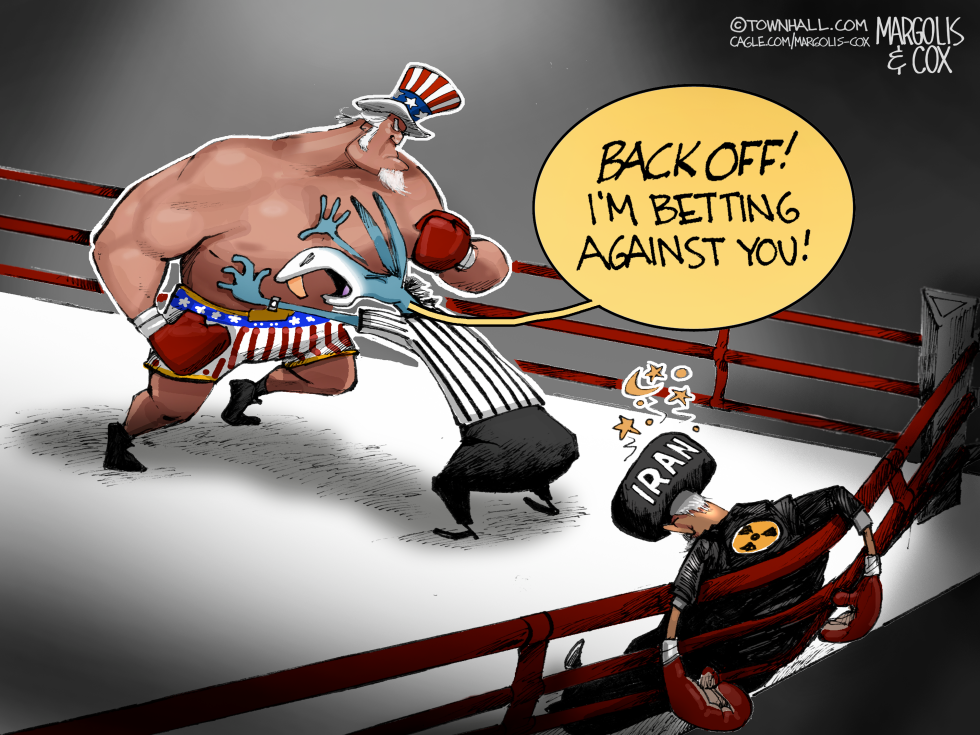
The cartoon depicts a boxing ring where Uncle Sam, wearing a top hat and patriotic shorts, advances aggressively, punching a referee in striped shirt who clutches a white dove. The referee's arm extends to halt the fight, but Uncle Sam shouts 'BACK OFF! I'M BETTING AGAINST YOU!' Meanwhile, the opponent, labeled 'Iran' with a nuclear symbol on his back, sprawls knocked out on the canvas. Stars indicate the impact. This setup uses boxing metaphor to satirize US foreign policy toward Iran, portraying America as betting against peace interventions, possibly represented by the dove-bearing referee. The artwork by Margolis & Cox captures tensions with dry humor, emphasizing unchecked aggression in international relations.
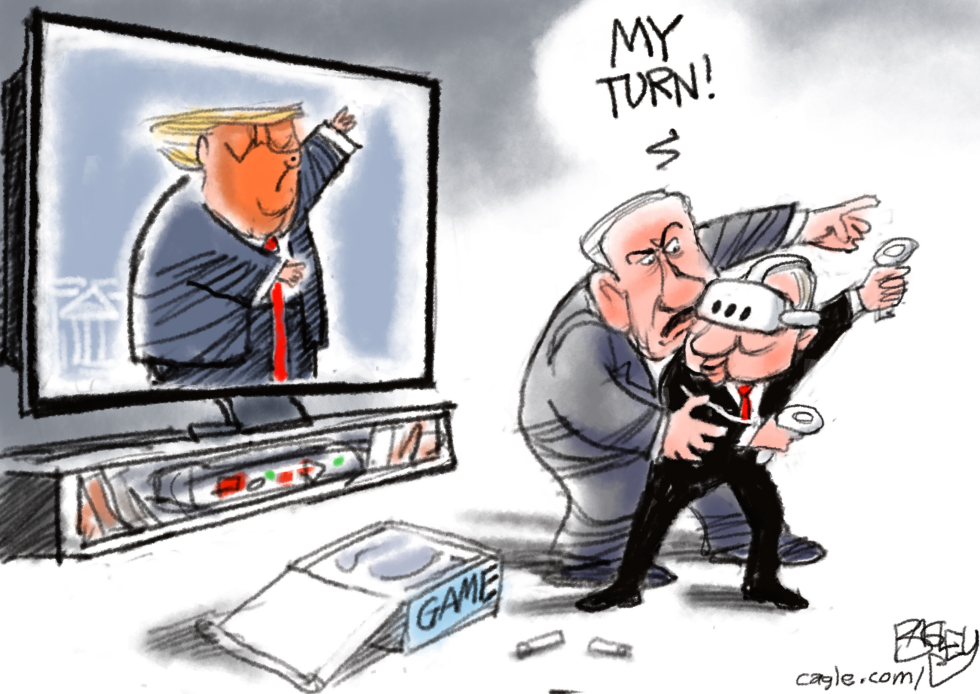
Pat Bagley's cartoon captures Vladimir Putin in a suit, firmly holding a smaller Benjamin Netanyahu who wears a VR headset and wields controllers, exclaiming 'My Turn!!' with frustration. Donald Trump dominates the TV screen, arm raised dramatically against a White House-like backdrop. The floor features a tipped 'GAME' box, underscoring the video game metaphor. This setup highlights themes of manipulation and turn-taking among leaders, delivered with sharp lines and exaggerated features typical of political satire. The dry humor lies in reducing global tensions to childish squabbles over a game, a classic cartoon trope that packs punch without overstatement.
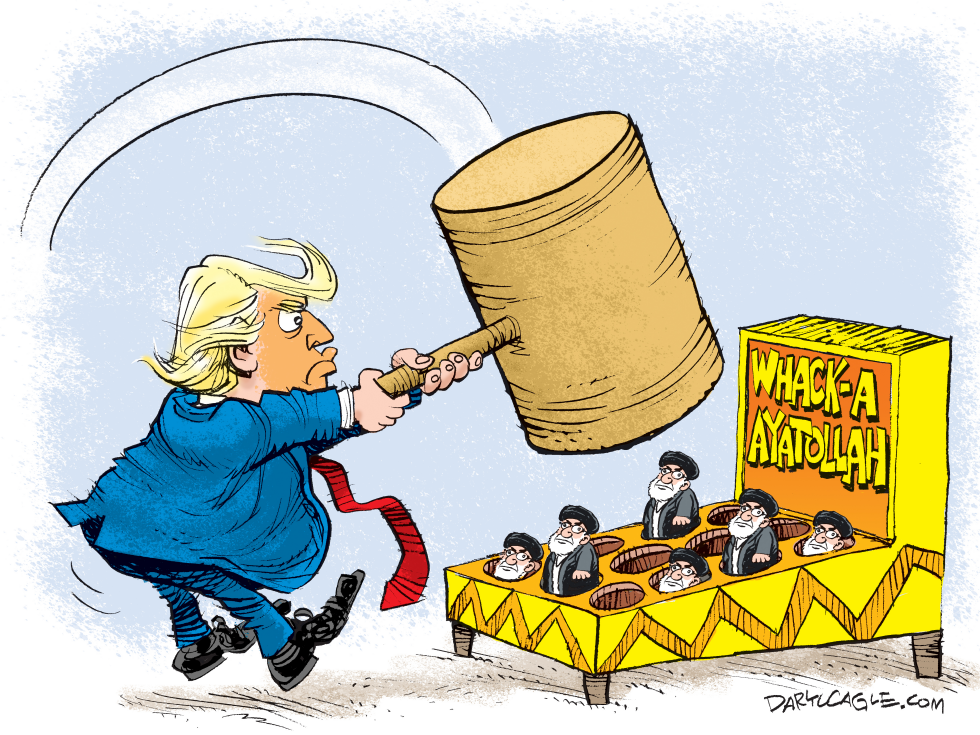
The cartoon shows Donald Trump in a blue suit swinging a massive wooden mallet at figures resembling Iranian Ayatollahs emerging from holes in a yellow arcade machine labeled Whack-A Ayatollah. The president appears mid-swing with motion lines indicating effort. The image comments on US policy toward Iran by framing the conflict as a repetitive carnival game where targets keep reappearing. Publication occurs during a period of heightened US-Iran tensions over nuclear issues and regional influence. The visual metaphor suggests difficulty in permanently resolving the challenge despite repeated attempts.
This biting political cartoon by Daryl Cagle depicts Donald Trump in his signature suit, his red tie extending into a coil of red tape that binds a furious, bearded figure representing Iran, complete with an 'iRan' hat. The image satirizes US-Iran relations, highlighting how bureaucracy and sanctions create entanglements in foreign policy. Trump's calm demeanor contrasts with Iran's angry struggle, underscoring the Trump administration's approach to Middle East diplomacy. Through clever visual metaphor, it comments on the nuclear deal fallout and ongoing tensions, making it a sharp piece of political humor that's both insightful and irreverent.
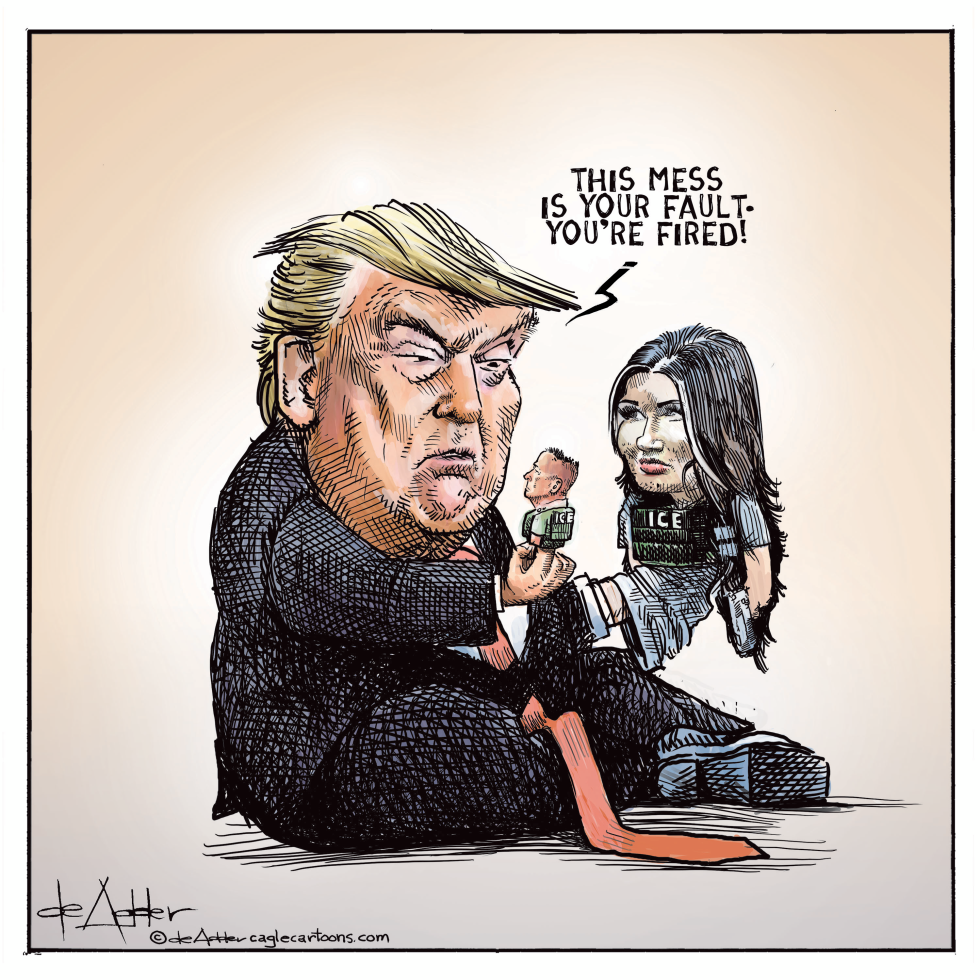
This biting political cartoon by Michael de Adder captures Donald Trump in a childish tantrum, holding and firing a diminutive Kirstjen Nielsen as an ICE agent clutching a separated baby, symbolizing the border crisis and family separation policies. The image skewers the Trump administration's immigration policy failures, with Trump shifting blame for the humanitarian mess at the US border. Through exaggerated caricature, it highlights themes of accountability, political satire, and the human cost of harsh enforcement, making it a viral-worthy jab at leadership in US politics.