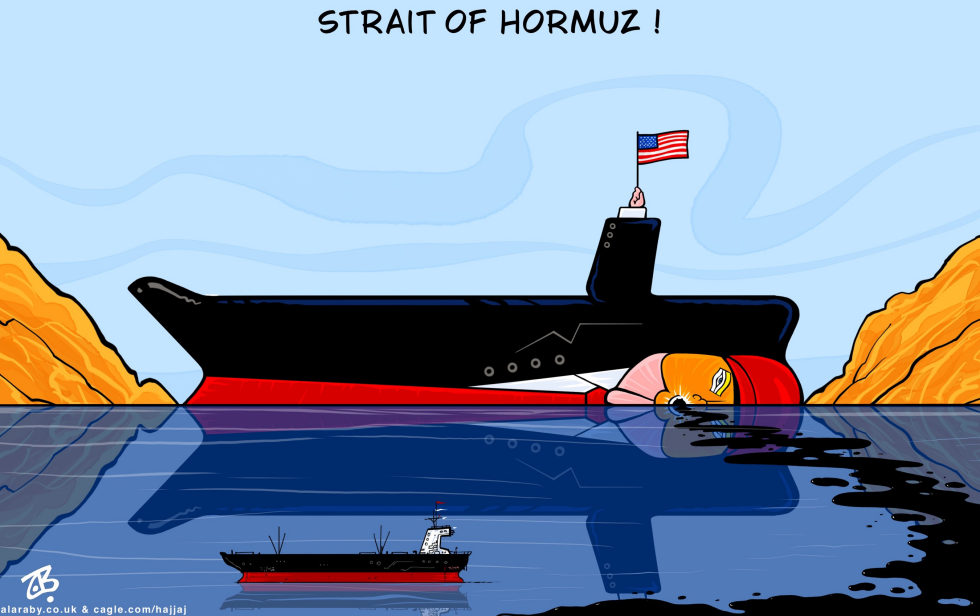
Emad Hajjaj's cartoon depicts a large black submarine with a red hull, stuck between orange landmasses in the Strait of Hormuz, its bow featuring an orange face with yellow hair and a red tie, clearly caricaturing Donald Trump. An American flag flies atop the vessel, while black oil spills into the blue water, reflecting the ship. Below, a smaller black tanker with a white figure onboard sails through the oily sea, tagged with Persian, Gulf, Sea, Tanker, Oil, War. The image satirizes US involvement in Middle East conflicts, particularly Iran war scenarios, without overreaching into hidden meanings. The composition is straightforward, with clear lines and bold colors emphasizing the blockage.
Arend van Dam's cartoon shows a gray battleship marked USA, complete with guns and missiles, driven by a figure in a suit at the wheel, as it goes over a waterfall between rocky cliffs under a blue sky. The image captures the essence of strategy failure in the Strait of Hormuz, tying into themes of Iran, ayatollahs, war, battleship mishaps, Middle East conflicts, oil, gas, energy, and economy. Such visuals often poke at misguided military moves, where the ship's plunge represents a dramatic downfall in strategic planning. The dry humor lies in the absurdity of a warship treating a strait like a river rapid, underscoring potential economic fallout from regional tensions. Cartoons like this thrive on clear, exaggerated metaphors that resonate with readers familiar with global news.
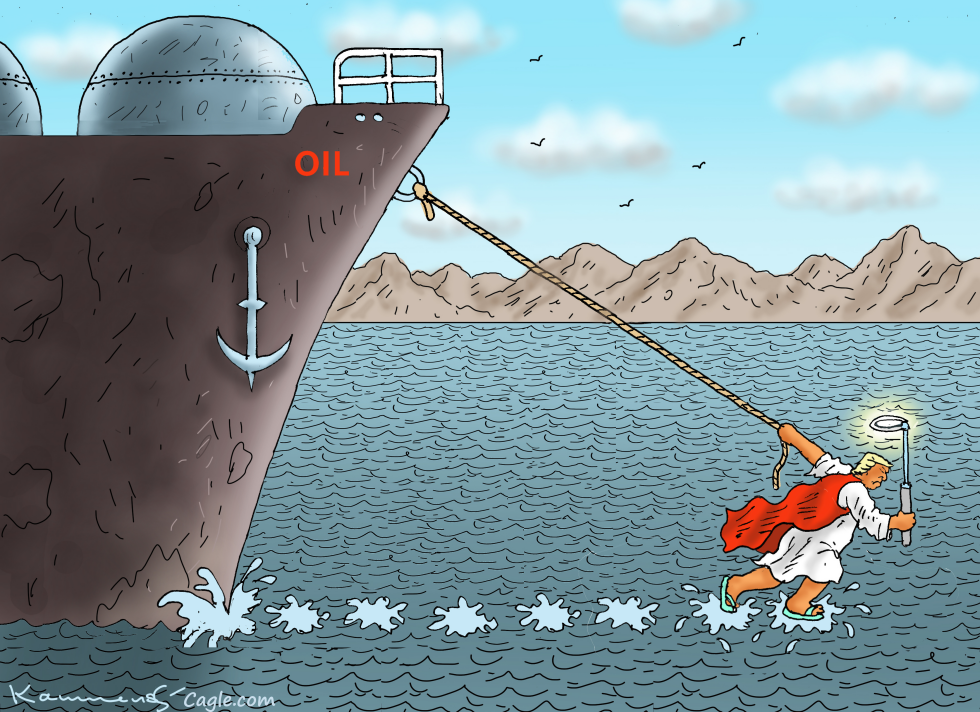
The image depicts a figure dressed in a white robe and red cape, complete with a glowing halo, running across the water while pulling a large oil tanker marked 'OIL' with a rope. He holds a golf club in one hand, splashing water with each step against a backdrop of mountains and a clear sky. This setup draws on tags like Trump, Hormuz, Iran, oil war, MAGA terror, and fascism to satirize political figures intervening in global oil crises. The cartoon's composition emphasizes the absurdity of a divine savior tackling economic and geopolitical issues, with birds flying overhead and distant peaks suggesting a Middle Eastern strait. Kamensky's style brings dry humor to the forefront, poking at notions of messianic leadership in turbulent times.
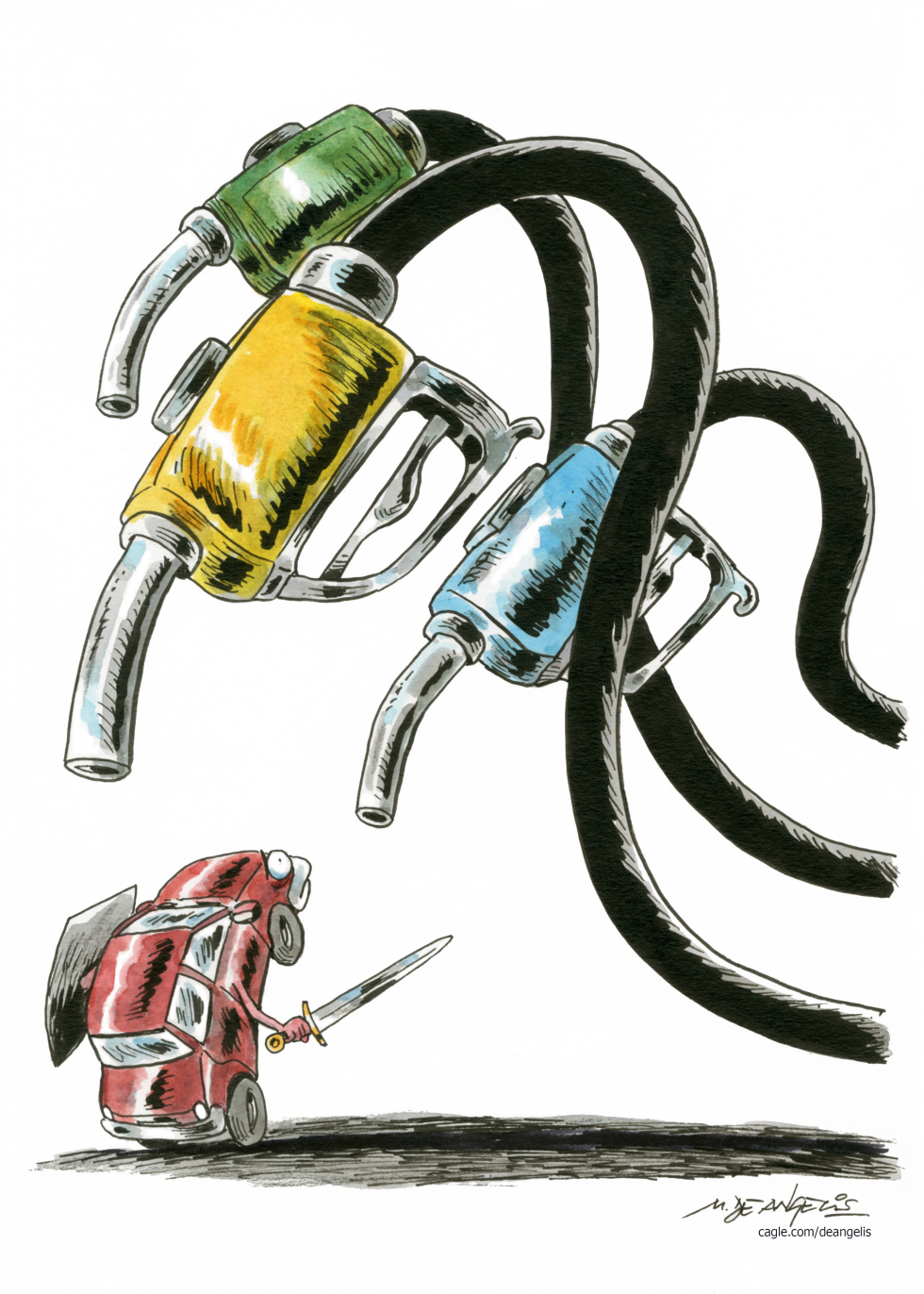
Marco De Angelis draws a clever twist on the ancient HYDRA myth, where a plucky red CAR, sword in hand, squares off against a beastly creature formed by three FUEL pump nozzles—green, yellow, and blue—attached to writhing black hoses. The scene plays on the endless battles drivers face with soaring OIL PRICES and FUEL costs, tying into broader ECONOMY woes. Tags like TRANSPORTATION, TRADE, WAR, CRISIS, IRAN, USA, and HORMUZ hint at real-world tensions in the Strait of Hormuz, where geopolitical strife disrupts global OIL supplies. It's a sharp commentary on how these issues regenerate like hydra heads, making every victory temporary in the fight against economic pressures.
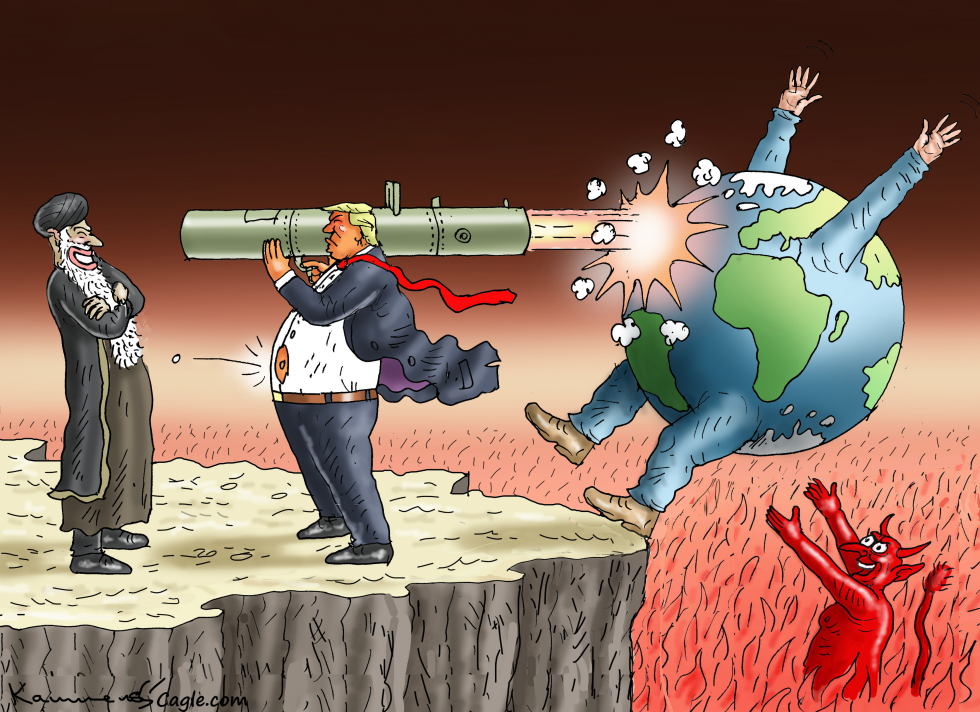
Marian Kamensky's cartoon shows a bearded figure in robes watching as a Trump caricature, with his signature hair and red tie, fires a massive rocket launcher. The blast hits a blue Earth globe with arms and legs, kicking it off a rocky cliff into a red, fiery abyss where a grinning devil waits with raised arms. The dark background emphasizes the dramatic fall. Incorporating tags such as Iran War, Trump, Hormuz, Fascism, Oil War, and MAGA Terror, the image captures a stark visual metaphor for escalating tensions and potential global catastrophe in a straightforward satirical style.
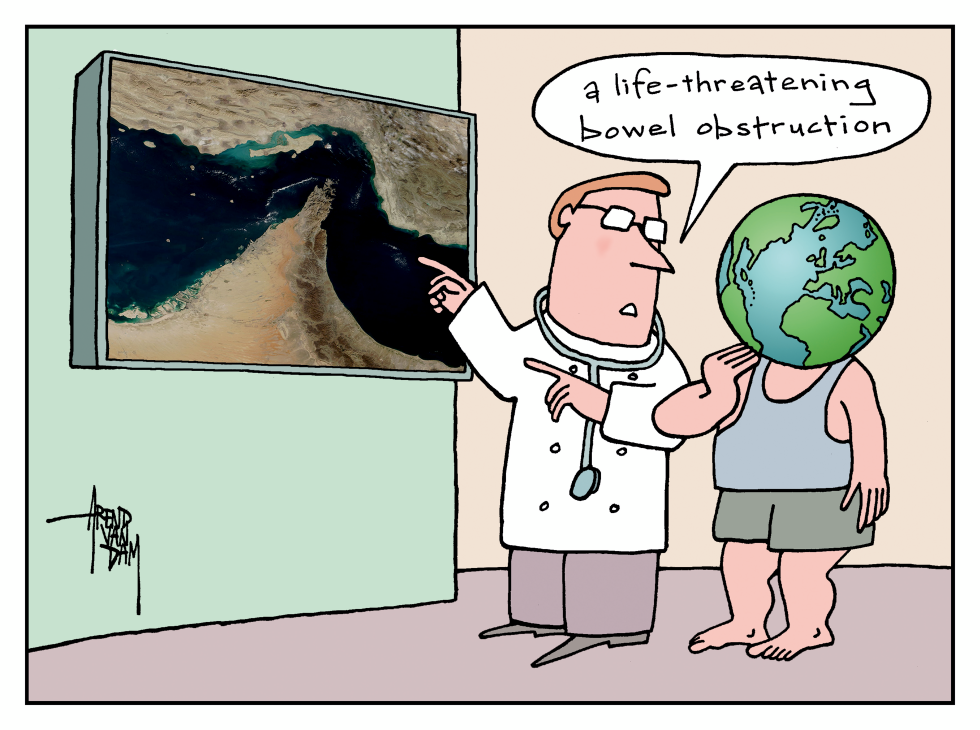
Arend van Dam\'s cartoon depicts a doctor diagnosing a child-like figure with a globe for a head, pointing to a screen showing the Strait of Hormuz as a life-threatening bowel obstruction. This visual metaphor ties into tags such as economy, world, oil, gas, obstruction, and war, illustrating how blockages in key trade routes threaten global stability. The barefoot patient in casual attire underscores vulnerability, while the doctor\'s serious demeanor adds dry humor to the geopolitical satire. Negotiations with ayatollahs and regime sanctions loom in the background, making the image a pointed commentary on how such conflicts create economic chokepoints. The overall composition blends medical analogy with international affairs for sharable impact.
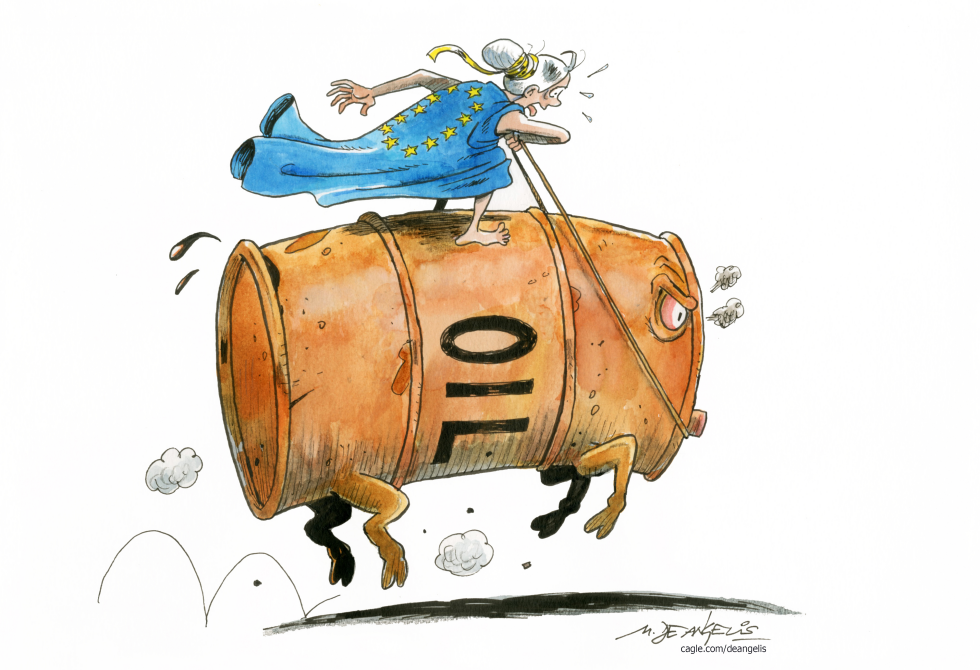
Marco De Angelis draws a sharp symbolic scene where a figure draped in the European Union flag clings to a bucking oil barrel marked OIL, legs kicking like a furious bull, smoke puffing from its nostrils. The rodeo metaphor nails the wild ride of economy and prices amid war in places like Hormuz. Europe looks desperate, one hand waving, mouth open in shock, as the oil tank rears up. It\'s a straightforward jab at how USA policies and global tensions turn energy into a beast no one can tame. Tags like symbolic, European, oil, tank, war, and economy drive the point home without fluff.
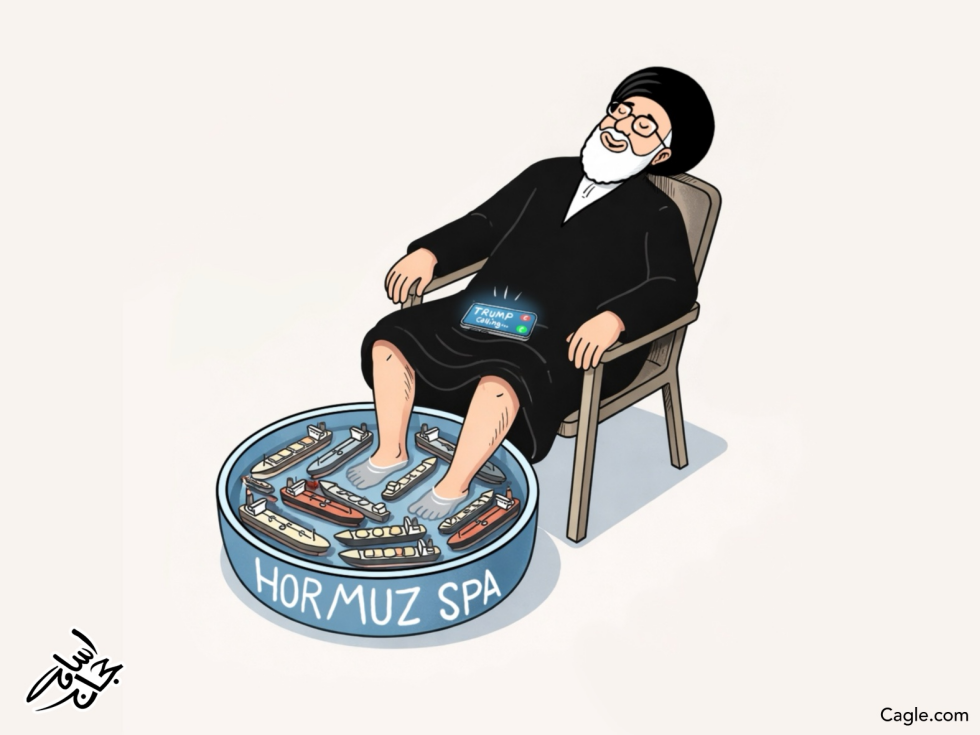
Osama Hajjaj draws an Iranian leader, resembling a cleric in black robes and turban, slouched in a chair with feet immersed in a blue basin labeled Hormuz Spa. Tiny ships float around his feet, evoking the Strait of Hormuz. A phone on his lap displays Trump with a green light, implying a call or alert. The scene captures dry satire on Iran-Trump relations, with the spa pun highlighting control over vital shipping lanes. Tags like Hormuz, Iran, Donald Trump, spa, and political cartoon underscore the humor in geopolitical friction.
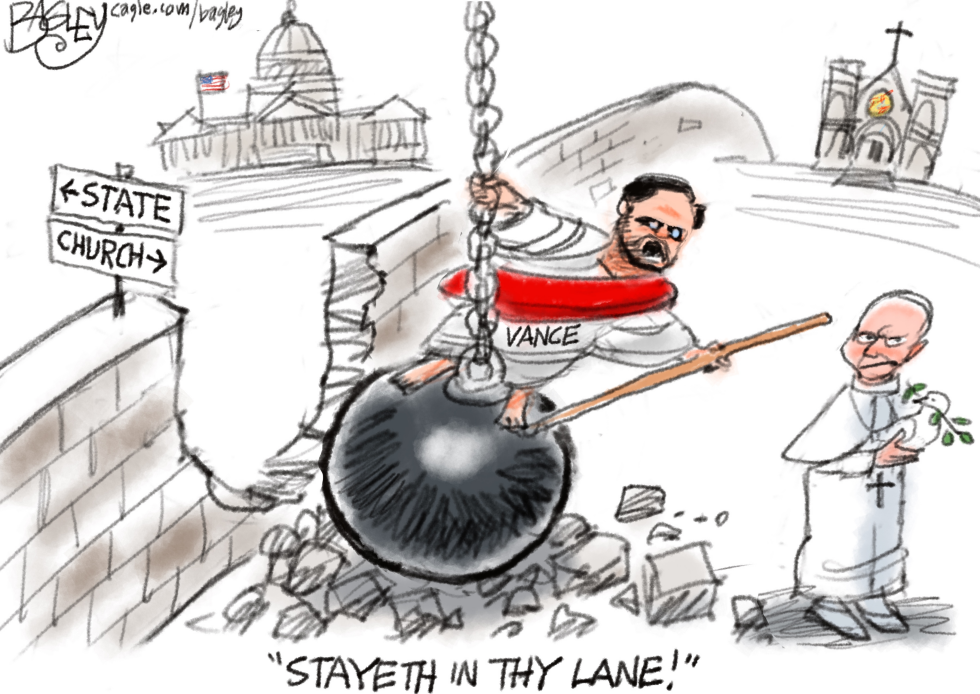
Pat Bagley's cartoon shows JD Vance dressed as Jesus, labeled 'VANCE,' swinging a massive wrecking ball to shatter a brick wall marked with signs pointing to 'STATE' and 'CHURCH.' He shouts 'STAYETH IN THY LANE!' at a figure resembling the Pope, who holds an olive branch and dove, symbols of peace. In the background, the U.S. Capitol flies an American flag, while a church with a cross represents the Vatican. Tags like war, peace, JD Vance, religion, Trump, and scripture underscore the satire on blurring lines between church and state, with Vance enforcing boundaries ironically through destruction. The image critiques political figures invoking religion amid Capitol politics.
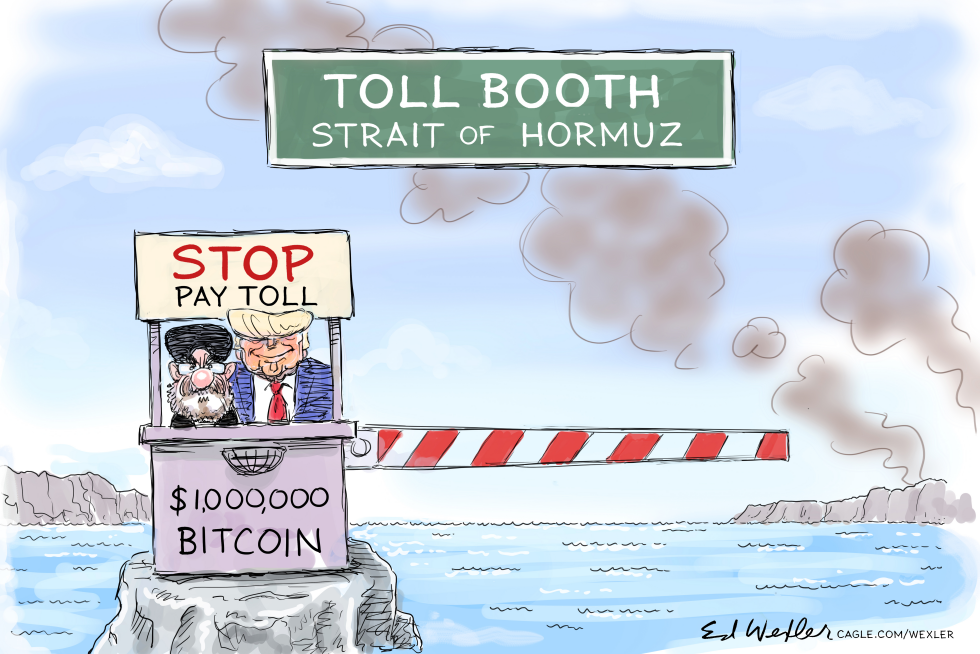
Ed Wexler\\\'s cartoon captures a toll booth in the Strait of Hormuz, where figures resembling Trump and the Ayatollah enforce a $1,000,000 Bitcoin toll. Smoke rises from what look like mines in the water, blending tags like Iran, Strait of Hormuz, tolls, Bitcoin, Trump, Ayatollah, and crypto into a sharp commentary. The barrier arm blocks passage, emphasizing control over this vital shipping lane. It\\\'s a straightforward jab at geopolitical tensions, with the toll sign demanding payment to proceed. No hidden layers here, just clear visuals tying economic pressures to digital currency in a contested area. The dry humor shines through in the absurdity of a Bitcoin booth amid potential explosions.