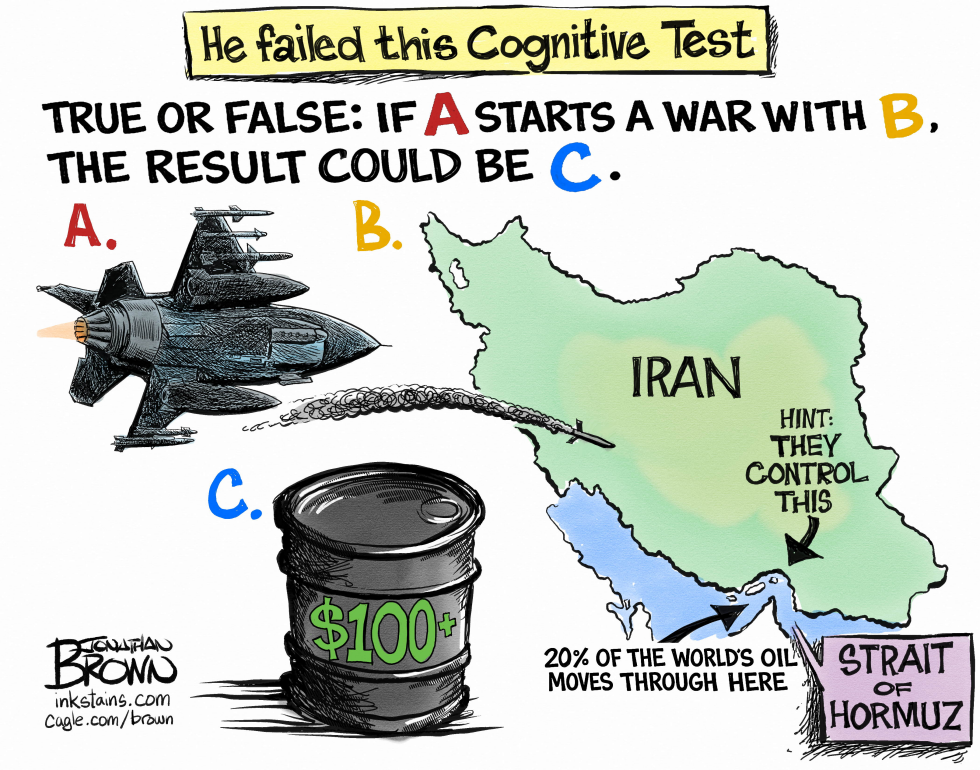
Jonathan Brown's cartoon presents a stark true-or-false cognitive test: if A (a fighter jet) starts a war with B (Iran), the result could be C (an oil barrel marked $100+). The map of Iran includes a hint pointing to the Strait of Hormuz, noting that 20% of the world's oil moves through there, underscoring control over this chokepoint. Tags such as cognitive test, war in Iran, oil prices, Strait of Hormuz, gas prices, and cost of war frame the satire. The artwork warns of economic fallout from conflict, with the jet trailing toward Iran and the oil barrel symbolizing surging costs. This piece captures geopolitical tensions in a simple, visual riddle.
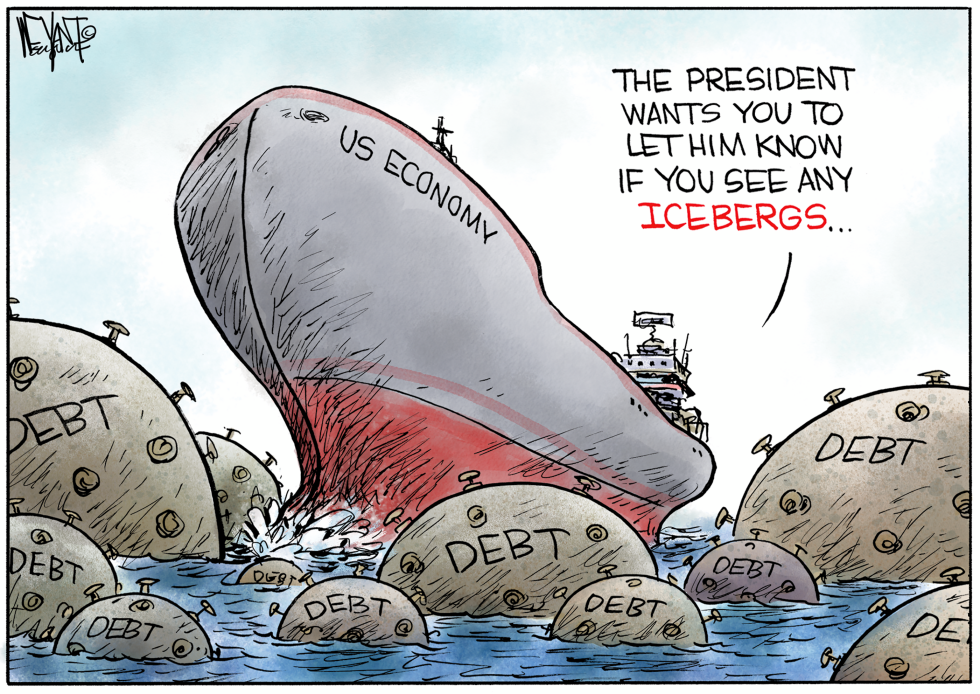
This political cartoon illustrates the US Economy as a massive ship labeled accordingly, dramatically sinking after colliding with numerous icebergs each marked 'DEBT.' A speech bubble from the ship warns to alert the president about icebergs, evoking the Titanic disaster in a clear metaphor for economic peril. Incorporating tags such as economy, debt, budget, inflation, prices, and costs, the image critiques fiscal irresponsibility. The artwork by Christopher Weyant uses simple lines and colors to emphasize the collision's impact, with water splashing and the ship's hull damaged. Such cartoons often highlight how mounting debt threatens stability, drawing parallels to historical maritime tragedies for satirical effect. The composition places the ship at an angle, surrounded by floating debt bergs, underscoring inevitable crisis if warnings go unheeded.
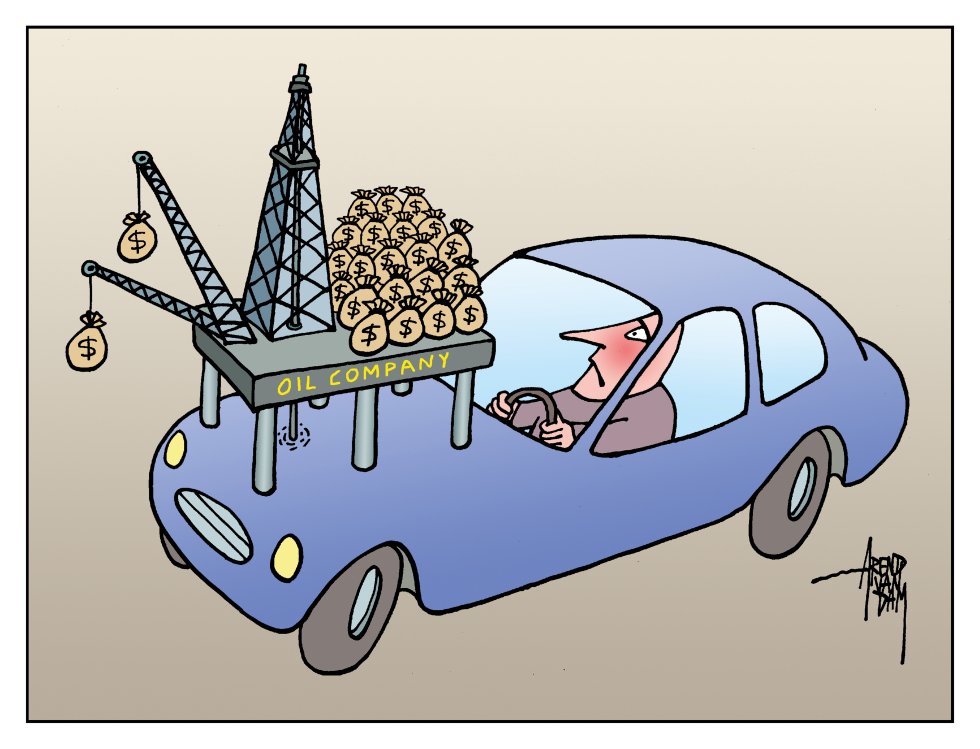
In this pointed political cartoon, an oil company platform sits atop a blue car, loaded with piles of dollar-sign money bags, while cranes dangle more profits. The frustrated motorist grips the wheel, face red with anger, illustrating how excessive profits from oil companies crush consumers at the pump. Tags like excessive profits, motorists, fuel, petrol, and refuel capture the essence, with Iran and Strait of Hormuz hinting at geopolitical tensions driving prices. This visual satire underscores the disparity between corporate windfalls and everyday drivers' pain, a timeless theme in energy politics.
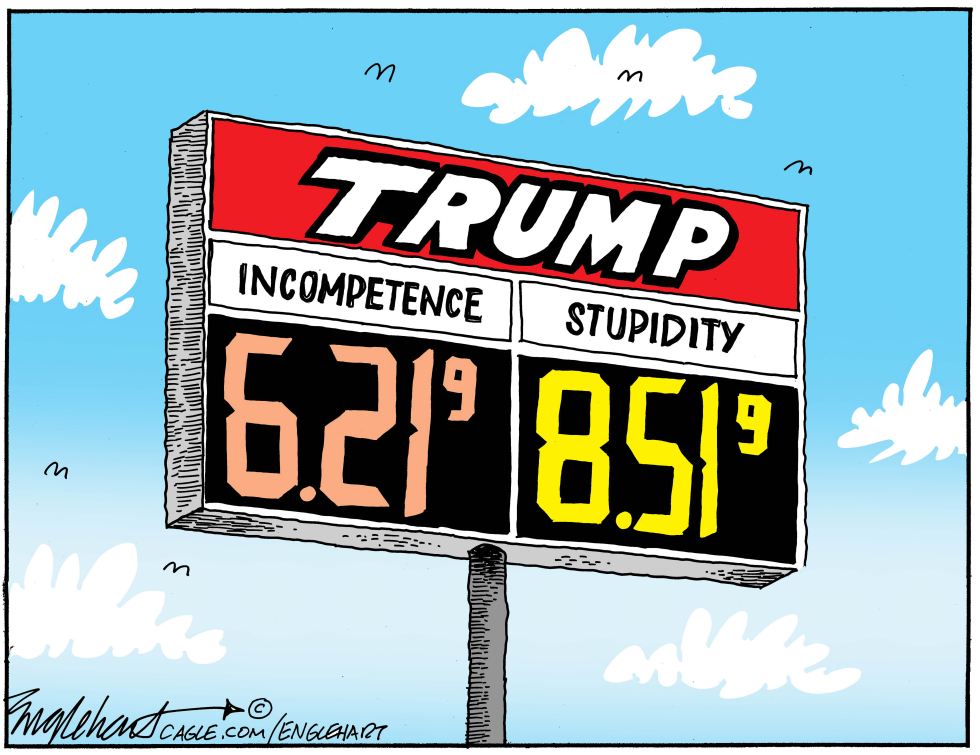
Bob Englehart's cartoon features a gas station sign with Trump at the top, showing prices for incompetence at 6.21⁹ and stupidity at 8.51⁹ against a blue sky with clouds. The tags Trump, Iran War, gas prices, gasoline, and gallon frame the visual pun. Such cartoons often tie political figures to everyday economic pains like fuel costs. The dry humor lands on how leadership flaws inflate prices, making it relatable for readers hit by pump shocks. With no characters, just the sign, it keeps the message direct. Tags like incompetence and stupidity drive the satire home, poking at perceived policy missteps without overcomplicating the scene.
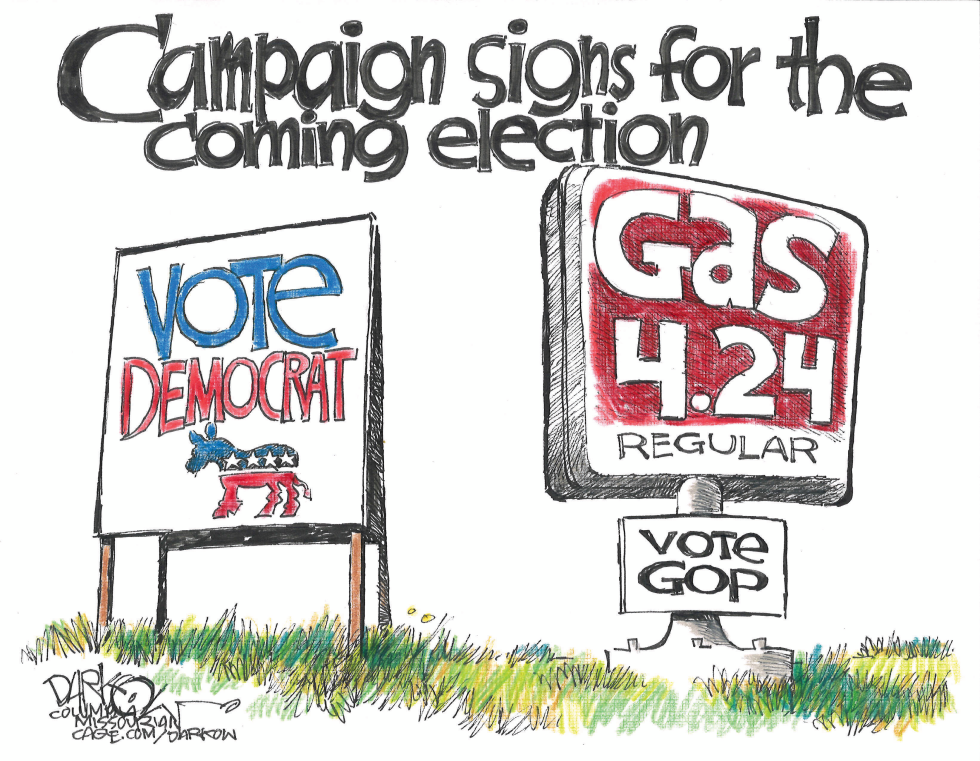
John Darkow's cartoon shows campaign signs for the coming election, with a straightforward Vote Democrat board featuring a blue donkey symbol, contrasted by a gas station-style sign advertising GAS 4.24 REGULAR and a small Vote GOP placard below. The image ties into 2026 midterms themes, highlighting gas prices, affordability, inflation, Strait of Hormuz tensions, cost of living pressures, and party strategies. The dry humor points to how economic issues like fuel costs become central in political advertising, with the GOP sign mimicking a bargain price to appeal to voters frustrated by rising expenses. This setup captures the insider view of how cartoons simplify complex voter concerns into visual punches.
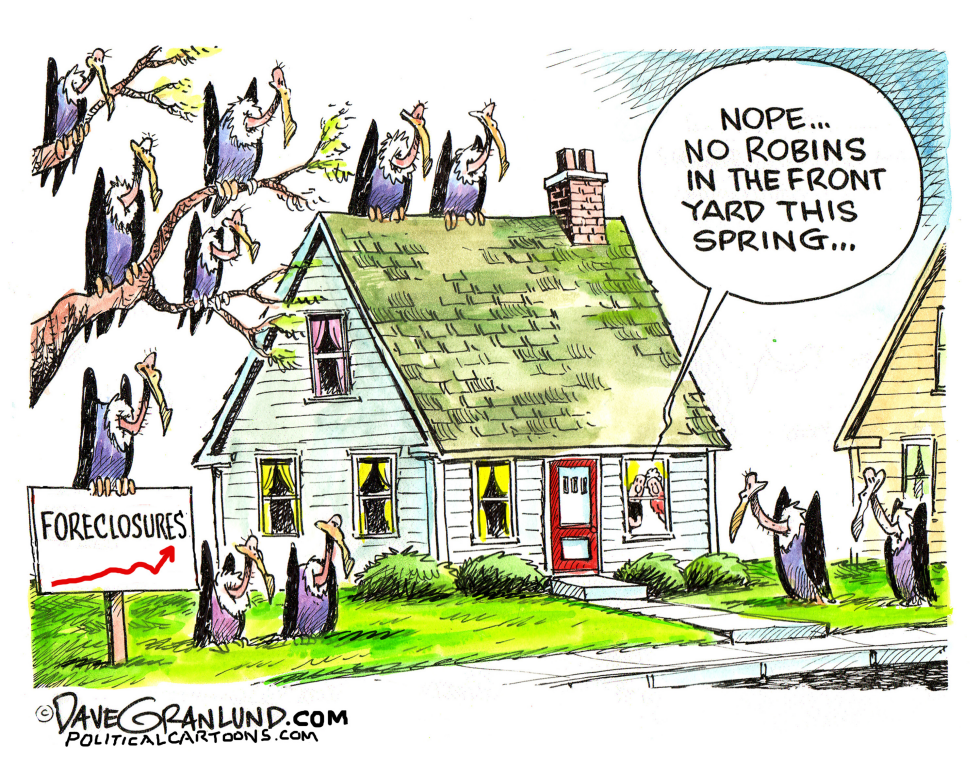
Vultures replace robins on a house marked by foreclosures in this cartoon. Tags include foreclosures, property taxes, inflation, interest rates, heating costs, fuel, maintenance and local taxes. The image shows birds holding papers near a green roof home with a red door and a sign in the yard.
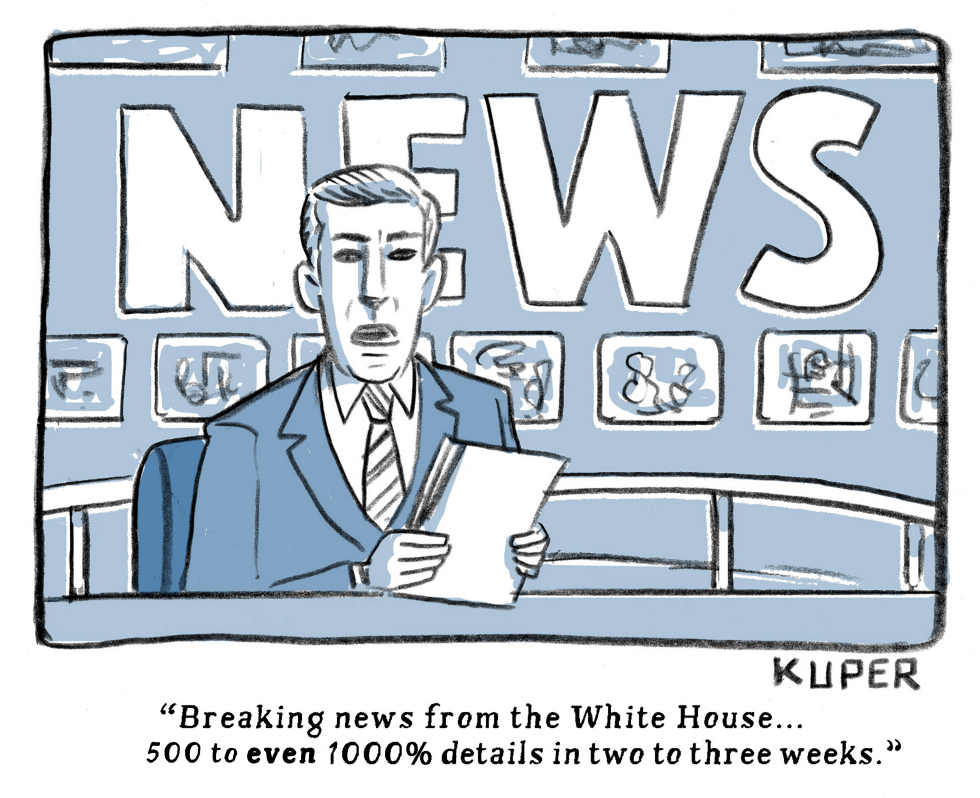
Peter Kuper\'s political cartoon depicts a stern news anchor at a desk under a large \'NEWS\' sign, holding a paper and announcing vague breaking news from the White House with promises of \'500 to even 1000% details in two to three weeks.\' The satire targets flip flopping, white house lies, and promises broken, reflecting on issues like no health care plan, food and drug prices rising, and soaring gas costs. Background elements include indistinct screens, keeping the focus on the anchor\'s absurd statement. This piece highlights distraction tactics amid war in iran continues and strait of hormuz closed, with warships and blockade adding to the billion dollars a day for military. The fbi epstein files tag suggests underlying scandals, but the image stays straightforward in its mockery of delayed truths.
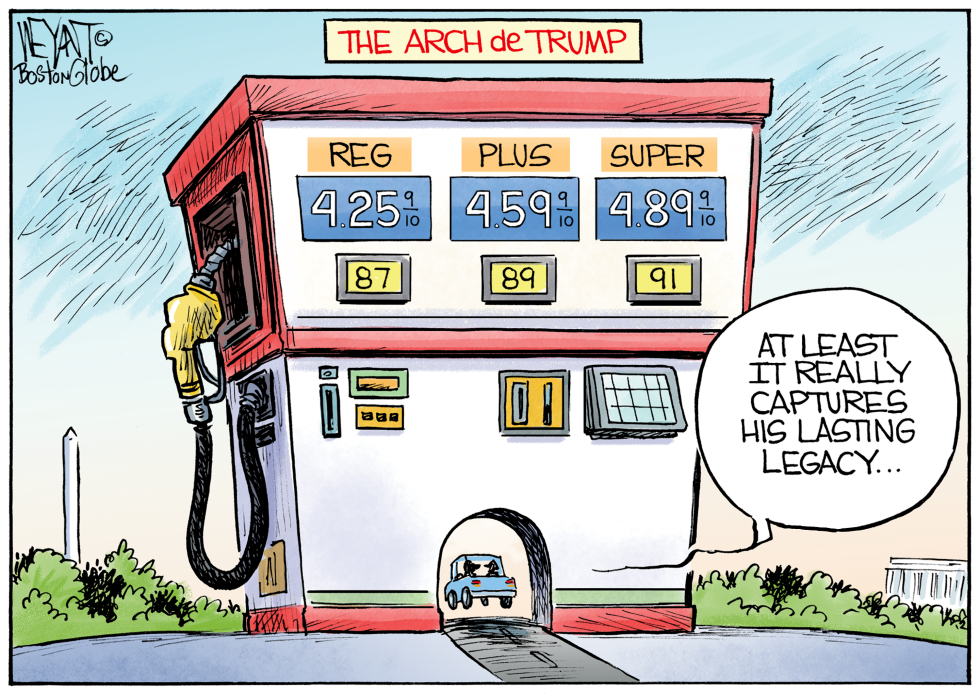
The cartoon illustrates a massive gas pump designed as an arch, prominently labeled 'The Arch de Trump,' with prices listed for regular at 4.25 per gallon, plus at 4.59, and super at 4.89, alongside octane ratings of 87, 89, and 91. A car drives through the arch, set against a backdrop of the Washington Monument and another structure resembling the Lincoln Memorial. A speech bubble comments, 'At least it really captures his lasting legacy...' This setup parodies monumental architecture, tying into themes of trump, gas prices, inflation, vanity, and Washington. The image uses dry humor to highlight economic elements without depicting any figures, focusing solely on the structure and text for its satirical punch. Tags like Middle East, Iran, and oil underscore the visible high prices, while the arch form evokes famous landmarks.
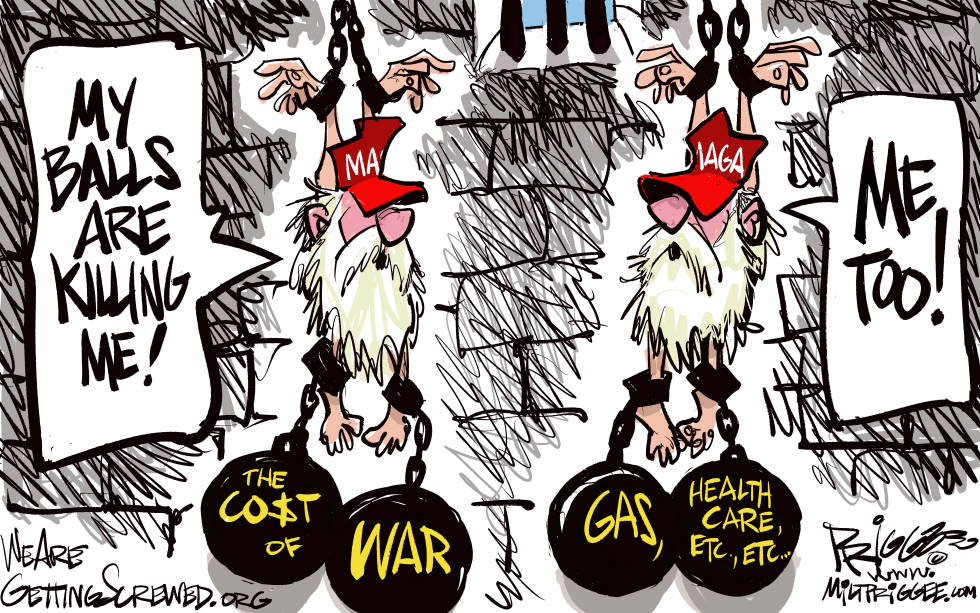
The cartoon shows two figures with white beards and red hats labeled parts of 'MAGA,' suspended upside down by chains from their ankles. Heavy black balls hang below, marked 'THE COST OF WAR,' 'GAS,' 'HEALTH CARE, ETC, ETC...' One figure speaks of balls killing him, the other agrees. Tags like MAGA, inflation, cost of living, healthcare, gas prices, Trump frame the visible elements. The drawing style is sketchy, with a dark background suggesting a dungeon. Signatures and a website appear at the bottom.