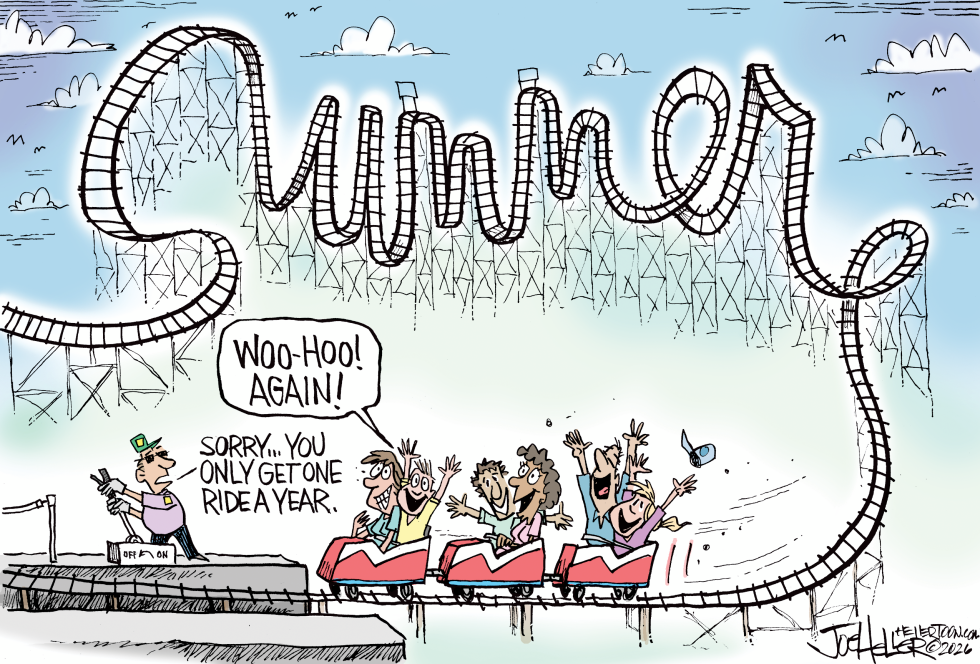
Late August brings the familiar end-of-summer realization that warm weather and leisure time feel fleeting. The cartoon depicts an amusement park enforcing a one-ride-per-year policy on a coaster shaped like the word summer. The editorial position highlights how quickly the season passes and how little time remains for enjoyment.
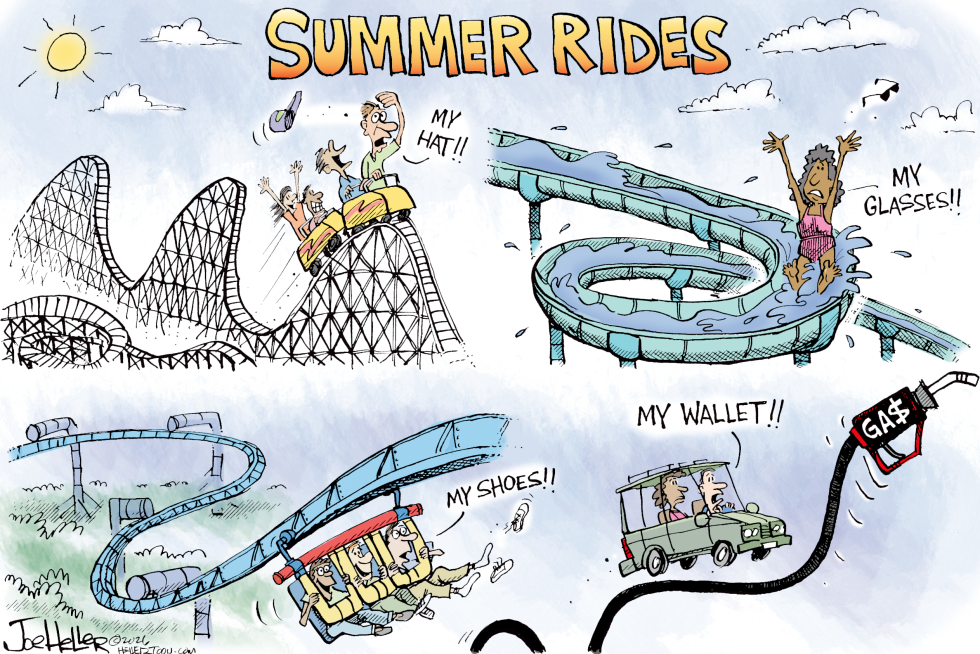
Joe Heller's cartoon depicts summer amusement park visitors losing personal items on rides while a final panel shows a wallet being consumed by a gas pump. The July 2026 image highlights the financial strain of high gas prices during peak vacation season. Riders on a roller coaster, water slide and log flume each shout about missing belongings. The visual ties everyday summer activities to broader economic pressures from energy costs.
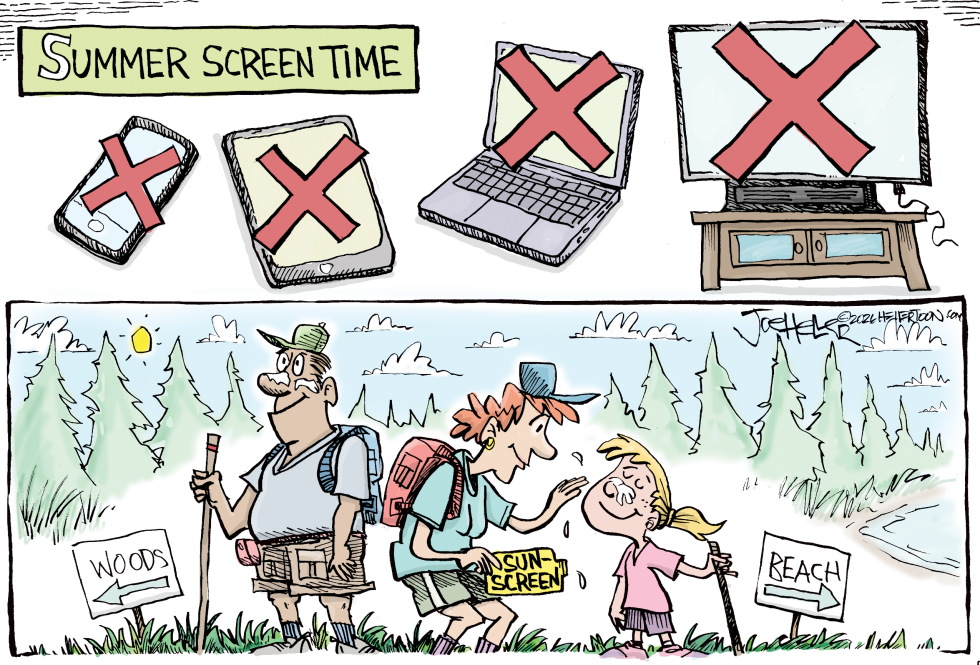
A family of three hikes along a forest trail in summer, leaving behind phones, tablets, laptops and televisions marked with red X's under a Summer Screen Time banner. The father carries a walking stick and backpack while the mother applies sunscreen to their daughter, who holds a stick near a Reach sign. A Woods sign points the way forward on the path.
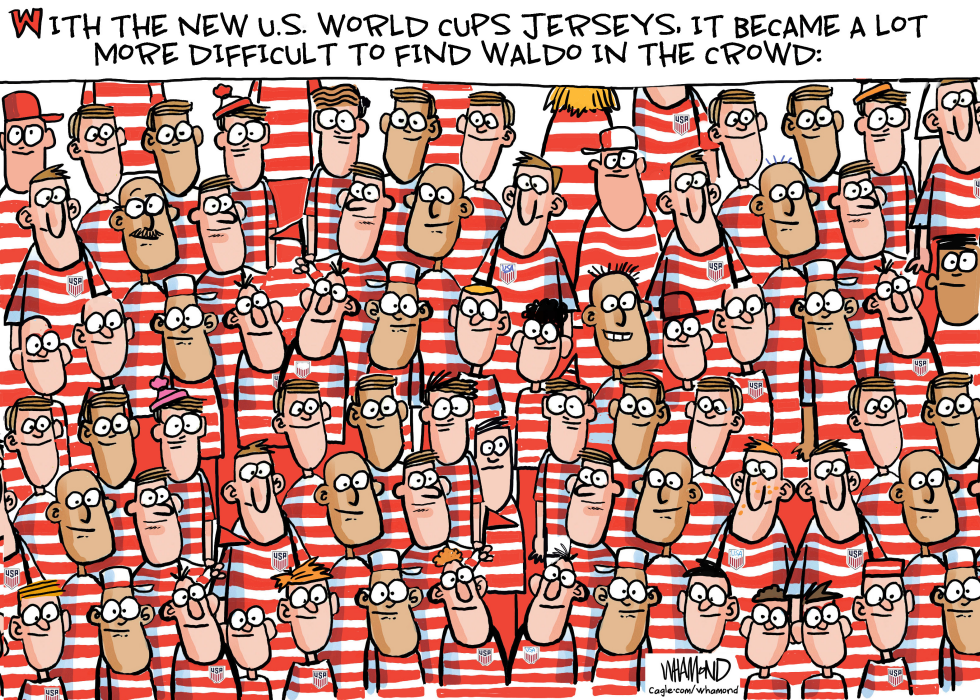
The cartoon shows a dense crowd of spectators wearing the new red and white striped U.S. World Cup jerseys. The top text notes that the uniforms make it much harder to locate Waldo among the fans. The image references the 2026 tournament hosted by the United States, Canada and Mexico. The visual plays on the classic Where's Waldo search books by filling the scene with similar striped shirts. The artist's signature appears in the lower right.
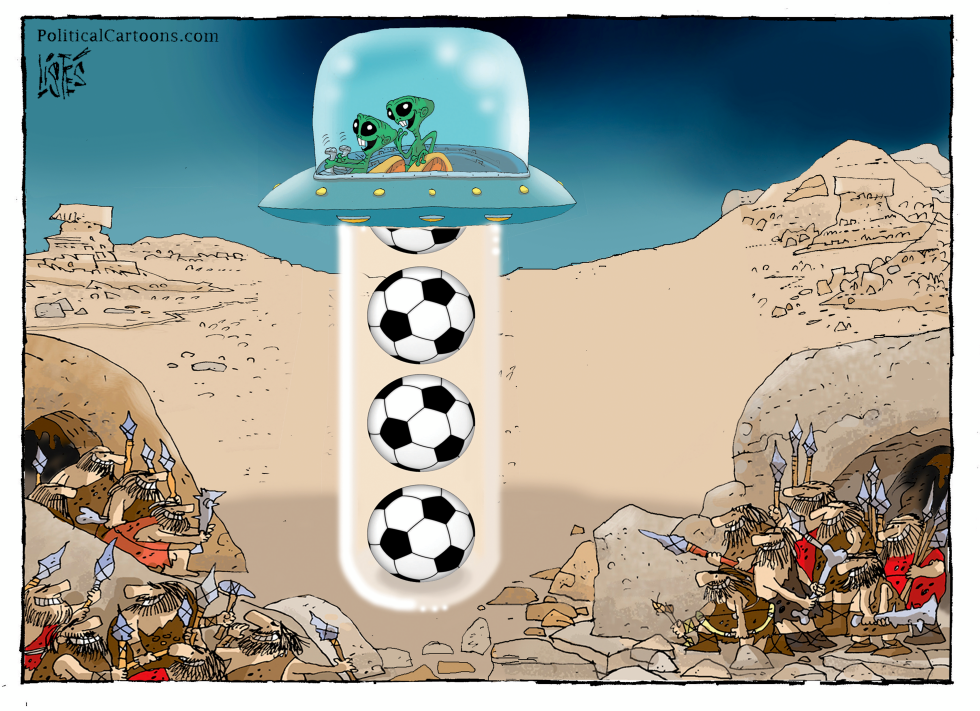
The cartoon depicts a UFO hovering over a desert landscape dotted with ruins. Two green aliens inside release a trail of soccer balls toward a group of cavemen armed with spears and clubs. The cavemen react with surprise and aggression as the balls descend. The scene plays on the idea of soccer's mysterious origins ahead of the 2026 World Cup hosted by the United States, Mexico, and Canada.
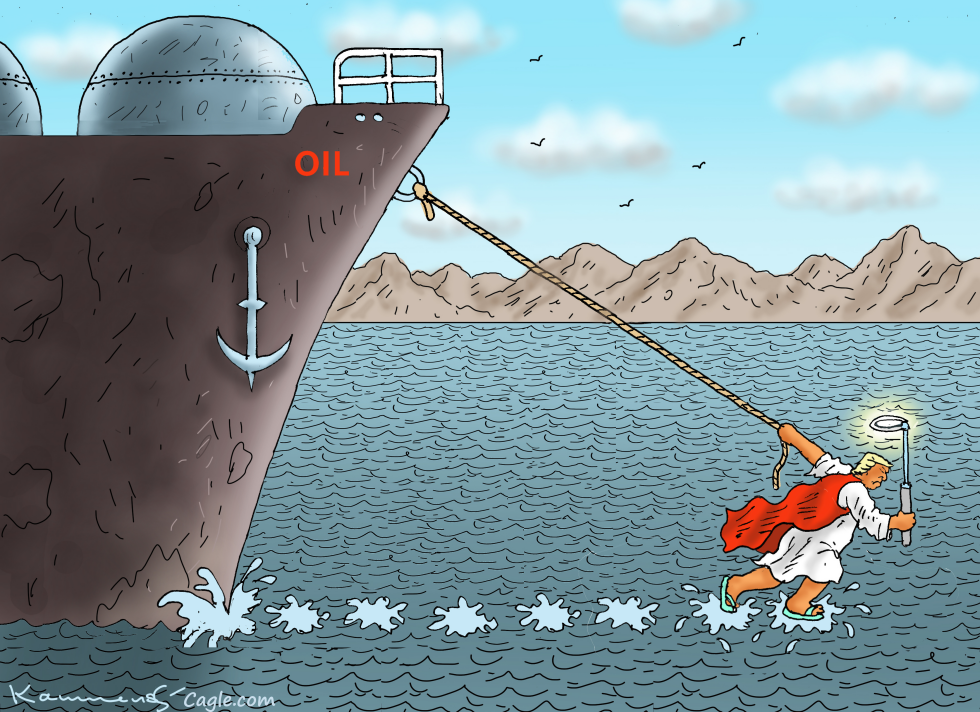
The image depicts a figure dressed in a white robe and red cape, complete with a glowing halo, running across the water while pulling a large oil tanker marked 'OIL' with a rope. He holds a golf club in one hand, splashing water with each step against a backdrop of mountains and a clear sky. This setup draws on tags like Trump, Hormuz, Iran, oil war, MAGA terror, and fascism to satirize political figures intervening in global oil crises. The cartoon's composition emphasizes the absurdity of a divine savior tackling economic and geopolitical issues, with birds flying overhead and distant peaks suggesting a Middle Eastern strait. Kamensky's style brings dry humor to the forefront, poking at notions of messianic leadership in turbulent times.
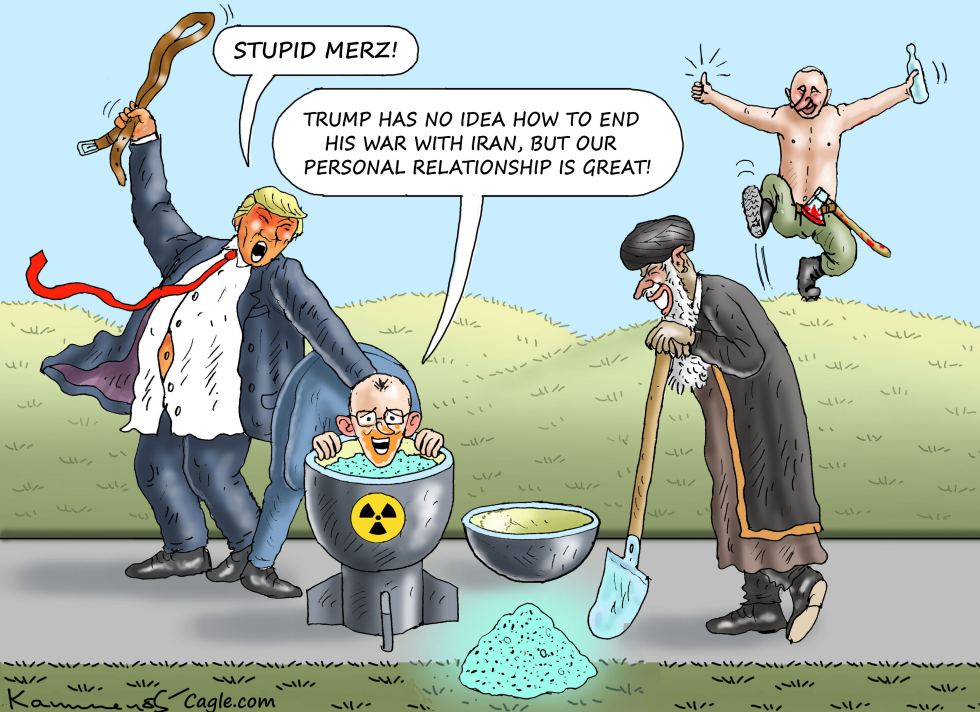
The cartoon depicts a red-faced Trump, tie askew, raising a belt to strike a bald, bespectacled man labeled Merz whose head pokes from a nuclear bomb-shaped vat of blue liquid. An elderly bearded man in turban and robe uses a shovel to scoop more blue material from a bowl, while a shirtless, axe-wielding figure resembling Putin jumps in approval, bottle in hand, speech bubble praising the great personal relationship amid Trump's cluelessness on ending his Iran war. Tags like Trump, Merz, Iran War, Middle East, Fascism, Maga Terror, Hormuz underscore the satirical jab at geopolitical follies, with dry humor poking at failed diplomacy and bizarre alliances in this Kamensky creation for Cagle.com.
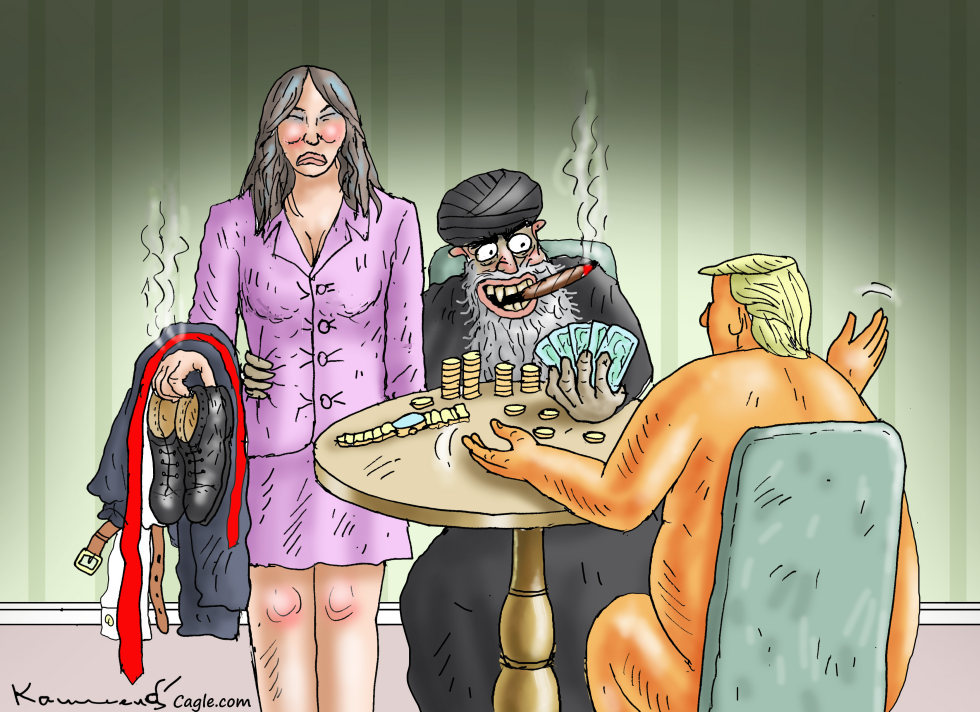
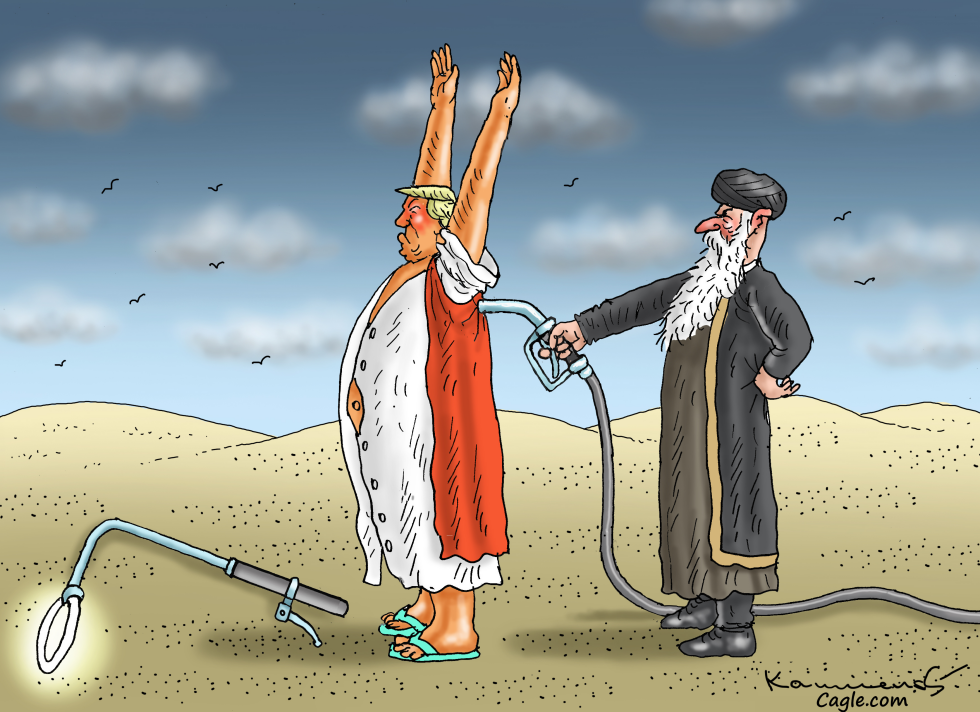
Marian Kamensky's cartoon captures a surreal scene in the desert where a figure resembling Trump, dressed in white and red robes with arms raised skyward, has a gas pump nozzle inserted into his side by a bearded man in dark robes and turban. The image plays on themes of Trump, Iran, Hormuz, fascism, MAGA terror, and oil war, blending religious imagery with modern geopolitical tensions. Birds fly in a cloudy sky over sandy dunes, emphasizing isolation and absurdity. The signature and Cagle.com mark confirm its syndication roots. This piece skewers the intersections of politics, religion, and resource dependency without words, relying on visual punch for impact. Such cartoons thrive in editorial pages for their sharp commentary on current events.
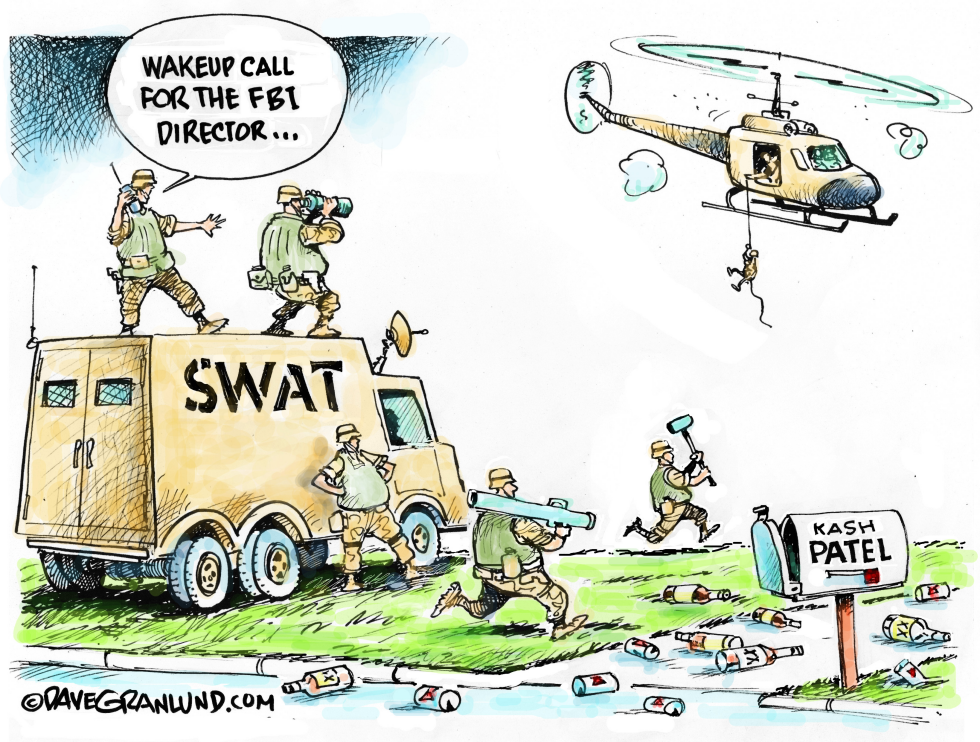
Dave Granlund's cartoon captures a SWAT team descending on Kash Patel's home, marked by a mailbox reading his name, with empty beer and booze bottles strewn across the grass. The scene includes a helicopter with a rappelling officer, a SWAT van, and armed figures advancing, one shouting a 'wakeup call for the FBI director.' Tags like FBI director, SWAT team, wellness check, party guy, alcohol, job, and beer highlight the satirical take on a nominated official's wild lifestyle clashing with high-stakes law enforcement duties. The dry humor underscores the absurdity of a raid as a morning greeting for someone eyed for such a serious position.
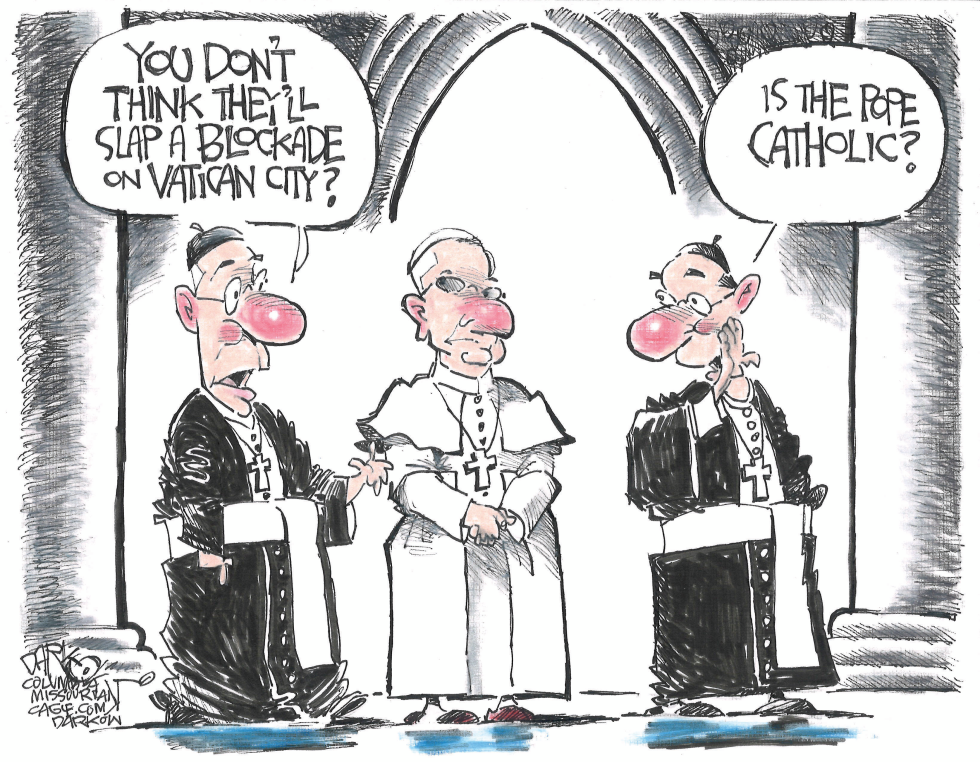
John Darkow's cartoon captures three Catholic clergy in traditional attire, with the central Pope figure amid a discussion on a Vatican blockade. The left figure worries about sanctions slapping Vatican City, while the right delivers the classic 'Is the Pope Catholic?' line, a rhetorical jab at obvious truths. This piece uses dry humor to spotlight tensions around religious institutions facing isolation, blending blockade fears with papal identity. The archway background grounds it in Vatican aesthetics, emphasizing the blockade theme without overreaching into unseen politics.
Taylor Jones draws a sharp contrast in this cartoon, with a pope-like figure in white robes and glasses, hands clasped, delivering the Sermon on the Mount line from Matthew 5:9 about blessed peacemakers being children of God. Beside him stands a blonde-haired man in a suit, halo above, mouth open in response, twisting John 3:16 to claim the Strait of Hormuz as a divine gift, or soon to be, labeled Don 3:16. The piece nods to Catholic Church teachings against a backdrop of Persian Gulf tensions, war in Iran, and oil exports disruptions. It's a dry poke at how leaders bend scripture for geopolitical gains, like controlling the Strait of Hormuz to spike crude prices. Vatican serenity meets brash claims, all in watercolor style on purple background.
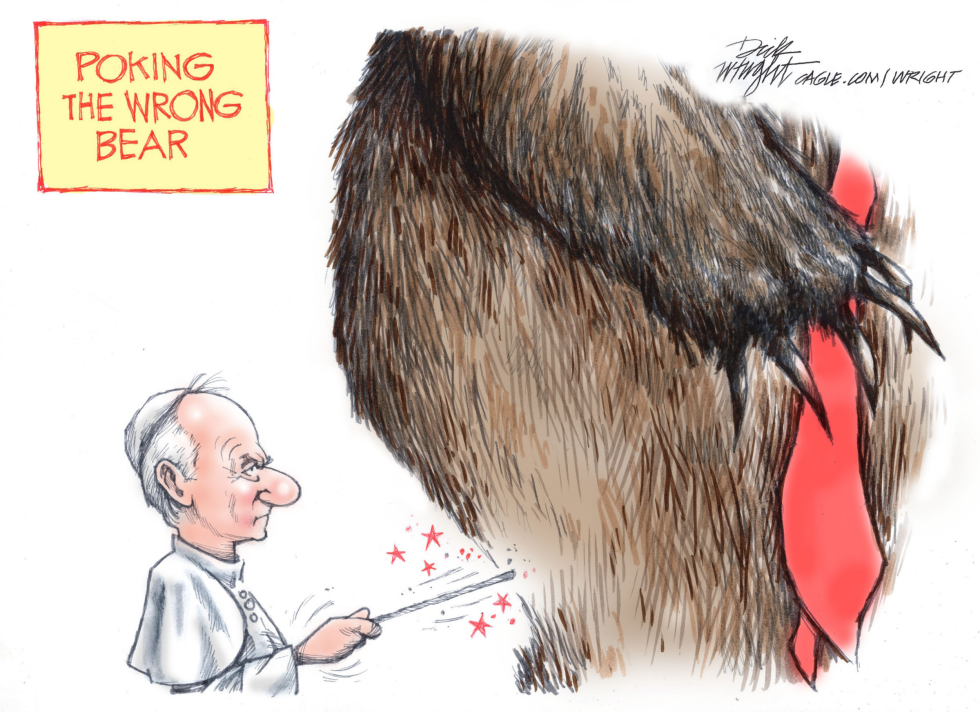
Dick Wright's political cartoon depicts a Pope-like figure in white attire, extending a thin rod toward the rear of a massive brown bear, complete with a dangling red tie and sparkling effects at the point of contact. The yellow label reads 'POKING THE WRONG BEAR,' playing on the idiom with a twist. This satirical illustration ties into the Trump-Pope feud, using the bear as a stand-in for power, the red tie evoking Trump's signature look, and the poking action suggesting provocation. Cartoonists often employ such animal metaphors for political commentary, and Wright's style here delivers clear lines and exaggerated features for impact. The image avoids overstatement, sticking to visible elements like the bear's claws and fur details, making it a straightforward jab at ongoing tensions.
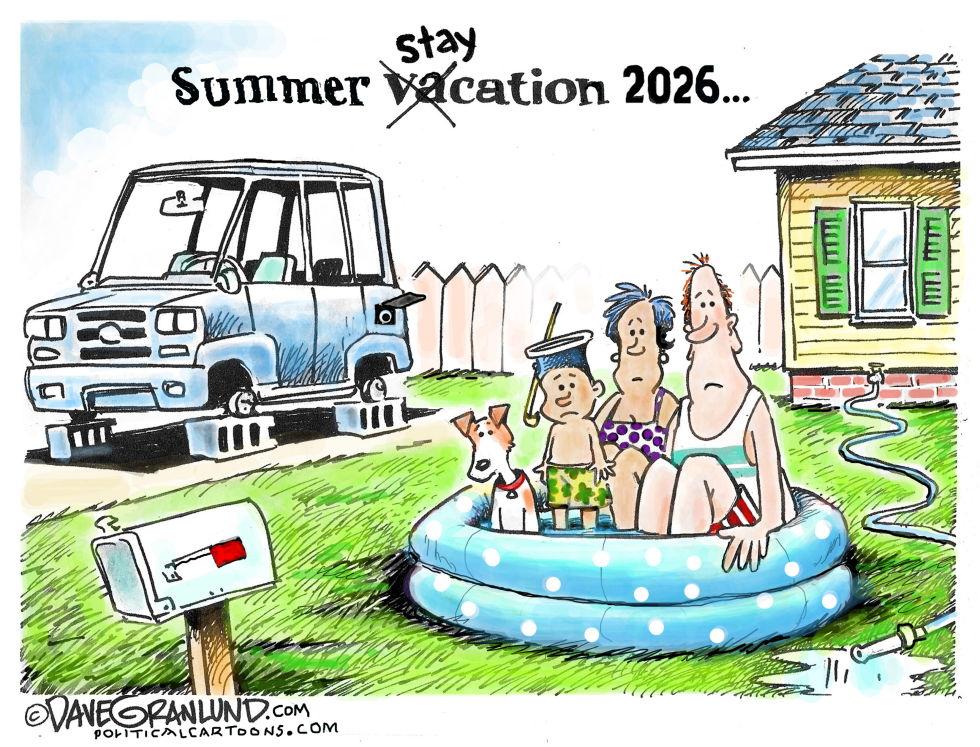
Dave Granlund's cartoon nails the frustration of high gasoline prices derailing summer road trips for families on limited budgets. Instead of hitting the highway in their autos, this crew opts for a stay home vacation, splashing in a backyard kiddie pool with the dog. The jacked-up minivan on blocks screams grounded plans, while the crossed-out 'Va' in vacation turns it into 'Staycation 2026.' It's a sharp poke at how fuel costs force folks to tighten belts, swapping grand adventures for hose-filled pools and mailbox views. Tags like gasoline prices, high cost, and stay home highlight the economic squeeze, making this a relatable jab at everyday belt-tightening.
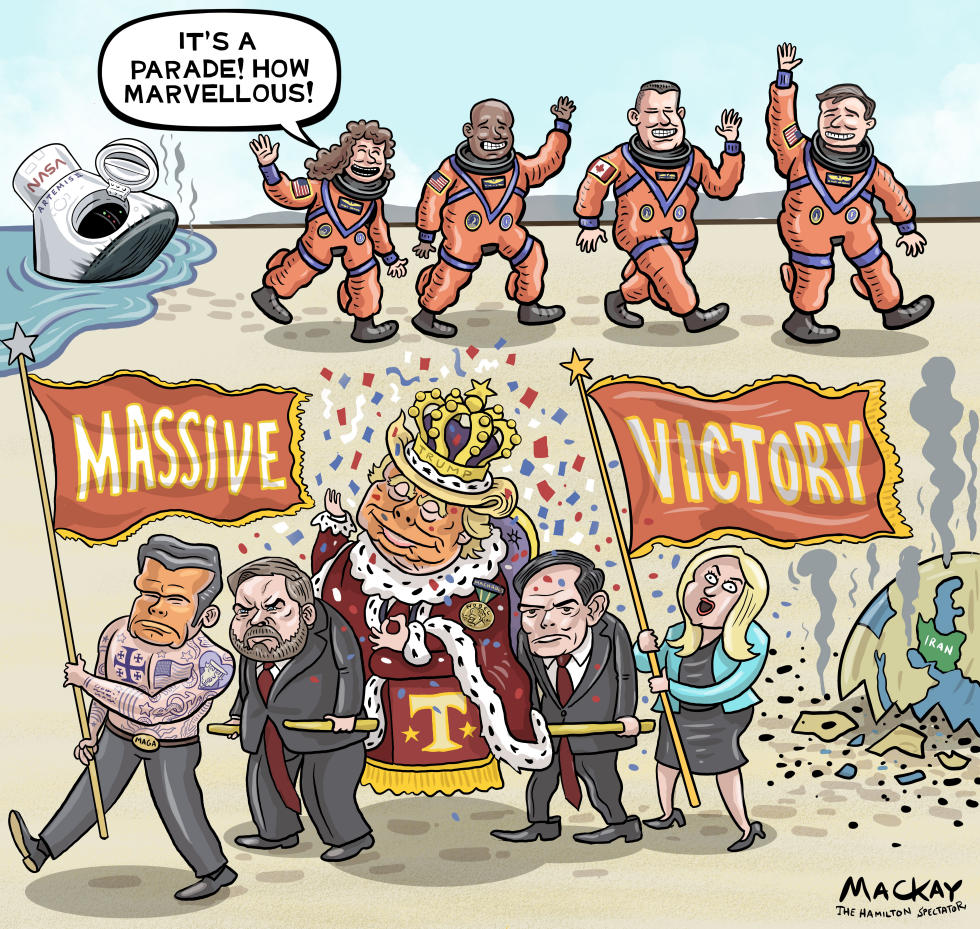
This political cartoon splits into two scenes: top shows astronauts in orange suits, one with NASA patch and another with Canadian flag, waving and exclaiming 'IT'S A PARADE! HOW MARVELLOUS!' as they march from a crashed, smoking NASA capsule in water on a sandy surface. Below, a group carries a regal throne with a crowned figure wearing a T medal, surrounded by confetti and banners reading 'MASSIVE' and 'VICTORY'. In the background, smoke rises from a fractured globe labeled 'Iran' and 'Iraq'. The artwork, signed by MacKay for The Hamilton Spectator, uses humor to juxtapose apparent failure with proclaimed triumph, featuring waving figures and stern expressions in a sandy landscape.