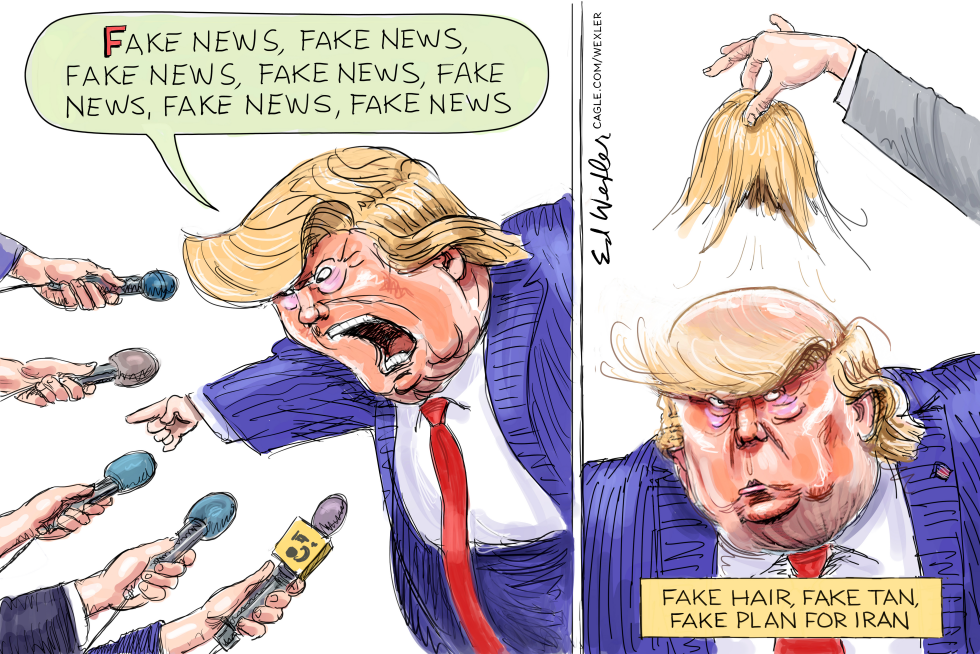
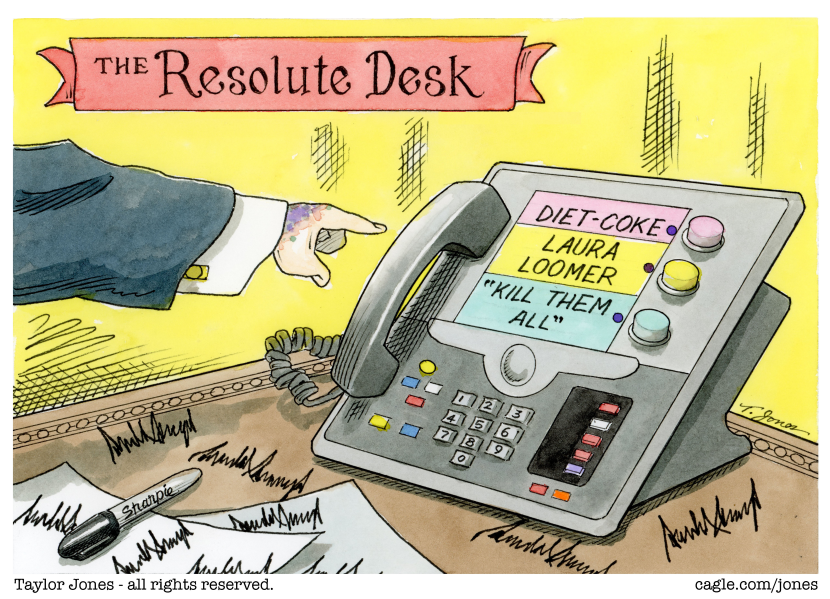
Donald Trump repeatedly labels media coverage as fake news during press encounters. The cartoon responds by questioning the authenticity of his appearance and his approach to Iran policy. It portrays the disconnect between his public statements and underlying realities.
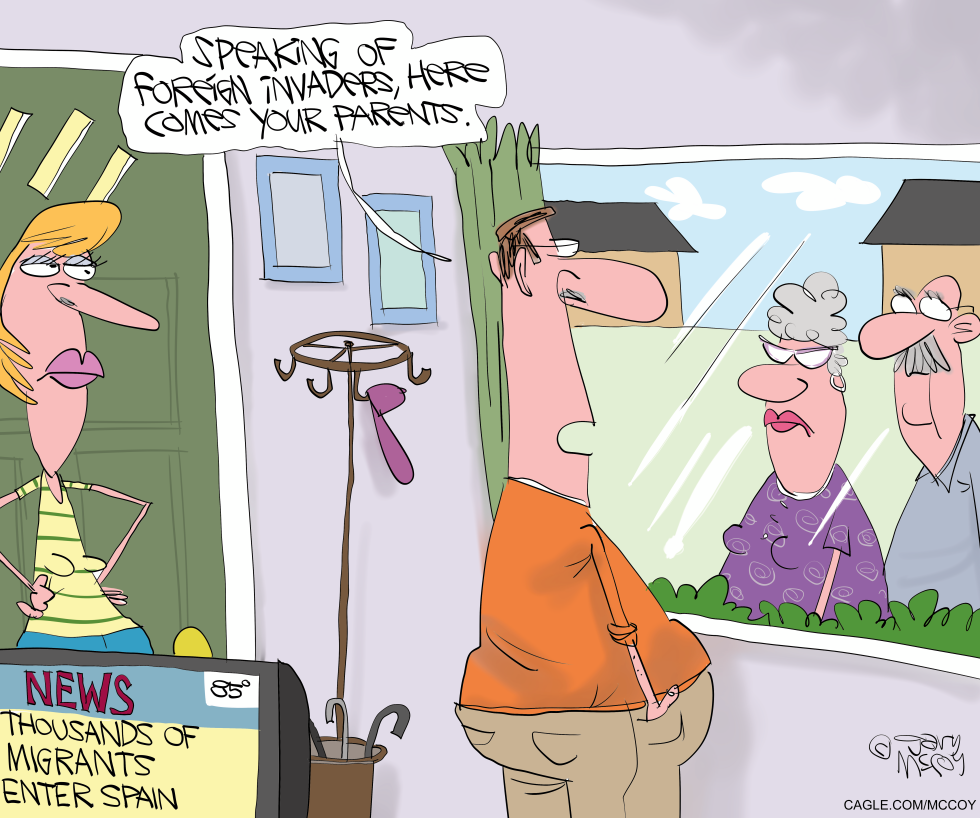
News reports show thousands of migrants entering Spain. The cartoon responds by having a man greet his in-laws with the same 'foreign invaders' label used in immigration debates. It highlights how inflammatory rhetoric can apply beyond policy to everyday family situations.
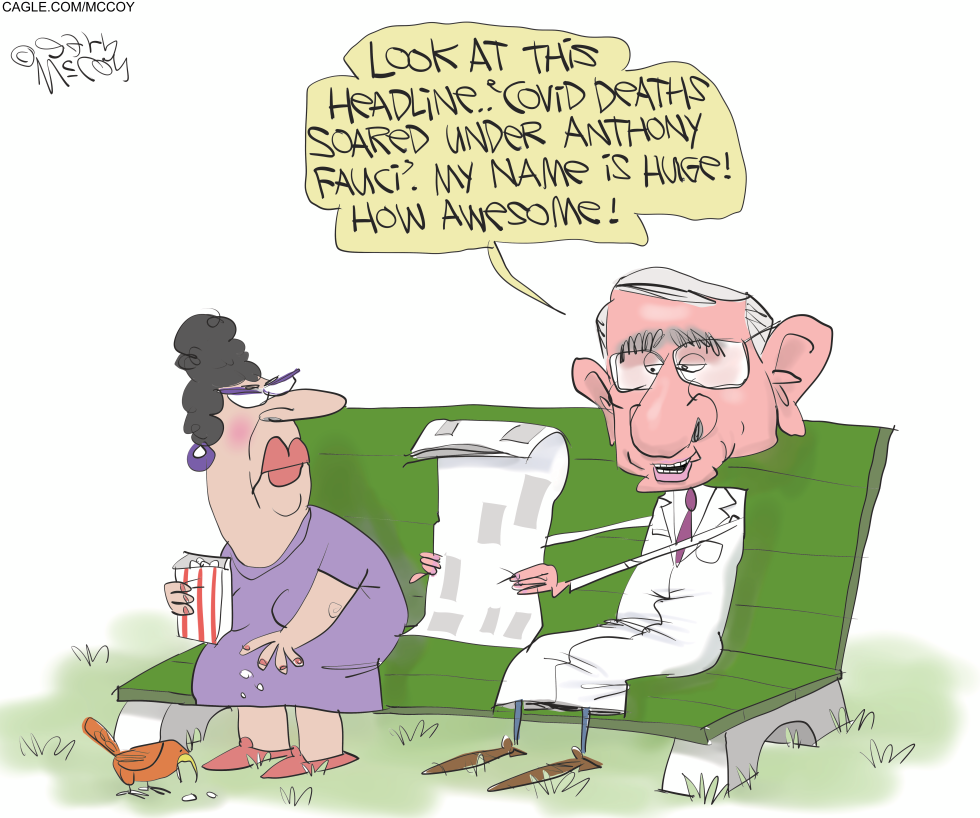
A newspaper headline reports COVID deaths rose under Anthony Fauci. The former health official reacts by celebrating the prominence of his own name in the story. The piece portrays this response as self-absorbed and detached from the human cost of the pandemic.
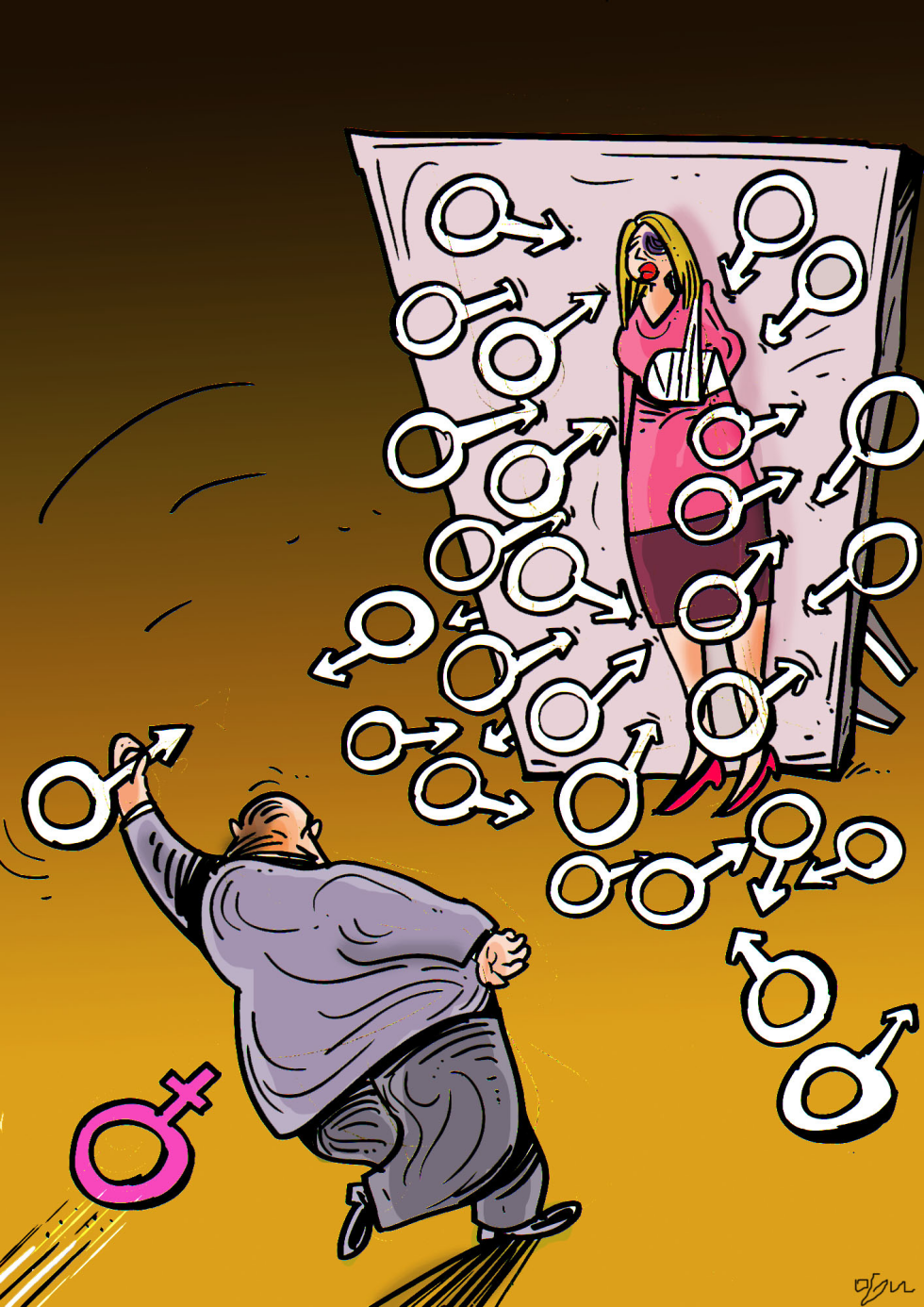
Violence against women remains a persistent social problem, with physical assaults and intimidation continuing in many communities. The piece responds to this ongoing dynamic by showing a male figure directing male symbols at an already injured woman, underscoring the editorial position that such aggression must be confronted directly.
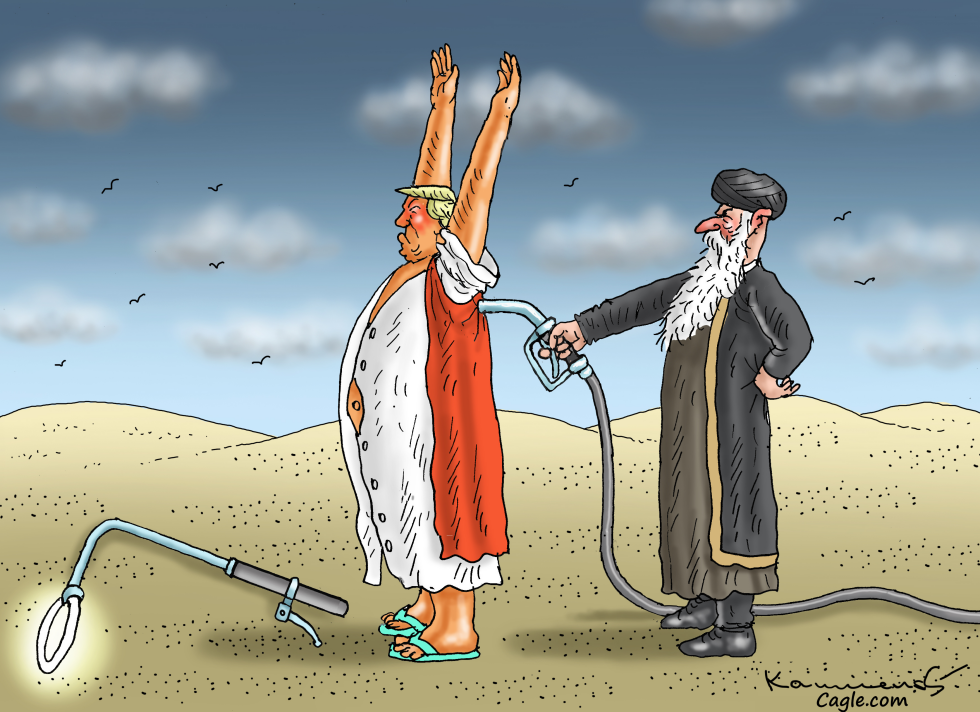
Marian Kamensky's cartoon captures a surreal scene in the desert where a figure resembling Trump, dressed in white and red robes with arms raised skyward, has a gas pump nozzle inserted into his side by a bearded man in dark robes and turban. The image plays on themes of Trump, Iran, Hormuz, fascism, MAGA terror, and oil war, blending religious imagery with modern geopolitical tensions. Birds fly in a cloudy sky over sandy dunes, emphasizing isolation and absurdity. The signature and Cagle.com mark confirm its syndication roots. This piece skewers the intersections of politics, religion, and resource dependency without words, relying on visual punch for impact. Such cartoons thrive in editorial pages for their sharp commentary on current events.
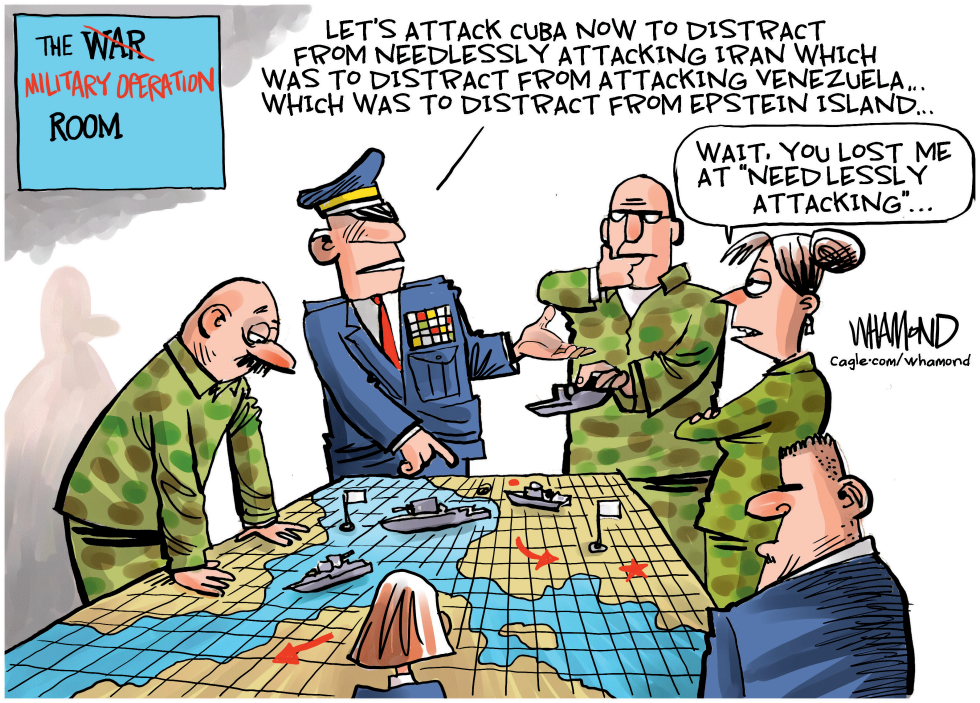
Dave Whamond's political cartoon depicts a group of military officials in a war room, gathered around a map with toy ships, discussing a chain of distractions starting from attacking Cuba to cover needless attacks on Iran, which distracted from Venezuela, looping back to Epstein Island. The scene captures the absurdity with one figure pointing at the map and another expressing confusion over 'needlessly attacking.' This satirical illustration uses dry humor to comment on convoluted military strategies and political diversions, incorporating elements like crossed-out 'War' sign replaced by 'Military Operation Room' for added irony. Tags like political satire, war distractions, foreign policy cartoon, Epstein Island reference, military humor, and endless distraction chain emphasize the cartoon's sharp critique.
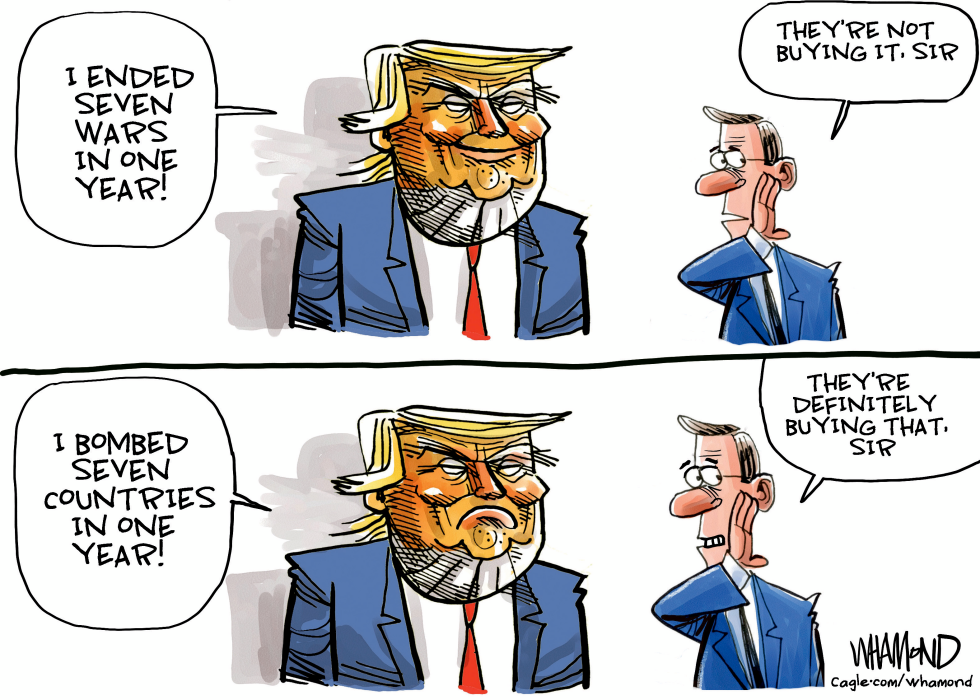
This Donald Trump cartoon masterfully captures the essence of satirical Trump presidency through political bombing humor. Trump boasts about ending seven wars, but his advisor notes the public's skepticism, leading to a pivot where he claims bombing seven countries instead, which the advisor says is 'definitely buying that.' The Trump wars satire underscores inconsistencies in Trump foreign policy cartoon style, poking fun at boastful claims versus reality. Created by Whamond, this political cartoon Whamond piece exemplifies humorous political analysis on US military satire, blending irreverent wit with insightful commentary on leadership and perception.
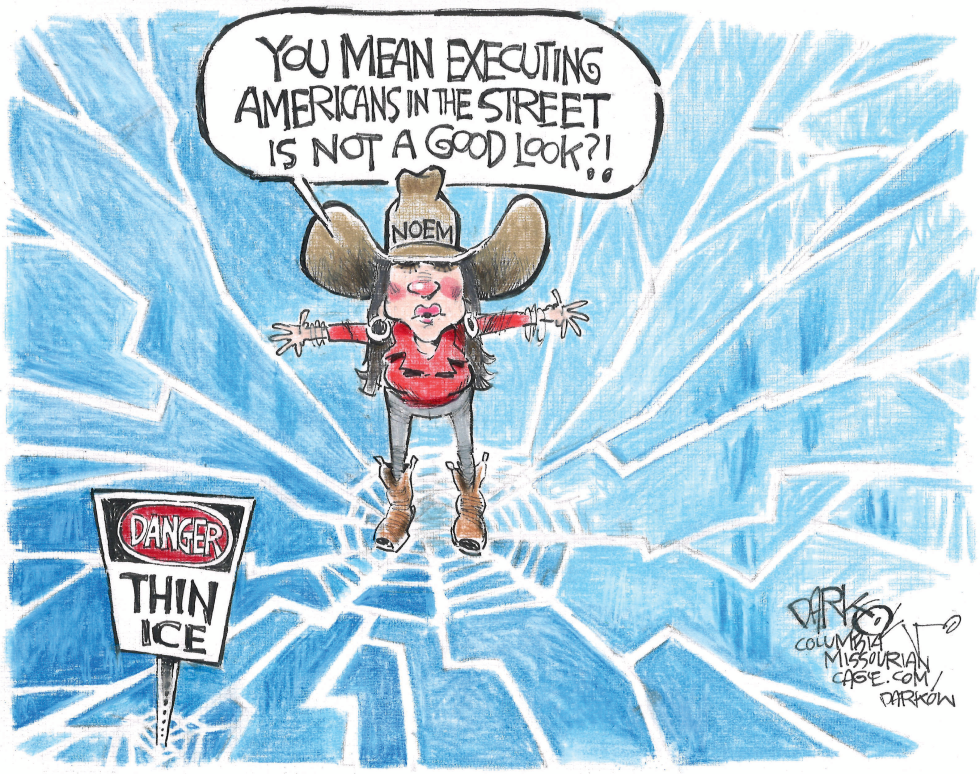
This Kristi Noem cartoon captures the South Dakota governor in a precarious position on thin ice, her hat emblazoned with 'NOEM' as she incredulously asks if executing Americans in the street isn't a good look. The image, a sharp political satire, alludes to the ongoing presidential immunity debates surrounding Donald Trump, where his allies like Noem find themselves on shaky ground. With the 'DANGER THIN ICE' sign prominently featured, the artwork highlights the risks of endorsing extreme views on executive power. Amid Noem's own memoir backlash involving her dog-killing anecdote, this thin ice metaphor amplifies the GOP backlash she's facing. The humorous political art style underscores the absurdity, making it a viral cartoon potential hit. Overall, it's a biting commentary on conservative politics satire in American discourse.
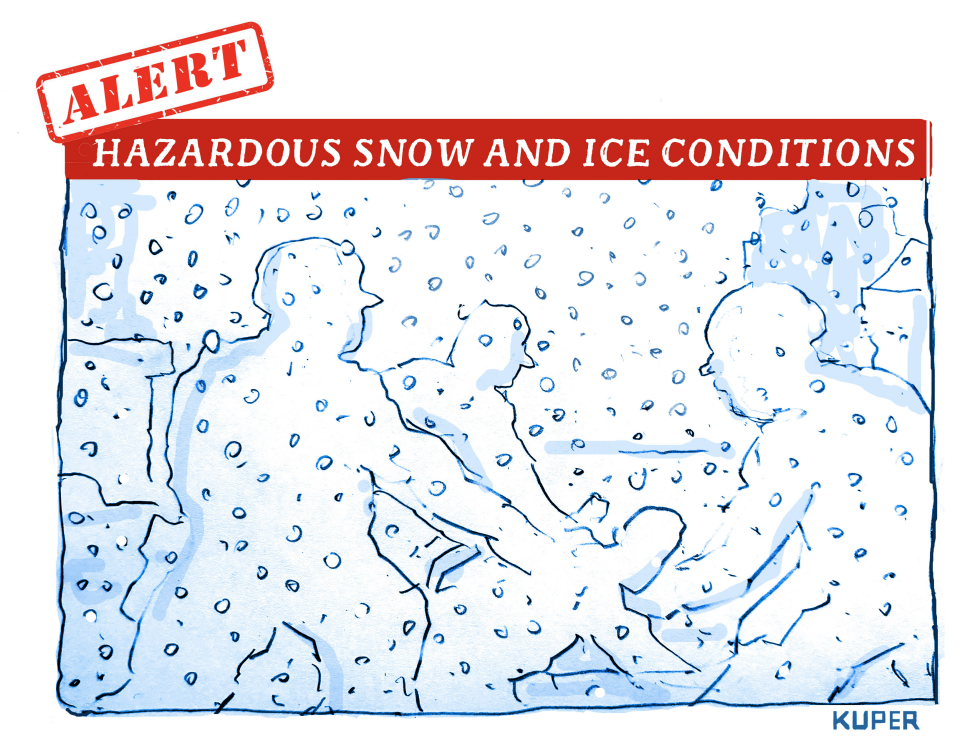
A weather-style alert warns of hazardous snow and ICE conditions. Silhouetted figures appear in distress amid heavy snowfall. The image responds to reports of immigration raids affecting American citizens in Minneapolis and similar cities during January 2026.
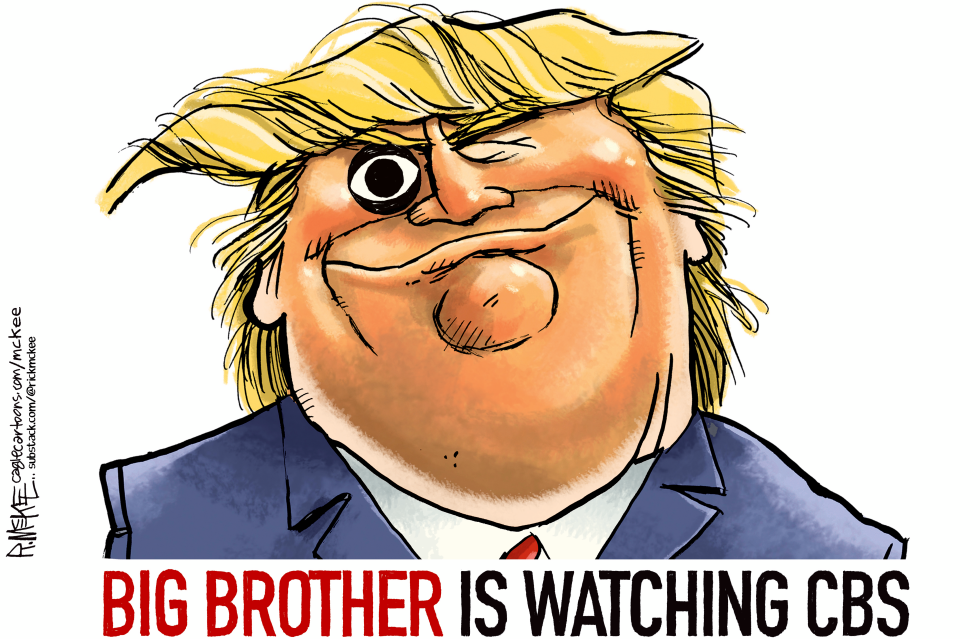
The illustration depicts Donald Trump with an exaggerated head and a single large eye, styled after the Big Brother figure from George Orwell's 1984. Bold text at the bottom declares Big Brother is watching CBS. The December 2025 piece appears amid ongoing tensions between the president-elect and major media outlets including CBS News and its 60 Minutes program.
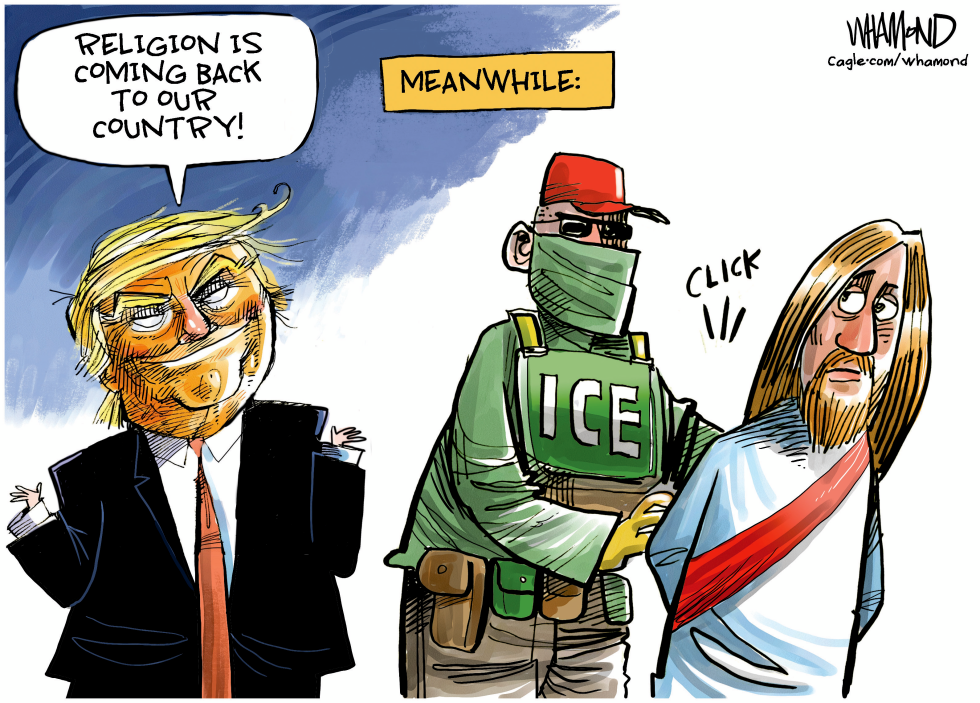
Dave Whamond's cartoon captures Trump religion cartoon essence with the former president boldly stating religion's return to America. Meanwhile, an ICE agent is shown handcuffing a figure resembling Jesus, complete with long hair, beard, and robes, in a clear ICE deporting Jesus satire. This piece dives into political cartoon religion America themes, poking at immigration policy religion hypocrisy. The dry humor shines through the contrast between Trump's proclamation and the 'meanwhile' scene of deportation. Such satirical take on US immigration and faith often sparks debate on religious revival and deportation. Overall, it's a pointed commentary on blending faith with strict border controls.
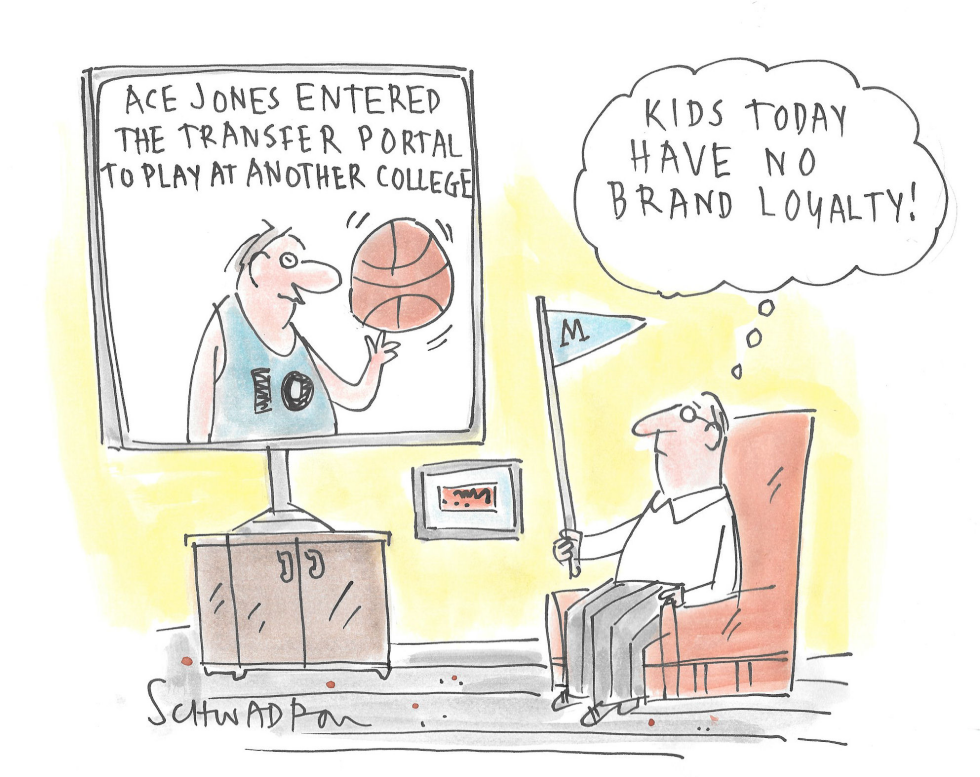
A political cartoon depicts an older sports fan watching television coverage of college basketball player Ace Jones entering the transfer portal. The fan, seated with a team pennant marked M, reacts with a thought bubble stating that kids today have no brand loyalty. The scene highlights ongoing discussions in college athletics about player movement between schools and shifting fan expectations around team allegiance. The image was created by Harley Schwadron and dated November 18, 2025.
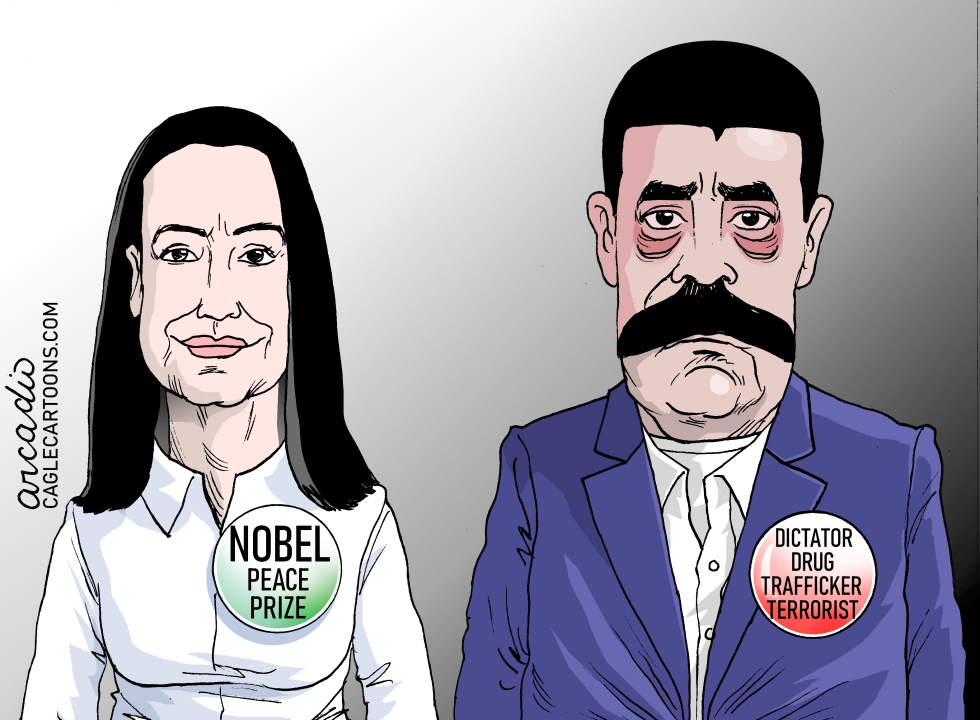
Arcadio Esquivel's cartoon contrasts a woman with a 'NOBEL PEACE PRIZE' badge against a man labeled 'Dictator Drug Trafficker Terrorist,' using tags like María Corina Machado, Maduro, and Venezuela to highlight political divides in a simple, label-driven satire.
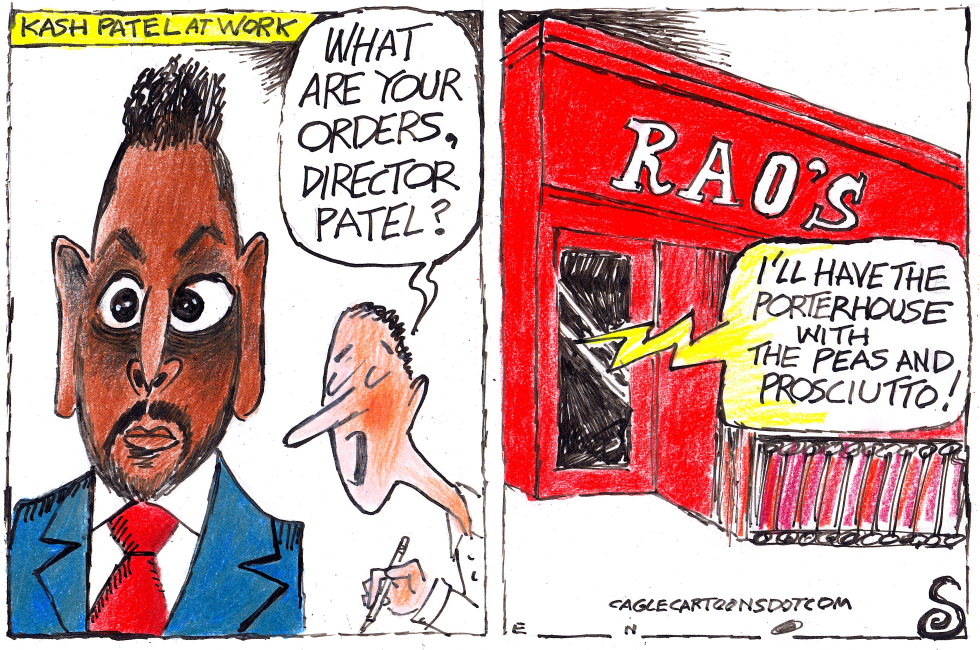
Randall Enos draws Kash Patel at work in this two-panel cartoon, where a subordinate asks for orders from Director Patel, only to cut to a restaurant scene at RAOS with a food order for porterhouse with peas and prosciutto. The tags highlight inefficient FBI, charlie kirk assassination, and congressional hearing elements, delivering dry humor on leadership mix-ups. Visible elements stick to the pun on 'orders,' avoiding deeper speculation, while the artist's style brings straightforward satire to government roles. This piece fits political cartoon syndication with its timely jab at figures like Kash Patel.
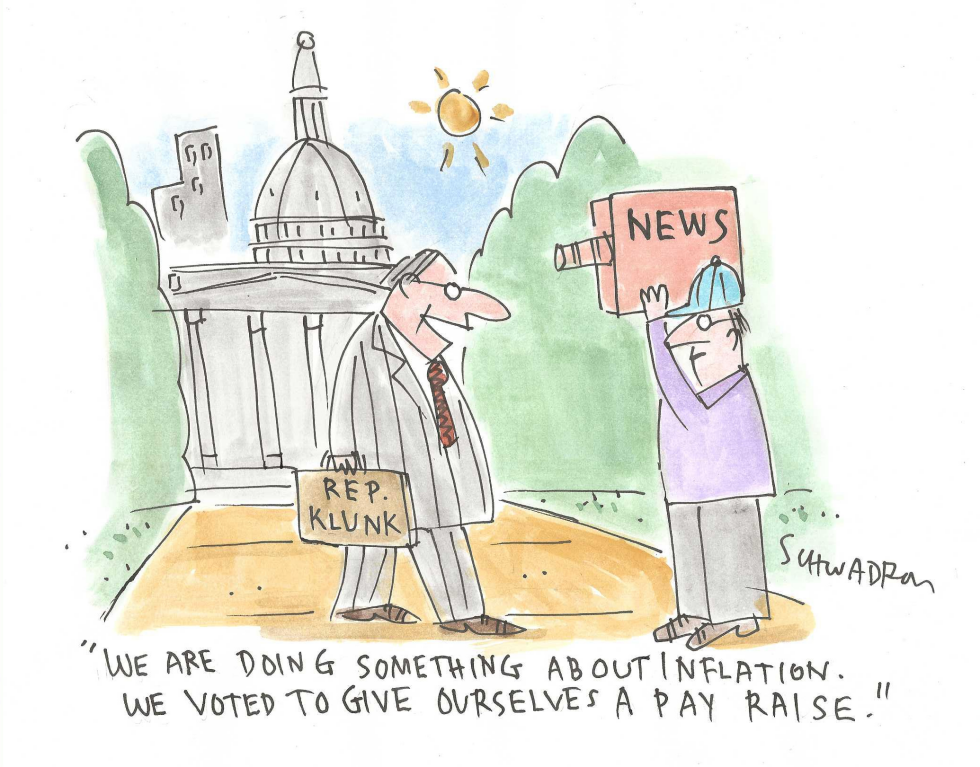
On September 9, 2025, a political cartoon depicts Representative Klunk leaving the Capitol building while a news reporter captures his statement that Congress addressed inflation by voting itself a pay raise. The scene shows the lawmaker in a suit and tie holding a briefcase, with the Capitol dome and trees in the background under a sunny sky. The cartoon highlights the disconnect between public economic concerns and legislative self-benefit.