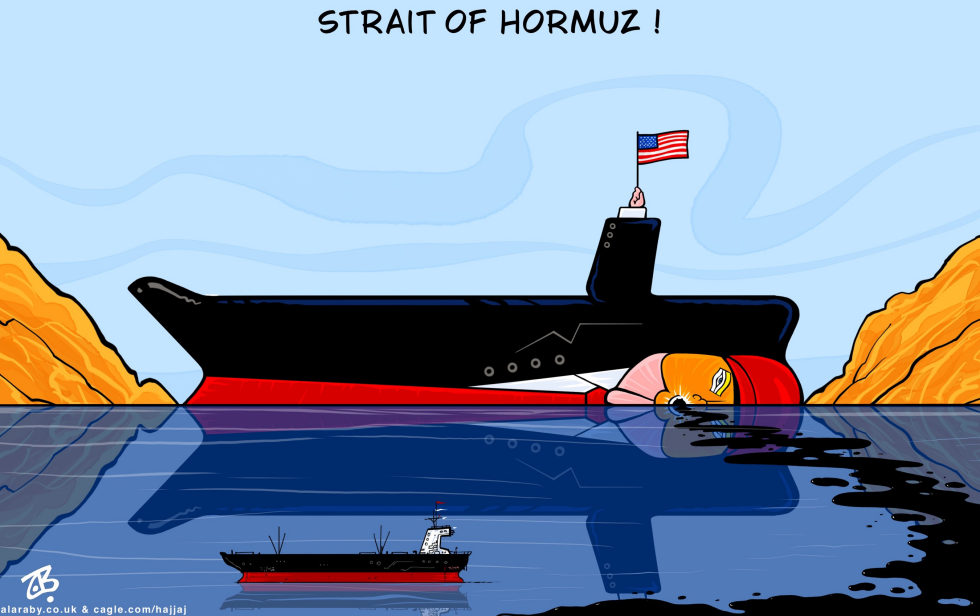
Emad Hajjaj's cartoon depicts a large black submarine with a red hull, stuck between orange landmasses in the Strait of Hormuz, its bow featuring an orange face with yellow hair and a red tie, clearly caricaturing Donald Trump. An American flag flies atop the vessel, while black oil spills into the blue water, reflecting the ship. Below, a smaller black tanker with a white figure onboard sails through the oily sea, tagged with Persian, Gulf, Sea, Tanker, Oil, War. The image satirizes US involvement in Middle East conflicts, particularly Iran war scenarios, without overreaching into hidden meanings. The composition is straightforward, with clear lines and bold colors emphasizing the blockage.
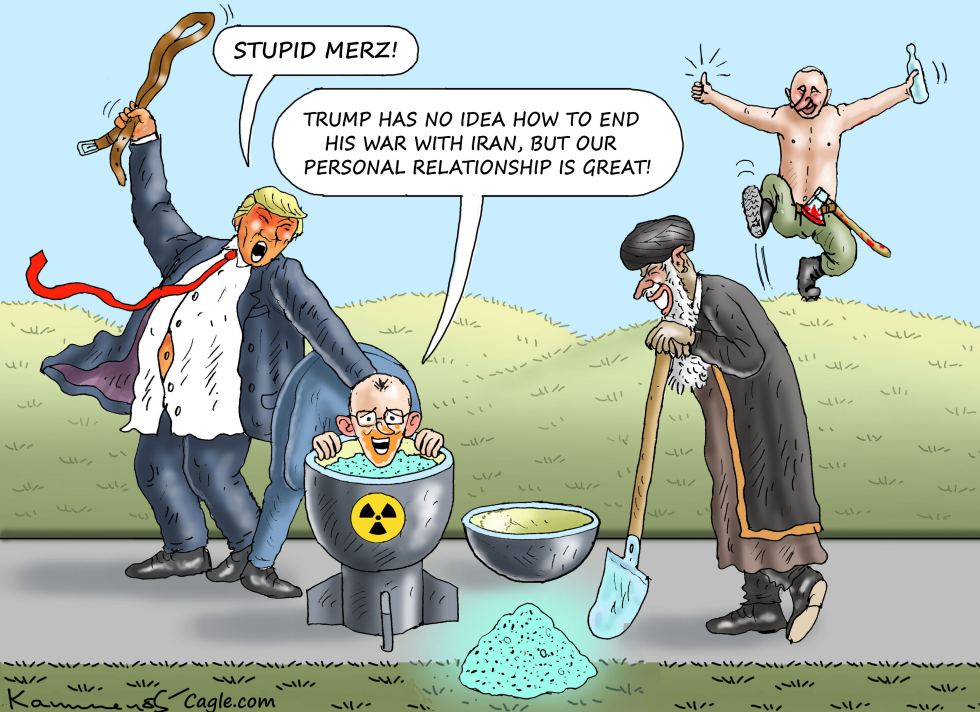
The cartoon depicts a red-faced Trump, tie askew, raising a belt to strike a bald, bespectacled man labeled Merz whose head pokes from a nuclear bomb-shaped vat of blue liquid. An elderly bearded man in turban and robe uses a shovel to scoop more blue material from a bowl, while a shirtless, axe-wielding figure resembling Putin jumps in approval, bottle in hand, speech bubble praising the great personal relationship amid Trump's cluelessness on ending his Iran war. Tags like Trump, Merz, Iran War, Middle East, Fascism, Maga Terror, Hormuz underscore the satirical jab at geopolitical follies, with dry humor poking at failed diplomacy and bizarre alliances in this Kamensky creation for Cagle.com.
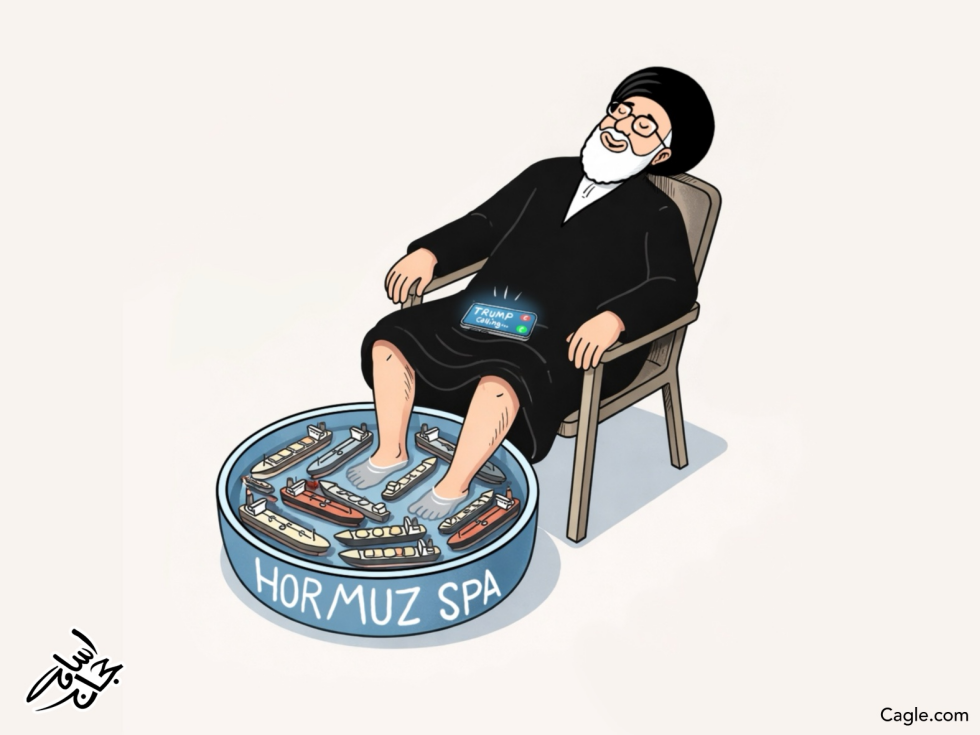
Osama Hajjaj draws an Iranian leader, resembling a cleric in black robes and turban, slouched in a chair with feet immersed in a blue basin labeled Hormuz Spa. Tiny ships float around his feet, evoking the Strait of Hormuz. A phone on his lap displays Trump with a green light, implying a call or alert. The scene captures dry satire on Iran-Trump relations, with the spa pun highlighting control over vital shipping lanes. Tags like Hormuz, Iran, Donald Trump, spa, and political cartoon underscore the humor in geopolitical friction.
Taylor Jones draws a sharp contrast in this cartoon, with a pope-like figure in white robes and glasses, hands clasped, delivering the Sermon on the Mount line from Matthew 5:9 about blessed peacemakers being children of God. Beside him stands a blonde-haired man in a suit, halo above, mouth open in response, twisting John 3:16 to claim the Strait of Hormuz as a divine gift, or soon to be, labeled Don 3:16. The piece nods to Catholic Church teachings against a backdrop of Persian Gulf tensions, war in Iran, and oil exports disruptions. It's a dry poke at how leaders bend scripture for geopolitical gains, like controlling the Strait of Hormuz to spike crude prices. Vatican serenity meets brash claims, all in watercolor style on purple background.
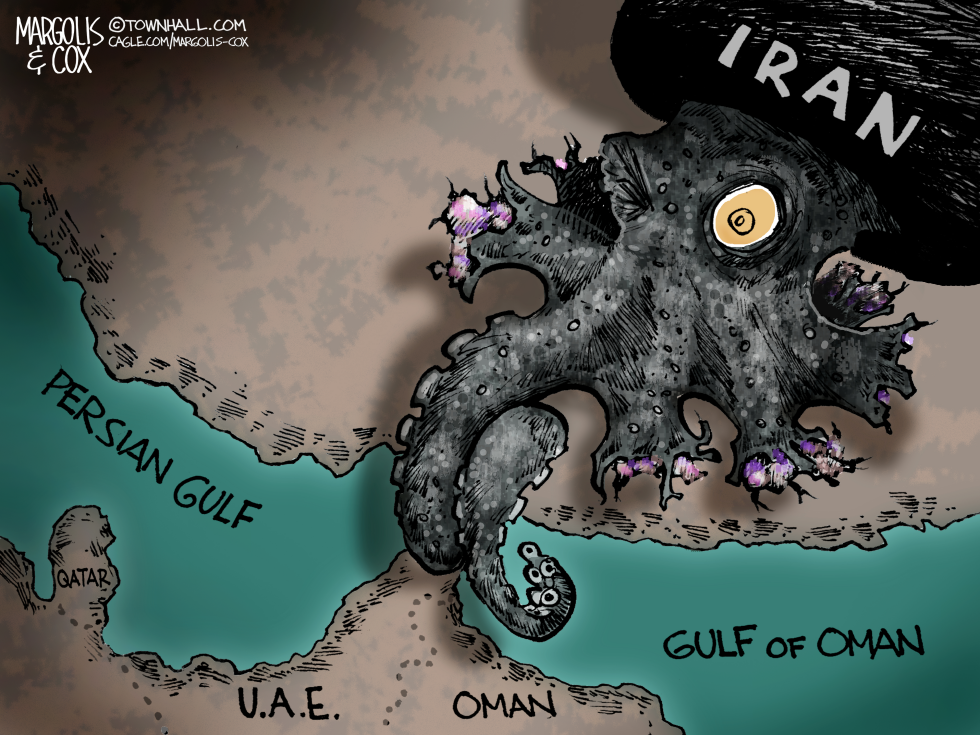
Cartoons like this one from Margolis and Cox cut straight to the absurdity of international posturing. Here, an oversized octopus labeled 'Iran' looms over a simplified map of the Persian Gulf and Gulf of Oman, its tentacles coiling tightly around the Strait of Hormuz. The creature's single eye glares out, while purple-tipped suckers grip the landmasses labeled Qatar, UAE, and Oman. It's a classic visual metaphor for control, poking at Iran's threats to block this crucial oil route. waterway. Such images remind editors how satire distills complex geopolitics into something shareable, even if the humor lands dry as desert sand. With tags like Iran Strait of Hormuz blockade, Persian Gulf tension, octopus metaphor, Middle East satire, oil route choke, and strategic dominance, the piece fits neatly into discussions of global energy security.
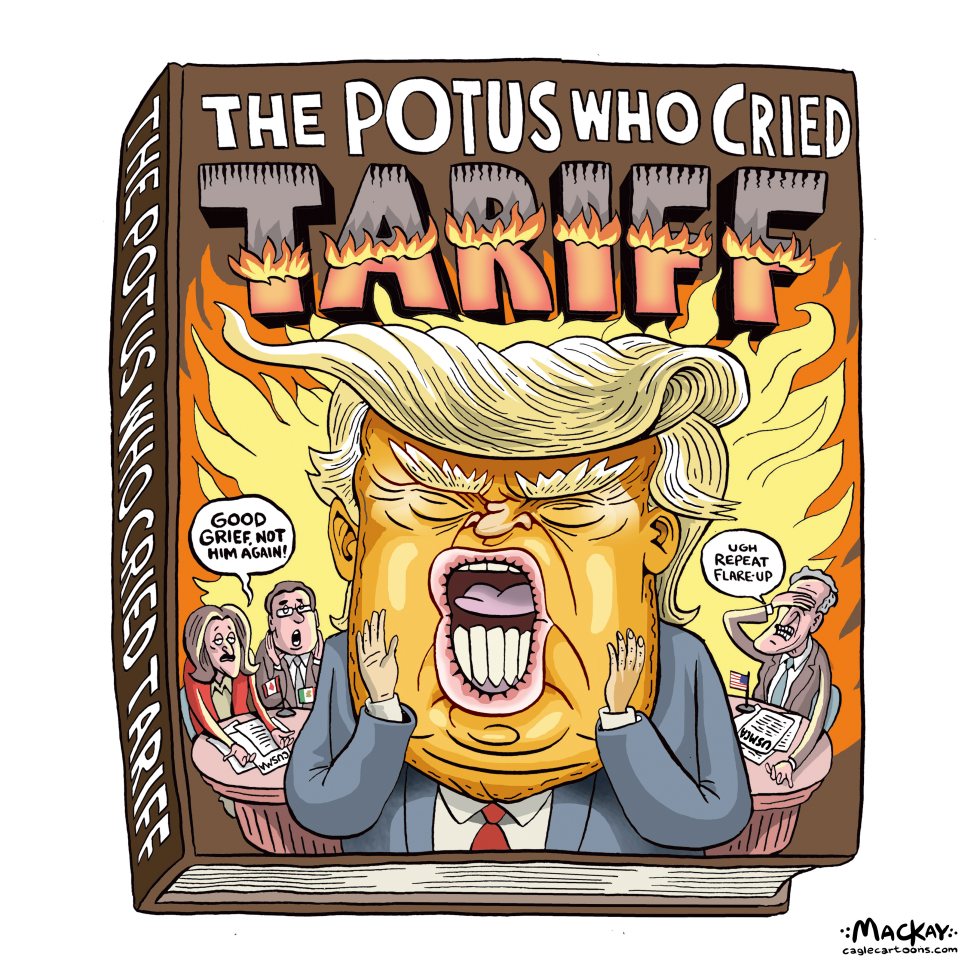
Graeme MacKay's cartoon reimagines Aesop's fable as 'The POTUS Who Cried TARIFF,' with Donald Trump's exaggerated face shouting on a fiery book cover. Representatives from USA, Mexico, and Canada sit at a table, showing exasperation with speech bubbles like 'Good Grief not him again!' and 'Ugh Repeat flare-up?' The tags USA, Mexico, Canada, trade, diplomacy, tariff, Donald Trump, USMCA, NAFTA, The Boy Who Cried Wolf, Aesop, and fable underscore the satire on repeat threats becoming ineffective. This visual pokes at how constant warnings lose impact in international relations.