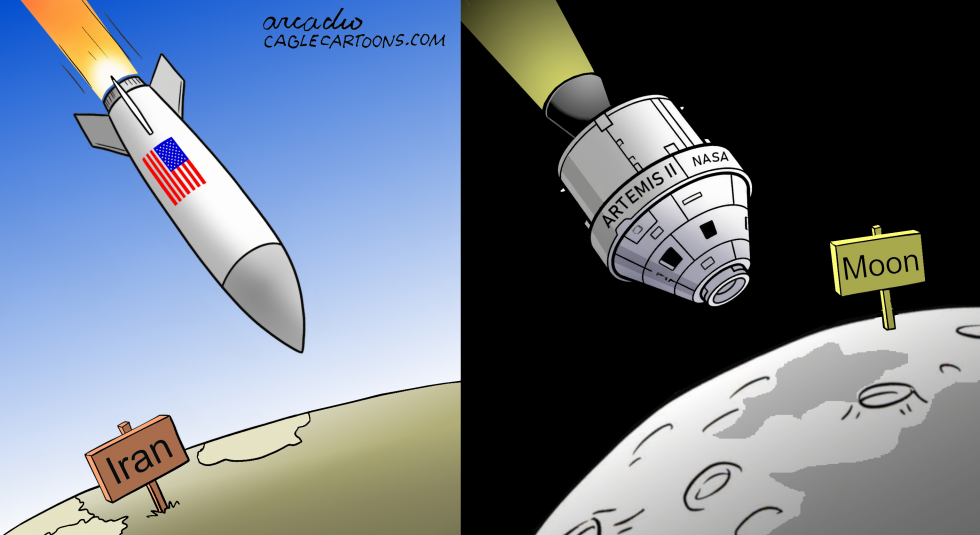
Arcadio Esquivel's cartoon splits the scene: on one side, a missile with an American flag streaks toward a planetary surface marked 'Iran,' flames trailing from its base against a blue sky. On the other, the Artemis II NASA capsule floats in space, nearing a gray lunar landscape labeled 'Moon' under a starry black backdrop. Tags including war, moon, exploration, Artemis II, NASA, Middle East, and Iran capture the visual pun. The dry humor points to misplaced priorities, where grand goals like space missions veer into military misadventures. Cagle Cartoons syndicates such pointed commentary, blending current events with sharp satire.
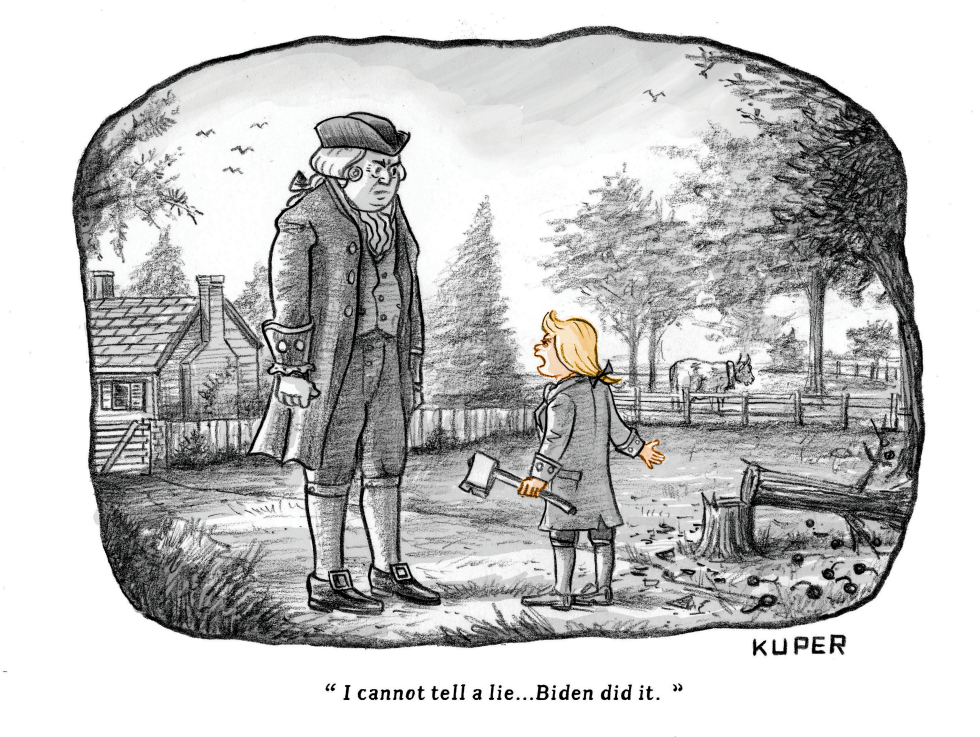
The cartoon reworks the George Washington cherry tree legend with a blonde child resembling Donald Trump holding an axe and declaring Biden responsible for the cut tree. An adult figure in 18th century attire looks on while a horse stands in the background. The scene references ongoing political blame games and recent cabinet tensions involving figures such as Kristi Noem and Pete Hegseth amid rising oil prices and foreign policy friction in the Strait of Hormuz.
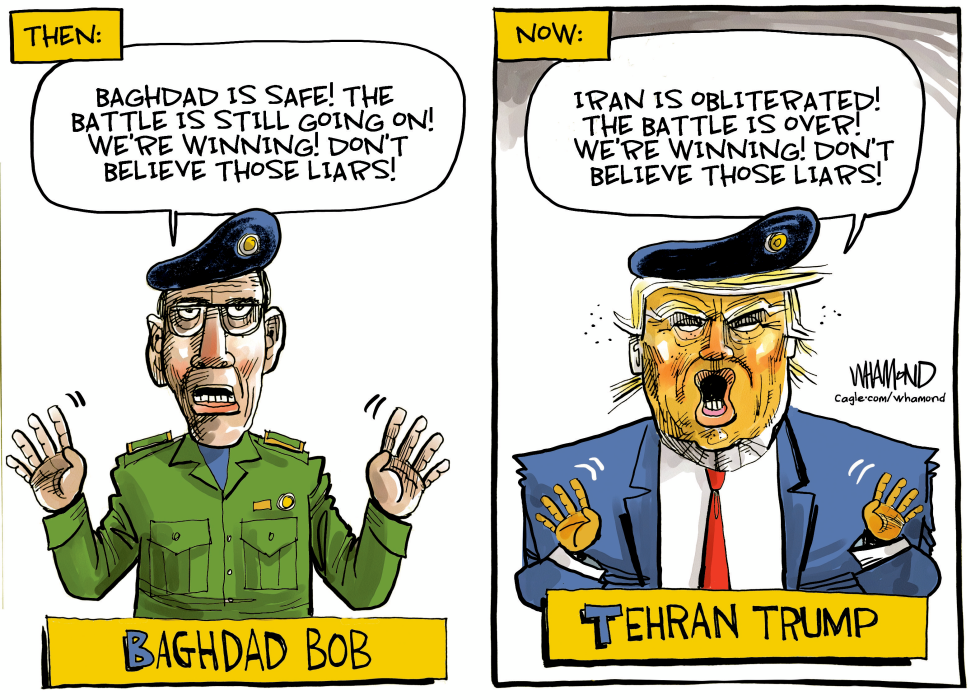
Dave Whamond's political cartoon splits into 'Then' and 'Now' panels, showing Baghdad Bob in military garb proclaiming Baghdad's safety and ongoing victory, dismissing liars. On the right, a Trump-like figure dubbed Tehran Trump, wearing a beret and suit, declares Iran obliterated and battle over, again urging disbelief in liars. The satire underscores parallels in propaganda and denialism, with tags like political satire, Trump caricature, Iraq War reference, Iran conflict, misinformation leaders, and historical parallel. This visual commentary critiques how figures twist realities in wartime narratives, blending dry humor with sharp observation on political exaggeration.
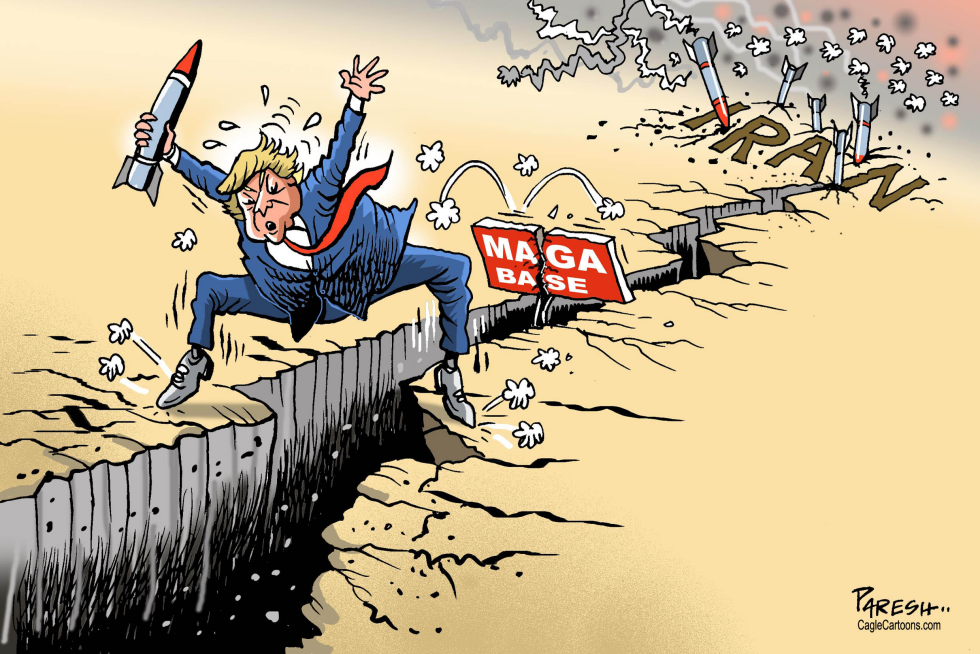
A political cartoon by Paresh Nath illustrates Donald Trump leaping across a widening crack in the ground marked MAGA BASE. He holds a missile in one hand as rockets fly toward the word IRAN on the far side. The image captures division within the president's support base over military action in the Middle East. The cartoon responds to reports of escalating tensions and public debate on involvement with Iran. The visual emphasizes the physical separation between the figure and the base he represents.
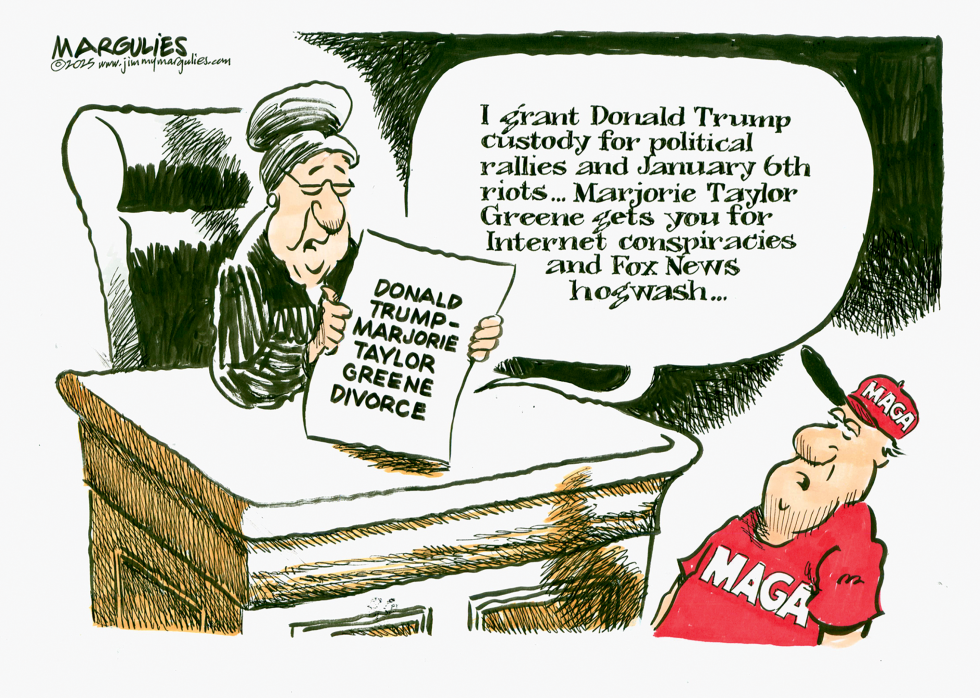
A judicial figure issues a divorce decree between Donald Trump and Marjorie Taylor Greene. The ruling awards Trump custody of political rallies and January 6 riots while Greene receives internet conspiracies and Fox News content. The scene shows a MAGA supporter looking on from below the bench.
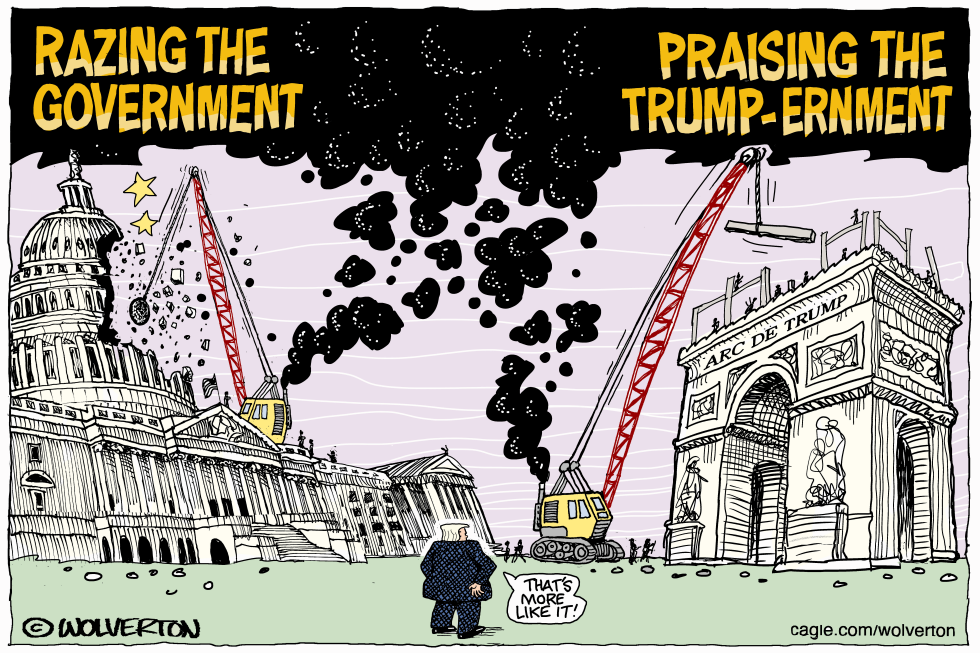
On October 18, 2025, a Monte Wolverton cartoon depicts President Donald Trump observing the demolition of the U.S. Capitol Building on the left and the construction of an Arc de Trump monument on the right. A wrecking ball and crane damage the Capitol while another crane assembles the arch. Black smoke fills the center. Trump, in the foreground, says 'THAT'S MORE LIKE IT!' The split headline reads 'RAZING THE GOVERNMENT' and 'PRAISING THE TRUMP-ERNMENT.' The image comments on federal workforce reductions and infrastructure priorities during the second Trump term.
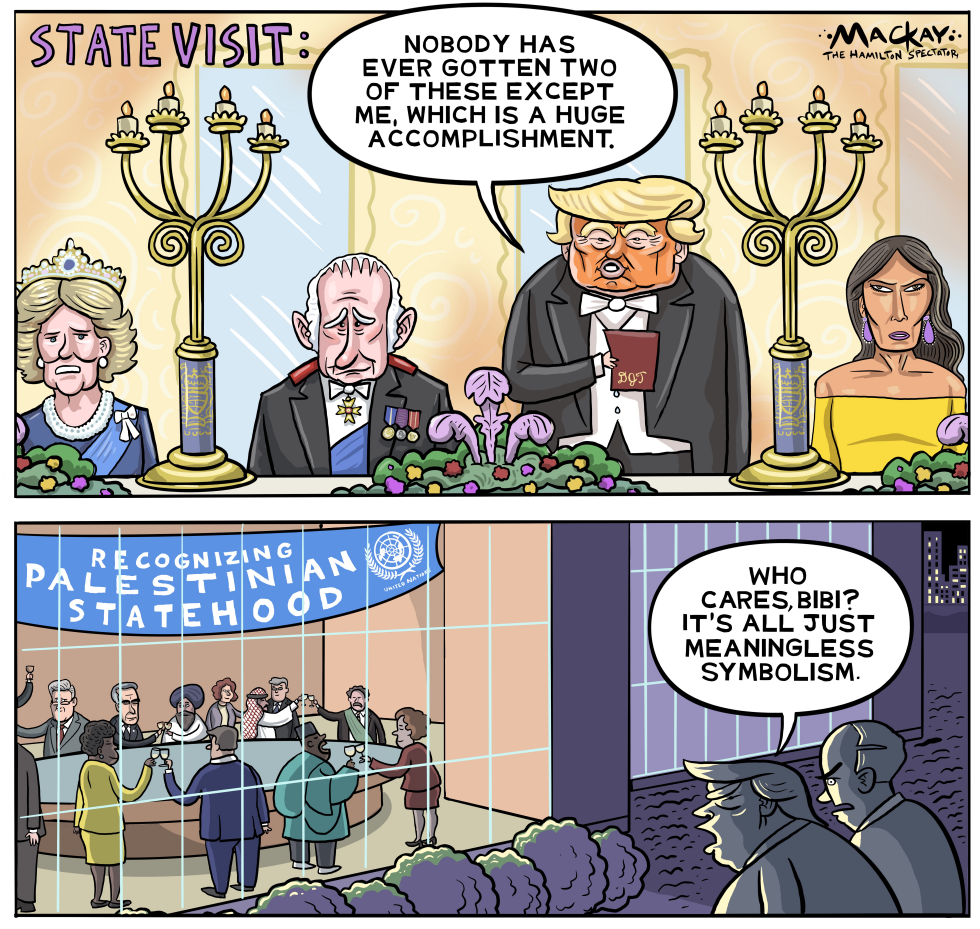
Graeme MacKay's cartoon captures a state visit dinner scene with figures at a table adorned with candelabras, where a caricature resembling Donald Trump boasts about unique accomplishments. The lower panel shifts to a United Nations setting with a banner reading 'Recognizing Palestinian Statehood,' showing delegates toasting, while outside, Trump and another figure, addressed as Bibi, dismiss the event as meaningless symbolism. Incorporating tags like Allies, Palestine, United Nations, Statehood, Recognition, and Peace, the artwork highlights contrasts in diplomatic perceptions. The composition uses split panels to juxtapose formal pomp with cynical realpolitik, emphasizing themes of symbolic gestures versus substantive policy in the Israel-Gaza conflict context.
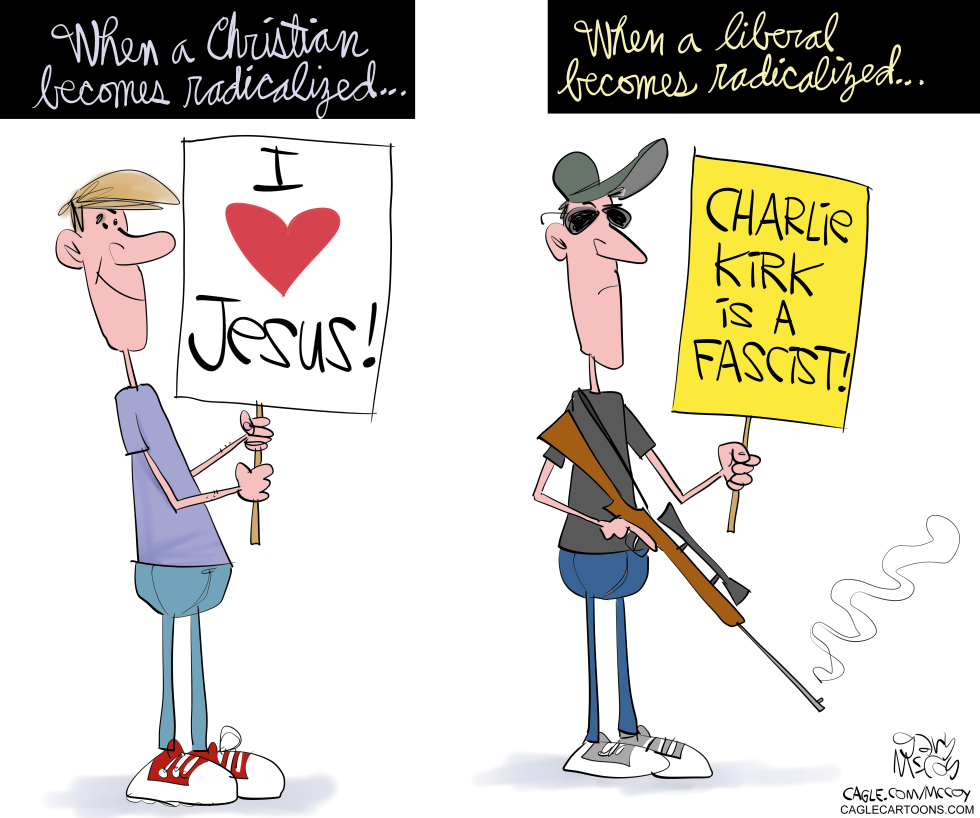
Gary McCoy's cartoon from 2025 divides the frame into two scenarios on radicalization. On the left, a figure in a cap holds a sign declaring 'I ♥ Jesus!' under the label 'When a Christian becomes radicalized...'. The right side shows a sunglasses-wearing man with a rifle emitting smoke, gripping a yellow sign that reads 'CHARLIE KIRK IS A FASCIST!' labeled 'When a liberal becomes radicalized.'. Tags like MAGA, Jesus, radicalized, Christian, liberal, Charlie Kirk, gun control, mental health, religion, Donald Trump, social media, and science frame the visual commentary. The piece highlights perceived disparities in how extremism manifests across ideological lines, with the Christian side shown as affectionate and the liberal as potentially violent.
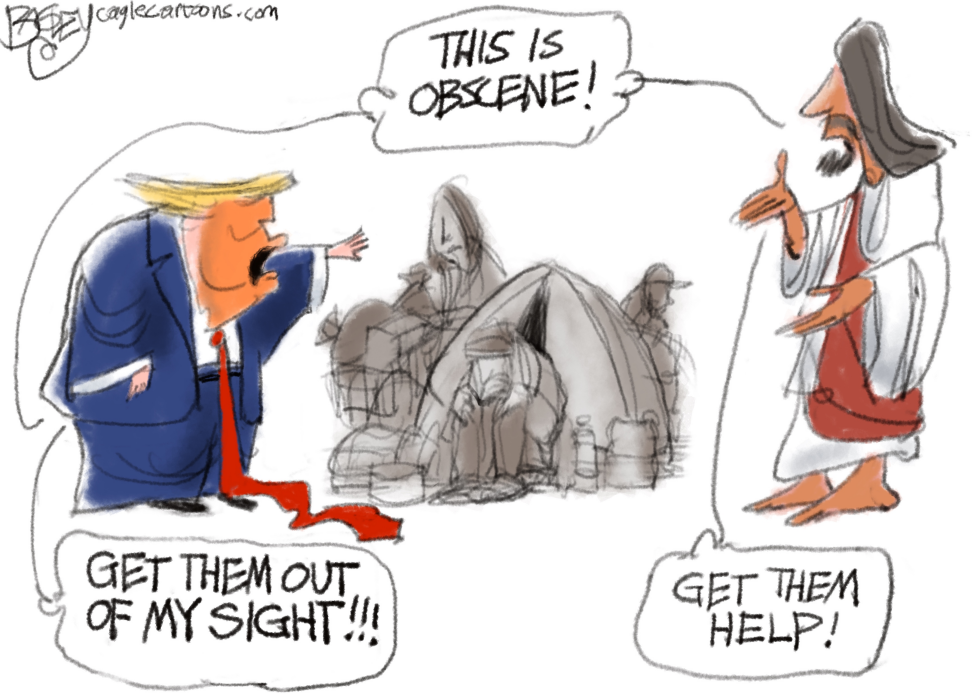
Pat Bagley's latest piece captures a stark contrast in this Trump homelessness cartoon, where a caricature in a blue suit and red tie gestures furiously at a cluster of makeshift tents and huddled figures, declaring the scene obscene and demanding their removal. On the right, a long-haired, bearded man in a white robe and red sash extends a hand, advocating to get them help instead. The homeless crisis political humor underscores differing approaches to urban plight, with the Trump Jesus contrast cartoon highlighting themes of expulsion versus empathy. Such editorial cartoon homelessness policy works often spark debate on societal responses, blending sharp lines and simple composition for maximum impact in satirical take Trump compassion.
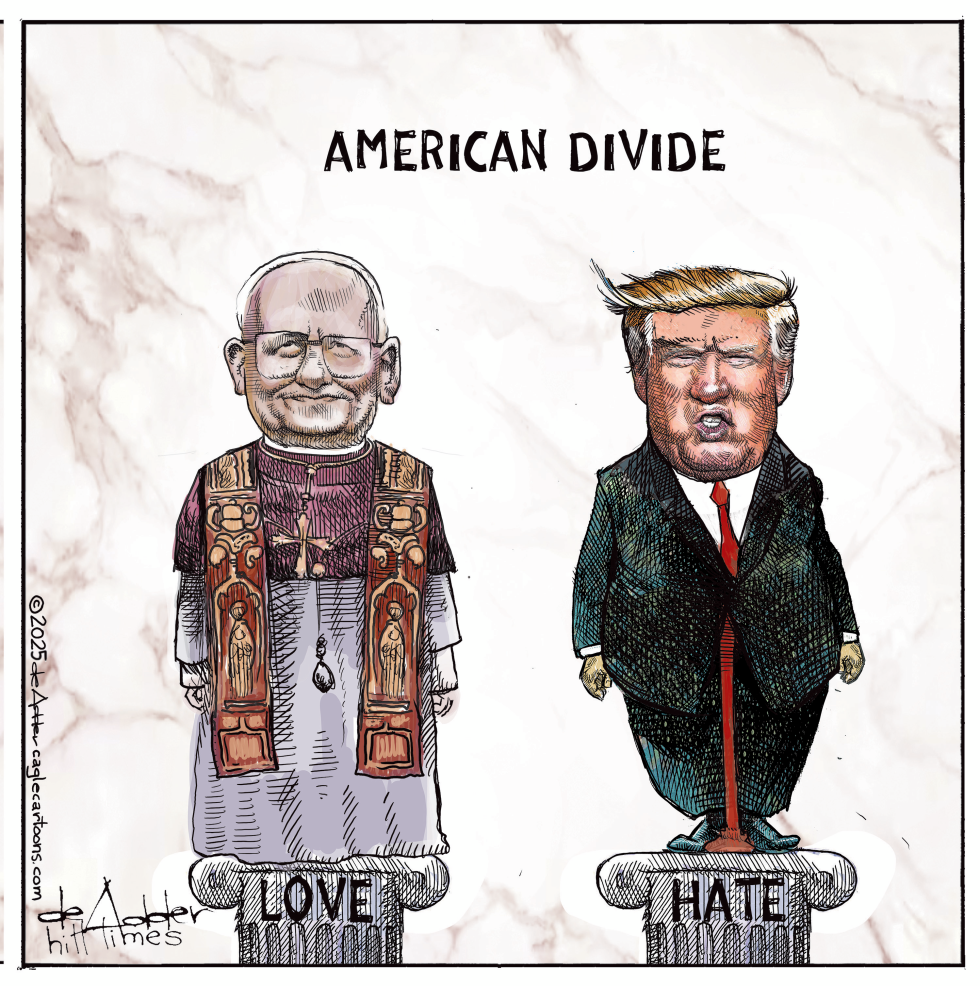
Michael de Adder's cartoon titled 'American Divide' shows a bald, bespectacled pope in ornate robes on a pedestal marked 'LOVE,' facing a caricature of Donald Trump in a suit on a pedestal marked 'HATE.' The marble background adds a classical touch to this commentary on polarization. Tags such as Trump, Pope, Leo XIV, Hate, Love, Vatican, Washington, USA capture the essence of contrasting figures representing opposing values in American society. The image highlights the divide between messages of compassion and animosity, with Trump, Pope, Hate, Love, USA emphasizing the cultural and political rift.