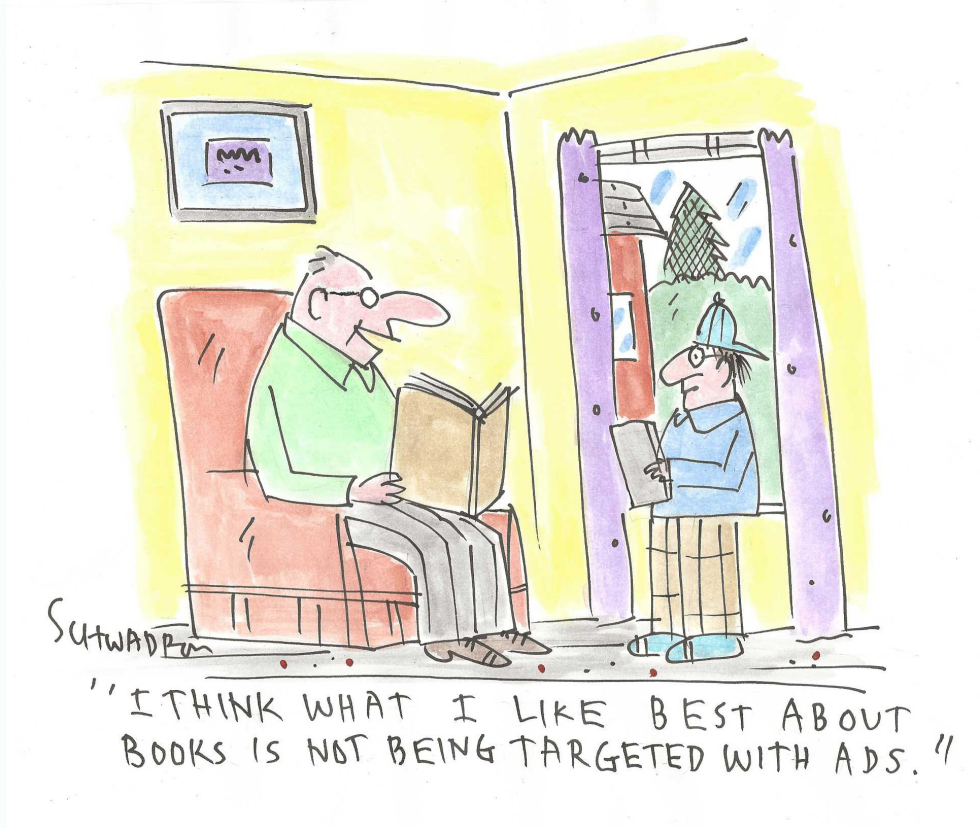
An elderly reader seated comfortably expresses a clear preference for traditional books precisely because they spare him from targeted advertising that follows users across digital platforms. The comment underscores a broader tension between print media and online content delivery systems that rely on data tracking. The piece takes the position that this ad-free quality remains one of books' strongest advantages in an era of constant commercial interruption.
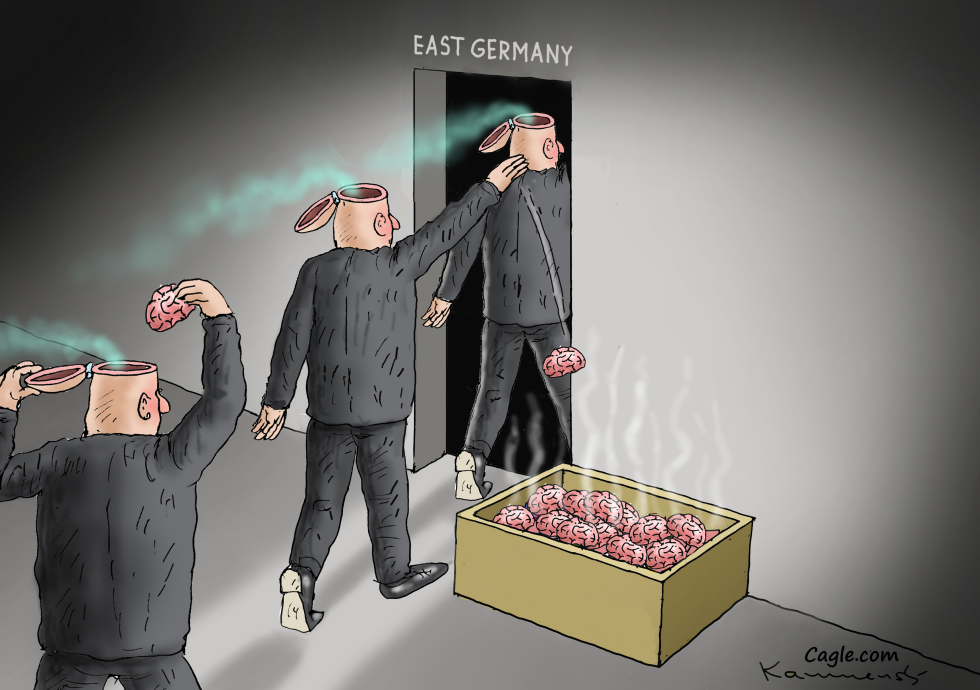
The cartoon responds to the enduring perception of East Germany as a place where independent thought is incompatible with entry. It depicts men voluntarily removing their brains before crossing the threshold. The editorial position frames the regime as one that demands the surrender of reason.
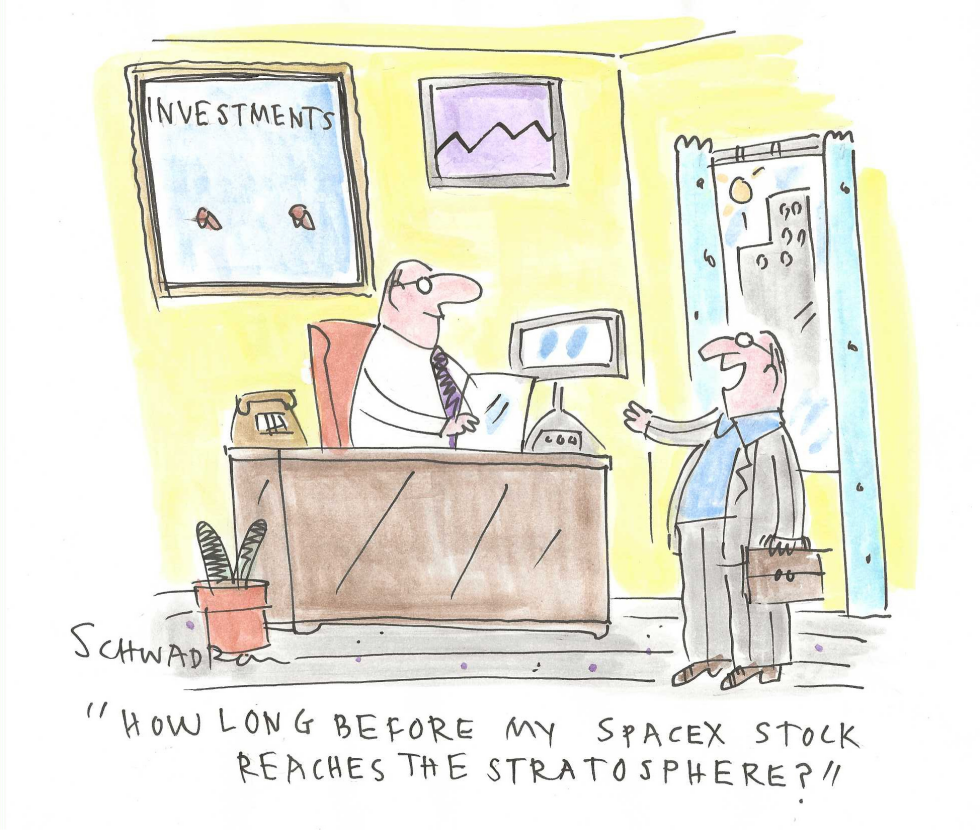
An investor meets with a financial advisor to discuss prospects for SpaceX shares. The private company remains a focal point for those tracking high-growth technology firms. The exchange highlights ongoing interest in valuation and future returns for such holdings. The piece frames the inquiry around expectations of substantial gains. It underscores the speculative nature of investing in non-public aerospace ventures.
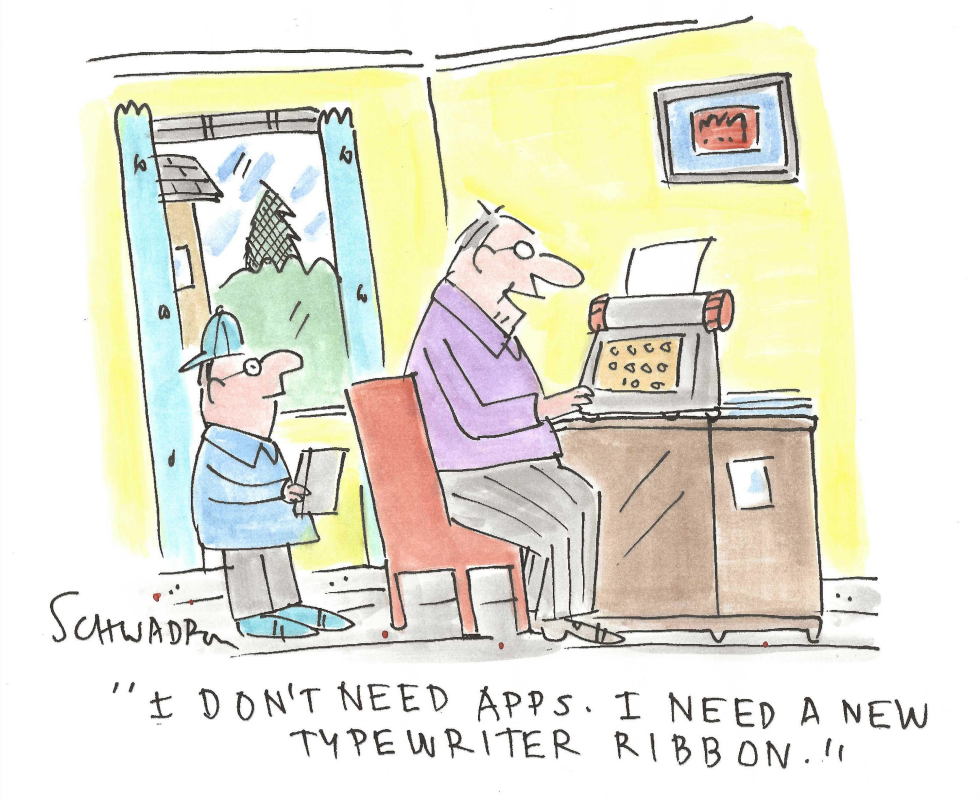
An elderly office worker continues using a manual typewriter despite widespread adoption of digital applications. The man explicitly states he requires only a replacement ribbon rather than any software tools. This reflects an ongoing generational divide where some older individuals maintain preference for analog equipment amid accelerating workplace digitization. The editorial highlights the persistence of traditional methods against pressure to adopt new technology.
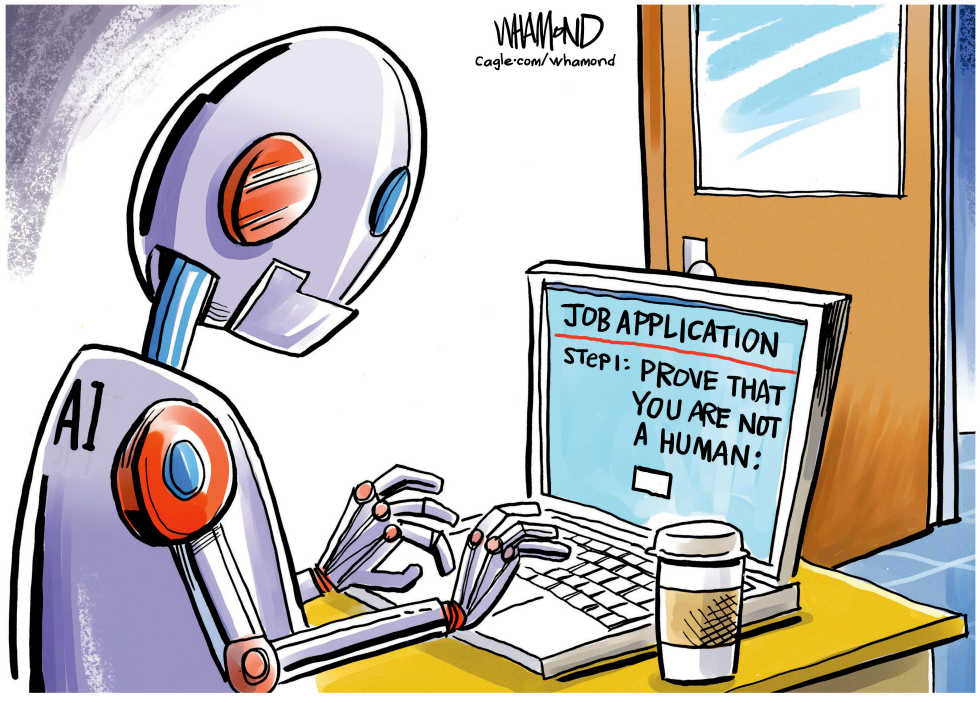
An AI robot applies for work by attempting to prove it is not human on a job application form. The scenario reflects ongoing debates over how rapid advances in artificial intelligence are reshaping labor markets and displacing workers. The piece takes the position that this reversal underscores the absurdity and speed of automation replacing people.
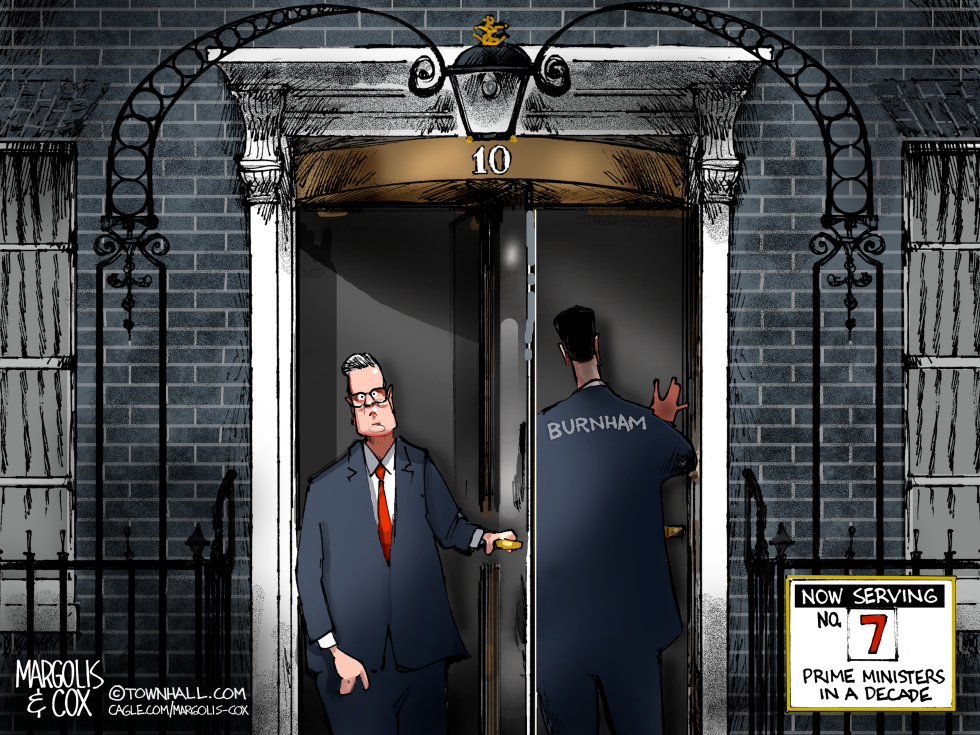
Keir Starmer exits the revolving door at 10 Downing Street while Andy Burnham enters from the opposite side. Starmer wears a dark suit with a red tie and glasses. Burnham has his name printed on the back of his jacket. A sign in the corner reads now serving number seven prime ministers in a decade. The image shows rapid leadership turnover at the United Kingdom government headquarters. It responds to ongoing political instability marked by multiple changes in the prime minister position over the past ten years, with the latest transition from Starmer to Burnham continuing the pattern of short tenures in the role.
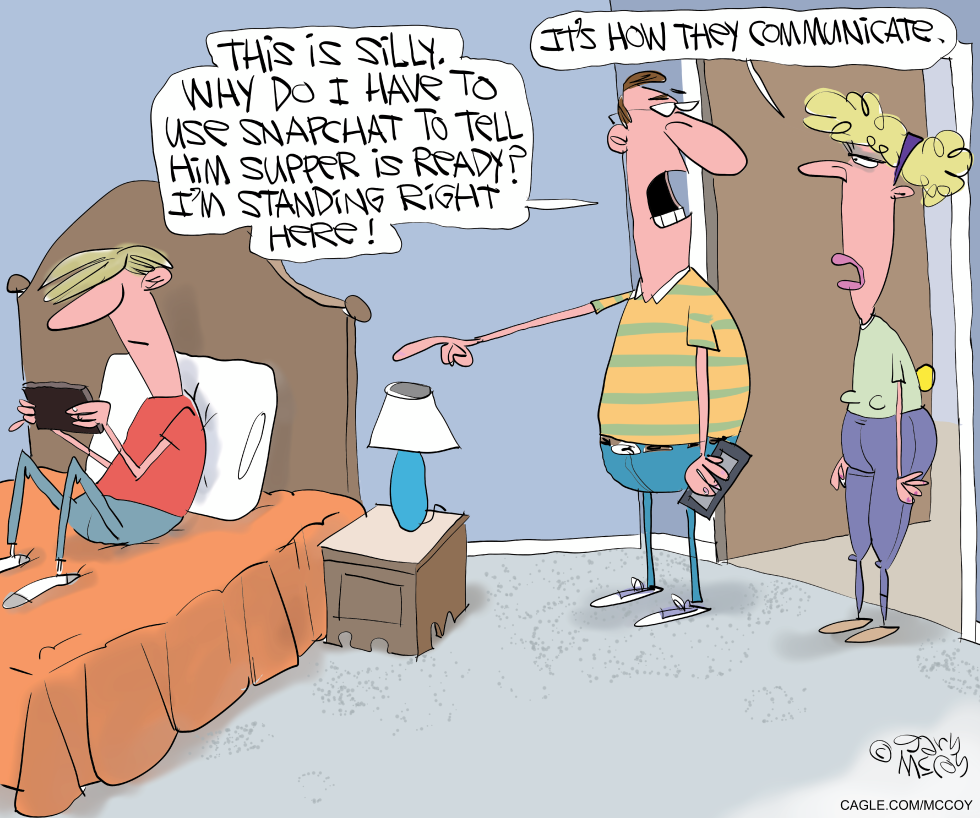
Parents increasingly rely on messaging apps to reach children inside the home rather than speaking directly. The practice reflects broader shifts in how families interact amid constant device use. The cartoon takes the position that this reliance on digital tools for routine matters like calling someone to supper has become normalized even when unnecessary.
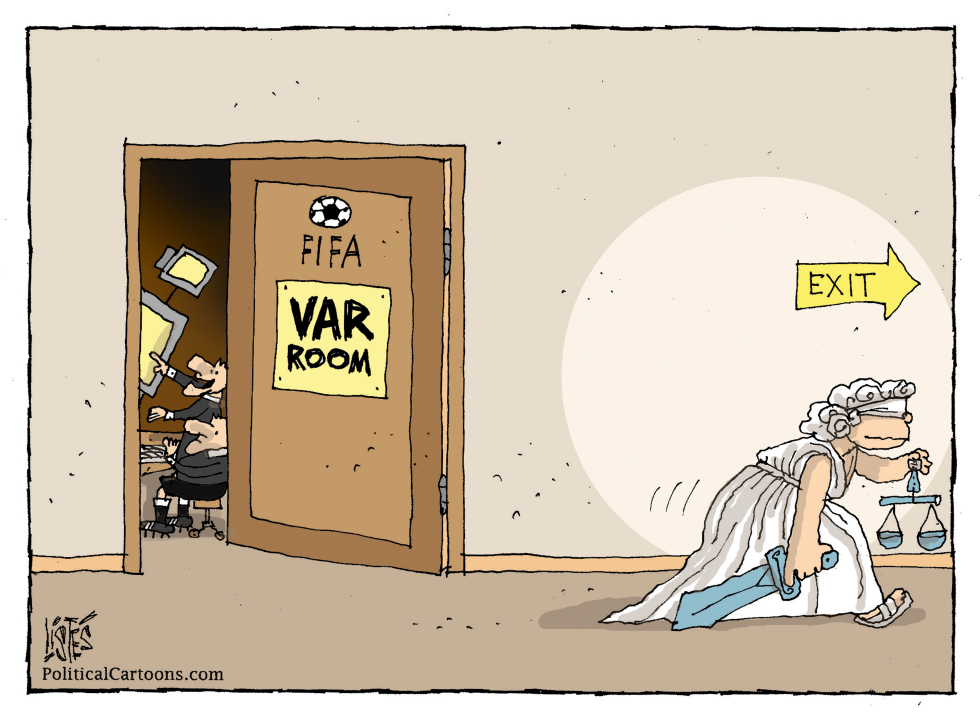
Lady Justice leaves the FIFA VAR room in the image dated July 14 2026. She carries tilted scales and a sword while walking toward a bright exit sign. Inside the open doorway referees examine multiple screens under a soccer ball emblem on the door. The scene shows the figure moving rightward with motion lines near her feet.
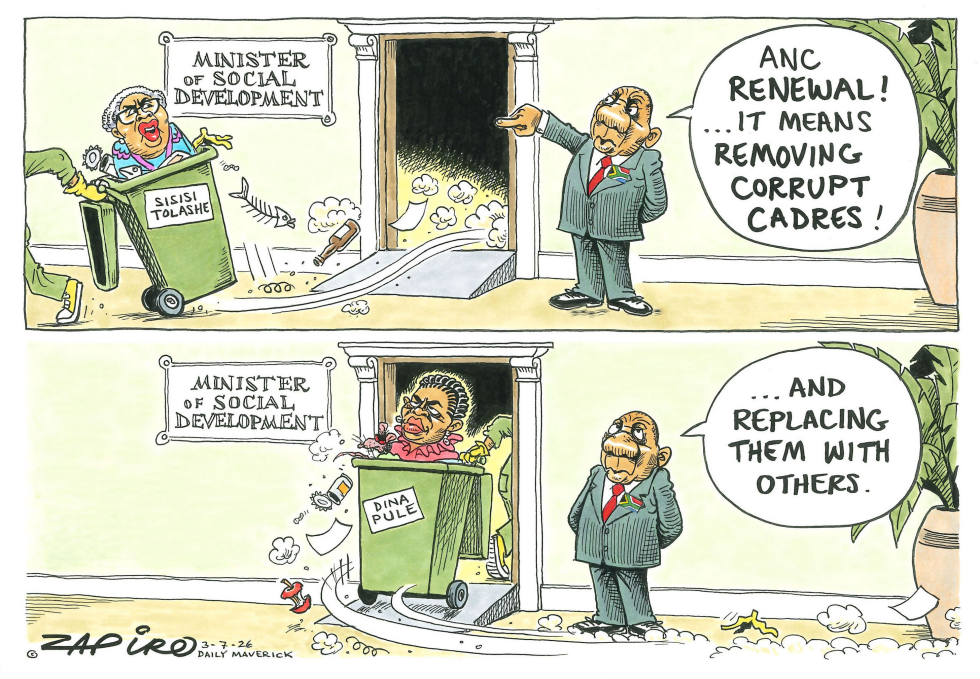
Zapiro's July 2026 cartoon mocks ANC renewal claims by showing the Minister of Social Development post swapped from Sisisi Tolashe to Dina Pule, with the party figure declaring removal of corrupt cadres only to replace them with others. The image responds to recent ANC efforts at internal reform and minister reshuffles in South Africa amid persistent allegations of cadre deployment and graft in government departments.
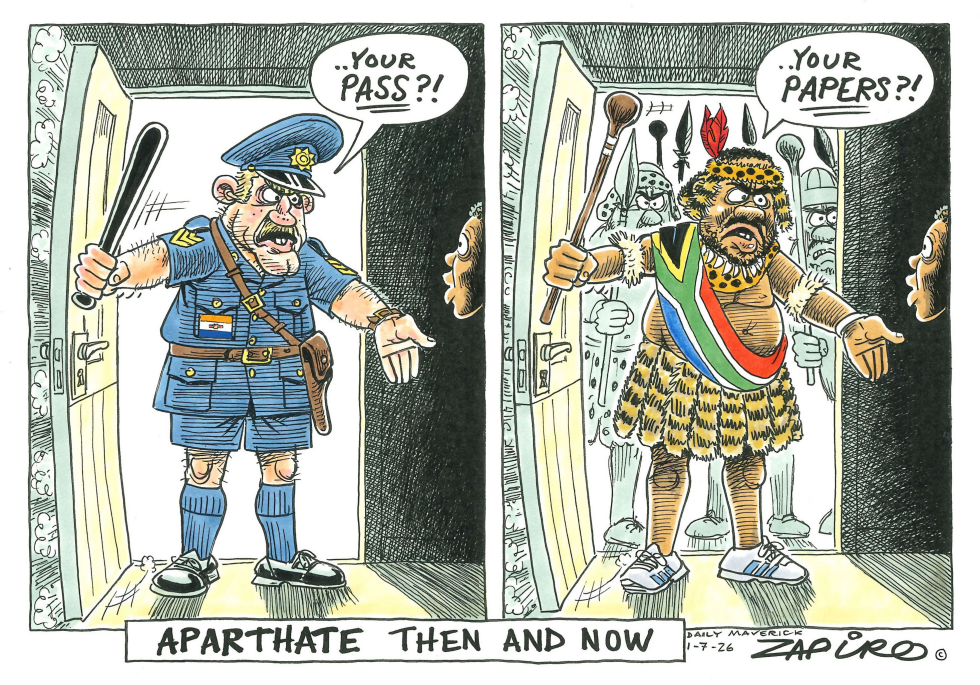
A two-panel cartoon contrasts a South African police officer in uniform demanding a pass during apartheid with a figure in traditional attire and South African flag sash making a similar demand in a modern setting. The bottom banner labels the comparison 'Apartheid Then and Now.' The work appears in the Daily Maverick dated 1-7-26 and is signed by Zapiro.
In this June 28, 2026 cartoon a mother and daughter stand in a doorway expressing alarm over the slumped father in the living room. The man wears a kilt, traffic cone hat, and Scottish flag socks while surrounded by bagpipes and a Saltire. The mother states she doubts he can survive another four years without the Scots. The scene captures domestic worry tied to the father's evident attachment to Scottish symbols and attire.
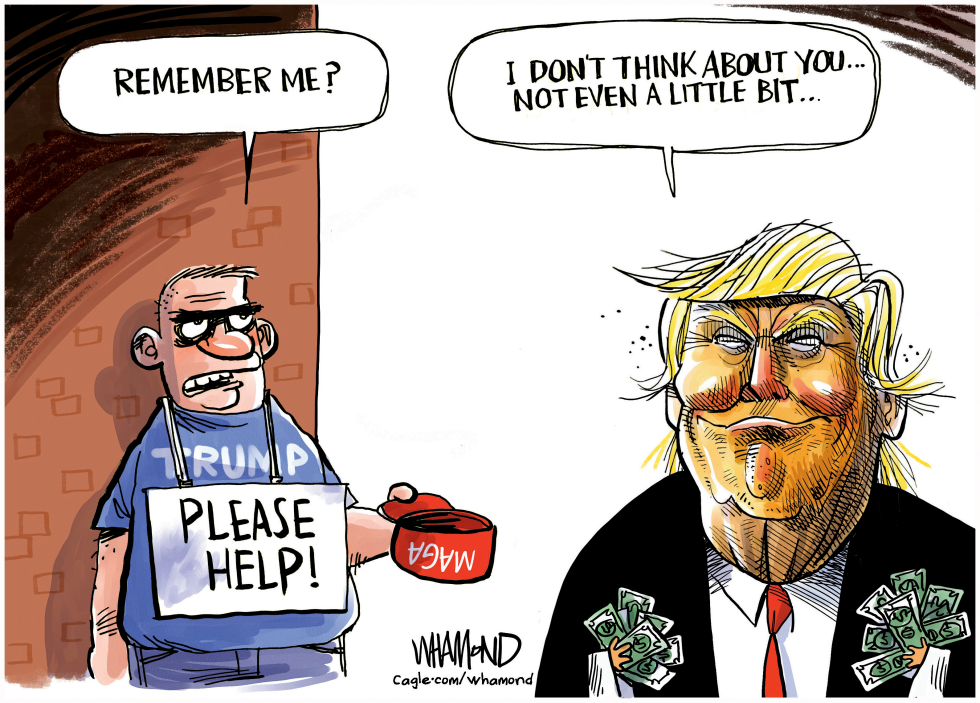
Visible in the cartoon are two figures facing each other. The left figure wears a blue shirt labeled trump, holds a white sign reading please help, and carries a red hat marked maga. The right figure has yellow hair, a black jacket with green bills protruding from pockets, and a red tie. Two speech bubbles display the phrases remember me and i dont think about you not even a little bit. The artist signature whamond and cagle.com/whamond appear at the bottom.
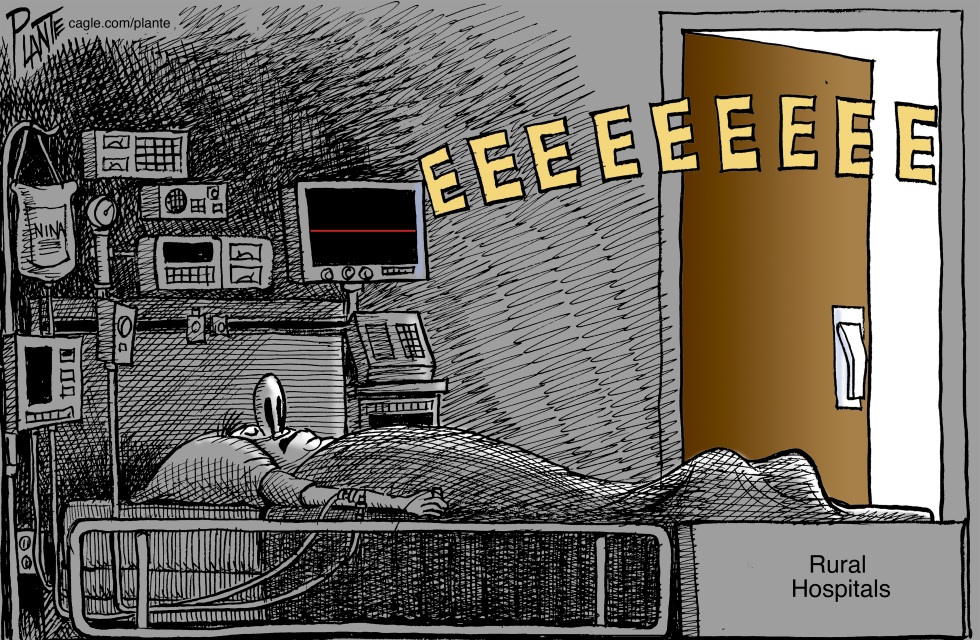
A hospital room scene depicts a patient lying in bed connected to monitors showing a flat red line. Medical equipment stands nearby including an IV bag marked NINA. Large yellow letters spell out a continuous tone across the upper portion of the room. An open doorway leads out beside the bed labeled Rural Hospitals at the base.
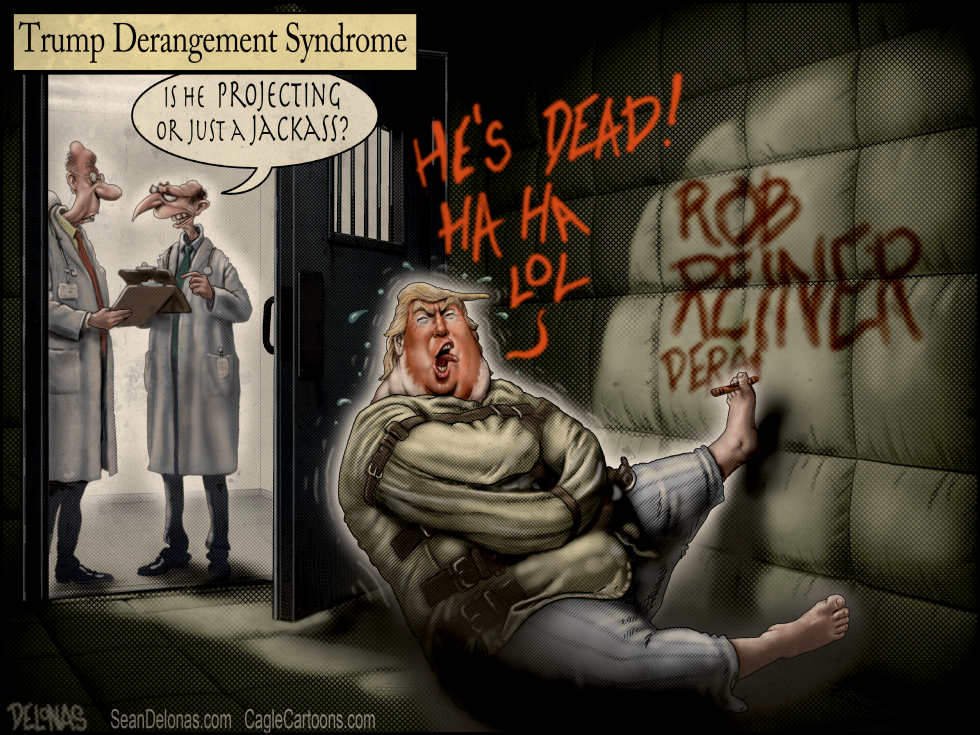
The cartoon depicts Donald Trump confined in a padded room wearing a straitjacket. He writes Rob Reiner's name and the word dead on the wall with a crayon. Red lettering above him declares the death with laughter. Two doctors stand outside the cell door. One asks whether Trump is projecting or merely a jackass. The banner labels the scene Trump Derangement Syndrome.
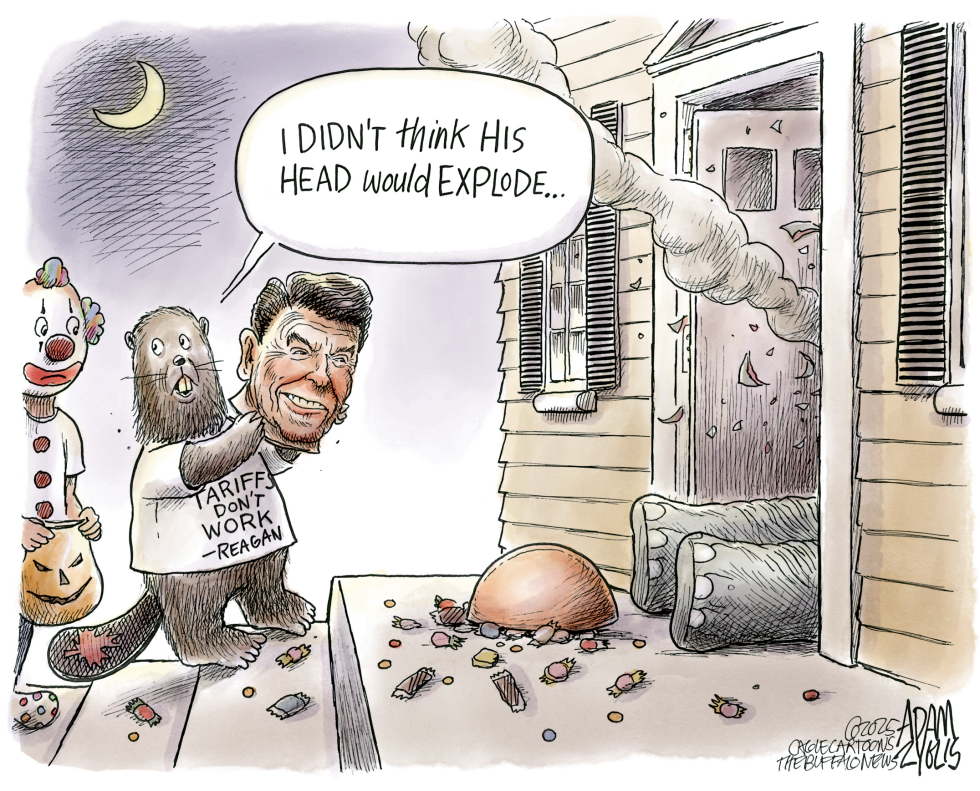
The cartoon depicts a beaver costumed as Ronald Reagan holding a prop head on a damaged porch while a clown stands nearby with a pumpkin bucket. Debris litters the steps after an apparent explosion inside the house. The beaver's shirt quotes Reagan against tariffs. The scene responds to recent Ontario ads criticizing proposed tariffs and their economic effects on Canada-US trade relations around late October 2025.