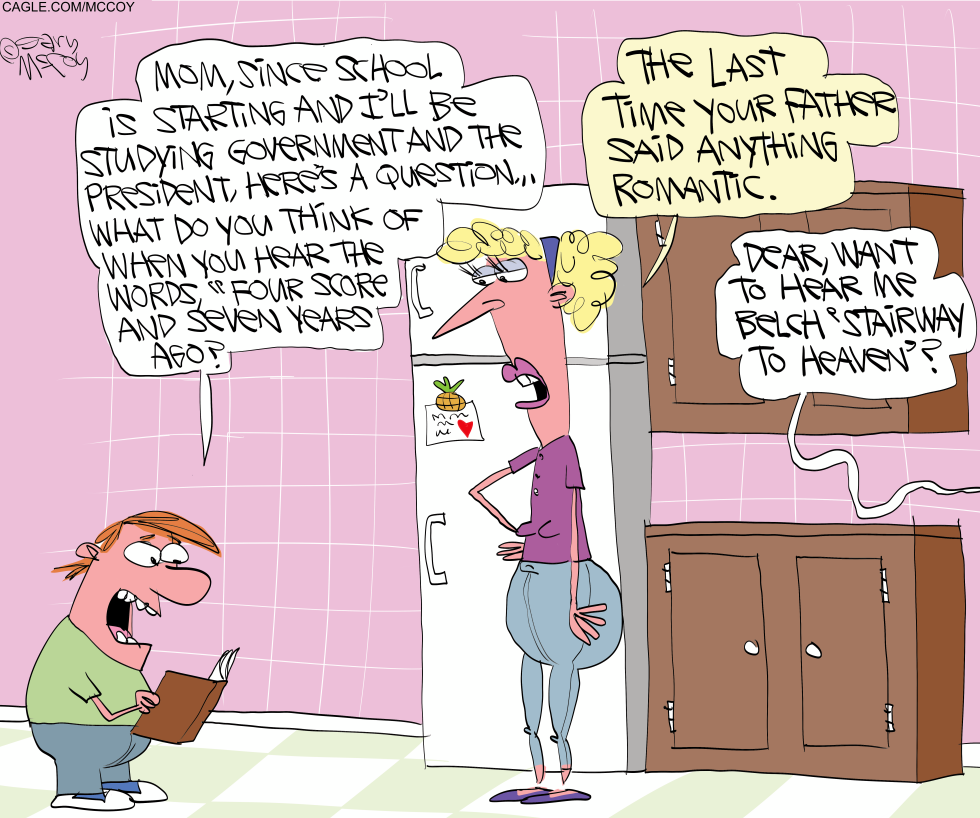
A child preparing for school asks his mother what she thinks of upon hearing Lincoln's famous opening line from the Gettysburg Address. Her reply points directly to the last time her husband said anything romantic. The father, hidden in a kitchen cabinet, responds by offering to belch the lyrics to Stairway to Heaven. The exchange highlights an ongoing household dynamic of mismatched expectations around affection and daily behavior.
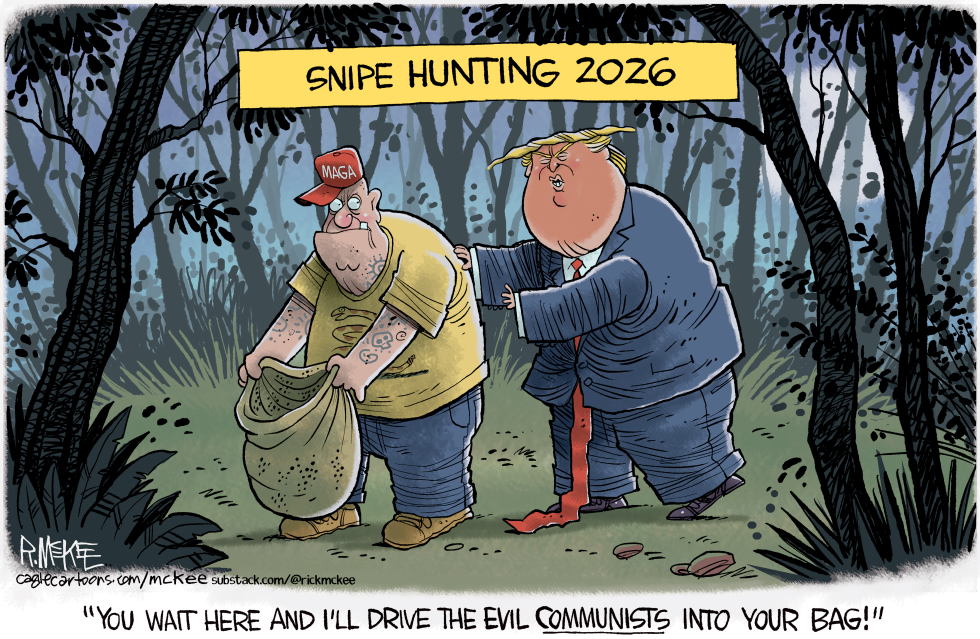
Donald Trump appears in a wooded setting with a MAGA supporter holding an open bag. Trump gestures ahead and vows to drive evil communists into the trap. The image frames the effort as a classic snipe hunt, highlighting the futility of the promised purge.
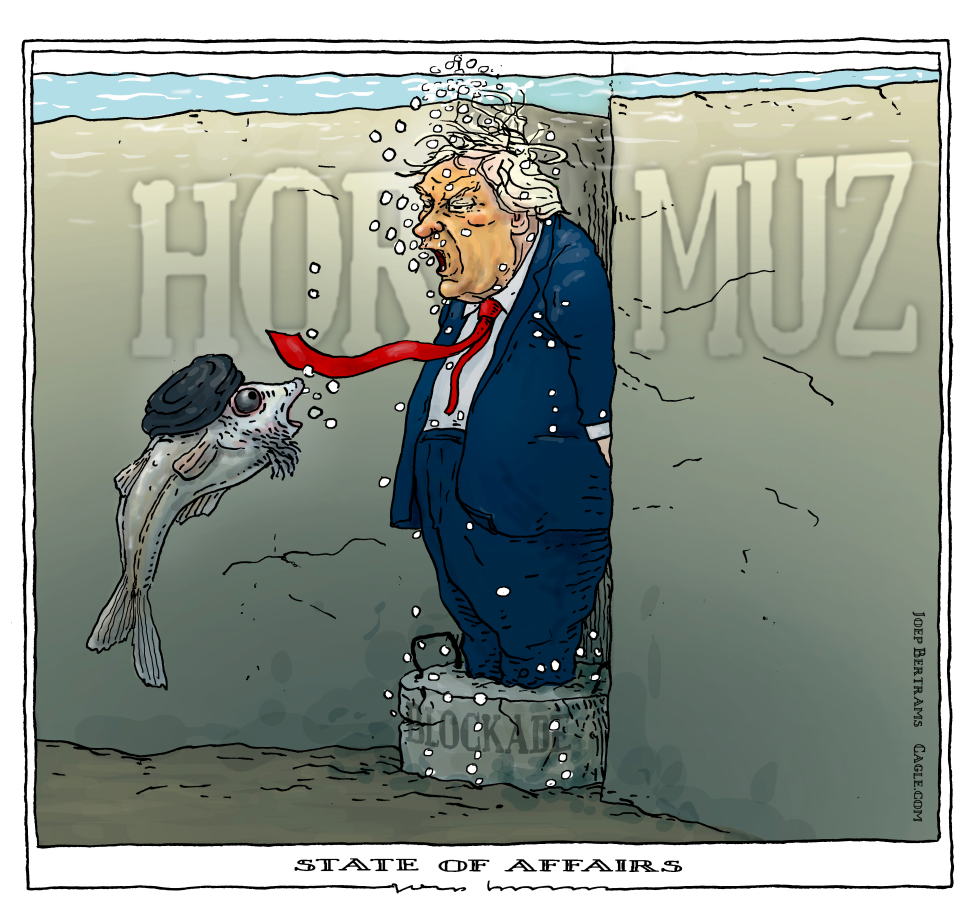
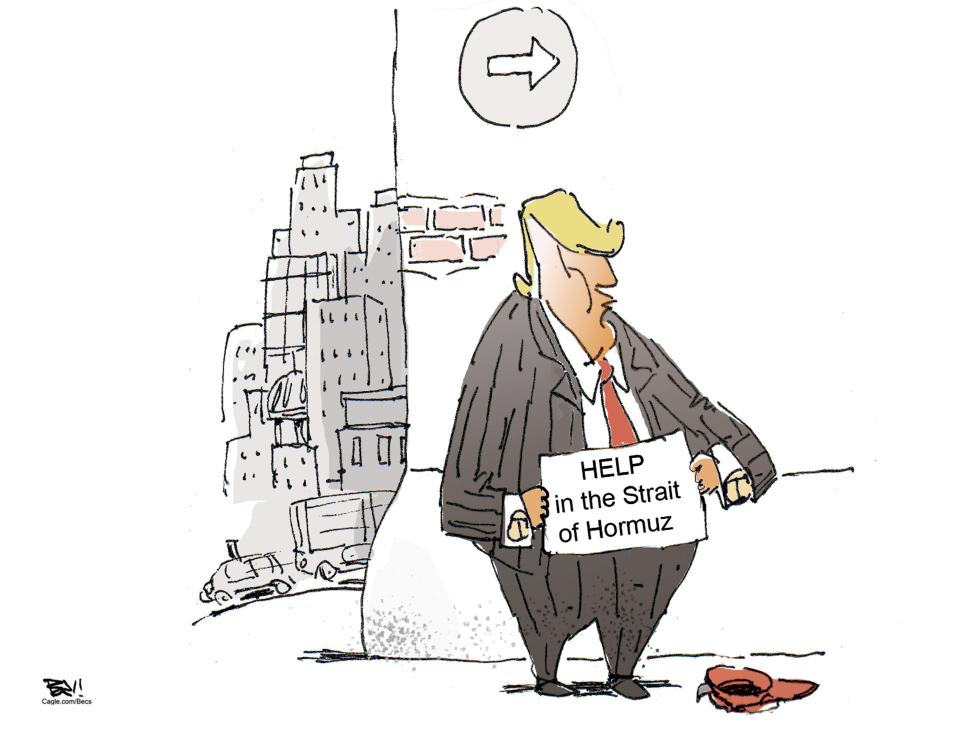
Joep Bertrams captures the Strait of Hormuz tensions with a caricature of Donald Trump sinking in concrete shoes marked blockade, bubbles rising from his open mouth as a fish in a black hat nibbles his red tie. The underwater setting features a cracked wall labeled Hormuz, emphasizing the sunk metaphor for diplomatic failures. Tags like Iran, concrete shoes, and fish highlight the satirical take on US-Iran relations, with the caption State of Affairs underscoring the dire situation. This cartoon from 2026 blends humor and commentary on potential blockades, showing Trump in a blue suit against a murky seabed.
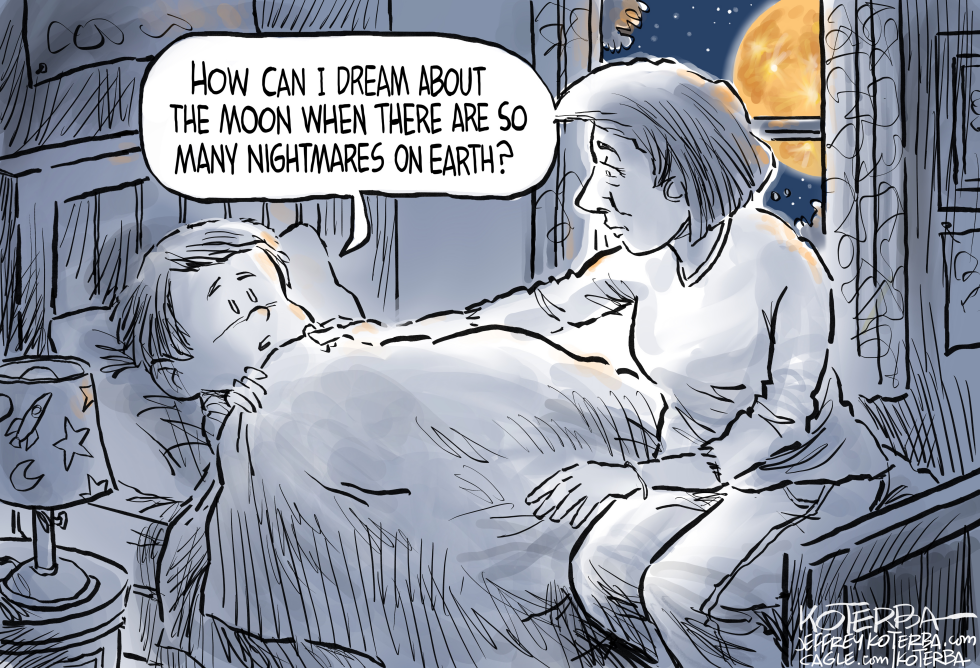
This poignant political cartoon depicts a child in bed, gazing toward a window framing a massive orange moon against a starry night sky, while confiding in a seated adult figure. The child's speech bubble reads: 'How Can I Dream About The Moon When There Are So Many Nightmares On Earth?' A bedside lamp with a star design illuminates the scene. Through this setup, the artwork satirizes how youth anxiety from global issues—like wars, climate woes, and social upheavals—stifles big dreams and aspirations. It's a clever commentary on how earthly nightmares eclipse celestial hopes, blending humor with insight into modern parenthood and childhood innocence lost. Tags: political cartoon, child nightmares, moon dreams, earth troubles, satirical illustration, youth anxiety, global chaos.
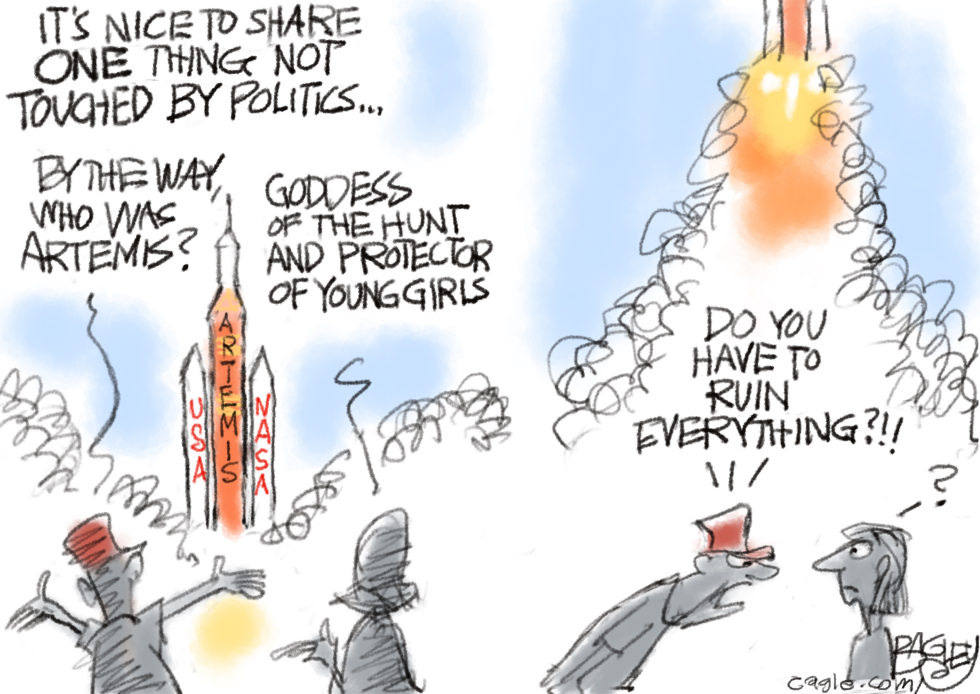
This political cartoon features a launching rocket labeled Artemis, SLS, NASA, and USA, with overlaid text praising one thing untouched by politics before asking about the goddess Artemis, described as goddess of the hunt and protector of young girls. A figure exclaims frustration at ruining everything, satirizing how even space missions get dragged into cultural debates. The irreverent sketch uses humorous figures with red hats to poke at over-politicization in science, blending mythology with modern rocketry in a witty critique. Tags like Artemis rocket launch political cartoon, NASA SLS Artemis mission satire, and politics invading science editorial cartoon underscore the cartoon's sharp insight into societal divisions spilling into apolitical realms like space exploration politicized cartoon.
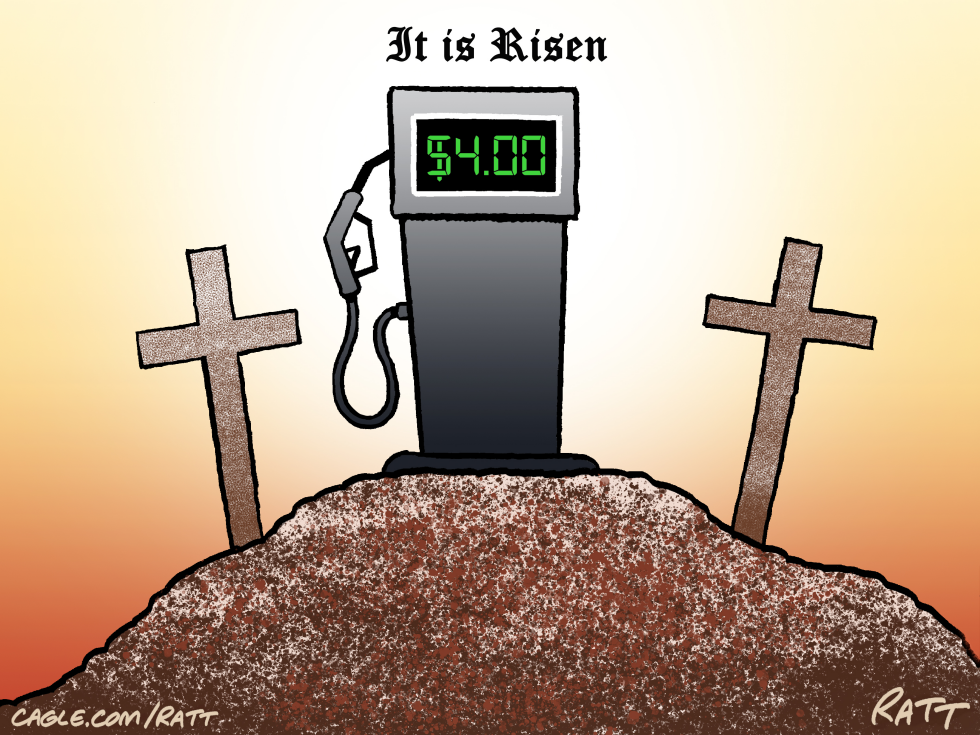
Ratt's cartoon captures Easter in America 2026 with a gas pump standing in for the central cross on a Calvary hill, showing $4.00 on its display and the text 'It is Risen' above, playing on rising gas prices. Tags like Easter, gas prices, oil, Iran war, and Strait of Hormuz suggest a future where geopolitical tensions drive fuel costs skyward. The artwork uses simple lines and a sunset background to evoke the biblical scene, but replaces resurrection with economic pain. This satire highlights how global events, including potential conflicts in the Strait of Hormuz, could lead to exorbitant oil prices by 2026. The dry humor underscores American dependence on foreign oil, making the cartoon timely and shareable amid ongoing energy debates.
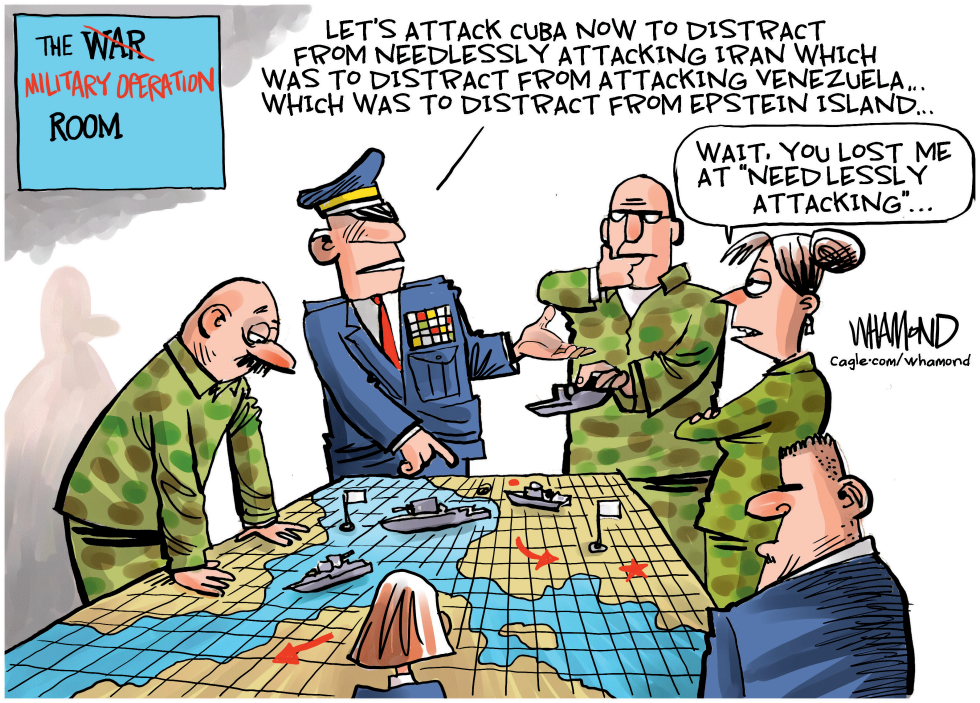
Dave Whamond's political cartoon depicts a group of military officials in a war room, gathered around a map with toy ships, discussing a chain of distractions starting from attacking Cuba to cover needless attacks on Iran, which distracted from Venezuela, looping back to Epstein Island. The scene captures the absurdity with one figure pointing at the map and another expressing confusion over 'needlessly attacking.' This satirical illustration uses dry humor to comment on convoluted military strategies and political diversions, incorporating elements like crossed-out 'War' sign replaced by 'Military Operation Room' for added irony. Tags like political satire, war distractions, foreign policy cartoon, Epstein Island reference, military humor, and endless distraction chain emphasize the cartoon's sharp critique.
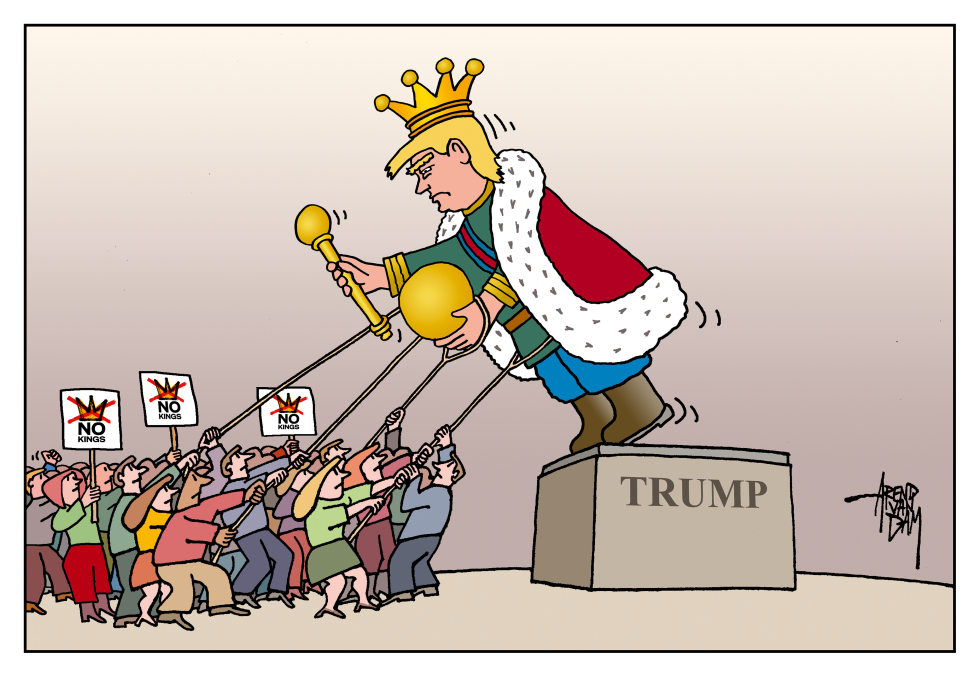
Arend van Dam's cartoon depicts a massive figure resembling Donald Trump, adorned with a crown and royal robe, perched atop a pedestal marked 'TRUMP.' A diverse group of protesters, holding signs reading 'NO KINGS,' 'NO,' and another 'NO,' tug on ropes attached to the figure's scepter, causing it to tilt as if being toppled in an act of resistance. The scene evokes themes of USA democracy clashing with autocracy, portraying a symbolic revolution against a would-be king or dictator. Protests and demonstrations fill the foreground, highlighting public outcry against unchecked power. Dated 2026, the artwork underscores ongoing concerns about authoritarian tendencies in politics.
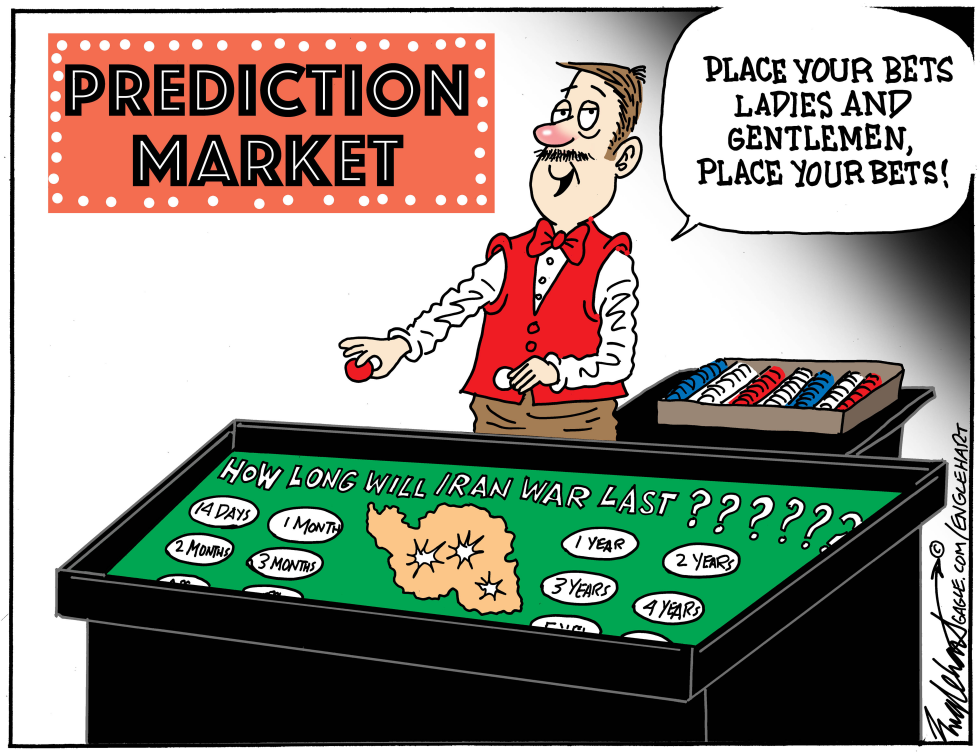
In a biting political cartoon, a smirking croupier oversees a prediction market table shaped like Iran, complete with explosion graphics, where punters can wager on war duration options ranging from 14 days to 5 years. This satirical take skewers the commodification of geopolitical betting, turning grave matters like Iran war into casino-style gambles. By blending elements of gambling on war with Middle East conflict, the artwork highlights the absurdity of prediction markets applied to real-world crises, offering humorous yet insightful commentary on how society speculates on political humor and potential catastrophes. The irreverent style underscores the folly of treating war length wager as just another market fluctuation.
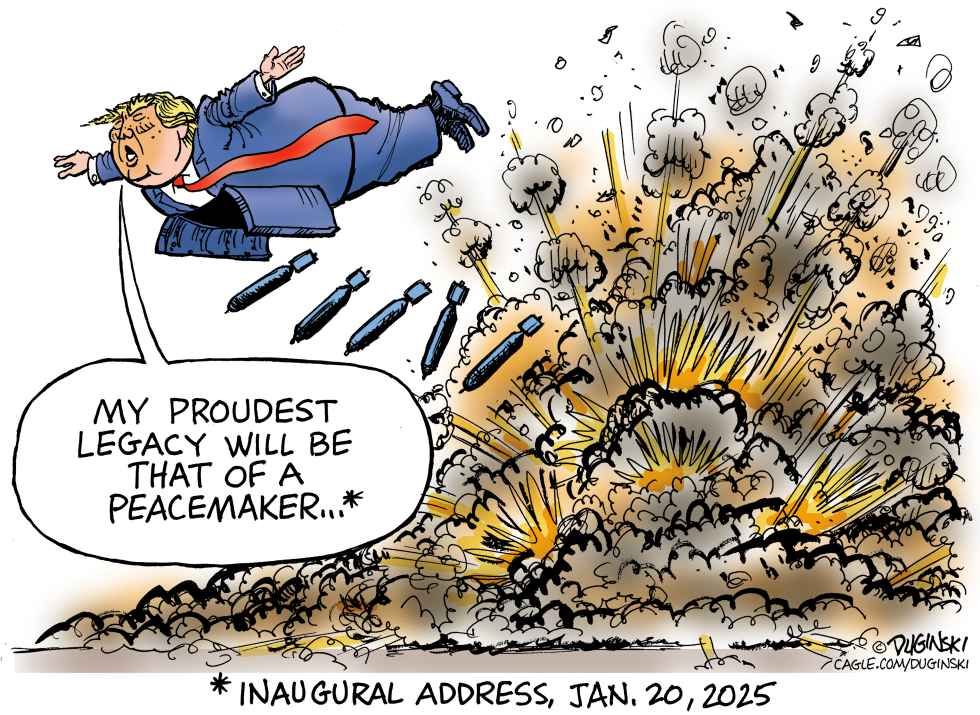
Duginski holds Trump accountable for his campaign promise to end wars within 24 hours of taking office. The Los Angeles Times illustrator catalogs the ongoing conflicts that remain unresolved. The broken promise imagery reflects sustained journalistic skepticism of Trump's foreign policy boasts.
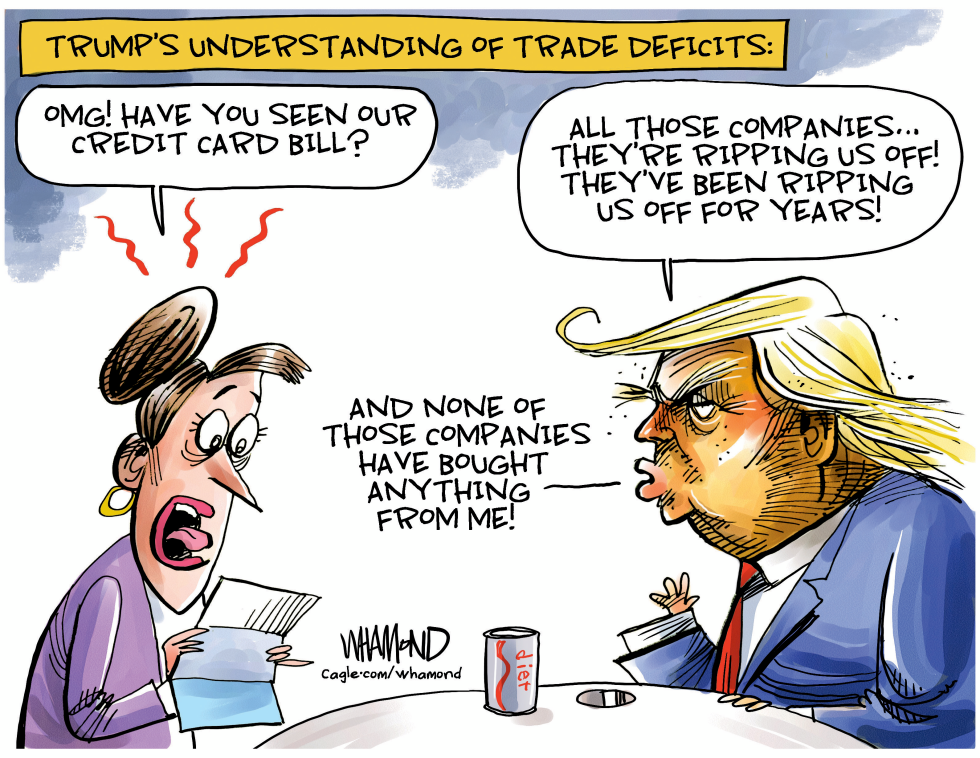
The August 2025 cartoon by Dave Whamond depicts Donald Trump misunderstanding trade deficits by comparing them to an unpaid credit card bill. Trump complains that companies have been ripping the US off for years and none have bought anything from him. The scene uses a domestic table setting to highlight the former president's focus on imports over balanced trade metrics like exports of goods and services.
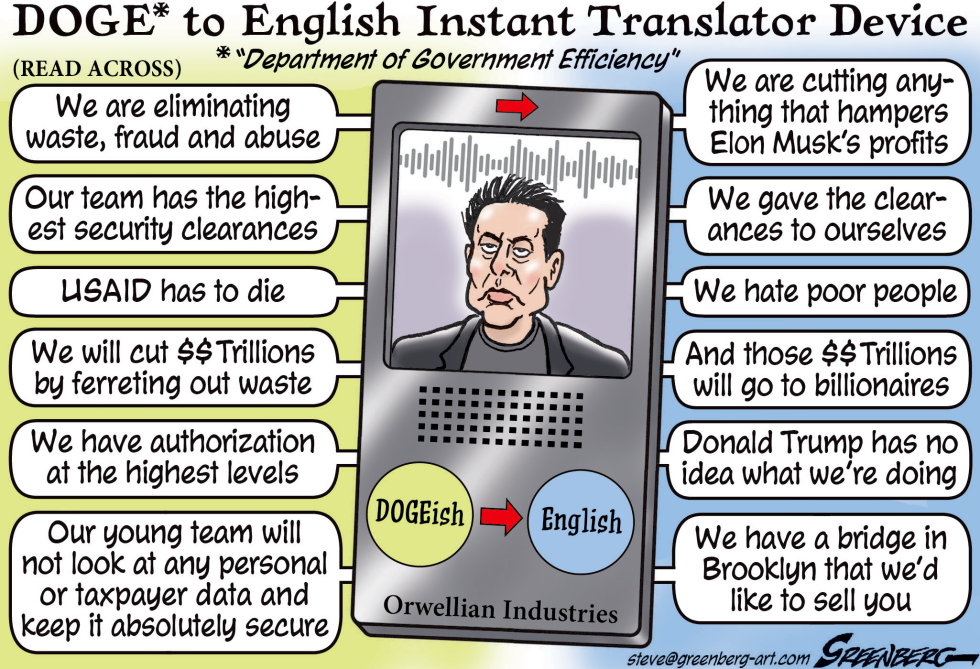
A political cartoon depicts an instant translator device branded with Elon Musk's face that converts statements from the Department of Government Efficiency into candid admissions. The left side lists official DOGE positions on eliminating waste and securing data. The right side provides translations suggesting cuts benefit Musk profits and billionaires. The device is labeled Orwellian Industries. The cartoon responds to recent DOGE activities involving USAID and federal data access as of February 2025.