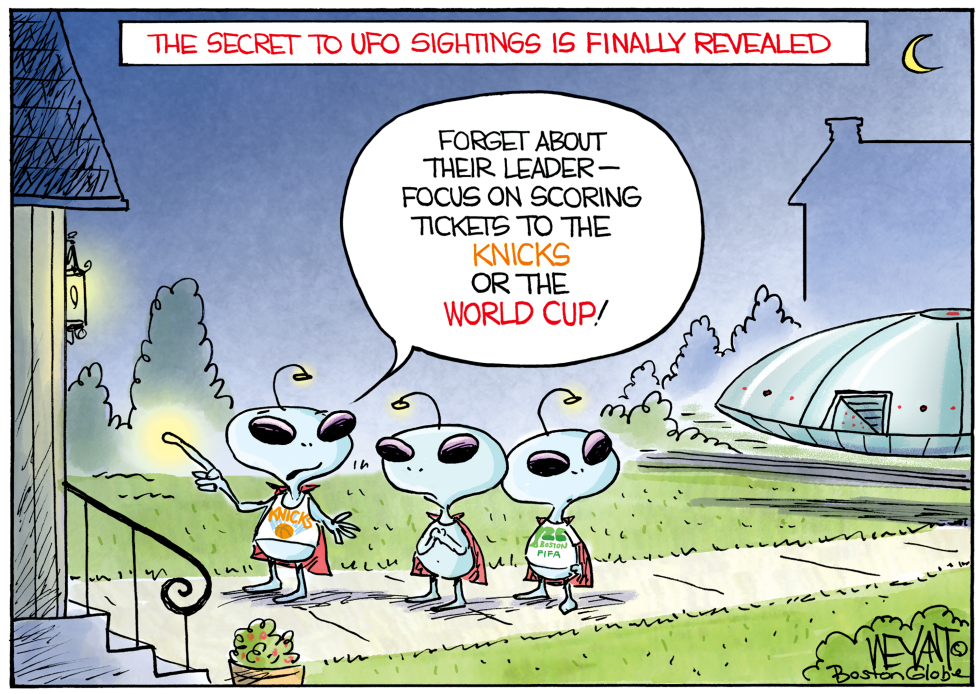
A cartoon published June 8 2026 shows three small aliens on a suburban lawn at night. One points toward a glowing house while a speech bubble urges focus on Knicks or World Cup tickets instead of their leader. A domed UFO rests on the grass nearby. The top banner states the secret to UFO sightings is finally revealed. The scene ties high demand for major sports events to unexplained aerial phenomena.
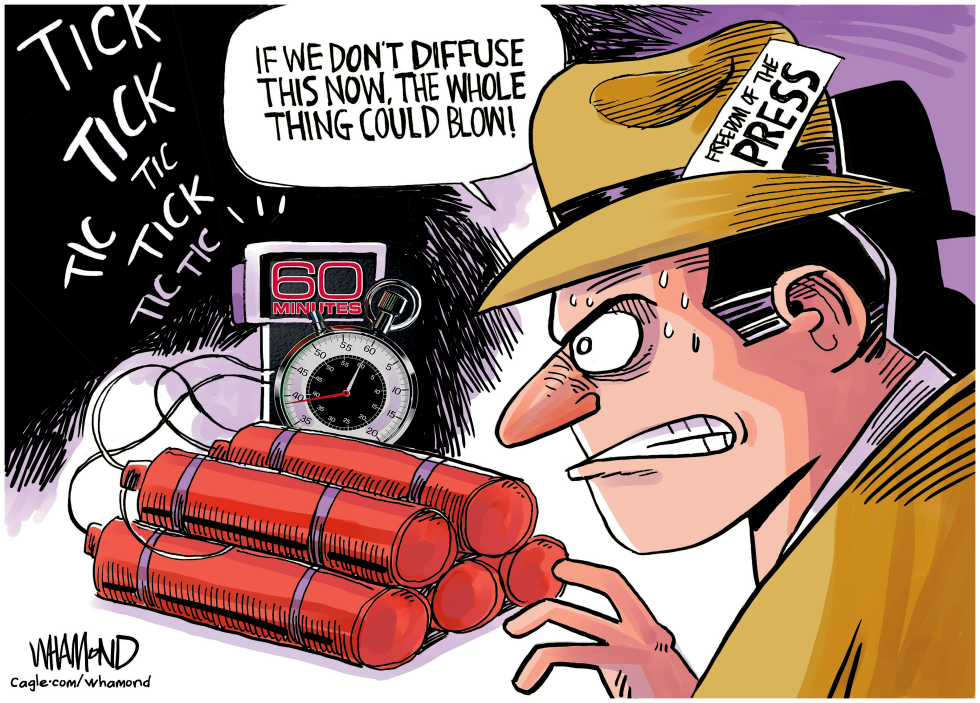
A sweating journalist wearing a Freedom of the Press hat leans over a bundle of dynamite sticks wired to a 60 Minutes timer. The timer ticks loudly as the figure warns in a speech bubble that failure to defuse the crisis will cause everything to blow. The image responds to reported turmoil at CBS News involving 60 Minutes correspondents and leadership changes at Paramount.
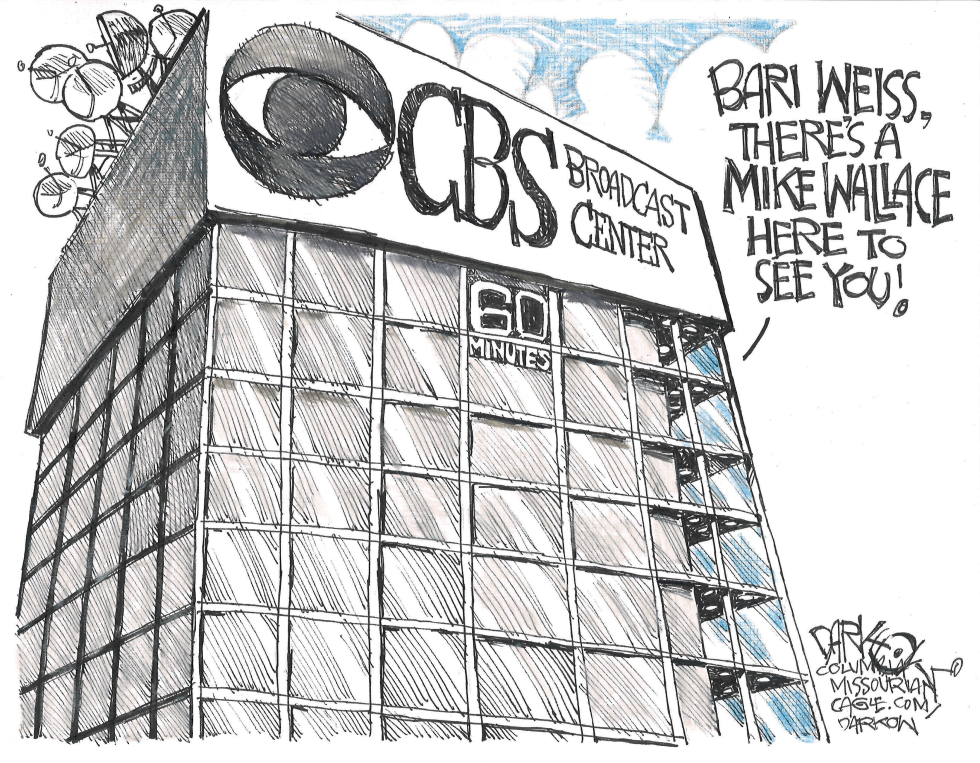
The drawing shows the CBS Broadcast Center in New York with its prominent eye logo and 60 Minutes signage. Large lettering on the right addresses Bari Weiss directly, stating a Mike Wallace figure has arrived to see her. The image appears amid reports of personnel changes and editorial disputes at CBS News in the spring of 2026.
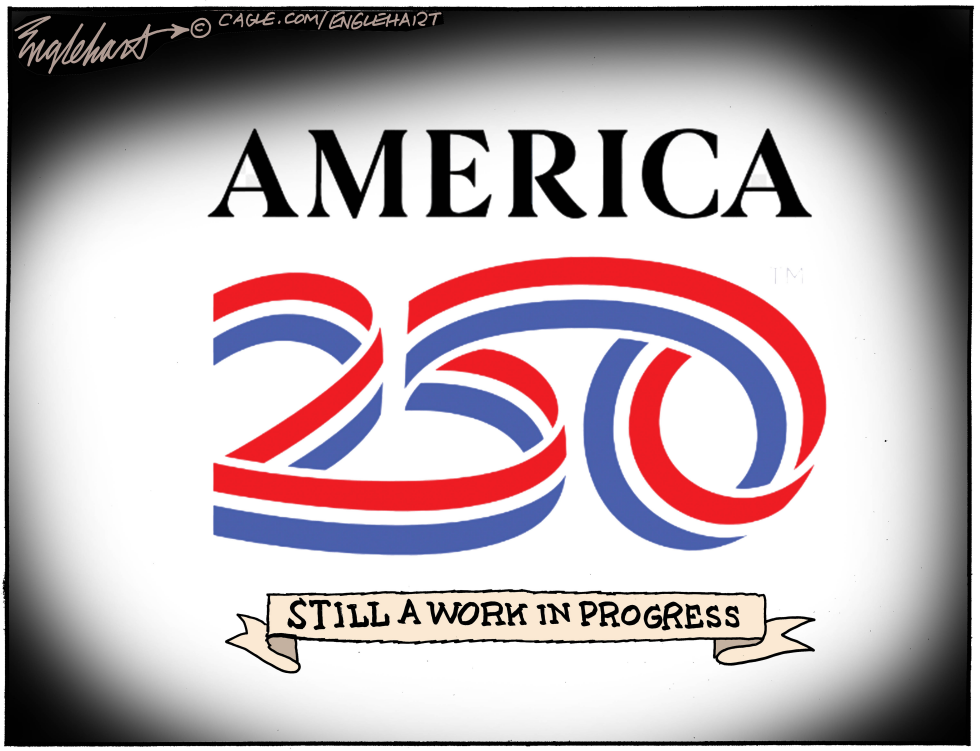
Bob Englehart's June 2026 cartoon marks America's 250th anniversary with a large stylized 250 in patriotic colors under the word AMERICA. A banner across the bottom reads STILL A WORK IN PROGRESS. The image ties directly to the upcoming semiquincentennial on July 4 2026 and offers a simple visual statement about the nation's continuing evolution.
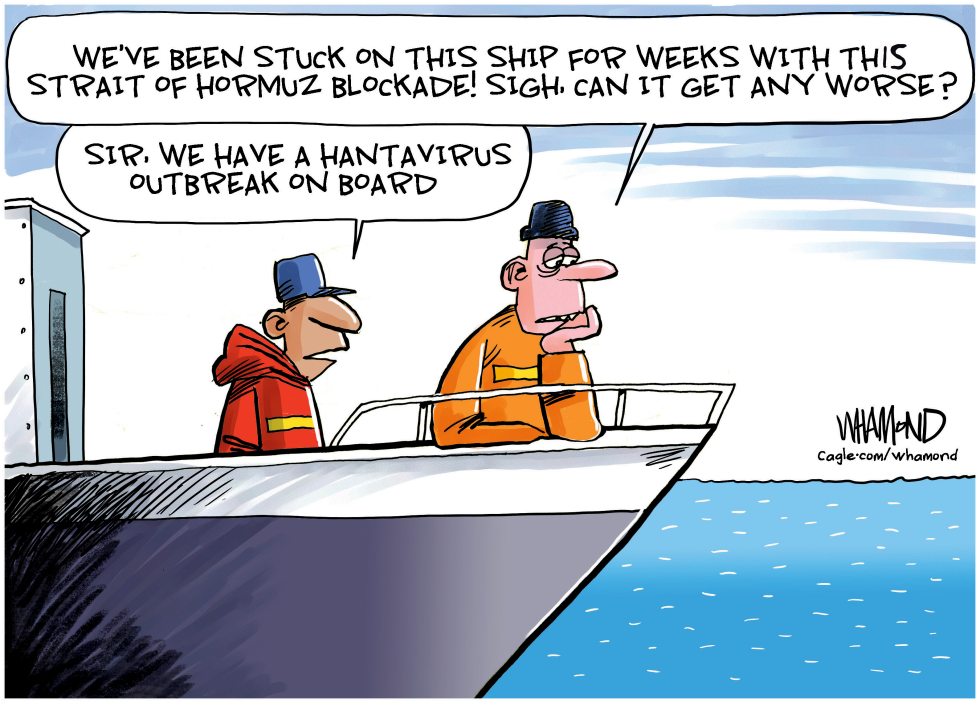
The cartoon depicts two sailors aboard a ship trapped in the Strait of Hormuz due to a naval blockade. One laments the weeks-long delay and wonders if conditions can worsen. The other reports a hantavirus outbreak on board. The image responds to ongoing tensions involving Iran and disruptions to global oil routes. As of the May 2026 publication date, the blockade has halted tanker traffic and strained energy markets. The added health crisis underscores the compounding risks for crews and supply chains. The visual ties geopolitical conflict directly to immediate human and economic consequences.
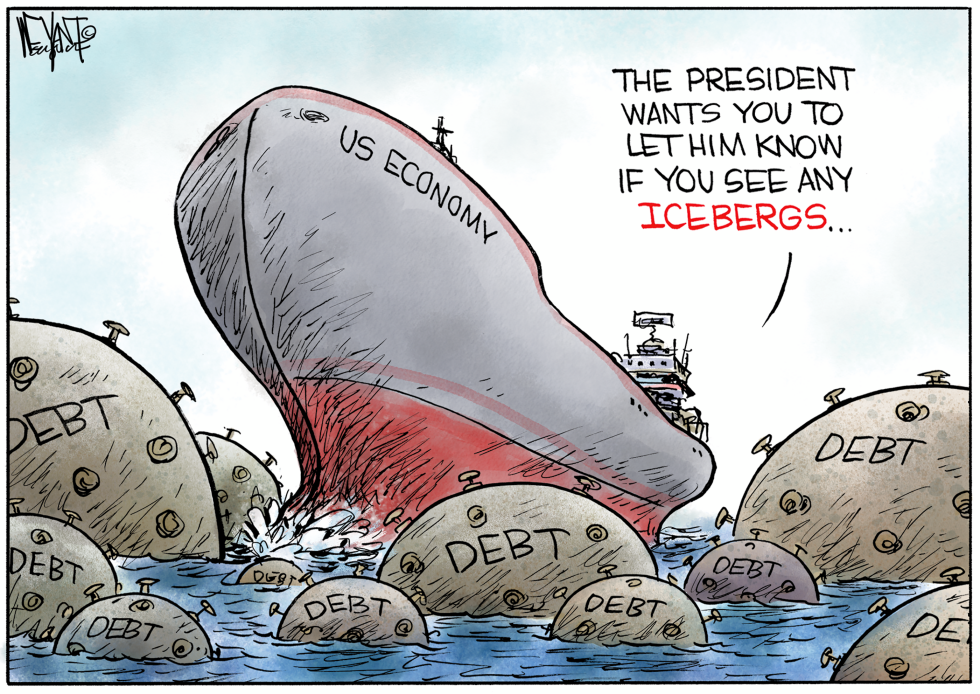
This political cartoon illustrates the US Economy as a massive ship labeled accordingly, dramatically sinking after colliding with numerous icebergs each marked 'DEBT.' A speech bubble from the ship warns to alert the president about icebergs, evoking the Titanic disaster in a clear metaphor for economic peril. Incorporating tags such as economy, debt, budget, inflation, prices, and costs, the image critiques fiscal irresponsibility. The artwork by Christopher Weyant uses simple lines and colors to emphasize the collision's impact, with water splashing and the ship's hull damaged. Such cartoons often highlight how mounting debt threatens stability, drawing parallels to historical maritime tragedies for satirical effect. The composition places the ship at an angle, surrounded by floating debt bergs, underscoring inevitable crisis if warnings go unheeded.
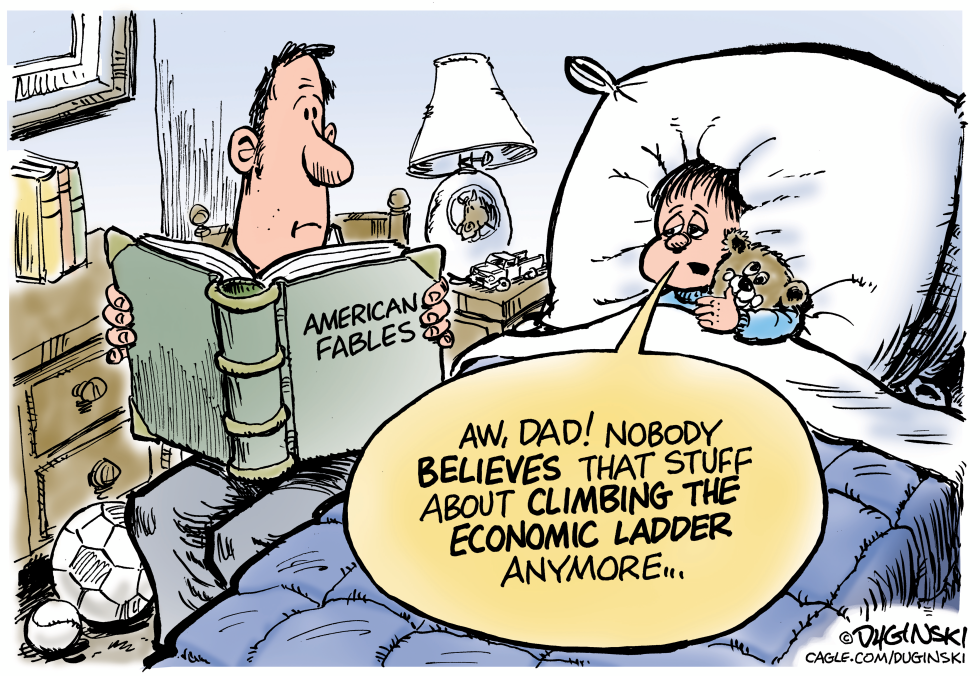
The image shows a father holding an open book titled American Fables beside a child tucked in bed with a teddy bear. The boy speaks from a large speech bubble rejecting the notion of climbing the economic ladder. A soccer ball rests on the floor near stacked books and a nightstand with a lamp and toy train. Tags include American Dream, climbing the economic ladder, upward mobility, cost of living, affordability, and inflation. The scene stays limited to these visible elements without added context.
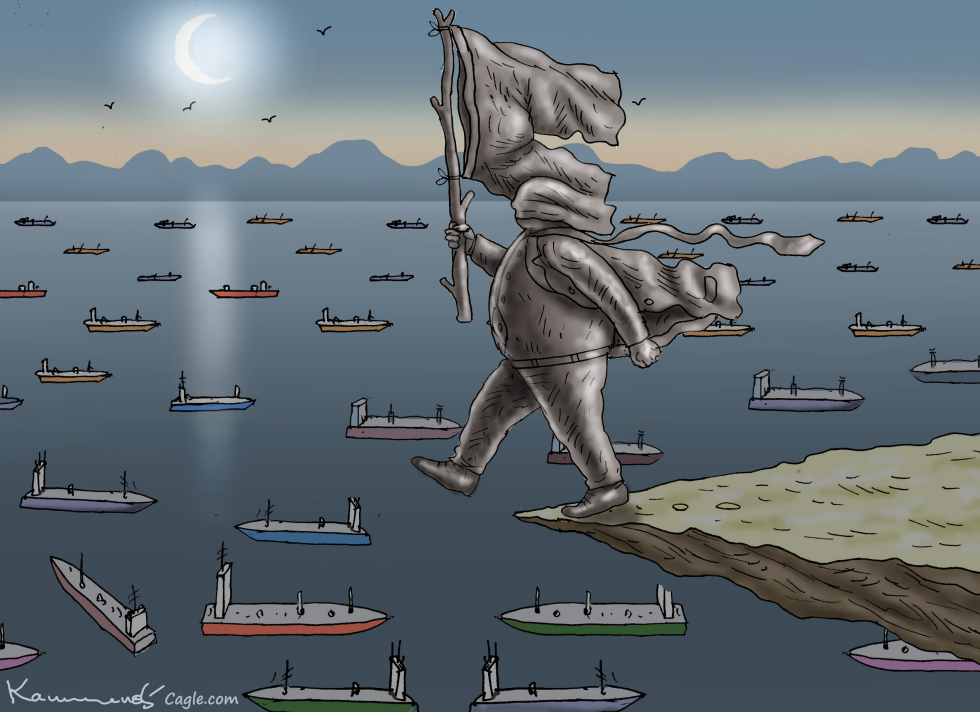
The cartoon shows a large, gray, statue-like figure with a hooded cloak, gripping a flag on a pole, as it steps forward off a cliff's edge. Below stretches a dark sea filled with many small ships of various colors, scattered across the water. In the background, mountains rise against a sky with a crescent moon and flying birds. The image, tagged with Banksy, Trumo, Hormuz, fascism, patriotism, and Maga terror, captures a moment of precarious advance. Artist Marian Kamensky signs it at the bottom left, linking to Cagle.com. This setup highlights a bold, unyielding march into potential downfall amid a busy maritime scene.
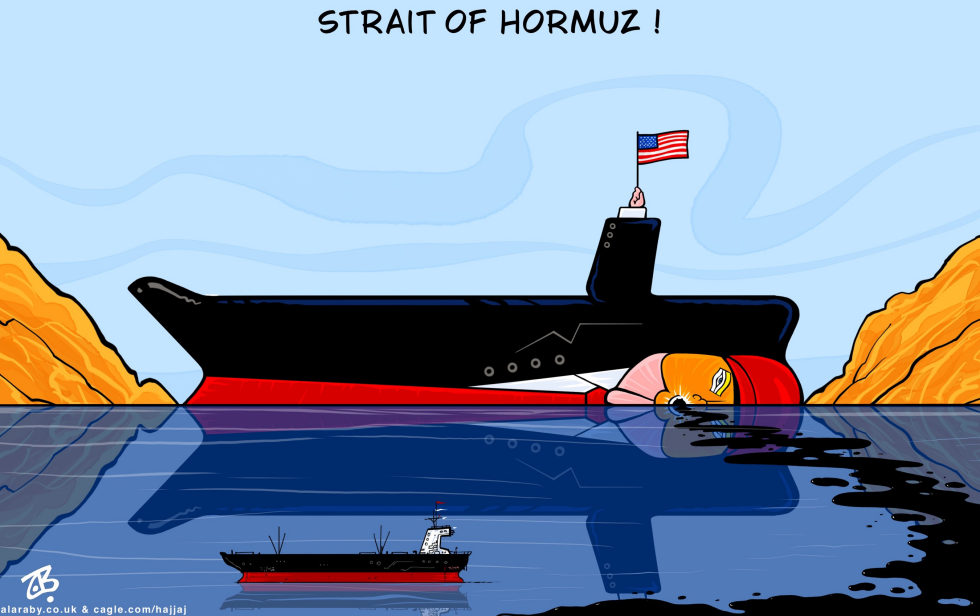
Emad Hajjaj's cartoon depicts a large black submarine with a red hull, stuck between orange landmasses in the Strait of Hormuz, its bow featuring an orange face with yellow hair and a red tie, clearly caricaturing Donald Trump. An American flag flies atop the vessel, while black oil spills into the blue water, reflecting the ship. Below, a smaller black tanker with a white figure onboard sails through the oily sea, tagged with Persian, Gulf, Sea, Tanker, Oil, War. The image satirizes US involvement in Middle East conflicts, particularly Iran war scenarios, without overreaching into hidden meanings. The composition is straightforward, with clear lines and bold colors emphasizing the blockage.
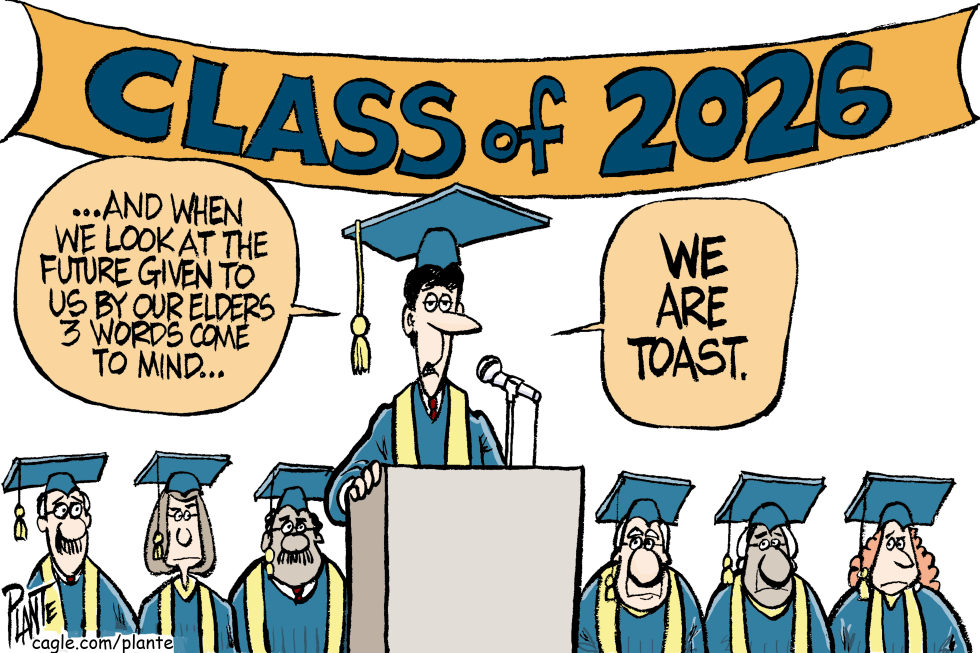
The cartoon shows a commencement speaker at a podium under a Class of 2026 banner. Graduates in blue gowns and caps sit in rows. One speech bubble reads the setup about the future given by elders and three words coming to mind. The second bubble states we are toast. Visible elements include microphone, stage, and bottom left signature area with cagle.com/plante.
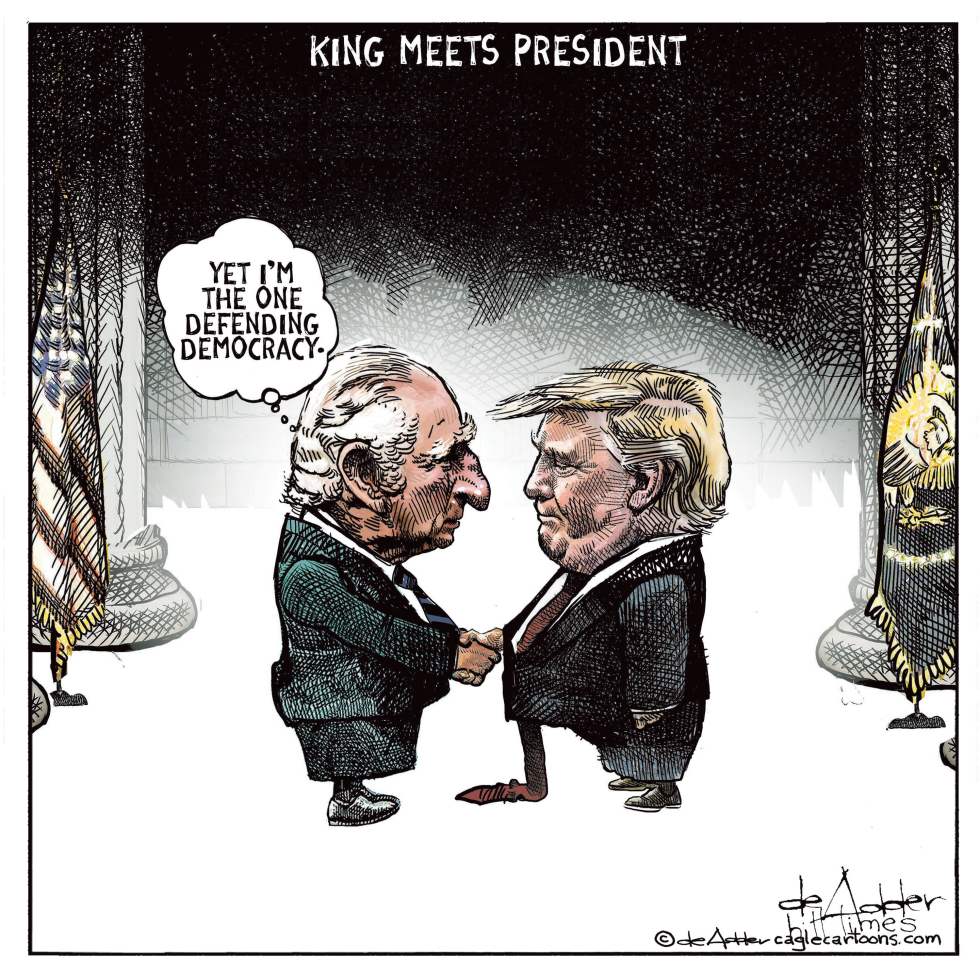
Michael de Adder's cartoon captures a handshake between King Charles and President Trump, set against American and implied British flags in a White House-like scene. The title 'KING MEETS PRESIDENT' tops the image, with Charles saying, 'Yet I'm the one defending democracy.' Tags like UK, United Kingdom, States, America, White House, Visit, State underscore the diplomatic theme. This satire touches on trade, tariffs, and economy without overreaching into unseen motives. The dry humor lies in the visual irony of two leaders in suits, one royal and one presidential, amid formal backdrops. Artistic style uses crosshatching for depth, keeping focus on the central exchange.
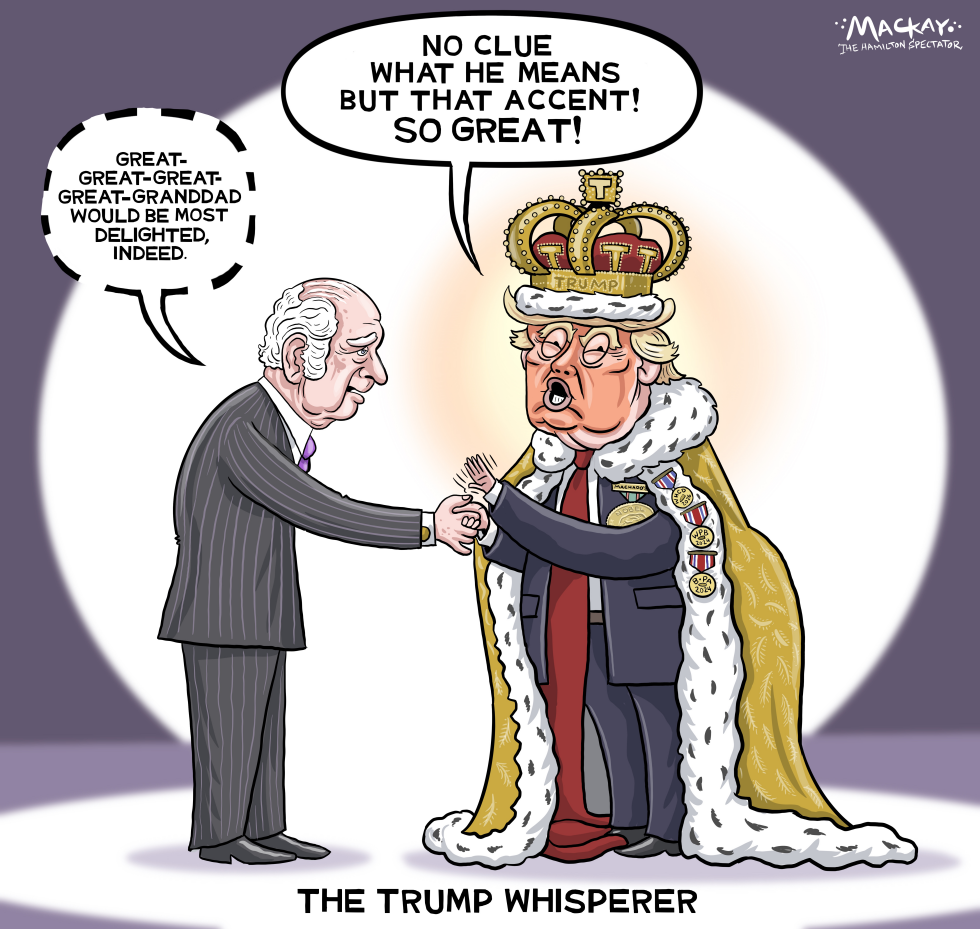
Graeme MacKay's cartoon depicts King Charles III leaning in to whisper a message from King George III to a regally dressed President Trump, who misinterprets it due to the accent. Tagged with USA, Canada, UK, the image explores monarchy, diplomacy, and alliance themes. Trump's crown labeled with his name adds symbolism of self-aggrandizement, while the 'Trump Whisperer' caption underscores the tension in this leadership encounter. Historical nods to tradition and stability contrast with modern visit dynamics, blending respect and satire in a visually striking composition.
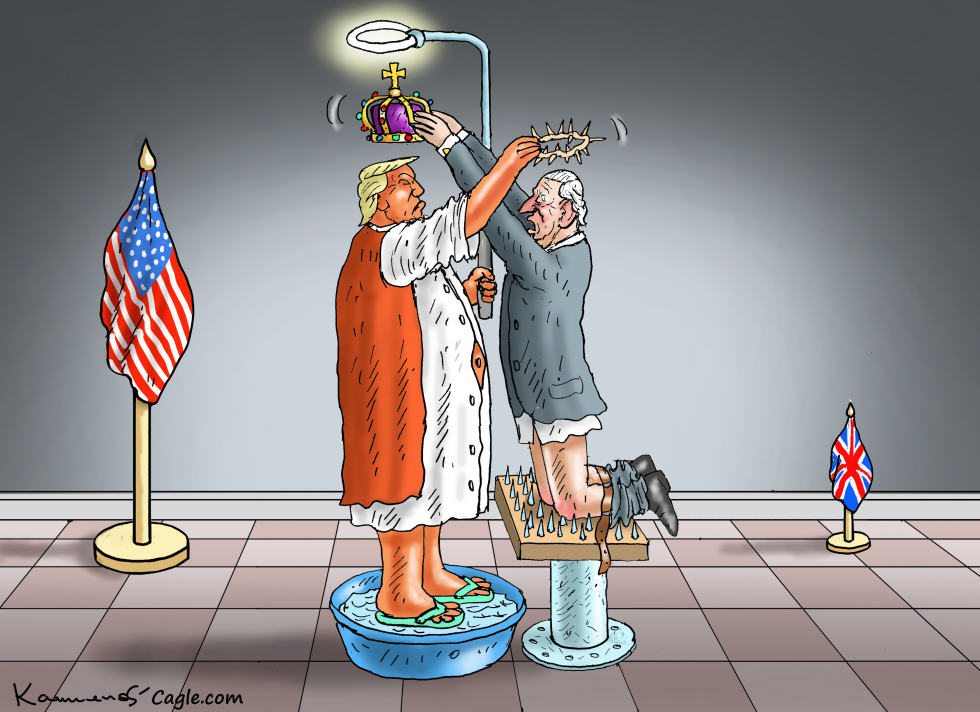
Marian Kamensky's cartoon depicts Trump holding a jeweled crown over King Charles's head while King Charles extends a crown of thorns, set against US and UK flags. The image, tagged Trump, King Charles, MAGA terror, Doctor Jesus, fascism, shows King Charles in a suit with pants down, standing in a basin on a spiked stool. This setup underscores themes of painful power exchanges, with Trump in a robe-like garment. The dark background and illuminated halo add to the satirical edge, commenting on political alliances and suffering in leadership.
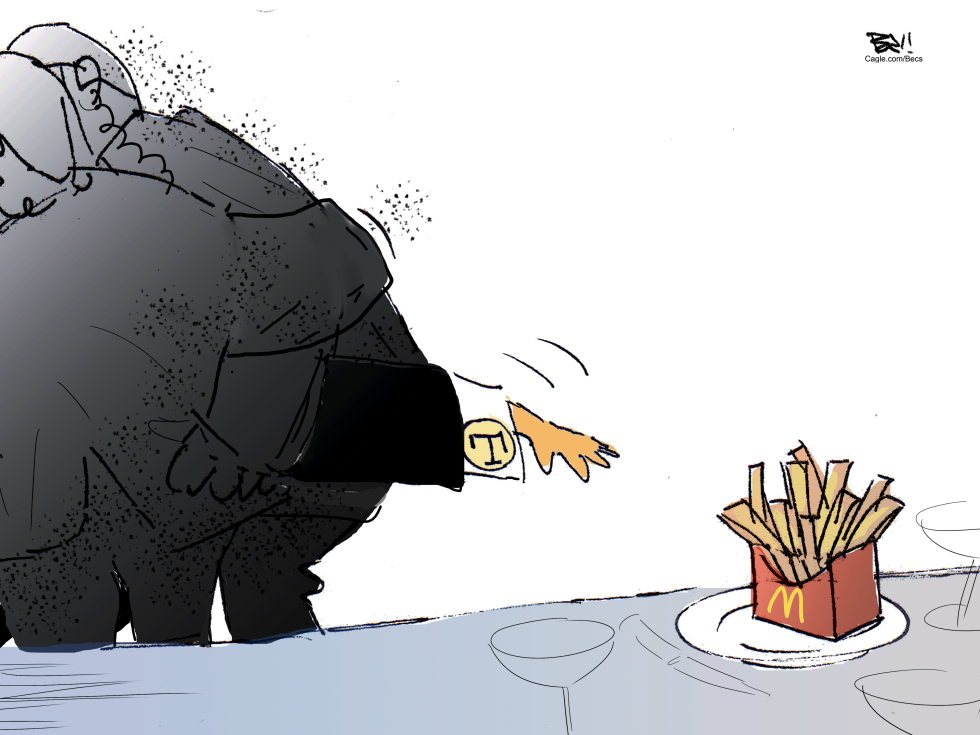
This political cartoon shows a bulky figure in a dark suit, viewed from behind, with a hand bearing a cufflink labeled TRUMP reaching out toward a red box of McDonalds fries overflowing on a white plate. The scene is set on a table with stemmed glasses, and there's a dusting of particles on the figure's shoulder. Incorporating tags such as Donald Trump Administration USA, attack, Hilton Hotel, shooting, terrorist, lone wolf, the image pokes fun at familiar tropes of excess and impulse. The artist's signature Becs and Cagle.com/Becs appear in the corner, grounding it in syndicated cartoon tradition. Such drawings often go viral for their sharp, relatable jabs at public figures. At around 100 words, this summary captures the essence without overreaching what's drawn.
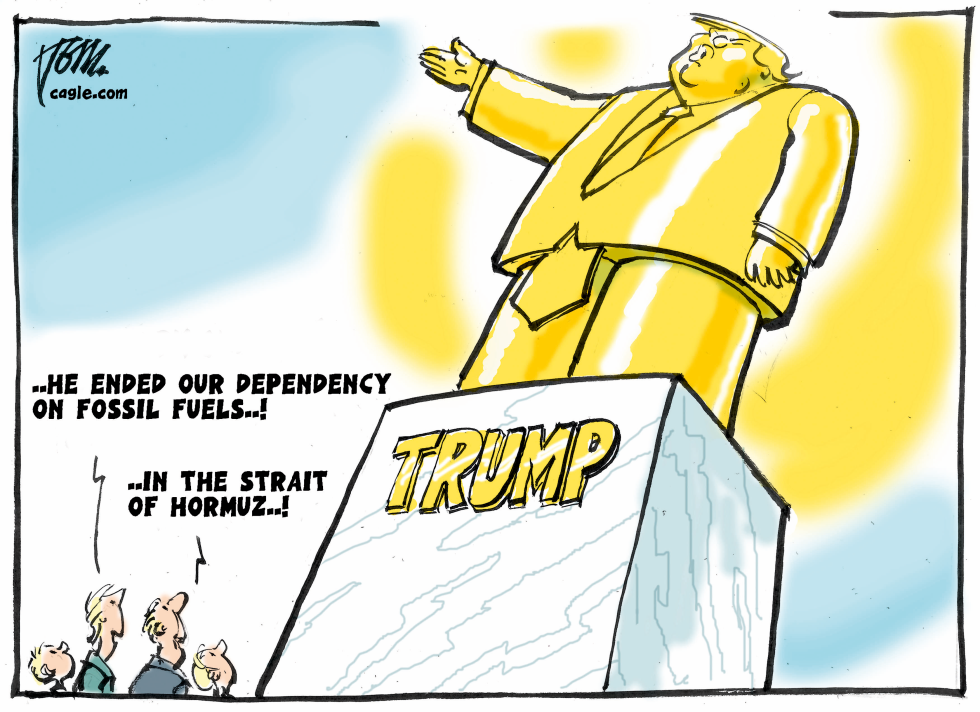
Tom Janssen draws a massive golden statue resembling Trump, arm raised triumphantly on a 'TRUMP' pedestal, with text boasting 'HE ENDED OUR DEPENDENCY ON FOSSIL FUELS!!' A small figure below quips '...IN THE STRAIT OF HORMUZ?!' Three tiny onlookers gaze up. The cartoon ties into tags like Strait of Hormuz, blockade, oil prices, inflation, Iran war, and fossil fuels. It pokes at ironic claims of energy independence through geopolitical tension. The yellow glow and exaggerated features amplify the dry humor on misguided victories. Cagle Cartoons syndicates such pointed takes, reminding editors how visuals cut through policy noise. This one's timely, blending current events with sharp wit.