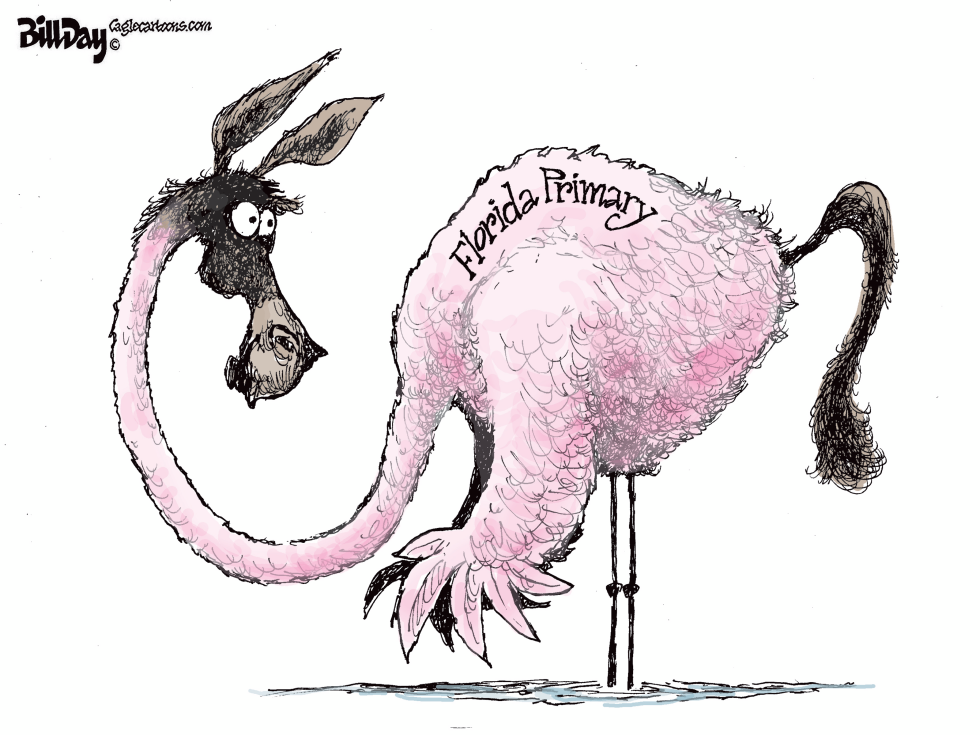
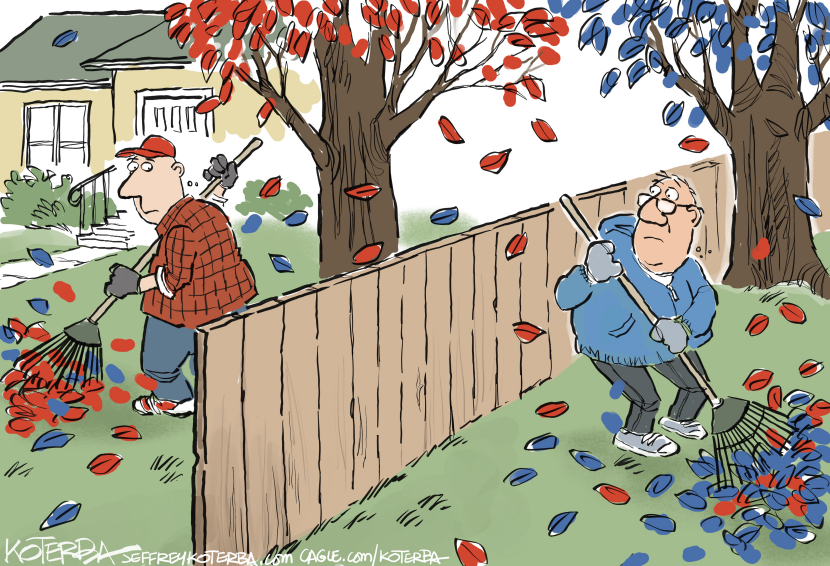
Florida prepares for its primary election with Democratic candidates competing for key nominations. The contest draws attention due to the state's role in national party positioning. The piece portrays the primary as an awkward fusion of traditional party identity and local Florida elements, suggesting the process strains familiar symbols.
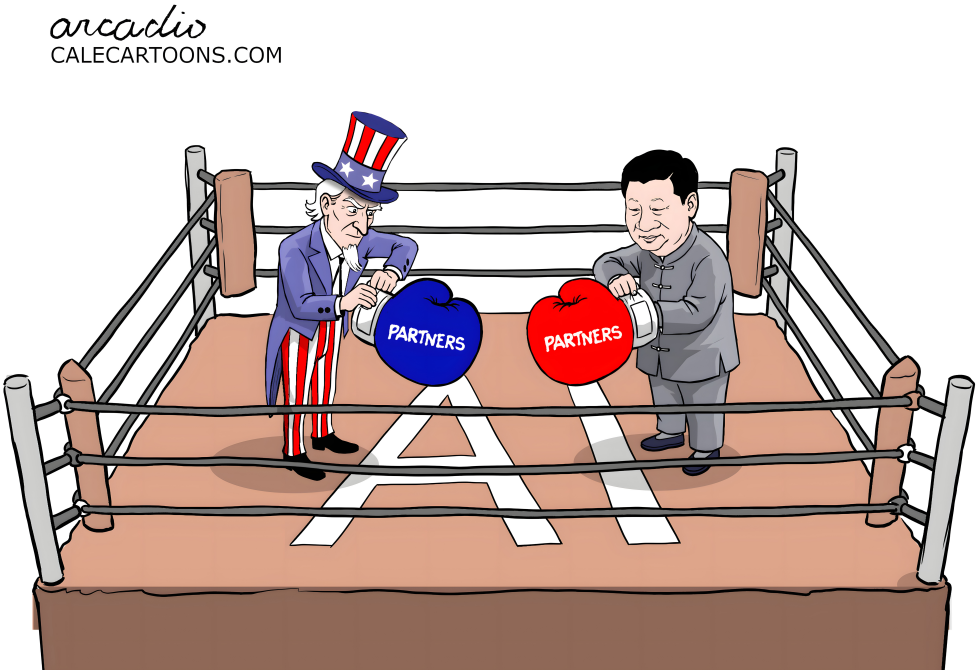
The United States and China continue their contest for leadership in artificial intelligence development. Both nations invest heavily in research and infrastructure to secure advantages in computing power and applications. The competition carries implications for economic growth, military capabilities, and global standards. Recent policy moves on export controls and domestic incentives underscore the stakes. The editorial position frames the dynamic as a direct contest where surface cooperation masks deeper rivalry.
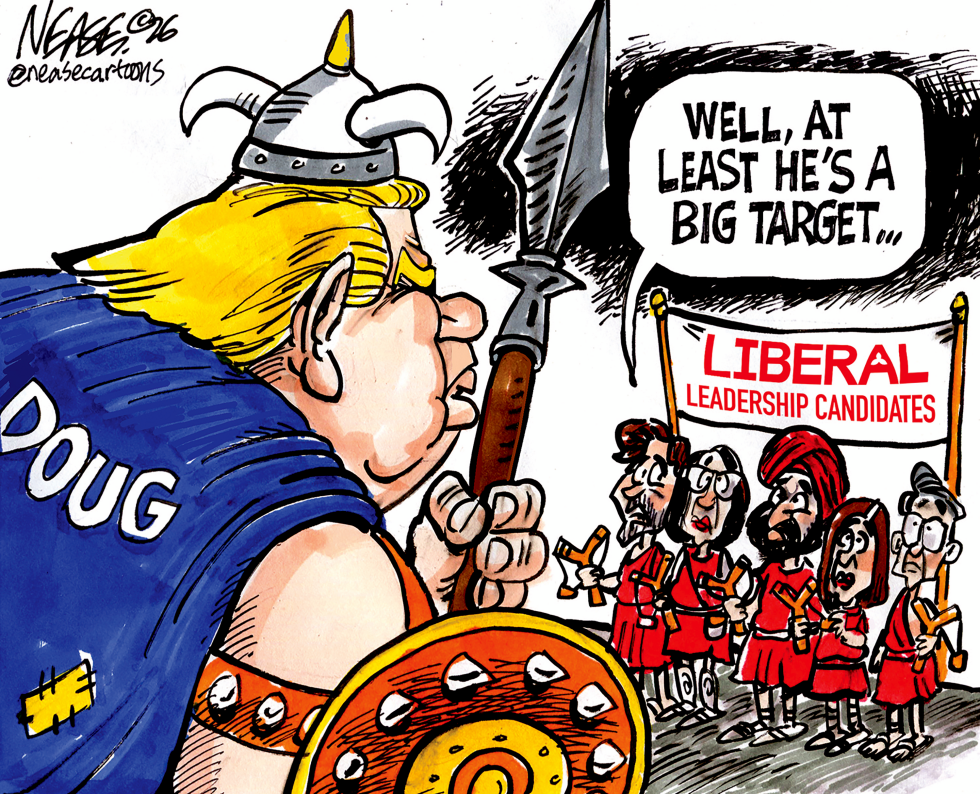
Liberal leadership candidates have identified a prominent opponent as their primary focus in an ongoing contest. The opponent, labeled Doug, appears as a large and visible figure in the political landscape. This dynamic highlights how one individual can dominate attention during a party’s internal selection process. The piece presents the situation as an opportunity for the candidates to rally around a clear adversary rather than internal divisions.
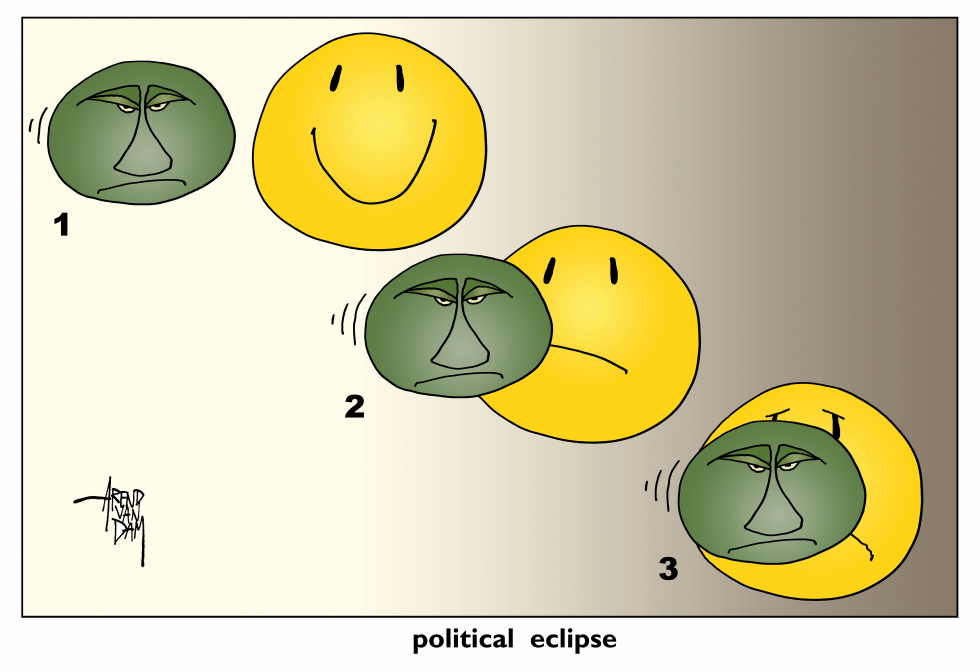
A political figure represented by a green frowning face progressively covers a yellow smiling face across three labeled stages. The interaction illustrates one presence gaining dominance while diminishing the other. The piece comments on the dynamics of political competition and shifting influence between rivals.
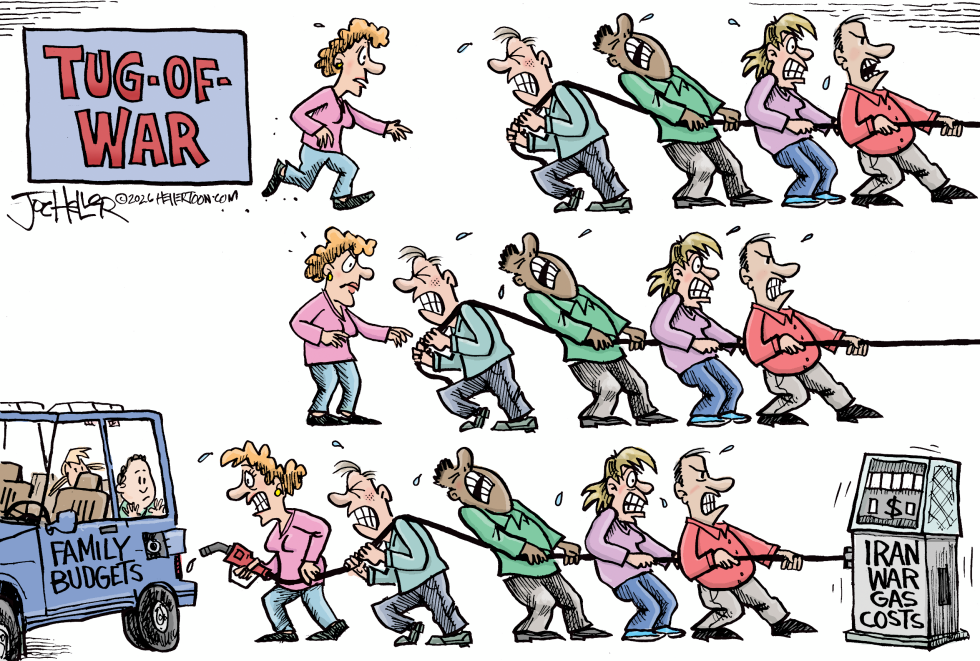
Rising gas prices linked to potential conflict with Iran are pressuring household budgets across the country. The cartoon illustrates the direct economic tug between military action abroad and everyday costs at the pump, arguing that families bear the immediate burden of such decisions.
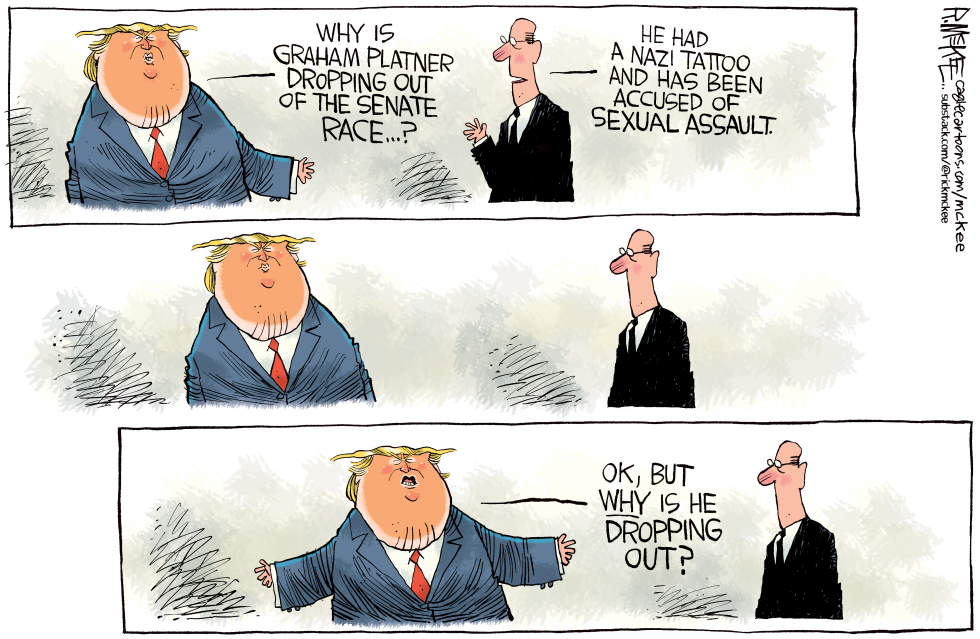
On July 10 2026 Rick McKee depicts Donald Trump questioning an aide about Graham Platner dropping out of a Senate race. The aide cites a Nazi tattoo and sexual assault accusation as reasons. Trump responds by asking again why the candidate is leaving the race. The exchange highlights the former president's focus on the withdrawal itself rather than the underlying controversies. Publication occurs during the 2026 election cycle when candidate viability and scandal impacts remain central topics in Senate contests.
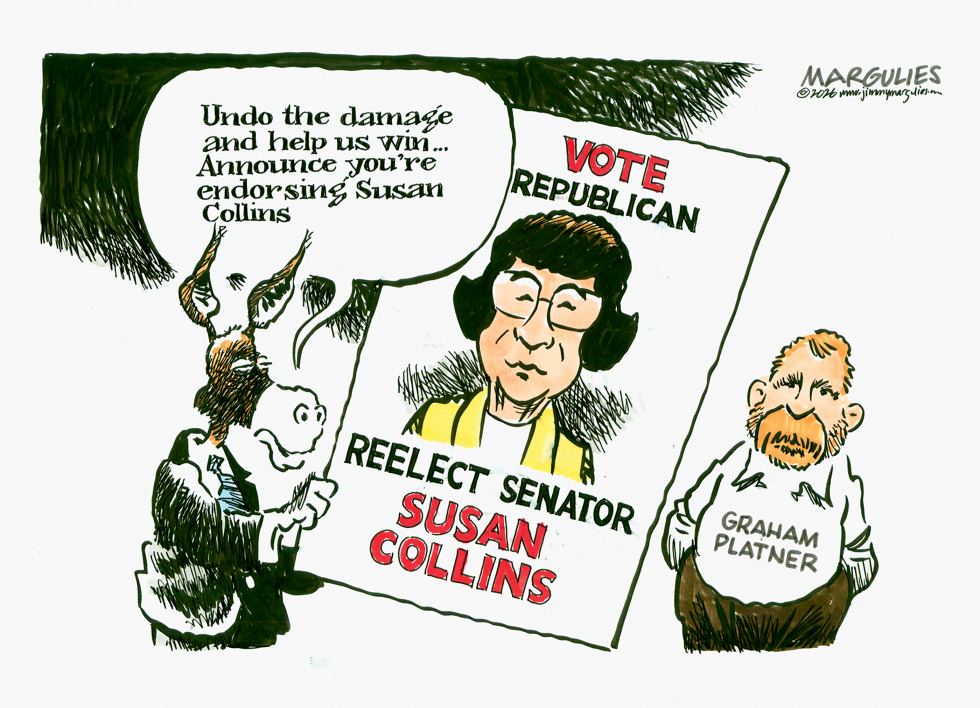
A cartoon depicts a Democratic donkey urging Graham Platner to announce an endorsement of Republican Senator Susan Collins. The donkey holds a large sign reading 'Reelect Senator Susan Collins' and 'Vote Republican.' Platner stands nearby wearing a shirt with his name. The speech bubble from the donkey calls for undoing damage and helping win by backing Collins. The image is dated July 2026 and signed by Jimmy Margulies.
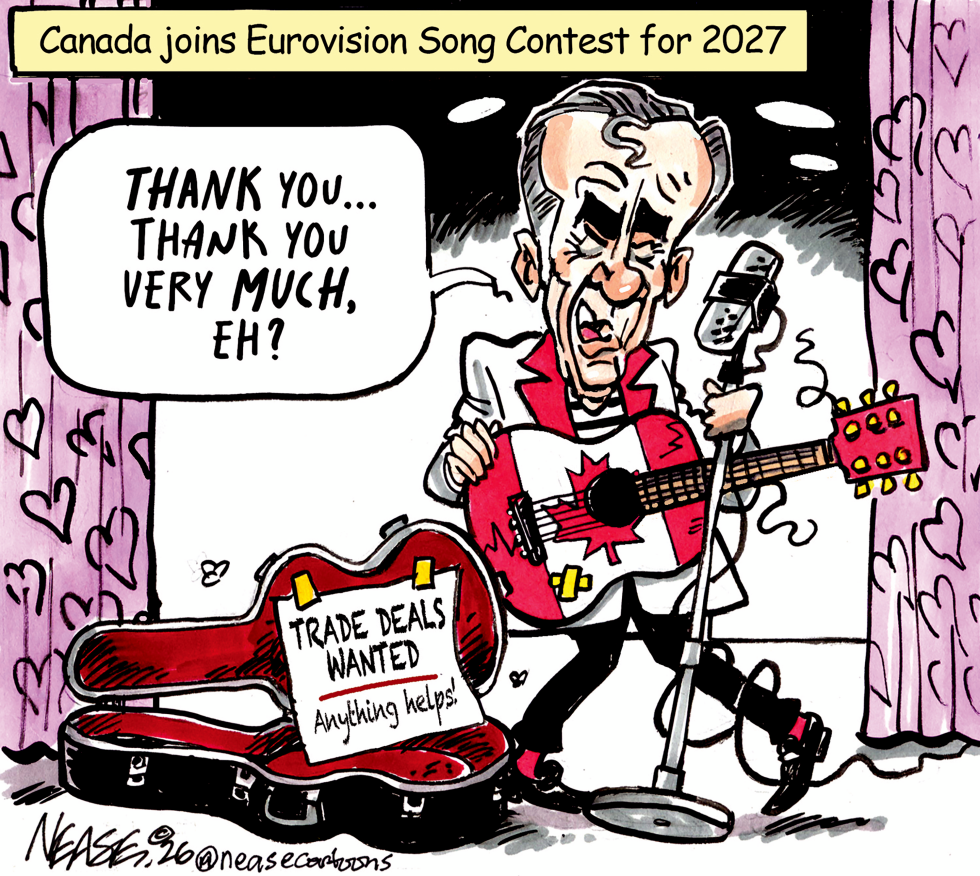
Prime Minister Justin Trudeau appears in an Elvis Presley costume on stage at the Eurovision Song Contest, holding a guitar painted with the Canadian flag. A speech bubble shows him saying thank you very much eh while an open guitar case on the floor bears a sign reading trade deals wanted anything helps. The top banner announces Canada joins Eurovision Song Contest for 2027. The cartoon by Steve Nease was published July 2 2026.
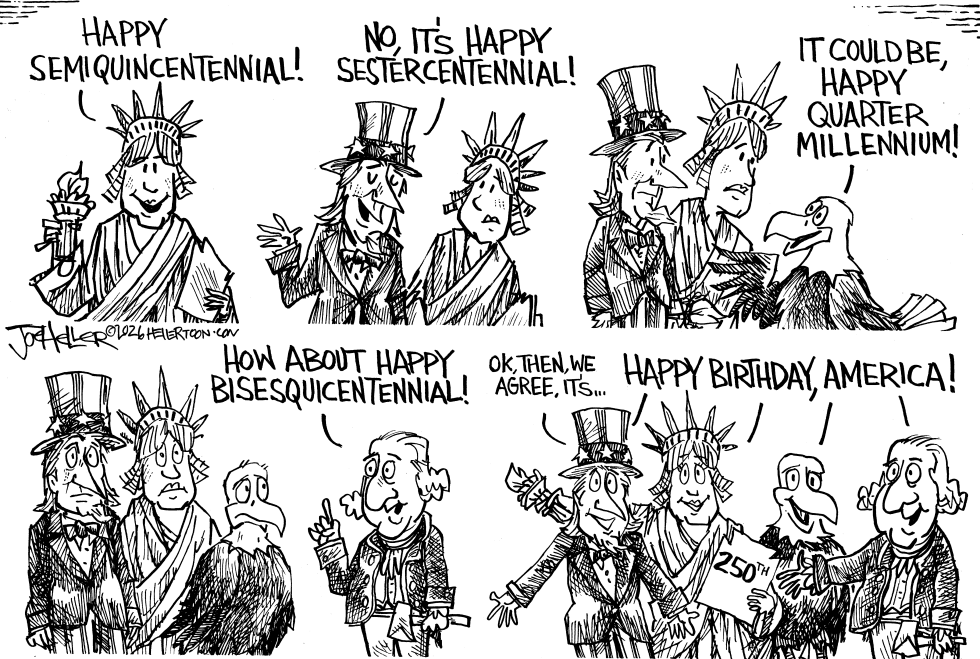
Joe Heller's June 2026 cartoon shows the Statue of Liberty, Uncle Sam, a bald eagle and Benjamin Franklin debating elaborate terms for America's 250th anniversary. The figures propose semiquincentennial, sestercentennial, quarter millennium and bisquincentennial before conceding to the straightforward greeting Happy Birthday, America! The strip marks the upcoming July 4, 2026 milestone with light humor on naming conventions.
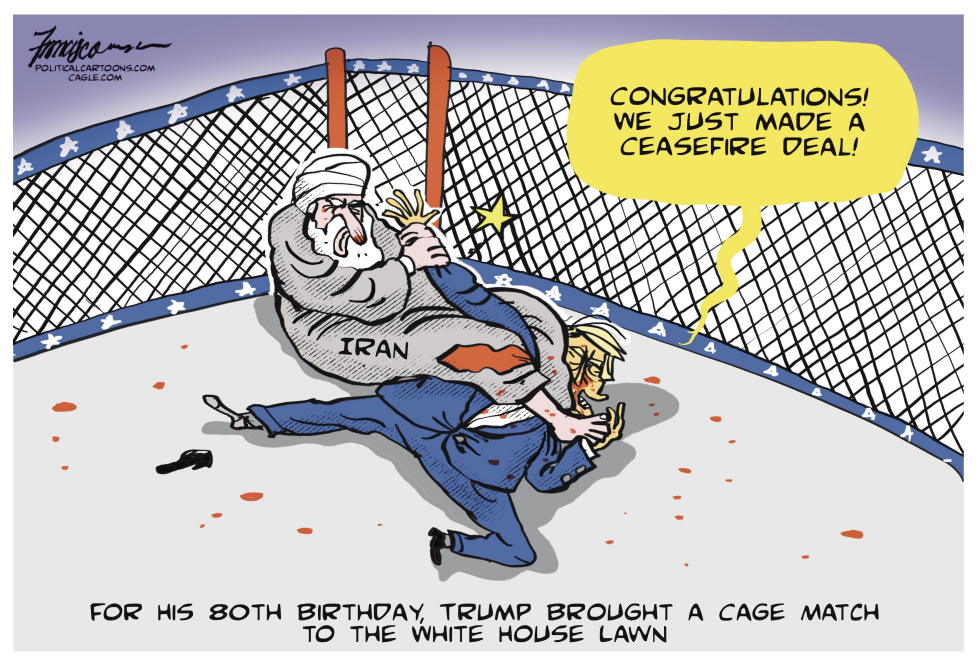
A cage match between the United States and Iran over a potential ceasefire deal has drawn attention amid ongoing Middle East tensions. The confrontation highlights the high stakes of direct engagement between the two nations. The piece portrays the encounter as a chaotic personal brawl rather than a measured diplomatic effort.
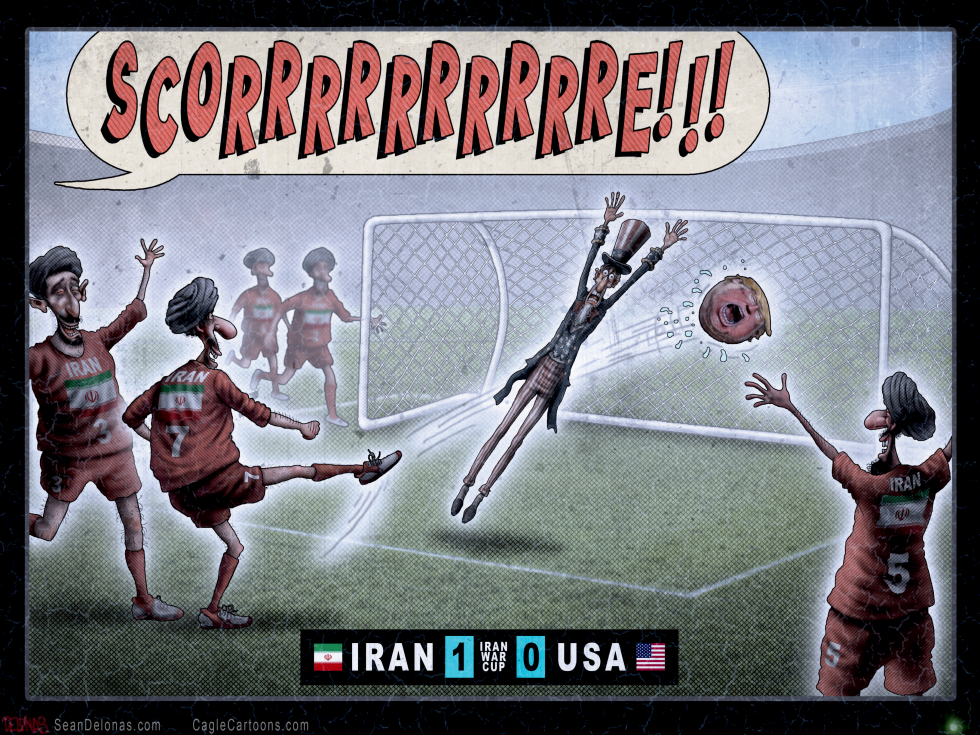
A soccer match on a green field features Iranian players in red jerseys celebrating as a tall figure in a top hat leaps toward the goal with its head detached and flying. The scoreboard reads Iran 1 USA 0 under the Iran War Cup title, with the date set in June 2026 amid ongoing Middle East tensions.
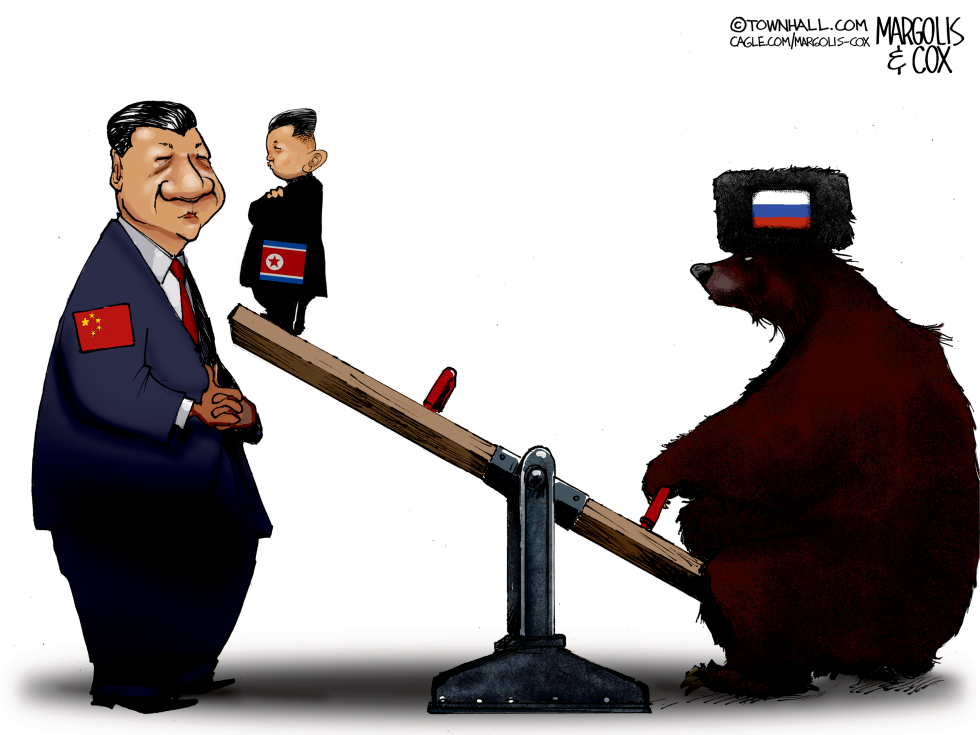
Xi Jinping stands on the left side of a seesaw while a Russian bear sits on the right. Kim Jong Un stands on the plank closer to Xi as the board tilts under their weights.
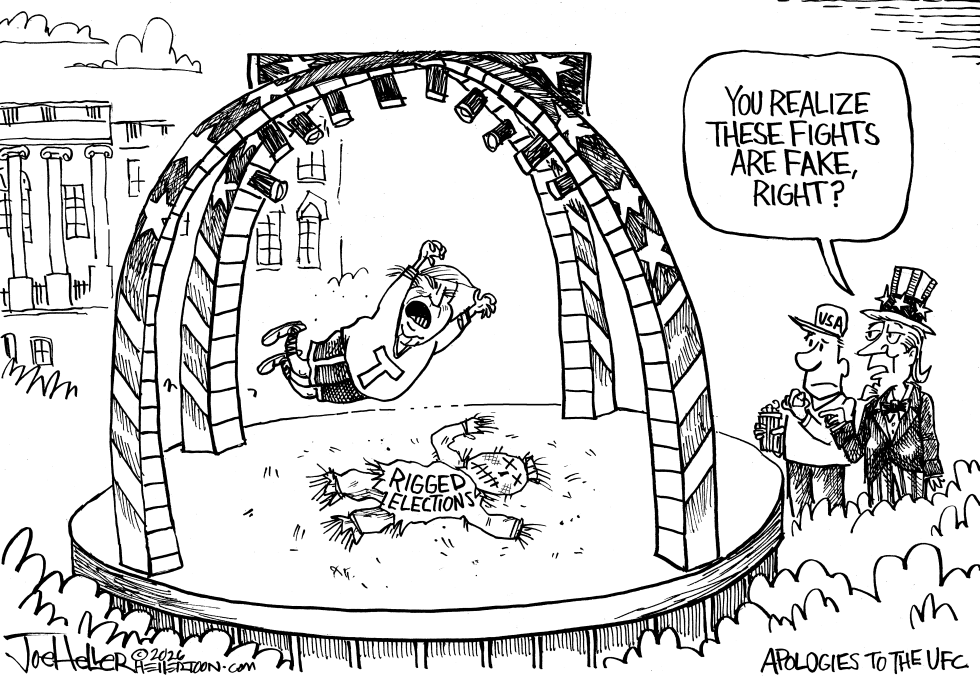
A wrestling ring scene shows a Trump figure thrown onto a mat labeled rigged elections while Uncle Sam remarks that the fights are fake. The image responds to ongoing 2026 election integrity debates with a direct visual comparison to staged matches.
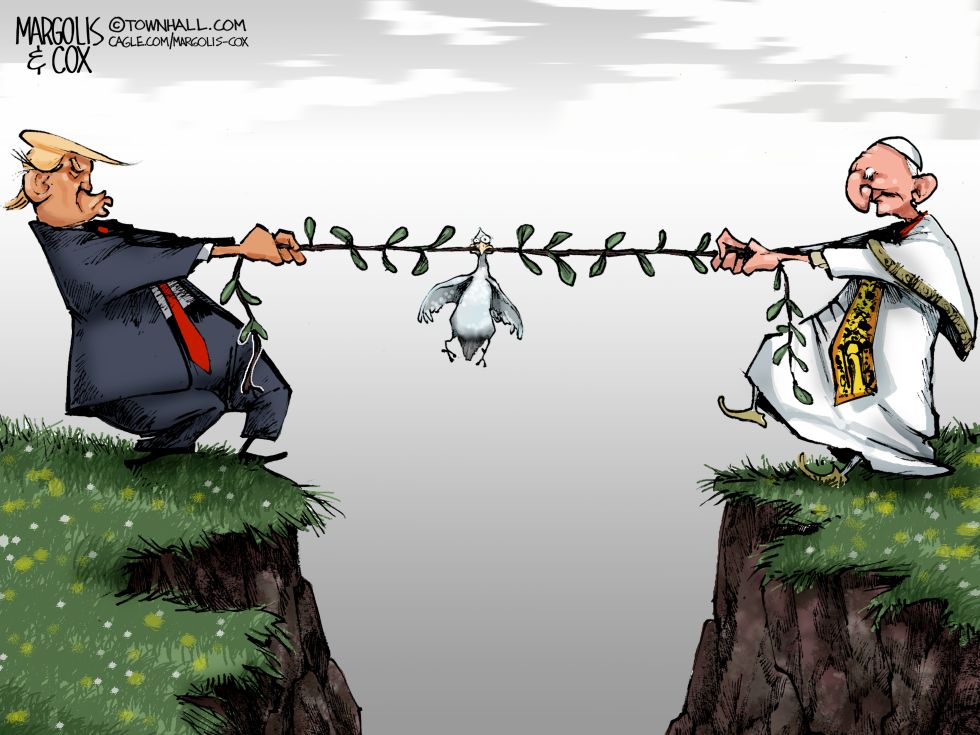
The cartoon shows a caricature of President Trump on one grassy cliff, gripping a vine with leaves that connects to a white dove in the center, while a figure resembling Pope Leo stands on the opposite cliff, also pulling the vine. They face each other across a deep chasm, with cloudy skies above. Tags like war, peace, dove, Iran, Middle East, and Church underscore the visual tension. The artists, Margolis & Cox, place their signature prominently. This setup captures a straightforward conflict over a peace symbol, without hidden layers. The dove hangs upside down, wings slightly spread, as the two figures strain. No emotions or backstories are added; it's just the visible pull between suited man and robed leader.
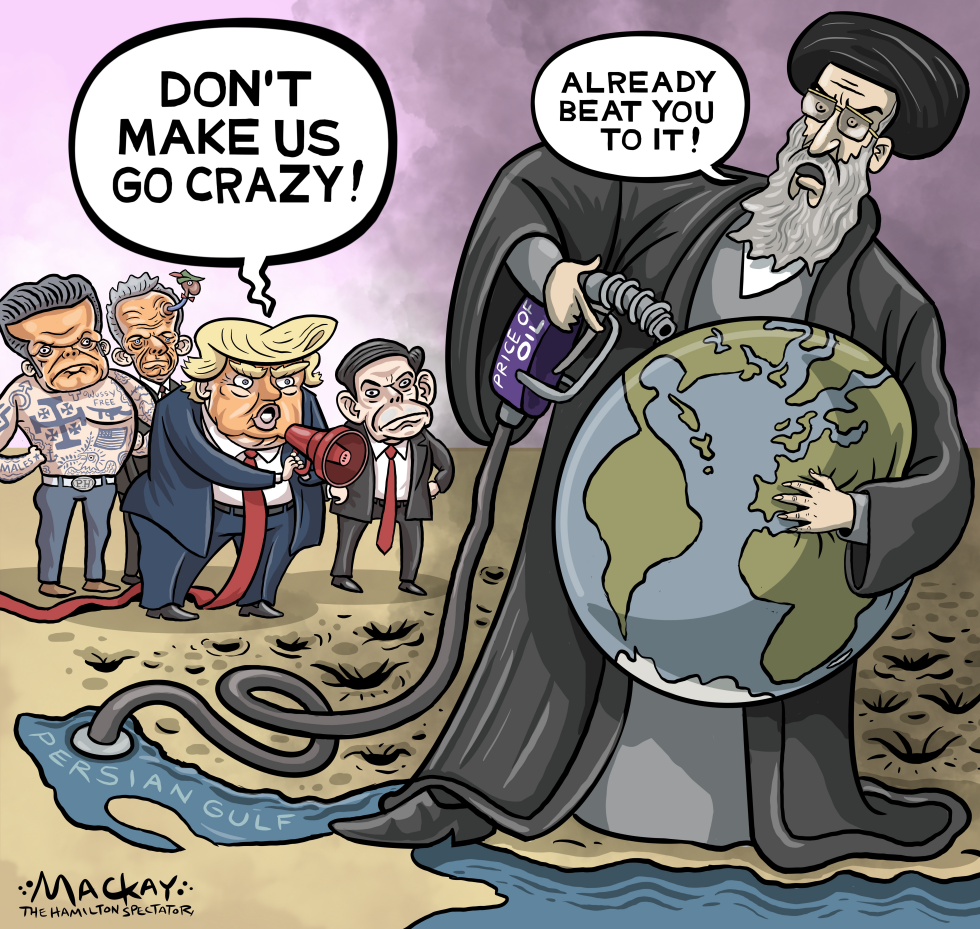
A political cartoon published March 12, 2026, shows Donald Trump and Iran's Ayatollah exchanging threats over oil prices and access to the Persian Gulf. Trump, holding a megaphone, warns against forcing the U.S. side to escalate, while the Ayatollah, gripping a gas pump labeled price of oil attached to a globe, claims to have already matched the move. Three figures stand behind Trump, including recognizable administration members. The scene references ongoing concerns about energy supplies and regional stability in the Middle East.