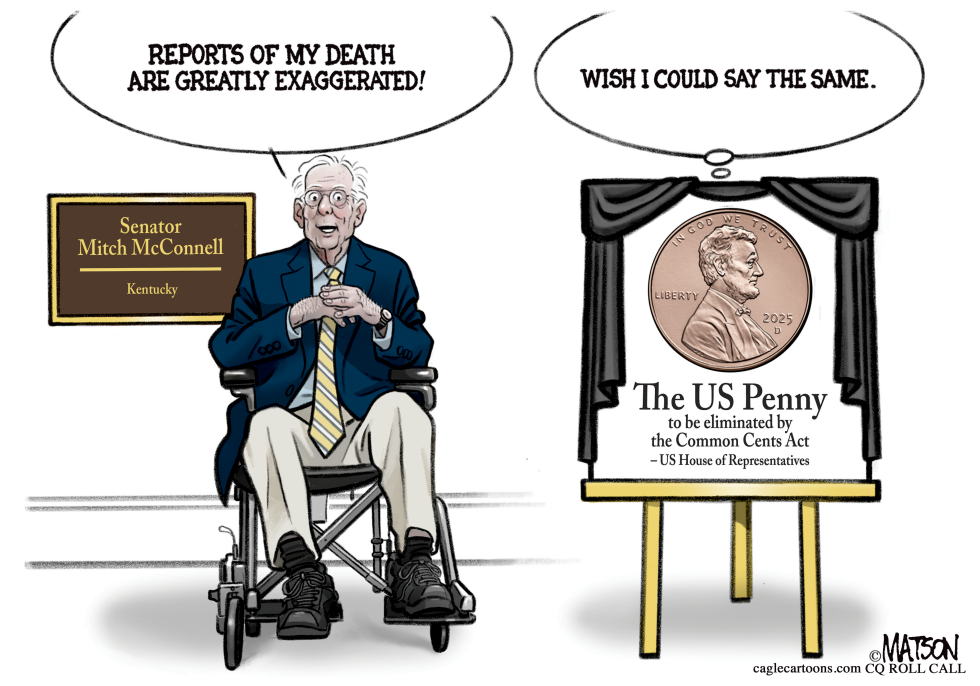
Senator Mitch McConnell returned to the Senate floor on September 15, 2026, after health-related absences, directly addressing rumors of his political demise. At the same time the House has advanced the Common Cents Act to eliminate the US penny. The move reflects ongoing efforts to modernize currency amid rising production costs. McConnell's return underscores his enduring influence in the chamber despite physical challenges. The cartoon uses a classic quote to juxtapose the senator's resilience against the penny's planned demise, suggesting one survives while the other does not.
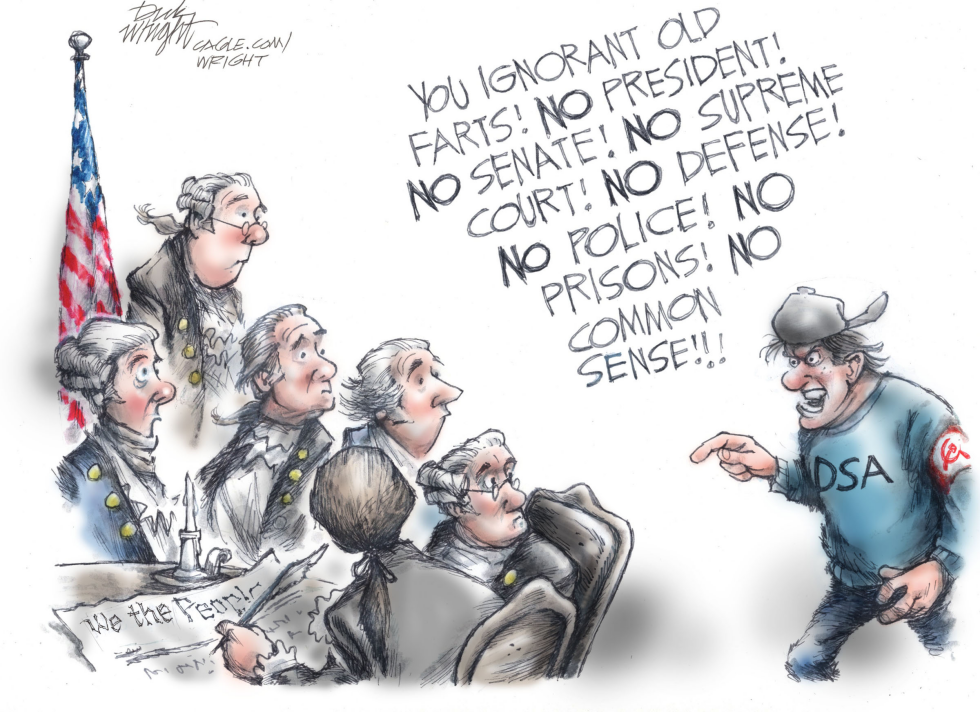
A DSA activist publicly rejects the presidency, Senate, Supreme Court, defense forces, police and prisons while addressing figures associated with the Constitution's creation. The exchange highlights ongoing tensions between socialist activists and defenders of established American governmental structures. The position frames these institutions as unnecessary and lacking basic logic.
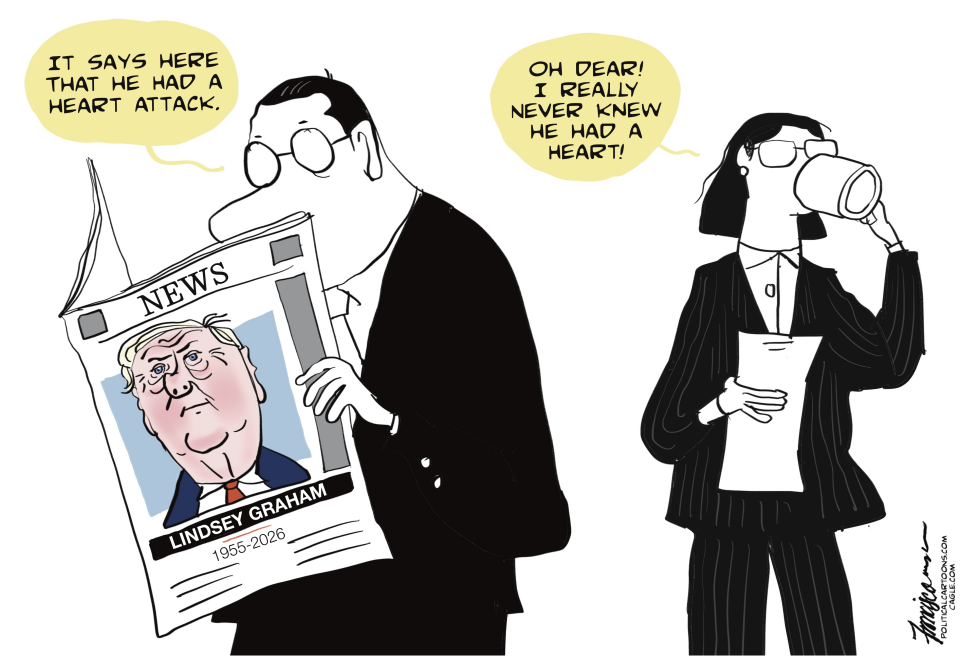
A political cartoon depicts a man reading a newspaper announcing the death of Sen. Lindsey Graham from a heart attack in 2026. A woman standing nearby responds with a pun, stating she never knew he had a heart. The image uses the obituary format and the double meaning of the word heart to highlight perceptions of the senator's demeanor.
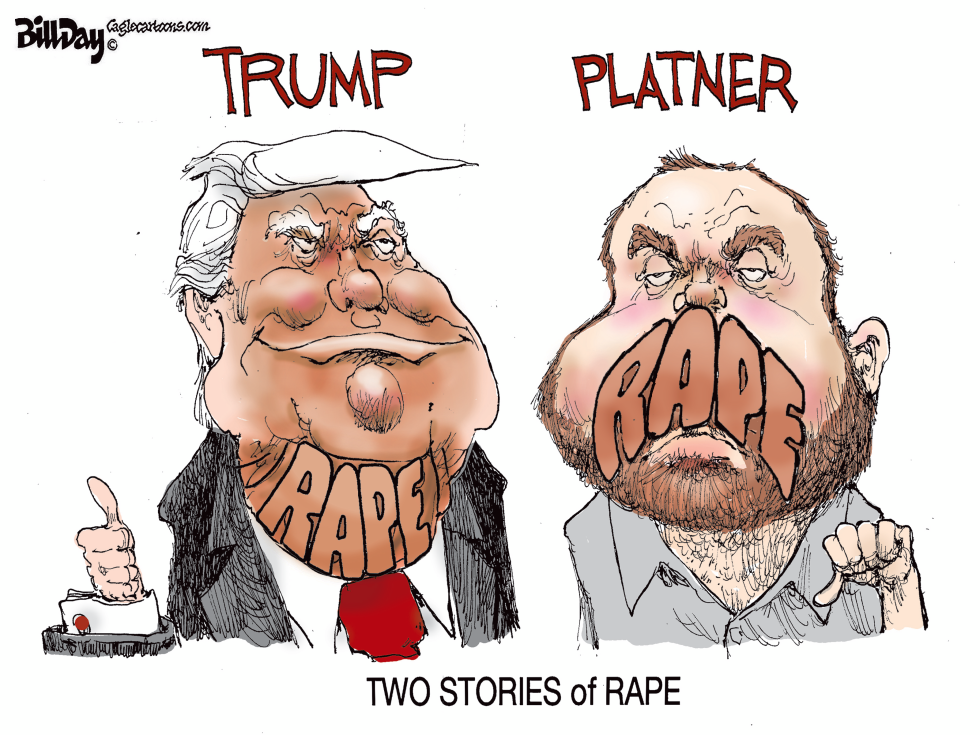
The image presents side by side depictions of Donald Trump and an individual named Platner. Each has the word rape overlaid on the lower face area. Trump extends a thumbs up gesture near papers while Platner extends a thumbs down gesture. Large red text at the bottom reads two stories of rape. The date of July 2026 places this in a period of ongoing public discussion around accusations involving prominent figures.
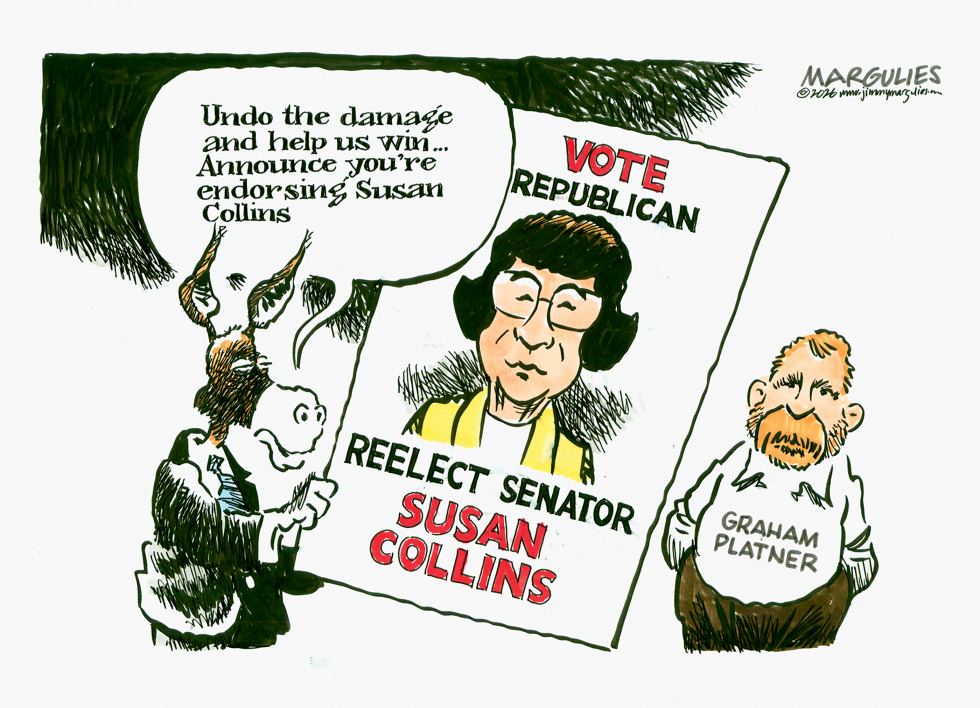
A cartoon depicts a Democratic donkey urging Graham Platner to announce an endorsement of Republican Senator Susan Collins. The donkey holds a large sign reading 'Reelect Senator Susan Collins' and 'Vote Republican.' Platner stands nearby wearing a shirt with his name. The speech bubble from the donkey calls for undoing damage and helping win by backing Collins. The image is dated July 2026 and signed by Jimmy Margulies.
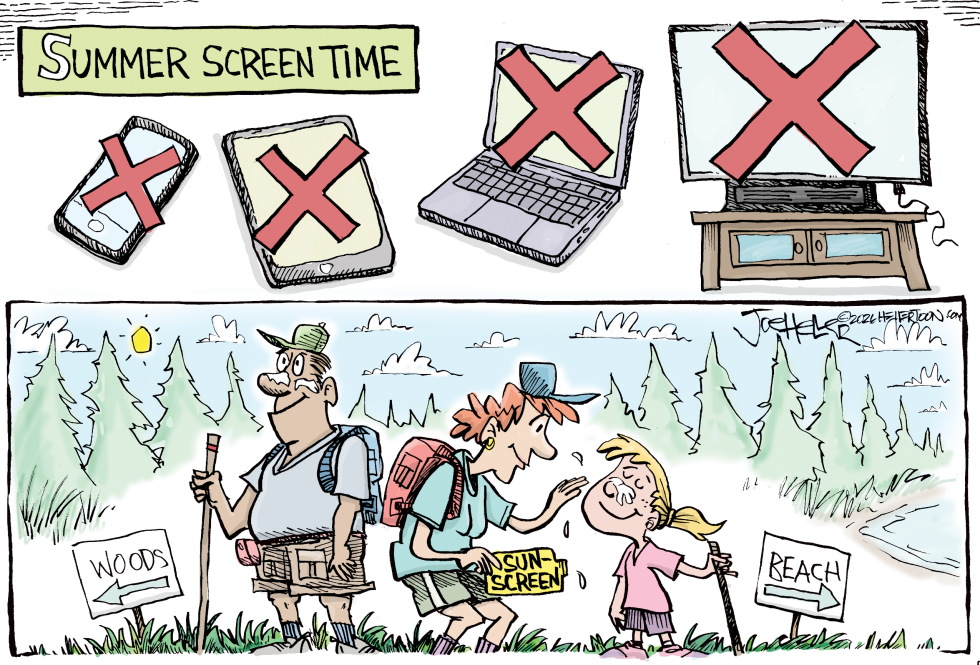
A family of three hikes along a forest trail in summer, leaving behind phones, tablets, laptops and televisions marked with red X's under a Summer Screen Time banner. The father carries a walking stick and backpack while the mother applies sunscreen to their daughter, who holds a stick near a Reach sign. A Woods sign points the way forward on the path.
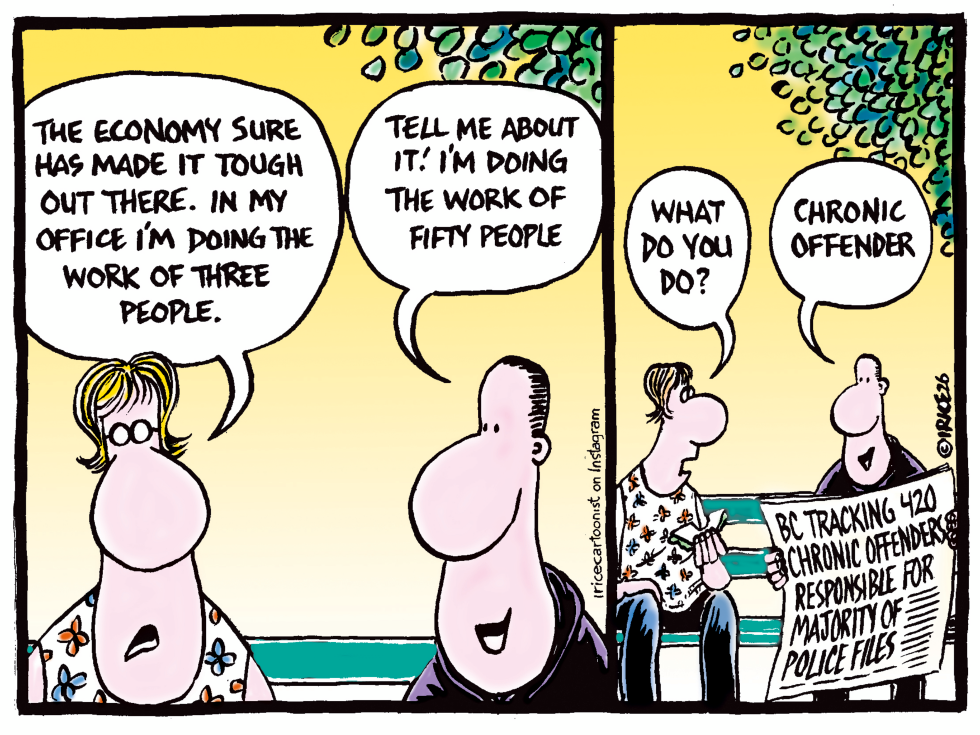
In a two-panel scene dated July 5 2026, office workers discuss heavy workloads caused by economic conditions, with one claiming to handle the work of three people and another fifty. The exchange shifts when a man on a bench identifies himself as a chronic offender, while a nearby newspaper headline reports British Columbia tracking 420 such individuals responsible for the majority of police files.
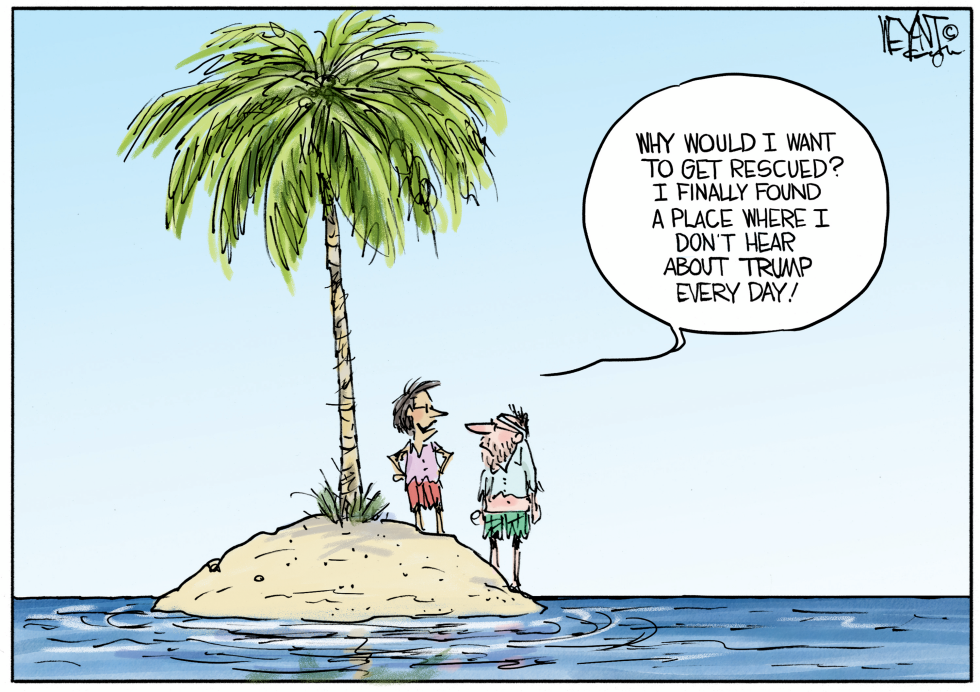
On June 29, 2026, a cartoon depicts two castaways on a tiny desert island with a single palm tree. One man in a speech bubble declares he has no interest in rescue because the location spares him daily mentions of Trump. The image captures widespread public exhaustion with political coverage centered on the former president during a period of intense media focus.
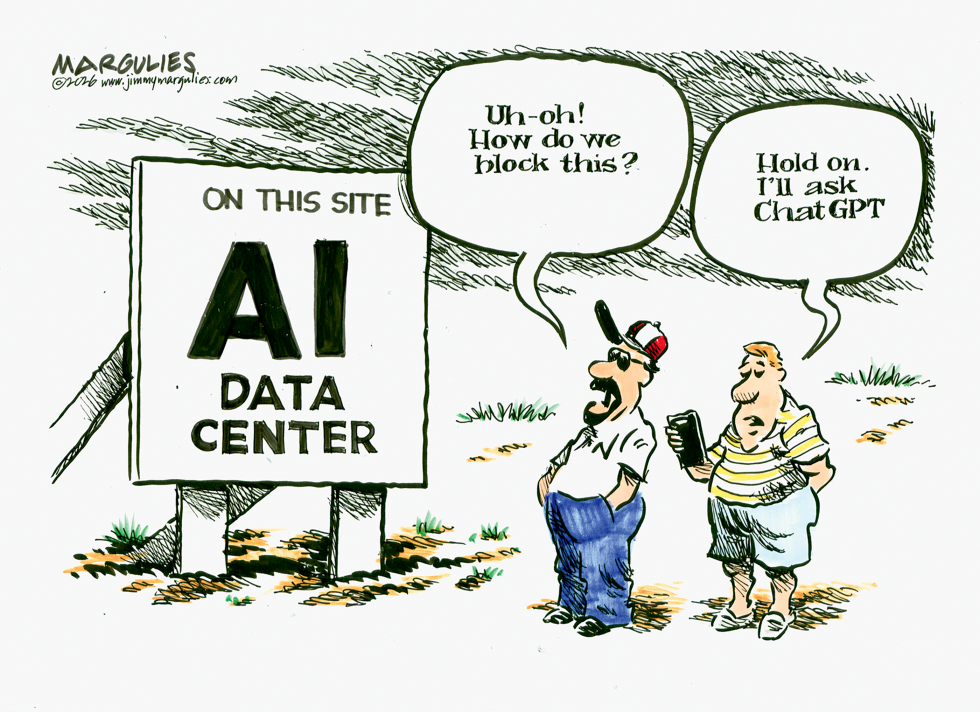
A large sign announces an AI data center on the site. Two men react with concern, one asking how to block access while the other suggests querying ChatGPT on his phone for a solution. The scene highlights the rapid spread of artificial intelligence infrastructure and the reflexive turn to AI tools even when questioning their presence.
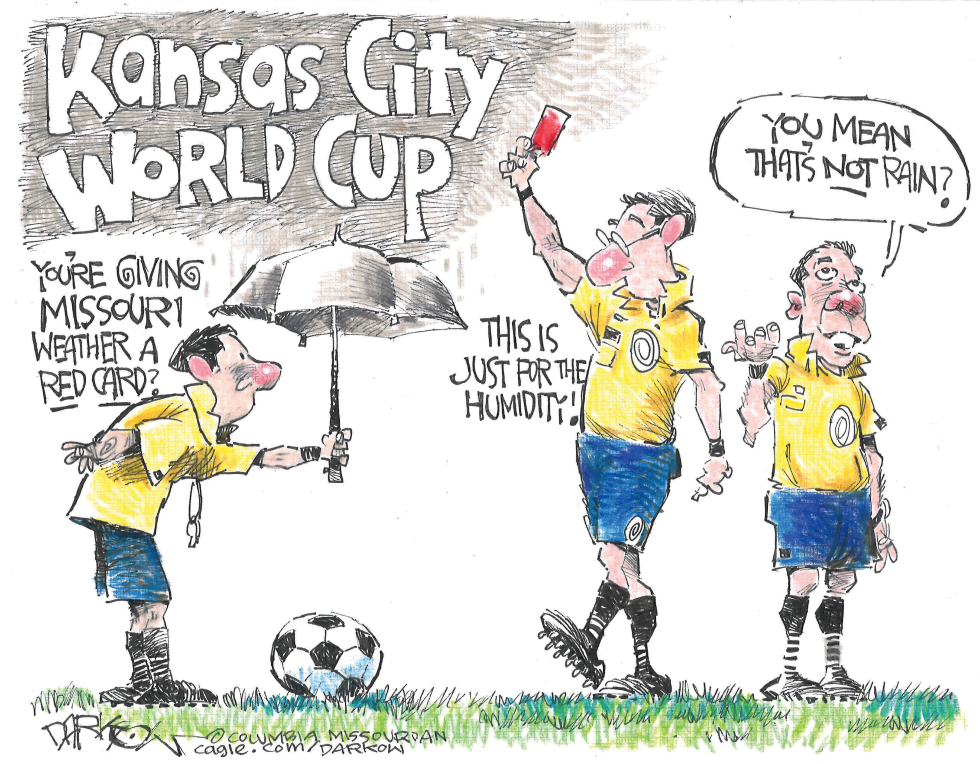
The cartoon depicts soccer referees issuing a red card to Missouri weather conditions during the Kansas City World Cup. One official holds an umbrella while declaring the card is for humidity alone. Another referee questions whether the precipitation qualifies as rain. The scene highlights the region's frequent humidity and showers through soccer penalty imagery.
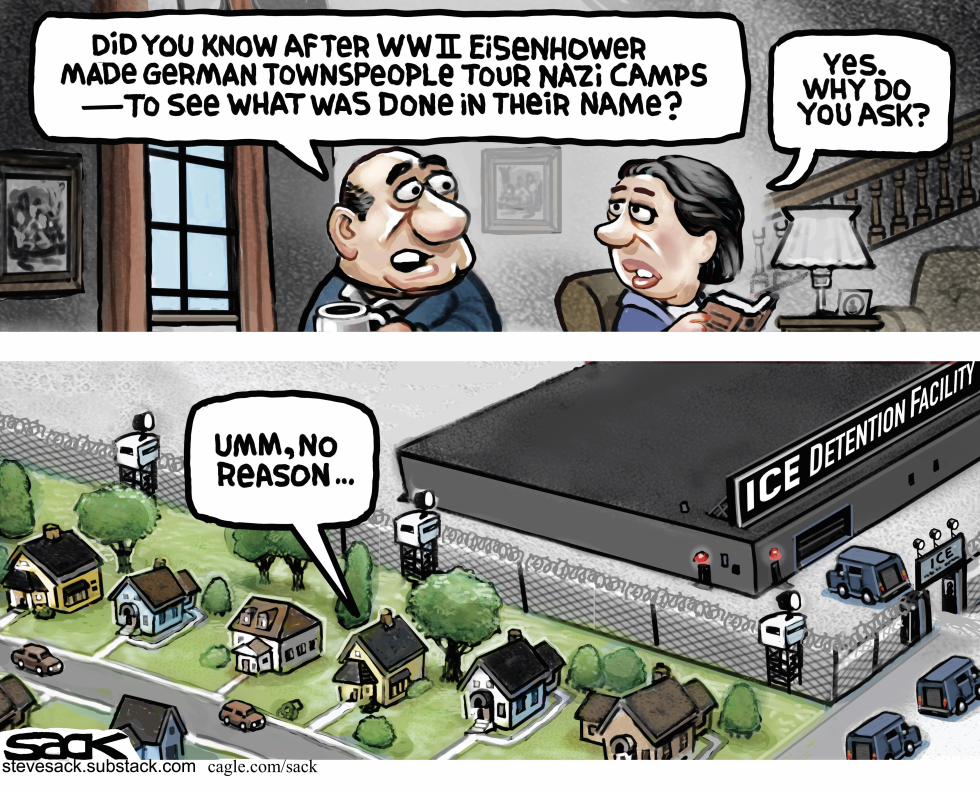
A two-panel cartoon contrasts a living room discussion of Eisenhower's order for German civilians to tour Nazi camps after World War II with a suburban scene featuring a large ICE detention facility adjacent to homes. One resident deflects when asked why the historical example was raised. The image highlights proximity of such facilities to neighborhoods and reluctance to acknowledge operations conducted in the community's name.
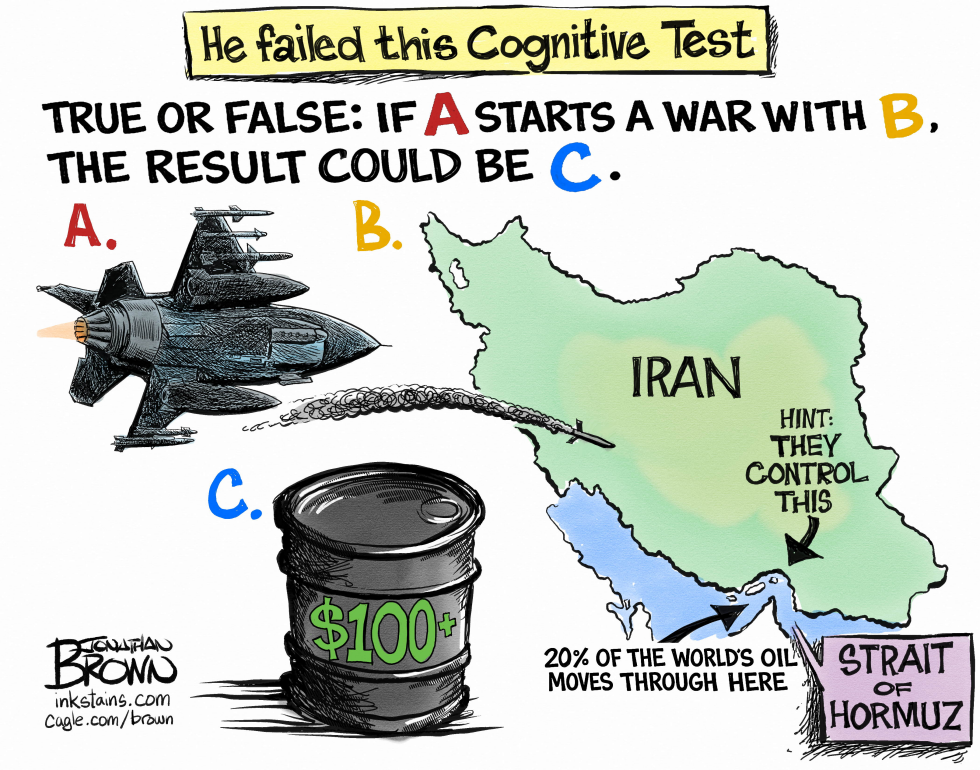
Jonathan Brown's cartoon presents a stark true-or-false cognitive test: if A (a fighter jet) starts a war with B (Iran), the result could be C (an oil barrel marked $100+). The map of Iran includes a hint pointing to the Strait of Hormuz, noting that 20% of the world's oil moves through there, underscoring control over this chokepoint. Tags such as cognitive test, war in Iran, oil prices, Strait of Hormuz, gas prices, and cost of war frame the satire. The artwork warns of economic fallout from conflict, with the jet trailing toward Iran and the oil barrel symbolizing surging costs. This piece captures geopolitical tensions in a simple, visual riddle.
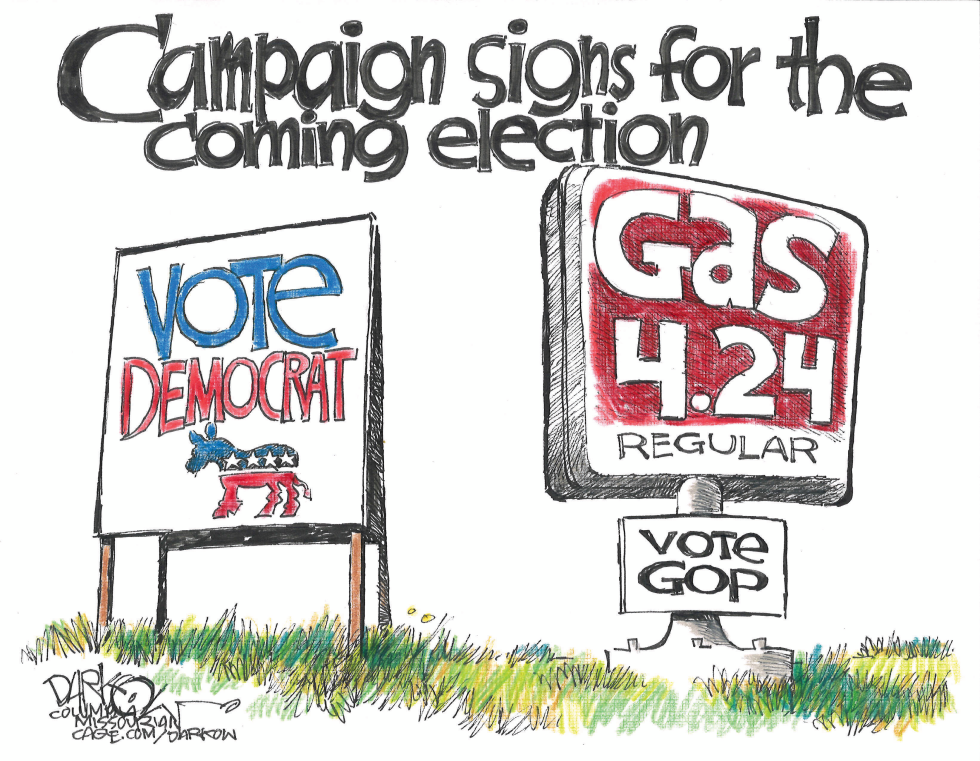
John Darkow's cartoon shows campaign signs for the coming election, with a straightforward Vote Democrat board featuring a blue donkey symbol, contrasted by a gas station-style sign advertising GAS 4.24 REGULAR and a small Vote GOP placard below. The image ties into 2026 midterms themes, highlighting gas prices, affordability, inflation, Strait of Hormuz tensions, cost of living pressures, and party strategies. The dry humor points to how economic issues like fuel costs become central in political advertising, with the GOP sign mimicking a bargain price to appeal to voters frustrated by rising expenses. This setup captures the insider view of how cartoons simplify complex voter concerns into visual punches.
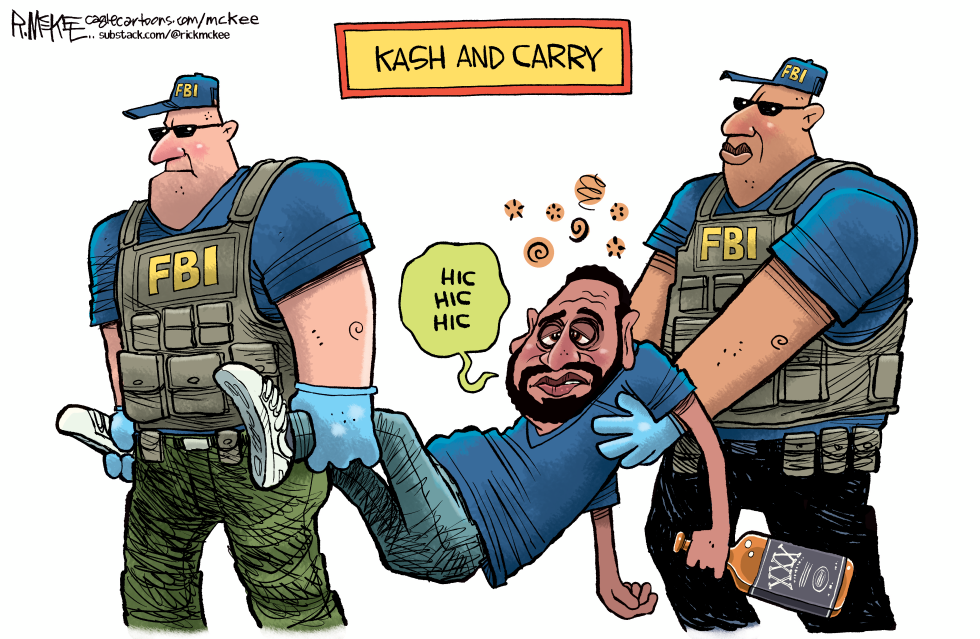
Rick McKee's cartoon shows two stern FBI agents in vests and caps, carrying a limp, bearded man who's clearly intoxicated, complete with hiccups and swirling symbols overhead, clutching a bottle marked XXX. The sign above reads 'Kash and Carry,' a clear pun tying into Kash Patel, the figure depicted. This piece tags into FBI, Federal Bureau of Investigation, drunk, alcohol, agents, criminal justice, and domestic policy, poking at the idea of leadership in a haze. The dry humor lands on the absurdity of carrying someone unfit, visually straightforward without hidden layers. Newspapers love this kind of sharp, unambiguous satire that comments on current events without overcomplicating the message.