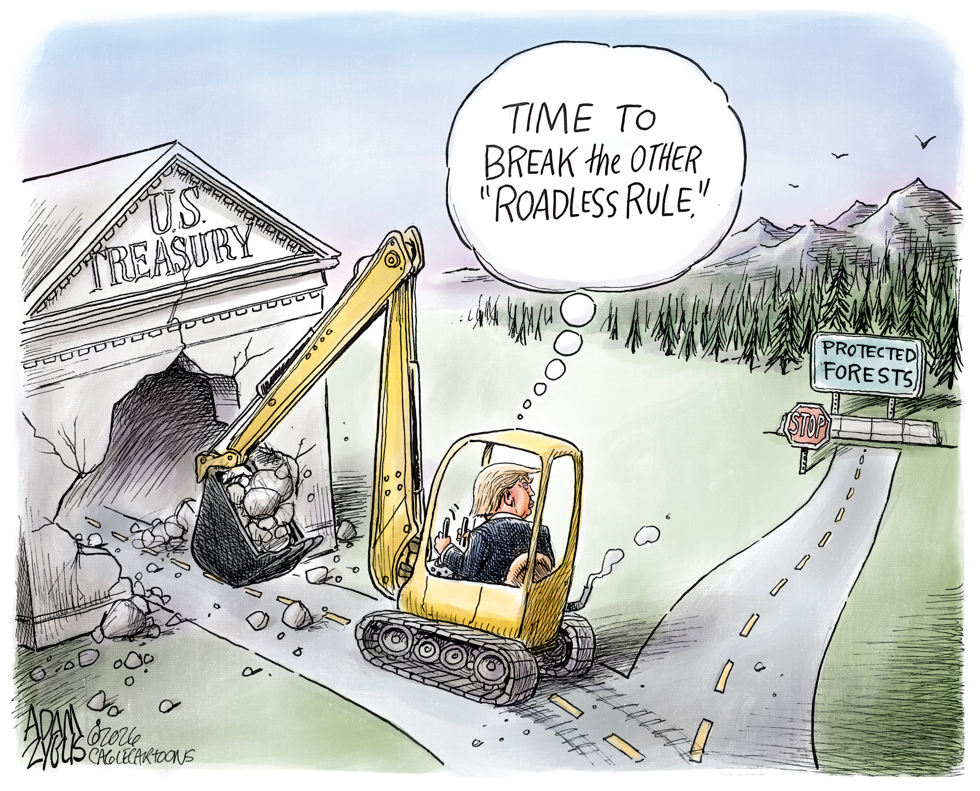
The cartoon shows Donald Trump at the controls of a yellow excavator that has already damaged the U.S. Treasury building. His thought bubble calls for breaking the other Roadless Rule while a sign marks protected forests ahead. The image comments on efforts to open national forests to development by repealing the 2001 Roadless Rule. It links the policy shift to broader questions about federal spending and regulatory priorities. The visual places the Treasury in the path of the machine to suggest fiscal or institutional costs alongside environmental changes.
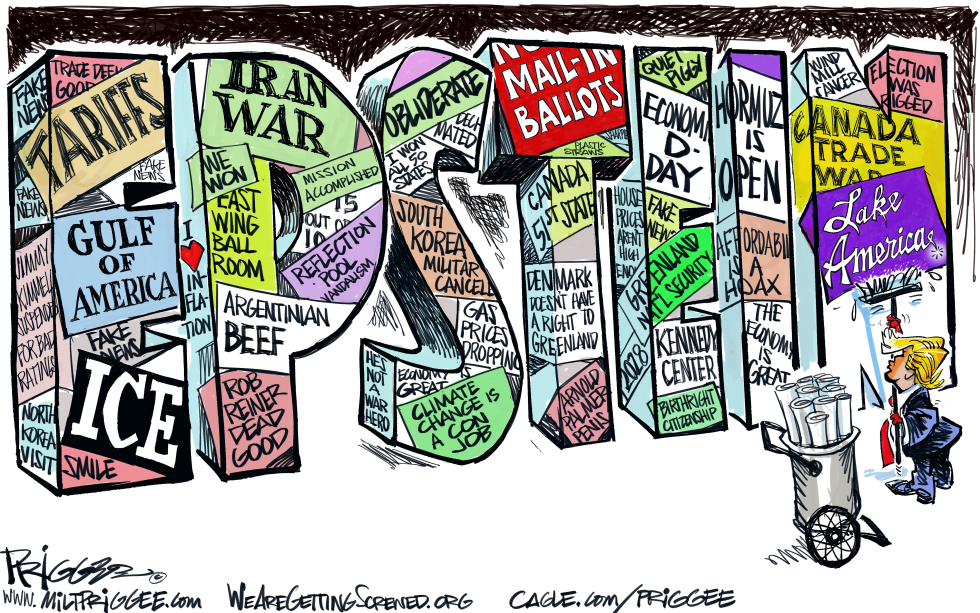
Donald Trump appears in a September 2026 cartoon pushing a cart stacked with signs promoting tariffs, questioning mail-in ballots, and asserting claims about Iran, Canada trade, and domestic issues. The image captures a pattern of public messaging that blends economic nationalism with repeated challenges to established processes. The editorial position frames these statements as a deliberate strategy to keep multiple controversies in motion at once.
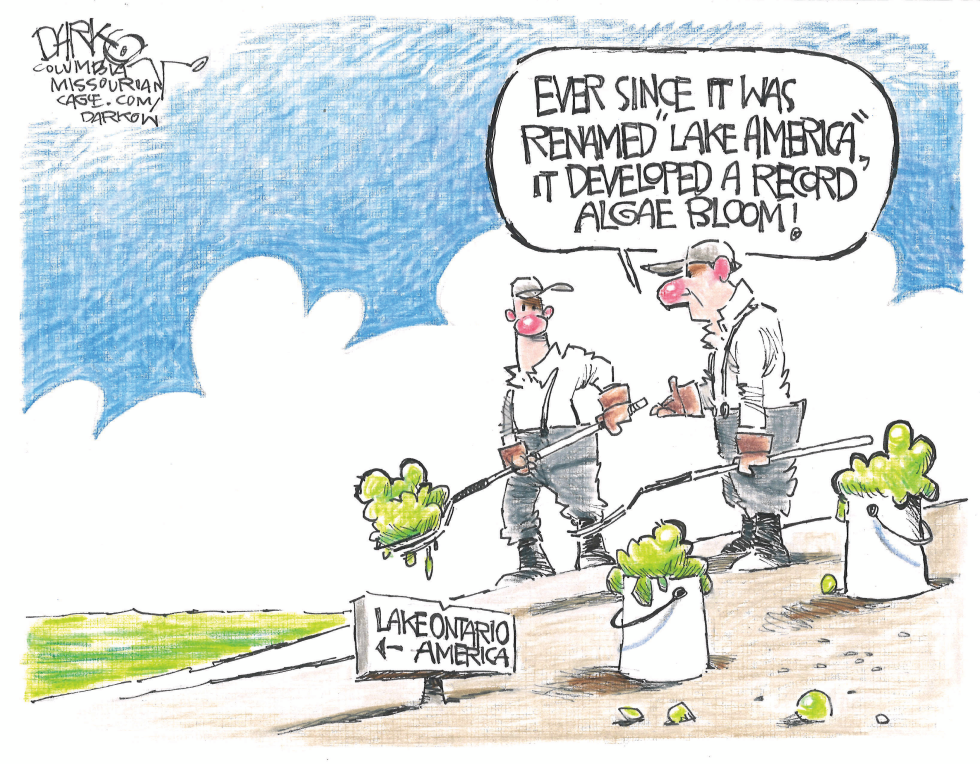
Workers clean a massive algae bloom from a lake recently renamed Lake America, formerly Lake Ontario. The outbreak follows the rebranding and draws attention to environmental conditions. The piece argues that superficial political gestures fail to address underlying ecological problems and may even coincide with worsening conditions.
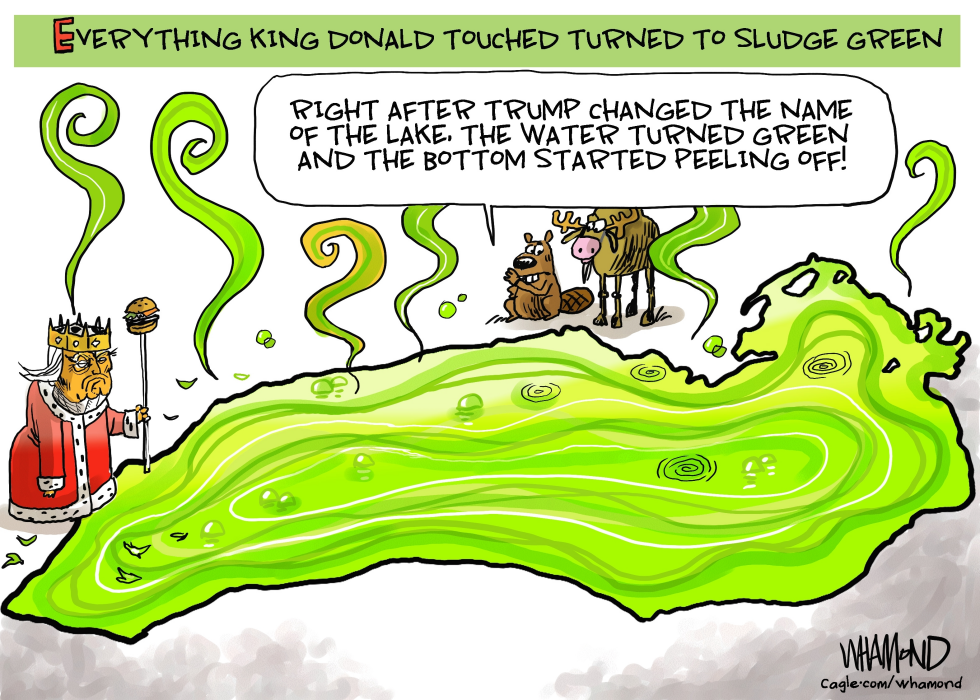
Donald Trump, depicted as a king, changes the name of a lake, after which the water turns green with sludge and the bottom begins peeling. Wildlife observers connect the timing directly to the renaming. The development raises concerns about environmental damage tied to executive actions. The piece portrays the outcome as an inevitable result of Trump's influence, turning natural areas into polluted sludge.
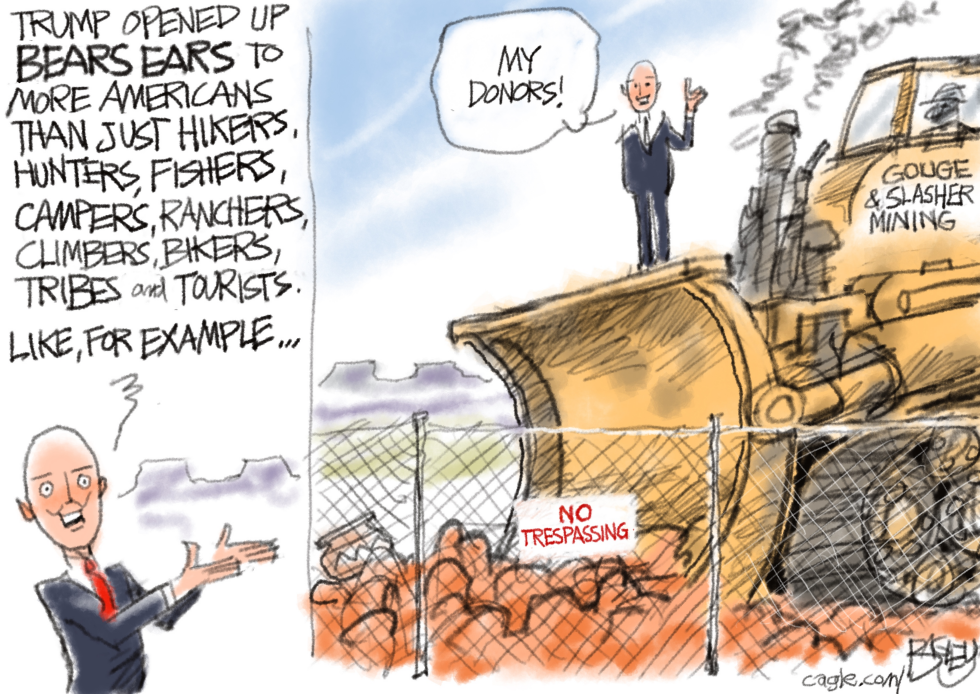
President Trump opened Bears Ears National Monument to expanded mining operations, citing broader public access. The move benefits mining companies and political donors while limiting protections for hikers, tribes and recreational users. The cartoon criticizes the decision as donor-driven favoritism over conservation.
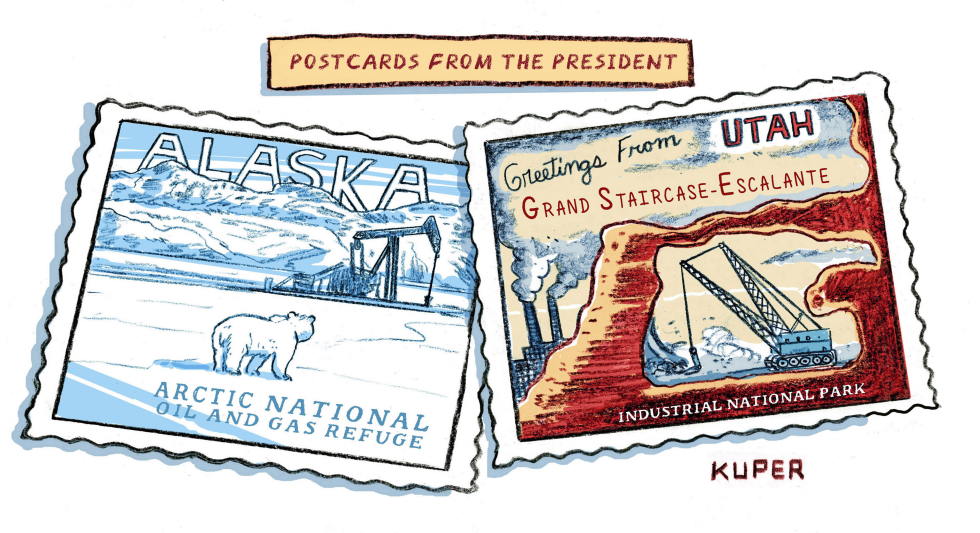
The president has advanced policies opening Arctic National Wildlife Refuge and Grand Staircase-Escalante to expanded oil and gas development. These moves prioritize domestic energy production over prior conservation designations. The editorial uses postcard imagery to critique the transformation of protected lands into industrial zones, arguing that short-term extraction gains undermine long-term environmental protections and public lands legacy.
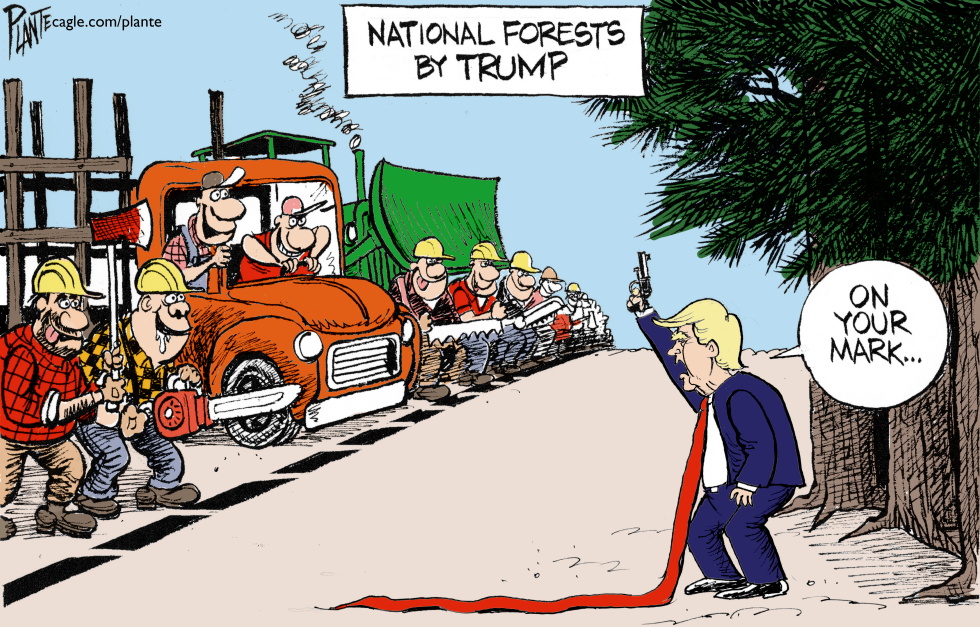
President Trump has directed expanded logging across national forests, ordering crews to begin timber harvests on federal lands. The move opens protected areas to commercial cutting under new administration policy. Critics argue the action prioritizes industry over conservation while supporters cite economic benefits and reduced wildfire risk. The cartoon depicts Trump firing the starting gun to launch the operations.
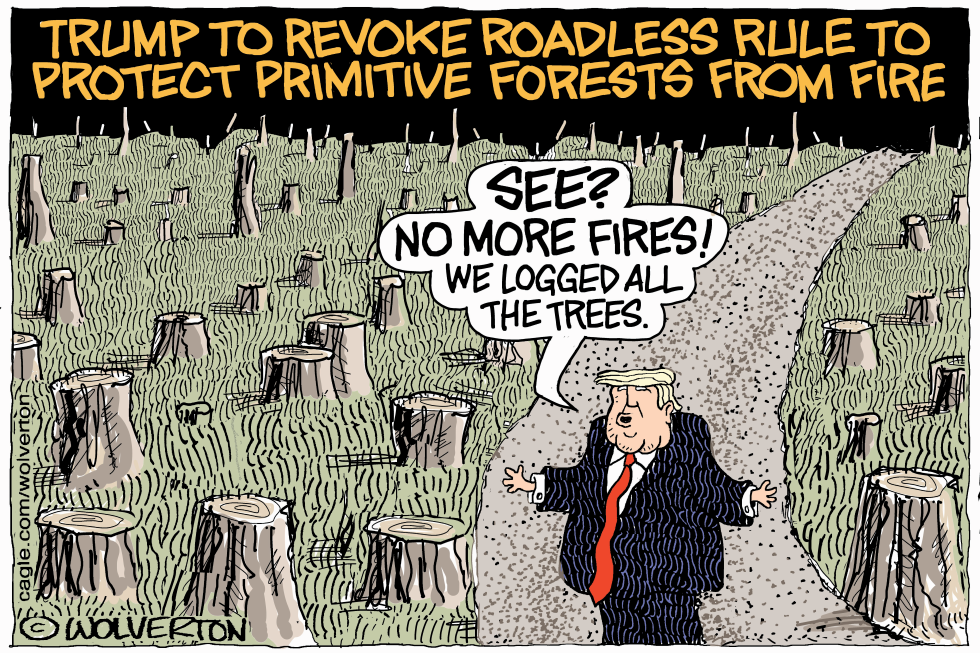
The cartoon shows Donald Trump in a landscape of tree stumps after revoking the roadless rule. He claims in a speech bubble that logging all trees eliminates forest fires. The image responds to the 2026 policy change allowing logging in previously protected primitive forests. The visual argument highlights the scale of tree removal as a supposed fire prevention measure. Publication occurred on August 18, 2026.
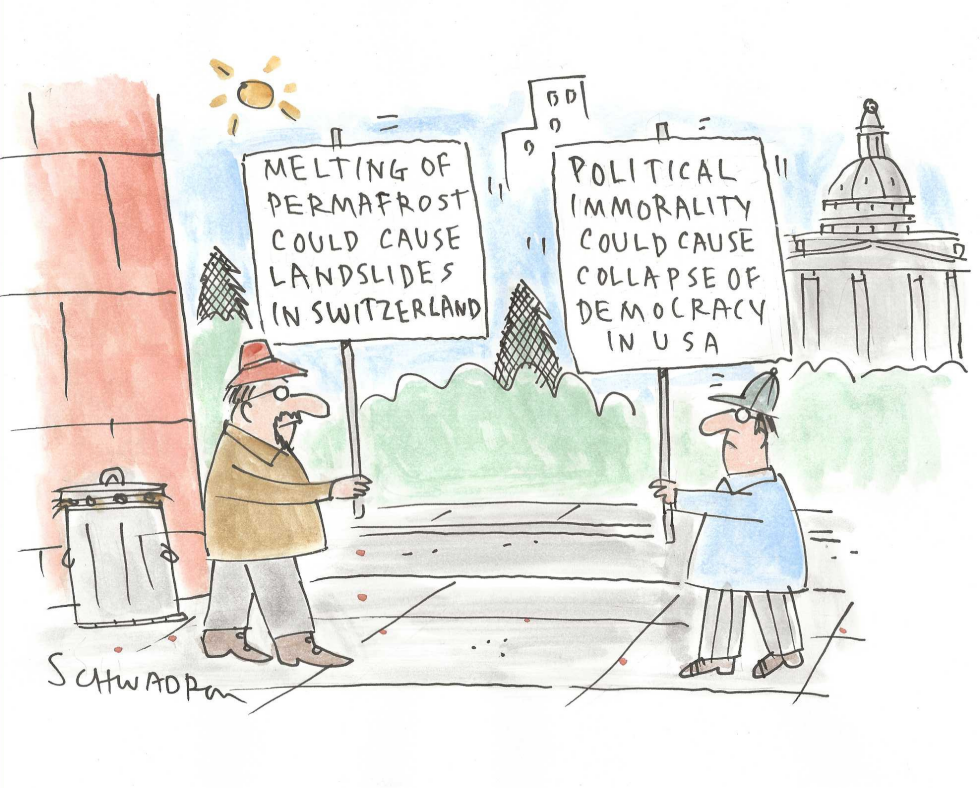
Activists in public spaces continue to draw parallels between accelerating climate impacts such as thawing permafrost and landslides in Switzerland and warnings about political conduct undermining democratic institutions in the United States. The signs highlight how environmental changes and governance failures each carry risks of sudden structural breakdown. The editorial stance underscores that both threats deserve equal public attention as visible warning indicators.
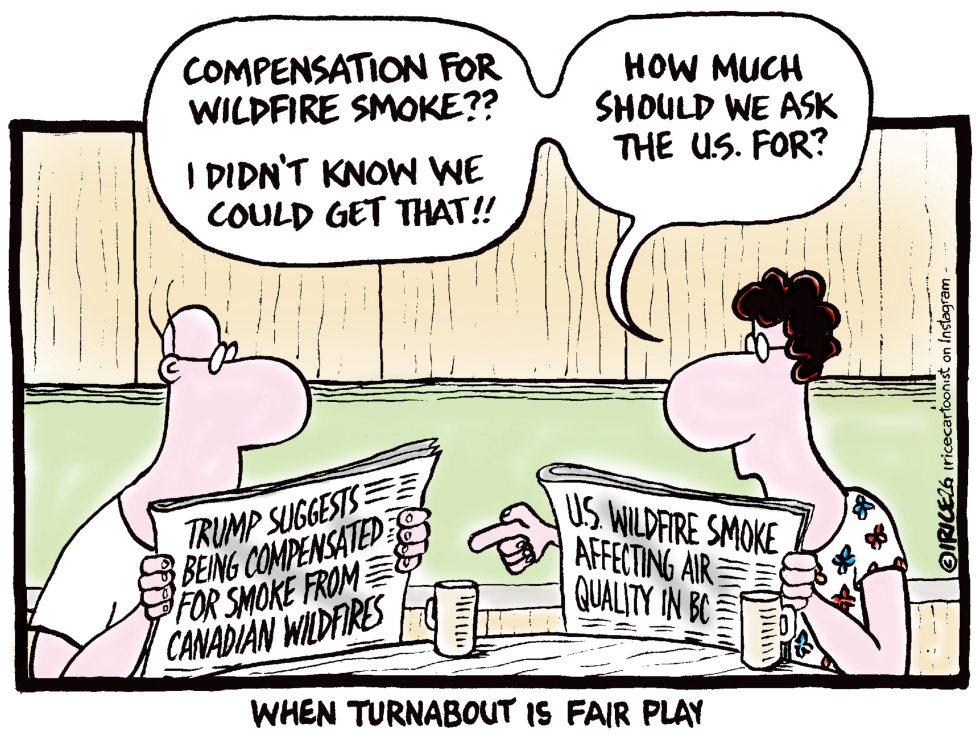
Donald Trump suggested the U.S. should receive compensation for smoke from Canadian wildfires. The cartoon responds by showing Canadians considering a reciprocal claim for smoke from U.S. wildfires affecting British Columbia air quality. It underscores the political dynamic of mutual environmental grievances between the two nations.
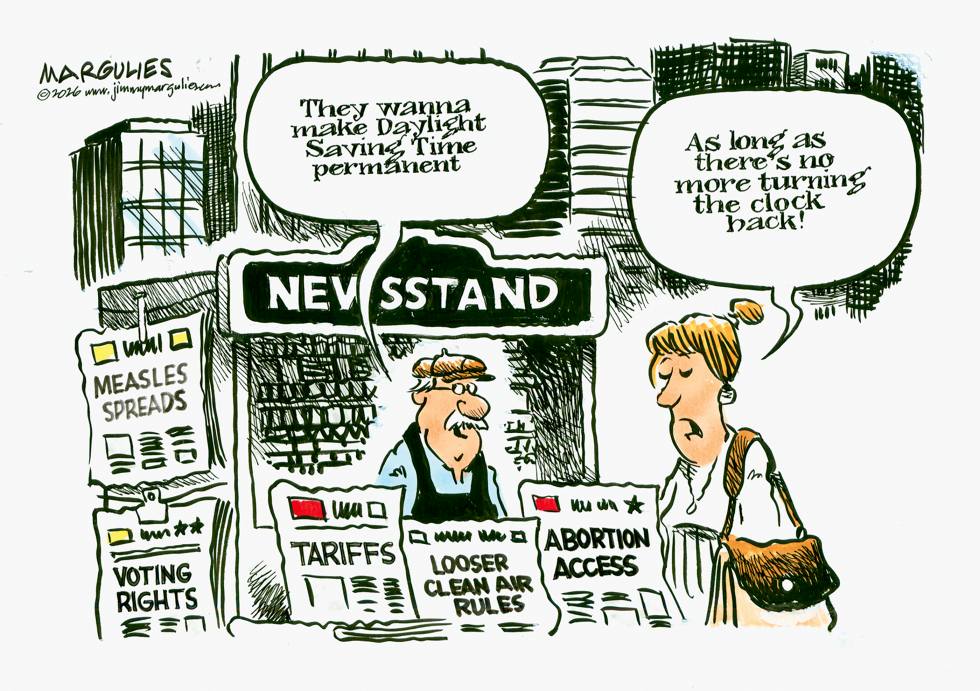
Proposals to make daylight saving time permanent coincide with debates over tariffs, abortion access, voting rights and environmental rules. The cartoon frames these as part of a broader pattern of policy shifts that some view as steps backward.
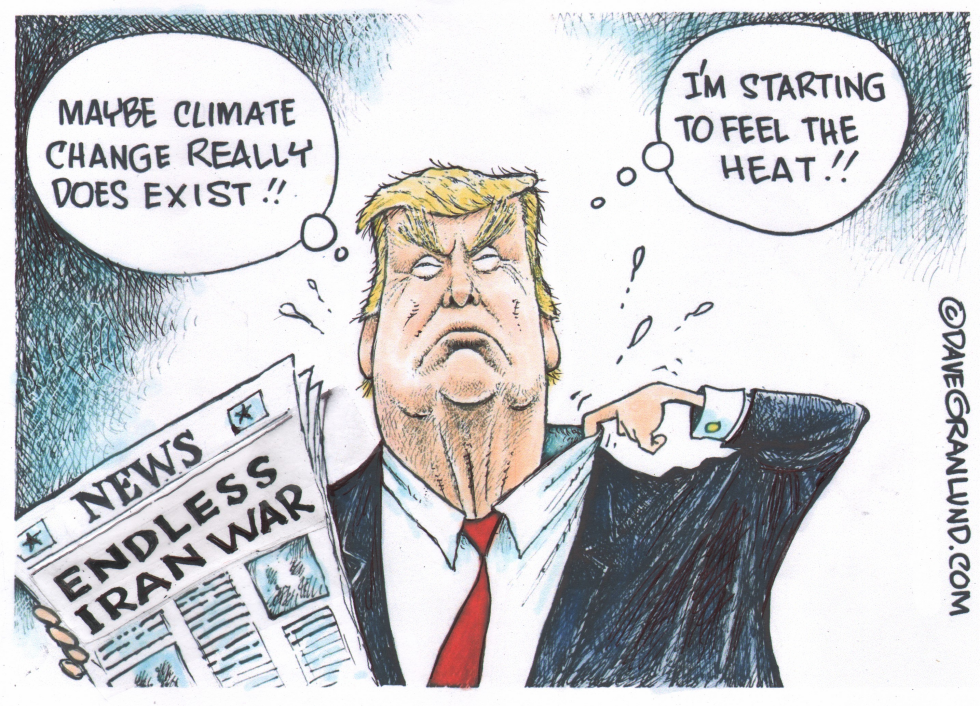
Donald Trump appears in the image sweating heavily with a flushed face. He holds a newspaper headlined Endless Iran War in one hand. His other hand pulls at his collar. One speech bubble states Maybe Climate Change Really Does Exist. Another states I'm Starting To Feel The Heat. The scene shows visible drops of sweat around his head and shoulders.
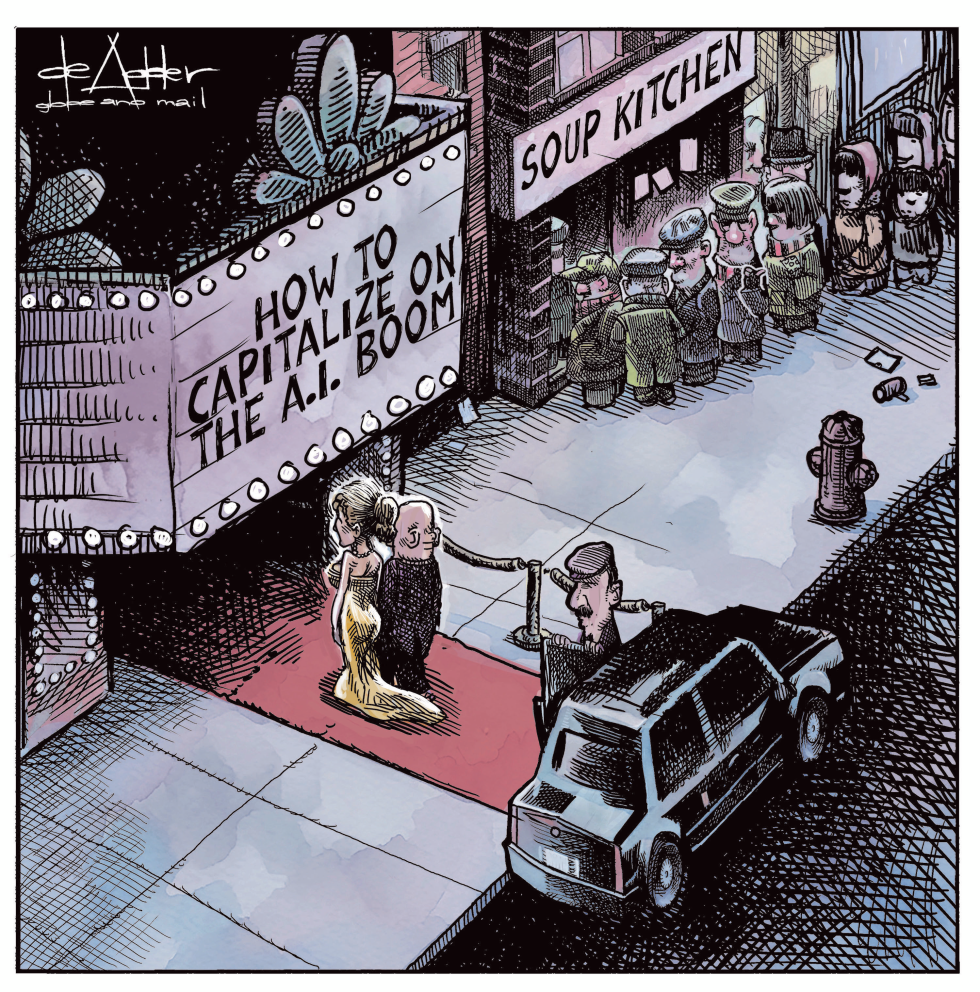
A political cartoon depicts a wealthy couple arriving at a theater hosting an event titled 'How to Capitalize on the A.I. Boom.' A red carpet and limousine service the entrance. Across the street a long line of people waits outside a soup kitchen. The image contrasts the gains from artificial intelligence for some with ongoing needs for others in 2026.
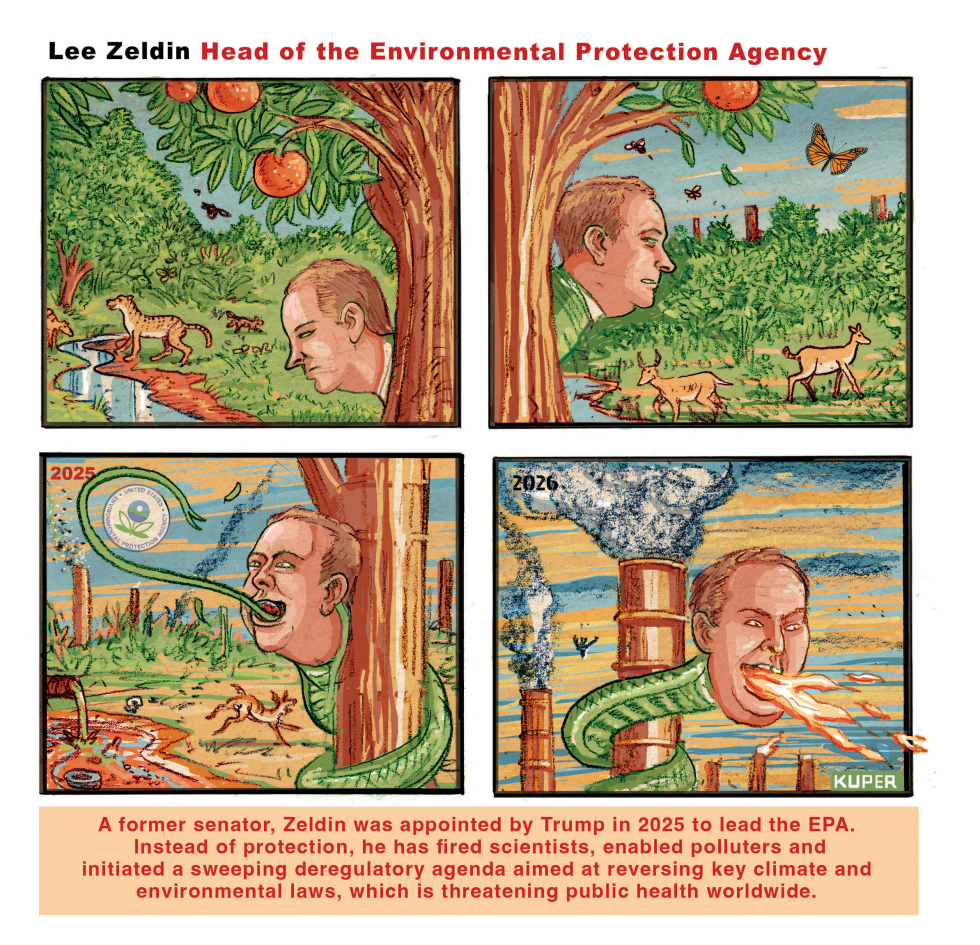
The cartoon by Peter Kuper portrays Lee Zeldin, appointed EPA administrator in 2025, across four panels that show a progression from intact natural habitats to scenes of industrial pollution and species loss. Early panels place Zeldin amid trees, animals and an EPA emblem. Later panels show him consuming the agency logo and exhaling flames from a smokestack. The caption states that Zeldin fired scientists and advanced deregulation targeting climate and environmental statutes. The work responds to ongoing policy shifts at the agency during the second Trump administration.
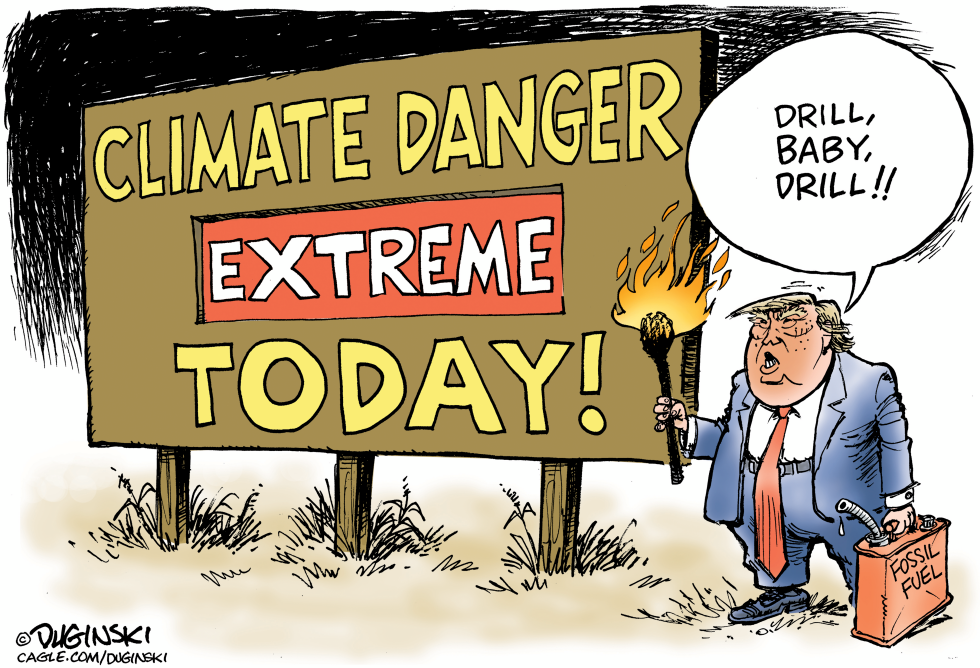
The cartoon shows a figure resembling President Donald Trump standing beside a large sign reading Climate Danger Extreme Today. He holds a lit torch in one hand and a can labeled Fossil Fuel in the other while shouting Drill Baby Drill in a speech bubble. The image responds to ongoing debates over fossil fuel policy and climate warnings active around the April 2026 publication date. Trump has long promoted expanded drilling and questioned climate alarm. The visual frames the president as directly confronting an official climate alert with traditional energy sources.