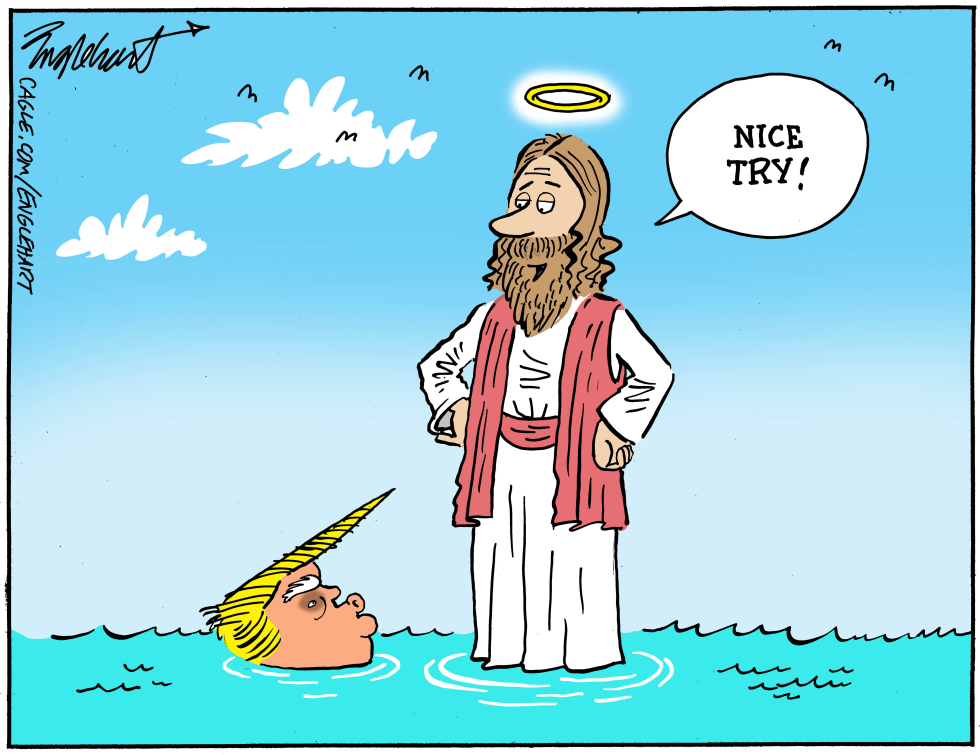
Bob Englehart's cartoon features a Jesus-like figure with a halo and robe, standing effortlessly on blue water under a clear sky, hands on hips, saying 'NICE TRY!' in a speech bubble. Below, a caricature head with exaggerated blonde hair sinks, eyes squinted, mouth open. Birds fly above fluffy clouds. Tags include political cartoon Trump Jesus comparison, satirical illustration Donald Trump biblical reference, Bob Englehart cartoon Trump walking on water fail, humorous depiction Trump messiah complex, editorial cartoon Trump self-comparison to Christ, and cartoon Trump sinking in water Jesus standing. The image pokes fun at overreaching self-images without deeper inference.
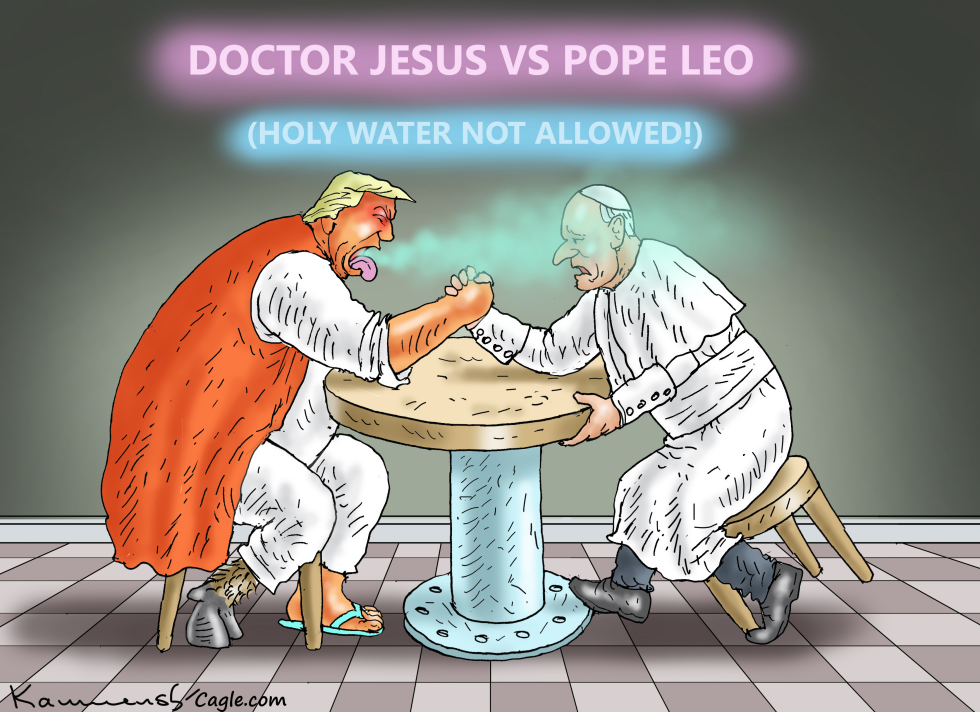
The image shows two figures engaged in arm wrestling, labeled as Doctor Jesus and Pope Leo, with a neon sign overhead stating 'DOCTOR JESUS VS POPE LEO' and a note that holy water is not allowed. Doctor Jesus appears with blonde hair, an orange cape, white robe, and sandals, while Pope Leo wears traditional white papal attire and shoes. A small elephant figure peeks from under Doctor Jesus's robe, and mist surrounds Pope Leo's head. The scene unfolds on a checkered floor with stools and a round table. This setup captures a direct, humorous confrontation between the caricatured holy figures, emphasizing the ban on holy water in their matchup. The artist's signature, Kamensky/Cagle.com, appears at the bottom.
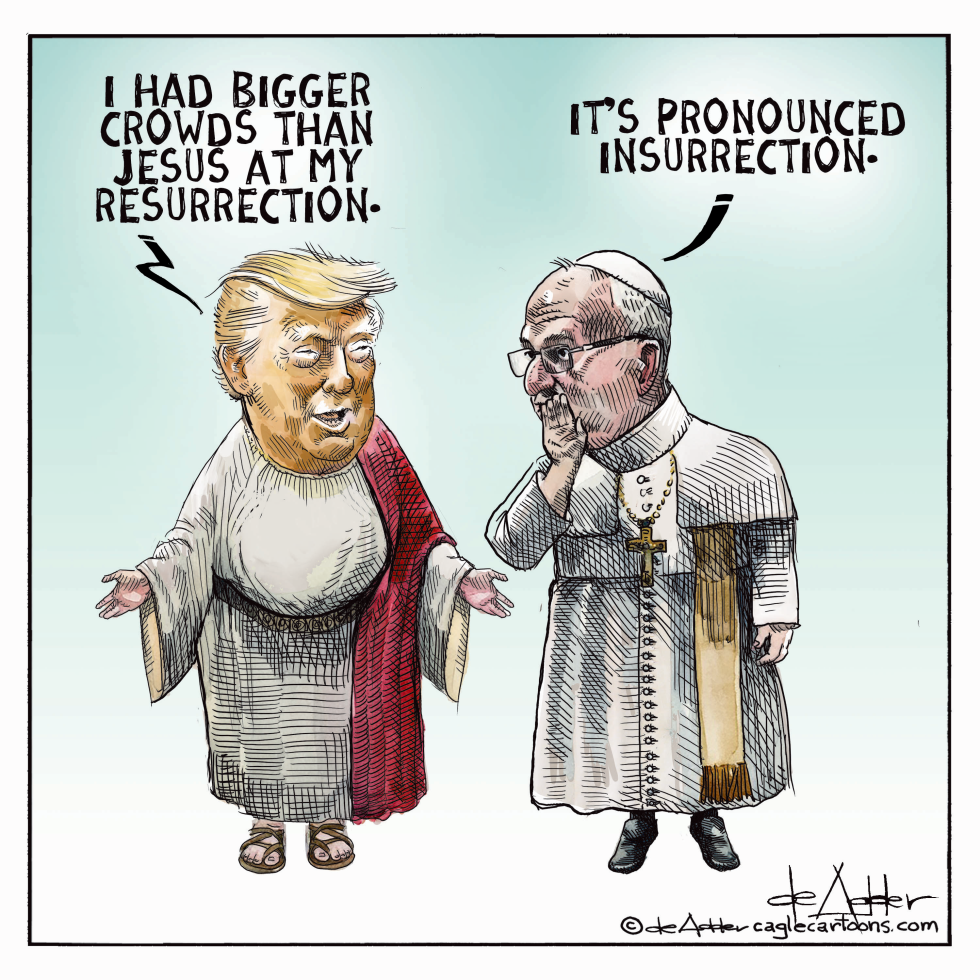
The cartoon depicts Donald Trump as Jesus Christ, complete with robe and sandals, claiming he had bigger crowds than Jesus at his resurrection. Standing beside him is the Pope, dressed in traditional Vatican attire with glasses and a cross, correcting the pronunciation to insurrection. Tags like Trump, Pope, Jesus, resurrection, and insurrection drive the humor, poking at Trump's known obsession with crowd sizes and linking it to the January 6 events. The artist, Michael de Adder, uses simple lines and a light background to focus on the figures and dialogue, creating a sharp satirical commentary on arrogance and political missteps. This piece fits well in editorial sections, blending religious imagery with current politics for a dry, pointed laugh.
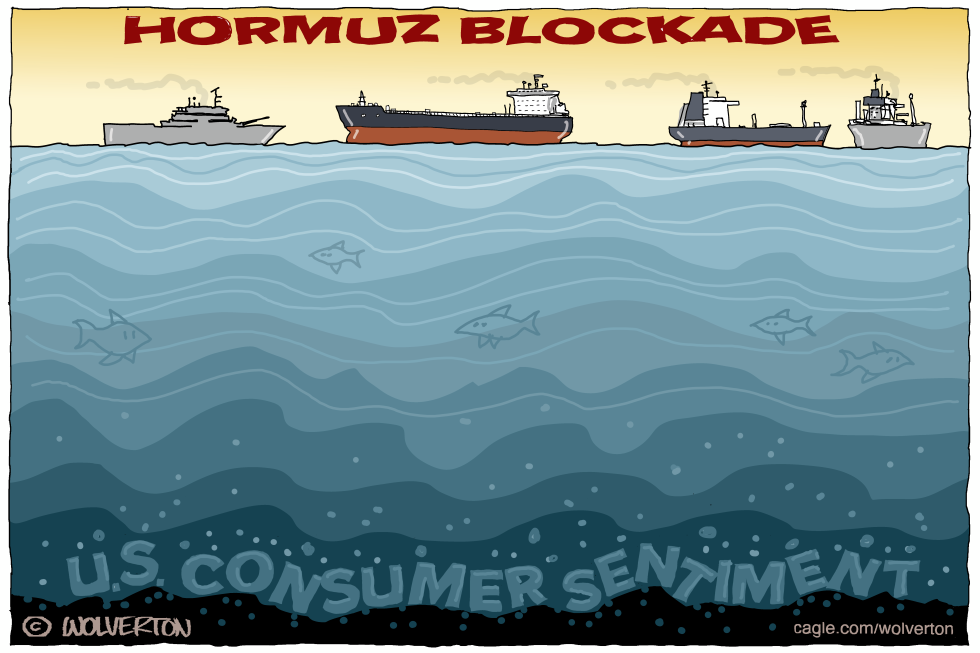
Monte Wolverton's cartoon captures the Hormuz Strait blockade with warships and tankers lined up on the water's surface, a clear nod to geopolitical strife in key oil passages. Below, the phrase U.S. consumer sentiment is etched into the ocean floor, surrounded by fish, driving home the idea of economic morale hitting rock bottom. This piece uses simple lines and color to highlight how international blockades can sink domestic confidence, tying into broader themes of global trade disruptions. The dry humor shines through in the visual pun, making it a standout in political satire circles. Tags like Hormuz Strait blockade political cartoon, US consumer sentiment sinking economy illustration, oil tanker ships naval blockade satire, Strait of Hormuz geopolitical tension comic, economic impact of Middle East conflict drawing, and consumer confidence underwater metaphor cartoon amplify its SEO reach.
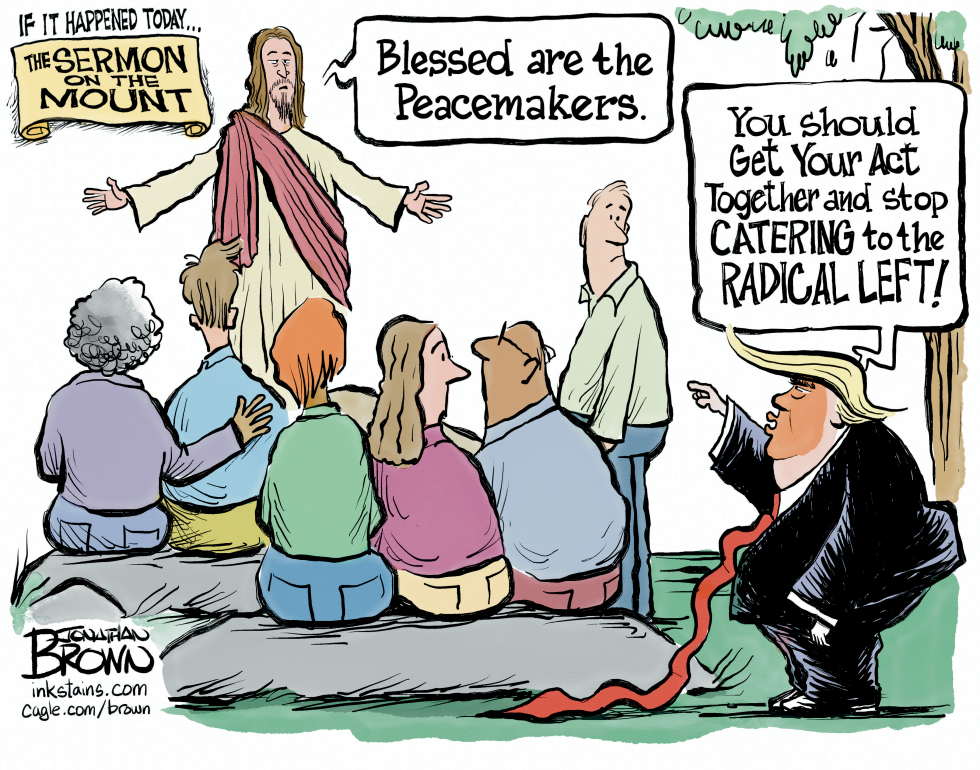
The cartoon depicts Jesus delivering the Sermon on the Mount, arms outstretched, proclaiming 'Blessed are the Peacemakers.' A banner reads 'If It Happened Today... The Sermon on the Mount.' A crowd sits on the ground, listening. A figure resembling Donald Trump, with distinctive hair and suit, points at Jesus and shouts, 'You Should Get Your Act Together and stop CATERING to the RADICAL LEFT!' The scene includes simple background elements like grass and a tree. Tags like war, peace, peacemakers, Jesus, and politics highlight the blend of biblical imagery with modern political commentary. This setup creates a direct contrast between messages of peace and partisan rhetoric.
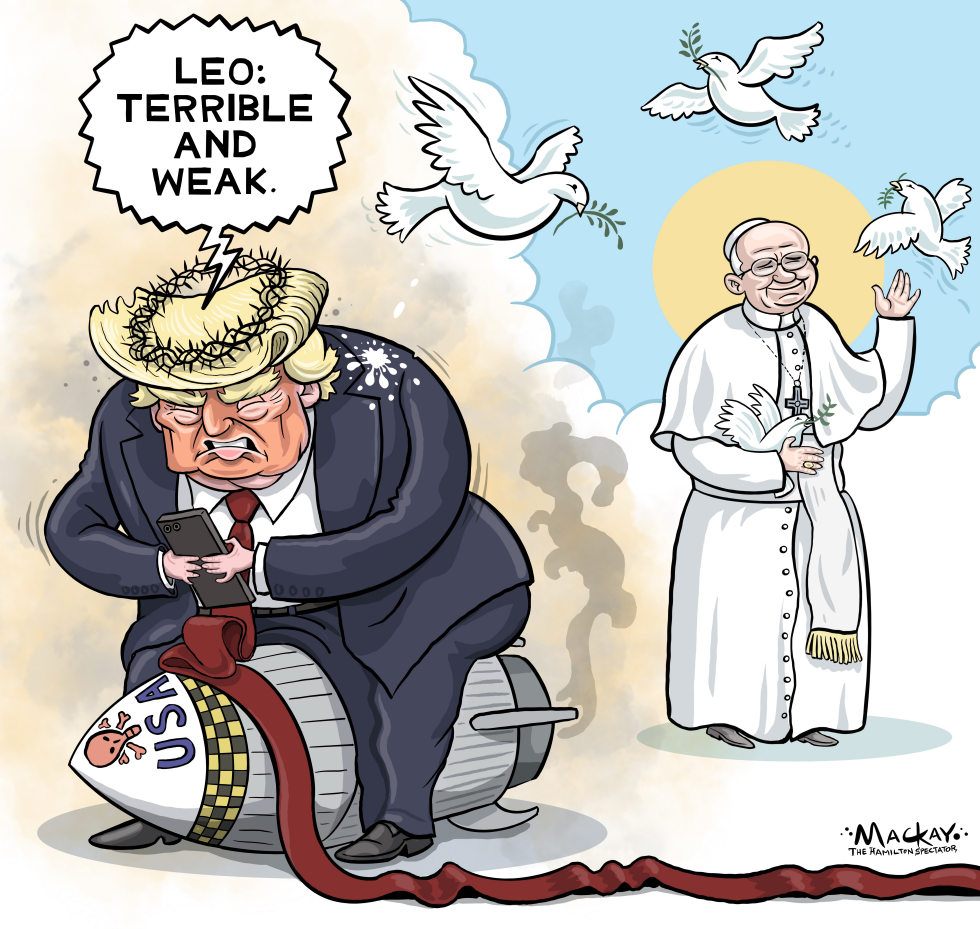
Graeme MacKay's political cartoon captures Trump, caricatured with crown of thorns hair, sitting on a bomb labeled USA with a skull symbol, holding a phone and declaring 'Leo: Terrible and Weak' in a speech bubble. Smoke rises from the missile, contrasting sharply with the Pope on the right, halo glowing, releasing white doves carrying olive branches. The scene unfolds against a cloudy sky, highlighting themes of war and peace. This satirical illustration pokes at political rhetoric, religious symbolism, and international tensions, blending humor with critique in a style that's both direct and pointed.
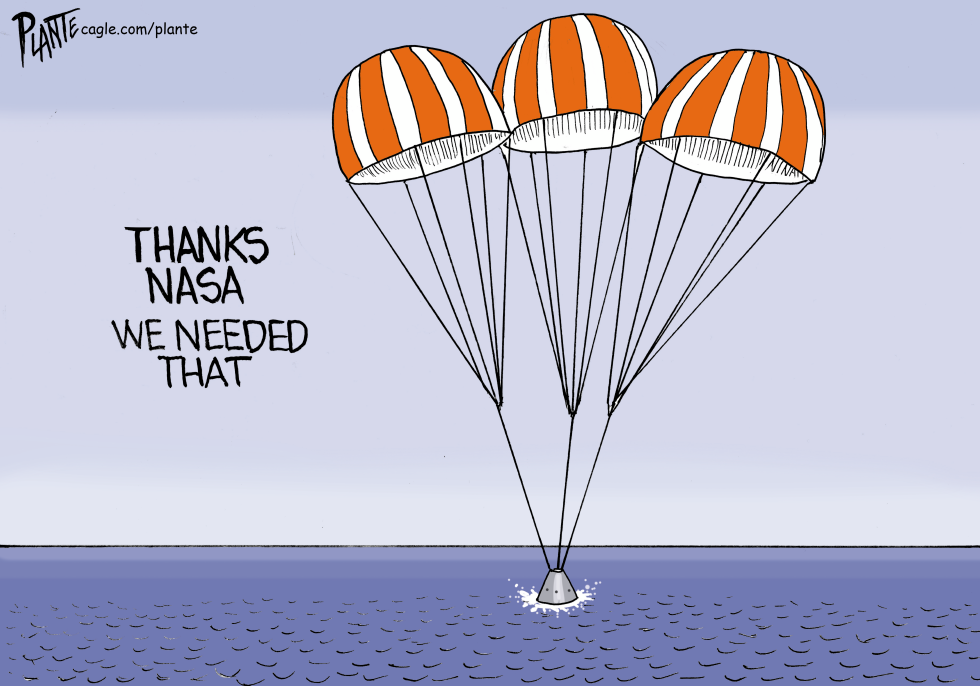
Bruce Plante\'s cartoon captures a space capsule\'s splashdown, complete with three orange and white striped parachutes guiding it to a blue ocean teeming with black fish-like forms. The prominent text \'Thanks NASA We Needed That\' adds a layer of sarcasm, typical in editorial illustrations commenting on high-profile events like the Artemis II mission. The simple composition, with a light blue sky and wavy ocean surface, emphasizes the moment of impact, shown by a small splash at the capsule\'s base. This piece fits into the tradition of political cartoons that highlight public sentiments toward government projects, using minimal elements for maximum impact. The artist\'s signature and website appear in the top left, grounding it in syndicated cartoon style.
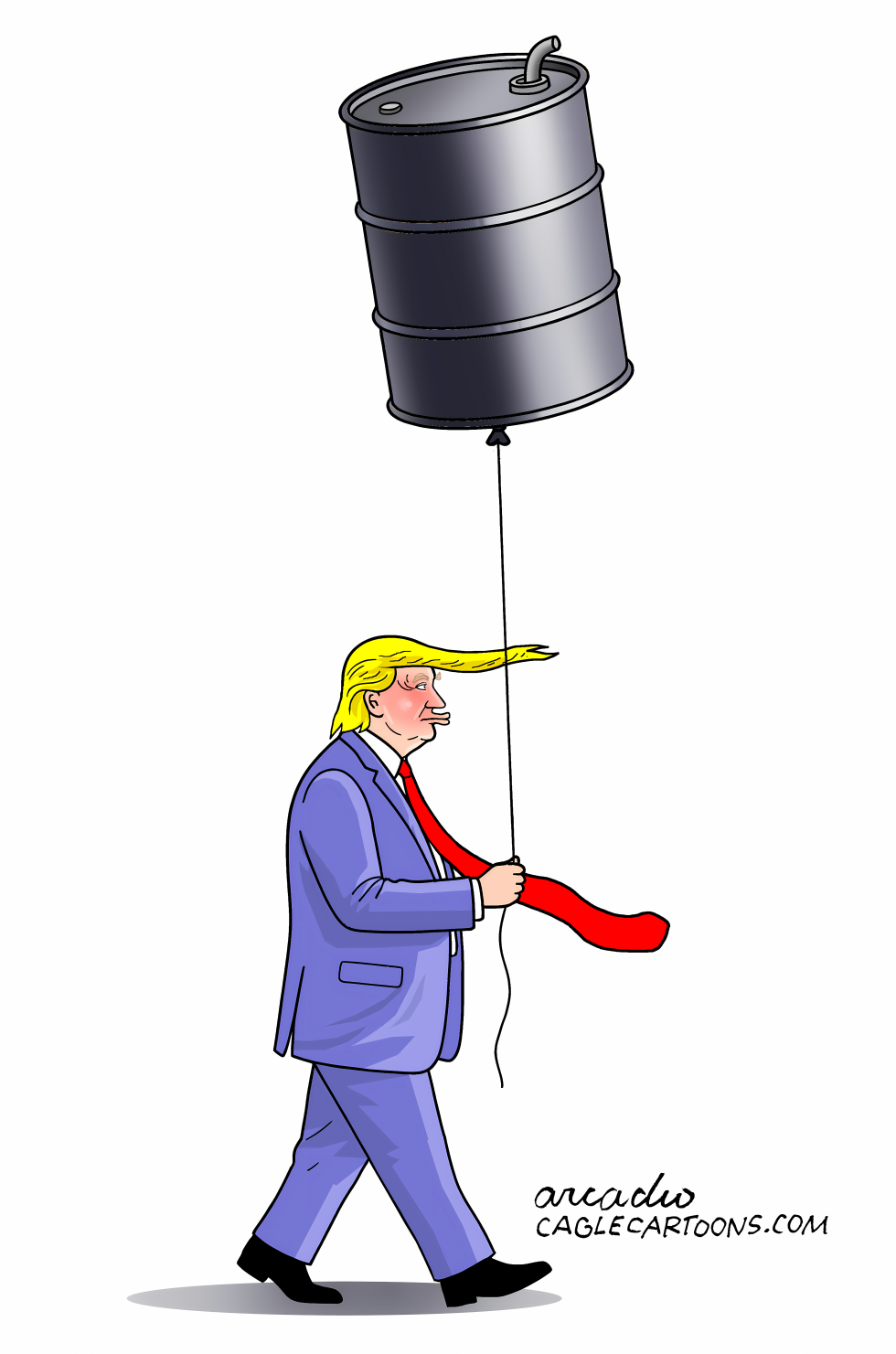
Arcadio Esquivel's cartoon captures Trump striding forward, his red tie extending upward to hold a massive oil barrel aloft like a helium balloon, with his yellow hair streaming behind. The simplicity highlights themes of Trump, oil prices, inflation, Hormuz, energy, and midterm elections. Such visuals often comment on economic pressures without words, relying on exaggerated features for recognition. Cartoonists like Esquivel use minimalism to drive points home, here linking a political figure to rising costs in a direct, unambiguous way. The white background keeps focus on the central elements, making the satire pop for viewers.
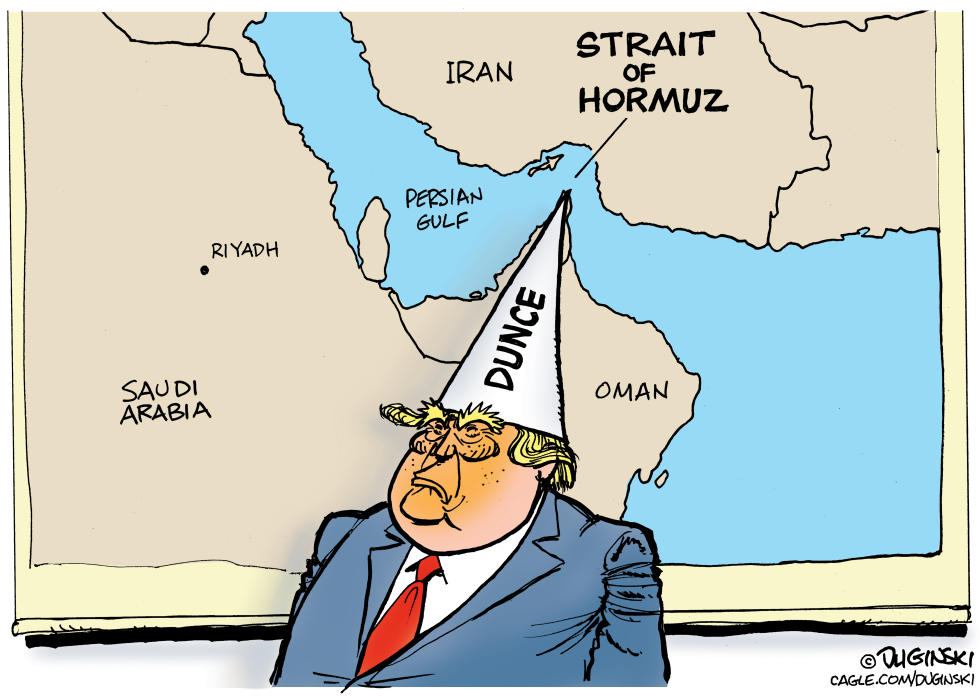
The cartoon depicts a simplified map of the Middle East, including labels for Iran, Saudi Arabia, Oman, Riyadh, and the Persian Gulf. The Strait of Hormuz is prominently marked, with a caricatured man in a suit and red tie wearing a dunce cap labeled \'DUNCE\' positioned over it. This setup uses the strait as a choke point for oil and energy, tying into themes of foreign policy, war, and ignorance. The image critiques handling of Middle East waterway issues, possibly linked to closure threats, tankers, and ceasefire efforts. Artist signature appears in the bottom right.
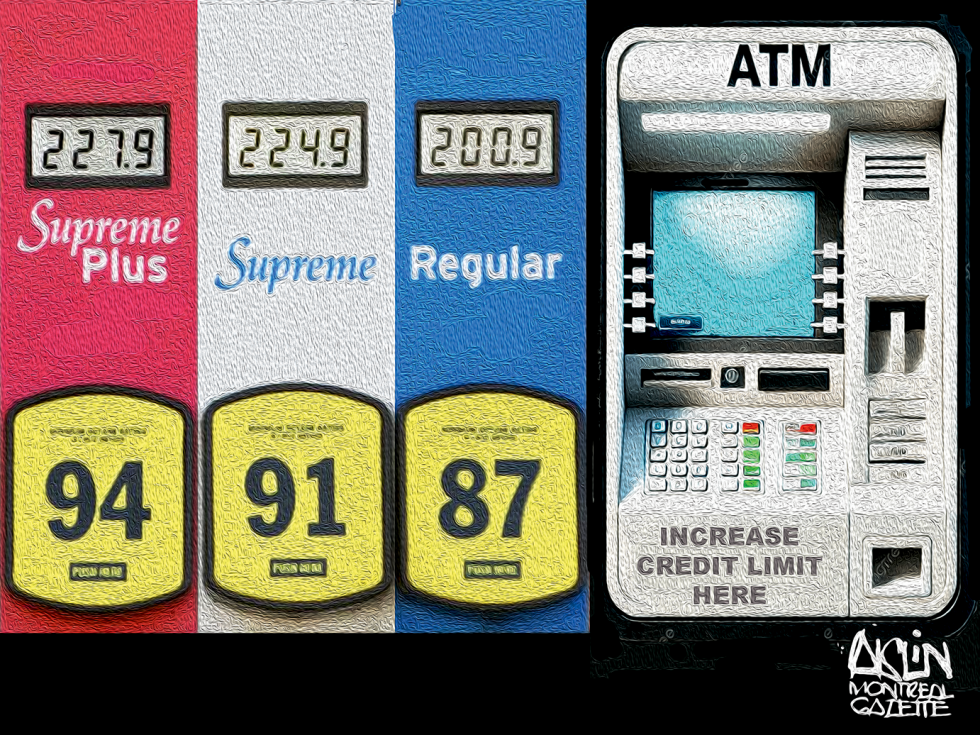
The cartoon shows a gas pump price board with supreme plus at 2.279 per gallon and 94 octane, supreme at 2.249 with 91 octane, and regular at 2.009 with 87 octane. Next to it sits an ATM labeled to increase credit limit here, poking at high gas prices and the economy's push toward more credit. Tags like gas, prices, cost, economy, credit, and pump underline the visual joke on affording fuel through debt. This setup captures the frustration with rising fuel costs without words, relying on the absurdity of blending a gas pump with credit services. Cartoonists often use such direct imagery to comment on everyday economic strains.
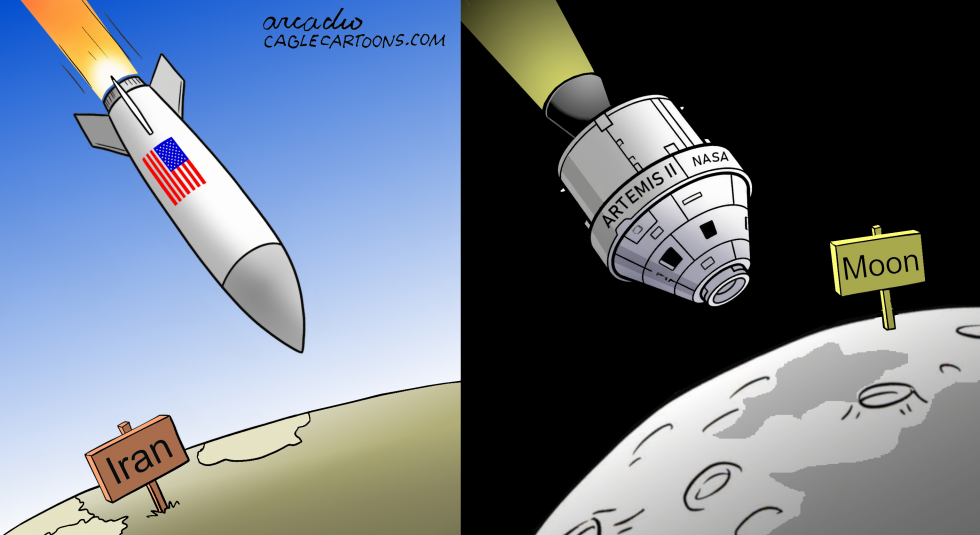
Arcadio Esquivel's cartoon splits the scene: on one side, a missile with an American flag streaks toward a planetary surface marked 'Iran,' flames trailing from its base against a blue sky. On the other, the Artemis II NASA capsule floats in space, nearing a gray lunar landscape labeled 'Moon' under a starry black backdrop. Tags including war, moon, exploration, Artemis II, NASA, Middle East, and Iran capture the visual pun. The dry humor points to misplaced priorities, where grand goals like space missions veer into military misadventures. Cagle Cartoons syndicates such pointed commentary, blending current events with sharp satire.
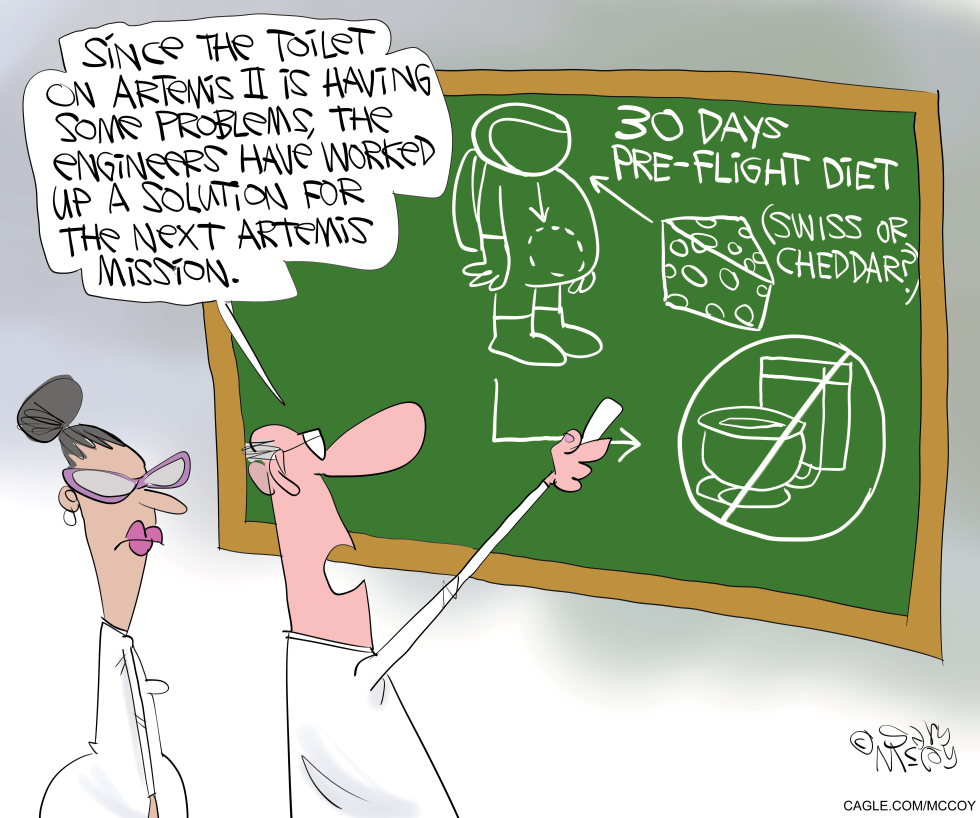
Gary McCoy\\\'s political cartoon depicts two figures in white coats, one pointing to a chalkboard with a speech bubble explaining a solution to Artemis II toilet problems via a 30-day pre-flight diet of Swiss or cheddar cheese. The board features a bloated astronaut sketch, a cheese cube, and a crossed-out toilet, poking fun at NASA engineering woes. This space mission satire uses dry humor to comment on technical glitches in the Artemis program, with tags like NASA Artemis II toilet problems, engineers solution Artemis mission, space mission pre-flight diet, Gary McCoy cartoon, cheesy diet fix, and humorous take on NASA solutions. The image stays light-hearted, focusing on visible elements without deeper speculation.
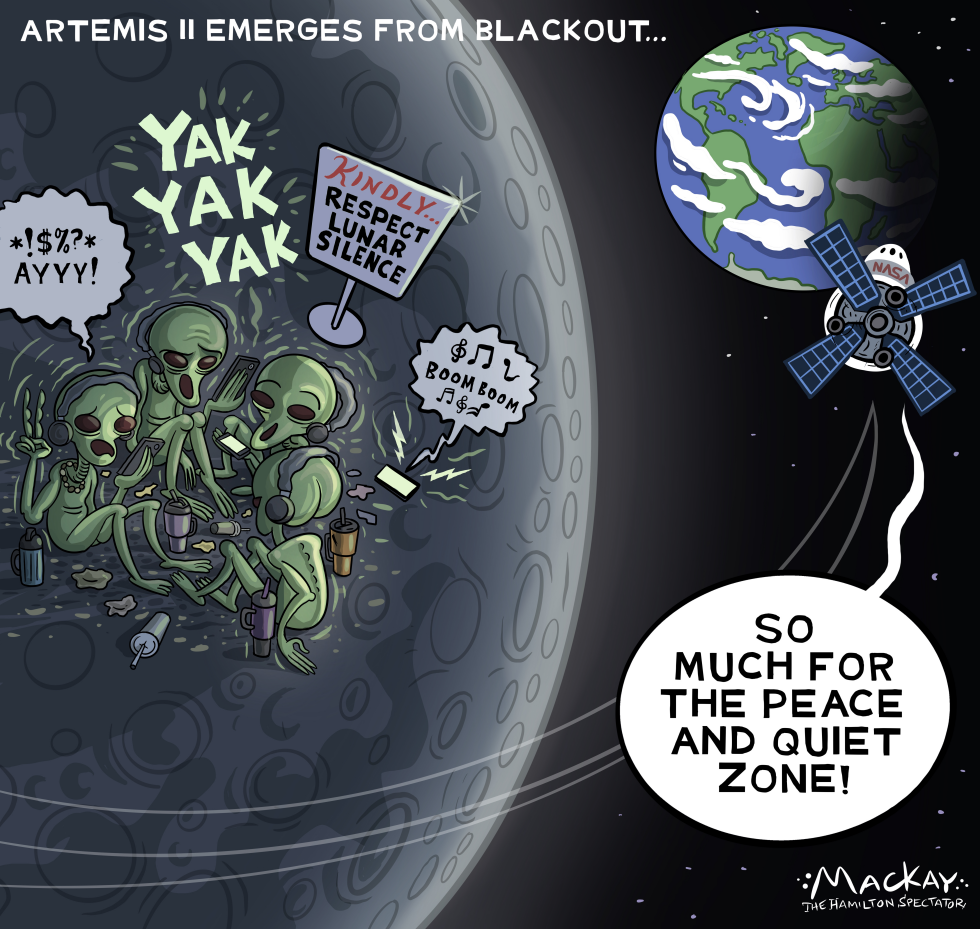
Graeme MacKay's cartoon shows a group of green aliens on the moon, clearly annoyed by the approaching NASA Artemis II spacecraft emerging from blackout. The aliens, depicted with headphones, phones, and drinks, make noisy exclamations like 'Yak Yak Yak' and music notes, while a sign pleads 'Kindly Respect Lunar Silence.' One alien laments, 'So much for the peace and quiet zone!' against the backdrop of Earth. This piece satirizes space exploration's impact on supposed lunar solitude, touching on tags like Artemis, moon, NASA, aliens, quiet zone, and communication. The far side setting emphasizes the interruption of silence by human astronauts.
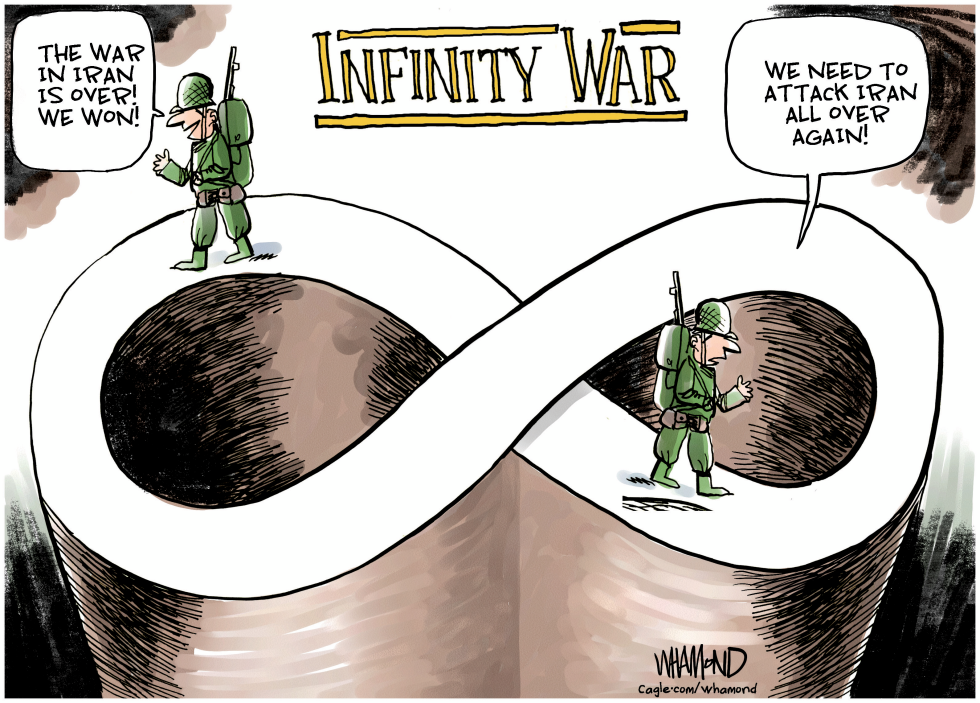
Dave Whamond's cartoon features two soldiers positioned on a large infinity symbol, one announcing victory in the Iran war while the other insists on attacking again, highlighting the perpetual nature of conflict. The title 'Infinity War' parodies endless warfare, with the loop representing cycles of victory and renewed aggression. Tags like iran war cartoon, infinity symbol war, endless conflict satire, military parody, perpetual war illustration, and satirical soldiers emphasize the dry humor in depicting how wars in regions like Iran seem to restart indefinitely, a common theme in political cartoons that resonates with ongoing global tensions.
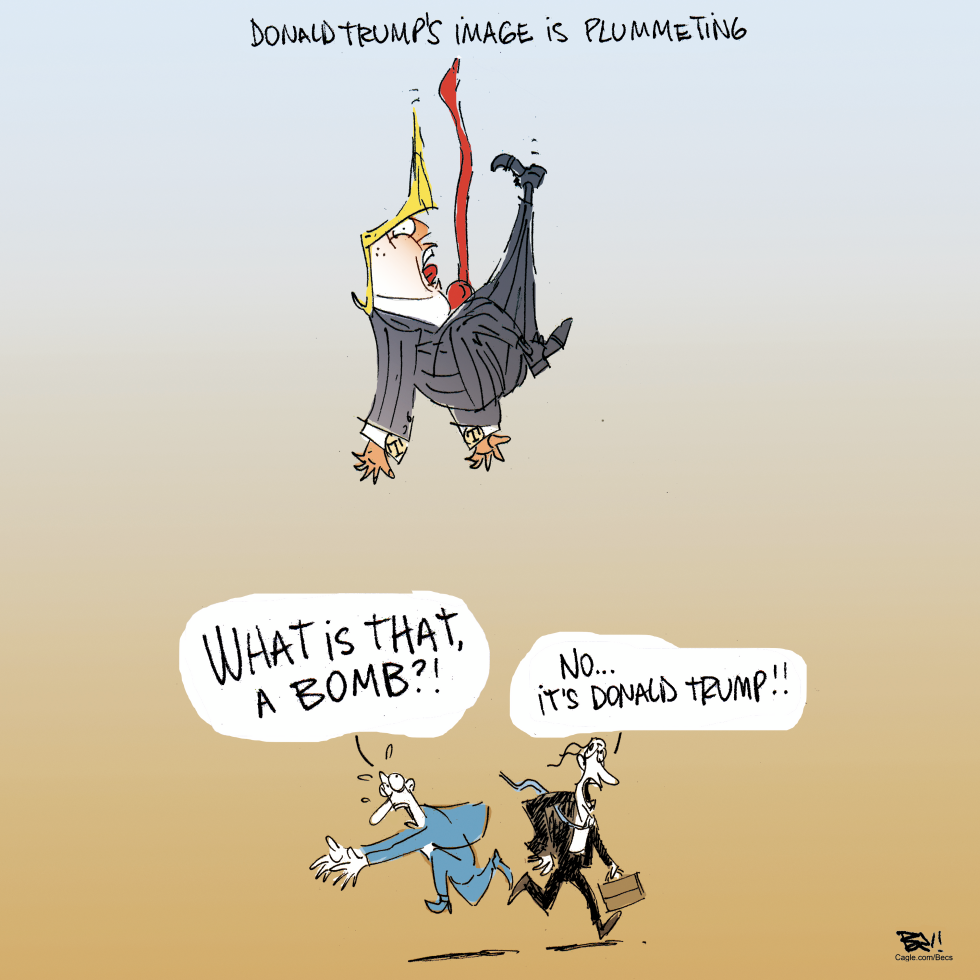
The cartoon depicts a figure with yellow hair and red tie, clearly caricaturing Donald Trump, diving headfirst from the sky like a falling bomb, mouth agape and limbs flailing. Below, two suited men run in panic, one asking if it's a bomb, the other identifying it as Trump. The title declares 'Donald Trumps Image is Plummeting,' playing on the pun of falling popularity. This piece skewers the Trump administration in the US for saying one thing then another, coming off as perverse and arrogant. It portrays him as thinking he's a king, the absolute tyrant of the world, with Europe and the world fed up. The dry humor lands through the visual metaphor, emphasizing global exasperation.