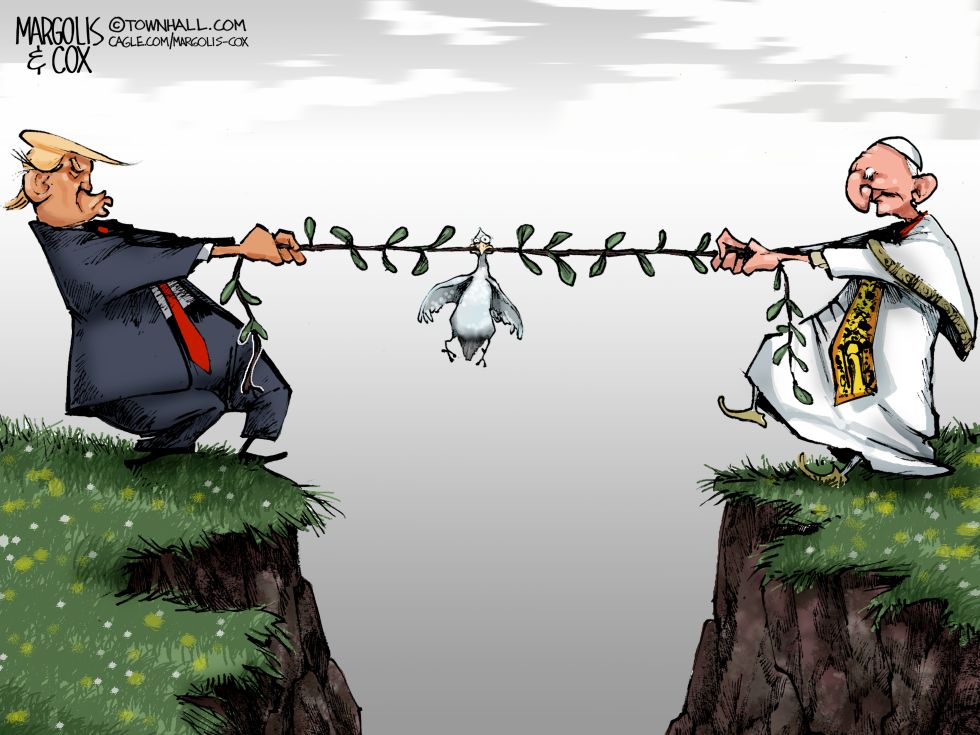
The cartoon shows a caricature of President Trump on one grassy cliff, gripping a vine with leaves that connects to a white dove in the center, while a figure resembling Pope Leo stands on the opposite cliff, also pulling the vine. They face each other across a deep chasm, with cloudy skies above. Tags like war, peace, dove, Iran, Middle East, and Church underscore the visual tension. The artists, Margolis & Cox, place their signature prominently. This setup captures a straightforward conflict over a peace symbol, without hidden layers. The dove hangs upside down, wings slightly spread, as the two figures strain. No emotions or backstories are added; it's just the visible pull between suited man and robed leader.
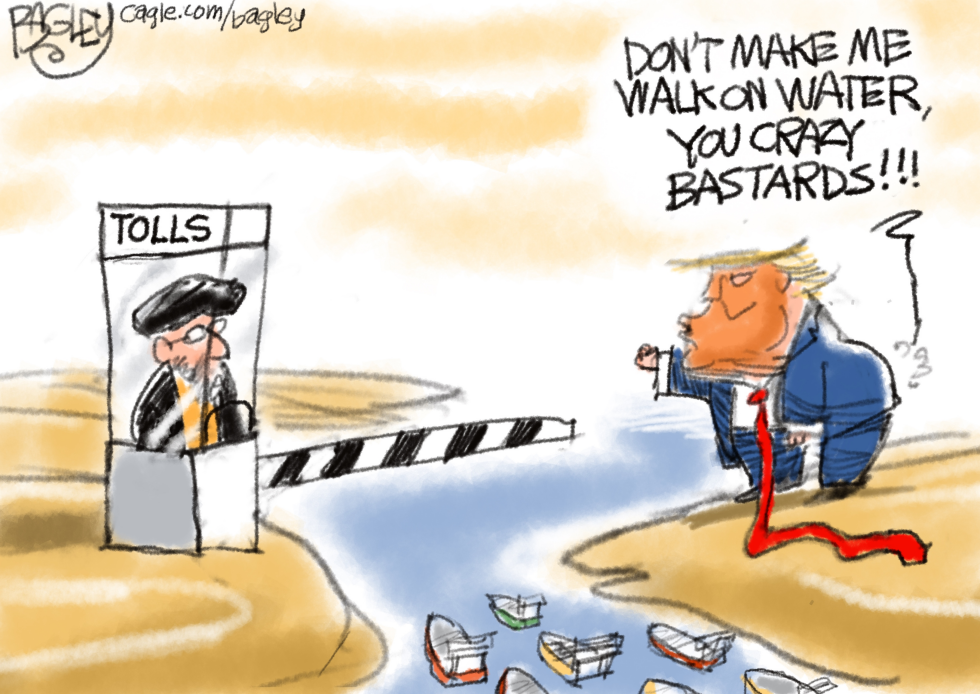
Donald Trump stands at the edge of a body of water confronting a toll booth operated by a figure resembling Ayatollah Khamenei. Small tankers sit in the water below while Trump issues a warning about walking on water. The scene references shipping routes through the Strait of Hormuz and surrounding nations.
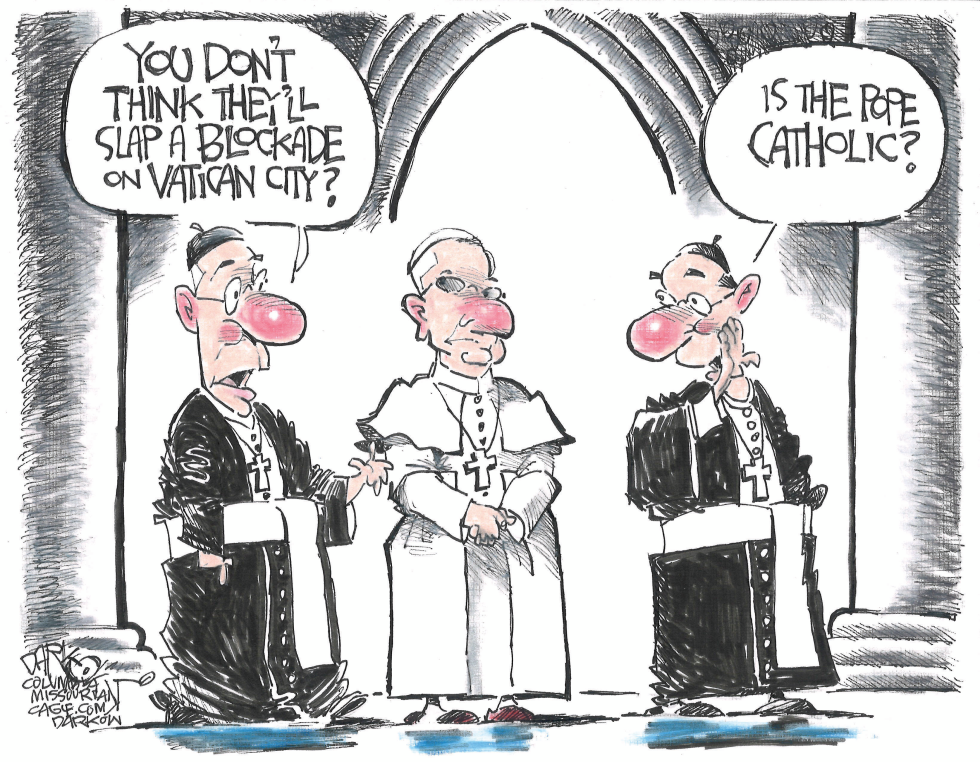
John Darkow's cartoon captures three Catholic clergy in traditional attire, with the central Pope figure amid a discussion on a Vatican blockade. The left figure worries about sanctions slapping Vatican City, while the right delivers the classic 'Is the Pope Catholic?' line, a rhetorical jab at obvious truths. This piece uses dry humor to spotlight tensions around religious institutions facing isolation, blending blockade fears with papal identity. The archway background grounds it in Vatican aesthetics, emphasizing the blockade theme without overreaching into unseen politics.
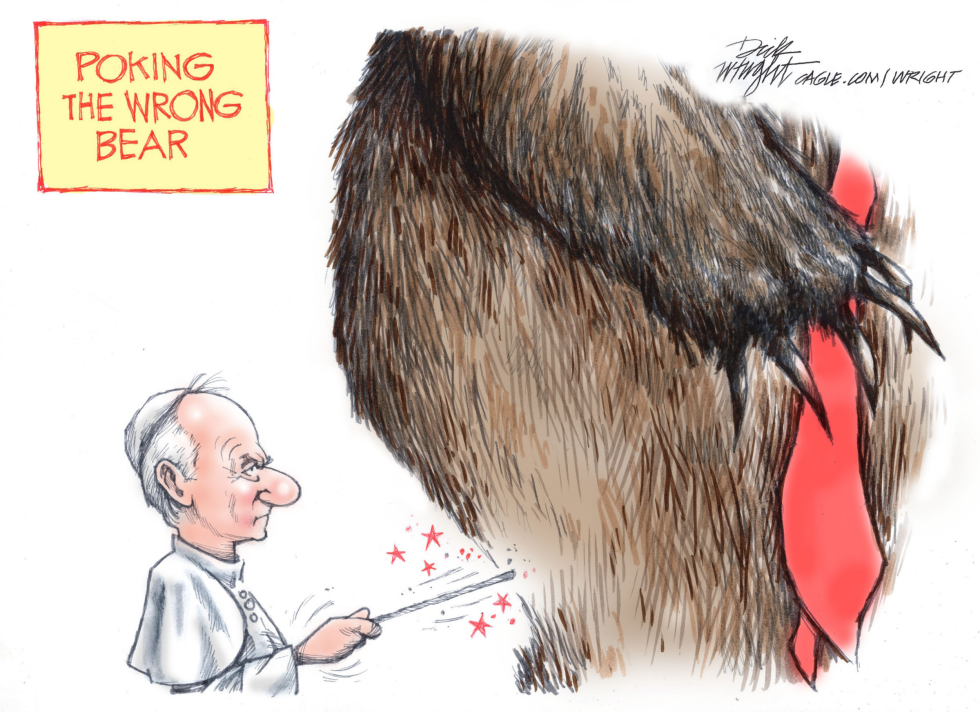
Dick Wright's political cartoon depicts a Pope-like figure in white attire, extending a thin rod toward the rear of a massive brown bear, complete with a dangling red tie and sparkling effects at the point of contact. The yellow label reads 'POKING THE WRONG BEAR,' playing on the idiom with a twist. This satirical illustration ties into the Trump-Pope feud, using the bear as a stand-in for power, the red tie evoking Trump's signature look, and the poking action suggesting provocation. Cartoonists often employ such animal metaphors for political commentary, and Wright's style here delivers clear lines and exaggerated features for impact. The image avoids overstatement, sticking to visible elements like the bear's claws and fur details, making it a straightforward jab at ongoing tensions.
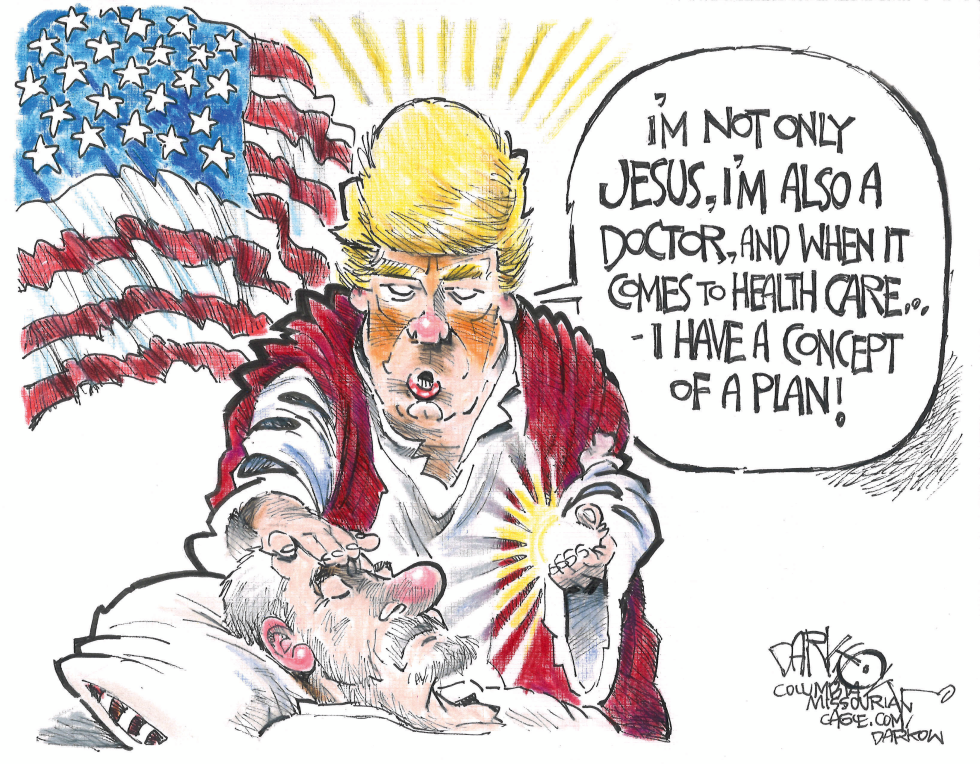
John Darkow's cartoon shows a blonde-haired figure resembling Donald Trump, clad in a red cape and white garment, extending a glowing hand toward an elderly man lying in bed. An American flag waves in the background with radiant beams from above. The speech bubble declares the figure as both Jesus and a doctor, boasting a concept of a health care plan. This setup highlights satirical elements in political imagery. Tags like donald trump political cartoon, trump health care plan satire, jesus doctor parody cartoon, american flag political humor, trump messiah complex illustration, and health care policy cartoon fit the visible components.
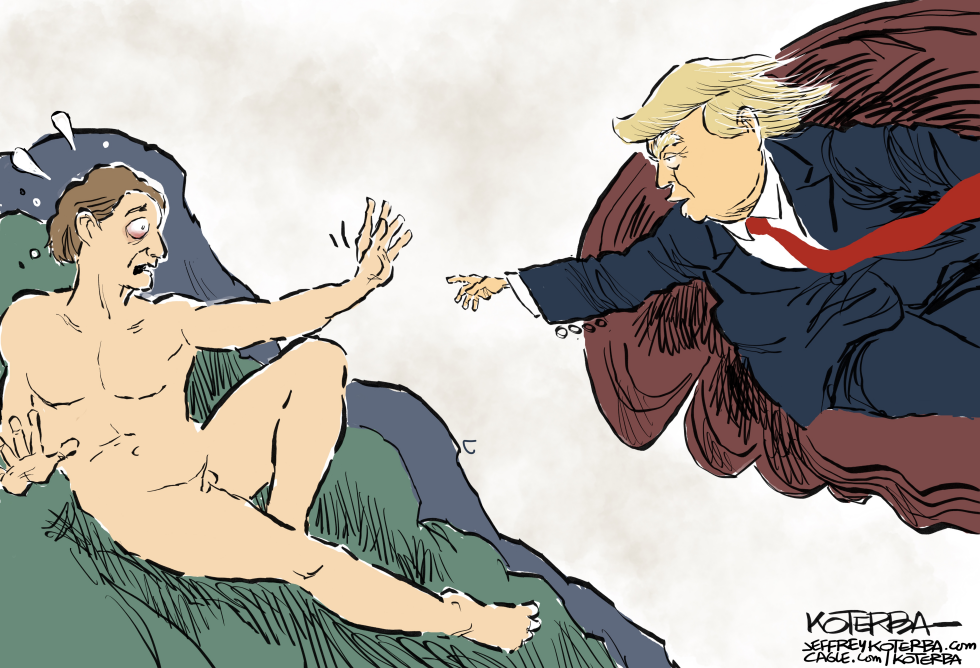
Jeff Koterba's cartoon reimagines Michelangelo's Creation of Adam, placing a Trump-like figure in the role of God, clad in a suit and red tie, floating in a red cloak while reaching toward a nude, shocked man resembling Adam on greenish rocks. The image captures satirical elements of presidential hubris, with tags including Trump caricature, political satire, divine parody, ego commentary, artistic homage, and cartoon humor. Such visuals often spark discussions on leadership perceptions, blending historical art with contemporary politics in a straightforward, humorous critique.
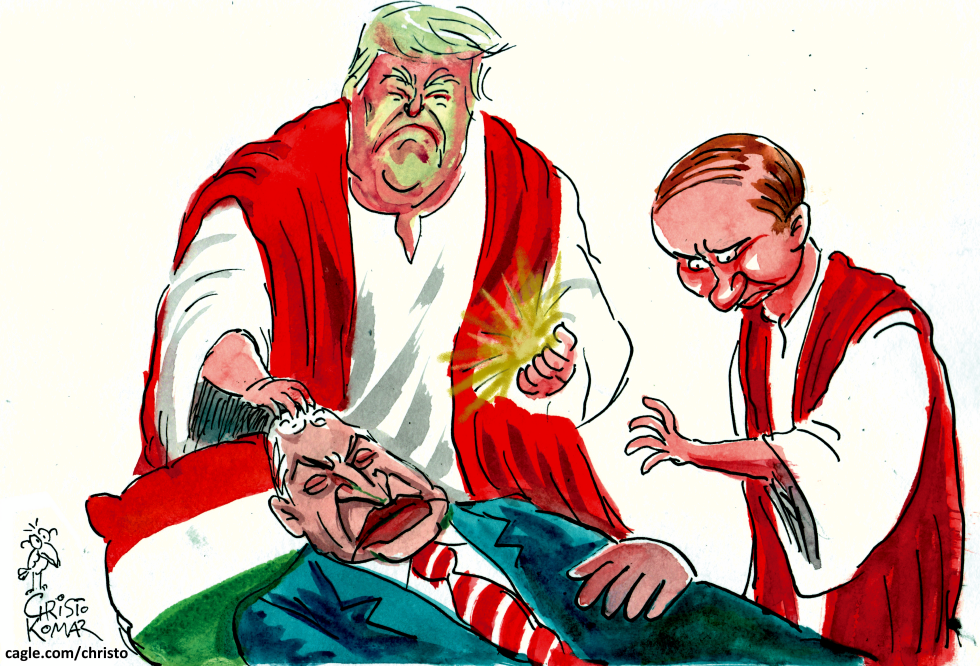
Christo Komarnitski's cartoon captures Trump dressed as a healer in red and white robes, his hand emitting a yellow spark as it touches the head of a mustached man in a suit, lying on a pillow colored like the Hungary flag with red, white, and green stripes. Beside him, another figure in matching robes extends a clawed hand. The image employs political satire, caricature, humor, editorial art, parody, and illustration to highlight the scene without deeper inference. The artist's signature appears at the bottom left, marking it as a straightforward visual gag in the tradition of sharp political cartoons.
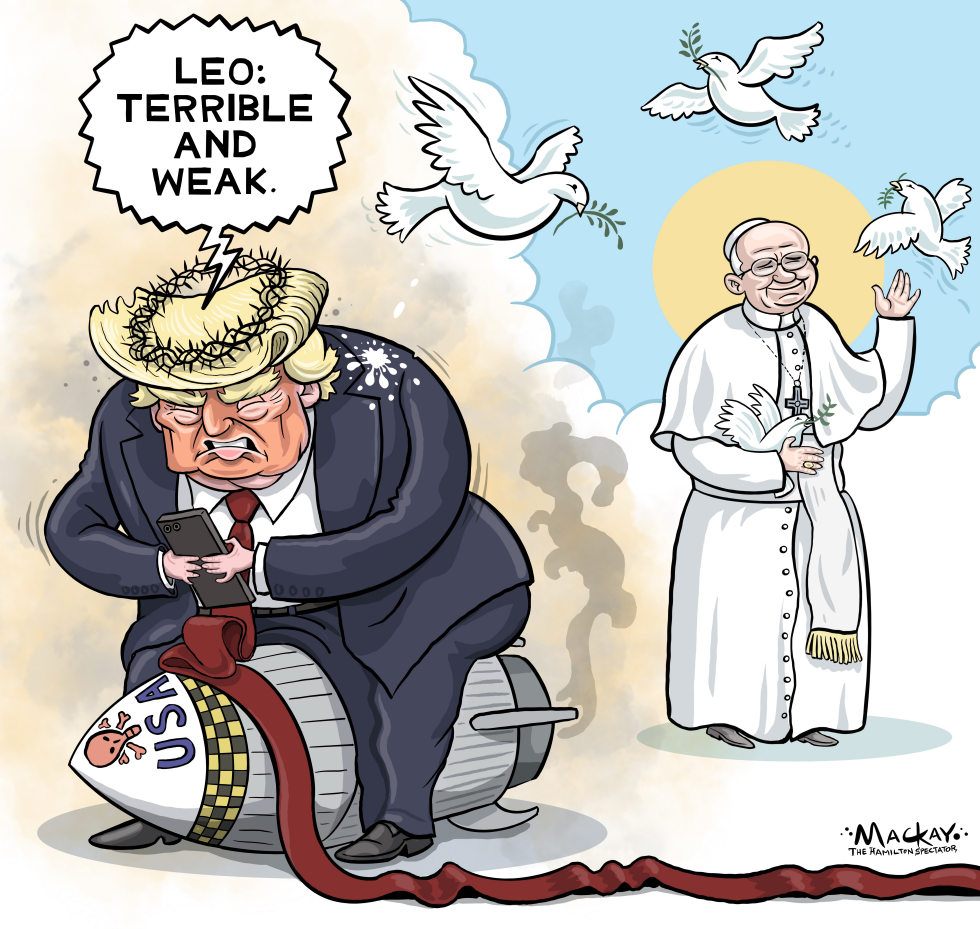
Graeme MacKay's political cartoon captures Trump, caricatured with crown of thorns hair, sitting on a bomb labeled USA with a skull symbol, holding a phone and declaring 'Leo: Terrible and Weak' in a speech bubble. Smoke rises from the missile, contrasting sharply with the Pope on the right, halo glowing, releasing white doves carrying olive branches. The scene unfolds against a cloudy sky, highlighting themes of war and peace. This satirical illustration pokes at political rhetoric, religious symbolism, and international tensions, blending humor with critique in a style that's both direct and pointed.
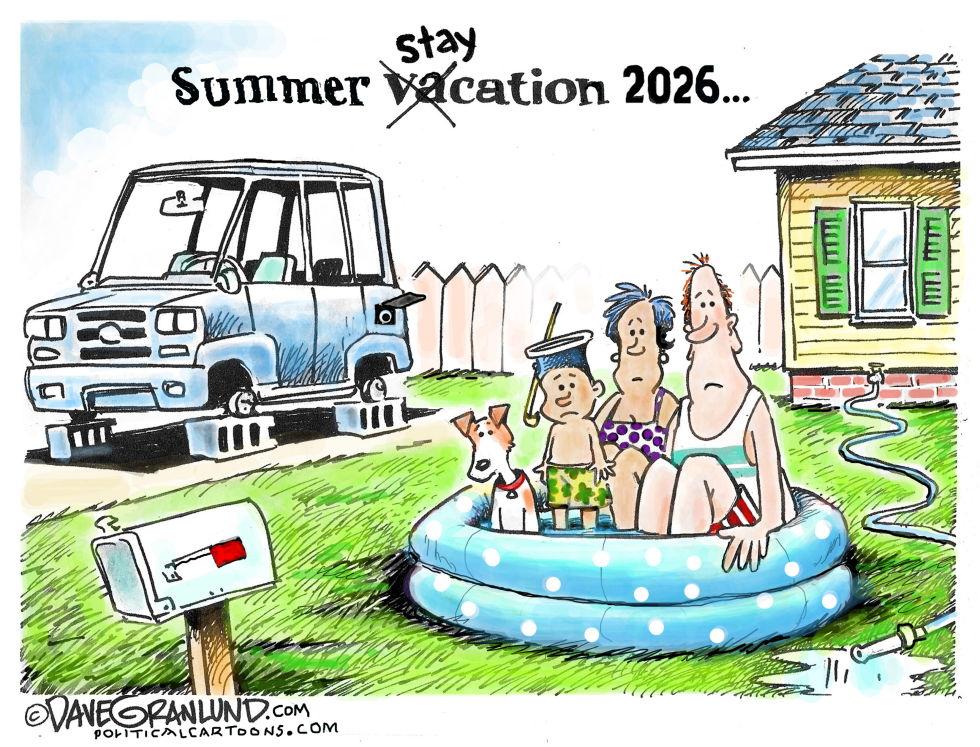
Dave Granlund's cartoon nails the frustration of high gasoline prices derailing summer road trips for families on limited budgets. Instead of hitting the highway in their autos, this crew opts for a stay home vacation, splashing in a backyard kiddie pool with the dog. The jacked-up minivan on blocks screams grounded plans, while the crossed-out 'Va' in vacation turns it into 'Staycation 2026.' It's a sharp poke at how fuel costs force folks to tighten belts, swapping grand adventures for hose-filled pools and mailbox views. Tags like gasoline prices, high cost, and stay home highlight the economic squeeze, making this a relatable jab at everyday belt-tightening.
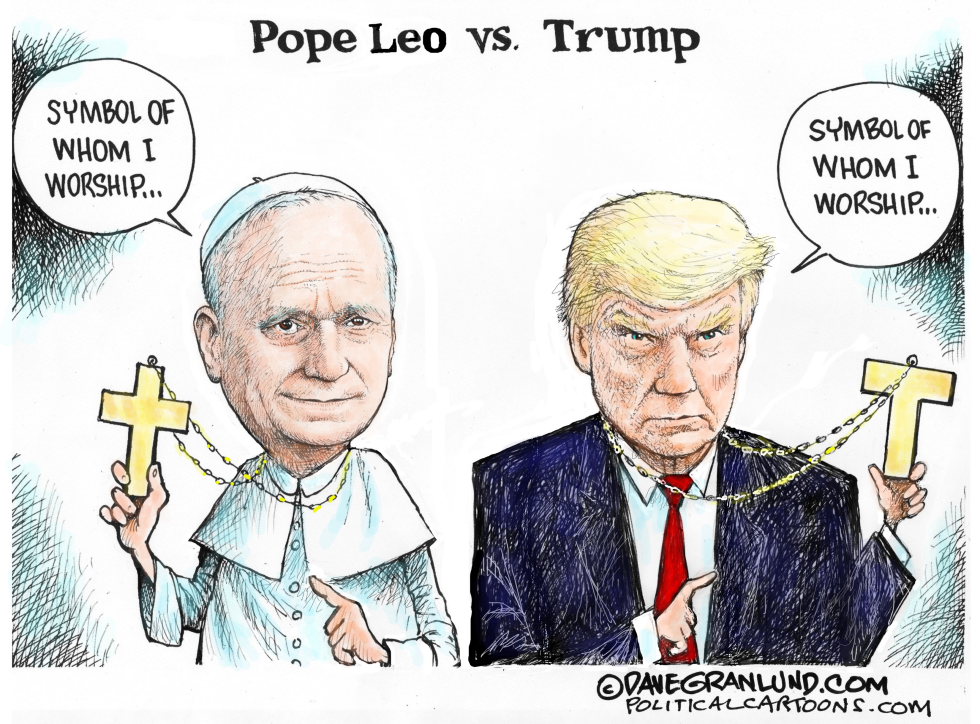
Dave Granlund's cartoon titled 'Pope Leo vs. Trump' features the pontiff holding a cross with the speech bubble 'Symbol of Whom I Worship...', directly contrasting Trump's figure gripping a 'T' pendant and echoing the same phrase. This setup underscores criticism against war, with Pope Leo positioned as a peace advocate facing off against Trump's self-referential symbol. Tags like insults pope, not a fan, Vatican, Catholics, and Christians amplify the satirical jab at political hubris invading religious spheres. The image stays simple, focusing on the two figures and their held items to drive home the point without added clutter.
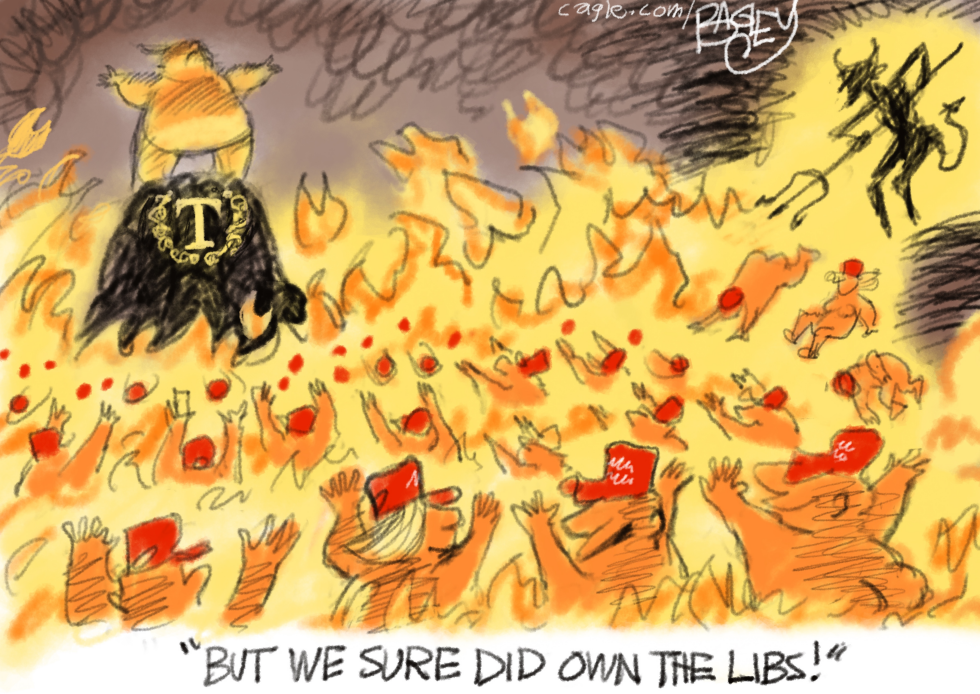
Pat Bagley's cartoon depicts a hellish scene labeled MAGA heaven, where a large Trump caricature stands on a black pedestal marked with a T emblem, arms raised amid orange flames. A crowd of small figures, many in red MAGA hats, reach up with the speech bubble declaring, 'But we sure did own the libs!' A devil figure hovers in the background with a pitchfork. This satirical take highlights political fervor through fiery imagery, red hats, and triumphant irony in damnation.
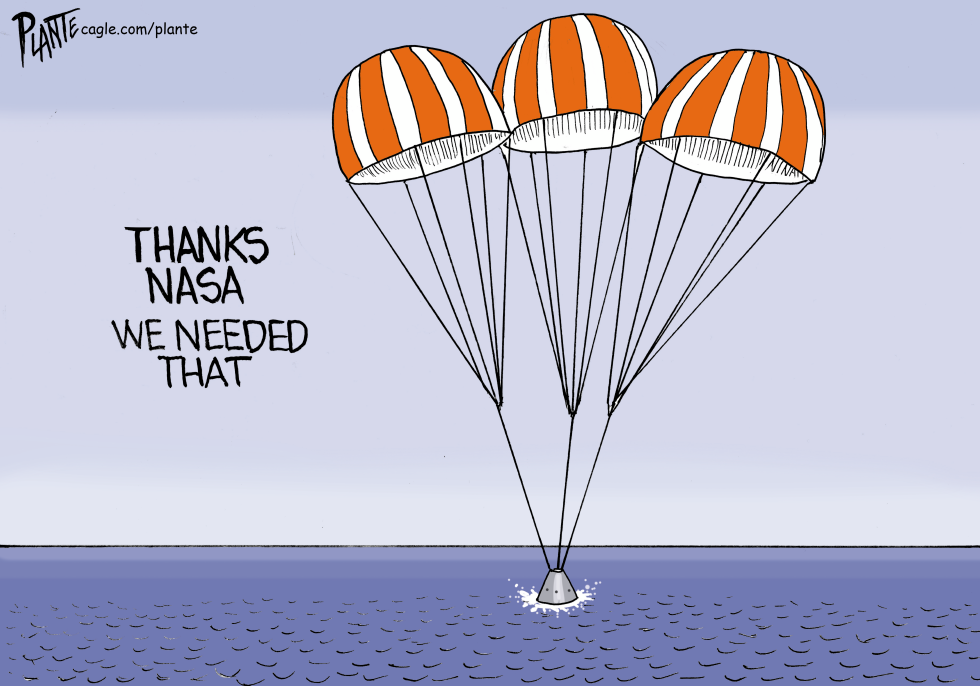
Bruce Plante\'s cartoon captures a space capsule\'s splashdown, complete with three orange and white striped parachutes guiding it to a blue ocean teeming with black fish-like forms. The prominent text \'Thanks NASA We Needed That\' adds a layer of sarcasm, typical in editorial illustrations commenting on high-profile events like the Artemis II mission. The simple composition, with a light blue sky and wavy ocean surface, emphasizes the moment of impact, shown by a small splash at the capsule\'s base. This piece fits into the tradition of political cartoons that highlight public sentiments toward government projects, using minimal elements for maximum impact. The artist\'s signature and website appear in the top left, grounding it in syndicated cartoon style.
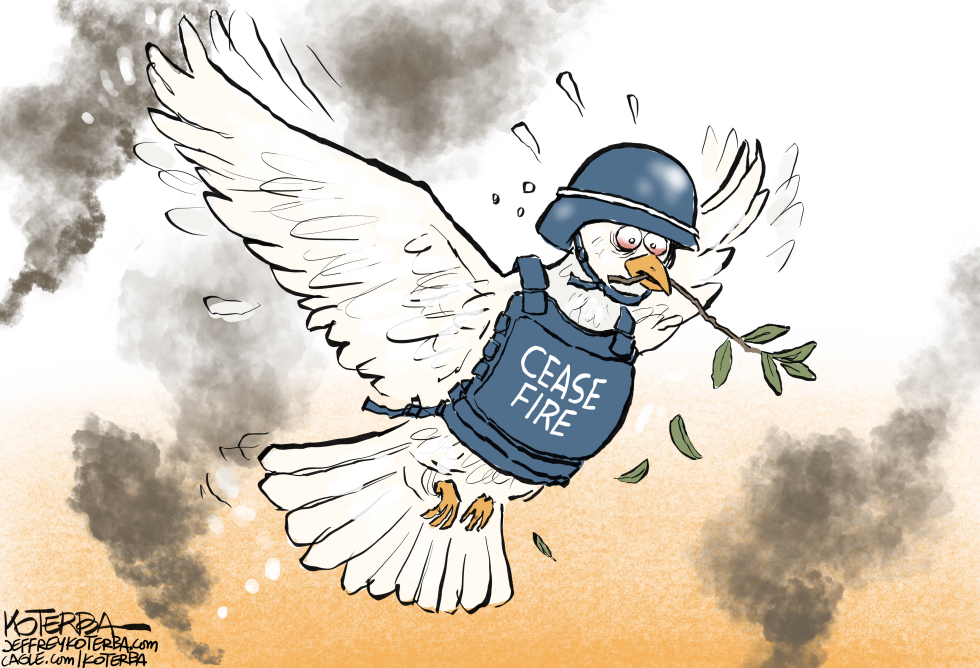
Jeff Koterba's cartoon shows a white dove, traditional symbol of peace, outfitted in a blue military helmet and a bulletproof vest marked 'CEASE FIRE.' The bird clutches an olive branch in its beak, eyes wide in surprise, as it navigates through billowing dark smoke clouds. This setup highlights the fragility of cease fire attempts in war zones, with the armored dove representing protected yet vulnerable peace initiatives. The orange-tinted background suggests a fiery landscape, emphasizing conflict's harsh reality. Tags like political cartoon, peace dove, cease fire vest, olive branch, war smoke, and satirical illustration capture the image's essence for SEO.
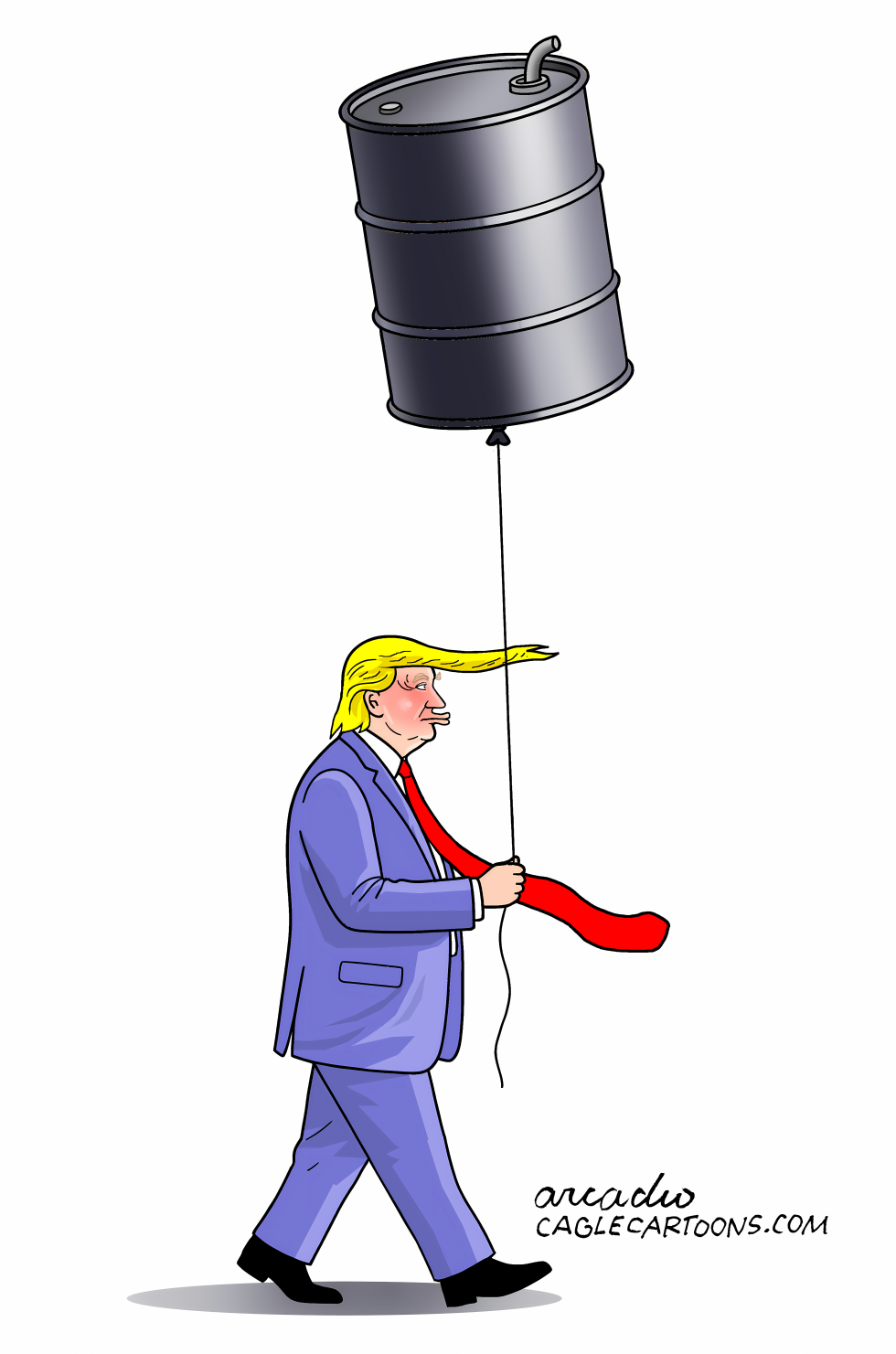
Arcadio Esquivel's cartoon captures Trump striding forward, his red tie extending upward to hold a massive oil barrel aloft like a helium balloon, with his yellow hair streaming behind. The simplicity highlights themes of Trump, oil prices, inflation, Hormuz, energy, and midterm elections. Such visuals often comment on economic pressures without words, relying on exaggerated features for recognition. Cartoonists like Esquivel use minimalism to drive points home, here linking a political figure to rising costs in a direct, unambiguous way. The white background keeps focus on the central elements, making the satire pop for viewers.
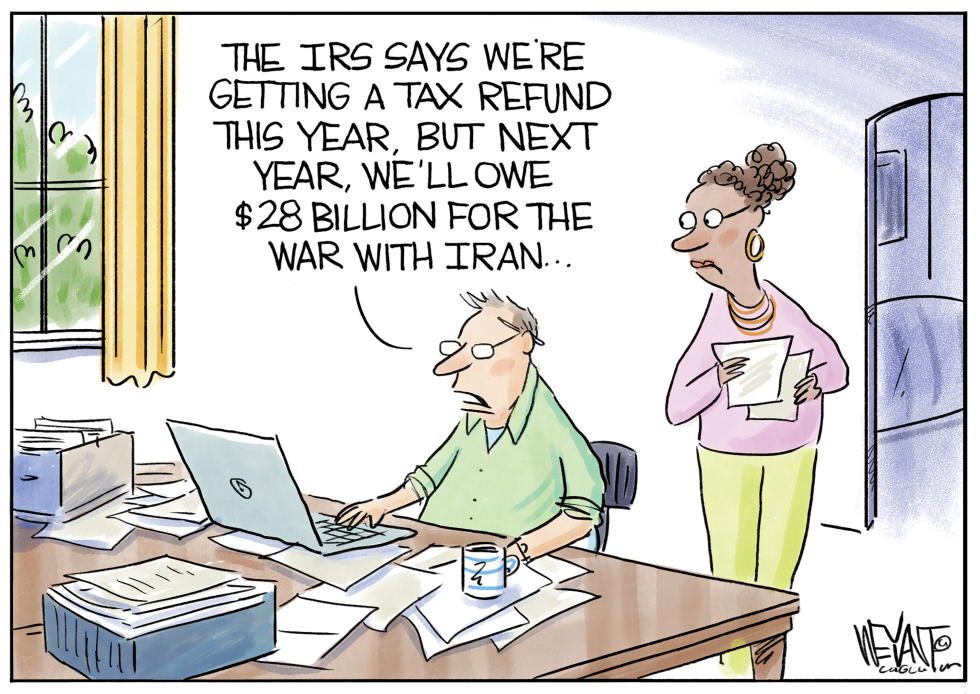
Dive into this biting political cartoon tax refund piece where a woman, holding papers, informs a laptop-working man about their IRS windfall this year, only to drop the bomb of owing $28 billion next for the war with Iran. The satirical cartoon Iran war vibe captures the absurdity of US taxes funding wars, with cluttered desks and exasperated expressions underscoring the humorous take on federal spending. It's a classic taxpayer burden Iran conflict jab, poking fun at government spending satire while illustrating the disconnect between personal finances and massive military expenses. Through cartoon about military expenses, it cleverly critiques fiscal policy in an office setting, making the war with Iran taxpayer joke both relatable and irreverently insightful for viewers pondering editorial cartoon fiscal policy.