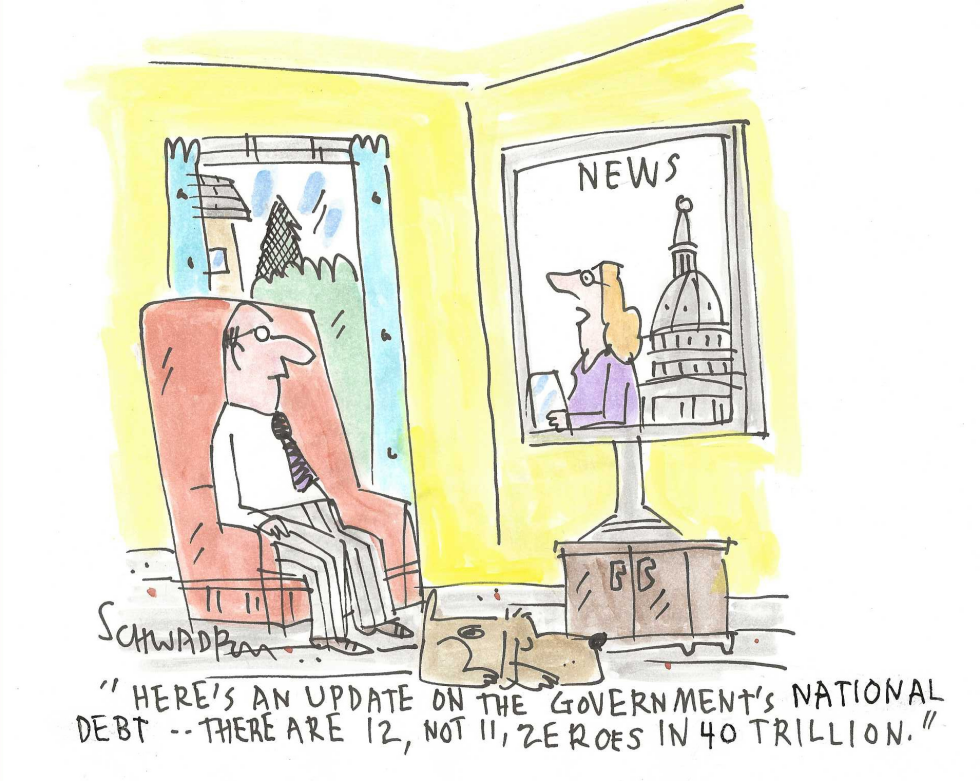
A television news report updates the national debt figure to 40 trillion dollars. The anchor emphasizes that the amount contains twelve zeros rather than eleven. The development underscores ongoing fiscal pressures on federal budgets and public attention to spending totals. The piece presents the correction as a straightforward broadcast detail delivered to a home audience.
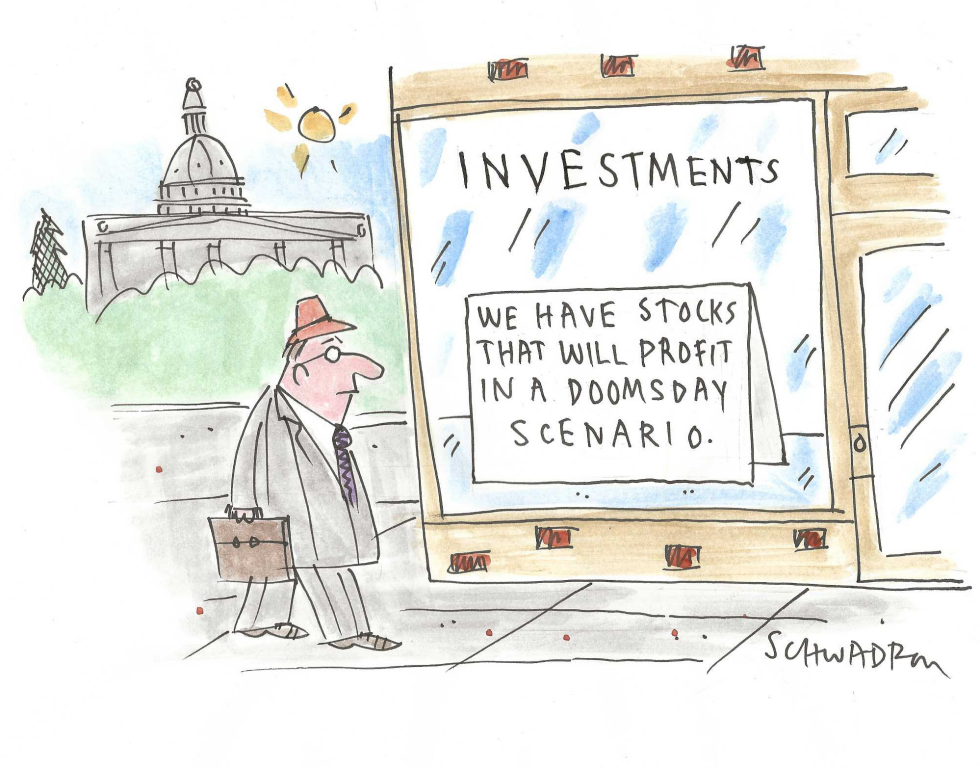
Investment firms continue to market specialized stock offerings designed to gain value during periods of widespread economic or geopolitical turmoil. Such products attract attention from clients seeking protection against market downturns or global instability. The cartoon highlights the persistent appeal of these instruments even as broader uncertainty lingers around policy and international developments.
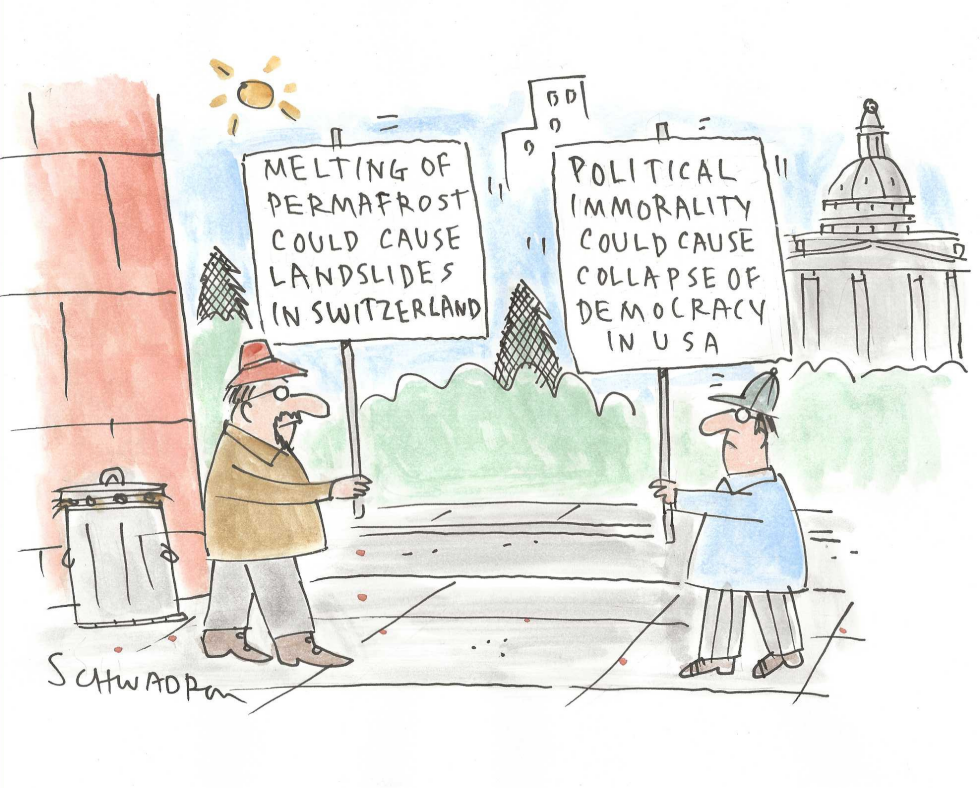
Activists in public spaces continue to draw parallels between accelerating climate impacts such as thawing permafrost and landslides in Switzerland and warnings about political conduct undermining democratic institutions in the United States. The signs highlight how environmental changes and governance failures each carry risks of sudden structural breakdown. The editorial stance underscores that both threats deserve equal public attention as visible warning indicators.
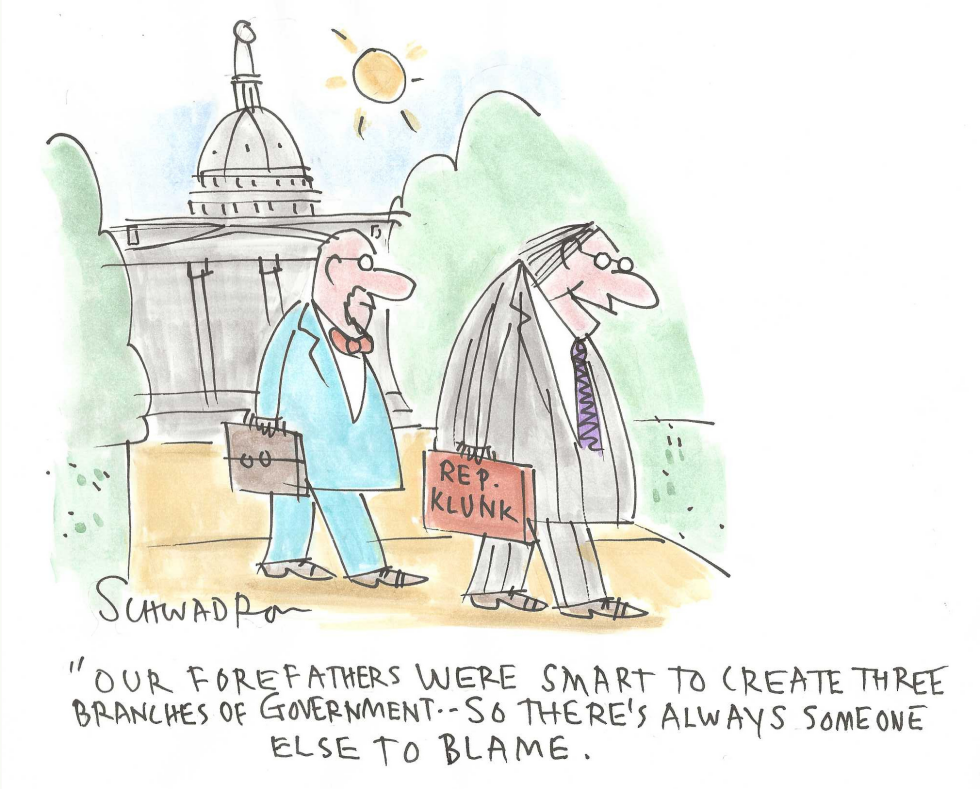
Members of Congress continue to deflect responsibility for legislative inaction by pointing to other branches of government. The dynamic persists amid ongoing budget disputes and stalled priorities on Capitol Hill. The editorial argues that the constitutional design intended to prevent tyranny now serves mainly as an excuse for avoiding accountability.
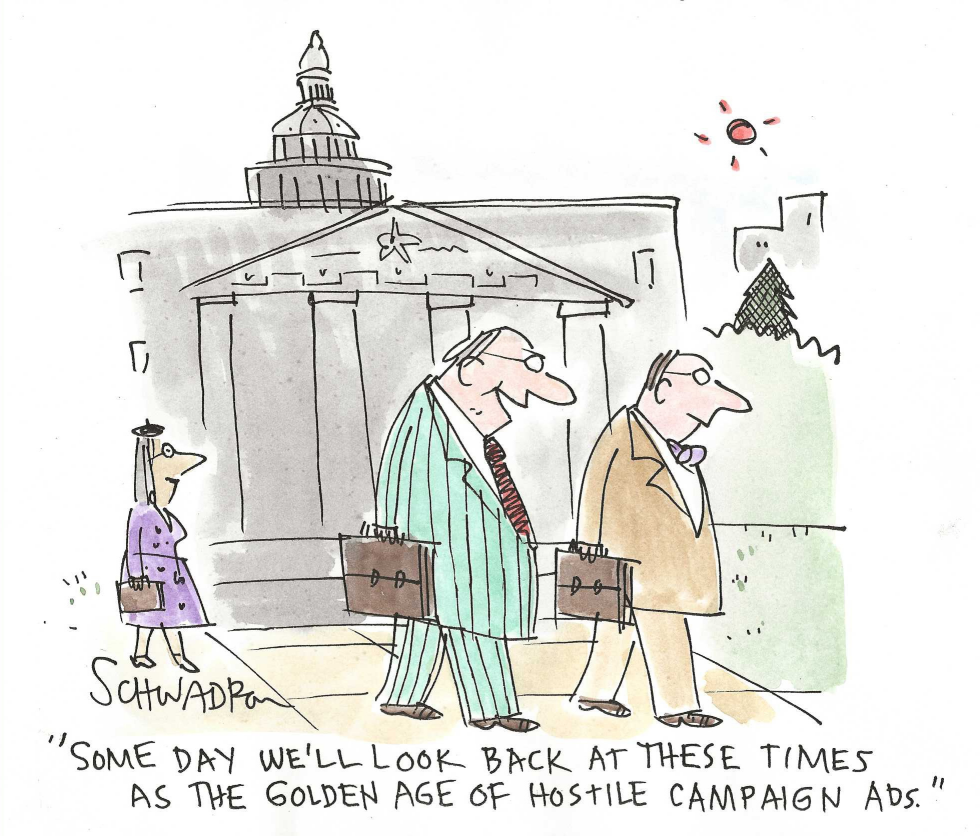
In mid-2026, partisan campaign rhetoric remains sharply negative with Democrats and Republicans trading attacks through ads and statements. The ongoing dynamic highlights deepening divides in Washington. The piece suggests these contentious times may later be viewed more favorably than current participants expect.
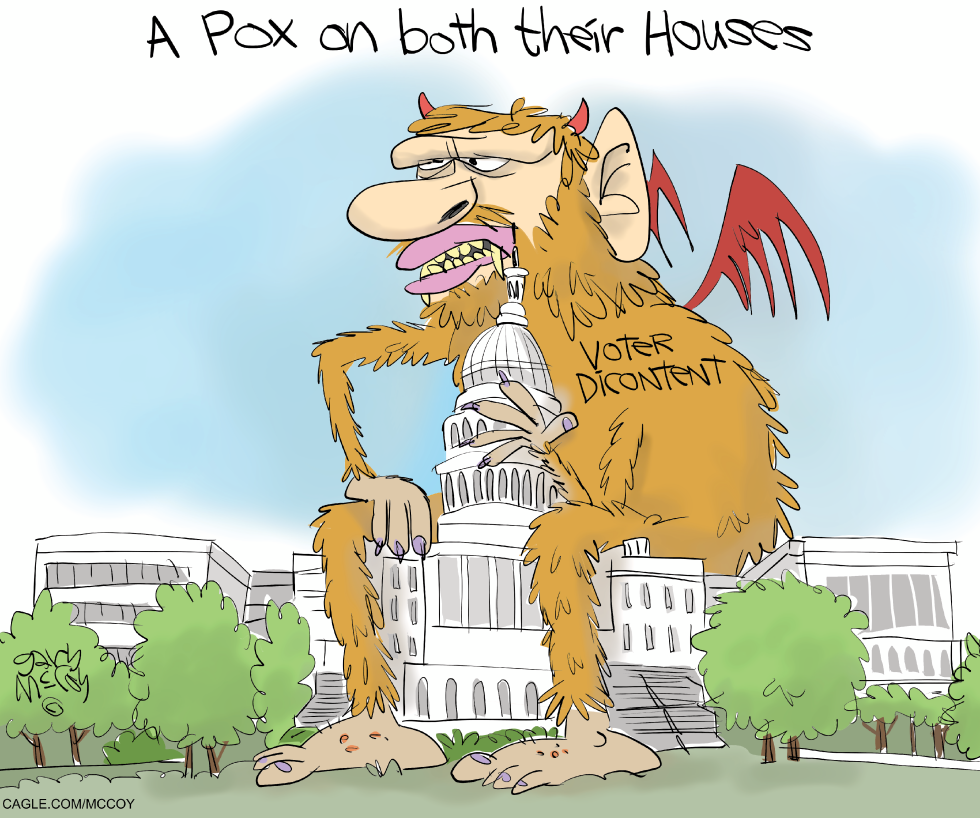
Voter frustration with Congress has grown amid stalled legislation and partisan gridlock on Capitol Hill. The piece portrays this sentiment as a towering monstrous force looming over the legislative branch. It argues that public anger targets both parties equally for failing to address key issues.
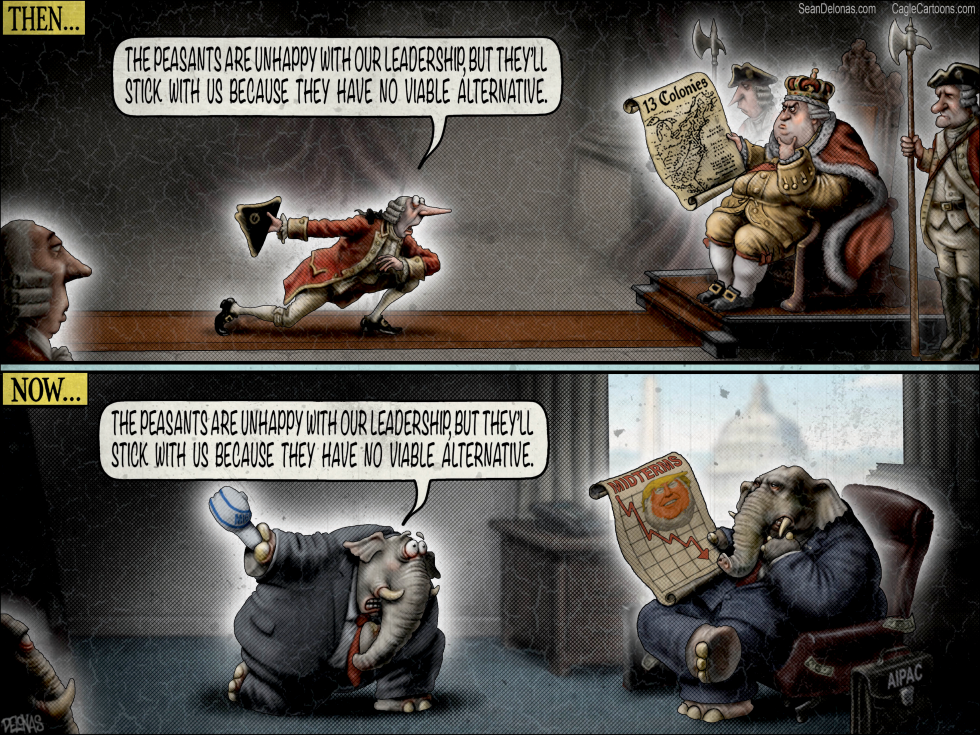
A two-panel cartoon contrasts King George III assuring aides that unhappy colonists have no viable alternative with a modern Republican elephant repeating the identical line while holding a plunging midterms chart marked with Donald Trump's face. The lower scene includes the U.S. Capitol dome and an AIPAC briefcase. The June 28 2026 date places the image weeks before the 2026 midterm elections.
Donald Trump stands on a Washington walkway beside a pond covered in green algae. A slimy green figure emerges holding an Algae Memorandum of Understanding and asks in a dripping speech bubble for the same deal Iran received. The Washington Monument and Capitol appear in the background under a cloudy sky.
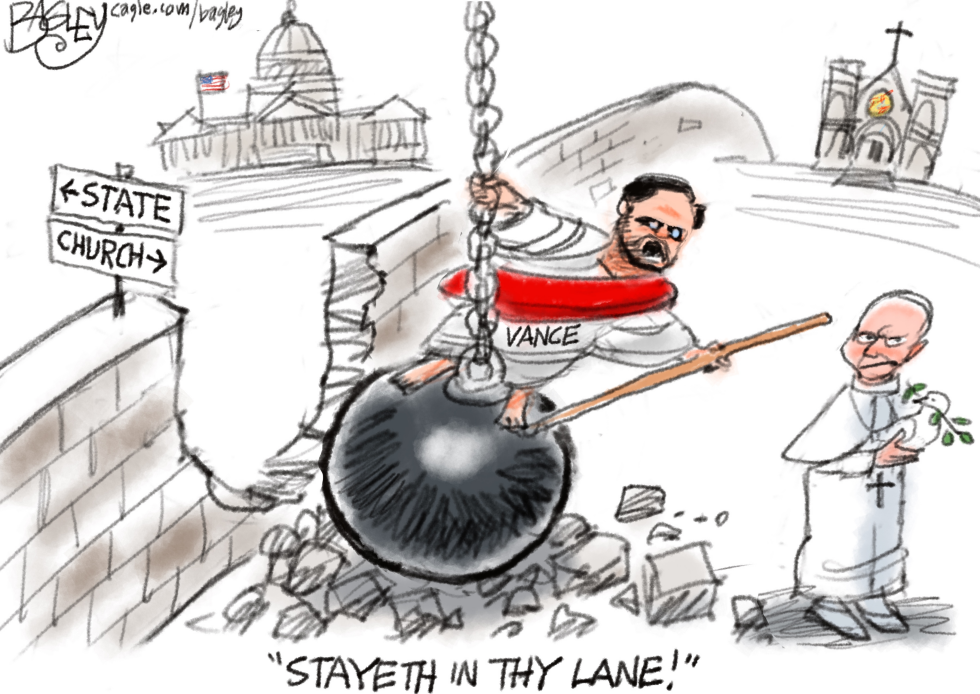
Pat Bagley's cartoon shows JD Vance dressed as Jesus, labeled 'VANCE,' swinging a massive wrecking ball to shatter a brick wall marked with signs pointing to 'STATE' and 'CHURCH.' He shouts 'STAYETH IN THY LANE!' at a figure resembling the Pope, who holds an olive branch and dove, symbols of peace. In the background, the U.S. Capitol flies an American flag, while a church with a cross represents the Vatican. Tags like war, peace, JD Vance, religion, Trump, and scripture underscore the satire on blurring lines between church and state, with Vance enforcing boundaries ironically through destruction. The image critiques political figures invoking religion amid Capitol politics.
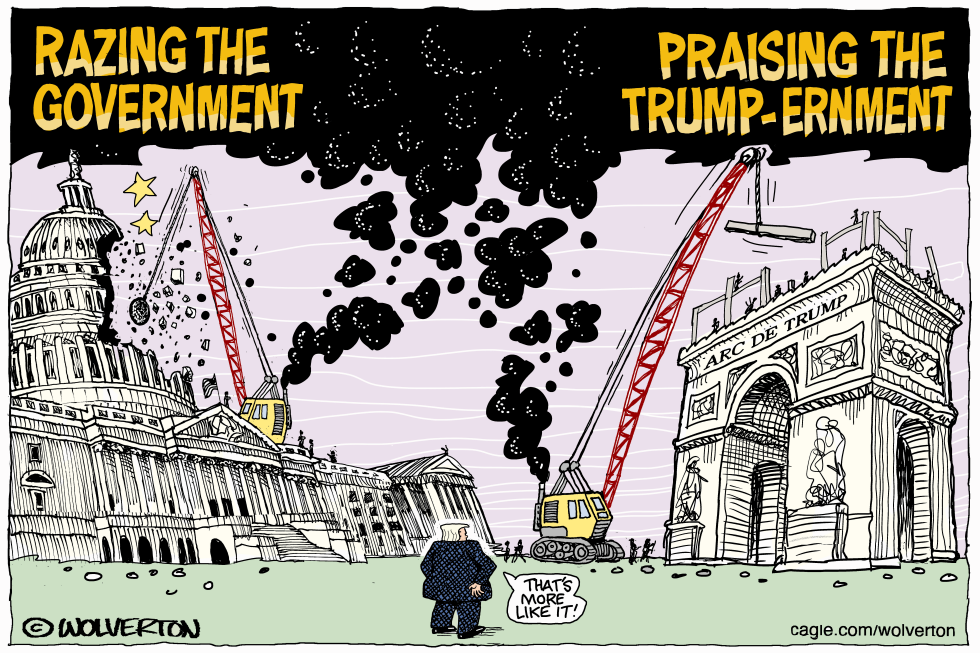
On October 18, 2025, a Monte Wolverton cartoon depicts President Donald Trump observing the demolition of the U.S. Capitol Building on the left and the construction of an Arc de Trump monument on the right. A wrecking ball and crane damage the Capitol while another crane assembles the arch. Black smoke fills the center. Trump, in the foreground, says 'THAT'S MORE LIKE IT!' The split headline reads 'RAZING THE GOVERNMENT' and 'PRAISING THE TRUMP-ERNMENT.' The image comments on federal workforce reductions and infrastructure priorities during the second Trump term.
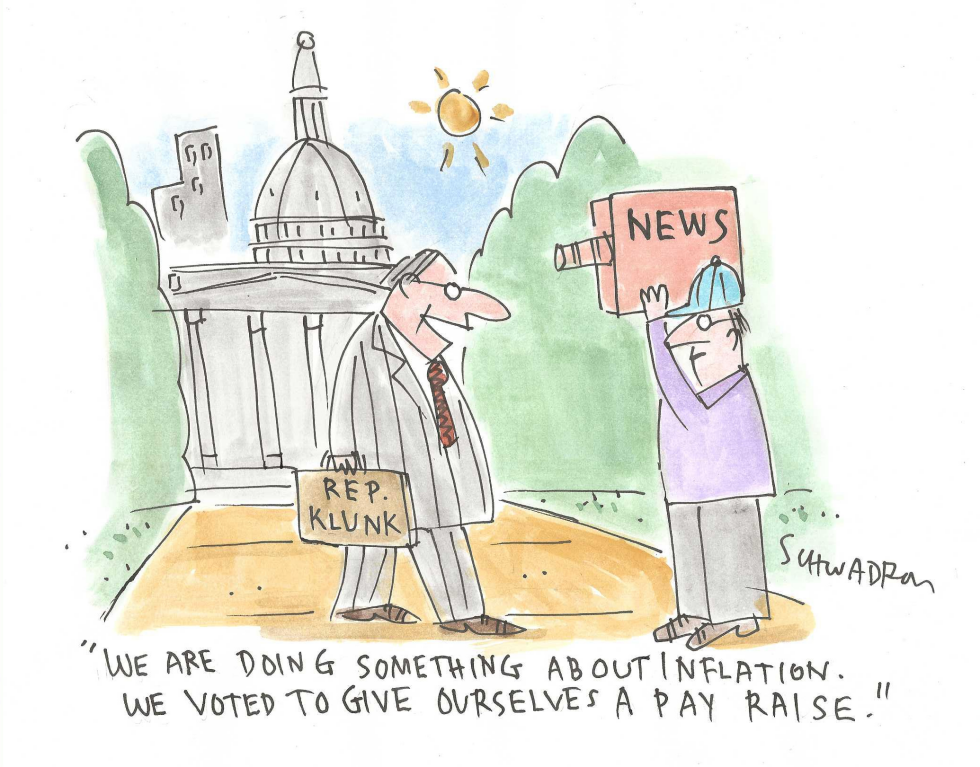
On September 9, 2025, a political cartoon depicts Representative Klunk leaving the Capitol building while a news reporter captures his statement that Congress addressed inflation by voting itself a pay raise. The scene shows the lawmaker in a suit and tie holding a briefcase, with the Capitol dome and trees in the background under a sunny sky. The cartoon highlights the disconnect between public economic concerns and legislative self-benefit.
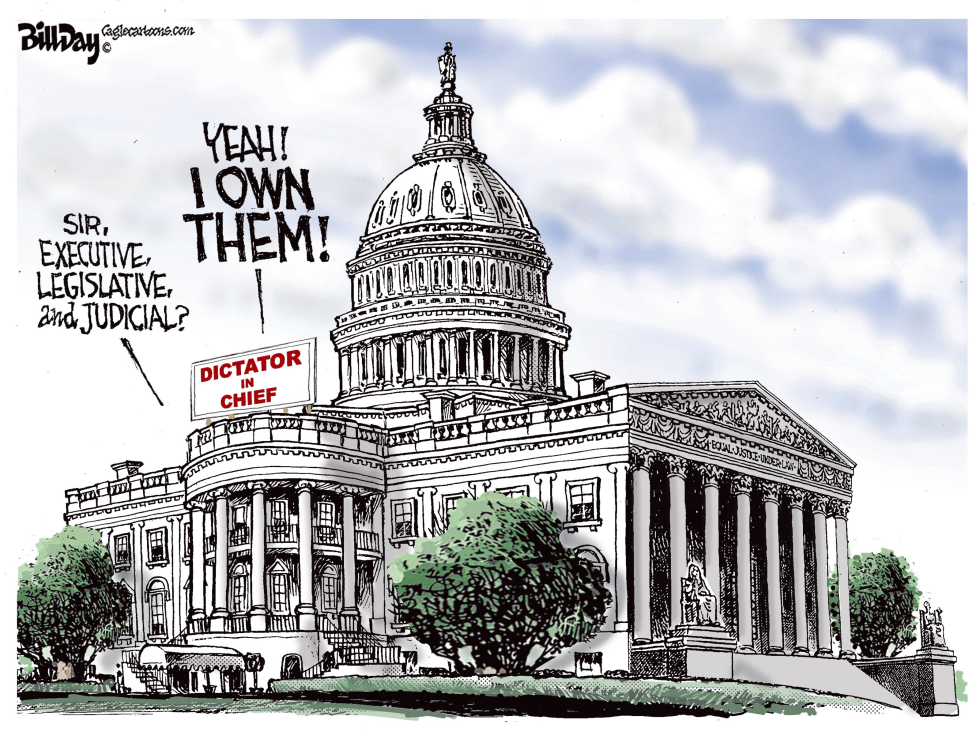
The drawing shows the U.S. Capitol building bearing a prominent sign reading Dictator in Chief. Large lettering above the dome proclaims Yeah! I Own Them! while a separate line of text asks Sir, Executive, Legislative, and Judicial? The composition merges elements of the Capitol dome with a classical columned facade bearing the inscription Equal Justice Under Law.
On June 30 2025 Joe Heller depicts Uncle Sam and a red-capped figure at a cliff edge debating a bunker buster bomb versus the big beautiful bill. The scene shows trillions added to debt raining down on the Capitol. The cartoon ties directly to ongoing congressional budget fights over tax cuts and deficits.
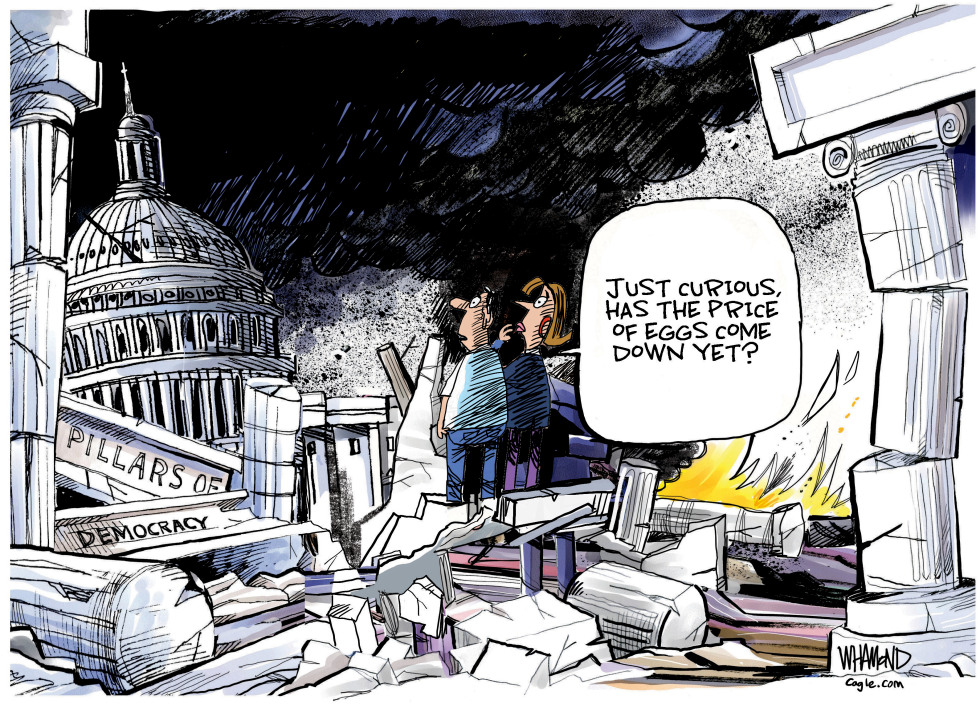
A political cartoon dated February 2, 2025, depicts the U.S. Capitol in ruins with broken pillars labeled 'PILLARS OF DEMOCRACY.' Two onlookers stand amid debris as one asks if egg prices have dropped. The image references ongoing debates over inflation, tariffs, and government changes following the 2024 election. Artist Dave Whamond uses destruction to highlight perceived costs of recent political decisions.