Government agencies continue to expand regulatory frameworks across multiple sectors, adding layers of oversight that increase compliance costs for businesses and individuals. The trend reflects ongoing debates over the proper scope of administrative authority and its impact on economic activity. The piece argues that such expansion has crossed into excess, creating unnecessary obstacles rather than protecting the public.
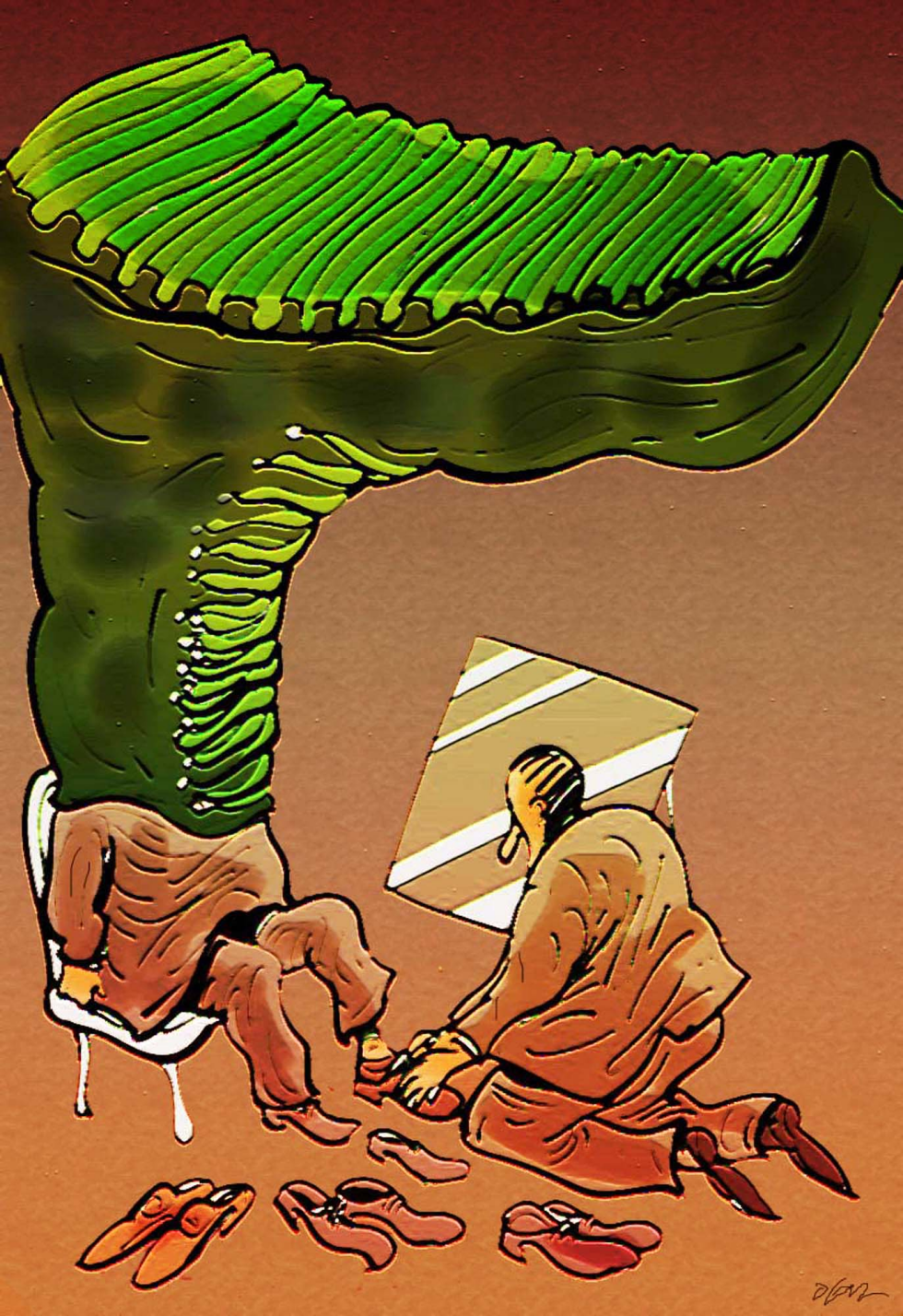
Political power structures continue to exert pressure on individuals and rivals in ongoing governance disputes. The dynamic highlights how dominant forces can sideline or overwhelm those in subordinate positions. The piece takes the position that such overreach undermines fair political processes and individual agency.
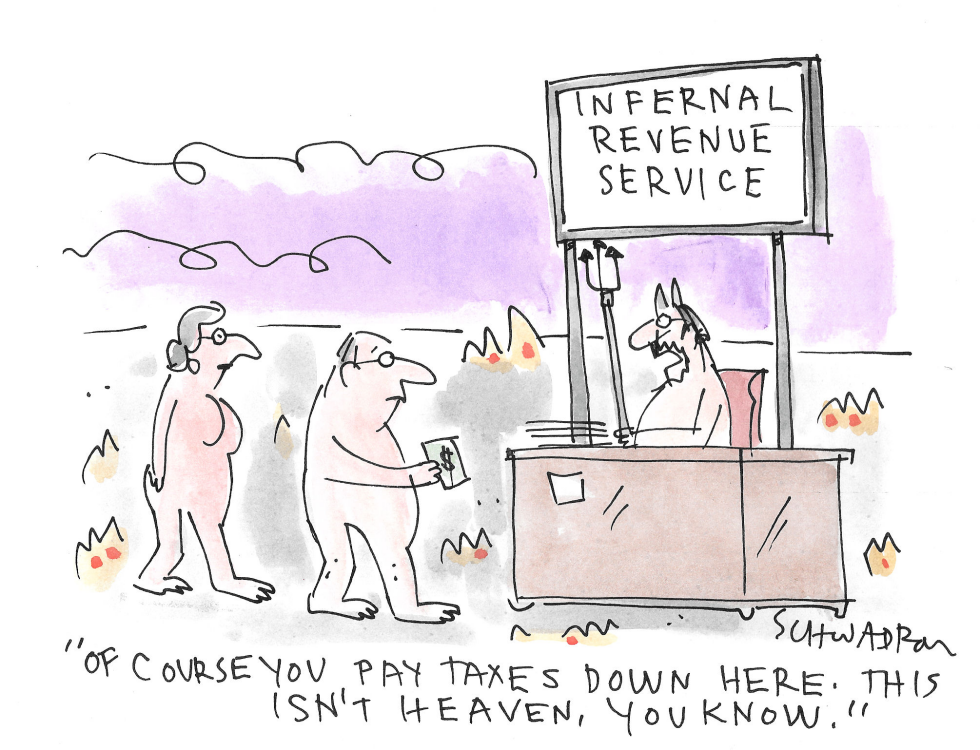
The long-standing adage that only death and taxes are certain receives fresh treatment in a cartoon depicting an IRS outpost operating in hell. No specific policy change or ruling prompted the piece, which instead plays on the enduring public frustration with tax collection as an inescapable force. The editorial stance pokes at bureaucratic persistence, suggesting the tax man follows citizens beyond the grave with the same relentless efficiency seen in life.
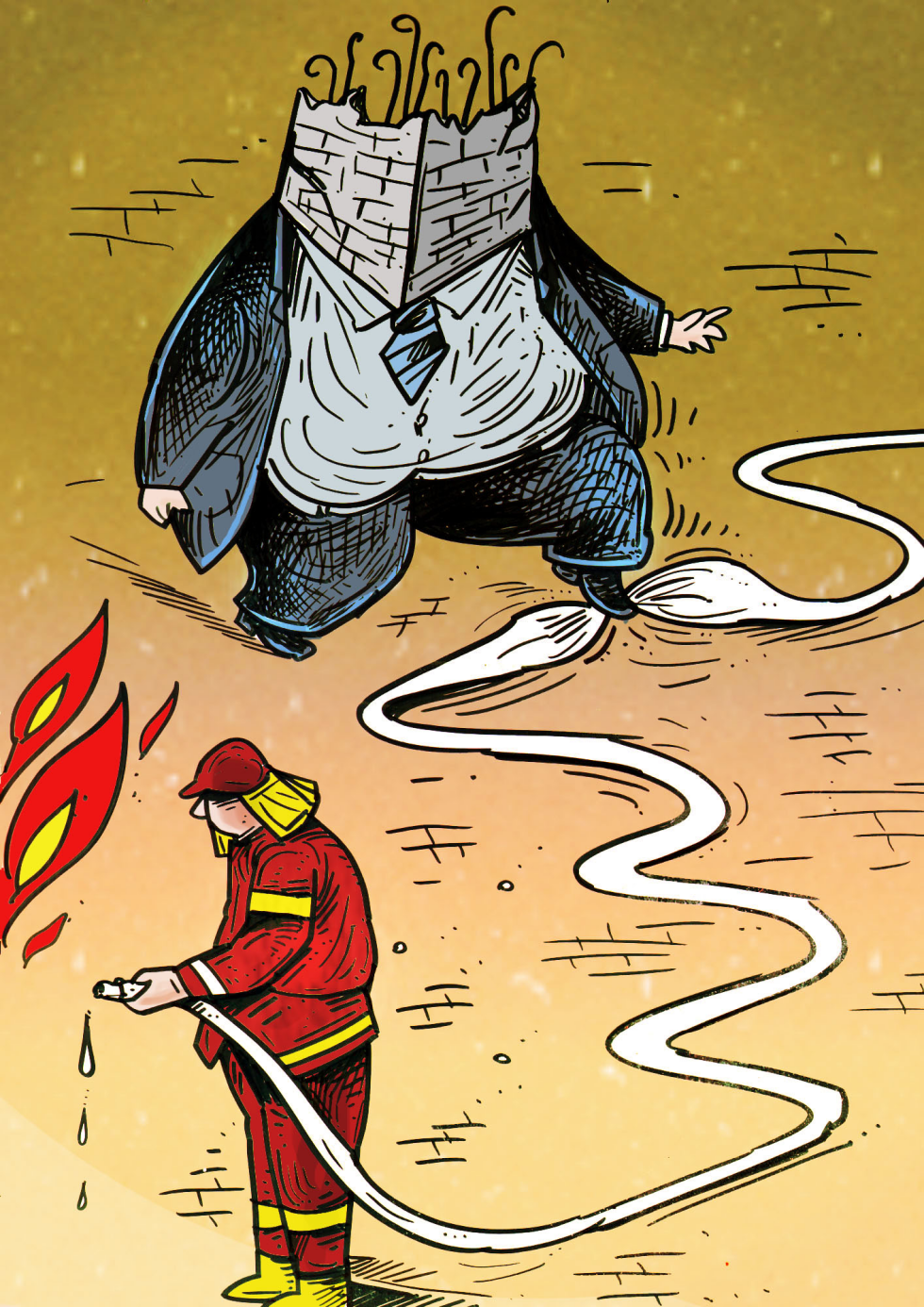
Government bureaucracy continues to slow emergency services through layers of procedure and obstruction. Officials embedded in routine create barriers that delay response times when speed matters most. The cartoon argues that such entrenched processes turn routine oversight into active hindrance during crises.
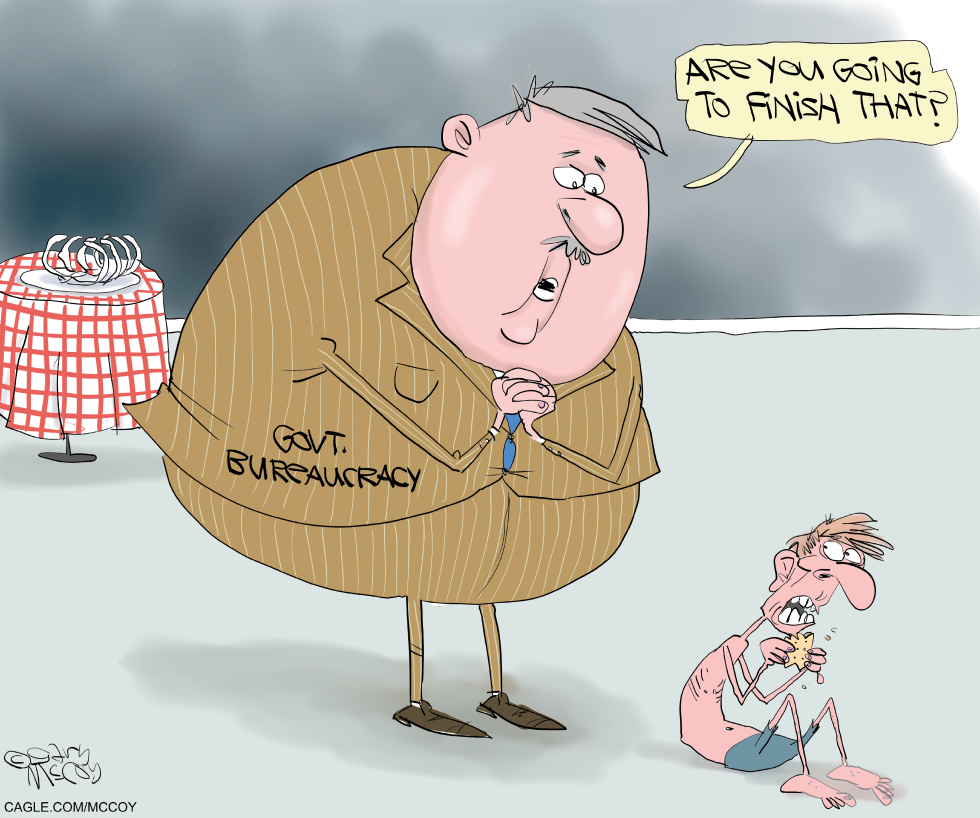
The cartoon shows an oversized man labeled Government Bureaucracy standing above a gaunt citizen who clutches a small star-shaped item. A nearby table holds only scraps. The large figure asks if the citizen plans to finish the food. The image comments on how expanding government operations can leave ordinary people with fewer resources. It uses scale and positioning to illustrate the imbalance between bureaucratic size and citizen need. The publication date places the work in a period of ongoing debate over federal spending and agency growth.
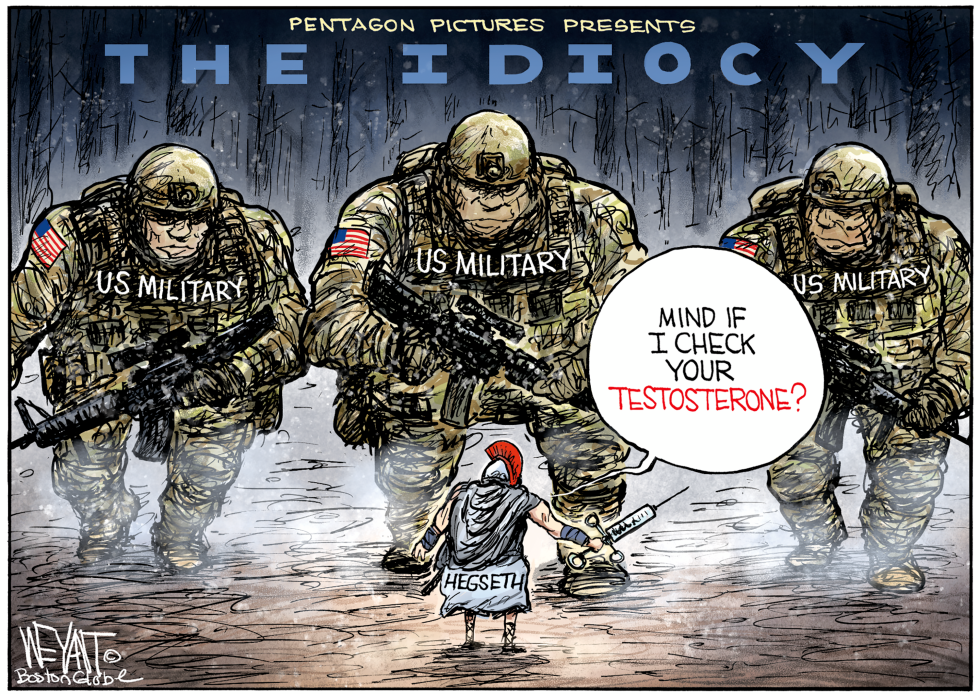
Defense Secretary Pete Hegseth has directed new scrutiny of testosterone levels across US military units. The move comes as the Pentagon reviews physical readiness standards for combat roles. Critics argue the focus distracts from broader readiness issues while supporters say it enforces accountability. The editorial takes the position that such micromanagement undermines troop morale and operational effectiveness.
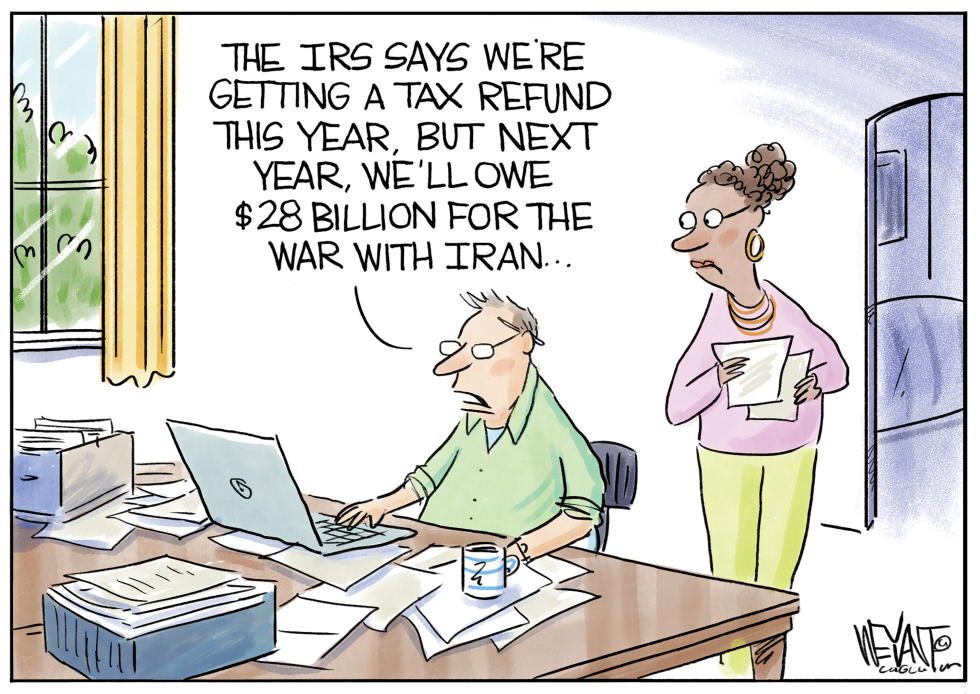
Dive into this biting political cartoon tax refund piece where a woman, holding papers, informs a laptop-working man about their IRS windfall this year, only to drop the bomb of owing $28 billion next for the war with Iran. The satirical cartoon Iran war vibe captures the absurdity of US taxes funding wars, with cluttered desks and exasperated expressions underscoring the humorous take on federal spending. It's a classic taxpayer burden Iran conflict jab, poking fun at government spending satire while illustrating the disconnect between personal finances and massive military expenses. Through cartoon about military expenses, it cleverly critiques fiscal policy in an office setting, making the war with Iran taxpayer joke both relatable and irreverently insightful for viewers pondering editorial cartoon fiscal policy.
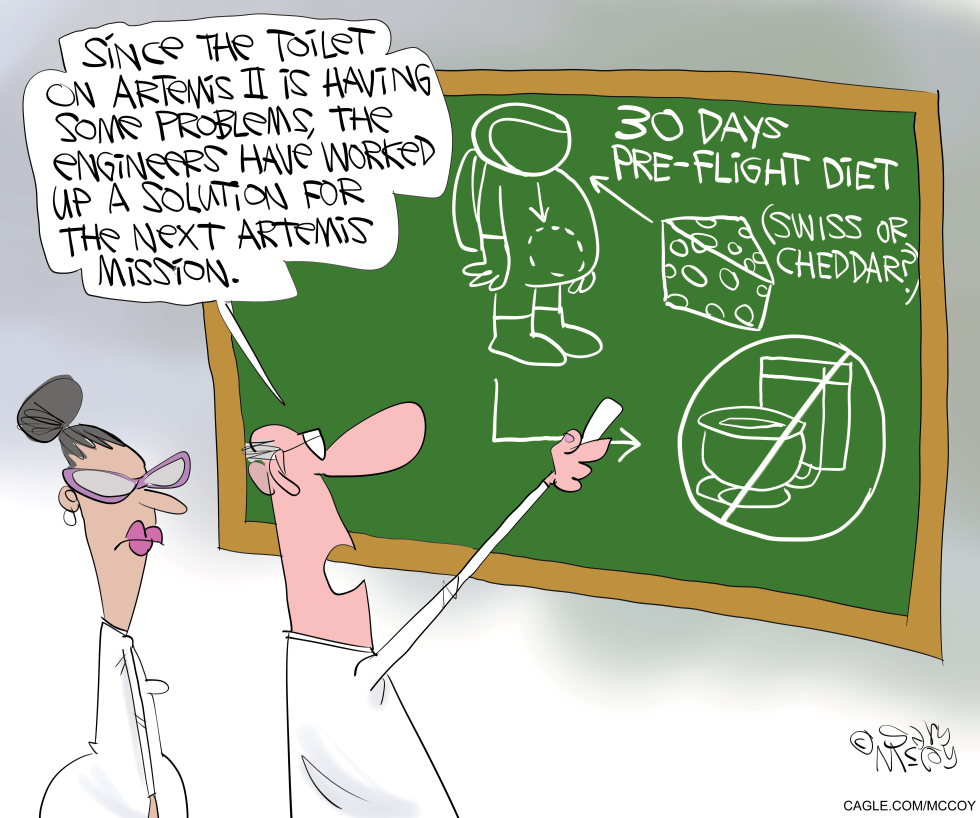
Gary McCoy\\\'s political cartoon depicts two figures in white coats, one pointing to a chalkboard with a speech bubble explaining a solution to Artemis II toilet problems via a 30-day pre-flight diet of Swiss or cheddar cheese. The board features a bloated astronaut sketch, a cheese cube, and a crossed-out toilet, poking fun at NASA engineering woes. This space mission satire uses dry humor to comment on technical glitches in the Artemis program, with tags like NASA Artemis II toilet problems, engineers solution Artemis mission, space mission pre-flight diet, Gary McCoy cartoon, cheesy diet fix, and humorous take on NASA solutions. The image stays light-hearted, focusing on visible elements without deeper speculation.
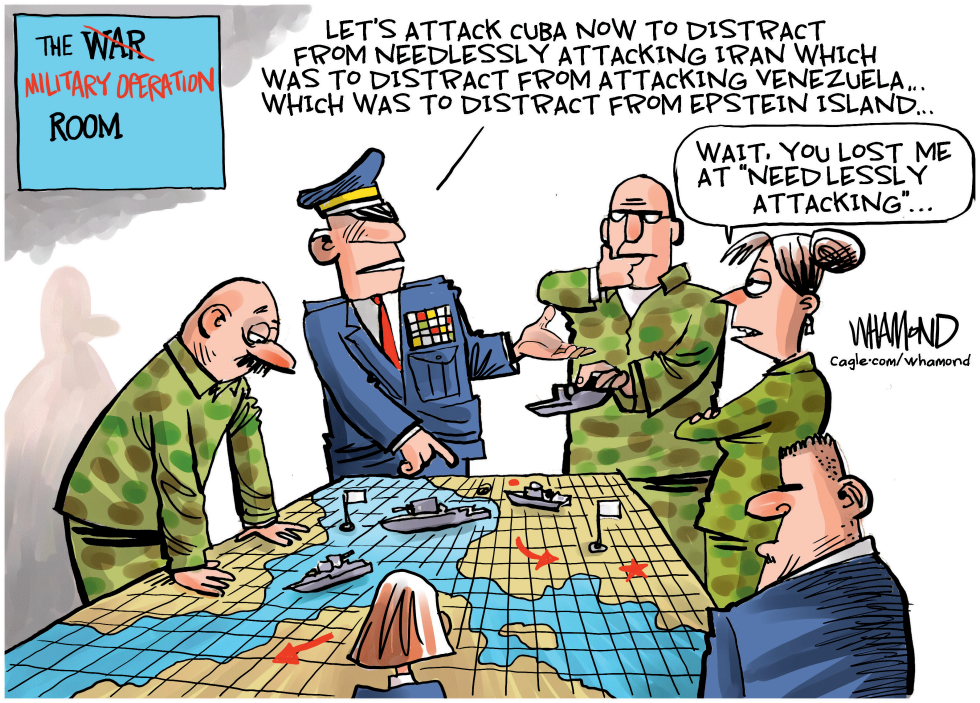
Dave Whamond's political cartoon depicts a group of military officials in a war room, gathered around a map with toy ships, discussing a chain of distractions starting from attacking Cuba to cover needless attacks on Iran, which distracted from Venezuela, looping back to Epstein Island. The scene captures the absurdity with one figure pointing at the map and another expressing confusion over 'needlessly attacking.' This satirical illustration uses dry humor to comment on convoluted military strategies and political diversions, incorporating elements like crossed-out 'War' sign replaced by 'Military Operation Room' for added irony. Tags like political satire, war distractions, foreign policy cartoon, Epstein Island reference, military humor, and endless distraction chain emphasize the cartoon's sharp critique.
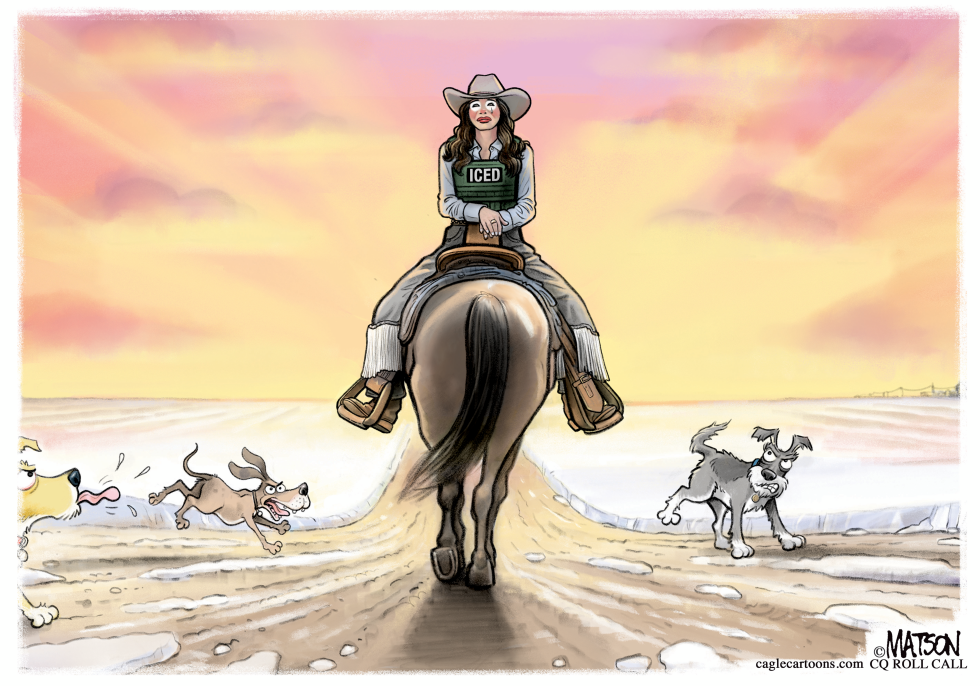
This sharp political cartoon captures an ICE agent, styled as a plucky cowgirl in a cowboy hat, galloping into a pastel sunset on her trusty horse, while a pack of frantic dogs—stand-ins for coyote smugglers—scatter in disarray. The 'ICED' vest adds a punny twist, perhaps nodding to the agency being put on ice amid heated immigration debates. With tags like political satire, border security, ICE criticism, cartoon dogs, western theme, and immigration policy, the image skewers the often chaotic world of enforcement, where even the bad guys (or dogs) get a comedic getaway. Matson's irreverent style shines through in this insightful jab at bureaucratic rodeos.
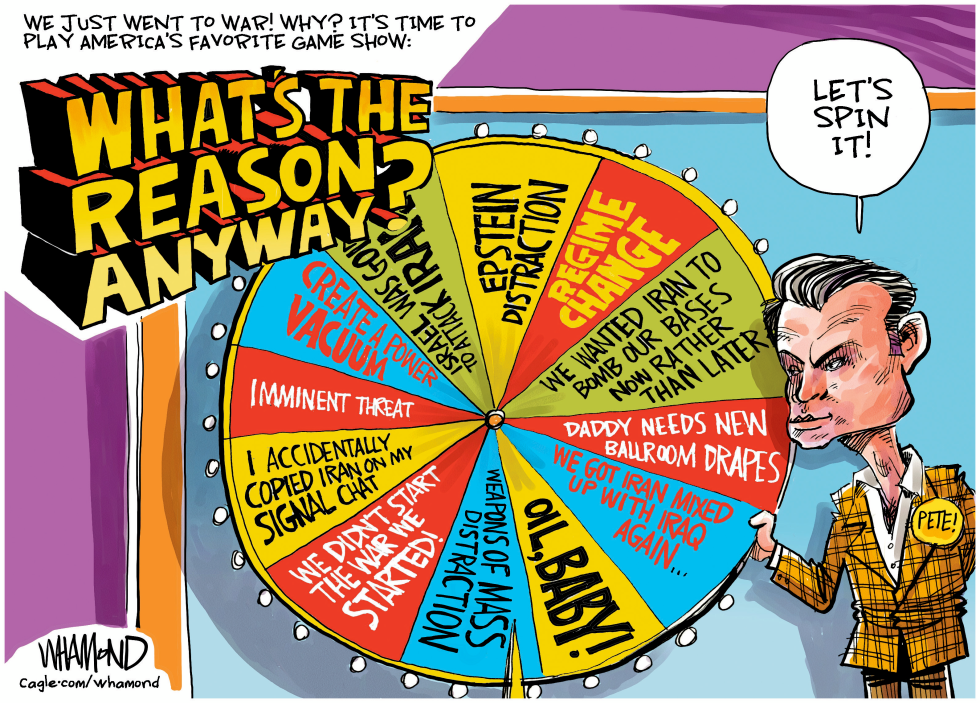
Dive into this biting political cartoon where America's war decisions are reduced to a game show parody wheel, featuring options like 'Imminent Threat,' 'Oil, Baby!,' and 'Regime Change.' The irreverent satire targets US foreign policy, highlighting how military interventions often spin on flimsy pretexts, from accidental escalations to resource grabs. With a host eagerly spinning the wheel, the artwork cleverly critiques the absurdity of war justifications, blending humor with insightful commentary on geopolitical cynicism. Tags like political cartoon, war justifications, and military intervention humor underscore its viral potential in today's polarized discourse.
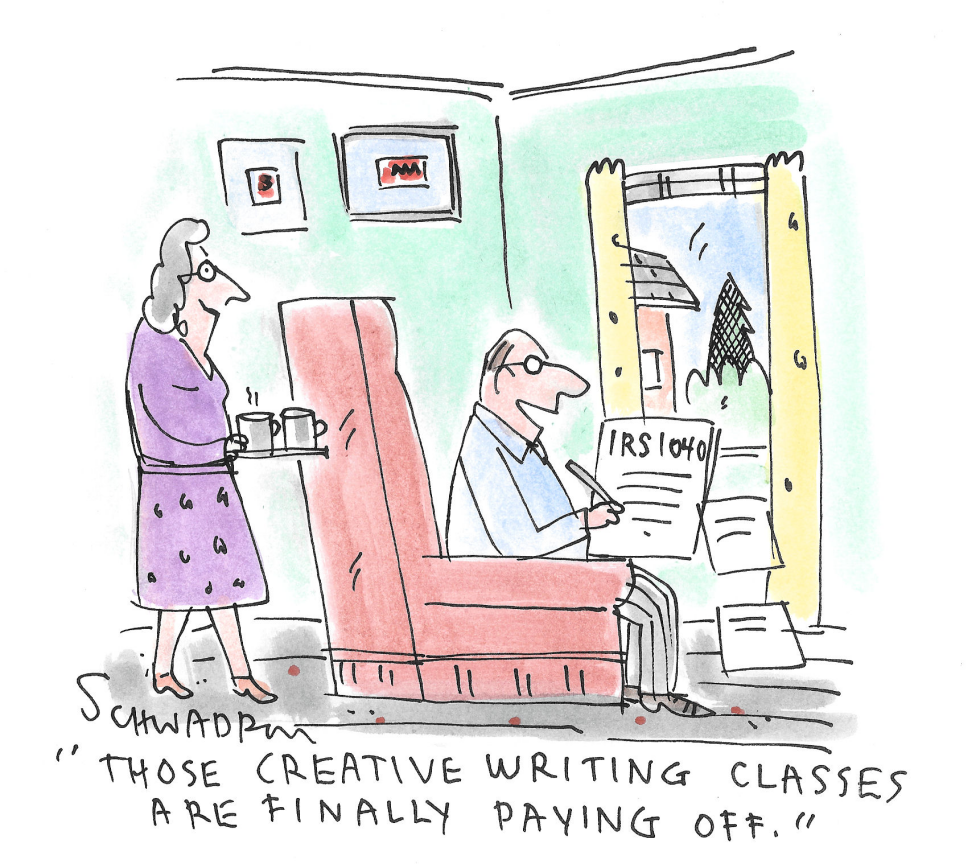
This tax season humor cartoon depicts an older man seated in a red armchair, penning details on an IRS 1040 form, as his wife stands nearby with a tray of steaming cups, delivering the punchline about creative writing classes paying off. The satirical view of income tax returns captures a domestic scene tax time parody, where the husband channels his educational investments into what appears to be an imaginative approach to tax filing. With a humorous take on tax preparation creativity, the illustration pokes fun at the notion of turning literary flair into fiscal advantage, all set against a simple indoor backdrop with wall art and a window view. The witty commentary underscores how seemingly unrelated skills like those from creative writing classes can 'pay off' in unexpected ways, especially during the dreaded tax season. Artist signature 'Schwadron' adds a touch of authenticity to this political cartoon on tax evasion creativity.
This biting political cartoon by Daryl Cagle depicts Donald Trump in his signature suit, his red tie extending into a coil of red tape that binds a furious, bearded figure representing Iran, complete with an 'iRan' hat. The image satirizes US-Iran relations, highlighting how bureaucracy and sanctions create entanglements in foreign policy. Trump's calm demeanor contrasts with Iran's angry struggle, underscoring the Trump administration's approach to Middle East diplomacy. Through clever visual metaphor, it comments on the nuclear deal fallout and ongoing tensions, making it a sharp piece of political humor that's both insightful and irreverent.
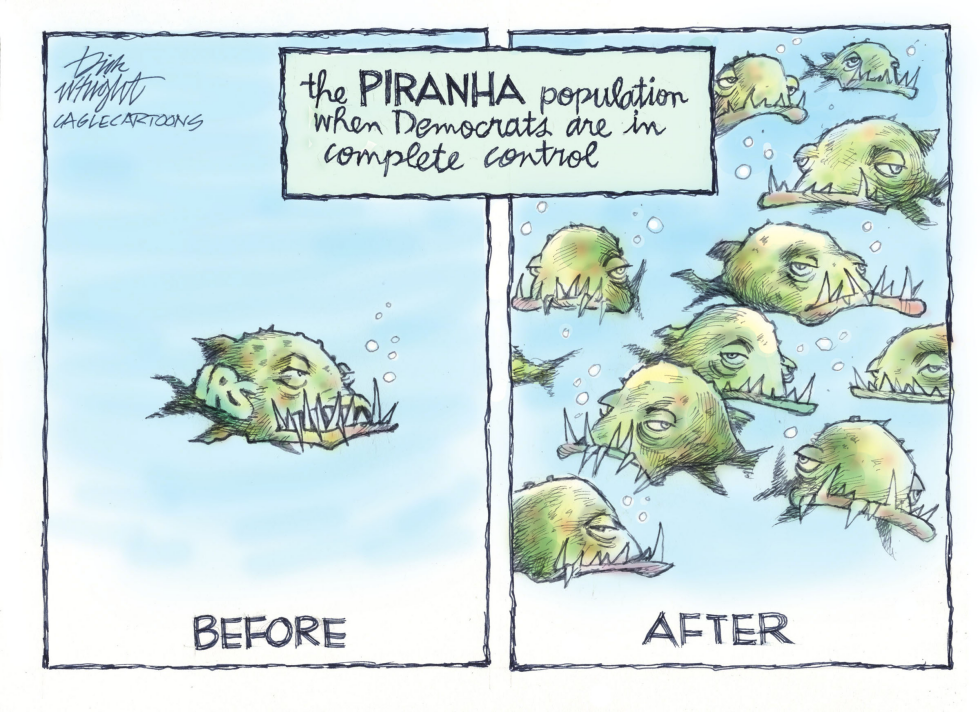
This Daryl Cagle political cartoon depicts the IRS as a lone piranha before Democrats assume complete control, then multiplying into a ferocious school afterward, bubbling with satirical bubbles. The IRS piranha metaphor cleverly critiques perceived overreach in tax enforcement, with the before after panels underscoring a conservative viewpoint on government expansion. Bubbles and grumpy fish expressions add humorous flair, making the Democrats control government satire both insightful and shareable. Overall, it's a witty jab at bureaucratic growth, perfect for sparking debates on fiscal policies.
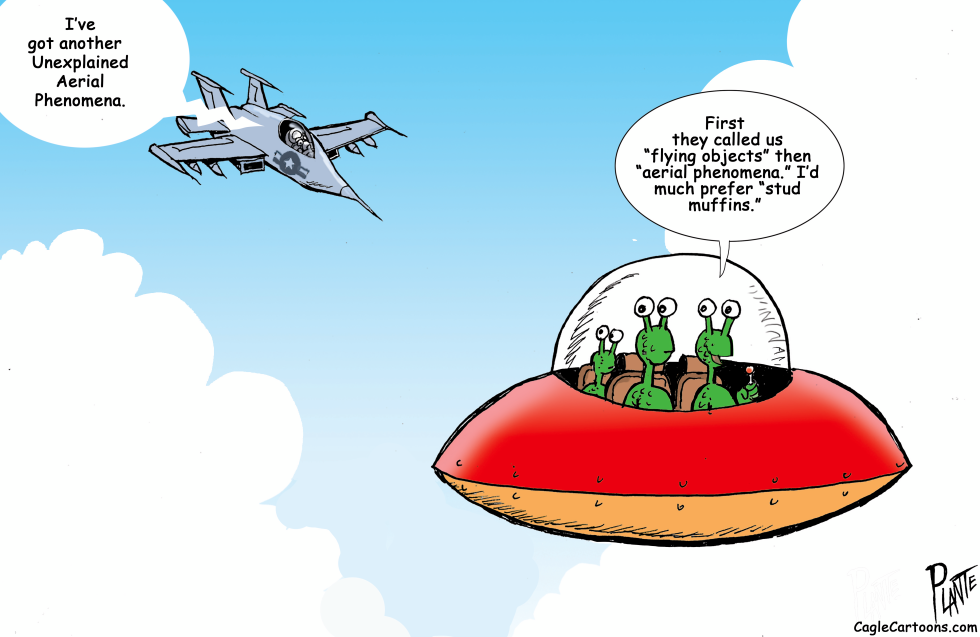
Bruce Plante's cartoon depicts a military jet encountering a red flying saucer piloted by green aliens. The pilot reports another unexplained aerial phenomena, while the aliens complain about the labels, from flying objects to aerial phenomena, humorously suggesting stud muffins as a better term. This piece satirizes the evolving terminology around UFO sightings, capturing the absurdity in a clear sky setting with dry wit. The illustration features cartoonish aliens with eyestalks, emphasizing the lighthearted poke at official jargon. Overall, it's a straightforward commentary on how phenomena are named, blending military elements with extraterrestrial humor for broad appeal.