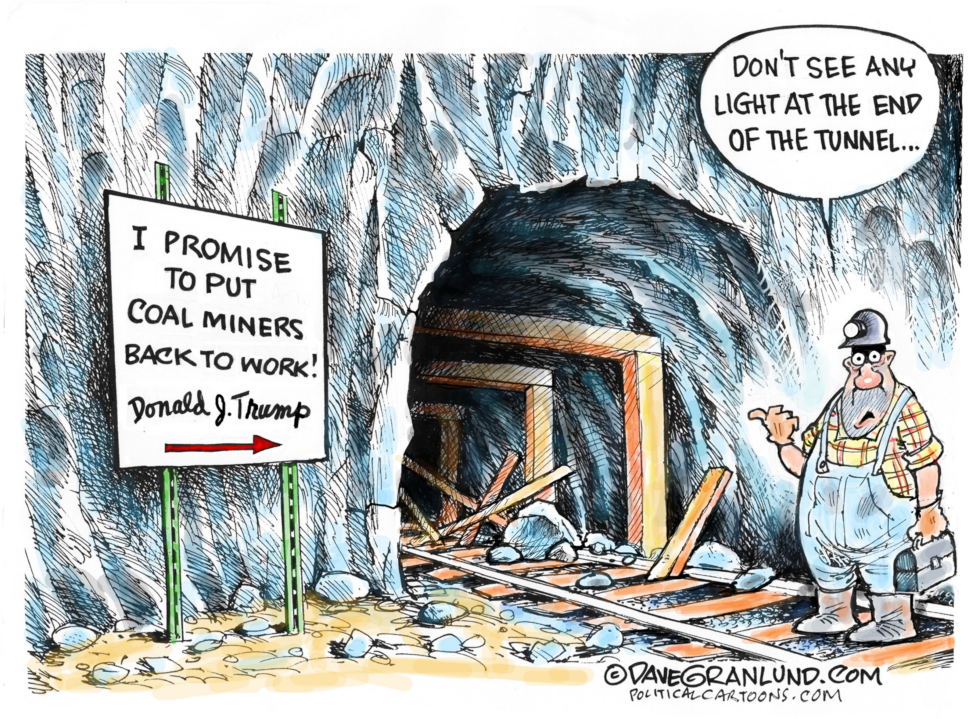
Donald Trump repeatedly pledged during his campaigns and terms to revive coal mining employment by rolling back regulations and boosting domestic production. Those commitments have not translated into sustained job growth for miners amid shifting energy markets and automation. The cartoon underscores the gap between the repeated assurances and the persistent lack of visible progress for workers in the sector.
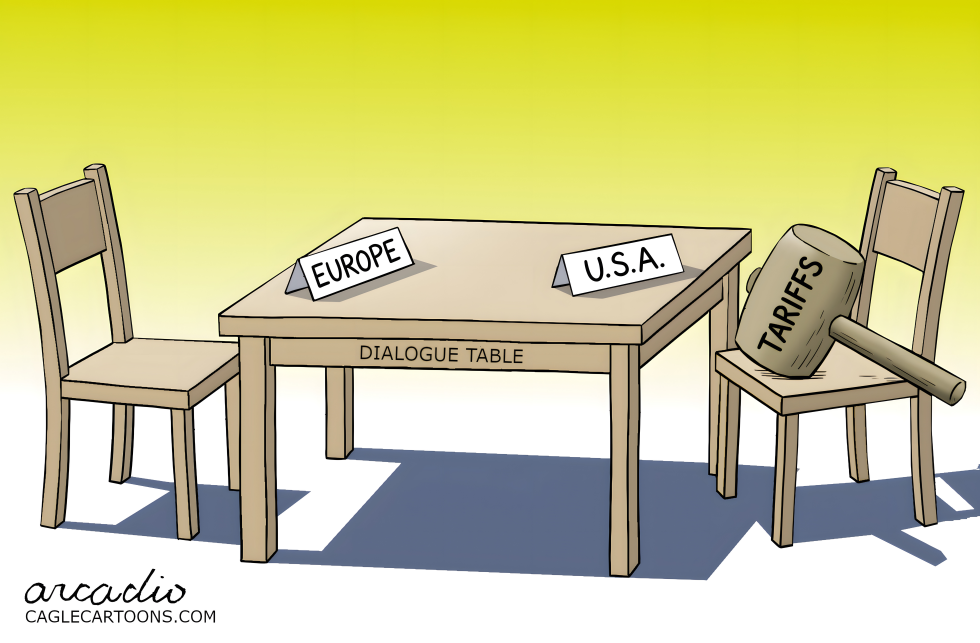
US and European officials face renewed friction over trade measures as tariffs disrupt scheduled talks. The impasse highlights ongoing disputes on import duties and market access that affect supply chains and consumer prices on both sides of the Atlantic. The editorial position criticizes the tariff approach for preventing constructive engagement and prolonging economic uncertainty.
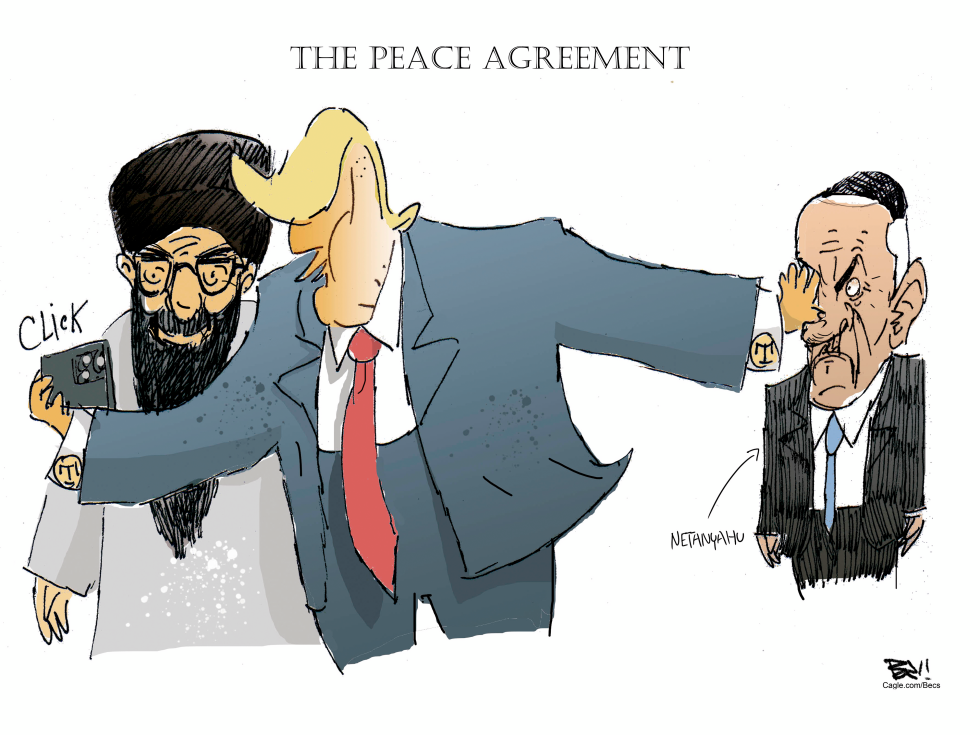
The image depicts Donald Trump extending an arm to cover Benjamin Netanyahu eye while Hassan Nasrallah holds a camera and takes a photo. The title reads The Peace Agreement. Netanyahu appears distressed with one eye obscured. The drawing responds to discussions around Middle East diplomacy involving these leaders in mid 2026.
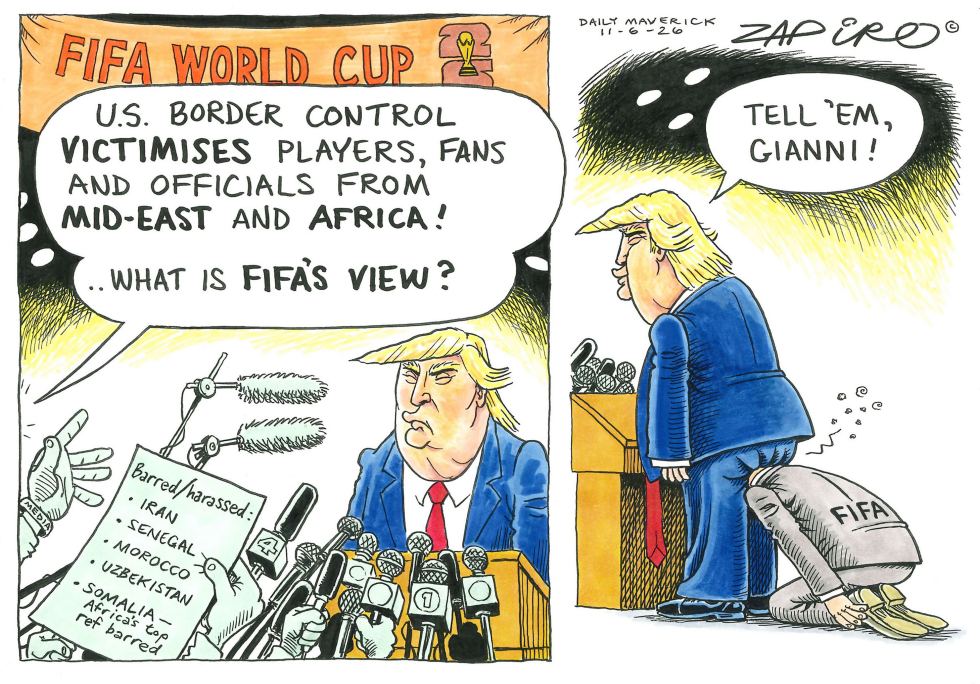
On June 19, 2026, a cartoon shows Donald Trump at a podium criticizing U.S. border policies for barring or harassing World Cup players, fans and officials from Iran, Senegal, Morocco, Uzbekistan and Somalia. He asks what FIFA thinks of the situation. In a separate panel Trump urges Gianni to speak out while a figure labeled FIFA kneels at his feet. The image responds to ongoing enforcement actions near the 2026 tournament.
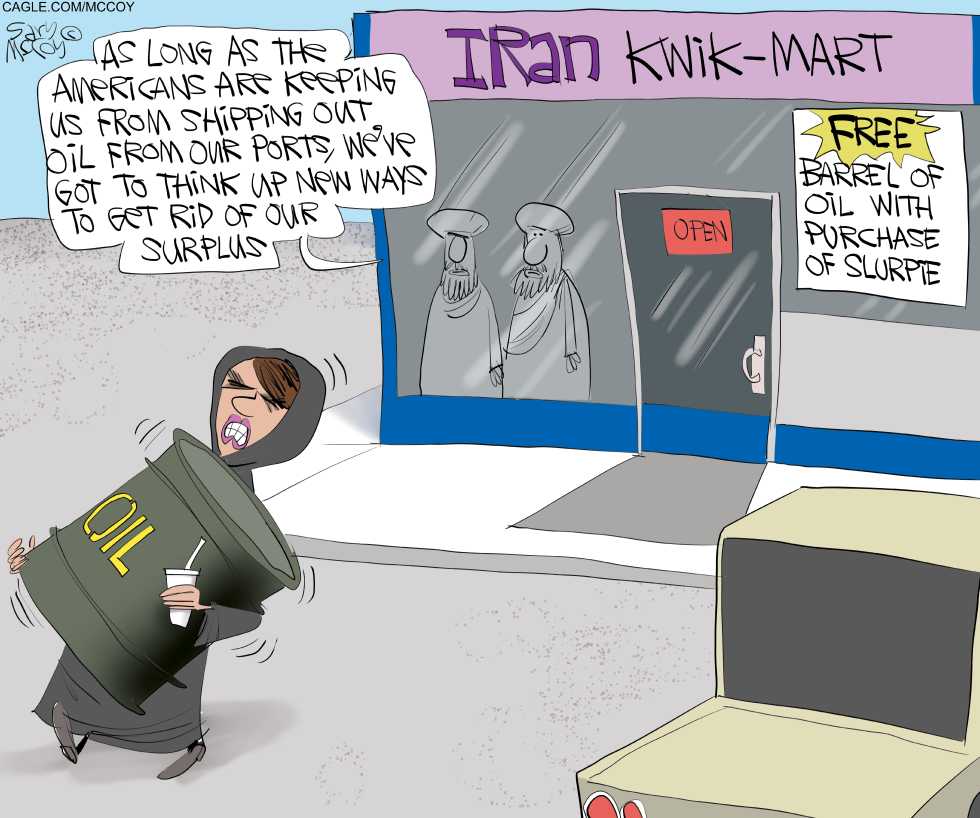
Gary McCoy's cartoon depicts two bearded Iranian clerics inside the Iran Kwik-Mart, promoting a free barrel of oil with Slurpee purchase to handle surplus crude. Outside, a hooded figure dumps an oil barrel into a car trunk, lamenting U.S. blockades on shipping ports. The image ties into Strait of Hormuz tensions, oil prices, Trump-era policies, Iran's Revolutionary Guard, and Middle East conflicts, highlighting ironic solutions to energy surplus amid international sanctions and naval standoffs. Commercial ships and tankers face barriers, forcing creative disposal methods in this dryly humorous take on global oil dynamics.
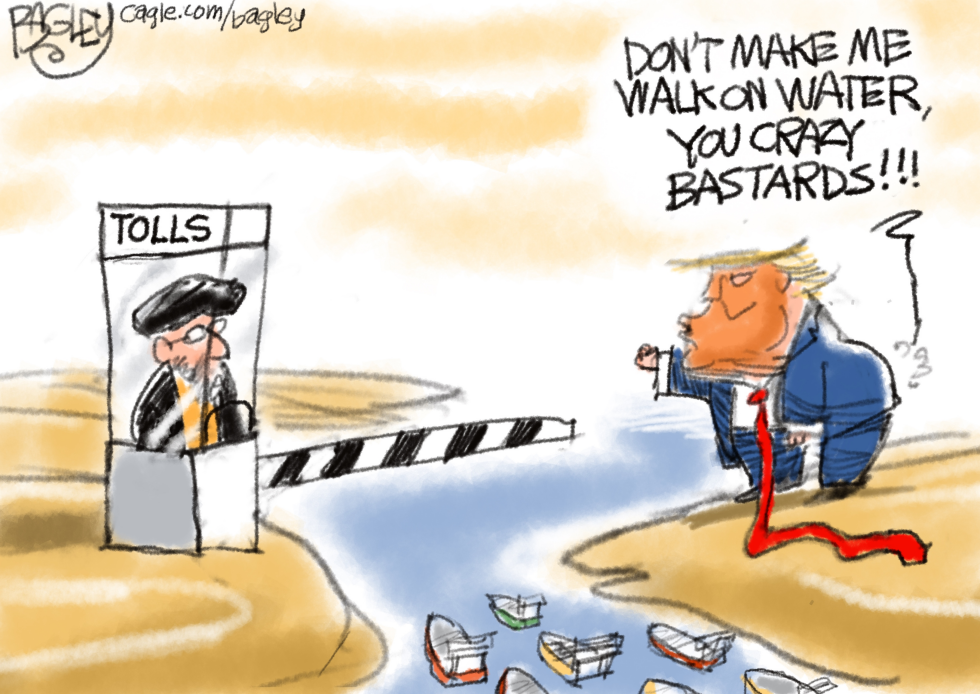
Donald Trump stands at the edge of a body of water confronting a toll booth operated by a figure resembling Ayatollah Khamenei. Small tankers sit in the water below while Trump issues a warning about walking on water. The scene references shipping routes through the Strait of Hormuz and surrounding nations.
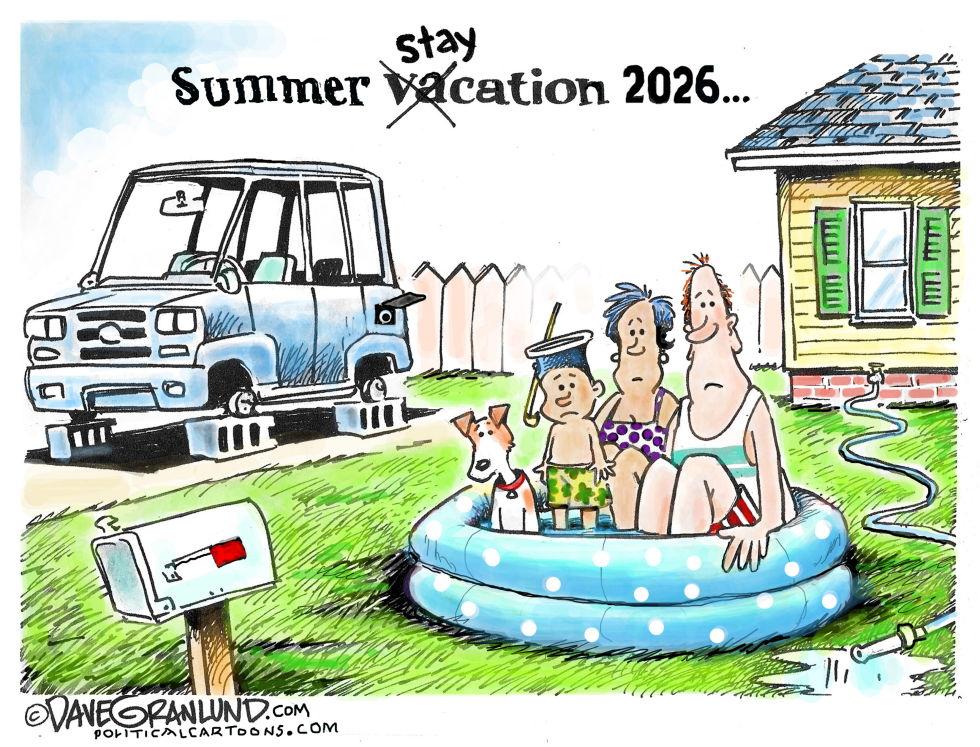
Dave Granlund's cartoon nails the frustration of high gasoline prices derailing summer road trips for families on limited budgets. Instead of hitting the highway in their autos, this crew opts for a stay home vacation, splashing in a backyard kiddie pool with the dog. The jacked-up minivan on blocks screams grounded plans, while the crossed-out 'Va' in vacation turns it into 'Staycation 2026.' It's a sharp poke at how fuel costs force folks to tighten belts, swapping grand adventures for hose-filled pools and mailbox views. Tags like gasoline prices, high cost, and stay home highlight the economic squeeze, making this a relatable jab at everyday belt-tightening.
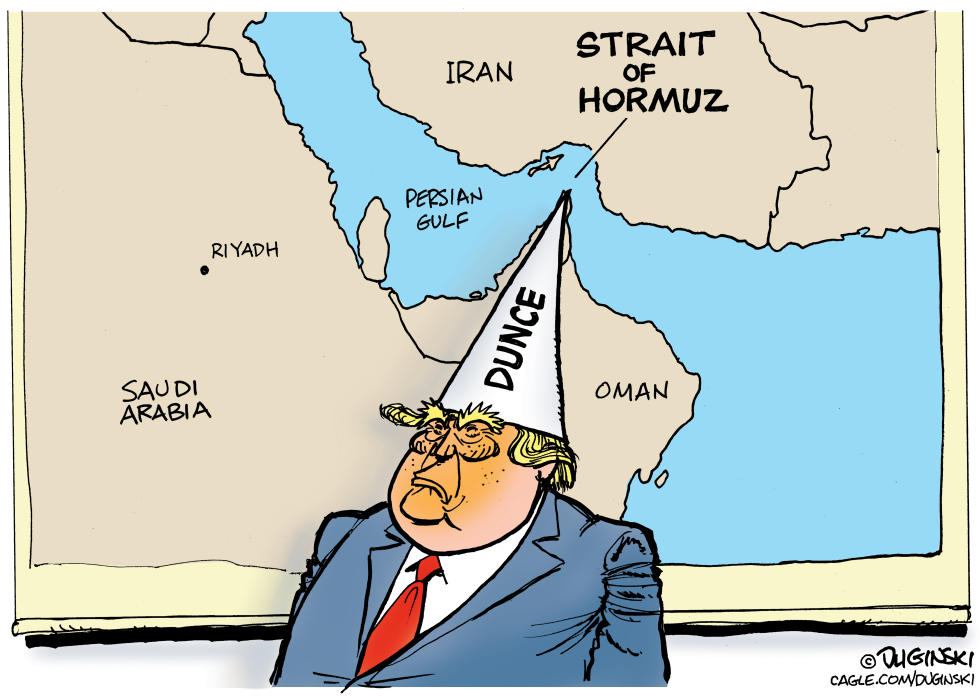
The cartoon depicts a simplified map of the Middle East, including labels for Iran, Saudi Arabia, Oman, Riyadh, and the Persian Gulf. The Strait of Hormuz is prominently marked, with a caricatured man in a suit and red tie wearing a dunce cap labeled \'DUNCE\' positioned over it. This setup uses the strait as a choke point for oil and energy, tying into themes of foreign policy, war, and ignorance. The image critiques handling of Middle East waterway issues, possibly linked to closure threats, tankers, and ceasefire efforts. Artist signature appears in the bottom right.
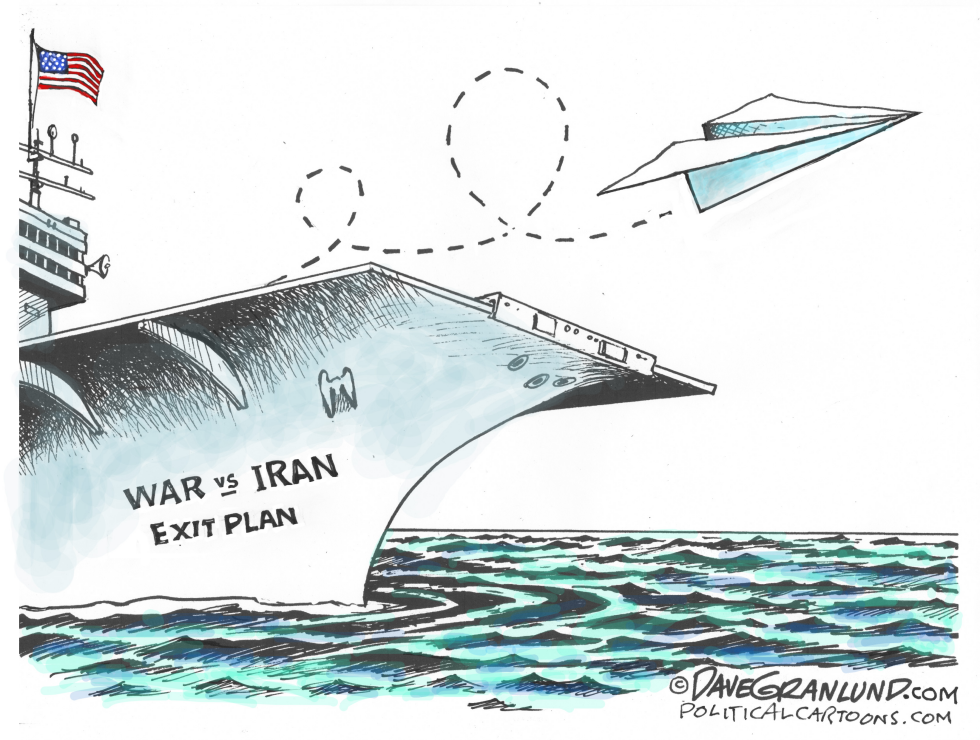
Dave Granlund's cartoon features a massive aircraft carrier flying the American flag, prominently labeled 'WAR vs IRAN EXIT PLAN,' from which a fragile paper airplane is taking off with a dashed flight path. The ocean waves below add to the maritime setting. This piece employs political satire, military humor, foreign policy commentary, war strategy parody, geopolitical cartooning, and illustrative wit to poke fun at planning. The simplicity of the paper airplane contrasts sharply with the imposing ship, underscoring themes of inadequacy in complex scenarios. Granlund's signature style brings dry humor to the forefront, making it a sharable critique of current events.