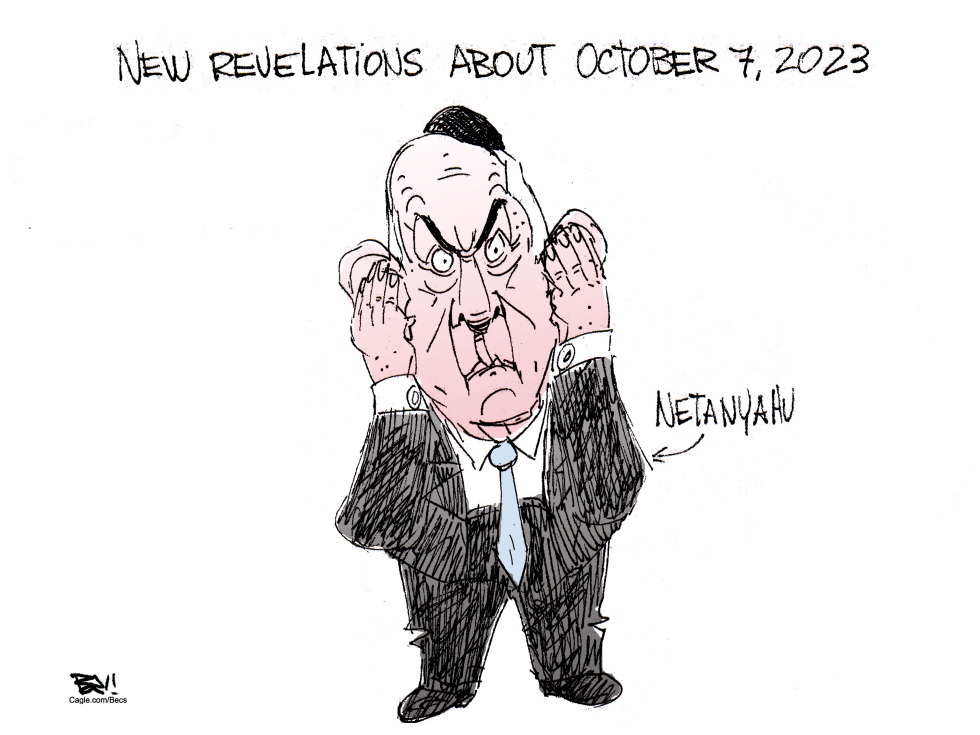
New details have surfaced regarding intelligence and preparedness failures ahead of the October 7, 2023 Hamas attacks. Israeli Prime Minister Benjamin Netanyahu has drawn criticism for appearing to dismiss these updates rather than address them directly. The ongoing debate centers on political responsibility for the deadliest attack in Israel's history and the government's handling of subsequent inquiries. Netanyahu's approach risks deepening public distrust in leadership during a period of heightened regional tension. The cartoon portrays this stance as deliberate avoidance of uncomfortable facts.
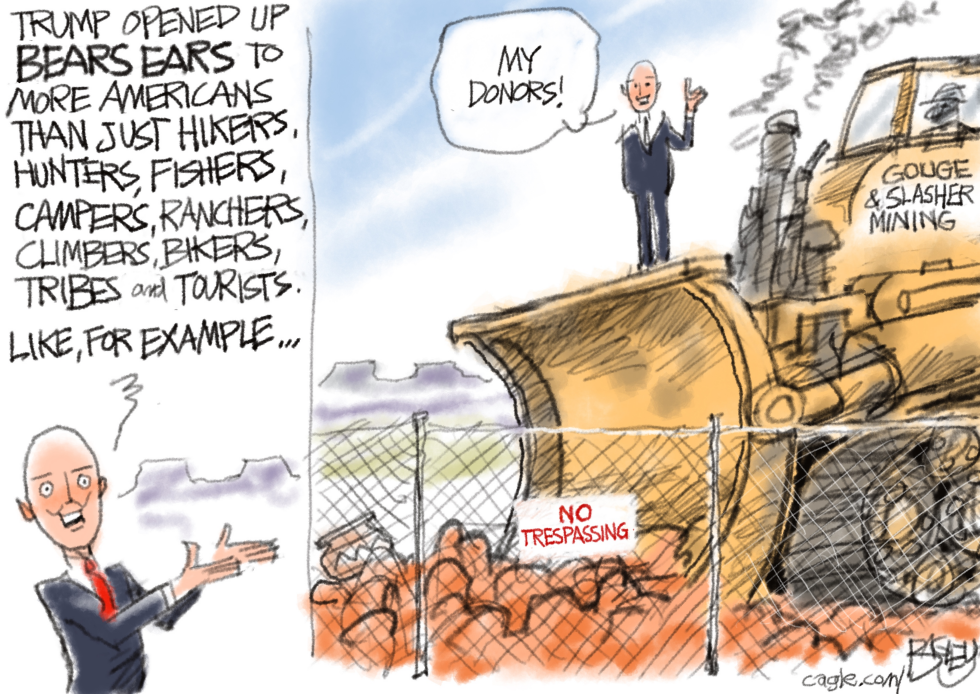
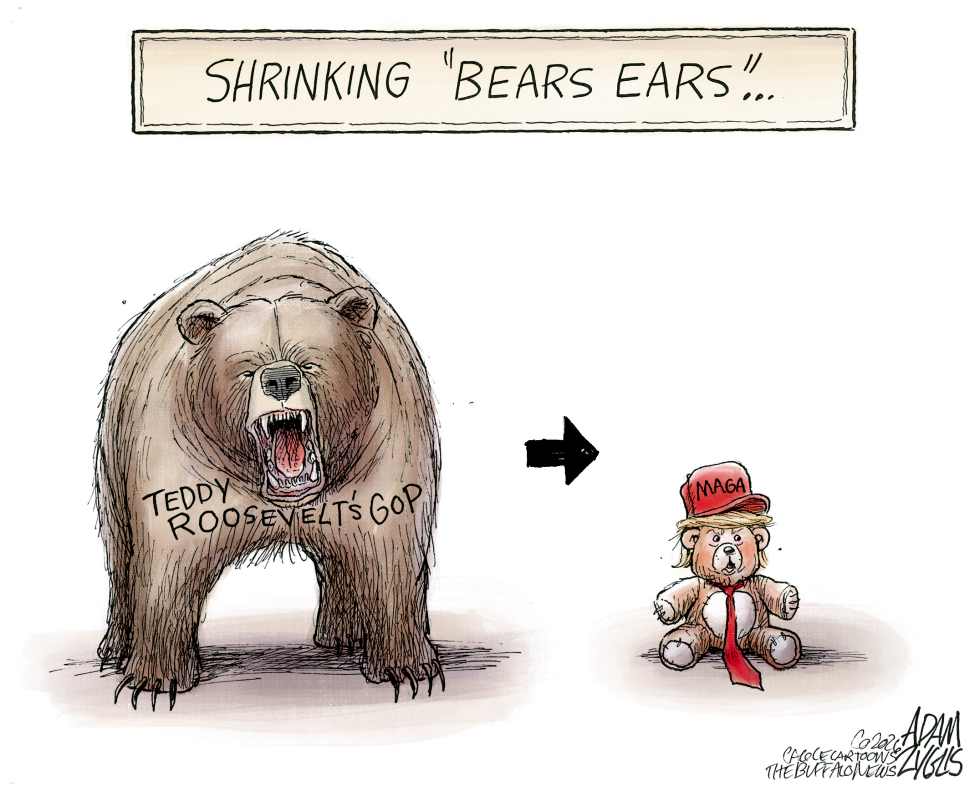
President Trump opened Bears Ears National Monument to expanded mining operations, citing broader public access. The move benefits mining companies and political donors while limiting protections for hikers, tribes and recreational users. The cartoon criticizes the decision as donor-driven favoritism over conservation.
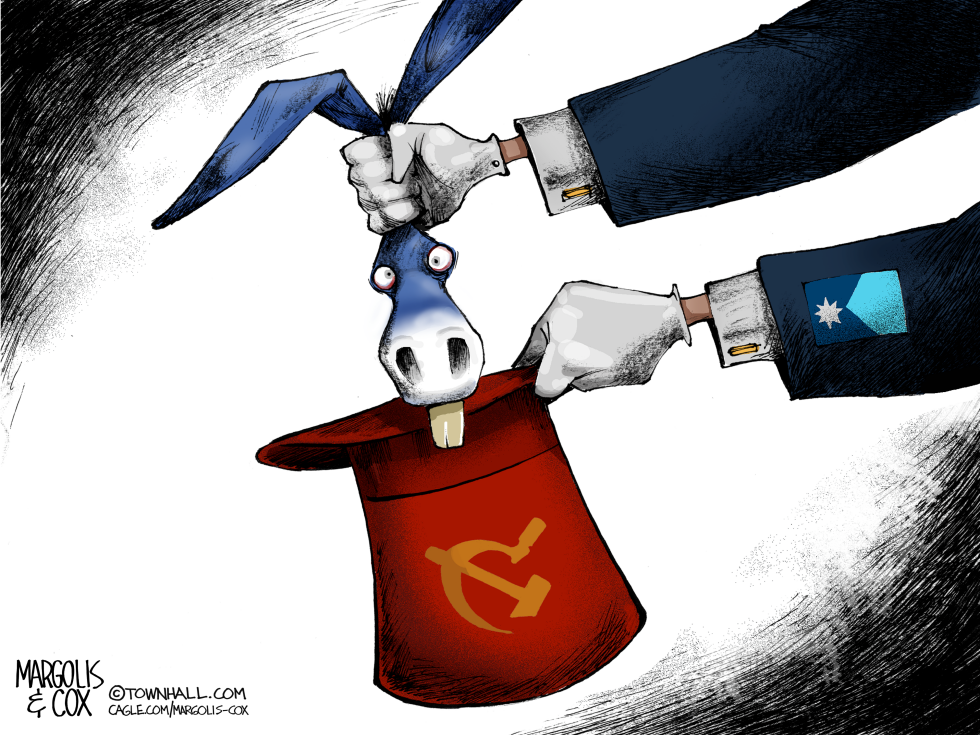
Accusations that Democratic policies carry communist undertones have persisted in partisan debate for years. The image frames the party as emerging directly from a communist emblem through a conjurer's reveal. This visual argument underscores ongoing conservative critiques that Democratic governance veers toward authoritarian economic controls rather than traditional American principles.
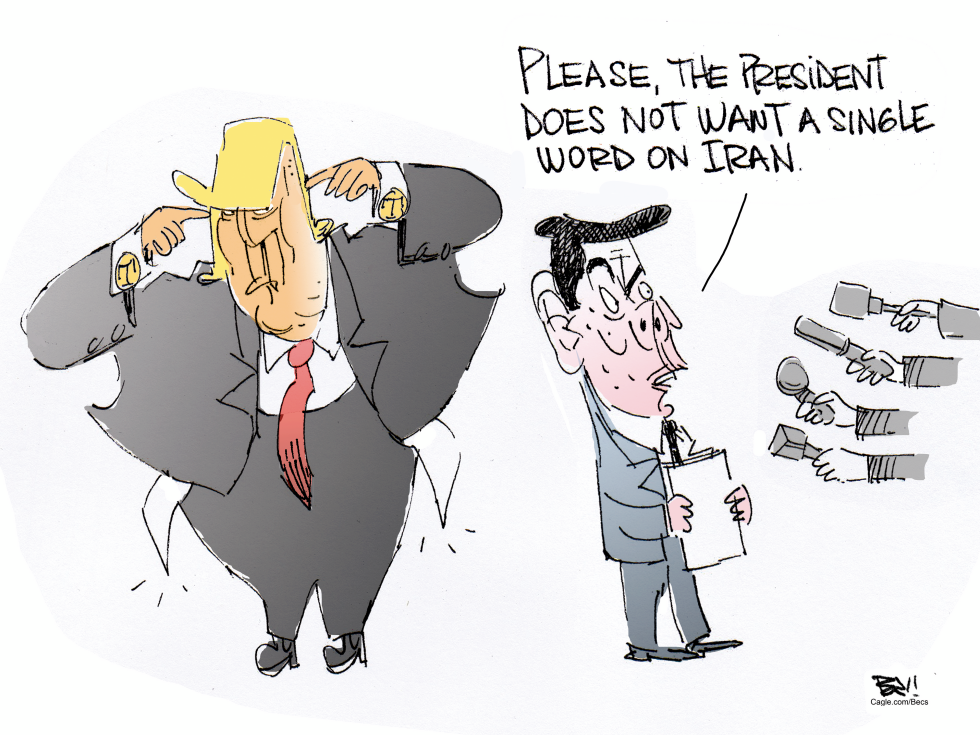
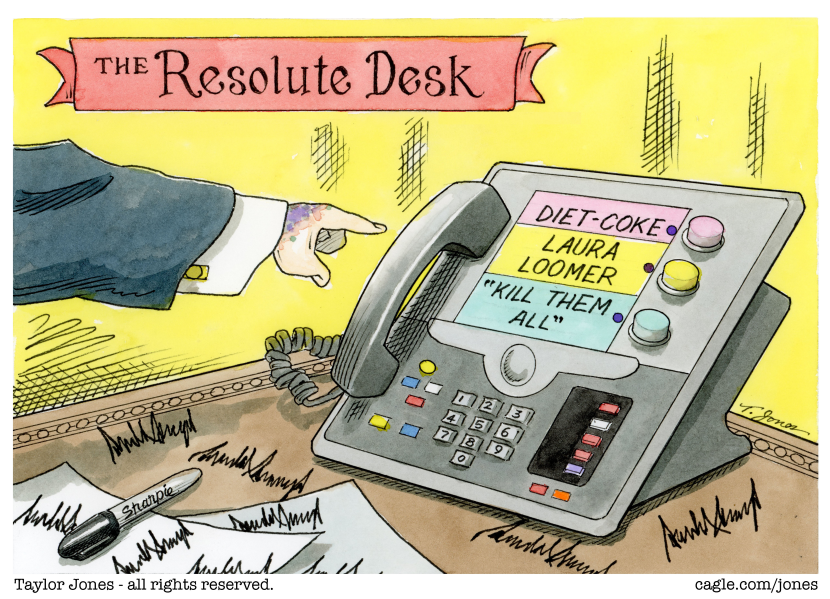
President Trump directed staff to avoid any public discussion of Iran policy. The move drew immediate pushback from reporters seeking clarification on administration plans. The editorial takes the position that the order reflects an effort to avoid accountability on a key foreign policy issue.
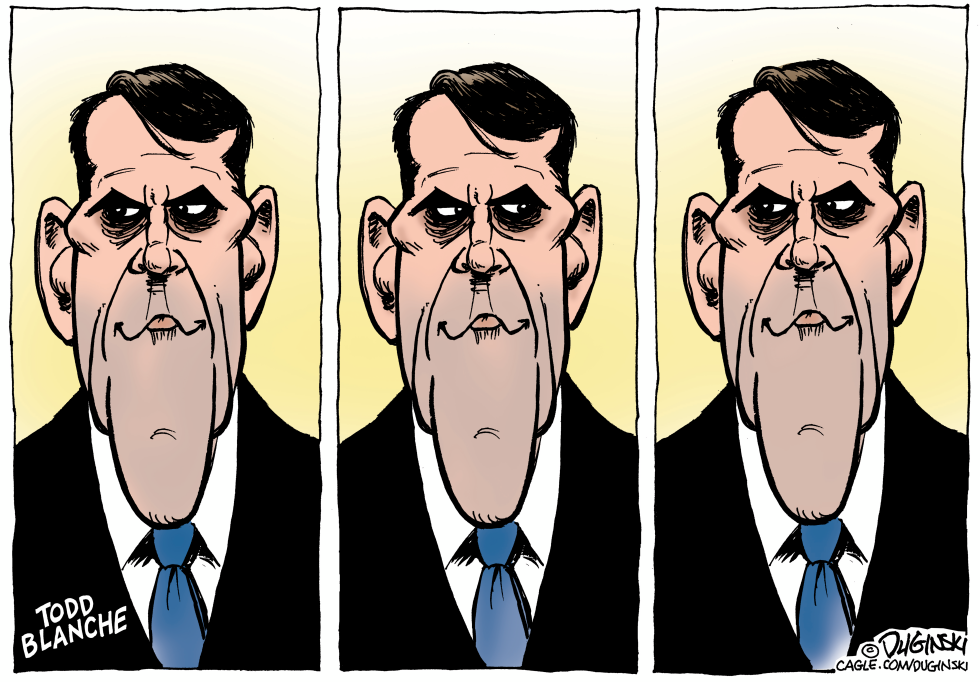
Todd Blanche is shown in three adjacent panels. Each panel presents a close view of the same man wearing a dark suit, white shirt and blue tie. The expressions feature narrowed eyes, furrowed brows and a downturned mouth. Slight variations appear in head angle and eye direction between the panels. The left panel includes the name Todd Blanche in capital letters at the bottom. The right panel includes a copyright notice at the bottom. All three images share a light yellow gradient background and black borders.
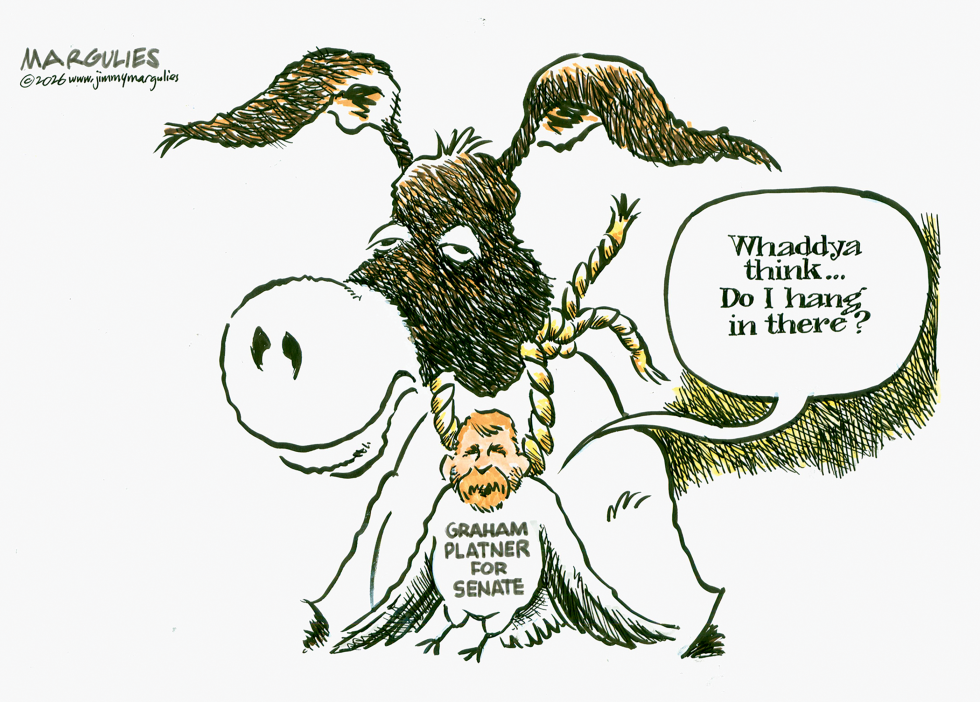
The image shows Graham Platner suspended by a noose from the neck of a Democratic donkey. The donkey has a speech bubble asking Whaddya think... Do I hang in there? Platner wears a shirt reading GRAHAM PLATNER FOR SENATE. The scene uses the party symbol and a hanging pun tied to the 2026 Senate race.
The cartoon shows the Democratic donkey clutching a handgun labeled uncritical Israel support. A box overhead reads Bibi Gun. The donkey wears a suit and tie. The image responds to ongoing debates over US policy toward Israel and Benjamin Netanyahu in June 2026.
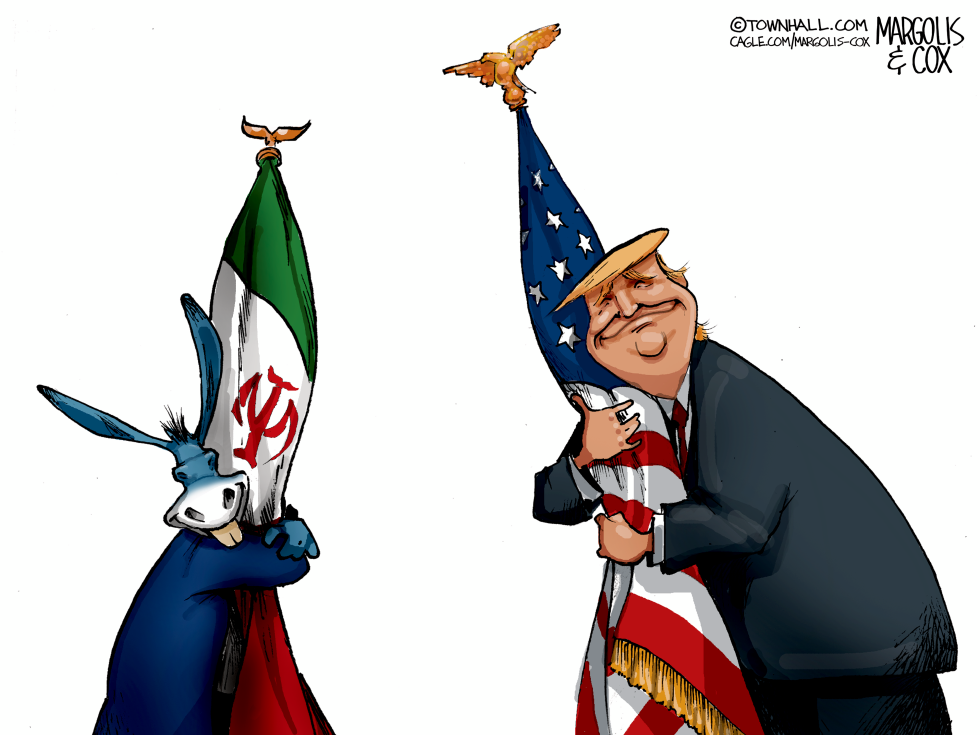
On June 21, 2026, the Margolis & Cox cartoon depicts Donald Trump wrapped in the American flag with an eagle perched above, facing a Democratic donkey wrapped in a flag resembling Italy's but marked with a hammer and sickle. The image responds to ongoing partisan debates over national identity and ideological leanings during the 2026 election cycle. Trump appears in a dark suit, smiling while holding the flag, while the donkey faces away. The visual argument centers on symbols of patriotism versus communism. Publication occurred via Townhall and Cagle.
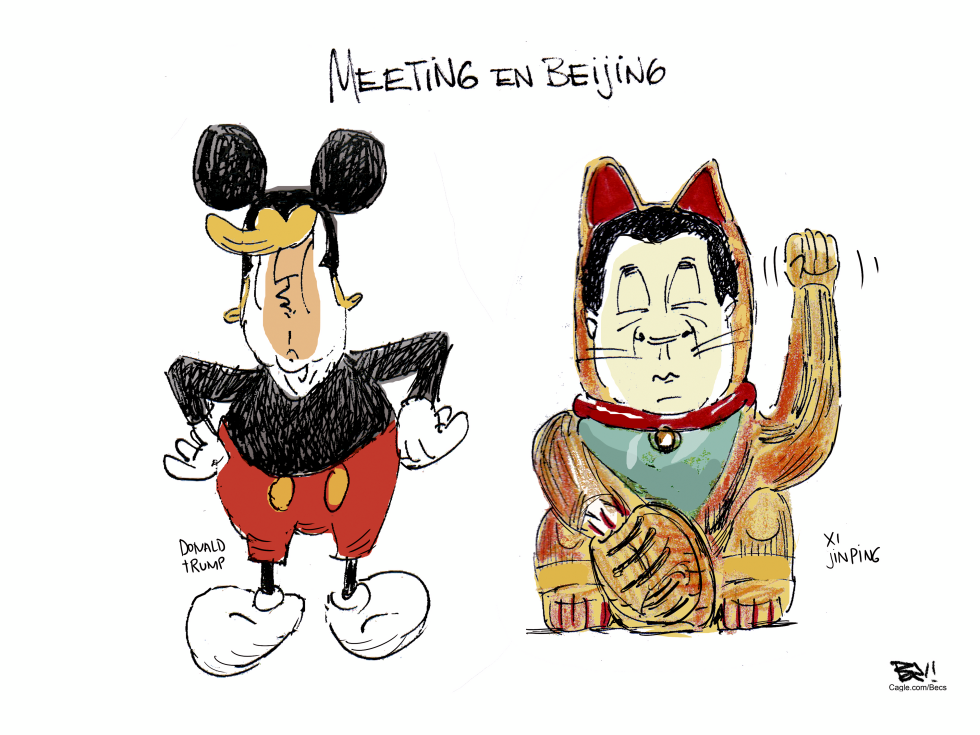
The image shows Donald Trump rendered as Mickey Mouse standing opposite Xi Jinping depicted as a golden Maneki-neko cat with one paw raised. Both figures are labeled clearly beneath them. The title Meeting in Beijing appears at the top. The scene references a bilateral encounter between the two leaders in the Chinese capital.
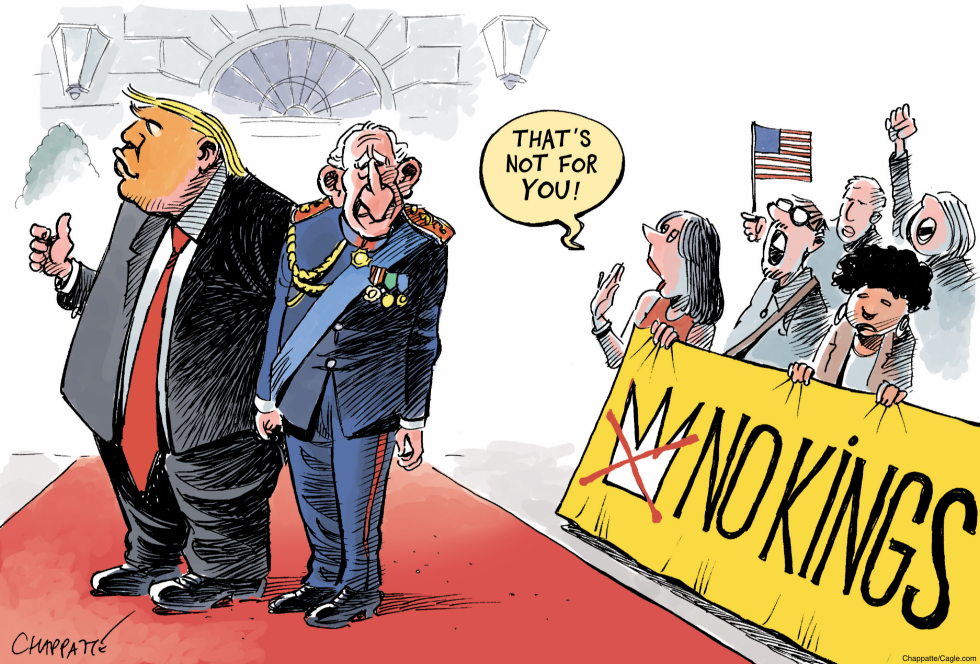
Patrick Chappatte's cartoon captures a fictional royal visit in Washington DC, where Trump, with his signature hair and suit, walks arm-in-arm with King Charles in full regalia. A group of protesters, waving a USA flag, holds a yellow sign featuring a crossed-out crown and 'NO KINGS,' while one shouts 'That's Not For You!' The scene tags USA, Great Britain, Trump, King Charles, monarchy, Democrats, demonstrations, United Kingdom, blending humor on transatlantic relations and anti-monarchy sentiments in a clearly visible setup on a red carpet against a grand building backdrop. The dry satire highlights visible contrasts without deeper inference.
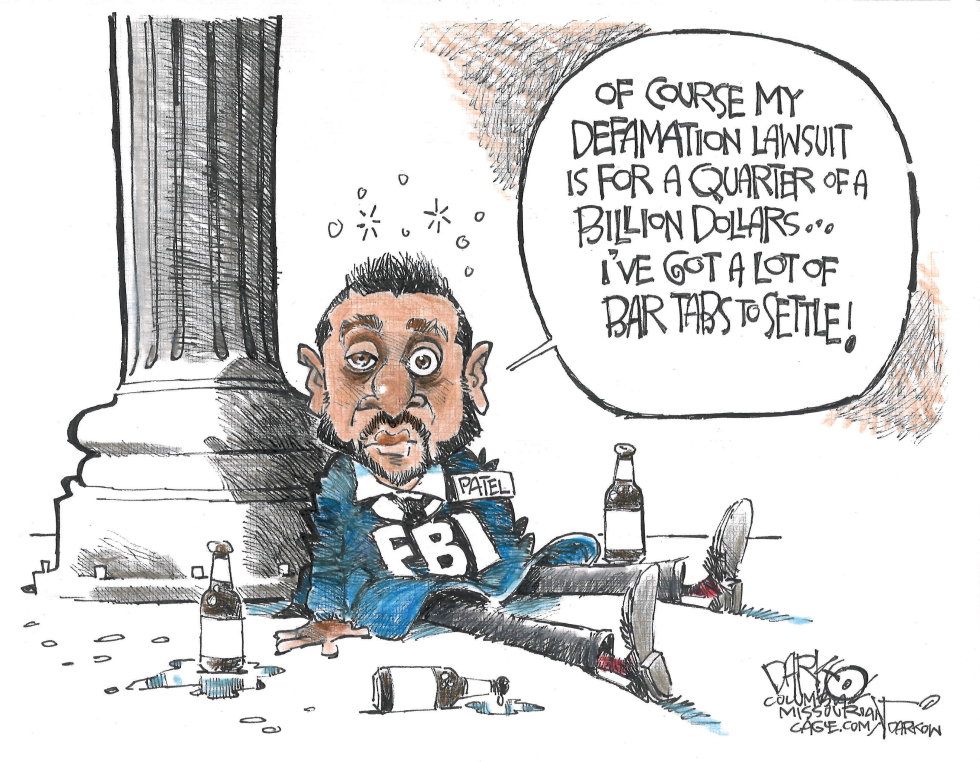
John Darkow's cartoon captures Kash Patel in a state of drunkenness, leaning against a grand pillar with empty beer bottles scattered around, his suit jacket labeled FBI and a name tag reading Patel. The speech bubble delivers the punchline about his defamation lawsuit being for a quarter of a billion dollars to settle bar tabs, tying into themes of DOJ, justice department, and availability. This piece offers a sharp satirical commentary on Patel's potential role as FBI director, using booze as a metaphor visible in the littered bottles and dazed expression. The artwork stays grounded in the visible elements, avoiding speculation, and highlights the humor in exaggerated features and setting.
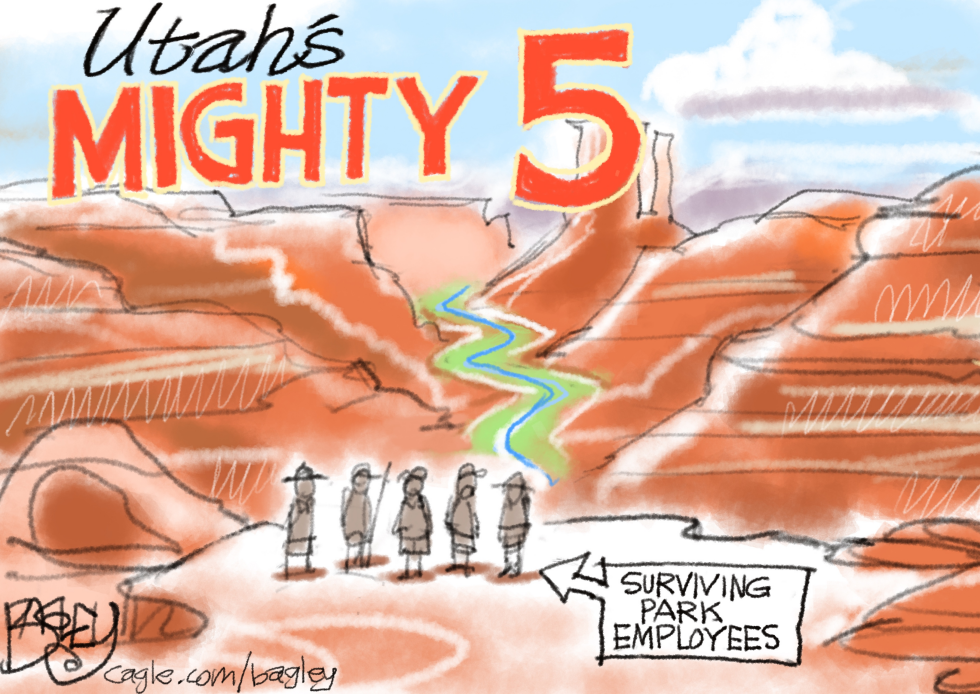
The cartoon depicts Utah's five major national parks with only five remaining employees standing in the foreground. The image responds to recent federal workforce reductions at the National Park Service linked to efficiency initiatives. The visual emphasizes the scale of the landscape against the tiny surviving workforce.
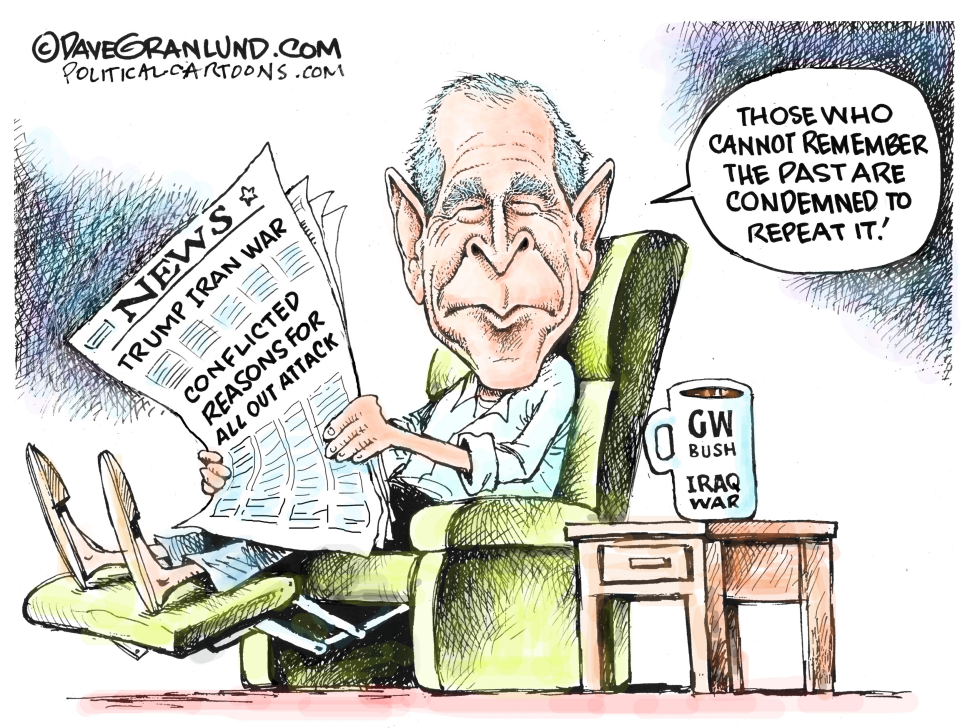
Dave Granlund's political cartoon cleverly lampoons the Trump Iran conflict by portraying a smug, elf-eared figure—possibly a nod to forgetful policymakers—lounging with a newspaper screaming 'Iran War' headlines, while clutching a mug emblazoned with 'GW Bush Iraq War.' The speech bubble twists George Santayana's famous quote on historical amnesia, warning that those who cannot remember the past are condemned to repeat it. This satirical jab underscores the eerie parallels between Bush's ill-fated Iraq invasion and Trump's bellicose posturing toward Iran, blending humor with sharp insight into geopolitical folly. Tags like Iraq War repetition and Trump Iran conflict amplify its relevance, making it a viral-ready critique of endless war cycles.