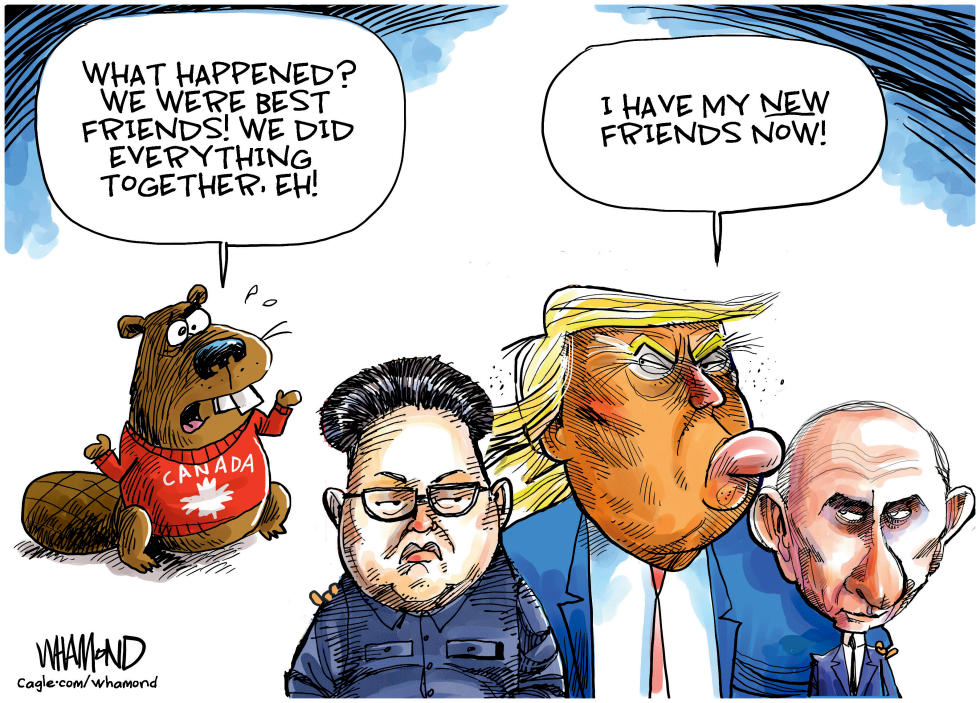
President Trump has redirected diplomatic priorities toward closer ties with Russian President Vladimir Putin and North Korean leader Kim Jong Un. Traditional partners such as Canada now face reduced engagement. The move reflects a broader realignment in U.S. foreign policy that favors authoritarian counterparts over longstanding democratic allies. Observers note the shift carries risks for trade, security cooperation, and international norms. The editorial position criticizes the pivot as shortsighted and damaging to established relationships.
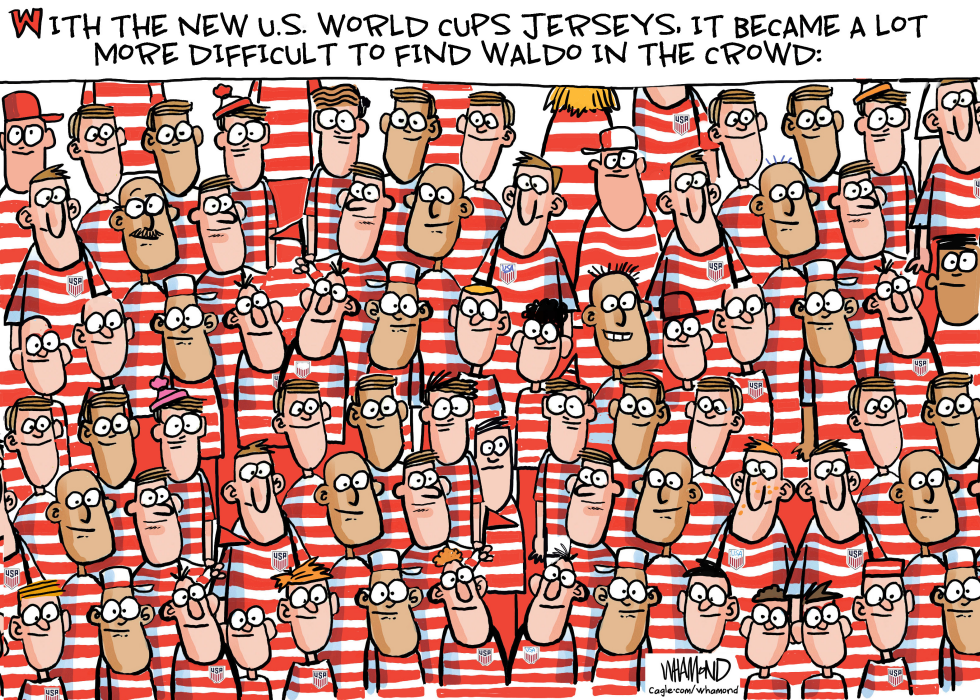
The cartoon shows a dense crowd of spectators wearing the new red and white striped U.S. World Cup jerseys. The top text notes that the uniforms make it much harder to locate Waldo among the fans. The image references the 2026 tournament hosted by the United States, Canada and Mexico. The visual plays on the classic Where's Waldo search books by filling the scene with similar striped shirts. The artist's signature appears in the lower right.
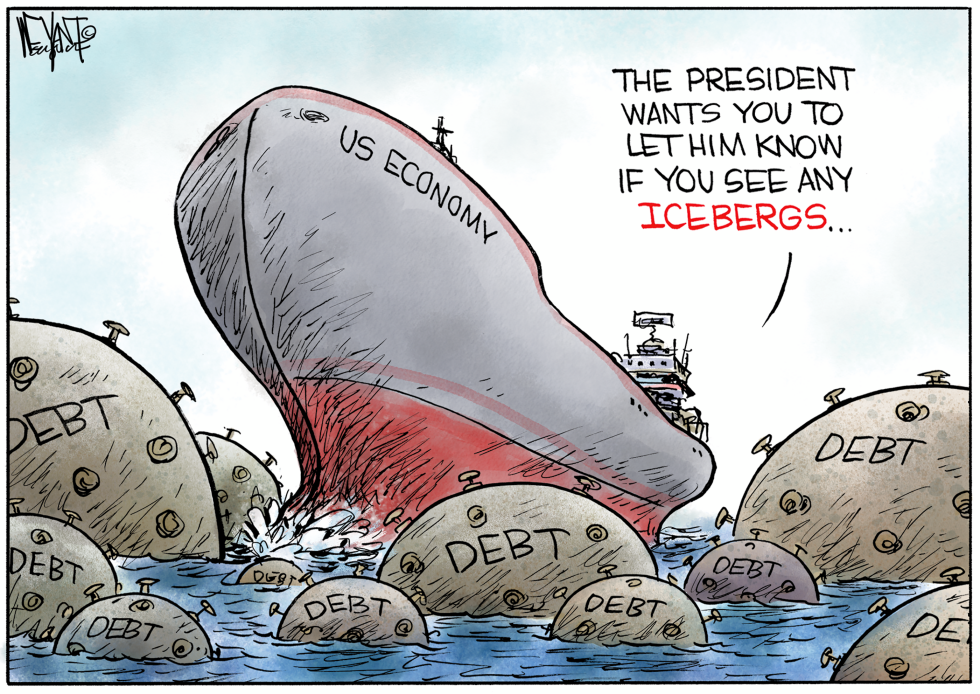
This political cartoon illustrates the US Economy as a massive ship labeled accordingly, dramatically sinking after colliding with numerous icebergs each marked 'DEBT.' A speech bubble from the ship warns to alert the president about icebergs, evoking the Titanic disaster in a clear metaphor for economic peril. Incorporating tags such as economy, debt, budget, inflation, prices, and costs, the image critiques fiscal irresponsibility. The artwork by Christopher Weyant uses simple lines and colors to emphasize the collision's impact, with water splashing and the ship's hull damaged. Such cartoons often highlight how mounting debt threatens stability, drawing parallels to historical maritime tragedies for satirical effect. The composition places the ship at an angle, surrounded by floating debt bergs, underscoring inevitable crisis if warnings go unheeded.
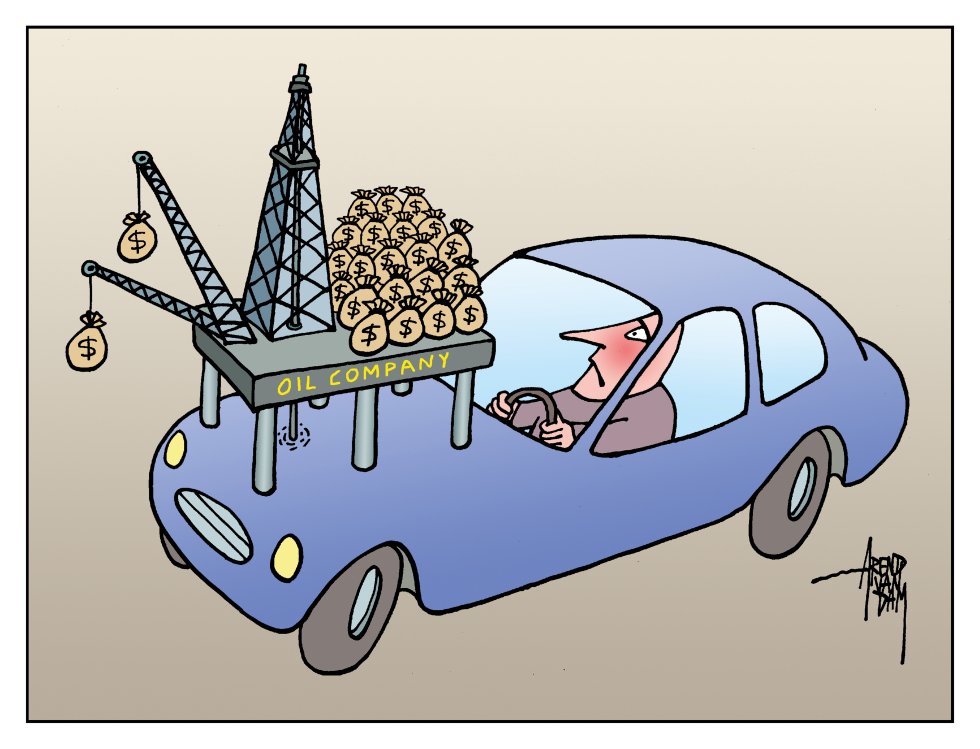
In this pointed political cartoon, an oil company platform sits atop a blue car, loaded with piles of dollar-sign money bags, while cranes dangle more profits. The frustrated motorist grips the wheel, face red with anger, illustrating how excessive profits from oil companies crush consumers at the pump. Tags like excessive profits, motorists, fuel, petrol, and refuel capture the essence, with Iran and Strait of Hormuz hinting at geopolitical tensions driving prices. This visual satire underscores the disparity between corporate windfalls and everyday drivers' pain, a timeless theme in energy politics.
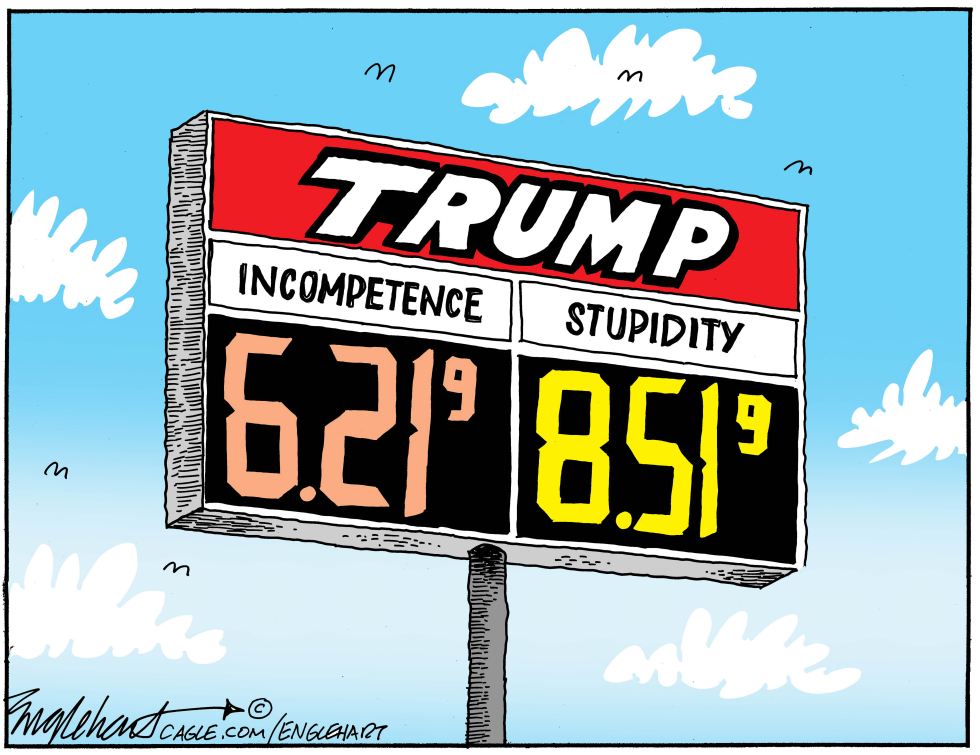
Bob Englehart's cartoon features a gas station sign with Trump at the top, showing prices for incompetence at 6.21⁹ and stupidity at 8.51⁹ against a blue sky with clouds. The tags Trump, Iran War, gas prices, gasoline, and gallon frame the visual pun. Such cartoons often tie political figures to everyday economic pains like fuel costs. The dry humor lands on how leadership flaws inflate prices, making it relatable for readers hit by pump shocks. With no characters, just the sign, it keeps the message direct. Tags like incompetence and stupidity drive the satire home, poking at perceived policy missteps without overcomplicating the scene.
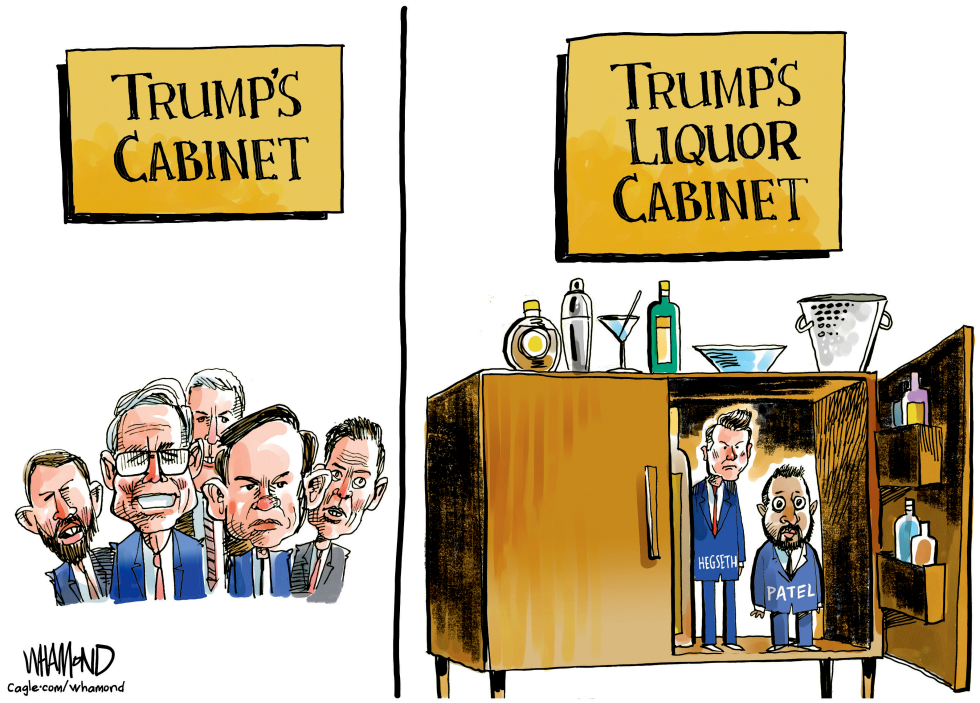
Dave Whamond's cartoon splits the scene between Trump's Cabinet of stern-faced men in suits and Trump's Liquor Cabinet, where caricatures labeled Hegseth and Patel emerge disheveled amid bottles and barware, poking at Trump's cabinet problems. The dry humor targets Kash Patel as FBI director nominee and Pete Hegseth for Secretary of Defense, amid drinking allegations and excessive drinking claims from The Atlantic. Unexplained absences and AWOL accusations add to the satire of unfit picks, with a defamation lawsuit looming. This piece captures the irony of Trump's best people turning into a partying liquor cabinet fiasco, all in a straightforward, insider jab at political absurdity.
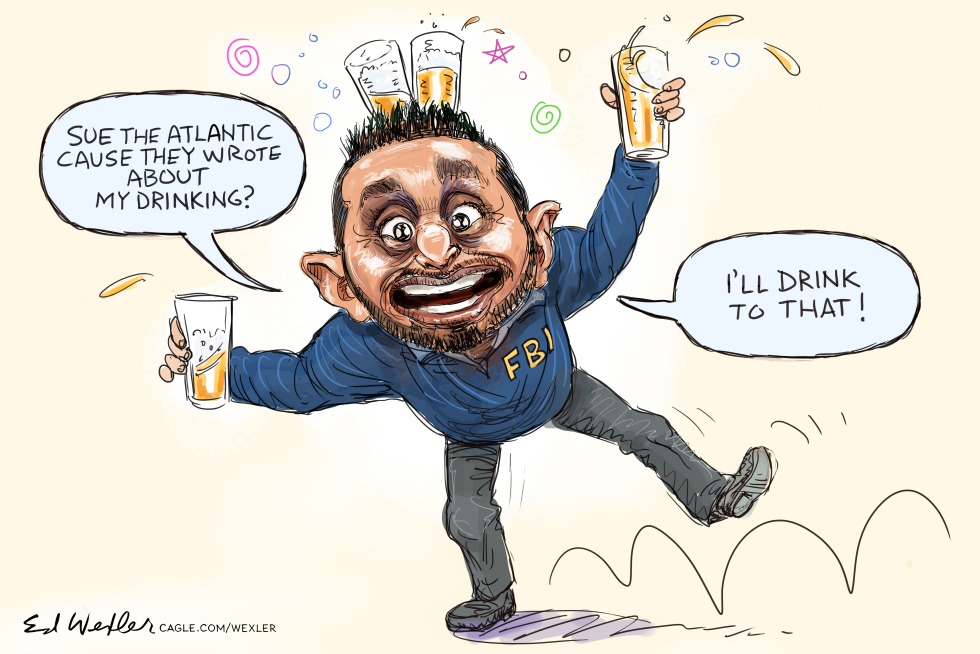
Ed Wexler's cartoon captures a man clearly modeled after a public figure, dressed in an FBI sweatshirt, balancing beers on his head and in his hands, with tags like kash, patel, the atlantic, drinking, alcohol, beer, obvious intoxication, and absences. The figure, showing signs of inebriation with wide eyes and a goofy grin, holds a glass in each hand while more pints teeter atop his spiky hair, foam spilling everywhere. Speech bubbles reveal his slurred plan to sue the Atlantic for writing about his drinking, followed by the punchline 'I'll drink to that!' Bubbles and stars float around, emphasizing the dizzy, drunken state. The signature at the bottom credits the artist and site, grounding the satire in visible elements of alcohol-fueled absurdity.
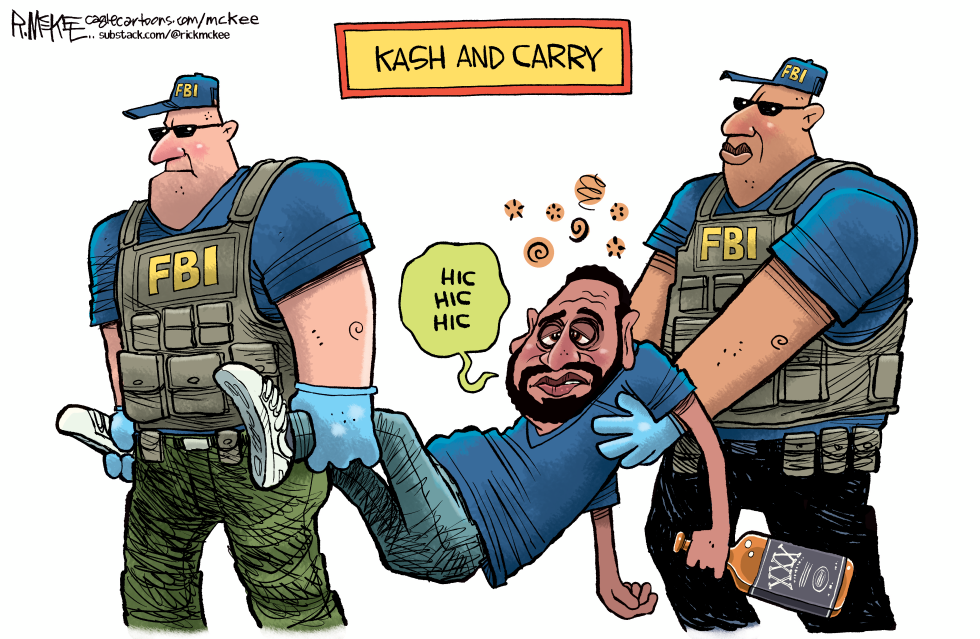
Rick McKee's cartoon shows two stern FBI agents in vests and caps, carrying a limp, bearded man who's clearly intoxicated, complete with hiccups and swirling symbols overhead, clutching a bottle marked XXX. The sign above reads 'Kash and Carry,' a clear pun tying into Kash Patel, the figure depicted. This piece tags into FBI, Federal Bureau of Investigation, drunk, alcohol, agents, criminal justice, and domestic policy, poking at the idea of leadership in a haze. The dry humor lands on the absurdity of carrying someone unfit, visually straightforward without hidden layers. Newspapers love this kind of sharp, unambiguous satire that comments on current events without overcomplicating the message.
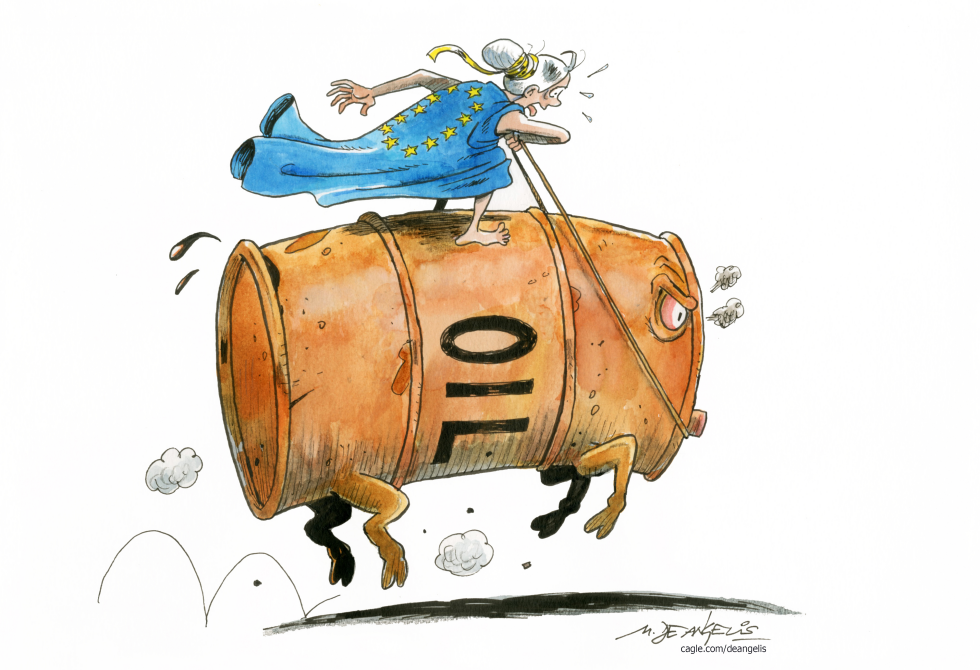
Marco De Angelis draws a sharp symbolic scene where a figure draped in the European Union flag clings to a bucking oil barrel marked OIL, legs kicking like a furious bull, smoke puffing from its nostrils. The rodeo metaphor nails the wild ride of economy and prices amid war in places like Hormuz. Europe looks desperate, one hand waving, mouth open in shock, as the oil tank rears up. It\'s a straightforward jab at how USA policies and global tensions turn energy into a beast no one can tame. Tags like symbolic, European, oil, tank, war, and economy drive the point home without fluff.
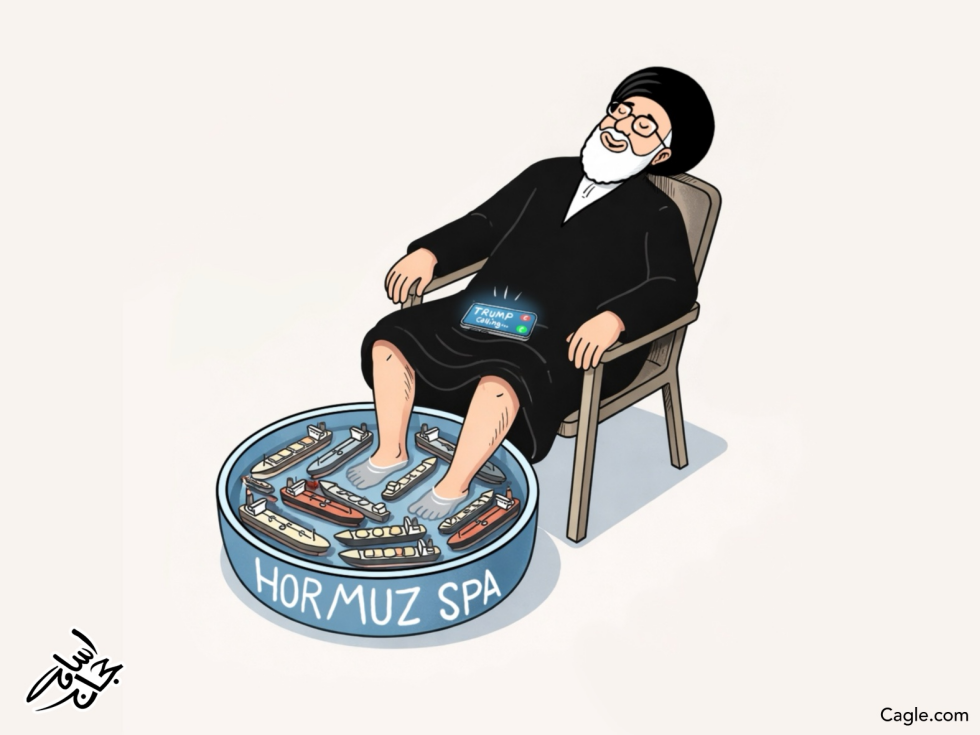
Osama Hajjaj draws an Iranian leader, resembling a cleric in black robes and turban, slouched in a chair with feet immersed in a blue basin labeled Hormuz Spa. Tiny ships float around his feet, evoking the Strait of Hormuz. A phone on his lap displays Trump with a green light, implying a call or alert. The scene captures dry satire on Iran-Trump relations, with the spa pun highlighting control over vital shipping lanes. Tags like Hormuz, Iran, Donald Trump, spa, and political cartoon underscore the humor in geopolitical friction.
Taylor Jones draws a sharp contrast in this cartoon, with a pope-like figure in white robes and glasses, hands clasped, delivering the Sermon on the Mount line from Matthew 5:9 about blessed peacemakers being children of God. Beside him stands a blonde-haired man in a suit, halo above, mouth open in response, twisting John 3:16 to claim the Strait of Hormuz as a divine gift, or soon to be, labeled Don 3:16. The piece nods to Catholic Church teachings against a backdrop of Persian Gulf tensions, war in Iran, and oil exports disruptions. It's a dry poke at how leaders bend scripture for geopolitical gains, like controlling the Strait of Hormuz to spike crude prices. Vatican serenity meets brash claims, all in watercolor style on purple background.