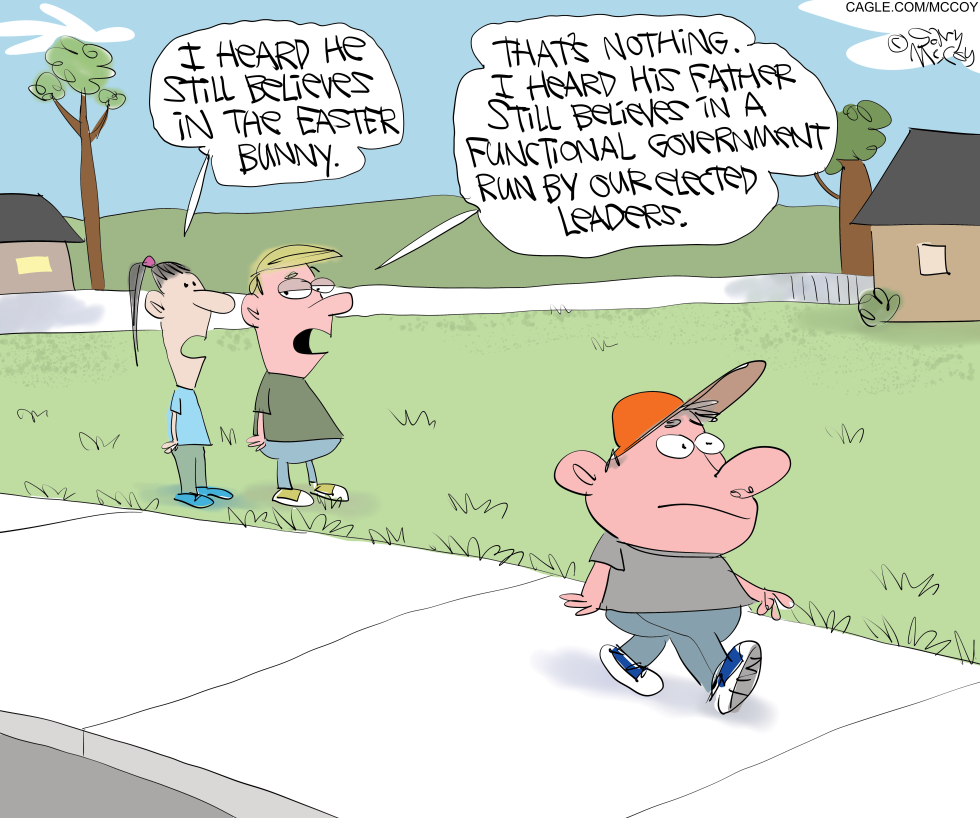
Public distrust in government institutions remains high as citizens question whether elected leaders can deliver effective results. Recent polls show widespread doubt about Congress and the executive branch functioning as intended. The cartoon captures this sentiment by likening such belief to childhood myths. It takes the position that expecting competent governance from current leaders is naive and unrealistic.
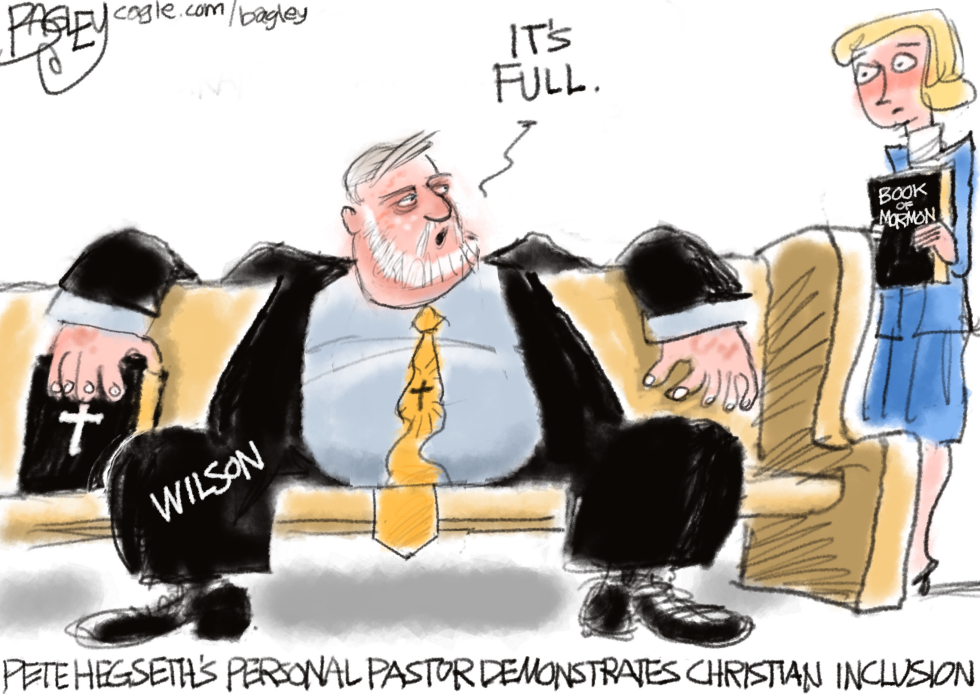
The July 2026 cartoon depicts Pastor Wilson seated on a couch holding a cross-emblazoned book and stating it is full. A woman stands nearby offering the Book of Mormon. The caption states that Pete Hegseth's personal pastor demonstrates Christian inclusion. The image responds to ongoing discussions about religious boundaries and denominational acceptance tied to the defense secretary nominee's faith advisors.
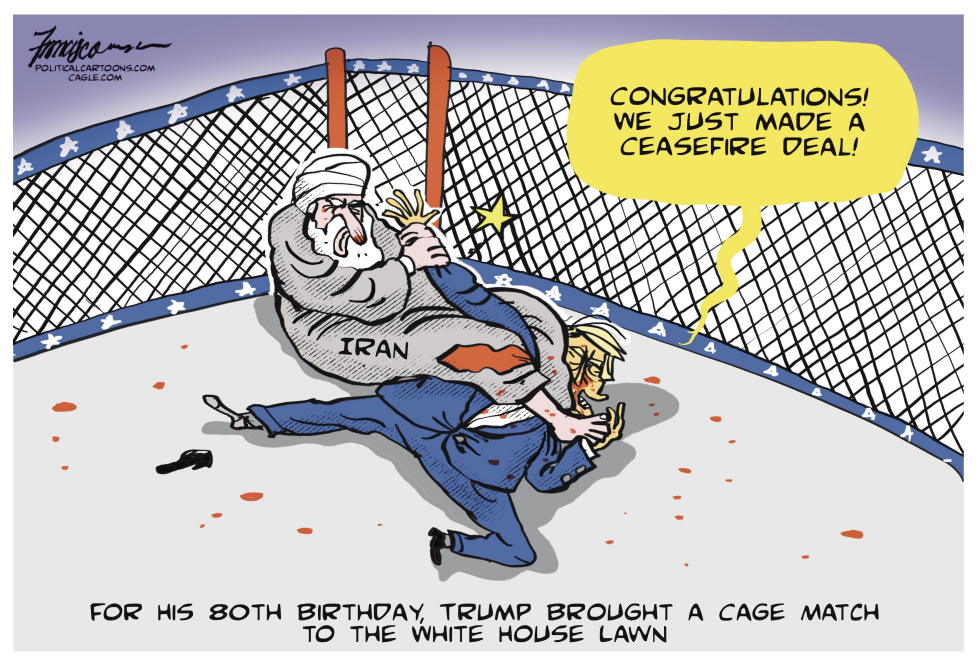
A cage match between the United States and Iran over a potential ceasefire deal has drawn attention amid ongoing Middle East tensions. The confrontation highlights the high stakes of direct engagement between the two nations. The piece portrays the encounter as a chaotic personal brawl rather than a measured diplomatic effort.
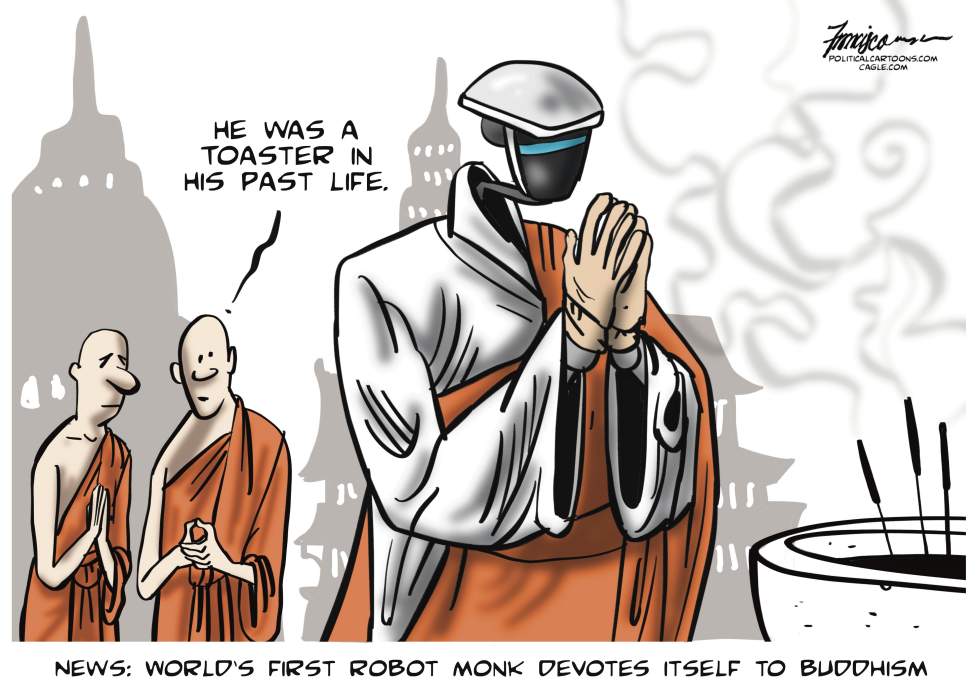
A tall robot dressed in monastic robes stands with hands pressed together while two human monks observe from the side. One monk recalls a prior life as a toaster. The scene references news of the first robot monk committing to Buddhist practice.
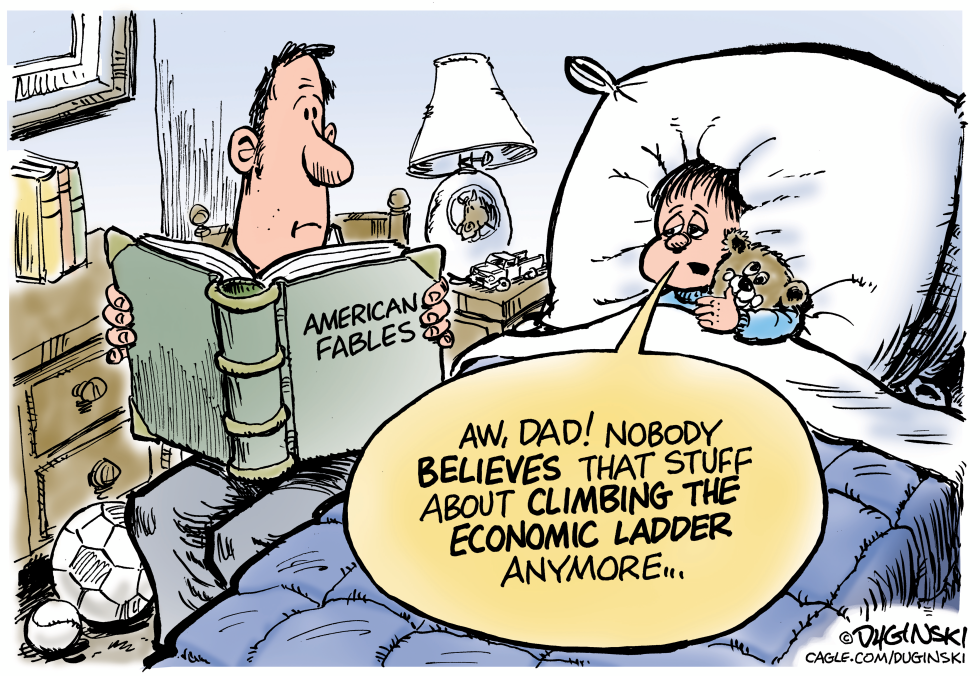
The image shows a father holding an open book titled American Fables beside a child tucked in bed with a teddy bear. The boy speaks from a large speech bubble rejecting the notion of climbing the economic ladder. A soccer ball rests on the floor near stacked books and a nightstand with a lamp and toy train. Tags include American Dream, climbing the economic ladder, upward mobility, cost of living, affordability, and inflation. The scene stays limited to these visible elements without added context.
Taylor Jones draws a sharp contrast in this cartoon, with a pope-like figure in white robes and glasses, hands clasped, delivering the Sermon on the Mount line from Matthew 5:9 about blessed peacemakers being children of God. Beside him stands a blonde-haired man in a suit, halo above, mouth open in response, twisting John 3:16 to claim the Strait of Hormuz as a divine gift, or soon to be, labeled Don 3:16. The piece nods to Catholic Church teachings against a backdrop of Persian Gulf tensions, war in Iran, and oil exports disruptions. It's a dry poke at how leaders bend scripture for geopolitical gains, like controlling the Strait of Hormuz to spike crude prices. Vatican serenity meets brash claims, all in watercolor style on purple background.
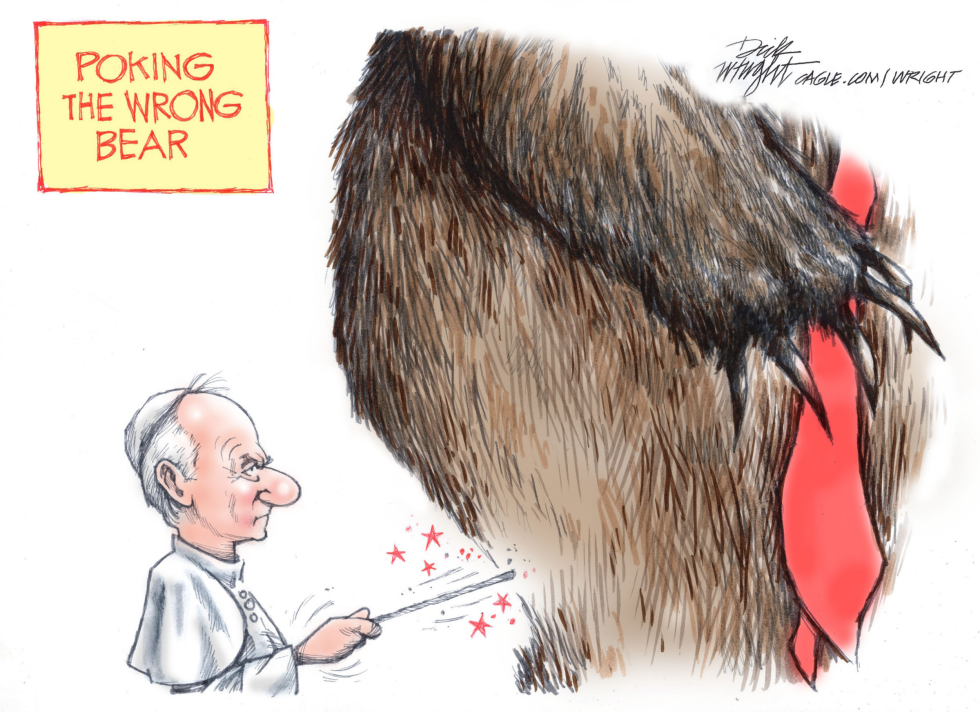
Dick Wright's political cartoon depicts a Pope-like figure in white attire, extending a thin rod toward the rear of a massive brown bear, complete with a dangling red tie and sparkling effects at the point of contact. The yellow label reads 'POKING THE WRONG BEAR,' playing on the idiom with a twist. This satirical illustration ties into the Trump-Pope feud, using the bear as a stand-in for power, the red tie evoking Trump's signature look, and the poking action suggesting provocation. Cartoonists often employ such animal metaphors for political commentary, and Wright's style here delivers clear lines and exaggerated features for impact. The image avoids overstatement, sticking to visible elements like the bear's claws and fur details, making it a straightforward jab at ongoing tensions.
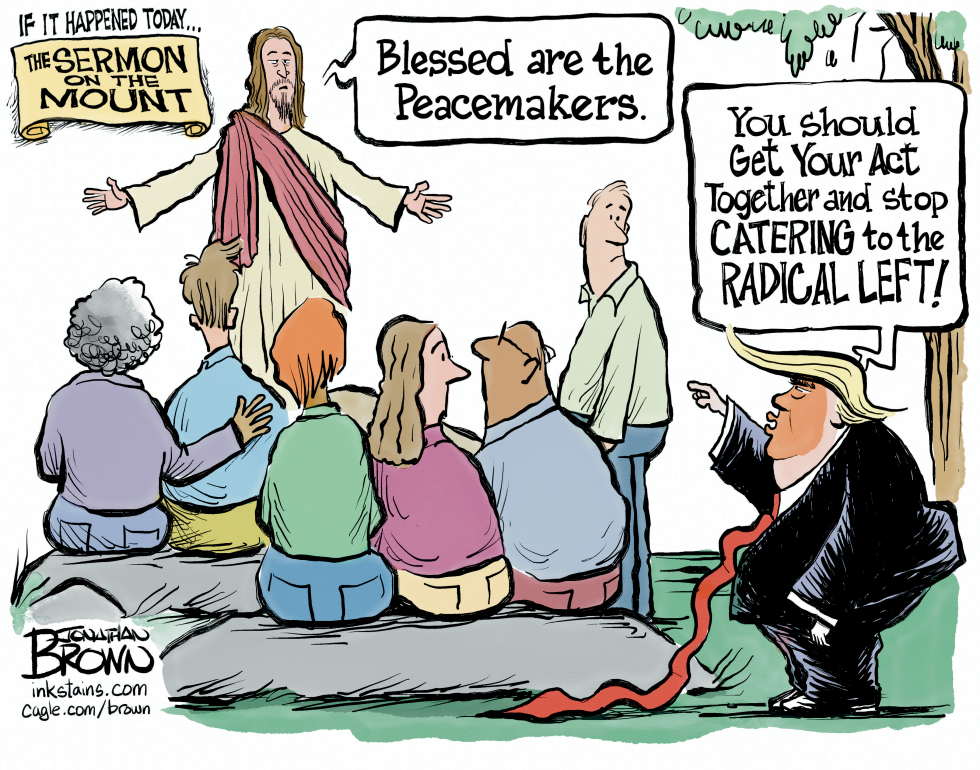
The cartoon depicts Jesus delivering the Sermon on the Mount, arms outstretched, proclaiming 'Blessed are the Peacemakers.' A banner reads 'If It Happened Today... The Sermon on the Mount.' A crowd sits on the ground, listening. A figure resembling Donald Trump, with distinctive hair and suit, points at Jesus and shouts, 'You Should Get Your Act Together and stop CATERING to the RADICAL LEFT!' The scene includes simple background elements like grass and a tree. Tags like war, peace, peacemakers, Jesus, and politics highlight the blend of biblical imagery with modern political commentary. This setup creates a direct contrast between messages of peace and partisan rhetoric.
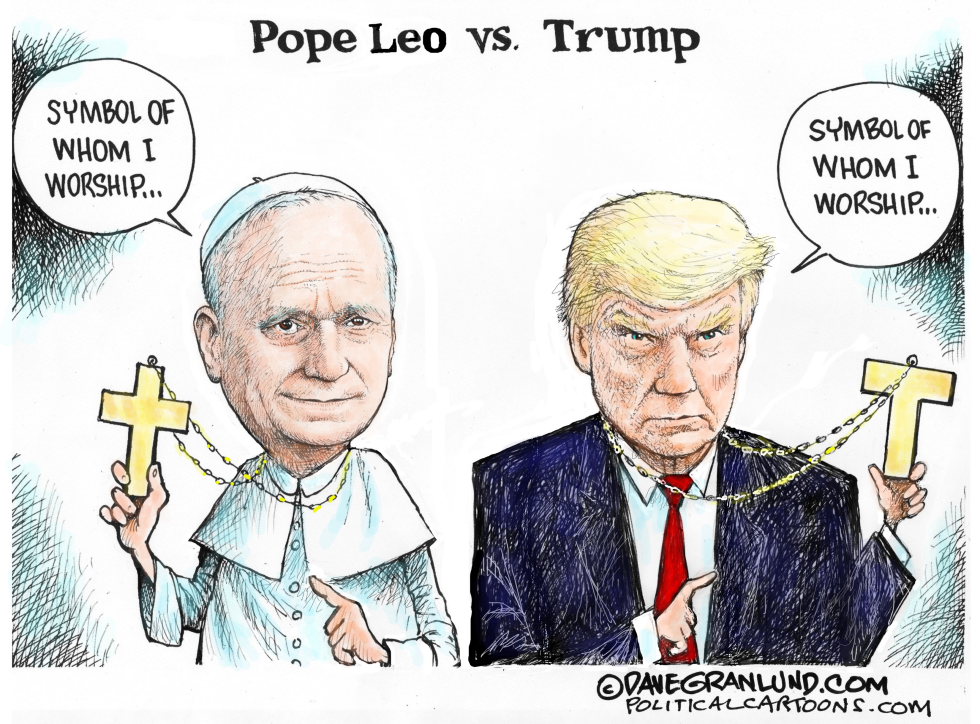
Dave Granlund's cartoon titled 'Pope Leo vs. Trump' features the pontiff holding a cross with the speech bubble 'Symbol of Whom I Worship...', directly contrasting Trump's figure gripping a 'T' pendant and echoing the same phrase. This setup underscores criticism against war, with Pope Leo positioned as a peace advocate facing off against Trump's self-referential symbol. Tags like insults pope, not a fan, Vatican, Catholics, and Christians amplify the satirical jab at political hubris invading religious spheres. The image stays simple, focusing on the two figures and their held items to drive home the point without added clutter.
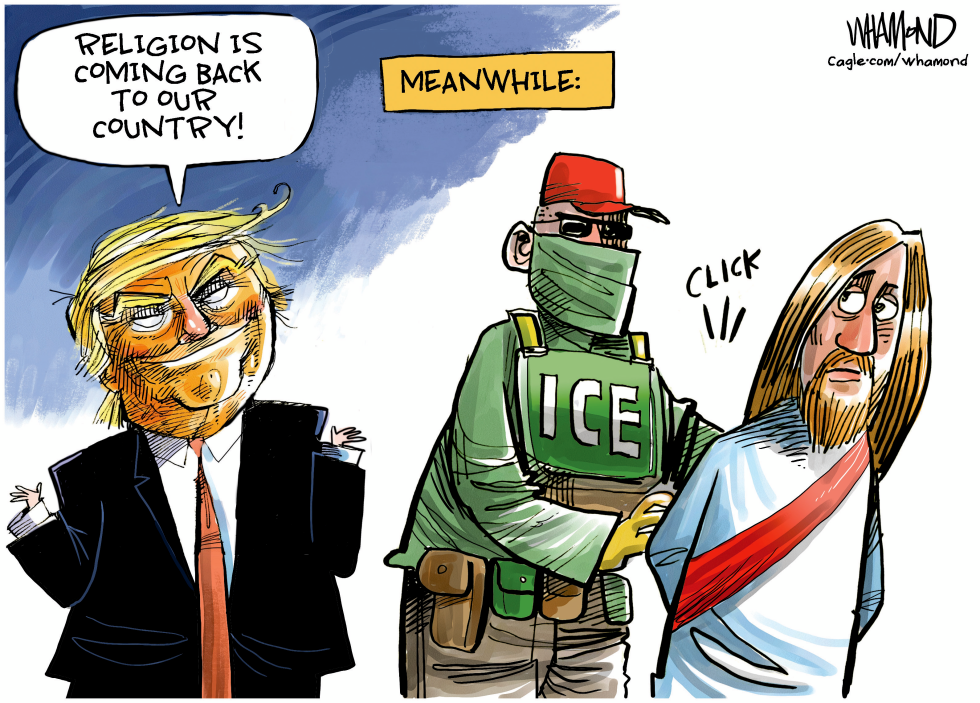
Dave Whamond's cartoon captures Trump religion cartoon essence with the former president boldly stating religion's return to America. Meanwhile, an ICE agent is shown handcuffing a figure resembling Jesus, complete with long hair, beard, and robes, in a clear ICE deporting Jesus satire. This piece dives into political cartoon religion America themes, poking at immigration policy religion hypocrisy. The dry humor shines through the contrast between Trump's proclamation and the 'meanwhile' scene of deportation. Such satirical take on US immigration and faith often sparks debate on religious revival and deportation. Overall, it's a pointed commentary on blending faith with strict border controls.
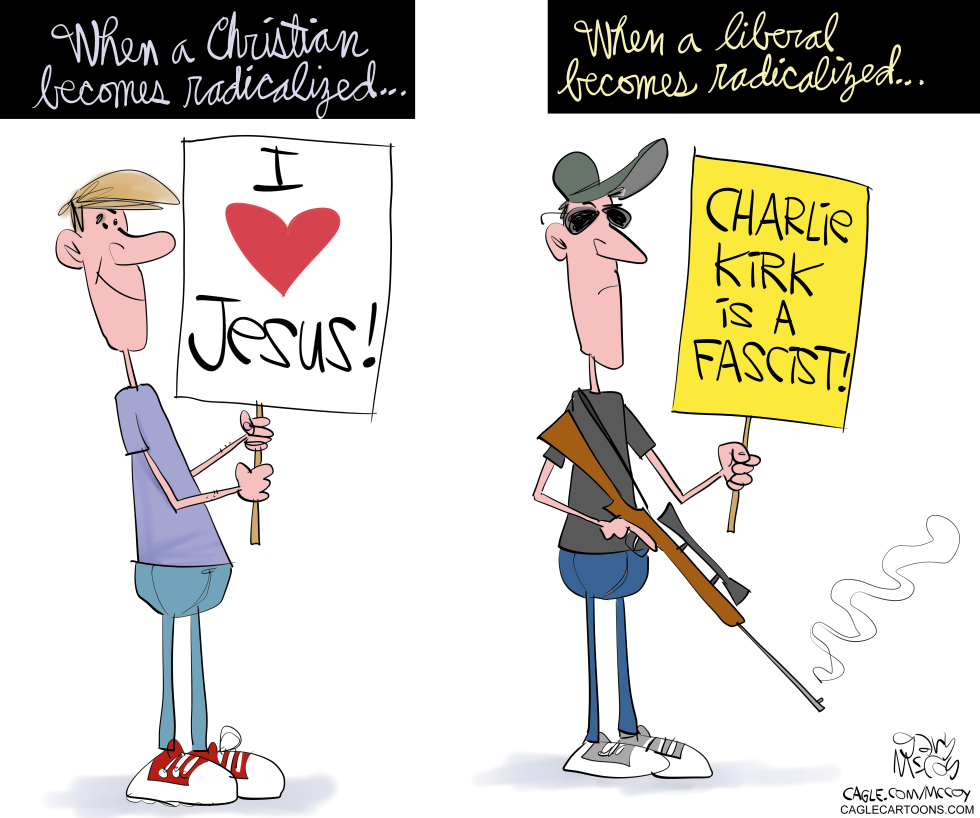
Gary McCoy's cartoon from 2025 divides the frame into two scenarios on radicalization. On the left, a figure in a cap holds a sign declaring 'I ♥ Jesus!' under the label 'When a Christian becomes radicalized...'. The right side shows a sunglasses-wearing man with a rifle emitting smoke, gripping a yellow sign that reads 'CHARLIE KIRK IS A FASCIST!' labeled 'When a liberal becomes radicalized.'. Tags like MAGA, Jesus, radicalized, Christian, liberal, Charlie Kirk, gun control, mental health, religion, Donald Trump, social media, and science frame the visual commentary. The piece highlights perceived disparities in how extremism manifests across ideological lines, with the Christian side shown as affectionate and the liberal as potentially violent.