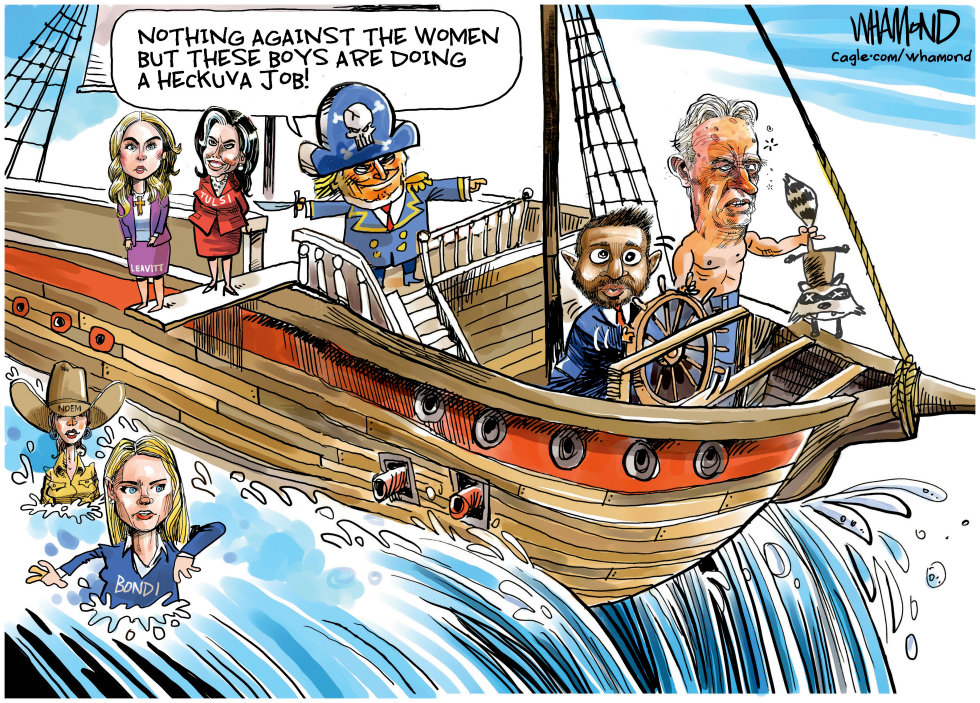
Dave Whamond's cartoon shows a wooden pirate ship tilting over waves, with a figure resembling Trump in a skull cap saying 'Nothing against the women but these boys are doing a heckuva job!' Women labeled Leavitt and Tulsi stand on a plank, another labeled Bondi splashes in water wearing a cowboy hat. A suited man steers, a shirtless man holds a raccoon, tying into tags like AG Pam Bondi ousted, Trump loyalist, walking the plank, Kristi Noem, Tulsi Gabbard, dead women walking, Kash Patel, incompetence, Trumps kooky cabinet, and ship metaphor for political upheaval.
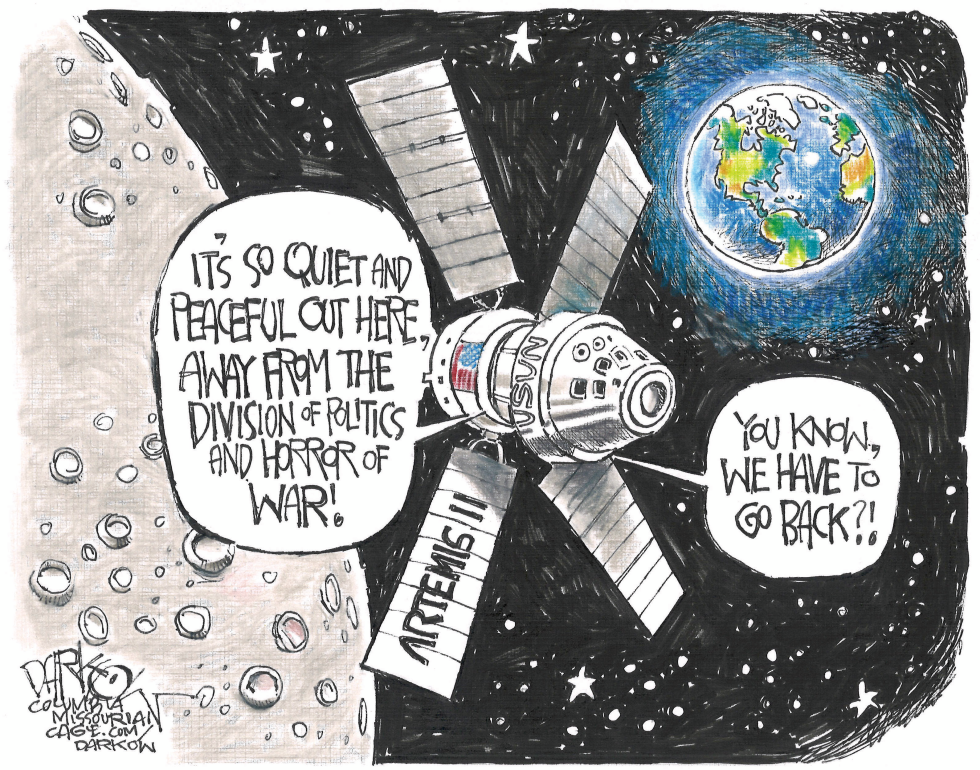
This Daryl Cagle political cartoon analysis features the Artemis II spacecraft floating in serene space, with Earth glowing in the background and the moon nearby. The left speech bubble extols the quiet peace away from division of politics and horror of war, while the right one resignedly notes the need to go back. It's a satirical cartoon on politics and war division, poking fun at how space exploration escaping earthly conflicts offers temporary respite. The NASA Artemis program humor illustration underscores the irony of advanced space missions contrasting with unresolved human divisions on Earth. Through this humorous take on returning to political division, the cartoon cleverly comments on the allure of peaceful space vs chaotic Earth without delving into specifics.
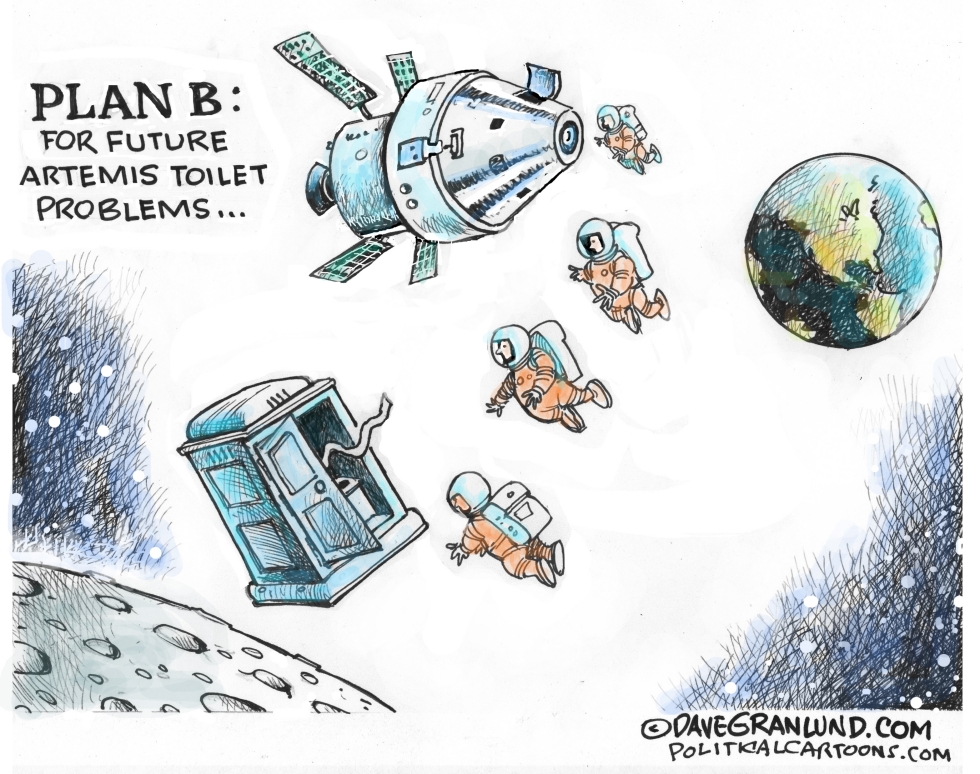
Dave Granlund\'s cartoon captures the absurdity of potential toilet glitch in the Artemis mission around moon, showing astronauts drifting toward a floating porta-potty labeled as Plan B for future Artemis toilet problems. The scene includes a spacecraft, the moon below, and Earth in the background, highlighting backup plan necessities in space travel. With tags like mission around moon, astronauts, toilet glitch, alternate, and one toilet, the image pokes fun at logistical challenges in lunar expeditions. Such humorous takes remind viewers of the everyday hurdles even in high-tech endeavors like NASA\'s Artemis program.
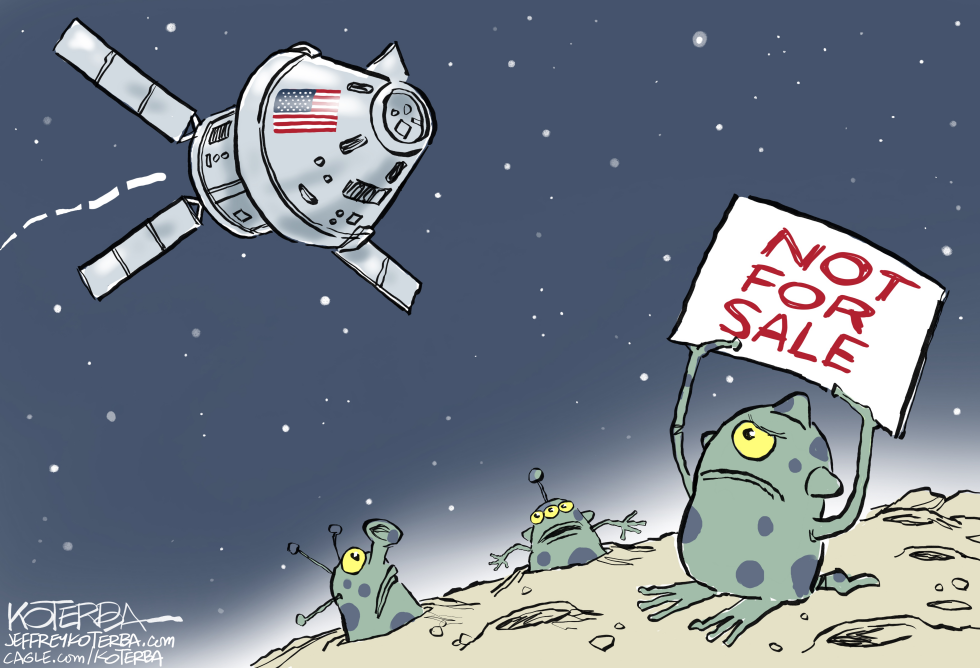
This political cartoon depicts green aliens on a sandy, moon-like surface, with one holding a \'NOT FOR SALE\' sign in red letters, facing a flying spacecraft adorned with an American flag and solar panels. The starry night sky background enhances the space exploration satire, while the trail behind the ship suggests approach. Incorporating elements like cartoon monsters, property rights protest, and US imperialism humor, the image offers an irreverent take on cosmic real estate. The artist\'s signature in the bottom left adds authenticity to this insightful editorial illustration, poking fun at human ambitions in outer space.
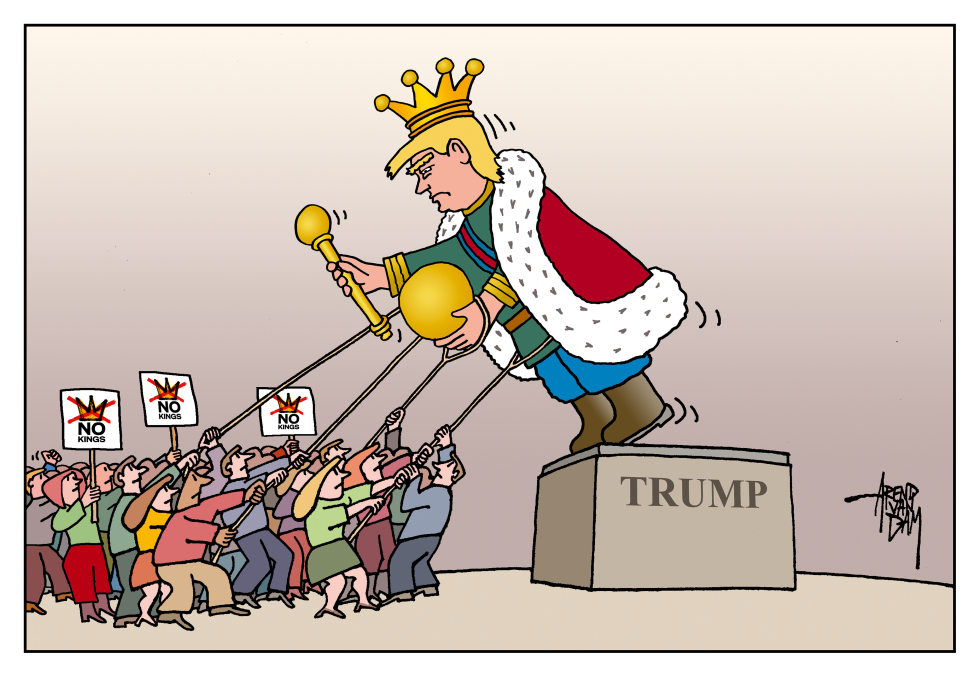
Arend van Dam's cartoon depicts a massive figure resembling Donald Trump, adorned with a crown and royal robe, perched atop a pedestal marked 'TRUMP.' A diverse group of protesters, holding signs reading 'NO KINGS,' 'NO,' and another 'NO,' tug on ropes attached to the figure's scepter, causing it to tilt as if being toppled in an act of resistance. The scene evokes themes of USA democracy clashing with autocracy, portraying a symbolic revolution against a would-be king or dictator. Protests and demonstrations fill the foreground, highlighting public outcry against unchecked power. Dated 2026, the artwork underscores ongoing concerns about authoritarian tendencies in politics.
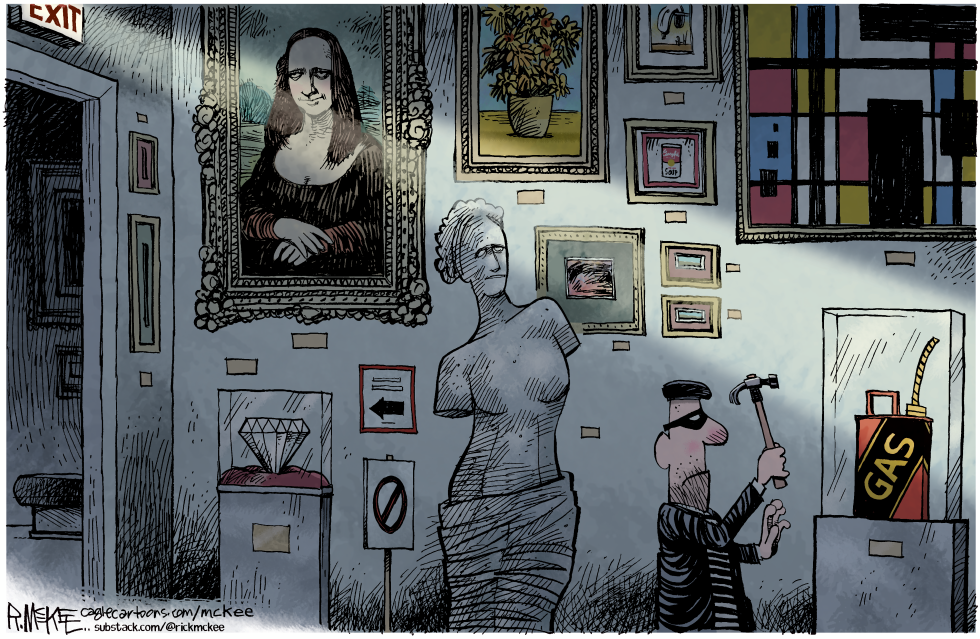
Rick McKee's cartoon depicts a dimly lit museum where a striped-shirted thief, masked and wielding a hammer, targets a display case with a red gas can marked 'GAS,' overlooking iconic pieces like the Mona Lisa portrait, Venus de Milo statue, a large diamond, Van Gogh-style sunflowers painting, abstract Mondrian-like art, and smaller framed works. An 'EXIT' sign glows above, and a 'no' symbol sign hangs nearby. The scene uses tags such as Trump, war, Iran, gas prices, oil, museum to comment on how escalating fuel costs make gasoline more valuable than cultural treasures, blending humor with commentary on energy crises.
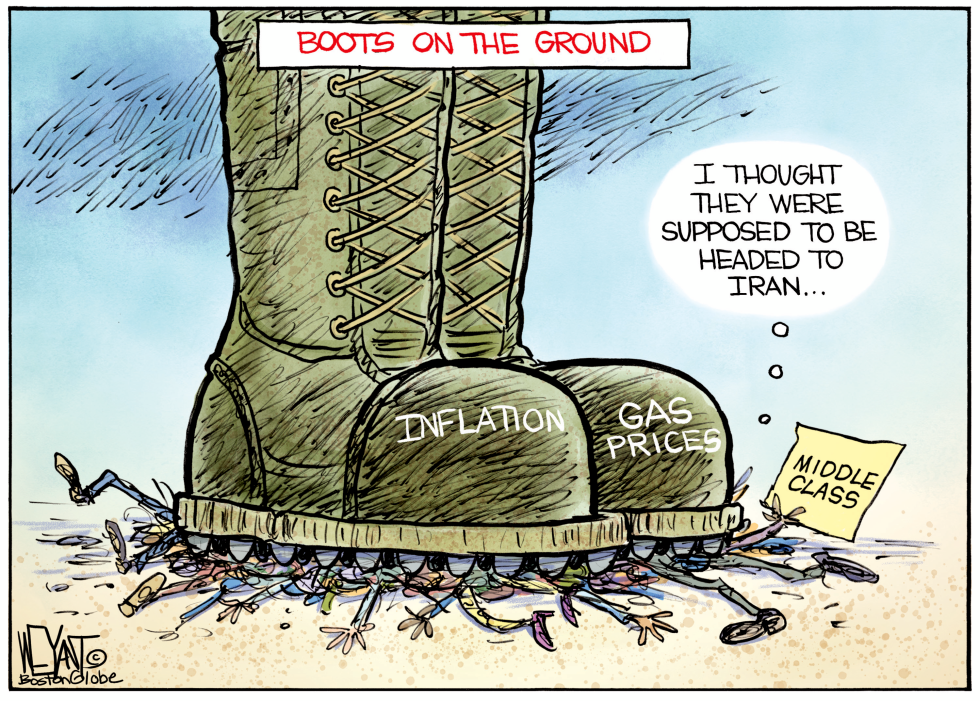
The cartoon shows a pair of massive military boots dominating the scene, one labeled 'Inflation' and the other 'Gas Prices,' as they crush small human figures on the ground, with a sign reading 'Middle Class' among them. A speech bubble from one of the crushed figures says, 'I thought they were supposed to be headed to Iran...' The title 'Boots on the Ground' sits at the top. This setup uses dry humor to highlight misplaced priorities in war, economy, inflation, gas prices, middle class, and Iran. The sandy ground and stormy sky add to the chaotic feel, tying into tags like Trump, negotiation, Strait of Hormuz, and domestic policy impacts.
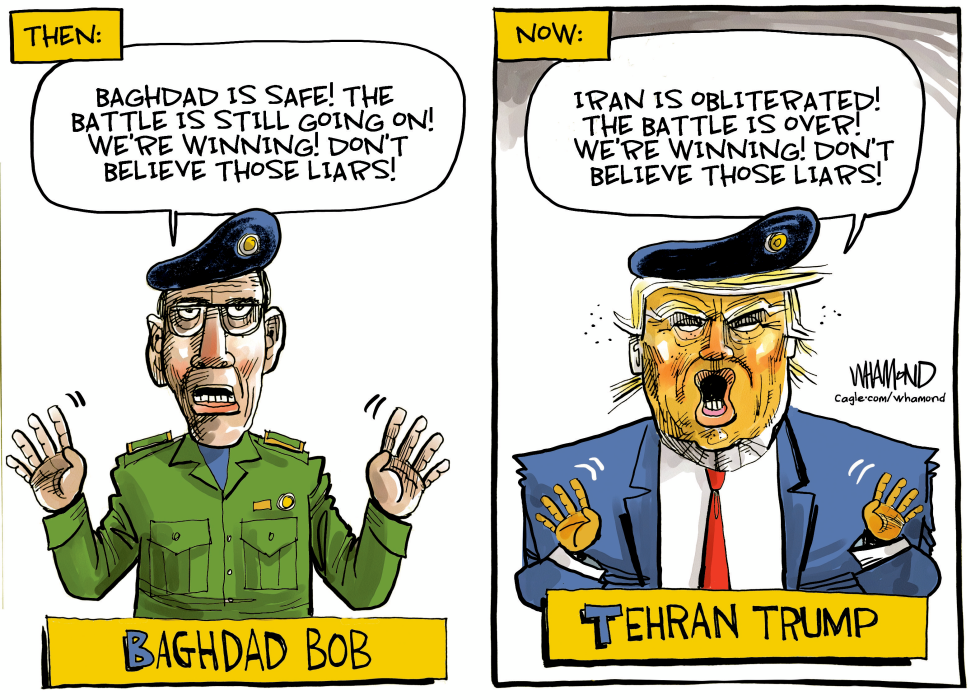
Dave Whamond's political cartoon splits into 'Then' and 'Now' panels, showing Baghdad Bob in military garb proclaiming Baghdad's safety and ongoing victory, dismissing liars. On the right, a Trump-like figure dubbed Tehran Trump, wearing a beret and suit, declares Iran obliterated and battle over, again urging disbelief in liars. The satire underscores parallels in propaganda and denialism, with tags like political satire, Trump caricature, Iraq War reference, Iran conflict, misinformation leaders, and historical parallel. This visual commentary critiques how figures twist realities in wartime narratives, blending dry humor with sharp observation on political exaggeration.
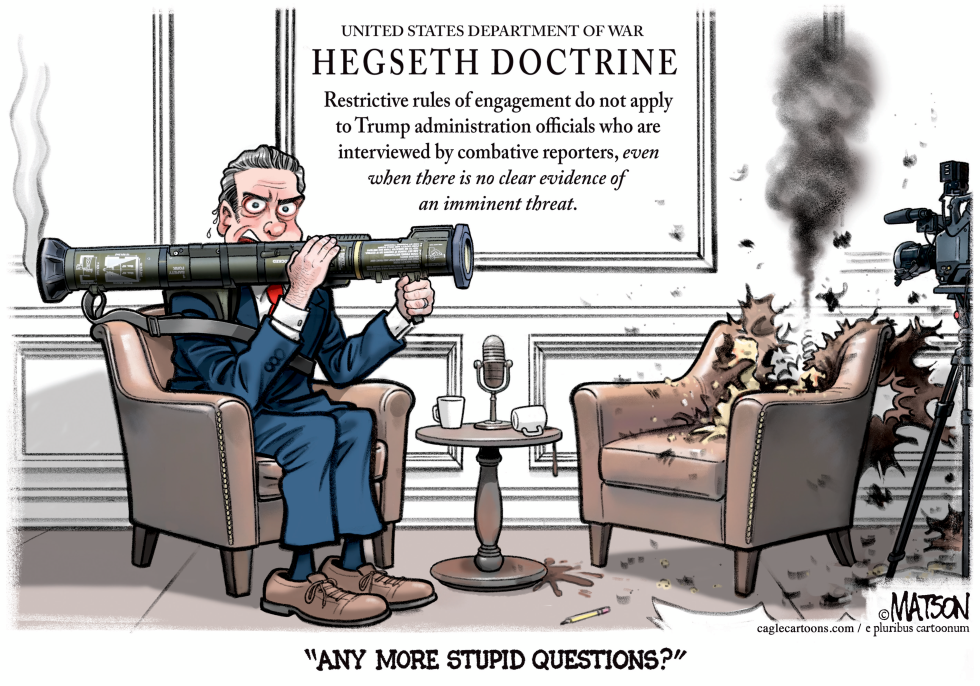
R.J. Matson's cartoon depicts a stern-faced official in a formal setting, wielding a massive rocket launcher that has just obliterated the interviewer's chair, smoke billowing from the debris. The header proclaims the 'Hegseth Doctrine' under the 'United States Department of War,' stating that restrictive rules of engagement don't apply to Trump administration officials facing combative reporters, even without clear evidence of an imminent threat. The official snarls, 'Any more stupid questions?' as a camera topples amid the chaos. This setup skewers the notion of overreactive defenses in political interviews, blending dry humor with sharp commentary on media relations. Tags like Hegseth Doctrine, Trump administration satire, press interview violence, combative reporters parody, imminent threat joke, and political cartoon Matson capture the essence of this visually punchy critique.
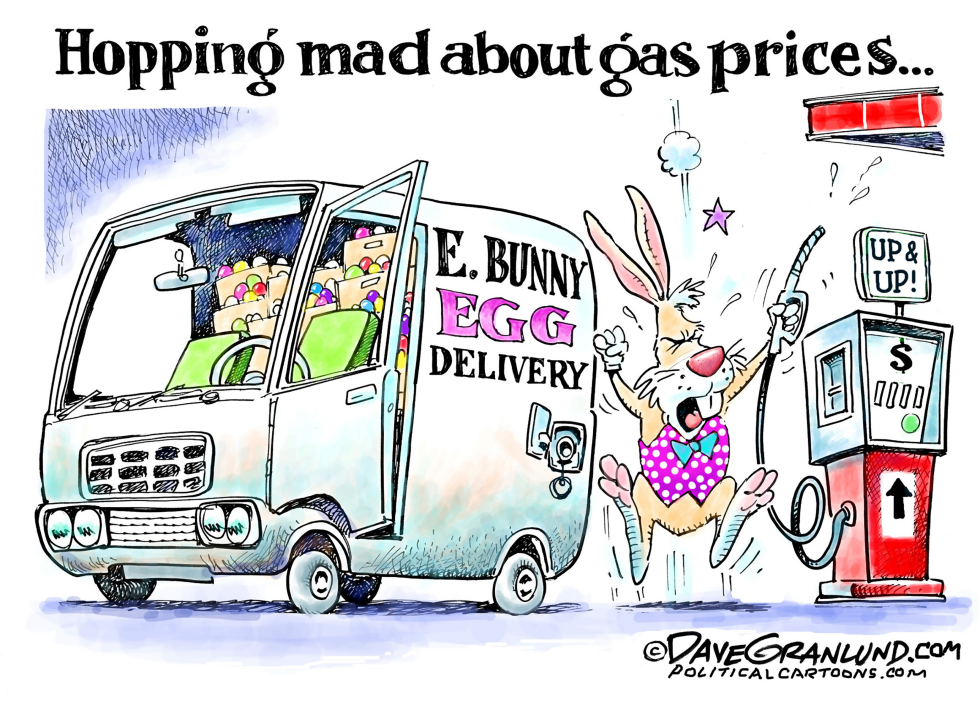
The cartoon depicts an anthropomorphic Easter bunny, dressed in a pink polka-dot outfit, leaping in frustration at a gas pump displaying 'UP & UP!' and dollar signs, while holding a fuel nozzle. Nearby stands a white delivery van labeled 'E. Bunny EGG DELIVERY,' filled with boxes of colorful Easter eggs. The headline 'Hopping mad about gas prices...' ties into the bunny's hopping nature and anger over soaring gas prices. Tags like holiday, easter egg delivery, bunny, gas prices soar, pumps, per gallon, hopping mad, iran war oil hike, and fuel disruption highlight the satire on how rising fuel costs, possibly from geopolitical events, disrupt even whimsical traditions like Easter deliveries. This visual pun combines seasonal cheer with economic frustration, making it relatable for audiences facing high per gallon rates during holiday travel.
John Darkow's cartoon captures the sting of high gas prices amid inflation and war, showing a yellow vehicle at a station with unleaded fuel marked at 3.95 9/10 per gallon, pay in advance. Speech bubbles reveal a conversation where one asks about not going anywhere for spring break, and the reply puns on being 'Spring Broke' due to gas costs. The image underscores travel disruptions, with tags like gas prices, inflation, spring break, travel, war, and economic satire emphasizing how rising fuel expenses halt vacation plans. This straightforward drawing uses dry humor to point out everyday economic frustrations without overcomplicating the scene.
Bruce Plante's cartoon depicts a typical American driver at a gas station, his purple car parked under the canopy, as he reacts with censored profanity to a coin-operated viewer. The sign reads 'TO SEE GAS PRICES DEPOSIT 25¢,' cleverly satirizing how #HighGasPrices have soared beyond easy visibility, like distant sights needing magnification. The man's USA shirt and coffee cup add a relatable everyman touch, emphasizing consumer shock. This piece fits into ongoing #FuelCosts debates, blending #InflationHumor with #EconomicSatire. Plante's style, straightforward and punchy, targets #EnergyPrices and their impact on daily life, making it shareable for #PoliticalCartoons enthusiasts. The dry humor underscores the absurdity without overstatement, a hallmark of syndicated work.
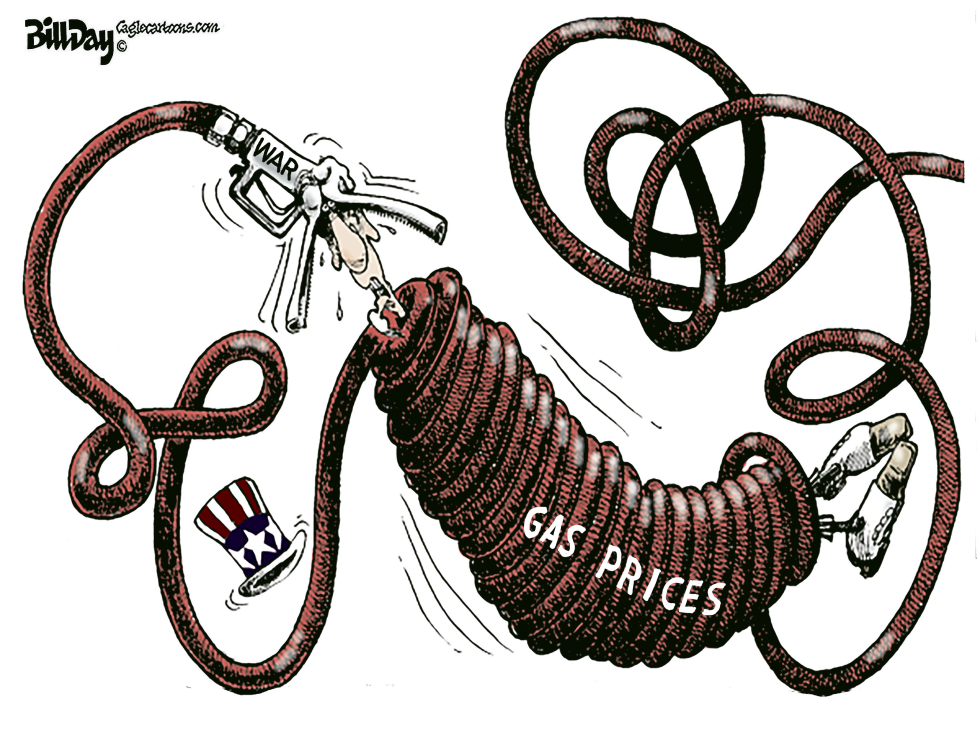
Bill Day's cartoon depicts a gas pump nozzle marked 'WAR' aggressively pumping into a twisted red hose that forms a noose-like figure labeled 'GAS PRICES,' with arms and legs dangling, suggesting strangulation. An Uncle Sam hat adorned with the American flag falls away, emphasizing national impact. This satirical image ties into tags like gas prices, Iran war, gas pump, Strait of Hormuz, and NATO, highlighting how military conflicts drive up fuel costs. The coiled hose resembles a hanged person, underscoring economic peril from oil disruptions. Day's style uses bold lines and clear labels for immediate visual punch, a staple in political cartoons that critique policy fallout.
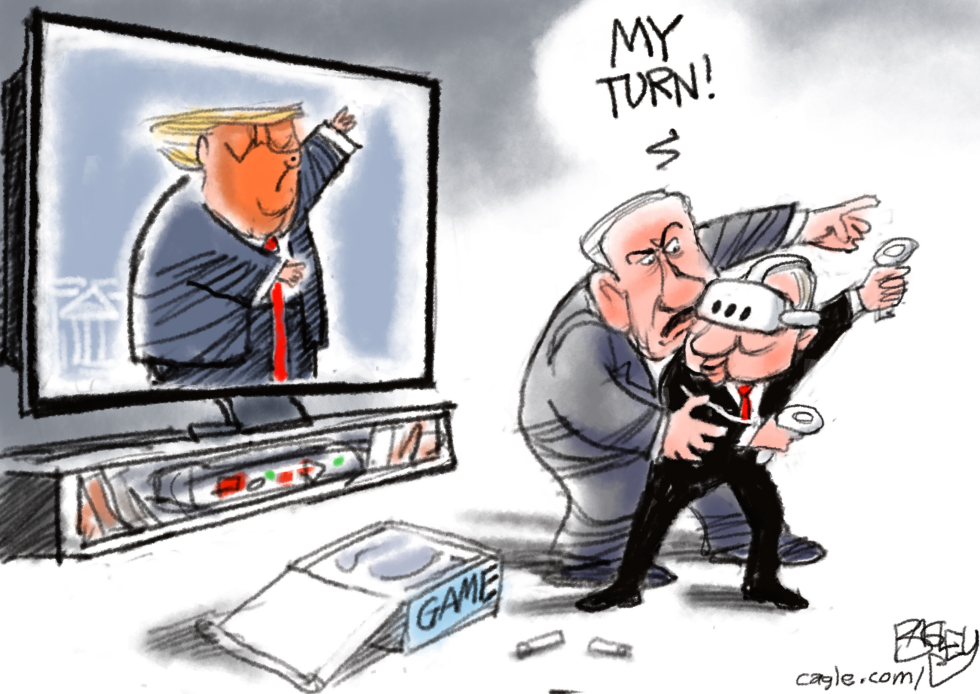
Pat Bagley's cartoon captures Vladimir Putin in a suit, firmly holding a smaller Benjamin Netanyahu who wears a VR headset and wields controllers, exclaiming 'My Turn!!' with frustration. Donald Trump dominates the TV screen, arm raised dramatically against a White House-like backdrop. The floor features a tipped 'GAME' box, underscoring the video game metaphor. This setup highlights themes of manipulation and turn-taking among leaders, delivered with sharp lines and exaggerated features typical of political satire. The dry humor lies in reducing global tensions to childish squabbles over a game, a classic cartoon trope that packs punch without overstatement.