FIFA President Gianni Infantino has positioned the organization around personal financial gain tied to the World Cup. Recent developments show expanded prize structures and commercial deals that concentrate benefits at the top. The cartoon portrays this as a deliberate scheme where the game itself serves as a vehicle for individual enrichment rather than sporting competition.
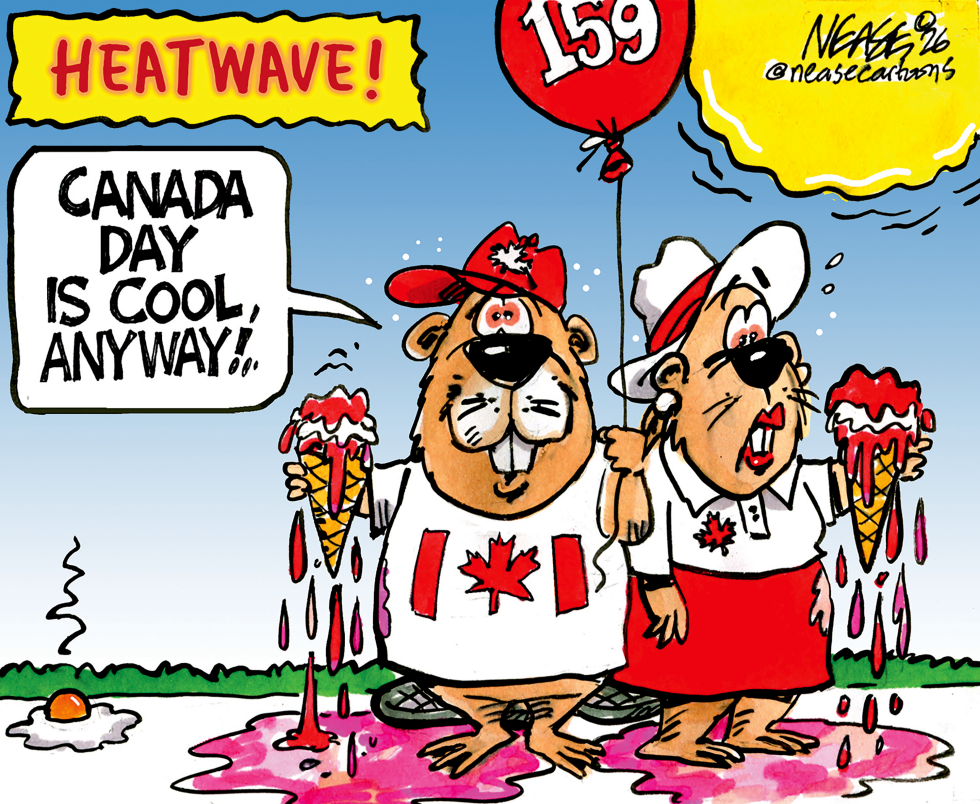
On June 30 2026 two cartoon beavers dressed in Canadian flag attire stand on melting pavement holding ice cream cones that drip heavily during an intense heatwave. A red balloon marked 159 floats above while a speech bubble declares Canada Day cool anyway. A fried egg lies on the ground near the pink puddle formed by the melting treats.
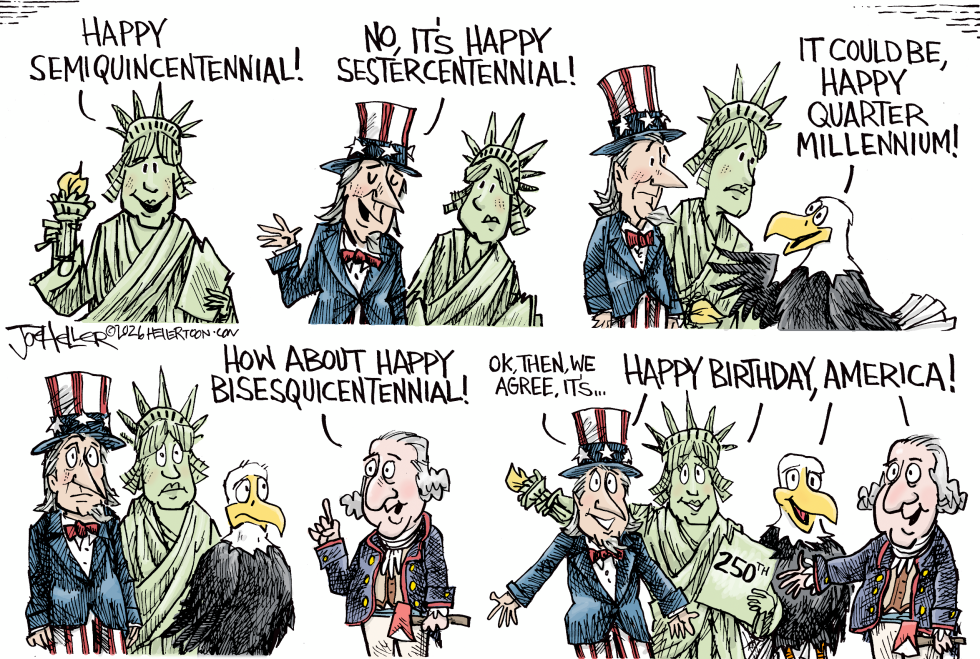
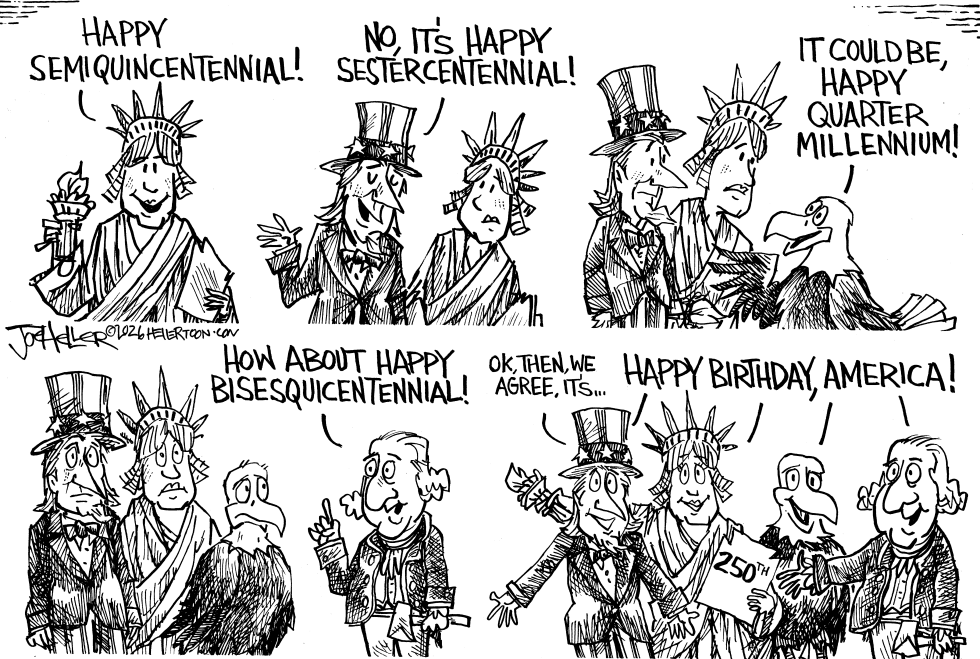
On June 29, 2026, Joe Heller's cartoon depicts Uncle Sam, the Statue of Liberty, Benjamin Franklin, and a bald eagle debating elaborate names for America's 250th anniversary. Proposals range from semiquincentennial and sestercentennial to quarter millennium and bisesquicentennial. The group ultimately agrees on the straightforward greeting Happy Birthday, America, accompanied by a 250th banner. The exchange highlights the challenge of selecting a fitting term for the milestone tied to the 1776 founding.
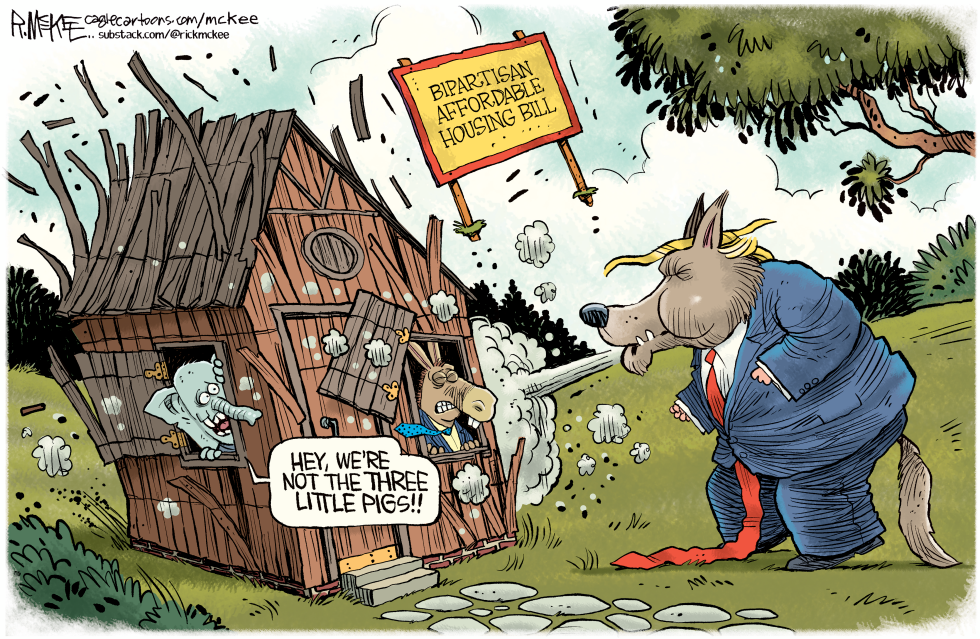
On June 25, 2026, cartoonist Rick McKee depicts former President Donald Trump as a wolf blowing down a wooden house marked as a bipartisan affordable housing bill. An elephant and donkey peer out from the damaged structure, one declaring they are not the three little pigs. The image responds to ongoing congressional debates over housing legislation in mid-2026.
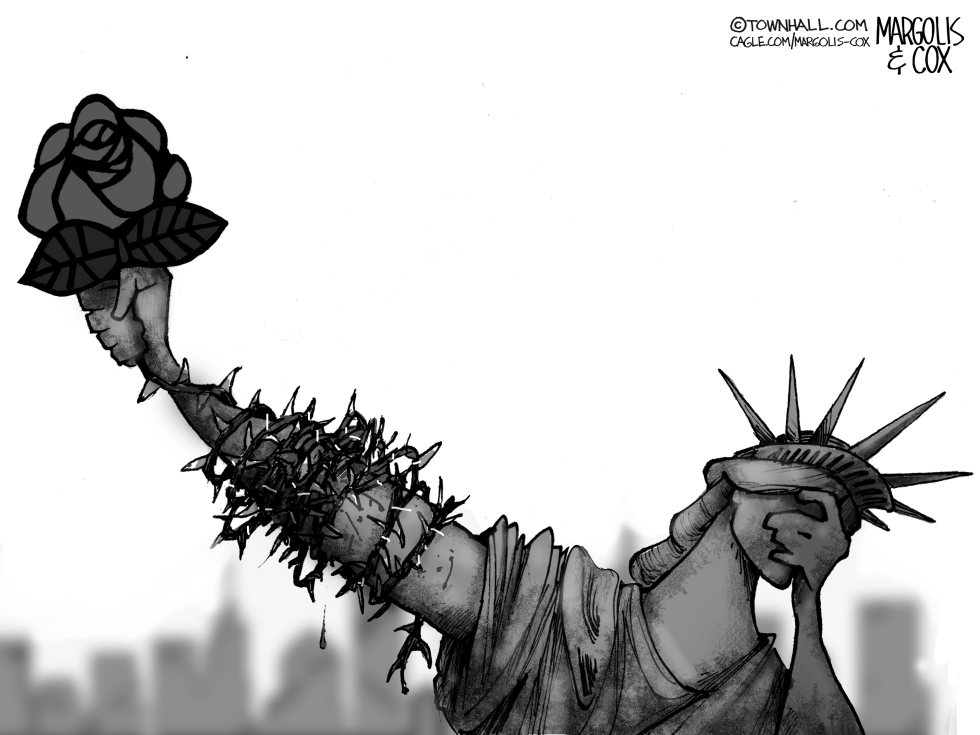
The illustration depicts the Statue of Liberty with a thorny rose vine tightly wrapped around her raised arm, the hand clutching a large rose. Her other hand covers her face as a single drop falls from the arm. A city skyline appears in the background. The work is credited to Margolis & Cox and published via Townhall and Cagle on June 24, 2026.
Joe Heller's June 2026 cartoon shows the Statue of Liberty, Uncle Sam, a bald eagle and Benjamin Franklin debating elaborate terms for America's 250th anniversary. The figures propose semiquincentennial, sestercentennial, quarter millennium and bisquincentennial before conceding to the straightforward greeting Happy Birthday, America! The strip marks the upcoming July 4, 2026 milestone with light humor on naming conventions.
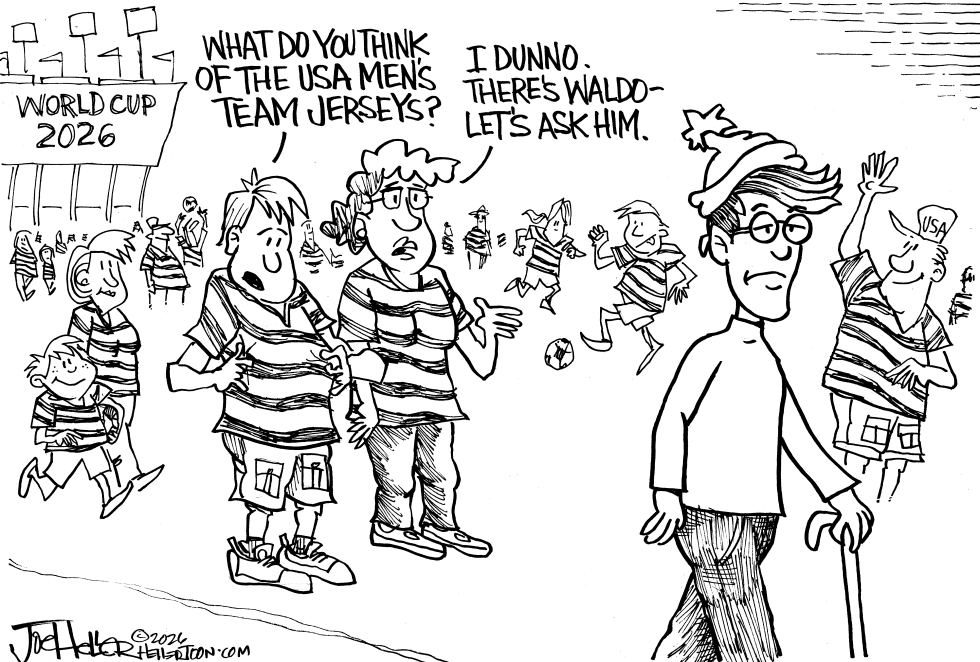
At the World Cup 2026, two fans in striped shirts debate the USA men's team jerseys, with one suggesting they ask Waldo, who stands nearby in similar attire. The scene plays on the resemblance between the team uniforms and the Where's Waldo character, set against a stadium backdrop filled with other striped figures and a soccer ball in play.
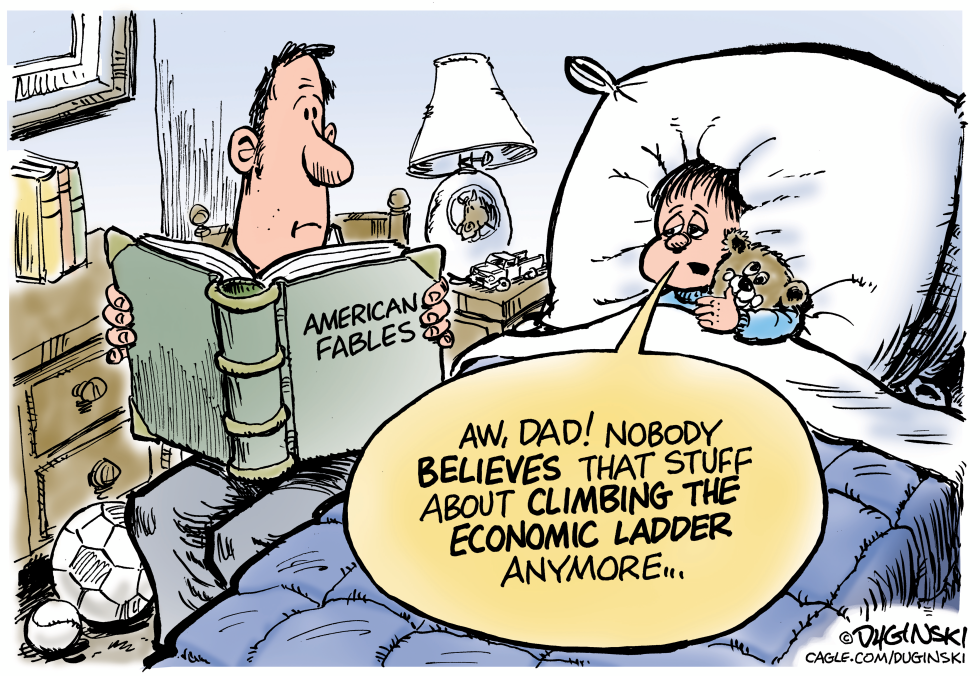
The image shows a father holding an open book titled American Fables beside a child tucked in bed with a teddy bear. The boy speaks from a large speech bubble rejecting the notion of climbing the economic ladder. A soccer ball rests on the floor near stacked books and a nightstand with a lamp and toy train. Tags include American Dream, climbing the economic ladder, upward mobility, cost of living, affordability, and inflation. The scene stays limited to these visible elements without added context.
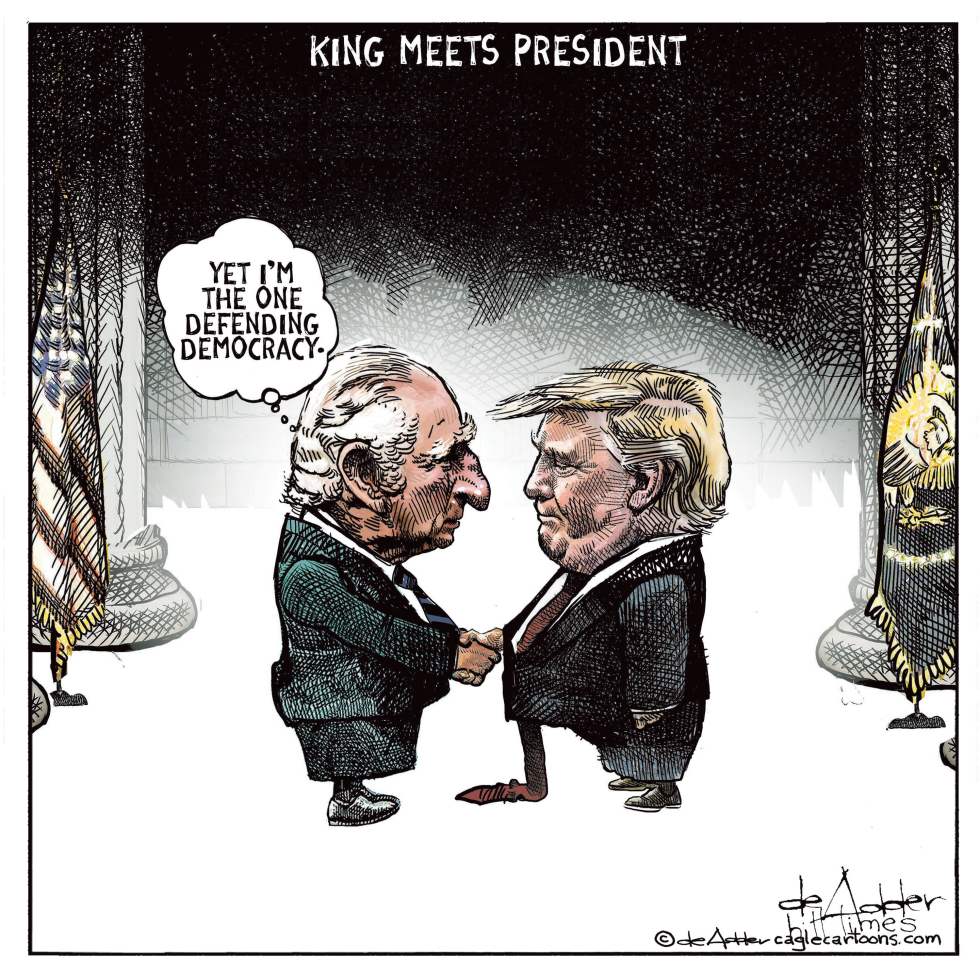
Michael de Adder's cartoon captures a handshake between King Charles and President Trump, set against American and implied British flags in a White House-like scene. The title 'KING MEETS PRESIDENT' tops the image, with Charles saying, 'Yet I'm the one defending democracy.' Tags like UK, United Kingdom, States, America, White House, Visit, State underscore the diplomatic theme. This satire touches on trade, tariffs, and economy without overreaching into unseen motives. The dry humor lies in the visual irony of two leaders in suits, one royal and one presidential, amid formal backdrops. Artistic style uses crosshatching for depth, keeping focus on the central exchange.
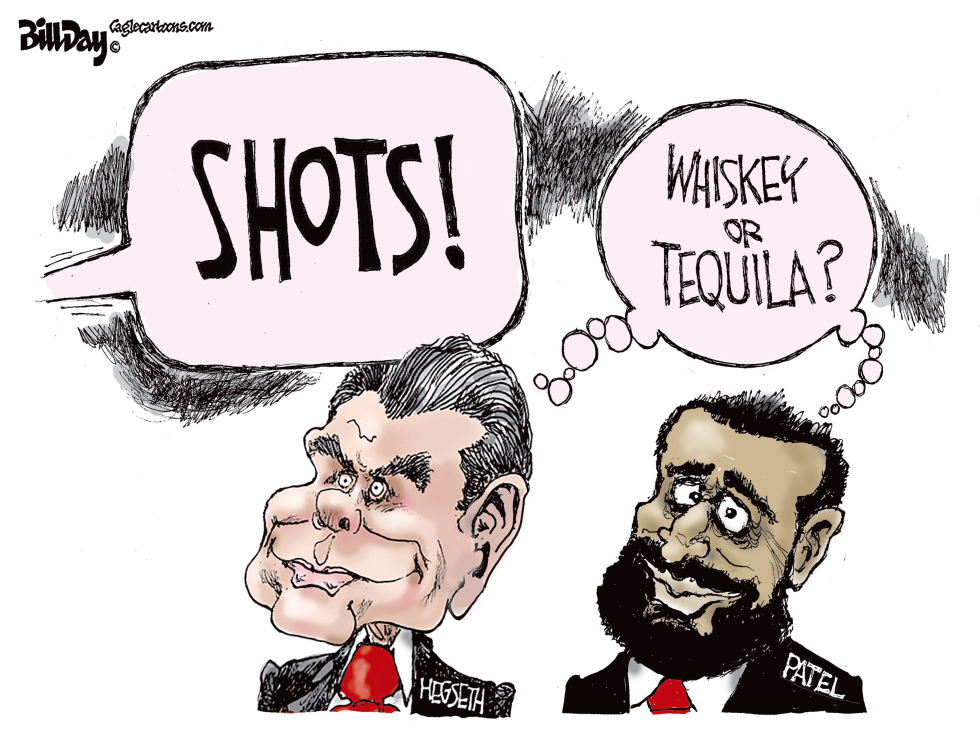
Bill Day's cartoon captures two suited figures, labeled Hegseth and Patel, in a moment of apparent revelry. Hegseth, on the left, bellows 'SHOTS!' from a speech bubble, his expression intense and caricatured. Patel, to the right, responds with a thought bubble pondering 'WHISKEY or TEQUILA?', his face drawn with wide eyes and a beard. The artwork, signed by Bill Day and linked to CagleCartoons.com, uses simple lines and shading for a classic political cartoon style. Tags such as shots, whiskey, tequila, Hegseth, Patel, and correspondence dinner frame the scene, suggesting a lighthearted jab at social or political gatherings. The white background keeps focus on the characters and their dialogue, emphasizing the pun on 'shots' without additional context or props visible.
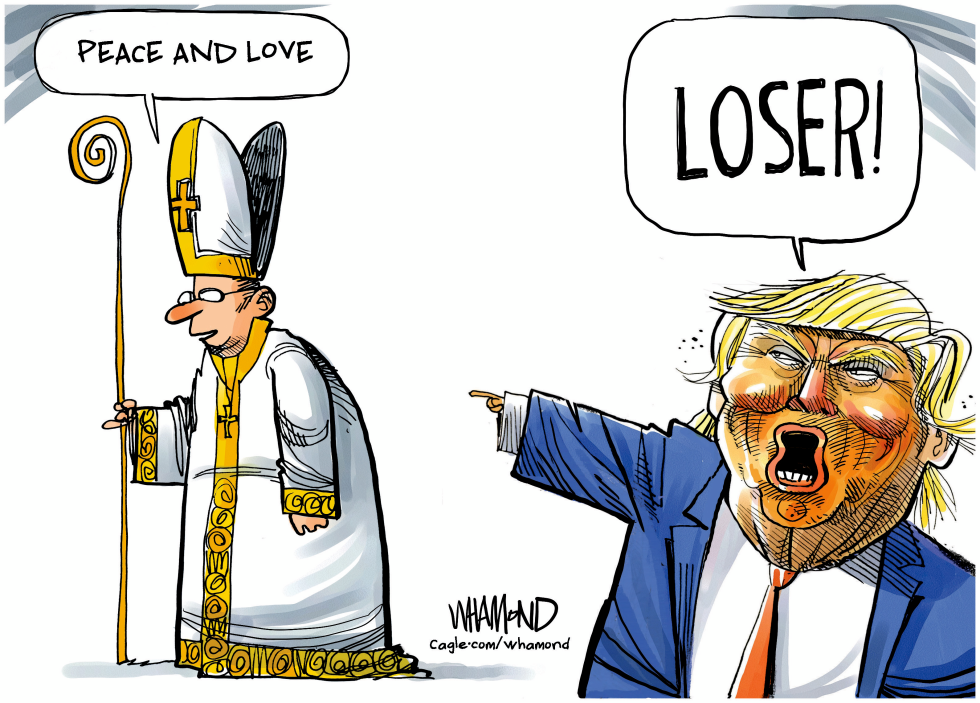
Dave Whamond's political cartoon captures Donald Trump in a blue suit, pointing aggressively and shouting 'loser' at a figure resembling the Pope, dressed in white robes with a tall mitre and holding a crozier, who calmly utters 'peace and love.' This satirical illustration underscores Trump's bombastic personality clashing with symbols of compassion and spirituality. The simple composition, with speech bubbles dominating the scene, amplifies the humor in the contrast between aggression and serenity. Tags like political cartoon Trump Pope, satirical illustration Trump insults religious leader, and cartoon Trump calls Pope loser emphasize the editorial bite. Such cartoons thrive in syndication for their timely jab at public figures. The dry wit lies in the exaggerated expressions, making it shareable across social media platforms.
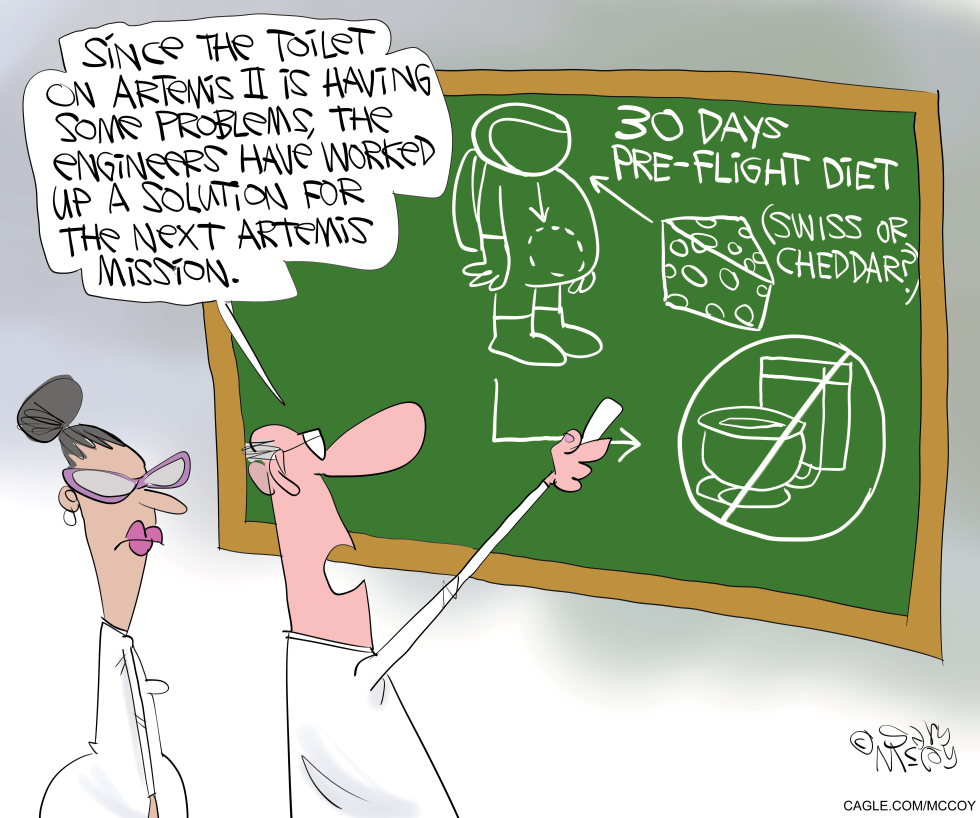
Gary McCoy\\\'s political cartoon depicts two figures in white coats, one pointing to a chalkboard with a speech bubble explaining a solution to Artemis II toilet problems via a 30-day pre-flight diet of Swiss or cheddar cheese. The board features a bloated astronaut sketch, a cheese cube, and a crossed-out toilet, poking fun at NASA engineering woes. This space mission satire uses dry humor to comment on technical glitches in the Artemis program, with tags like NASA Artemis II toilet problems, engineers solution Artemis mission, space mission pre-flight diet, Gary McCoy cartoon, cheesy diet fix, and humorous take on NASA solutions. The image stays light-hearted, focusing on visible elements without deeper speculation.
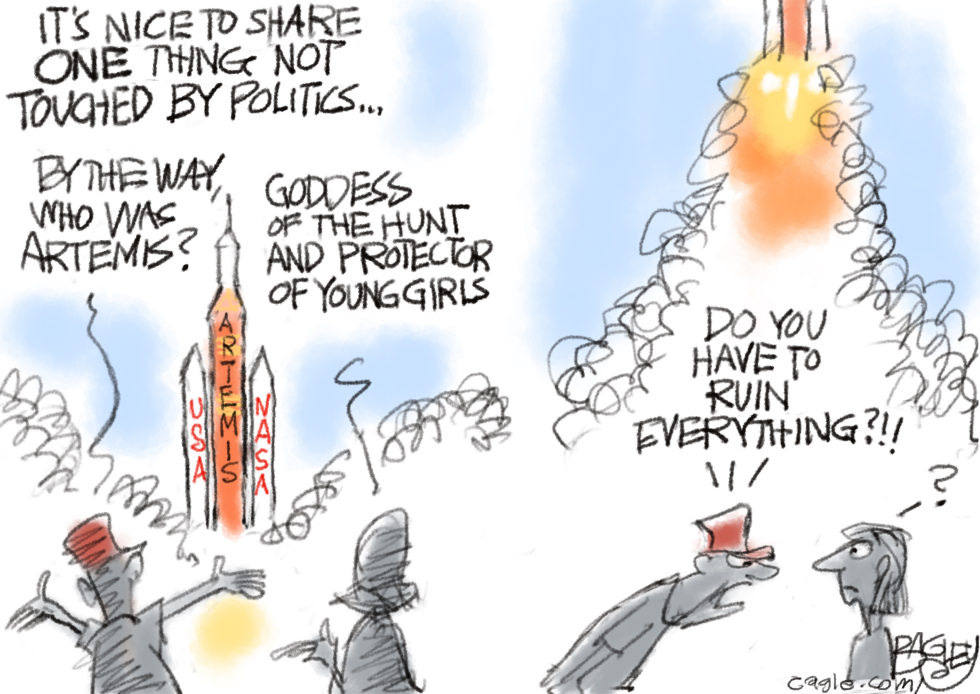
This political cartoon features a launching rocket labeled Artemis, SLS, NASA, and USA, with overlaid text praising one thing untouched by politics before asking about the goddess Artemis, described as goddess of the hunt and protector of young girls. A figure exclaims frustration at ruining everything, satirizing how even space missions get dragged into cultural debates. The irreverent sketch uses humorous figures with red hats to poke at over-politicization in science, blending mythology with modern rocketry in a witty critique. Tags like Artemis rocket launch political cartoon, NASA SLS Artemis mission satire, and politics invading science editorial cartoon underscore the cartoon's sharp insight into societal divisions spilling into apolitical realms like space exploration politicized cartoon.
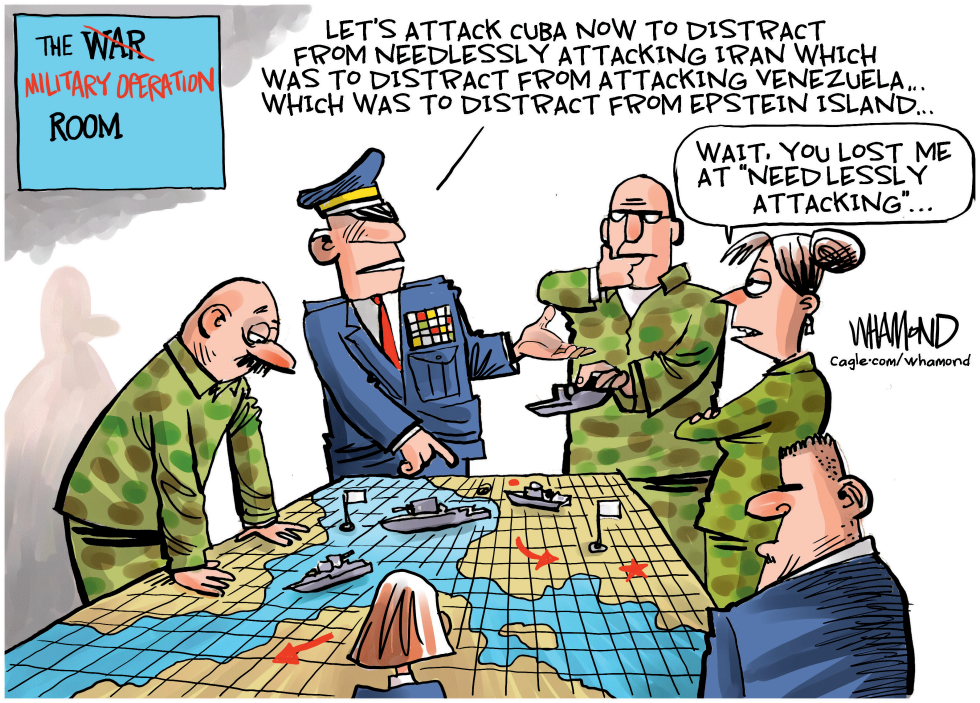
Dave Whamond's political cartoon depicts a group of military officials in a war room, gathered around a map with toy ships, discussing a chain of distractions starting from attacking Cuba to cover needless attacks on Iran, which distracted from Venezuela, looping back to Epstein Island. The scene captures the absurdity with one figure pointing at the map and another expressing confusion over 'needlessly attacking.' This satirical illustration uses dry humor to comment on convoluted military strategies and political diversions, incorporating elements like crossed-out 'War' sign replaced by 'Military Operation Room' for added irony. Tags like political satire, war distractions, foreign policy cartoon, Epstein Island reference, military humor, and endless distraction chain emphasize the cartoon's sharp critique.